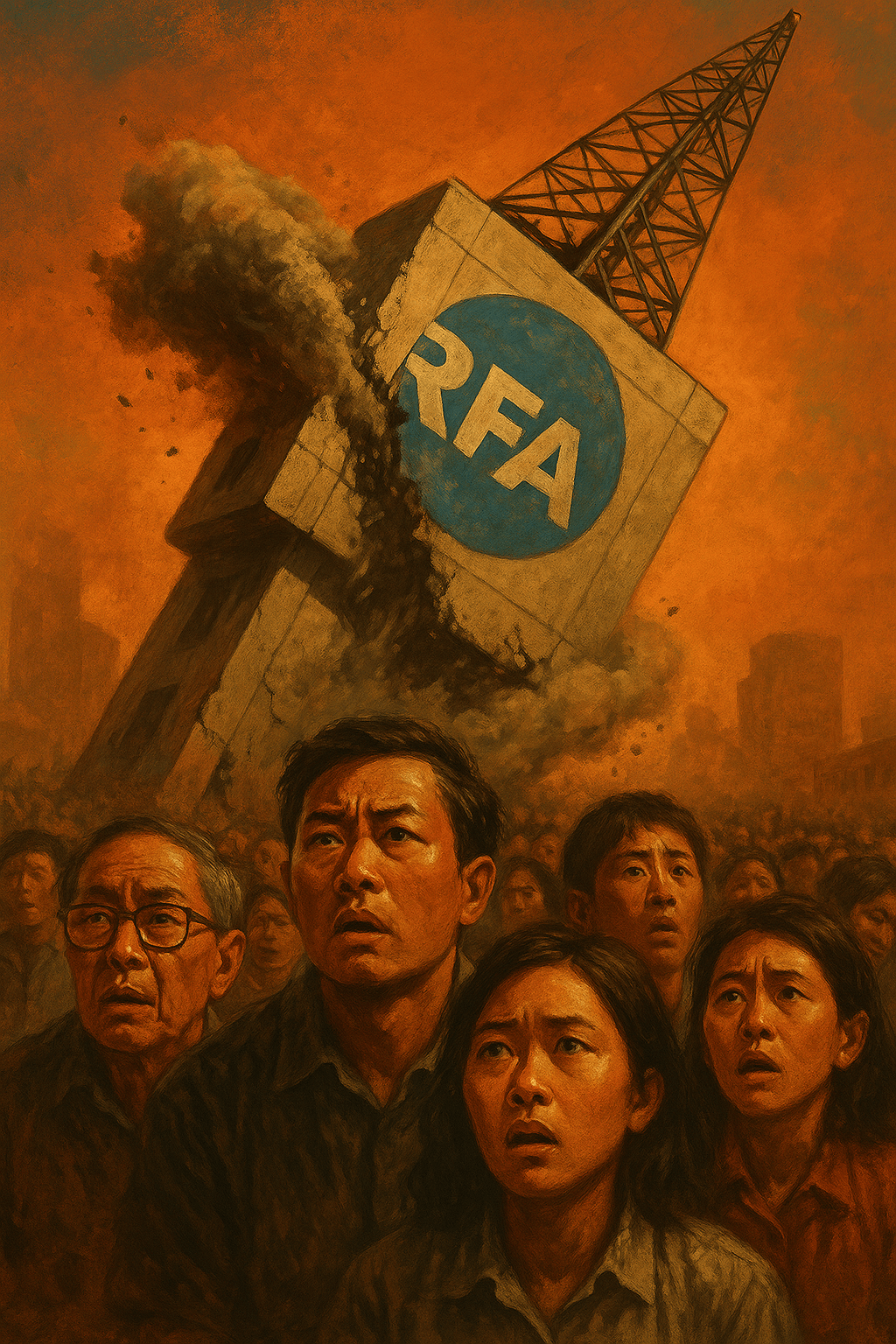
Washington mourns a psyops relic—Asia exhales. The empire’s loudspeaker goes silent, and in the static, new revolutionary frequencies emerge.
By Prince Kapone | Weaponized Information | June 6, 2025
I. “Independent” Propaganda: When the Empire Loses Its Microphone
The Washington Post article covering the defunding of Radio Free Asia isn’t a story about press freedom. It’s a story about empire losing one of its oldest loudspeakers. Trump cut funding to RFA, and now the imperial press is howling. According to reporters Sarah Ellison and Cate Cadell, the U.S. has “ceded ground” in the battle of ideas to China. What they’re really mourning is the loss of narrative supremacy in a region the U.S. has long treated as its ideological plantation.
Let’s take a moment to understand who’s doing the talking. Sarah Ellison is a Beltway journalist through and through—her resume reads like a who’s who of elite liberal media, from Vanity Fair to the Washington Post. Cate Cadell, on the other hand, has done stints with Reuters and Bloomberg, both of which specialize in laundering Wall Street’s worldview through columns dressed up as reporting. These aren’t independent voices. These are the scribes of empire, the couriers of national security talking points, the careerists who confuse briefings with truth.
Their outlet, The Washington Post, is owned by Jeff Bezos—yes, the same Bezos whose other business supplies the CIA’s cloud infrastructure. It’s not a newspaper; it’s a boardroom’s bulletin. And in this piece, it platforms figures like Florida Congressman Carlos Gimenez, who sits on the House committee engineered to confront China; Alim Seytoff of RFA’s Uyghur service, a longtime player in the U.S. propaganda machine; and the U.S. Agency for Global Media (USAGM), the umbrella under which RFA was born, funded, and militarized.
Now let’s break down the bones of the propaganda. It’s not subtle—but it is strategic.
- 1. Flipping the Script: The writers tell us, “Radio Free Asia… was operating under the umbrella of the U.S. Agency for Global Media.” That’s like saying the Marines operate under the umbrella of the Pentagon. RFA isn’t just close to the state—it is the state. It was built for ideological warfare, funded by Congress, and created to destabilize governments that won’t bow to U.S. power. But here, it’s painted as just another newsroom.
- 2. Empire of the Good Guys: The article warns that “China’s propaganda is surging” as RFA retreats, with Beijing gaining a “monopoly on the narrative.” But the whole piece rests on the fantasy that American propaganda doesn’t exist—that RFA’s messaging is neutral, even noble. It’s the same old trick: when we do it, it’s journalism. When they do it, it’s authoritarianism.
- 3. Missionary Journalism: Ellison and Cadell write that U.S.-funded media were “often the only outside voice” in places that “criminalize independent reporting.” The implication? That colonized peoples can’t think for themselves, can’t produce their own media, and can’t resist repression unless the U.S. speaks for them. It’s white saviorism with a press badge.
- 4. Manufactured Outrage: The authors tell us that “RFA played a significant role in drawing attention to Beijing’s mass internment drive.” But they don’t ask: whose interests were served? How was that information verified? What was left out? In reality, much of RFA’s Uyghur coverage was built on anonymous claims, intelligence leaks, and a geopolitical agenda. Yet here, it’s sold as gospel truth.
- 5. Sanitized History: Not once does the article mention that RFA was born out of Cold War counterinsurgency. No mention of psyops. No mention of how its older cousins—Radio Free Europe and Voice of America—were CIA-sponsored tools of ideological sabotage. The authors treat RFA like it was built to save the world, not destabilize it.
- 6. Euphemism as Camouflage: “Trump issued an executive order demanding drastic cuts to U.S.-backed media.” Notice the phrasing. Not “Trump dismantled a psychological warfare apparatus,” but “cut media.” It’s like describing a military base closure as downsizing a public park.
What we’re seeing here isn’t journalism—it’s damage control. The empire is losing control of the story, and its faithful scribes are writing elegies for their megaphones. What they call a “loss” for freedom is really a setback for U.S. cognitive warfare. And in the cracks left by RFA’s retreat, maybe something real can grow—truth not made in Langley, but born from struggle.
II. Psyops by Another Name: The Facts They Give and the Truth They Bury
Beneath the Washington Post’s soft lighting and loaded prose, a handful of facts manage to slip through—fragments of a much larger machine. These are the bones of the story. But bones alone don’t tell you how the body moved. That requires dissection—and context.
Extracted material facts from the article:
- Trump issued an executive order slashing funding to U.S.-backed international broadcasters, including Radio Free Asia (RFA).
- RFA’s shortwave broadcasts to China, Tibet, and Xinjiang have ceased.
- China responded by expanding its own state-run shortwave services, adding 80 new frequencies, including 26 in Tibetan and 16 in Uyghur.
- U.S.-funded media under the U.S. Agency for Global Media (USAGM) are in financial crisis and operating month-to-month via emergency judicial orders.
- RFA’s coverage, particularly on Xinjiang, is cited as essential to global awareness of Chinese “abuses.”
That’s the scaffolding. But without the full structure of imperial ideology and state function, these facts are just bricks without mortar. So let’s put them in their real place.
First, Radio Free Asia is not a news agency in any independent sense. It was created by the U.S. Congress in 1996 and placed under the U.S. Agency for Global Media—a soft-power organ formerly known as the Broadcasting Board of Governors. The same agency oversees Voice of America and Radio Martí, all born from Cold War doctrine and shaped by the same mission: to wage psychological war on anti-imperialist states using the language of liberty. These weren’t neutral media outlets. They were and are state-sponsored projection systems, designed to fracture national unity and foment internal dissent.
The article notes that “shortwave signals can travel for thousands of miles” and that they “protect anonymity” in repressive states. But this was never about anonymous truth. This was about anonymous infiltration—about embedding U.S. strategic narratives into the hearts of colonized and occupied peoples. It is no coincidence that RFA targeted Vietnam, Laos, Myanmar, China, North Korea, Cambodia, and the minority regions of Tibet and Xinjiang. That is not a journalistic beat—it is a hitlist.
Even the oft-repeated talking point about “RFA exposing the Uyghur camps” requires reframing. Yes, China took decisive action in Xinjiang—but not against peaceful civilians, as the Western narrative insists. The reality is that parts of the Uyghur region had become infiltrated by armed separatists and foreign-trained jihadist mercenaries, some of whom fought openly alongside Al Qaeda and ISIS in Libya, Syria, and Afghanistan. These forces carried out real acts of terrorism—bombings, knife attacks, and targeted killings of civilians—with clear political objectives. Unlike the United States, which launched a global war of terror that left entire nations in ruins and millions dead, China did not respond with shock and awe, drone strikes, or regime change operations.
Instead, China deployed what it called “reeducation” programs, seeking to isolate radical elements, offer ideological rehabilitation, and reintegrate people into society through education, vocational training, and regional development. You don’t have to support every tactic to see the contrast: the U.S. waterboarded and assassinated its way across the planet; China built roads, schools, and cultural centers. One model carpet-bombed Iraq. The other poured investment into rural western China.
But none of this context makes it into the Washington Post article. The authors take the usual route—framing China’s actions as authoritarian repression, and U.S. psyops as heroic truth-telling. They say RFA “drew attention” to Beijing’s abuses, but never question the timing, sourcing, or motive. That’s because the point of the coverage was never justice. It was pressure. It was weaponized moralism deployed as an instrument of geopolitical containment. And that’s why RFA’s closure is being treated not as a bureaucratic adjustment, but as a national security emergency.
Now, why is RFA being shut down now? That’s the real fracture point. The Trump regime isn’t backing off China ideologically—it’s recalibrating. Under Trump 2.0, the empire has pivoted away from Cold War-style psyops institutions and toward technofascist stabilization at home. Domestic cognitive warfare through Big Tech, predictive surveillance, algorithmic control, and information suppression on platforms like X and Facebook has become the new terrain. Global propaganda is no longer centralized—it’s privatized, digitized, and dispersed.
In this new paradigm, RFA looks like a relic. It costs too much, it’s too analog, and its narratives no longer hold global monopoly. This isn’t a retreat from control—it’s a shift in strategy. It’s not the end of propaganda. It’s the empire outsourcing it to Silicon Valley, to influencers, to data brokers, and to algorithmic gatekeepers who don’t need to explain themselves in a press release.
The authors of this piece want us to believe that cutting RFA is a sign of American decline and Chinese expansion. In a way, they’re right. But what they won’t say is that this decline is structural, and it’s not just ideological—it’s imperial. The U.S. can no longer afford to fund Cold War psyops and wage digital counterinsurgency at home and abroad at the same time. Something had to give.
And what gave was the illusion of neutral journalism.
III. When the Megaphone Breaks: Telling Our Own Stories Without the Empire
Let’s stop pretending. The fall of Radio Free Asia is not a crisis for journalism. It’s a crack in the casing of empire. For decades, RFA wasn’t just a broadcaster—it was an occupation force wrapped in a press badge. It sent U.S.-scripted messaging into Asia the same way the Pentagon sends drones: without invitation, without accountability, and always with strategic interests in mind. That’s not “media freedom.” That’s colonial ventriloquism.
So what happens when that machine shuts off? The Washington Post calls it a catastrophe. But for the rest of the world—especially those who’ve lived with a radio tower in their backyard and a boot on their neck—it might just be the first moment of quiet in decades. Not the silence of ignorance, but the silence that allows for our voices to finally be heard.
RFA’s collapse didn’t come because its mission was complete—it came because it couldn’t keep up. The U.S. lost its monopoly on information. Countries once forced to consume U.S.-filtered narratives now have sovereign media systems, regional platforms, and independent networks. Whether it’s Pan-African news cooperatives, Bolivarian digital syndicates, or Chinese and Russian state media carving out non-Western counterspaces, the tide has shifted. What the empire calls “propaganda competition,” we call multipolarity. And in that contested media landscape, the oppressed are no longer just objects of stories—they are narrators, analysts, educators, and revolutionaries.
This doesn’t mean we romanticize every alternative outlet or assume new powers are benevolent. It means we finally have space to breathe. It means the monopoly has broken—and with it, the illusion that only American state-funded broadcasters could “speak truth.” What RFA offered wasn’t truth. It was empire’s version of it. And truth, when held hostage by empire, is nothing but a script.
So this isn’t just a story about one agency closing shop. It’s the unraveling of a structure—an imperialist epistemology that insisted colonized people couldn’t know themselves, couldn’t govern themselves, and couldn’t narrate their own histories. Now, with RFA flickering off the airwaves, the challenge—and opportunity—is clear: tell our own stories. Not in opposition to the West, but in unity with the people they tried to silence. Not as counterpropaganda, but as collective memory, rooted in struggle and grounded in truth.
That’s the work ahead. Not just critiquing the empire’s lies, but building the infrastructure to tell the people’s truth—and to tell it in every dialect, every street, every village and screen where imperialism once broadcast its gospel. The airwaves are clearing. Let’s make them revolutionary.
IV. From Rupture to Resistance: Seizing the Airwaves for the People
The collapse of Radio Free Asia isn’t just the empire’s technical glitch—it’s an opening. A breach in the circuitry of U.S. cognitive warfare. And like every fracture in the armor of imperialism, it calls not for celebration alone, but for mobilization.
Because while one psyops node shuts down, others are still live—louder, slicker, more algorithmically tailored. Big Tech, cable news, intelligence-funded “fact checkers,” and NGO mouthpieces continue the work of narrative pacification. We’re not dealing with a retreating empire—we’re facing an empire under recalibration. The mission has shifted, but the objective is the same: preserve domination by controlling perception.
What do we do with the vacuum RFA leaves behind? We fill it—not with mimicry, but with militant truth. Not with “alternative” media that merely shadows the empire’s form, but with media rooted in anti-imperialist sovereignty, guided by the interests of the global proletariat and peasantry. Our task is not to recreate platforms. It’s to reclaim the narrative terrain.
Concrete points of action:
- Translate revolutionary content—into Uyghur, Tibetan, Lao, Khmer, Vietnamese, and Burmese. Let every language carry the fire of truth.
- Support and amplify independent anti-imperialist media in Asia and beyond—platforms not tethered to USAGM, NED, or corporate funding. Build horizontal solidarity with comrades resisting from within the region.
- Expose the legacy of U.S. psyops infrastructure through public education: host teach-ins, produce infographics, publish timelines. Show that “Radio Free” was never free—only weaponized.
- Create narrative alliances with those facing similar propaganda operations across Latin America, Africa, and the Middle East. Link Xinjiang to Gaza, Tibet to Venezuela, Cambodia to Congo. The struggle is global.
- Build dual and contending power in media—collectives, print publications, encrypted distribution channels, radio networks, and revolutionary cultural platforms not governed by Silicon Valley’s algorithmic overlords.
The collapse of RFA is a crack in the façade of U.S. moral authority. But cracks don’t widen on their own. They must be pried open, turned into rupture. That means stepping boldly into the space it leaves behind—not with apologies, but with purpose. We are not here to restore “balance.” We are here to end the empire’s monopoly on meaning.
So let the imperialists mourn their fallen transmitter. Let them weep for their fading reach. We’ve got louder voices now. And we don’t need their frequencies—we’ve got our own.
Weaponized Information stands with the revolutionary workers, peasants, cultural producers, and guerrilla intellectuals building media outside the empire’s chokehold. This isn’t the end of the story. It’s the beginning of ours.
 Weaponized Information
Leave a comment