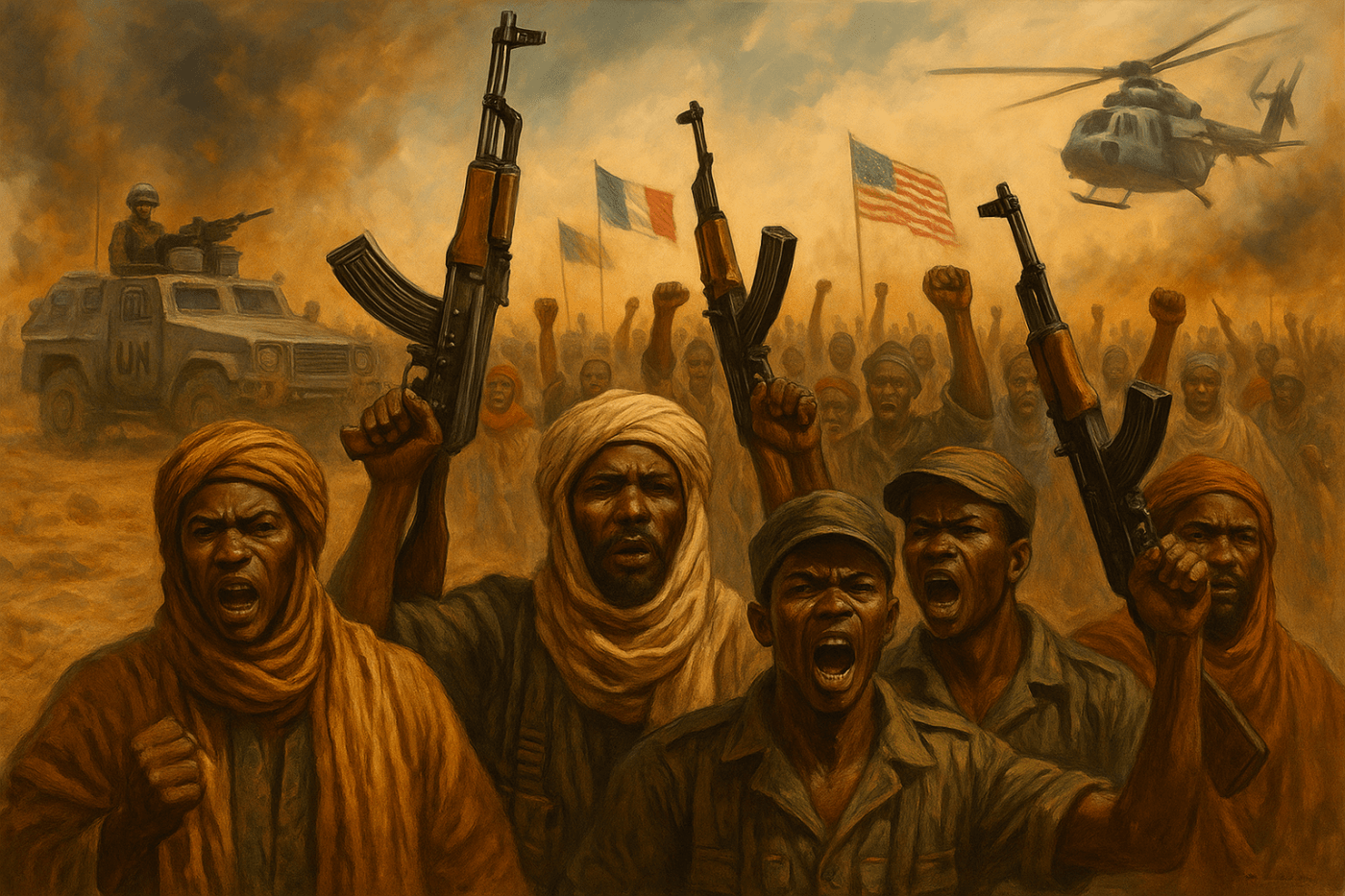
The Sahel Doesn’t Beg Anymore: Mali, Niger, and the Fracturing of the Neocolonial Order
As Barrick scrambles to defend its mines and the Red Cross cries foul, Mali and Niger are doing something dangerous—they’re choosing sovereignty over subservience. This isn’t chaos—it’s counterpower in motion.
By Weaponized Information | June 7, 2025
I. Propaganda by the Ounce, Humanitarianism by the Ton
Two stories, two battlefields, one enemy. In Reuters’ report on Mali, we’re told that a West African nation is “disrupting” global investment flows by daring to enforce its updated mining code against Canadian gold giant Barrick. Meanwhile, the Associated Press paints Niger’s expulsion of the Red Cross as a reckless act of junta overreach, endangering civilians and breaching humanitarian norms. But behind the alarmist tone is a strategic pattern: both articles frame African assertion of sovereignty as crisis—not because it threatens people, but because it threatens power.
The Reuters piece emerges from the polished assembly line of global capital journalism—written not by on-the-ground investigators, but by economic technocrats whose job is to stabilize markets, not to inform readers. It frames Mali’s actions not as the exercise of legal rights under its 2023 mining code, but as an economic “risk.” There is no mention that Barrick’s Loulo-Gounkoto mine is 80% foreign-owned, or that Mali’s move to seize 3 metric tons of gold came after years of one-sided contracts that denied the country full value for its resources. The Associated Press, for its part, performs humanitarian damage control—lamenting the Red Cross expulsion without addressing the documented pattern of Western NGOs acting as arms of soft-power intelligence operations across the Sahel. AP maintains its branding as a nonprofit “neutral” outlet, but functions structurally as a U.S.-centric narrative engine, reinforcing the ideological terrain necessary for sanctions, coups, and occupation.
Reuters calls Mali’s enforcement of its 2023 mining code “disruptive,” but says nothing of the fact that Barrick controls 80% of Loulo-Gounkoto, with Mali left holding just 20% of its own gold. This isn’t instability—it’s the violent equilibrium of neocolonial control being interrupted. Similarly, the AP omits that ICRC’s expulsion came just days after it reported 120,000 conflict victims—evidence that undermined Niger’s security narrative. What the press hides is what power needs hidden: the audacity of a break.
And who benefits from this media choreography? Mark Bristow, Barrick’s CEO, who has spent decades converting African veins into shareholder dividends. Mirjana Spoljaric, president of the ICRC, who defends neutrality while her organization is embedded in NATO-aligned theaters of war. ECOWAS, repackaged as a continental body, but steered by France, the U.S., and capital-heavy comprador regimes like Nigeria. The IMF, which now uses development loans and “climate finance” to reward compliant states like Senegal and punish sovereign ones like Mali, Burkina Faso, and Niger.
The propaganda method is mechanical and precise: label legal action against foreign corporate abuse as “instability”; frame the removal of compromised humanitarian agencies as a “humanitarian crisis”; cite anonymous “diplomatic sources” while excluding the voices of Africans reclaiming their future. By omitting the power structures behind these decisions—colonial treaties, unequal trade regimes, extractive lawfare—the press constructs a false moral binary: benevolent West, unruly Africa. It’s not journalism—it’s a casing for recolonization.
Let’s be clear. What Mali and Niger are doing is not chaos—it’s insurgency against empire. What the press calls “disruption” is an attempt to redistribute control over life, land, and law. These are not isolated flare-ups—they are revolutionary pulses. And the media’s job is not to explain them. It’s to suppress their meaning before the fire spreads.
II. Two Fronts of the Same War: Material Sovereignty and Institutional Breaks
This is not chaos. This is clarity—the kind that only comes when the veil of “development” drops and the boot is no longer disguised as a handout. In Mali and Niger, the question is the same: who owns the land, who decides the law, and who gets to speak in the name of the people? One nation confronted a Canadian gold giant. The other shut the gates on a Western NGO dressed in humanitarian robes. And together, they cracked open the myth that imperialism ever left Africa—it just changed clothes.
Let’s begin with Mali. Since November 2024, the government has blocked Barrick Gold’s exports and in January 2025, seized 3 metric tons of gold. They now seek provisional administration of the mine—directly challenging the company’s claims that its 1990s contracts remain sacred under new law. In 2023, Barrick paid Mali $460 million—a fraction of the $3.5 billion in peak revenues. These moves caused a 23% drop in Mali’s industrial gold output in 2024. But this isn’t economic failure. It’s sovereignty with a cost—and Mali’s willing to pay it.
The numbers speak louder than diplomacy. In 2023, Barrick pulled an estimated $3.5 billion in revenue from Mali, while tossing the state a $460 million payout like loose change. When Mali blocked exports and demanded control, it knew what it was risking: a 23% drop in national gold output, foreign investment flight, and media howling about “instability.” But what the media calls instability is just resistance refusing to stay polite. This is anti-imperialist sovereignty—not in theory, but in ounces and tons.
Now to Niger. In February 2025, the junta kicked out the International Committee of the Red Cross (ICRC), accusing it of colluding with armed groups and manipulating data. The Red Cross denies it, of course. But here’s the inconvenient truth: its last report listed over 120,000 conflict victims—a figure that contradicted the state’s claims of restoring order. And so, like all soft-power proxies that outstay their usefulness, it was shown the door. Niger’s interior minister has stated the need to “supervise” aid organizations that are “waging war against the state.” This wasn’t a tantrum—it was a strategic purge. Just like in Burkina Faso, where France-linked NGOs were banned, Niger is clearing house.
We are often told that aid is neutral. But in the Sahel, aid is a weapon. It lands like a drone, quiet and untraceable, cloaked in humanitarian language. But behind the medical tents and peace reports lies a vast machine of intelligence gathering, political influence, and narrative laundering. When Niger expelled 26 foreign Red Cross staff, it wasn’t rejecting humanitarianism—it was rejecting occupation by other means.
And they did this while 3.3 million people in Niger face acute food insecurity, sanctions choking their economy, and Western donors threatening to close every tap. In other words, under siege. Yet even in this moment of material scarcity, they chose sovereignty over subservience. It’s not about charity. It’s about counterinsurgency from below: identifying the frontlines of colonial power—whether in gold exports or humanitarian credentials—and drawing a line.
In both cases, these governments are not just reacting. They are acting—with law, with resolve, and with the calculated fury of a region that has spent too long being mined, mapped, and managed by foreign hands. Mali is waging lawfare against corporate giants. Niger is reclaiming the right to define its own legitimacy. This is not collapse—it’s construction. What they are building is slow, fragile, and full of contradictions. But it is real. It is theirs. And it’s not waiting for applause.
III. From Keita to the Bloc: A Revolutionary Alignment Begins
If you listen to Brussels or Langley, they’ll tell you this is a breakdown. But if you listen to history, to the long breath of anti-colonial struggle, you’ll hear something else: alignment. Coordination. The painful beginnings of a bloc not born in boardrooms, but on red soil, under embargo, through contradiction. Mali, Niger, and Burkina Faso aren’t just governing—they’re building something more dangerous: dual and contending power. And they’re doing it in full view of an empire that doesn’t know how to stop bleeding but insists on telling others how to bandage.
After France’s expulsion, after ECOWAS sanctions, after the West abandoned the pretense of democracy promotion, these three states did something imperialists never expected: they turned toward each other. They formed the Alliance of Sahel States (AES). Not a free trade zone. Not a donor consortium. But a bloc of states confronting imperialism not as theory, but as fact. They’ve ejected U.S. and French troops, severed ECOWAS ties, and launched coordinated political, military, and legal offensives to protect their sovereignty. This is not rebellion—it is recalibration from below. It is anti-imperialist sovereignty in motion.
The alliance is already redrawing the map. Militarily, they’ve expelled French and U.S. troops and signed new defense pacts with Russia, forcing the closure of a $100 million U.S. drone base in Niger. Economically, they’ve withdrawn from ECOWAS and launched the AES to avoid what they call “imperial debt traps.” The IMF, in response, redirected $100 billion in loans to compliant regimes like Senegal. This is imperialist recalibration in real-time. But the AES is holding the line.
Resource nationalization is next. Mali’s gold reclamation is one front. Niger’s seizure of French-controlled uranium mines is another. The markets are paying attention: Barrick’s stock fell 3.37% during negotiations. This is not symbolic. It is structural. It is the crisis of imperialism expressed in numbers.
Mali is taking on neocolonial extraction with legal weapons. Niger is tearing apart the myth of humanitarian neutrality. Burkina Faso is building out the social infrastructure of revolutionary governance—clean water, local food production, people’s security brigades. These are not isolated acts. They are chapters in the same text. The ruling class calls it “authoritarianism.” We call it revolutionary rupture.
And yes, contradictions abound. None of these states are socialist. Not yet. But they are doing what revolutionary process demands: seizing space, time, and legitimacy from empire. They are not begging the IMF for better terms. They are denying the IMF’s terms altogether. They are not calling for Western “dialogue.” They are exposing dialogue as the imperial pause button between drone strikes. And as they do this, the Global North trembles—not because three landlocked nations are threatening the world order, but because they are threatening the myth that it cannot be disobeyed.
The AES bloc is not the final answer. It is the first real question posed in a long time: What does postcolonial power look like when it stops apologizing for its own existence? It looks like $438 million in gold reclaimed from Canadian firms. It looks like 26 foreign Red Cross staff expelled from sovereign land. It looks like an empire caught off guard—not by coups, but by coherence.
This is what Sankara dreamed of and what Modibo Keita risked everything to build: an African horizon not measured in donor graphs or compliance scores, but in political dignity and material control. The AES is far from perfect. But perfection is not the point. Power is. Autonomy is. And in the Sahel, the people are remembering how to wield both.
IV. Empire Will Strike Back—So We Must Stand First
Make no mistake—Washington, Paris, and Brussels are watching. Not because they care about the people of Mali or Niger. They never did. They’re watching because something dangerous is unfolding: proof of possibility. Proof that it is still possible to say no to imperialism. To kick out foreign troops. To nationalize stolen wealth. To build a future without permission from the IMF. That’s what frightens them. Not coups. Not “instability.” But disobedience that spreads.
This isn’t hypothetical. It’s already happening. Climate funding, gender equality programs, food relief—all now rerouted to governments who pledge “technological neutrality”—a code phrase for allowing fossil-fuel dependence under Western terms. In short: financial warfare disguised as moral governance. Sovereignty-first policies are punished. Obedience is subsidized.
And they are already responding. ECOWAS—long ago turned into a subcontractor for French and U.S. interests—is threatening new border closures. The IMF is quietly rerouting funds and development programs to “compliant” regimes like Senegal, offering over $100 billion in soft loans as a bribe for obedience. Climate funds, gender equality grants, food relief—all weaponized as financial warfare against sovereignty-first states. This isn’t charity withheld. It’s sanctions architecture by another name.
Empire has a thousand tools: drone bases, NGO reports, trade deals, SWIFT codes. When one fails, they reach for another. If lawfare doesn’t work, they send in Special Forces. If military occupation becomes unsustainable, they back opposition candidates and call it democracy. The AES bloc knows this. That’s why they’re rushing to integrate economically, legally, and militarily—before the next round of sabotage hits. If Togo defects, the AES bloc gains Atlantic Ocean access—shattering ECOWAS’s containment strategy. If Ghana pivots, the entire West African balance shifts. The only thing holding the empire together is its ability to isolate, sanction, and divide. But this time, the bloc isn’t blinking.
So what do we do? We don’t wait for the next headline. We act now. We spread their example. We defend their sovereignty not with hashtags, but with organized refusal. We expose the lies of the imperialist media apparatus. We fight the sanctions in our own streets. We tell our unions, our organizations, our communities: the Sahel is not a tragedy. It’s a test. And how we respond will determine if this rupture is contained—or if it spreads like wildfire.
This is not about charity. This is about strategy. About refusing to let the first real attempt at dual and contending power in 21st-century Africa be crushed under the weight of Western retaliation. About recognizing that what Mali, Niger, and Burkina Faso are doing is not just their struggle—it’s our front, too.
The Sahel is not a collapse. It is a challenge. It is $438 million in reclaimed mining revenue and 26 Red Cross staff sent packing. It is a line drawn across the red soil of Africa that says: no more. If they can hold that line, maybe the rest of us will remember how to draw one too.
🔗 Endnote: Read More from the Weaponized Information Archive
To understand the deeper historical, geopolitical, and ideological context behind the Sahel’s revolutionary rupture, we recommend the following related pieces from our archive:
-
Senegal Tries to Break Free—But the IMF Still Has the Keys
Explores the limits of electoral rupture in West Africa when financial sovereignty remains under lock and key. -
The Sahel Rises: Inside Burkina Faso’s Revolutionary Turn Under Ibrahim Traoré
A deep dive into the most advanced revolutionary statecraft emerging in the Sahel and its implications for regional sovereignty. -
Proxy War in the Sahel: How Empire Uses Coups to Break the BRICS Bloc
Dissects the geopolitical sabotage of West African integration efforts and the global implications of Sahelian resistance. -
Fortuna’s Flight: How a Canadian Mining Giant Fled People’s Sovereignty in Burkina Faso
Exposes how corporate mining giants react to revolutionary resistance by fleeing zones of worker power and relocating to more compliant regimes. -
Niger Didn’t Expel China—It Recalibrated the Terms of Struggle
Reframes Niger’s strategic shifts not as ideological betrayal but tactical maneuvering in the struggle for sovereignty. -
Weaponized Development: How the World Bank Blames Africa for the Wounds It Inflicted
Unpacks the ideological function of “development” institutions as instruments of recolonization dressed in technocratic language. -
Modibo Keita: The Teacher Who Defied the French Empire
A tribute to the revolutionary legacy of Mali’s first postcolonial leader and a historical touchstone for today’s struggle.
 Weaponized Information
Leave a comment