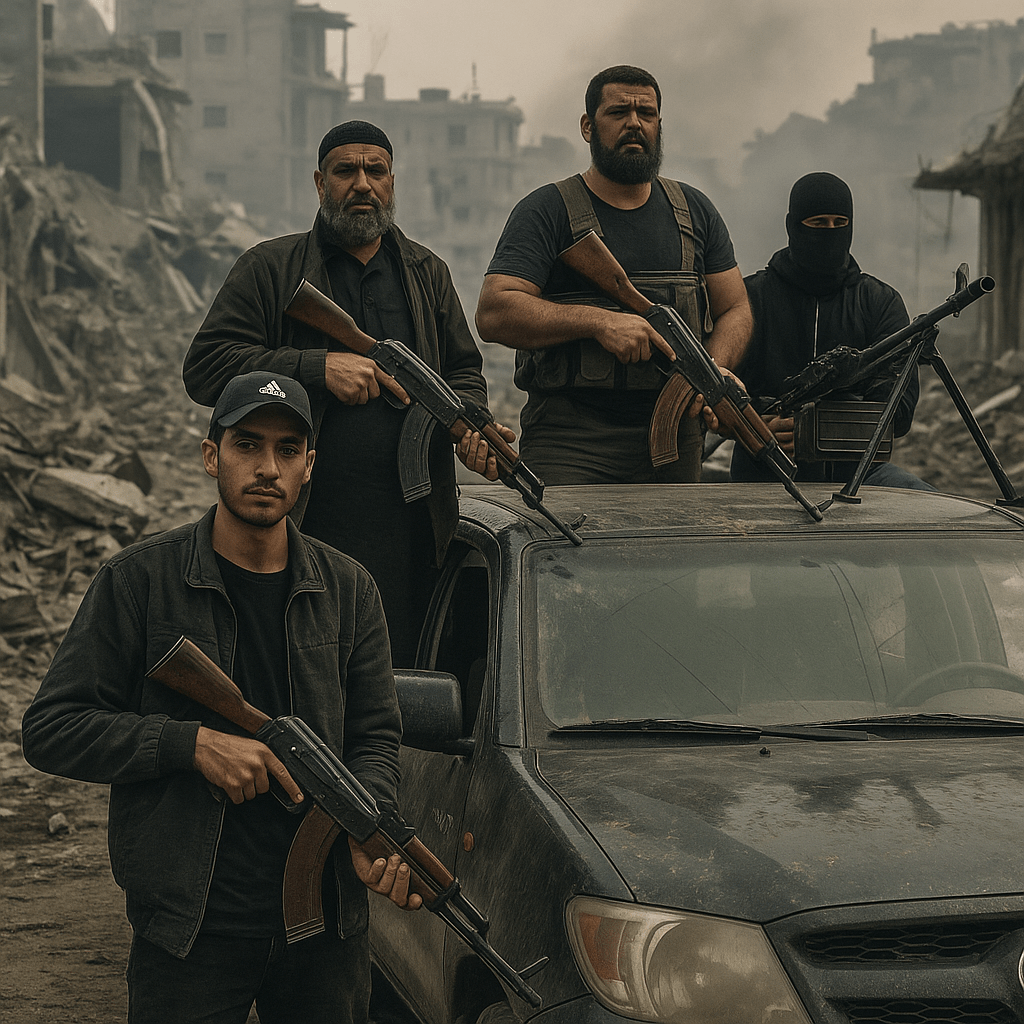
Settler colonialism doesn’t need stability—it needs sabotage. Netanyahu’s proxy militias aren’t a security failure. They’re the plan.
By Prince Kapone | Weaponized Information
June 6, 2025
I. When the Settler Hires the Gangster: Media Clarity and Colonial Chaos
In a June 6 report from Middle East Eye, we learn that Israeli Prime Minister Benjamin Netanyahu has openly admitted to arming criminal gangs inside Gaza—specifically the Abu Shabab clan—to stir up violence against Hamas and destabilize the enclave from within. Backed by video evidence, satellite images, and statements from Israeli officials and opposition figures like Avigdor Lieberman, the article reveals how Israel is using local collaborators to carry out looting, sow chaos, and fracture what remains of Palestinian unity. The piece is refreshingly unfiltered in its facts, but still stops short of naming the deeper strategy behind the operation: this isn’t rogue behavior—it’s settler-state doctrine.
Middle East Eye deserves credit for publishing material the rest of the corporate press either censors or buries. But even independent media exists within a broader ideological terrain shaped by empire. And so while the article lays out the evidence—Netanyahu’s admissions, Lieberman’s alarms, the Kalashnikovs funneled to gangs under Israeli military protection—it fails to frame this as a deliberate weapon of counterinsurgency. There’s no analysis of how settler colonialism operates through criminal proxies, or how Zionism depends not just on brute force, but on internal rot—on turning parts of a colonized people into tools of their own repression.
Lieberman’s claim that the gang is linked to ISIS isn’t outrage—it’s optics. The Israeli press echoes him not to oppose the tactic, but to manage its fallout. Behind the scenes, it’s the usual suspects doing the real work: IDF generals, Shin Bet handlers, private arms dealers, U.S.-trained think tank advisors, and a class of politicians whose careers are built on turning Gaza into a testing ground for pacification warfare. What they call “activating clans” is just colonial code for outsourcing death to keep settlers safe and resistance buried.
And that’s what this story is really about. Not just the arming of gangsters, but the logic behind it. The settler doesn’t just shoot the native—he funds the native’s cousin to do it for him. That’s been the model from the Americas to Algeria. From Belfast to Baghdad. And now, once again, in Gaza. This isn’t a “clan conflict”—it’s a state-backed strategy to turn liberation into looting, solidarity into suspicion, and popular resistance into street crime. It’s settler-colonial pacification by other means. MEE gives us the bones of the story—but we need to put flesh on it. We need to call it what it is: gangsterism in the service of genocide, sold to the world as counterterrorism, and carried out with the full machinery of a settler-colonial state that would rather rule over ruins than see a free Palestine.
II. Divide, Destabilize, Dominate: From Cold Facts to Colonial Function
Let’s start with the hard evidence. Netanyahu confessed on video to “activating” anti-Hamas clans in Gaza—specifically the gang led by Yasser Abu Shabab. The gang, reportedly around 100 armed men strong, has been operating under Israeli protection in areas directly controlled by the occupation army. Israeli officials confirmed they provided the gang with Kalashnikov rifles, including weapons seized from Hamas. Lieberman, a fascist politician and former defense minister, alleged the group is tied to ISIS. Humanitarian aid organizations and local families accuse Abu Shabab’s gang of looting relief convoys. Hamas forces have reportedly killed several of its members. Even the Abu Shabab family has publicly disowned Yasser for his collaboration with the occupation. According to Haaretz, satellite imagery confirms the gang’s movements and the existence of armed compounds inside Israeli-controlled zones. UN memos cited by the Washington Post reveal that these gangs are “benefiting from a passive if not active benevolence” of the Israeli military.
But these facts don’t exist in a vacuum. This isn’t just a strange twist in the ongoing war on Gaza. This is a textbook counterinsurgency maneuver—an imperialist pattern deployed in every colonial theater where the settler or occupier seeks to destabilize indigenous resistance. In Genocide by Design and Famine as Frontier, we mapped how the Zionist regime deliberately engineers the collapse of Gaza’s civil society—from its healthcare system to its food supply chain. What we’re seeing now is the internal security corollary: the deliberate erosion of popular unity and political coherence through armed collaboration. It’s a settler strategy older than the state of Israel itself.
Zionism does not merely aim to conquer land—it seeks to annihilate the very idea of Palestinian sovereignty. And to do that, it must dismantle not only organized resistance like Hamas, but the social fabric that sustains the will to resist. The introduction of armed gangs, looters, and collaborators into the bloodstream of Gaza’s daily life is no accident. It is part of a systematic campaign of settler-colonial pacification, where violence becomes internalized, directionless, and indistinguishable from ordinary survival. What Abu Shabab’s gang represents is not criminal deviance—it is imperial design: a subcontracted counterinsurgency force wearing local colors, discrediting the resistance by mimicking it, and destabilizing the community by pretending to protect it.
This is why Netanyahu boasts about “saving Israeli soldiers’ lives.” What he’s really doing is outsourcing risk. Let the collaborators bleed for Zionism. Let Gaza collapse from within. And when the armed gangs destabilize what’s left of civic life, Israel can step in with tanks and drones and say: “Look, there’s no one left to talk to.” It’s the same logic behind the U.S. arming of death squads in El Salvador, or the French use of the Harkis in Algeria. This is counterinsurgency 101: break the resistance not just with bombs, but by creating an internal enemy that wears the face of the people. This isn’t security policy—it’s a psychological war campaign. A social demolition project. A full-spectrum assault on the political imagination of the colonized.
As we documented in No Mercy, No Mask, Israel’s actions in Gaza are not isolated horrors—they are the integrated machinery of settler exterminationism. First, famine and siege. Then, the bombing of hospitals and schools. And now, the injection of internal chaos to ensure that even if Gaza survives, it will be a society torn apart at the seams. This is what Syria Recolonized showed us in a different theater: that imperialism no longer needs to rule through puppet regimes alone—it can rule through gangs, warlords, mercenaries, and manufactured anarchy.
Abu Shabab is not an outlier. He is a model. A new form of colonial auxiliary that hides the hand of empire behind the mask of domestic collapse. His gang’s operations—targeting aid, murdering civilians, and posing as “anti-terror” forces—are meant to blur the line between liberation and criminality. And in doing so, they justify Zionist domination as the only “solution” to the chaos they themselves have manufactured. This is the settler-colonial playbook perfected: provoke, destabilize, deny. Then call it security, call it governance, call it peacekeeping. But make no mistake—this is not peace. It is planned political entropy, designed to kill the idea of a unified Palestinian future before the bombs even land.
III. The Gangster, the Settler, and the Strategy: Reframing Colonial Chaos
The story we’ve been told is that Israel is desperate to defeat Hamas. That it’s improvising, scrambling, trying whatever it can to “restore order” in Gaza. But that’s a lie. This isn’t desperation—it’s doctrine. What’s unfolding isn’t a “clan conflict” or a lapse in military discipline. It’s a calculated operation rooted in a long imperial tradition: manufacture chaos, criminalize resistance, and use collaboration to collapse a colonized society from within. Abu Shabab isn’t a thug gone rogue. He’s a subcontractor of Zionism. An armed gang member repurposed as a counterinsurgency asset. And this is what settler-colonial warfare looks like when it evolves past the mask of law.
As we’ve shown in Famine as Frontier and From Poll to Pogrom, the Zionist regime has already entered the stage of open exterminationism. But extermination doesn’t always wear the uniform of a soldier. Sometimes it wears the sneakers of a looter. Sometimes it drives a pickup truck with aid supplies in the back and an Israeli-issued rifle on the seat. This is settler-state gangsterism as military strategy. And its goal is not simply to destroy Hamas, but to delegitimize Palestinian resistance entirely—by associating it with violence, theft, and disorder.
That’s the brilliance and brutality of the tactic: if the occupation can no longer control Gaza, it will discredit it. If it cannot fully destroy the resistance through airstrikes, it will turn parts of the population into proxies who do the work for them—dirtying the very idea of collective self-defense. The colonized are made to look like the problem, so the colonizer can look like the solution. This is not new. It’s the same counterinsurgency formula the U.S. used in Iraq, the French used in Algeria, and the British used in Kenya: turn the oppressed into agents of their own oppression, then blame them for the fallout.
But Palestine is not a failed society—it is a society under siege. The people of Gaza are not rioting—they are resisting collapse with every thread of social coherence they have left. And even as Zionism floods the Strip with famine, disease, and now gangs, it has failed to kill the dream of liberation. That dream lives not in the mansions of the collaborators, but in the alleyways where families feed each other under siege. In the refugee camps where children memorize the names of martyrs. In the defiant funeral chants and the burned-out classrooms turned revolutionary study halls.
The Abu Shabab model will fail because it misunderstands the nature of Palestinian resistance. Zionism believes that if it can fragment Gaza, it can fracture the will to fight. But what it doesn’t understand—what no empire has ever understood—is that when the people have nothing left to lose but their chains, the resistance becomes indivisible. Abu Shabab may carry a gun, but he doesn’t carry the people. And without the people, the gangster becomes just another dead end in a long road of failed colonial tactics.
It’s time we name what this is. Not chaos. Not security policy. This is a war on Palestinian unity, disguised as internal unrest. This is settler counterinsurgency by proxy. And just like every previous phase of the occupation, it will collapse under the weight of the people’s resistance. Because you can’t kill a people’s future with hired guns. You can only delay it. And every gang you arm, every collaborator you protect, every structure you implode—only makes that future more inevitable.
IV. No Peace Without Unity: Material Solidarity Against the Settler Proxy War
We stand without hesitation or qualification on the side of the Palestinian people—against settler colonialism, against Zionist extermination, and against the gang proxies sent to fracture their resistance. The arming of the Abu Shabab clan is not an isolated atrocity. It is part of a broader campaign to dismantle the last threads of collective survival in Gaza. But we know this much: Palestine is not falling apart. It is being torn apart. And from every corner of the Global South to every colonized neighborhood in the heart of empire, our task is to make sure those threads are re-tied—with revolutionary clarity and internationalist discipline.
This is not a time for mourning alone. It is a time for material solidarity. For action. For resistance in every form. In Gaza, resistance continues through survival: smuggling bread, protecting aid, burying martyrs with honor, and refusing to surrender to criminal collaborators. Across Palestine, youth are rebuilding political cells and resistance networks—underground, decentralized, resilient. This is not the end of resistance—it is its reconfiguration under fire.
And internationally, our duty is just as clear. We must:
- Expose the proxy war: Refuse every media narrative that calls settler-backed gangs “civil unrest.” Name it as counterinsurgency by collaboration. Share and cite the analysis in this report and others like Genocide by Design and Famine as Frontier.
- Support Palestinian self-organization: Redirect funds, supplies, and technical resources not to NGOs but to revolutionary mutual aid groups, grassroots civil defense networks, and underground education initiatives still operating under siege.
- Target the collaborators and profiteers: Organize local campaigns to disrupt and expose companies supplying arms and surveillance to Israel. Disrupt Elbit Systems, Rafael Advanced Defense Systems, and their financial backers in your region. Treat the arming of gangs as a war crime—not just in Gaza, but wherever empire replicates itself.
- Build revolutionary unity from below: Link the struggle in Gaza to local struggles against police militarization, prison repression, and racialized surveillance. Connect Zionist counterinsurgency to domestic counterinsurgency. In the U.S., Europe, and settler colonies like Canada and Australia, name the shared colonial logic that binds these regimes together.
Palestinian resistance has never asked for saviors—only for comrades. And to be a comrade means more than posting slogans or waving flags. It means naming enemies, seizing contradictions, and showing up where it matters. On the picket line. On the prison yard. On the campus. On the battlefield of ideas. It means taking a side when neutrality is complicity and silence is surrender.
The settler state arms gangs to shatter unity. We arm ourselves with revolutionary clarity to build it. There can be no peace under occupation. No justice without resistance. And no freedom without the total defeat of Zionist settler colonialism—from the river to the sea, and across every front line of empire.
 Weaponized Information
Leave a comment