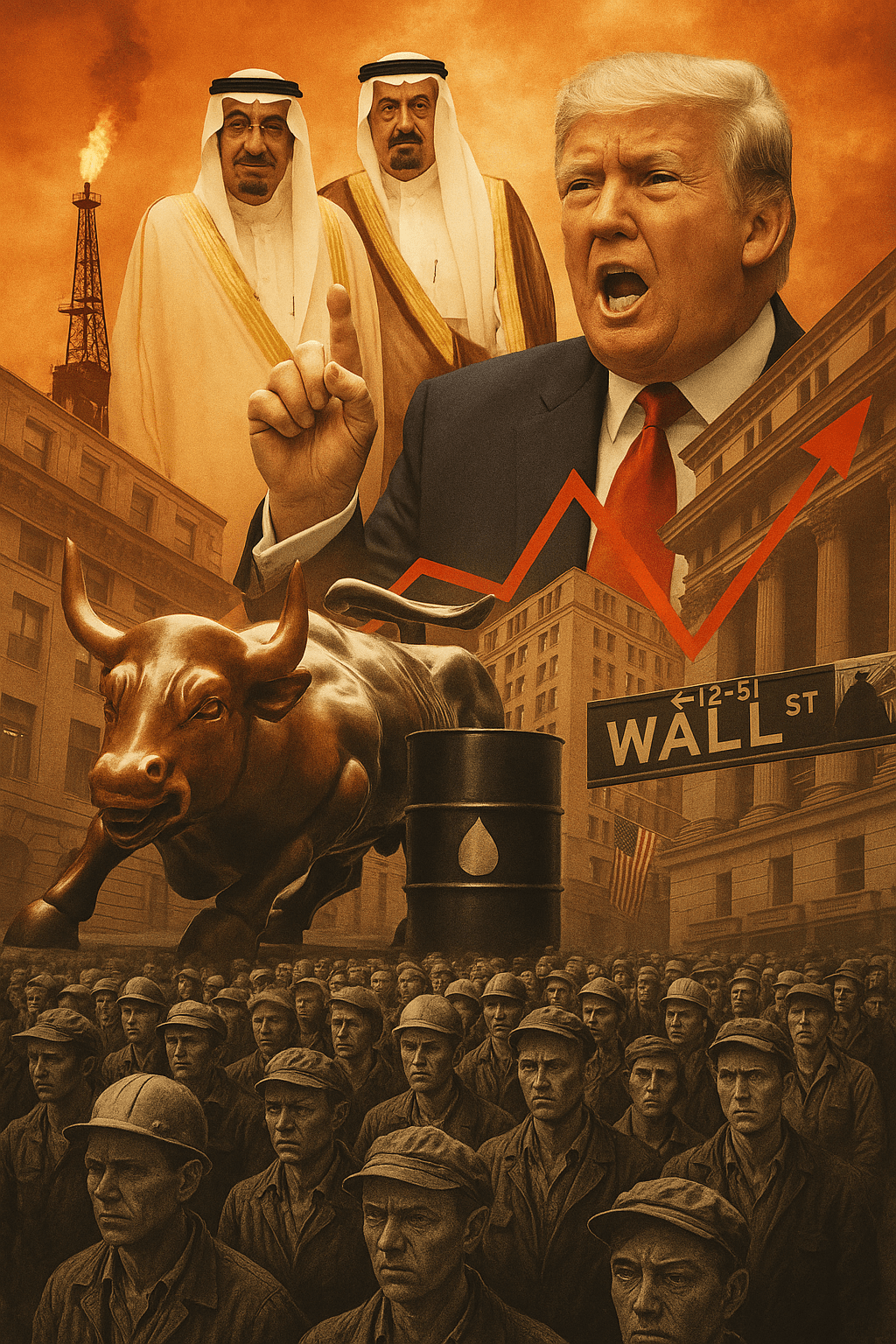
Behind The Guardian’s Polite Lies: How Gulf Petrodollars, Liberal Media, and Financial Deregulation Collide to Enrich Empire and Enslave the Working Class
By Prince Kapone | Weaponized Information
May 15, 2025
I. The Guardian Guards the Bankers
Let’s get straight to the heart of it, comrades: Kalyeena Makortoff, banking correspondent for The Guardian, isn’t scribbling her dispatches from some neutral cloud above history. Her career spent cozying up within London’s finance districts has made her the ideal mouthpiece for capitalism’s soothing lullabies. And The Guardian? It may wave the progressive banner, but it remains owned by capital, shaped by capital, and loyal only to capital. Expecting revolutionary clarity from this media institution is as naïve as expecting landlords to abolish rent—a sheer fantasy.
Makortoff’s recent article neatly hands the microphone to Wall Street’s biggest parasites—JP Morgan and Goldman Sachs—who we’re told have “long complained” that post-2008 banking regulations are too “burdensome,” hindering their sacred profits. Amplifying their complaints alongside Makortoff are familiar faces: the Financial Times, capital’s house organ, and Britain’s Chancellor Rachel Reeves, dutifully parroting Wall Street’s deregulation gospel across the Atlantic.
But beneath this genteel veneer lies a calculated ideological project. Trump’s regime, Makortoff gently informs us, plans “to slash capital rules for banks designed to prevent another 2008-style crash.” Notice the careful framing: a “deregulation drive,” as if Trump were merely tidying up some bureaucratic loose ends rather than handing financial oligarchs the keys to another global heist. The passive language—”Watchdogs are reportedly planning”—erases human agency, obscuring the clear class interests at play. Who exactly are these watchdogs? Whose orders are they following? Makortoff conveniently sidesteps these essential questions, quietly assuring readers that these anonymous bureaucrats must surely know best.
Here lies the core of liberal propaganda: Makortoff passes along Wall Street’s grievances about being penalized for holding supposedly “low-risk assets,” such as U.S. debt, without critique or context. Low-risk? Tell that fairy tale to the millions who lost jobs and homes when these same banks blew up the global economy in 2008, gambling on precisely these “safe” instruments. Makortoff briefly nods to unnamed critics but swiftly returns to the bankers’ sob stories about “hindered competition.” In her hands, billionaire bankers become the oppressed proletariat, valiantly struggling against regulation’s supposed tyranny.
Let’s clarify the stakes: deregulation is never about efficiency or competitiveness—it’s naked class war. It’s the ruling class stripping away the last restraints, gearing up to loot once more. Makortoff’s gentle euphemisms—her sanitized phrases—aren’t accidental; they are carefully crafted ideological weapons designed to pacify resistance, transforming outright financial piracy into something as innocuous as adjusting traffic rules.
In short, comrades, when The Guardian writes about finance capital, remember it’s guarding the bankers. Liberal media exists to politely launder capitalism’s brutality, normalizing empire, and softening the path for technofascist recalibration. Our duty is clear: expose their ideological sleight-of-hand, dissect their language, and arm ourselves intellectually against the propaganda machinery that makes robbery appear reasonable and empire inevitable.
II. Imperial Recalibration: Trump’s Financial Piracy and the Gulf Connection
To fully grasp the ideological sleight-of-hand performed by Makortoff and The Guardian, we must situate Trump’s deregulation push firmly within its historical and geopolitical context. This isn’t mere bureaucratic housekeeping—it is an imperial recalibration, carefully orchestrated at a time when U.S. hegemony faces deepening multipolar pressures. The American empire, once comfortably dominant through neoliberal globalization and debt-driven expansion, now teeters precariously amid the rising assertiveness of BRICS+, China’s economic resilience, and anti-imperialist sovereignty movements across the Global South. Faced with dwindling opportunities to freely exploit abroad, U.S. imperialism under Trump is turning its predatory gaze inward, restructuring its domestic economy into a zone of intensified financial piracy.
In total, Trump returned from the Gulf States with over $10 trillion in pledged investments and capital infusions—$1 trillion from Saudi Arabia alone, alongside massive financial commitments from the United Arab Emirates and Qatar. These aren’t diplomatic gestures—they’re imperial rent payments, tribute funneled into Wall Street’s coffers in exchange for continued U.S. military protection and the suppression of anti-colonial movements across the region.
This Gulf wealth infusion directly intersects with Trump’s deregulation policy. Makortoff’s polite journalism omits this essential context, choosing instead to portray deregulation as an isolated, bureaucratic decision rather than the calculated imperial strategy it truly represents. Wall Street—flush with fresh petrodollar liquidity—now demands freedom from regulatory restraints not to “stimulate lending,” but to unleash another speculative frenzy of derivatives gambling, toxic loans, and asset bubbles. We must recognize clearly: Trump’s deregulation is deliberately engineered financial piracy, facilitated by Gulf monarchies whose survival depends entirely upon U.S.-backed imperial militarism.
Historically, such deregulation is neither spontaneous nor unprecedented. Recall the run-up to the 2008 financial collapse: aggressive deregulation, unchecked speculation, and monopoly finance capital’s increasing fusion with the state apparatus precipitated catastrophe, impoverishing millions globally. Today, the same predatory logic resurfaces, driven by the same Wall Street banks—JP Morgan, Goldman Sachs, BlackRock—that orchestrated prior crises and subsequent bailouts. These institutions now openly dictate policy through Trump’s cabinet and lobbyists, maneuvering to repeat history’s profitable cycle of privatizing gains while socializing losses.
Thus, Trump’s financial deregulation must be understood dialectically—not as an isolated domestic policy adjustment, but as integral to a broader imperial recalibration strategy. The American empire, experiencing multipolar erosion of its global economic dominance, desperately shifts toward hyper-imperialist tactics characterized by intensified domestic exploitation and external financial looting. Gulf monarchies are not charity donors—they are imperial tributaries, funneling wealth extracted from oppressed populations directly into Wall Street’s speculative casinos, ensuring imperial profits even as the empire’s global standing weakens.
Makortoff and The Guardian conveniently omit this geopolitical context precisely because to expose it would mean admitting the deeply imperialist nature of deregulation. Instead, readers are spoon-fed a sanitized narrative, stripped of agency, context, and historical continuity. This isn’t journalistic neutrality—it’s calculated propaganda, designed to quietly condition consent for imperial piracy, transforming class warfare into bureaucratic minutiae.
Our revolutionary responsibility demands we expose these silences, reclaim historical context, and name clearly the imperialist logic underlying Trump’s financial deregulation. The empire, faced with existential contradictions, resorts openly to financial looting as a survival strategy. Understanding this recalibration is key to preparing our resistance, revealing the hidden mechanisms of imperialist plunder, and exposing the complicity of liberal propaganda outlets like The Guardian in sanitizing financial terrorism.
III. The Casino Economy Unmasked: Deregulation as Imperialist Class Warfare
Ten trillion dollars. That’s the sum total of tribute secured from Gulf monarchies—blood-soaked capital from Saudi, Emirati, and Qatari oligarchs now flowing directly into Wall Street’s speculative machine.
Now let’s strip away the polite euphemisms completely. Beneath The Guardian‘s sanitized prose, Trump’s deregulation reveals itself unmistakably as financial piracy—raw, naked class warfare unleashed by monopoly finance capital against workers and colonized peoples alike. Deregulation isn’t administrative housekeeping or regulatory refinement; it’s the calculated maneuver of a declining empire determined to extract wealth by any means necessary. To call it anything less is to become complicit in capitalism’s daily violence.
Consider carefully the dynamics at play. Trump’s Gulf-financed Wall Street banks, liberated from the supposed tyranny of regulations, now openly prepare for another round of speculative looting: derivatives gambling, predatory loans, artificially inflated asset bubbles. When the inevitable collapse arrives—as it did in 2008—Wall Street oligarchs will once again privatize their profits while forcing the global working class to socialize their losses through austerity, unemployment, and mass dispossession. This cycle is not accidental; it’s structural violence integral to capitalism’s survival strategy, designed explicitly to enrich financial parasites at society’s expense.
Yet, the damage won’t stop domestically. As deregulated banks speculate, the empire reinvests those profits into militarization, tightening sanctions regimes, funding counterinsurgency campaigns, and waging economic warfare against liberation movements across Palestine, Venezuela, the Philippines, and beyond. Thus, finance capital isn’t merely an economic force—it’s ammunition in the imperialist war against global self-determination. Gulf petrodollars funneled into JPMorgan and Goldman Sachs become the bombs dropped on Yemen, the sanctions strangling Cuba, and the surveillance technology terrorizing migrant communities.
Internally, deregulation aligns perfectly with Trump’s broader technofascist strategy. Financial instability, generated deliberately, becomes a pretext to intensify surveillance capitalism, militarize policing, expand mass deportations, and deepen worker precarity. Economic chaos weaponizes division, setting workers—Black, Brown, migrant, Indigenous, poor whites—against each other in a desperate scramble for survival, fracturing revolutionary solidarity before it can coalesce. Deregulation, therefore, is not merely economic—it is counterinsurgency on a financial battlefield.
The Guardian conceals this brutal logic behind its sanitized, technocratic language. But as revolutionary intellectuals, our duty is to expose deregulation clearly and explicitly as class warfare—a deliberate act of economic sabotage executed by finance capitalists, facilitated by the state, and sanitized by liberal media. We must refuse their false narratives and name clearly the imperialist crimes hidden behind polite journalism.
For the working class—both in the imperial core and the colonized periphery—the implications are unmistakable. Trump’s deregulation will not lead to growth or prosperity, only intensified exploitation, precarity, and misery. Our solidarity must recognize clearly that the same financial predators impoverishing Detroit and Oakland also strangle Caracas and Gaza. Workers everywhere, colonized and oppressed peoples globally, share a common enemy: monopoly finance capital and its technofascist enforcers. Only by acknowledging this shared struggle can we build revolutionary unity strong enough to confront and dismantle imperialist finance.
Capitalism’s casino economy is irreformable—its logic fundamentally incompatible with human dignity. Our response must therefore move beyond critique toward revolutionary confrontation. No illusions can remain. Our task is clear: build revolutionary unity, organize fiercely, and overthrow the entire imperialist apparatus of financial piracy. Nothing less will suffice.
IV. From Resistance to Revolution: Transforming Imperial Crisis into Revolutionary Opportunity
Every crisis carries within it the seeds of revolutionary possibility. The empire’s accelerating financial piracy, openly demonstrated by Trump’s deregulation drive, signals not only desperation but vulnerability. History teaches us repeatedly that the ruling class’s turn from subtle coercion to naked aggression reflects fundamental weakness—a declining ability to maintain consent through ideological manipulation alone. Deregulation’s transparent class warfare opens new spaces for revolutionary consciousness and strategic mobilization, if we dare to seize them.
But revolutionary potential alone does not guarantee victory. Theory without praxis remains sterile; critique without disciplined action leads nowhere. Our task now is to translate analysis into militant, organized resistance—transforming imperial crisis into revolutionary rupture. We must clearly recognize deregulation not as mere economic policy but as economic warfare, demanding a collective response rooted in solidarity across borders, communities, and sectors of struggle.
First, we must relentlessly expose deregulation’s predatory logic through mass political education, grassroots propaganda, and independent media campaigns. Revolutionary media—like ours at Weaponized Information—must counteract the sanitized narratives peddled by liberal outlets such as The Guardian, clearly articulating deregulation as class warfare designed to enrich Wall Street parasites at the expense of the global working class. Through teach-ins, community forums, street-level agitation, and digital guerrilla warfare, we must relentlessly puncture ruling-class propaganda, equipping our communities with revolutionary clarity to resist capitalist psychological operations.
Second, practical solidarity with communities directly targeted by deregulation is essential. Solidarity must be tangible—materially supporting migrant communities terrorized by deportation raids, workers facing wage theft, Black and Indigenous communities resisting police violence, and tenants fighting displacement. We must intensify mutual aid collectives, sanctuary networks, community bail funds, and neighborhood defense groups against state violence. Every deportation prevented, every eviction resisted, every cop confronted—these represent not symbolic acts, but critical victories toward building revolutionary confidence and class unity.
Third, we must strategically target finance capital itself, hitting institutions directly profiting from deregulation’s predatory schemes. BlackRock, JPMorgan, Goldman Sachs—these nodes of imperialist power must become focal points of organized boycotts, divestment campaigns, and direct actions. Targeted disruptions to their operations and exposure of their profiteering practices can weaken their ideological legitimacy, reveal their imperialist function clearly, and materially threaten their bottom lines. Revolutionary struggle demands we confront the enemy directly, not merely in rhetoric, but in organized, sustained, militant action.
Fourth, revolutionary movements must actively build dual and contending power—alternative institutions rooted in collective self-determination, anti-racist praxis, ecological stewardship, and anti-imperialist sovereignty. Initiatives like worker cooperatives, community-controlled agriculture, autonomous worker centers, and local people’s assemblies offer survival strategies against capitalist crises, while simultaneously serving as embryonic forms of revolutionary governance. These institutions must embody explicitly anti-imperialist principles, demonstrating concrete alternatives to the technofascist state’s rule by violence and financial terrorism.
Fifth, internationalism remains our most potent revolutionary weapon. The fight against Trump’s deregulation is inseparable from global anti-imperialist struggles in Palestine, Venezuela, Cuba, the Philippines, Mali, and beyond. Revolutionary internationalism demands active participation in global solidarity movements—supporting Boycott, Divestment, Sanctions (BDS), anti-sanctions campaigns, defense of revolutionary Cuba and Venezuela, and militant opposition to imperialist aggression everywhere. Victories abroad strengthen revolutionary possibilities at home, reinforcing our collective struggle against capitalism’s global machinery of death.
This era of imperial recalibration demands revolutionary recalibration from us as well. We are entering heightened class warfare and imperial violence, yet history also provides a clear lesson: every ruling-class assault generates resistance, and resistance—organized effectively—can blossom into revolution. The empire’s crisis is our revolutionary opportunity. Now is the time to recalibrate revolutionary strategy, uniting our scattered struggles into a cohesive front against the technofascist state, monopoly finance capital, and settler-colonial violence itself.
If we recognize clearly, organize effectively, and fight collectively, their war against us can transform into our revolutionary triumph over them. Comrades, the enemy’s desperation reveals their vulnerability. The contradictions of imperialist capitalism are irreconcilable. Our moment has come—now, more than ever, we must translate revolutionary theory into revolutionary victory.
 Weaponized Information
Leave a comment