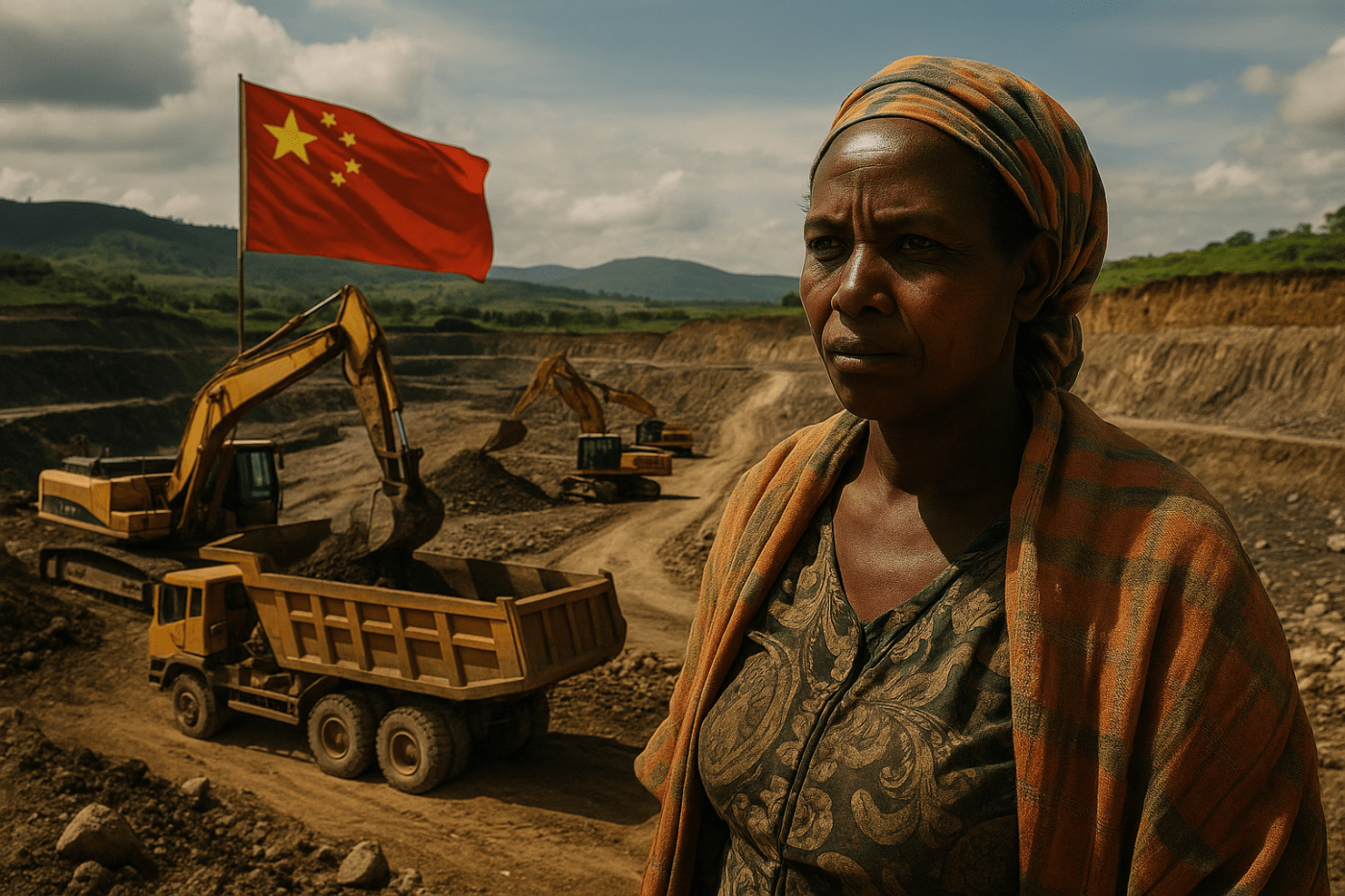
How $1.6 Billion in Chinese Mineral Deals Mark a Revolt Against IMF Rule
By Prince Kapone | Weaponized Information | May 15, 2025
I. Behind the Headlines: Who Writes the Script for Empire?
By Weaponized Information | May 2025
Let’s not get it twisted—Tsvetana Paraskova didn’t stumble upon Ethiopia’s new mineral deals while wandering through the streets of Addis. She’s not a journalist of the people. She writes for Oilprice.com, a digital bulletin board for Wall Street energy traders, resource speculators, and the fossil fuel mafia. This isn’t reporting—it’s asset management in paragraph form.
Paraskova’s beat is global energy, but her lens is locked from the penthouse: dollar signs, market signals, investor confidence. When she writes about the Global South, she doesn’t see colonized nations trying to reclaim control over their future—she sees “emerging markets” with “underdeveloped infrastructure” and “resource potential.” Translation: how much can be pulled from the earth before these people get wise?
Her outlet, Oilprice.com, operates as a mid-tier node in what we call the imperialist media apparatus: not quite CNN, but not far off. It recycles press releases from multinationals and policy “guidance” from the IMF and World Bank, laundering them into supposedly objective news. It’s the financial news equivalent of a NATO press conference—polished, bloodless, and obedient to capital.
That’s why this article parrots the same old refrain: China is investing, Ethiopia is reforming, the IMF is “cautiously optimistic.” But nowhere does it ask why a country rich in coal, gold, and solar potential can’t feed all its people or escape the chokehold of Western debt. Nowhere does it name the real contradiction: between anti-imperialist sovereignty and hyper-imperialist sabotage. And nowhere—of course—is there mention of BRICS+, multipolarity, or the long arc of Global South resistance.
Instead, the piece reduces an epochal economic shift into a spreadsheet. A $1.6 billion investment is just a “deal,” not a declaration of independence. Huawei Mining isn’t building a special economic zone—it’s helping Ethiopia exit the dungeon of IMF debt. But you wouldn’t know that from reading Paraskova. Her job isn’t to illuminate—it’s to tranquilize. To put the masses to sleep while empire updates its portfolio.
This is how cognitive warfare works in the age of declining unipolarity. The facts might be technically true—but the story they tell is pure anesthesia.
II. Beneath the Surface: What the Article Says—and What It Hides
Strip the spin from Paraskova’s reporting and what remains is a set of raw facts, almost begrudgingly admitted: Ethiopia has secured over $1.6 billion in energy and mineral investments, the vast majority from Chinese firms. Huawei Mining is planning a $500 million project focused on mineral exploration and processing. Sequa Mining, a Sino-Ethiopian joint venture, is putting up another $600 million for coal. Hanergy and Sesar Energy are investing a combined $460 million to expand solar infrastructure. On paper, it reads like a clean list of business transactions. But history is not written in balance sheets—it’s written in blood, sovereignty, and contradiction.
First, what’s missing: any mention of the crushing debt Ethiopia faces from prior IMF-backed “reforms”. As of mid-2024, the country remains in default. The IMF is still holding out on releasing funds unless Ethiopia agrees to a devaluation of the birr—one that would spike inflation, hike the cost of living, and squeeze working-class families to pay off foreign creditors. In Paraskova’s world, these austerity programs are “ambitious.” In the real world, they’re a noose.
Also missing is the scale of China’s broader economic presence in Ethiopia. According to the Ethiopian Investment Commission, China accounts for nearly half of all foreign direct investment in the country—over 4,500 projects totaling more than $8.5 billion and employing hundreds of thousands of Ethiopians. This is not charity, nor is it a replica of colonialism. It is part of a new historical phase—what we have defined as multipolarity: a contested, conflictual transition from the unipolar U.S.-EU-led order toward a world where the Global South asserts its own developmental paths. China is not a neutral actor, but it is not Wall Street. It does not demand currency devaluation, mass layoffs, or total privatization as preconditions for investment.
The other sleight-of-hand is the framing of Ethiopia’s “private-led growth.” This phrase, echoed by the IMF, the World Bank, and the Addis technocrats they groom, is code for state retreat. What they want is to hollow out national industry, hand over infrastructure to multinational monopolies, and recode neoliberalism as modernization. But Ethiopia’s mineral deals with Chinese and joint-venture firms reflect a different logic: state-directed industrial policy and the strategic use of foreign capital to develop domestic capacity. This is not the fantasy of a free market. It’s a survival strategy against financial piracy.
What the article also refuses to acknowledge is that these agreements follow a larger pattern across the Global South. In recent years, China has financed railways in Kenya, ports in Djibouti, solar plants in Zimbabwe, and digital infrastructure from South Africa to the Sahel. While the U.S. offers coups, sanctions, and think-tank scoldings, China offers cables, power lines, and industrial zones. To be clear: this is not a moral contrast—it’s a geopolitical one. One empire is collapsing and lashing out. Another state, forged by socialist revolution and shaped by anti-colonial solidarity, is offering a different—but still strategic—model. Our task is not to romanticize either, but to trace the real fault lines of struggle.
Ethiopia’s choice to pursue investment from the East, not loans from the West, is not incidental. It is a rejection of conditionality. It is a refusal to privatize the future. It is a turn—halting, incomplete, and contradictory—toward anti-imperialist sovereignty.
III. Beyond Austerity: Building on Our Terms, Not Theirs
Let’s be clear: this is not a fairytale of South-South cooperation. It is a battlefield of competing interests, but one where the oppressed have a fighting chance to win. When Ethiopia signs a $1.6 billion set of deals with Chinese and domestic partners for energy and mineral development, it isn’t just brokering contracts—it’s breaking with a centuries-old pattern of neocolonial extraction dictated by Western capital and enforced by the imperialist media apparatus.
This isn’t just about investment flows—it’s about political independence. The same Western press that parrots IMF talking points about “reform” stays silent when Chinese firms build infrastructure without demanding currency devaluation, wage suppression, or forced liberalization. That silence is strategic. Because when the Global South chooses to deal with China—or with any BRICS+ partner—on terms that prioritize infrastructure over interest rates, sovereignty over subservience, and production over austerity, it weakens the entire structure of hyper-imperialism.
This is the danger Ethiopia poses—not because it’s rejecting the West entirely, but because it’s refusing to beg. These deals prove that you don’t need to grovel at the feet of the IMF to secure capital. You don’t have to surrender your land, gut your social programs, or privatize your future. What Ethiopia is testing—haltingly, unevenly—is the potential of multipolarity as a material option: not a fantasy of equal nations, but a contested arena where the colonized can maneuver, push, and fight for space to breathe.
Of course, contradictions remain. There is no guarantee that these Chinese-backed investments will automatically serve the Ethiopian working class. Corruption, elite capture, and displacement are real dangers. But here’s the difference: unlike with the IMF, the terms of Chinese agreements are not embedded in the framework of structural violence. The power dynamic, while still uneven, is not absolute. Ethiopia can—and must—bargain, demand, and shape the direction of development. That’s what it means to reject financial piracy and chart a path toward anti-imperialist sovereignty.
Let’s remember that this isn’t just about Ethiopia. It’s about the cracks in the unipolar empire. As BRICS+ expands, as the Global South increasingly trades in yuan instead of dollars, as capital begins to flow without colonial chains attached—Washington loses leverage. And when Washington loses leverage, its only remaining tool is coercion: sanctions, coups, information warfare, and military threats. Ethiopia’s pivot to multipolarity is not just economic maneuvering—it’s geopolitical defiance. And that defiance must be defended, deepened, and made permanent by the people themselves.
Ethiopia’s working class has no illusions. They’ve seen what IMF deals look like. They’ve watched the price of teff rise while debt repayments balloon. They know that privatization doesn’t bring prosperity—it brings layoffs, land grabs, and inflation. So if Chinese-backed solar plants bring electricity, if new mineral zones bring employment, if South-South ties create breathing room—then the choice is obvious. Not because China is a savior, but because it is not the IMF. Not because capital is benevolent, but because this version isn’t shackled to Western financial colonialism.
The future is not guaranteed. But Ethiopia’s move to deal on new terms is a rupture worth defending—and a step that must be radicalized from below. Let the technocrats call it “private-led growth.” Let the West call it “strategic risk.” We know what it really is: the beginning of an exit from structural servitude. The first blows in a long war for economic liberation.
IV. The Work of the Living: From Solidarity to Strategy
The age of watching from the sidelines is over. Ethiopia’s pivot toward multipolar development is not a spectator event—it’s a frontline skirmish in the broader battle to dismantle the dictatorship of the dollar and the global scaffolding of hyper-imperialism. For those of us living within the belly of empire, this moment demands more than commentary. It demands position. And from position must come practice.
First, we declare ideological unity with the right of Ethiopia—and every nation in the Global South—to pursue industrial development without Western permission. That means rejecting the imperialist narrative that all Chinese investment is just “new colonialism” in disguise. It’s not just lazy—it’s strategic disinformation. When the IMF comes calling, it brings austerity and financial piracy. When Chinese firms show up, they bring contracts, infrastructure, and state-to-state negotiation. The difference isn’t just semantics—it’s sovereignty.
Second, we must expose and oppose the enforcement mechanisms of Western finance capital. That means naming and shaming the institutions waging economic warfare against Ethiopia: the IMF, the World Bank, and the unelected rating agencies like Fitch and Moody’s who punish sovereign decisions with debt downgrades. These are not neutral bodies—they are instruments of empire. And when the working classes in the imperial core lend them legitimacy through silence, they become accomplices.
Third, we elevate the ongoing efforts of grassroots African and pan-Africanist organizations pushing for anti-imperialist sovereignty, land control, and economic self-determination. Movements like the Pan-African Federalist Movement, the All-African People’s Revolutionary Party, and the People’s Alliance for Development and Sovereignty in Ethiopia are building the mass political infrastructure needed to make sovereignty real. Their work must be studied, shared, supported.
Fourth, within the imperial core, we organize material solidarity campaigns targeting U.S. and EU imperial institutions. That includes:
- Demanding the end of IMF conditionality and loan-linked structural adjustments
- Organizing teach-ins and propaganda campaigns that reframe Chinese investment in Africa through the lens of multipolarity, not paranoia
- Refusing to let “leftist” critiques be co-opted into parroting NATO propaganda against the Global South’s right to development
- Linking the Ethiopian case to broader struggles against financialized counterinsurgency and debt bondage in places like Argentina, Ghana, and Sri Lanka
Finally, we recommit ourselves to building dual and contending power within the core. The capitalist state cannot be reformed into an engine of liberation—it must be rendered obsolete by the growth of people’s institutions that practice proletarian internationalism not as a slogan, but as a method. From community-controlled mutual aid networks to revolutionary political education projects, we must anchor our work in the same anti-imperialist clarity that guides Ethiopia’s defiant pivot.
This is not a local story. This is a world-historical faultline. In the cracks of imperial decline, something new is struggling to be born. Ethiopia’s path is neither perfect nor guaranteed—but it is a blow against the old order. And every blow must be defended, echoed, and multiplied. Our task is clear: turn analysis into action, solidarity into struggle, and prophecy into plan. The future won’t be negotiated in IMF boardrooms—it’ll be built in the streets, from Addis to Atlanta, from Gondar to Gaza.
 Weaponized Information
Leave a comment