Nicaragua at the 9th CELAC Summit: A Revolutionary Shadow on a Fractured Continent
By Prince Kapone
Founder & Editor-in-Chief, Weaponized Information Multimedia
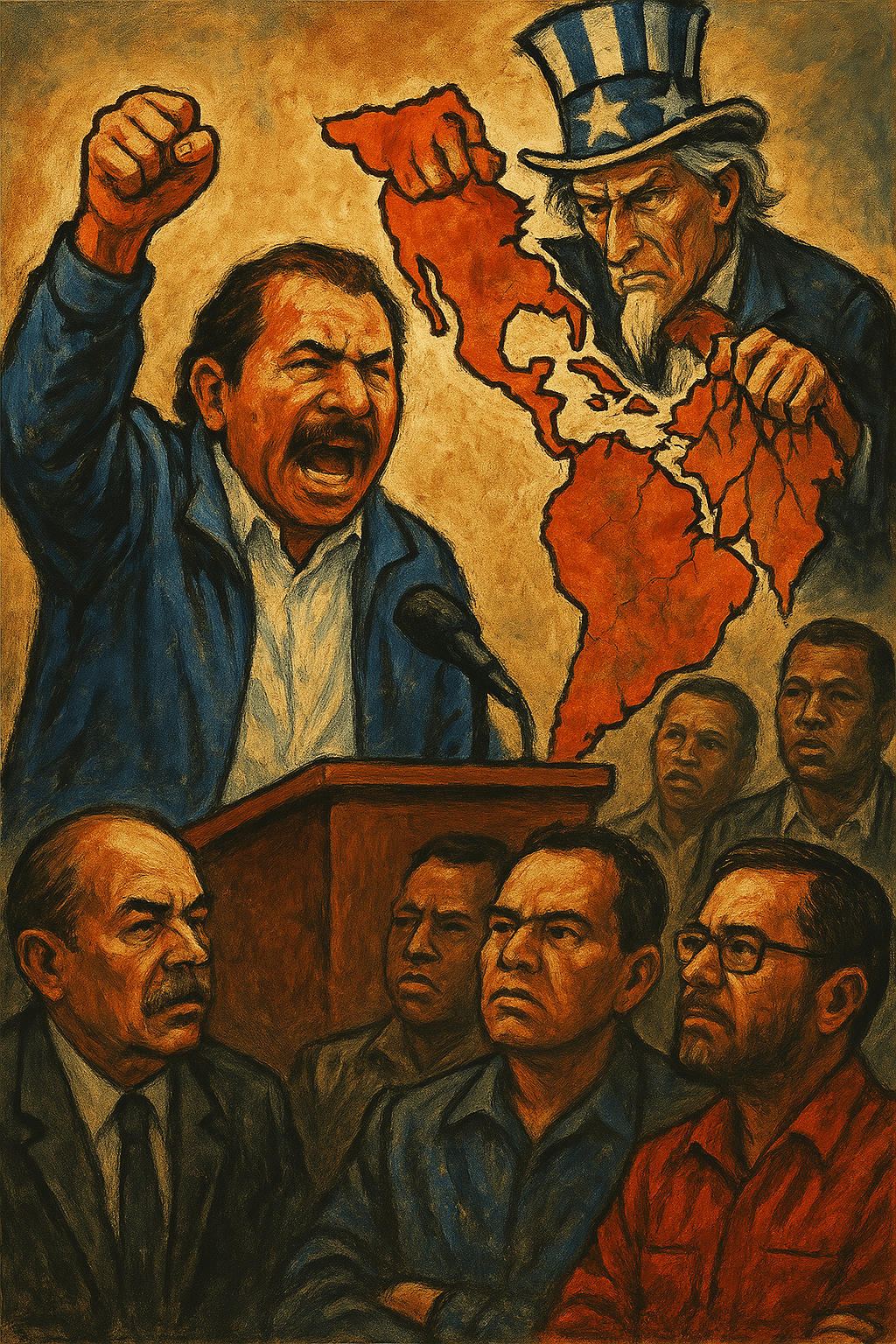
It was supposed to be a reunion of comrades. A regional chorus of unity in the face of empire, a gathering to declare Latin America and the Caribbean as a sovereign bloc against imperialist domination. Instead, the 9th CELAC Summit revealed the deep cracks in that dream, and Nicaragua — revolutionary, besieged, and defiant — stood at the fissure’s edge, half in and half out.
The Sandinista delegation’s cautious, measured intervention — delivered not by President Daniel Ortega, but by Foreign Minister Valdrack Jaentschke — barely concealed the unease. It was a tight-lipped reaffirmation of principles, not a revolutionary call to arms. Absent were the fiery tones of Sandino or the soaring defiance of the 1980s FSLN. This was not the Nicaragua of Radio Sandino — it was a Nicaragua watching and waiting, nodding but not marching.
The Revolutionary Legacy Meets a Fractured Present
Nicaragua is no stranger to isolation. In the 1980s, it faced down the CIA, the Contras, the World Bank, and Washington’s economic sabotage with the fierce optimism of revolution. Its literacy campaigns and health brigades were matched by Cuban doctors and Soviet wheat. It was a beacon of socialist internationalism in Central America — until the tide turned.
Fast forward to 2025, and the terrain has changed. The socialist pink tide has returned, yes, but fractured, cautious, and struggling to navigate a global crisis of capitalism. CELAC, once the answer to OAS irrelevance, now flirts with becoming just another photo op. Meanwhile, the ghosts of coups past — Bolivia, Honduras, Peru — still haunt the halls of the summit. U.S. bases remain. Sanctions tighten. The IMF whispers sweet austerity. And Nicaragua remembers.
Jaentschke’s Speech: Between Principle and Withdrawal
Jaentschke’s speech, though short, was dense with implication. He reiterated Nicaragua’s principled opposition to interventionism, reaffirmed the sovereignty of all nations, and rejected sanctions. But there was no enthusiasm, no strategic alignment, no mention of regional integration mechanisms. Most notably, Nicaragua has still not returned to the Bank of the South, has kept a quiet distance from CELAC’s more ambitious proposals, and declined to take part in Petro’s call for a new multilateralism rooted in collective sovereignty.
Why? The answer lies partly in ideology — but more deeply in geopolitics and survival.
Nicaragua’s Skepticism: Between Multipolarity and Survival
Nicaragua’s statecraft today is a dance of defensive realism under siege. It remains in the crosshairs of the U.S. State Department, subject to the “RENACER” Act and ongoing regime-change operations. The technofascist Trump 2.0 regime considers Nicaragua part of the “axis of authoritarianism” to be destabilized in the coming years. And while Venezuela and Cuba have deepened economic and energy ties with China and Russia, Nicaragua’s smaller economy and more limited trade leverage make it more vulnerable to isolation.
Here lies the contradiction: Nicaragua believes in the plurinational, anti-imperialist future of CELAC — but it doesn’t trust the present configuration of leaders to defend it. It sees Brazil flirting with MERCOSUR-European Union agreements, Mexico still trying to please Washington, and even Argentina torn between sovereignty and capitulation. The revolutionary road is narrowing, and Nicaragua doesn’t want to walk it alone again.
Hyper-Imperialism, Chokepoints, and the Limits of Solidarity
CELAC’s summit unfolded under the long shadow of global hyper-imperialism — a new strategy of chokepoint control, sanctions, asymmetric warfare, and economic blackmail aimed at crushing any sovereign resistance. The U.S. doesn’t need to invade anymore; it suffocates. In this context, Nicaragua’s guarded tone reflects both clarity and caution: clarity that the world system is collapsing, and caution that unity without strategy is suicide.
For Weaponized Information, this moment confirms our analysis: the Global South must build real sovereignty through autonomous integration, collective defense mechanisms, and material solidarity. Multipolarity is not a slogan — it is a battlefield, and CELAC must choose whether it will be a shield or a stage.
Conclusion: The Sandinista Shadow Remains
In the end, Nicaragua spoke little, but its silence was loud. It reminded CELAC of the blood that has already been spilled, of the betrayals that have already taken place, and of the stakes of this historical moment. The Sandinista Revolution may not have roared at this summit, but its shadow loomed. And in that shadow lies a warning: unity without struggle, without clarity, and without courage, is just theater.
The hemisphere stands at a crossroads — and Nicaragua, bruised but unbowed, waits to see who will walk it with them.
Long live the resistance. Long live the dream of a sovereign, socialist, plurinational America.
 Weaponized Information
Leave a comment