By Prince Kapone
Weaponized Information
I. The Return of La Patria Grande
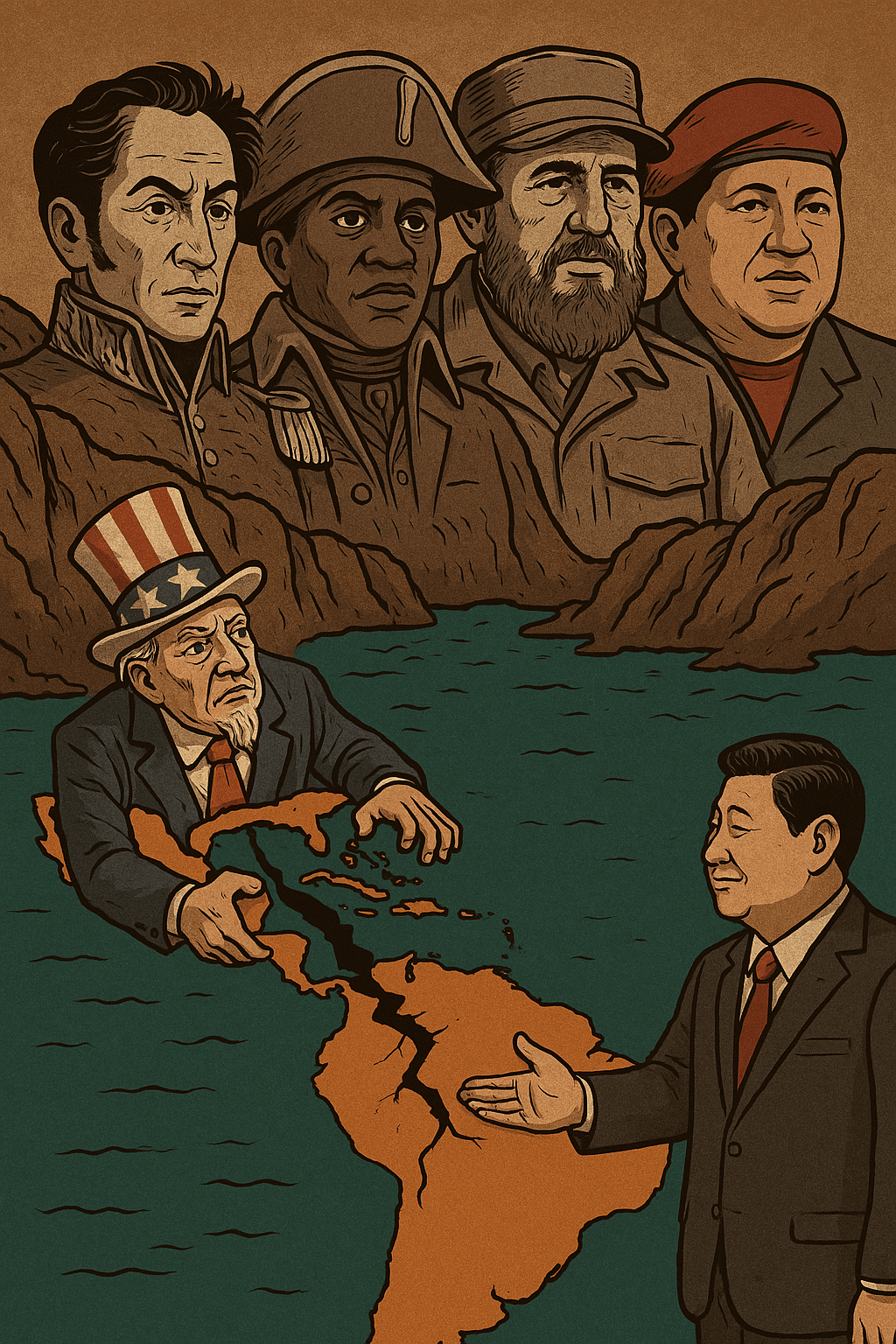
The 9th Summit of the Community of Latin American and Caribbean States (CELAC), held in April 2025 in Tegucigalpa, Honduras, is more than a diplomatic gathering. It is the latest chapter in a centuries-long struggle to consolidate a sovereign and unified Latin American and Caribbean region—La Patria Grande—free from the grip of empire, debt, and foreign capital.
Founded in 2011 in Caracas, Venezuela, CELAC emerged in the wake of the Pink Tide—a period when leftist and anti-neoliberal governments swept into power across the region. This period saw the revival of historic dreams long repressed by coups, colonialism, and structural adjustment: regional integration not under the domination of the United States, but against it.
CELAC’s formation was an intentional geopolitical rupture: a post-OAS formation, excluding the U.S. and Canada, and designed to enable the region to speak with its own voice. Its founding document, the Caracas Declaration (2011), emphasized sovereignty, cooperation, and unity in diversity.
Over the past decade and a half, CELAC has weathered political instability, reactionary backlash, and fragmentation. Yet it has survived—reactivated today by a new generation of popular governments (Mexico, Colombia, Brazil, Bolivia, Honduras) seeking to rebuild a multipolar, decolonial order from below.
II. The Geopolitical Cauldron of 2025
This summit occurs at a pivotal moment. The post-Cold War neoliberal consensus has collapsed, but nothing coherent has taken its place. The U.S., facing economic stagnation and global decline, has responded with militarization, economic coercion, and destabilization tactics.
- The U.S. accounts for over 300 sanctions programs worldwide, disproportionately affecting Global South nations (TNI, 2023).
- Remittances from the U.S. to Latin America totaled $155 billion in 2023, making the region heavily reliant on the U.S. economy (World Bank).
- Climate-related disasters displaced over 2 million people in Latin America in 2023 alone (IDMC, 2023).
These forces have made the need for regional sovereignty more urgent than ever. CELAC is being reactivated not as a forum for declarations, but as a strategic battlefield for sovereignty, development, and survival.
III. Contradictions Shaping the Summit
This year’s summit reflects a regional elite—fractured but awakening—recognizing that Latin America and the Caribbean must integrate or perish. The following contradictions frame the summit:
- Integration vs. Fragmentation: While some governments push for unity, others remain tied to bilateral deals with Washington or Brussels. Political heterogeneity limits cohesion.
- Sovereignty vs. Dependency: Efforts to build food, energy, and health sovereignty clash with decades of neoliberal dependency.
- Popular Aspirations vs. Elite Control: Social movements demand plurinational justice and redistribution, while many CELAC leaders remain within capitalist development paradigms.
- Anti-Imperialism vs. Multipolar Realism: CELAC rejects U.S. hegemony but must also navigate dependency on new powers like China, Russia, and BRICS+.
As the summit unfolds under these tensions, the future of CELAC—and of a truly sovereign Latin American future—hangs in the balance.
Part II: Diagnosing the Present, Designing the Future – Inside the 9th CELAC Summit
The summit opened with powerful statements that reaffirmed the bloc’s founding principles—sovereignty, unity, and resistance to imperialism—while offering a range of perspectives on the region’s crises and paths forward.
Claudia Sheinbaum (Mexico)
Mexico’s President called for a regional “Summit for Economic Well-being,” highlighting the need for integrated development that centers the poor. Sheinbaum proposed concrete collaboration on food sovereignty, pharmaceutical production, renewable energy, and educational exchange, while condemning the U.S. blockades of Cuba and Venezuela. Her framing of “for the good of all, the poor come first” echoes Latin American liberationist thought and challenges neoliberal growth metrics.
Miguel Díaz-Canel (Cuba)
Cuba’s President denounced the return of the Monroe Doctrine and criticized Washington’s aggression through sanctions and blacklists. He called for an end to the “criminal blockade” and emphasized CELAC’s role in defending the dignity of small nations. Díaz-Canel reaffirmed Cuba’s commitment to South-South solidarity and multipolarity, advocating for a region-wide defense of sovereignty against imperial intervention.
Gustavo Petro (Colombia)
As the new pro tempore president of CELAC, Petro laid out a vision for connecting Latin America with Africa and Asia, and building new trade corridors that bypass imperial chokeholds. He highlighted inequality, climate collapse, and economic dependency as core contradictions, calling for a “New Pact for Life” rooted in sustainable development, social justice, and hemispheric integration.
Luiz Inácio Lula da Silva (Brazil)
Lula condemned the global economic architecture that enables “arbitrary tariffs, financial speculation, and political blackmail.” He championed a regional strategy to protect strategic resources like lithium, water, and food, while urging CELAC to become a strong voice in global climate and financial negotiations. Lula warned that without sovereignty, integration is “a castle built on sand.”
Nicolás Maduro (Venezuela)
Speaking via videoconference, President Maduro called for deeper unity to confront external coercion and imperial aggression. He emphasized the role of CELAC in promoting integration, defending sovereignty, and amplifying South-South cooperation. Maduro’s speech underscored the need for “conscious, anti-imperialist unity” and denounced sanctions as collective punishment against the people of Venezuela and other nations of the Global South.
Yván Gil (Venezuela – Foreign Minister)
In his in-person intervention, Gil stressed the urgency of confronting the rise of global fascism, economic warfare, and unilateral sanctions. He reaffirmed Venezuela’s commitment to building CELAC as a political space of dignity and resistance, and emphasized that sovereignty must be matched with institutional strength and cultural integration.
Other Key Contributions
- Xiomara Castro (Honduras): Framed CELAC as a legacy of Bolívar and Martí, and called for mass political education and cultural integration among member states.
- Ralph Gonsalves (St. Vincent & the Grenadines): Called for reparations for colonialism and slavery, and demanded action on debt relief and regional health equity.
- Yamandú Orsi (Uruguay): Pushed for legal harmonization and cross-border infrastructure to facilitate regional mobility and economic integration.
Although details on Nicaragua’s specific contributions remain limited in public records, official sources confirm the country’s participation, indicating its alignment with the summit’s broader objectives of sovereignty, anti-imperialism, and integration.
Across these interventions, several themes resonated: anti-imperialism, regional self-reliance, South-South solidarity, and the defense of national sovereignty in an era of renewed imperial aggression. The summit marked a shift away from passive diplomacy toward a more confrontational and strategic approach to building autonomy in the Global South.
Part III: The Tegucigalpa Declaration – Building the Bloc in the Belly of Empire
As the war drums of hyper-imperialism beat louder and the technofascist world order consolidates its digital borders, the 9th CELAC Summit responded with an ancient weapon: collective resolve. In a bold, if cautious, stroke, 33 nations emerged from the summit with the Tegucigalpa Declaration—a document that is part proclamation, part barricade, and part blueprint for regional defiance.
I. Against the World the Empire Built
The Declaration reaffirmed Latin America and the Caribbean as a Zone of Peace. This isn’t mere sentimentality—it’s an indictment. It positions CELAC as a firewall against the return of gunboat diplomacy 2.0, with Washington’s regime-change machine now powered by sanctions, psyops, and blockchains. In this age of permanent global counterinsurgency, calling for peace is itself a form of resistance.
The signatories rejected unilateral coercive measures—technocratic jargon for sanctions, embargoes, financial strangulation, and other tools in the imperialist toolbelt. Venezuela, Cuba, and Nicaragua know these methods intimately. Their resistance is not theoretical—it is lived, battered, and bleeding. But it is also a line drawn in the sand: this far, no further.
II. The Bloc and the Bullet Points
The Tegucigalpa Declaration is filled with cautious yet pointed affirmations:
- Strengthening CELAC as the central mechanism of regional unity—an anti-OAS platform in both form and function.
- Support for a Latin American or Caribbean woman as the next UN Secretary-General—a symbolic challenge to the global caste system of leadership, where empire appoints and the South obeys.
- Defense of Haiti—not as a charity case, but as a fellow nation under siege, facing the aftershocks of imperial occupation and NGO neocolonialism.
- Rejection of the Monroe Doctrine—without saying the name, but staring directly at the face of the beast.
III. Regional Sovereignty or Multipolar Dependence?
The summit laid groundwork for regional initiatives that may—or may not—escape the orbit of empire:
- Mexico’s call for a “Summit on Economic Well-Being” hints at class-conscious development, but remains entangled in capitalist frameworks. Can there be prosperity without expropriation?
- Brazil’s push for a UN seat reveals the bloc’s double consciousness—resisting empire while still seeking legitimacy in its institutions.
- Petro’s critique of migration and inequality strikes the right tone, but stops short of naming the global capitalist system as the culprit.
The danger is clear: replacing Yankee domination with multipolar subservience. The Chinese Belt is no freer than the Western Boot if sovereignty is merely rebranded dependency. Regional integration must be more than a shift in currency—it must be a rupture in the logic of accumulation and extractivism.
IV. Fractures in the Bloc
Not all voices sang in harmony. Argentina, Paraguay, and Nicaragua withheld full endorsement. Their silence or dissent reflects the reality: CELAC is not a revolutionary bloc. It is a contradictory formation—a coalition of progressive governments, nationalist bourgeoisies, and warring class interests trying to navigate the end of the American century without drowning in the next empire’s tide.
V. The People’s Summit Yet to Come
For CELAC to live up to its insurgent potential, it must transcend summits and become a platform for the people: for Indigenous nations, landless workers, barrio communards, and migrant mothers. Until then, the Tegucigalpa Declaration is a start—not a strike.
But make no mistake: in the blood-soaked context of 2025, even a declaration of peace is a declaration of war—against a world built on pillage, profit, and predictive policing. What remains to be seen is whether CELAC becomes a permanent thorn in the side of empire, or another managed contradiction in the technofascist transition.
 Weaponized Information
Leave a comment