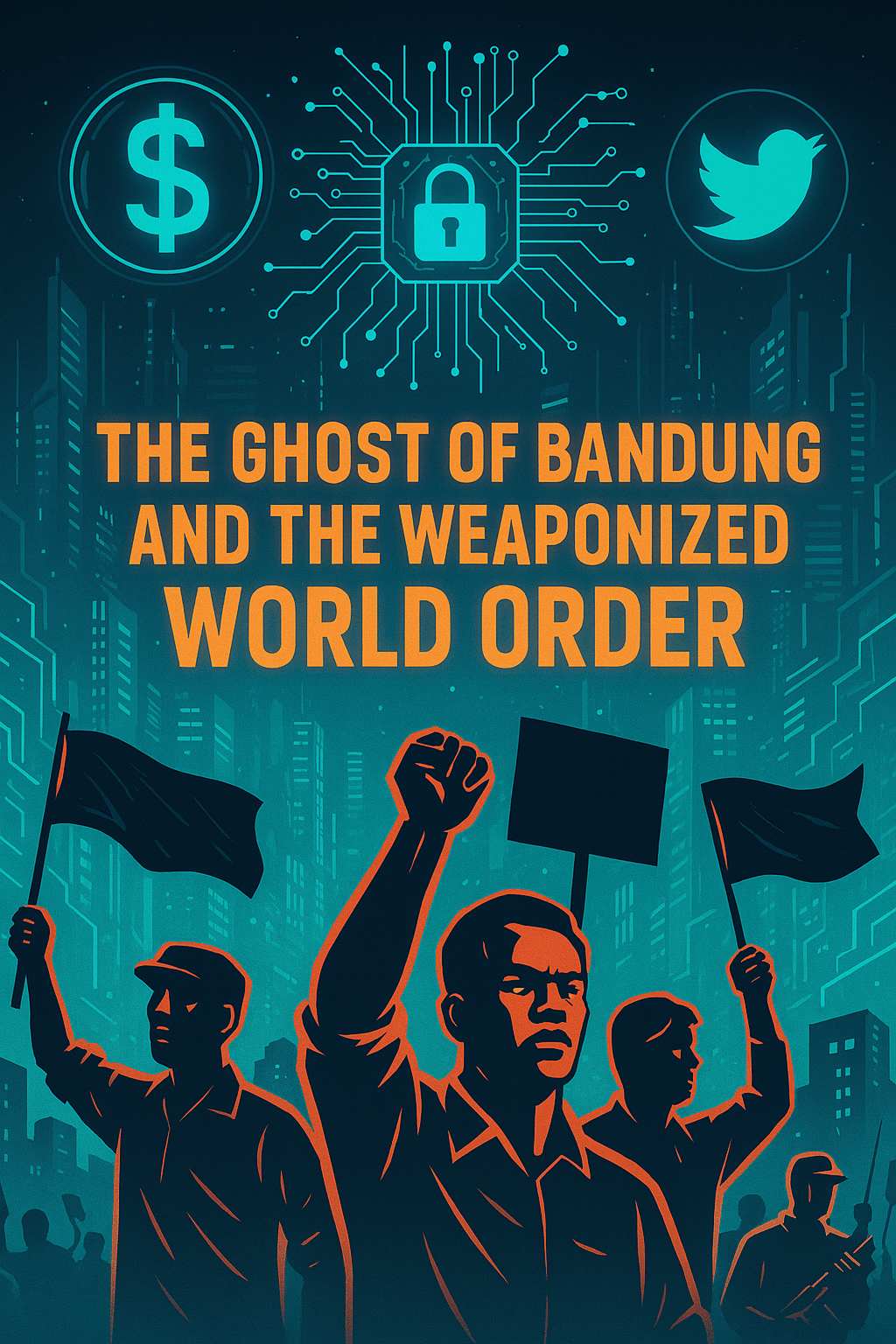
Bandung as a Weapon, Not a Memory
By “Booby” Bolden, Weaponized Information (WI) | April 2025
This essay is written as a comradely engagement with Dossier No. 87, “The Bandung Spirit”, published by the Tricontinental: Institute for Social Research in April 2025.
At Weaponized Information, we draw deeply from the work of Tricontinental, Black Agenda Report, and other revolutionary sources who maintain principled anti-imperialist, anti-colonial commitments amidst an increasingly reactionary and technofascist world order. Our goal here is not to critique but to amplify and dialectically develop the essential arguments of this vital dossier for the purposes of building revolutionary consciousness and organization in our time.
Bandung: A Signal from the Past That Haunts the Present
The Tricontinental’s Dossier No. 87 recovers and reanimates one of the most significant moments in the history of anti-colonial resistance: the 1955 Bandung Conference. It shows how the Bandung Spirit emerged from the concrete struggles of oppressed nations and sought to create a world founded on sovereignty, peace, economic cooperation, and dignity. Tricontinental rightly emphasizes that Bandung was not a utopian ideal but a material convergence of anti-imperialist state projects and mass movements that challenged the Western-dominated international order.
But it also reminds us that this Spirit was not eternal. It was violently assaulted, suffocated, and ultimately dissolved by the coordinated counterinsurgency of imperialist powers: coups, assassinations, debt traps, neocolonial economic restructuring, and a Cold War ideological offensive that weaponized everything from food to cinema to NGOs.
The Bandung era was crushed not only by guns and bombs but by the architecture of what we at WI call hyper-imperialism — the unified, increasingly militarized, financialized, and informational domination of the globe by the U.S.-led axis of empire.
The Weaponization of Memory and the Pacification of Spirit
Tricontinental’s analysis of the 2005 Asian-African Summit as a nostalgic ritual is a crucial insight. We live in an age where revolutionary history is pacified through commemoration. The Bandung Spirit has been bottled, branded, and transformed into a harmless cultural memory—depoliticized and stripped of its anti-imperialist teeth.
This is a central concern for WI. In the terrain of psychological warfare, memory itself is weaponized. The ruling class permits sanitized versions of history that celebrate past resistance while severing it from present-day struggle. Thus, the Bandung Spirit is remembered, but never reborn. Its principles are cited in neoliberal documents and UN reports but not mobilized by mass movements or anchored in state policy.
Technofascism and the New Conditions of Global Repression
Dossier 87 ends with a sober accounting of the structural limits currently preventing a new Bandung Spirit from emerging. Tricontinental identifies five major obstacles—from dependency on Western finance and media, to internalized colonial ideologies, to the fragmentation of left movements and their hesitation to seize power.
We at WI fully unite with this assessment and seek to name and elaborate the evolving form of imperialism that generates these limits. We call it technofascism.
Technofascism is the internal regime of capitalism in crisis: a fusion of digital control, financial surveillance, and militarized counterinsurgency designed to secure profit, suppress dissent, and discipline populations within the imperial core. Its external projection—hyper-imperialism—targets the Global South through drone wars, economic sanctions, algorithmic propaganda, and coup coordination via NGOs and “civil society.”
Technofascism is not a break from liberal capitalism. It is its logical conclusion: monopoly finance capital digitized, securitized, and unbound by national democratic constraints. It is why even the moderate sovereignty asserted by BRICS or Belt and Road becomes intolerable to the U.S. and its allies.
This is why a Bandung 2.0 must not only coordinate development—it must confront and defeat technofascism as a global class project.
Bandung from Below: Reclaiming the Mass Base
The original Bandung moment was only made possible because anti-colonial governments were pressured, led, or even overthrown by mass movements—peasants, workers, students, women, and cultural workers who made national liberation a living force.
Today, as Tricontinental observes, that mass base is fragmented, disorganized, and often demobilized. Progressive governments often emerge not from revolutionary movements but from center-left coalitions disillusioned with neoliberal collapse. This weakens their ability to confront the imperialist system decisively.
Without a Bandung from below, we risk reproducing a managerial Global South capitalism that trades Western dependency for elite multilateralism.
We need to re-politicize Bandung: not as a symbol of past glory, but as a blueprint for future struggle.
Bandung as a Weapon, Not a Memory
What if we treated Bandung not as an event to commemorate, but a weapon to wield? What if the principles of the 1955 Ten-Point Declaration were sharpened into a global revolutionary platform?
What if BRICS was pushed not only to de-dollarize trade, but to support debt cancellation, media sovereignty, and demilitarization?
What if regional blocs like ALBA, the African Union, or the Shanghai Cooperation Organisation were held accountable to the Bandung principle of non-intervention?
What if Global South movements launched an international campaign to dismantle the U.S. military archipelago of 800+ bases?
This is the spirit we must revive. Not merely to remember, but to organize. Not just to reflect, but to fight.
Conclusion: Towards a Bandung of the 21st Century
We thank Tricontinental for this dossier. It is not just a historical summary but a strategic intervention. It reminds us that history is not past. The struggle is not over. The Spirit is not dead.
But if the Bandung Spirit is to live again, it must be forged in the heat of mass struggle. It must be disciplined by revolutionary organization. It must be animated by the colonized proletariat, the lumpen masses, the peasant classes, and those in the imperial core who choose defection over collaboration.
Weaponized Information is committed to that task. We stand with the Global South, not out of charity or guilt, but because our liberation is bound together. In the face of technofascism and hyper-imperialism, the Bandung Spirit must become a weapon once again.
Let the dead bury the dead. The living have a world to win.
 Weaponized Information
Leave a comment