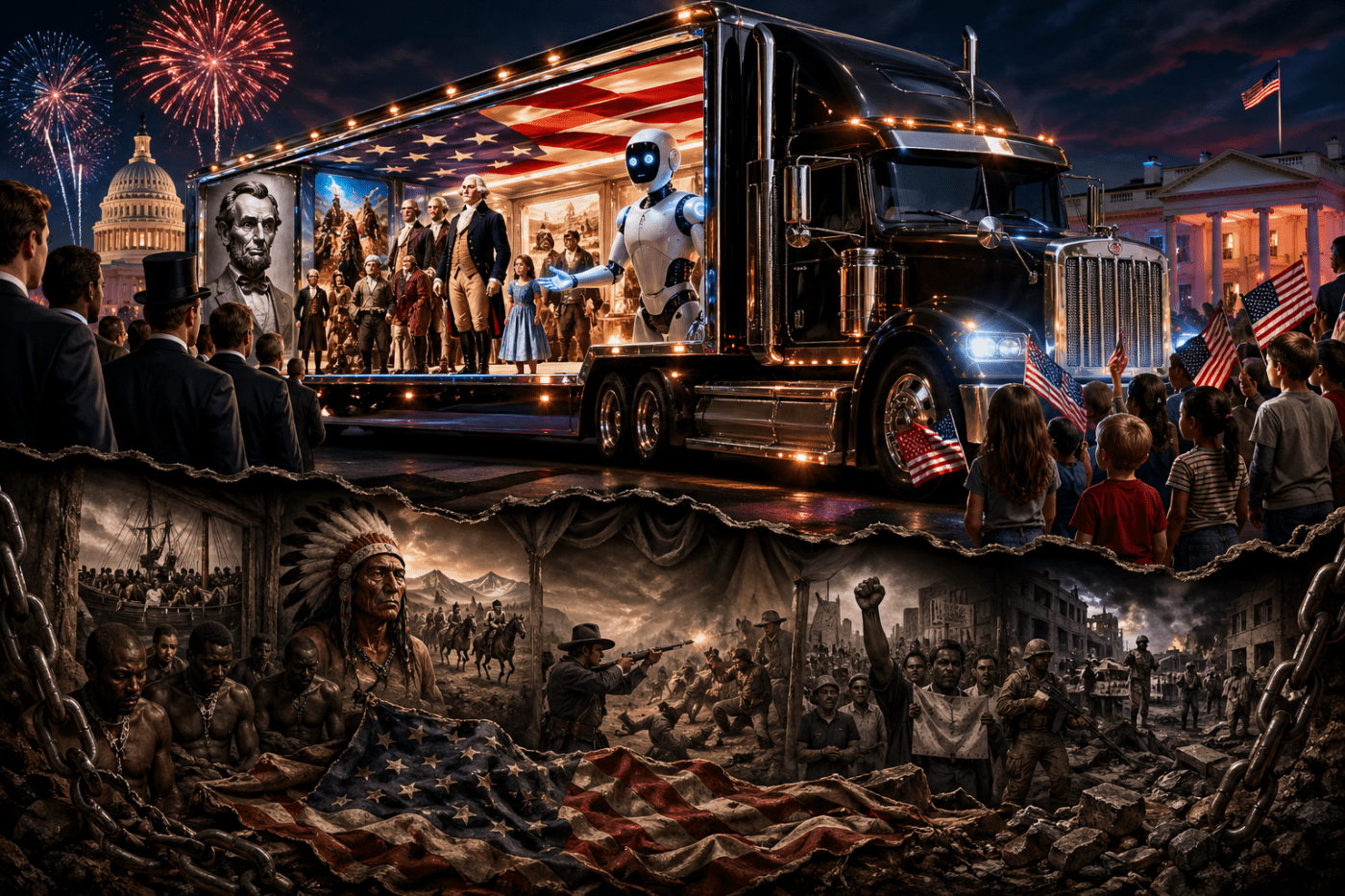
The Guardian exposes a traveling spectacle where AI founders, corporate money, and state power fuse into a mobile myth machine celebrating a sanitized America. Behind the patriotic theater lies a coordinated apparatus—federal funding, private donors, and ideological institutions—shaping what history is told and what is buried. This is a deeper struggle over power, where a system in crisis rewrites its origins to mask the contradiction between its ideals and its material reality. Against this machinery, educators, organizers, and communities are building a counter-history rooted in truth, struggle, and the lived experience of the oppressed.
By Prince Kapone | Weaponized Information
April 29, 2026
The Museum on Wheels Where Empire Teaches Children to Forget
Ed Pilkington’s “‘Freedom Trucks’: a tour of Trump’s skewed tribute to American history – on 18 wheels”, published in The Guardian on April 29, 2026, takes the reader inside one of Donald Trump’s semiquincentennial “Freedom Trucks,” six mobile museums touring the country ahead of the United States’ 250th anniversary. The basic report is simple enough: these 18-wheel patriotic roadshows, powered by PragerU, present an interactive version of American history where AI George Washington talks to visitors, children sign facsimiles of founding documents, “American heroes” beam from museum walls, God hovers over the republic like a celestial landlord, and Trump appears at the end like the orange-tinted executor of Providence. Washington opens the show. Trump closes it. There, in miniature, is the entire ideological operation: the founding myth is not being remembered; it is being transferred, polished, baptized, corporatized, digitized, and delivered back to the public as obedience training.
The Guardian, of course, approaches this spectacle from the standpoint of liberal alarm. It sees the danger clearly enough: Trump’s personality cult, Christian nationalism, historical whitewashing, public-private donor murk, PragerU’s youth-targeted propaganda machine, and the cheerful conversion of national memory into a rolling recruitment booth for reaction. As a liberal Western outlet, however, The Guardian remains most comfortable treating the matter as a distortion of American democracy rather than an exposure of American democracy’s original contradiction. It is disturbed by Trump’s rewriting of history, but less able to say that the official history of the United States has always required rewriting, laundering, bleaching, and deodorizing. The house was built on stolen land and enslaved labor; Trump merely arrives with gold paint, AI animation, and a donor package.
Pilkington writes as a professional liberal journalist with a sharp eye for authoritarian theater. He notices the staging: Washington crossing the Delaware on the side of the truck, “Welcome Patriots!” scrawled outside, “In God We Trust” glowing inside, and Trump’s video sermon waiting at the exit like the gift shop of a dying empire. He also does important work by letting visitors speak. A wounded Gulf War veteran calls Trump kingly. A Black teenager feels the need to ask permission before criticizing the president inside an exhibit about freedom. A Trump supporter celebrates the possibility that Iran will be “freed,” by which she means bombed into submission by the empire’s favorite missionary department, the Pentagon. A religious mother sees Trump as divinely appointed. The article lets the contradiction walk around in cowboy boots and fairground dust.
The propaganda devices inside the Freedom Truck are not subtle. The first is narrative framing: the nation is presented as a sacred freedom project born from heroic white founders, not as a settler-colonial republic forged through slavery, Indigenous dispossession, territorial conquest, and class rule. The second is transfer: Washington’s revolutionary image is made to bless Trump’s political project, as though the old plantation republic has been waiting 250 years for a real-estate monarch to complete its destiny. The third is glittering generalities: “freedom,” “liberty,” “equality,” “God,” “patriot,” and “America” are thrown around like confetti at a ruling-class parade, emptied of material content and refilled with obedience. The fourth is omission: slavery appears as a regrettable wrinkle, Native genocide barely appears at all, and the conquest of Mexican land vanishes like a magician’s assistant in a flag-colored box. The fifth is testimonial: AI Washington, Trump, PragerU, Hillsdale, and carefully chosen “heroes” are assembled to tell children that capitalism, Christianity, and America are one holy trinity. The sixth is card stacking: the exhibit gathers the founding documents, heroic battles, patriotic paintings, and divine language while quietly sweeping the auction block, the burned village, the stolen continent, and the plantation ledger under the truck.
The Guardian’s article succeeds in showing that the Freedom Truck is less a museum than a mobile myth factory. But the deeper excavation must begin where liberal critique usually stops. This is not just Trump corrupting history. This is the U.S. ruling class in crisis, rolling its founding legend through fairgrounds and schools because the present is too ugly to explain honestly. When a nation at war, armed to the teeth, ruled by billionaires, and haunted by its crimes must teach children that it was chosen by God to embody freedom, we are not looking at history education. We are looking at counterinsurgency on wheels.
What the Truck Carries—and What It Leaves in the Dirt
The Freedom Trucks do not emerge from nowhere. They are part of a formally organized, state-backed and privately fueled commemorative apparatus tied to the U.S. semiquincentennial. The official Freedom 250 initiative describes the trucks as a fleet of mobile museums traveling nationwide, designed to bring a curated version of American history directly into communities, schools, and public spaces. These are not spontaneous patriotic displays; they are planned ideological deployments. The partnership structure is equally revealing. PragerU openly states that it powers the Freedom Trucks, positioning itself as both educational authority and cultural gatekeeper, while U.S. military channels acknowledge collaboration with institutions like Hillsdale College and federal agencies. This is not merely a museum—it is a coordinated node linking state, corporate, ideological, and military-adjacent structures.
The financial architecture underneath the spectacle further exposes its material base. The Institute of Museum and Library Services confirms that $14 million in federal funding supported the Freedom Trucks, demonstrating that public resources are being funneled into this ideological project. At the same time, the private side of the operation remains deliberately opaque. U.S. senators have launched an investigation into Freedom 250 over reports that wealthy donors were offered privileged access to the president and anniversary events. The structure is clear: public money builds the stage, private capital buys proximity to power, and ideology is packaged as national heritage.
This project also exists in direct tension with the officially sanctioned, bipartisan commemorative framework. The U.S. Semiquincentennial Commission, established by Congress, is tasked with coordinating the nation’s 250th anniversary, yet Trump’s Freedom 250 initiative operates alongside—and effectively on top of—it. What appears as duplication is in fact displacement: a parallel apparatus reshaping the narrative terrain of national memory in real time. This is reinforced at the executive level. Trump’s executive order “Restoring Truth and Sanity to American History” explicitly directs federal institutions to purge what it calls “divisive” or “anti-American” interpretations. The Freedom Trucks are not isolated; they are the mobile extension of a broader state campaign to discipline historical consciousness.
The ideological content of that campaign is not neutral. It is embedded in an existing educational pipeline aimed particularly at youth. PragerU confirms that its materials are approved for use in multiple U.S. states, meaning the narratives presented in the Freedom Trucks do not end at the fairground—they circulate through classrooms, lesson plans, and digital platforms. The intellectual lineage of this effort is equally traceable. Hillsdale College’s leadership role in Trump’s 1776 Commission ties the trucks directly to earlier attempts to construct a “patriotic education” counter to the 1619 Project. What we are witnessing is not improvisation but continuity: a long-term effort to recode American history at the level of mass consciousness.
To understand what is being omitted, one must reconstruct the historical terrain that the Freedom Trucks flatten into myth. The founding narrative presented inside the trucks invokes liberty while muting the material conditions of its emergence. Yet Thomas Jefferson’s original draft of the Declaration of Independence condemned the slave trade, a passage later removed from the final document, revealing that the so-called universal principles of freedom were negotiated alongside the preservation of slavery. The contradiction becomes concrete when one examines the lives of the founders themselves. Jefferson alone enslaved over 600 people during his lifetime, turning the language of liberty into a political cover for plantation accumulation.
The same pattern extends to the question of land. The Freedom Truck invokes expansion as destiny while erasing the violence that made it possible. The Northwest Ordinance promised that Indigenous lands would not be taken without consent, yet that promise was systematically violated as the United States expanded westward. This contradiction deepens when we examine territorial conquest beyond the original colonies. The Treaty of Guadalupe Hidalgo forced Mexico to cede over half its territory to the United States, embedding conquest into the geographic foundation of the modern nation. The absence of this history is not accidental—it is necessary for the maintenance of the myth.
Even where violence is acknowledged, its scale and meaning are minimized. The narrative of westward expansion often presents Indigenous displacement as incidental or tragic but inevitable. Yet educational material from the National Museum of the American Indian explicitly raises whether U.S. actions against Native peoples meet the definition of genocide. This is not marginal scholarship—it is institutional acknowledgment of a foundational crime. Its exclusion from the Freedom Trucks is therefore not an oversight but a deliberate act of historical management.
When placed together, these facts reconstruct the terrain that the Freedom Trucks seek to obscure. Public funding, private capital, executive directives, ideological institutions, and educational pipelines converge to produce a traveling narrative in which freedom is abstract, violence is minimized, and the structural foundations of the United States are rendered invisible. The exhibit’s omissions are not gaps in knowledge; they are the conditions that make the story function. Without them, the myth collapses under the weight of its own history.
When Power Can’t Defend the Present, It Rewrites the Past
Step back from the truck itself and the pattern becomes unmistakable. This is not just a strange political project or a flashy piece of Trump-era propaganda. It is something older and more familiar: a ruling class trying to hold onto its authority by reshaping how people understand the world. When a system can no longer justify itself through lived reality—through people’s actual experiences of work, war, inequality, and repression—it turns to history. It reaches backward, cleans things up, cuts things out, and tells a story that makes the present seem natural, inevitable, even righteous.
The Freedom Truck is one piece of that effort. It takes a past already smoothed over and sands it down even further. The contradictions that sit at the heart of American history—freedom alongside slavery, democracy alongside dispossession, equality alongside conquest—are not debated or explored. They are pushed aside. In their place comes a simple, clean narrative: a nation born in virtue, guided by God, carried forward by heroic men, and now waiting to be restored to greatness. It is a story designed not to explain, but to reassure.
But that reassurance is doing heavy political work. Because once those buried facts come back into view—once people begin to see that the wealth of this country was built on stolen land and forced labor, that its expansion meant the destruction of entire nations, that its promises of equality were always limited and contested—the whole picture changes. The United States stops looking like a beacon and starts looking like a battlefield. History stops being a source of pride alone and becomes a record of struggle: between classes, between races, between those who hold power and those forced to fight for it.
This is why the omissions matter so much. They are not accidental gaps or innocent simplifications. They are necessary to keep the story intact. If you tell the full truth, the story no longer holds together. If you show Jefferson as both author of liberty and owner of hundreds of enslaved people, if you show westward expansion as both opportunity and conquest, if you show independence as both rebellion and the beginning of a new system of domination, then the clean narrative breaks apart. And once it breaks, people start asking different questions—about power, about ownership, about who benefits and who pays.
Trump’s role in all this is not to invent the myth, but to push it harder, more openly, and with fewer restraints. Where earlier versions of the story tried to balance pride with a limited acknowledgment of injustice, this version drops the balancing act. It insists on celebration. It treats criticism as betrayal. It wraps the nation in religious language so that its history feels sacred rather than political. And it delivers that message not just through speeches or textbooks, but through a coordinated effort that includes schools, media, public events, and now these traveling exhibits.
What makes this moment different is the intensity. The push to control how history is taught, what books are allowed, what institutions can say, and what children are encouraged to believe is happening at the same time that the country faces deep contradictions—wars abroad, widening inequality, political division, and a growing sense among many that the system is not working for them. The more those contradictions sharpen, the more pressure there is to manage how people interpret them.
And that is what the Freedom Truck is ultimately about. It is not just telling people where the country came from. It is telling them how to think about where the country is now. It says: trust the story, not your experience. Trust the founders, not the evidence. Trust the nation, not your doubts. It offers a ready-made answer to questions people are increasingly asking.
But there is a limit to how far that can go. Because people do not live inside exhibits. They live in a reality shaped by wages, by debt, by policing, by war, by opportunity denied and struggle endured. When the story they are told drifts too far from what they see and feel, the gap becomes impossible to ignore. And it is in that gap—between the myth and the lived reality—that new understanding begins to take shape.
The Freedom Truck tries to close that gap. It tries to smooth it over with spectacle, technology, and patriotic language. But in doing so, it reveals just how wide the gap has become.
From Rolling Myth to Organized Memory: Building the Counter-History Front
The Freedom Truck does not arrive alone. It arrives with money, with state backing, with corporate sponsorship, with a curriculum pipeline, with executive orders, and with a clear objective: to shape consciousness before it can resist. That means any serious response cannot be rhetorical. It must be organized, material, and rooted in institutions that already exist on the ground, already doing the work of breaking the spell. The task is not to invent resistance out of thin air. It is to link up with the forces already fighting to teach the truth of this system—its origins, its violence, and its present contradictions—and to scale that struggle wherever the ideological machine rolls in.
One of the clearest fronts in this struggle is the Zinn Education Project, which organizes national campaigns to bring people’s history into classrooms and communities. Its work is not abstract; it produces concrete teaching materials rooted in slavery, Indigenous resistance, labor struggle, and anti-imperialism. Crucially, it operates through educator networks rather than state directives. Its organizational structure is supported through independent nonprofit funding streams documented in its fiscal sponsorship and project disclosures via its partnership with social justice–oriented fiscal sponsors, demonstrating a degree of autonomy from direct state ideological control. This is a base that can be mobilized, not just admired.
Alongside curriculum production stands educator defense. The Freedom to Learn campaign, supported through the National Education Association’s organizing infrastructure, provides a platform for resisting censorship, book bans, and state repression of historical truth. While operating within a union framework, its financial transparency is publicly documented through NEA’s nonprofit filings and funding disclosures, allowing us to evaluate its position within the broader terrain. This layer matters because teachers are often the first line of contact between state ideology and youth—and therefore the first line of resistance.
Beyond institutions tied to formal education, movement-based political education plays a decisive role. The People’s Institute for Survival and Beyond conducts nationwide “Undoing Racism” workshops rooted in structural and historical analysis, reaching organizers, educators, and community leaders. Its long-term independence and operational model are reflected in its nonprofit financial filings and funding disclosures, which allow verification of its material base. This is not curriculum in the narrow sense; it is consciousness-building tied directly to struggle.
At the level of intellectual infrastructure, Rethinking Schools has spent decades producing radical educational material critiquing empire, racism, and capitalism. Its independence is reinforced through public nonprofit records detailing its funding structure, making it a durable node in the ecosystem of counter-hegemonic education. This is where teachers, activists, and students find the tools to dismantle official narratives and replace them with grounded analysis.
What does this mean in practice? First, wherever the Freedom Trucks appear, they must be met—not with outrage alone, but with organized counter-presence. Teach-ins, pamphlets, community lectures, and alternative exhibits must be deployed in the same spaces: fairs, schools, libraries, and community centers. The goal is not to chase the truck but to fracture its monopoly on narrative. Second, educators must be organized and defended. The struggle over curriculum is not symbolic; it is a battle over what future generations will understand about power, exploitation, and resistance. Third, political education must extend beyond classrooms. Community-based workshops, reading groups, and movement schools must be built and expanded, creating spaces where historical truth is linked to present struggle.
Finally, solidarity must be explicit. The fight against historical falsification in the United States is inseparable from the global struggle against imperialism. The same system that erases Indigenous genocide at home wages war abroad, imposes sanctions, and disciplines nations that refuse to submit. To teach the real history of the United States is therefore not an academic exercise—it is an act of alignment with the oppressed, both within and beyond its borders. The Freedom Truck seeks to produce loyal subjects. The counter-movement must produce conscious actors.
The road is already contested. The infrastructure of resistance already exists. The task now is to connect it, strengthen it, and deploy it wherever the machinery of myth attempts to roll through unchallenged.


Leave a Reply