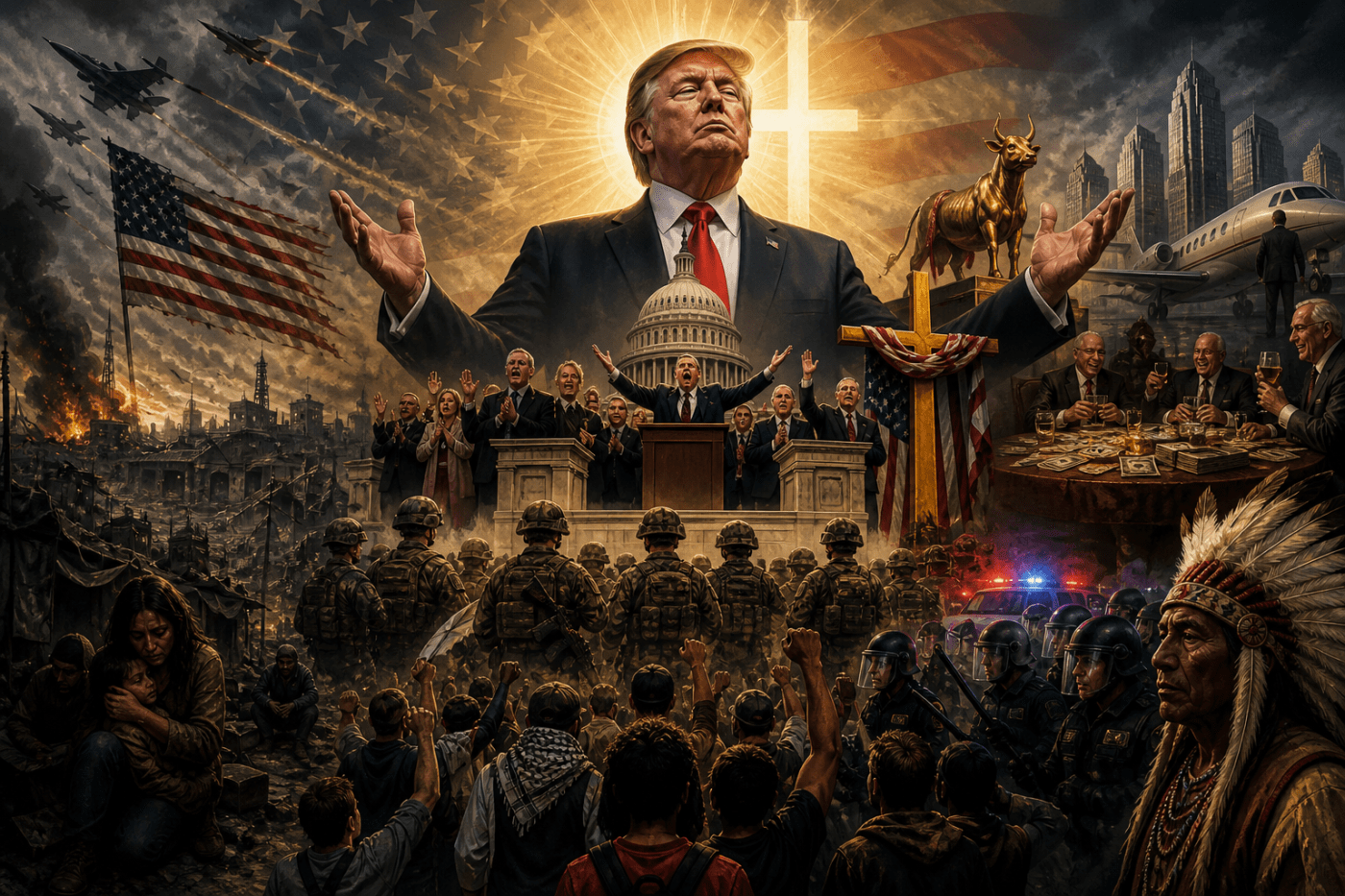
USA TODAY’s coverage of Trump’s Rededicate 250 spectacle accidentally exposes something much bigger than a controversy over religion: a decaying empire trying to glue itself back together with crosses, flags, patriotic mythology, and holy-sounding bullshit about “national unity.” Beneath the language of prayer and renewal sits a growing alliance between executive power, Christian nationalism, militarized patriotism, historical revisionism, and ruling-class panic as the old myths holding American society together begin to crack apart in public view. As inequality deepens, institutions rot, wars drag on, and millions of ordinary people lose faith in both the political system and the future itself, the ruling bloc increasingly reaches for God, nation, and sacred identity to manufacture emotional cohesion where material legitimacy no longer exists. Against this reactionary consolidation, anti-imperialist, working-class, secular, and liberation-oriented movements are struggling to defend historical truth, political consciousness, and the collective memory of the people from the sacred theater of a dying empire trying to pray away its own contradictions.
By Prince Kapone | Weaponized Information | May 5, 2026
The Gospel According to Empire
In a May 5, 2026 USA TODAY article, reporter Karissa Waddick examines Trump’s upcoming “Rededicate 250” prayer rally on the National Mall, a massive patriotic-religious spectacle being organized through the Freedom 250 apparatus ahead of the United States’ 250th anniversary celebrations. The article’s basic revelation is simple enough: despite all the soft language about unity, diversity, and bringing Americans together, the event is overwhelmingly Christian in composition, featuring fourteen Christian religious leaders and only a single non-Christian representative. Liberal clergy and advocacy groups quoted in the piece criticize the imbalance and argue that the gathering fails to reflect the actual religious diversity of the United States. And in the careful, professional, house-trained language of respectable corporate journalism, the article quietly signals that something politically unsettling is beginning to take shape around a state-adjacent national celebration increasingly wrapped in Christian symbolism and nationalist mythology.
But even while criticizing the event, the article never really escapes the ideological prison cell of the system it belongs to. USA TODAY is not some neutral neighborhood newsletter put together by workers around a folding table after shift change. It is a corporate media institution owned by one of the largest newspaper conglomerates in the United States, part of the same capitalist media machine that spent decades gutting local journalism while concentrating more and more narrative power into fewer and fewer hands. Like most corporate media outlets, its job is not to uncover dangerous truths but to manage them safely — to turn deep structural contradictions into consumable little dramas that can circulate through the spectacle without threatening the spectacle itself. So the article approaches the event mainly as a problem of optics and representation. Diversity becomes the issue. Inclusion becomes the issue. The deeper machinery underneath all this holy language — the old marriage between empire, conquest, whiteness, Christianity, and state power — mostly remains sitting in the dark offstage where corporate journalism prefers to keep it.
And that narrowing of the frame happens through a bunch of familiar propaganda habits so common in bourgeois media that people barely notice them anymore. The first is narrative framing itself. The entire issue gets reduced to whether enough faith groups received invitations to the empire’s prayer circle. The second is omission. Readers are told that critics accuse Trump and Freedom 250 of promoting Christian nationalism, but almost no effort is made to seriously excavate the historical relationship between Christianity, settler colonialism, slavery, anti-communism, militarism, and American empire itself. Christian nationalism gets treated like some unfortunate ideological infection creeping in from the margins rather than one of the oldest operating systems inside the American project.
The article also leans heavily on source hierarchy. Legitimacy flows downward from institutional voices: nonprofit executives, clergy, historians, commissions, advocacy professionals, and officially respectable critics. But the people who actually live beneath the boot of American nationalism — the colonized, the poor, prisoners, migrants, workers sacrificed in wars and economic restructuring, entire populations buried beneath the rubble of “American greatness” — barely exist inside the narrative at all. America remains the central character in its own story. The debate revolves around what kind of America this should be, not what America materially is or what it has done across the world. Even the criticism operates inside the assumption that the United States is fundamentally a democratic experiment drifting away from its ideals, rather than a violent empire trying to spiritually stabilize itself during a period of visible decay and internal fracture.
Then comes concision — one of the oldest tricks in corporate journalism. Huge structures of power, ideology, mythmaking, nationalism, and social crisis get compressed into the safe little language of “controversy” and “backlash.” The house is on fire, but the media conversation must revolve around whether the curtains match the furniture. Instead of examining how religion is being mobilized to reinforce state legitimacy during a period of instability, the article reduces everything to a dispute over representation and inclusion. Structural crisis gets transformed into cultural disagreement. Political economy gets transformed into aesthetics. Empire gets transformed into vibes.
Maybe the most revealing thing about the article is its tone. There is concern. There is criticism. There is mild alarm. But nowhere does the piece seriously entertain the possibility that the event is functioning exactly as intended. The language of “One Nation Under God” gets treated like a rhetorical controversy rather than part of a broader political project. But ruling classes do not suddenly start hugging the cross tighter during periods of confidence and stability. They reach for sacred language when earthly legitimacy begins slipping through their fingers. When inequality explodes, institutions rot, wars drag on forever, social trust collapses, and millions stop believing the future has anything decent waiting for them, power starts wrapping itself in mythology. Flags become holy. Armies become righteous. History becomes scripture. Politicians start sounding less like administrators and more like preachers trying to hold together a frightened congregation while the roof caves in overhead.
And that is where the contradiction quietly reveals itself beneath the polished language of the article. USA TODAY recognizes that something exclusionary is emerging, but it hesitates to ask why this exclusion is becoming politically useful in the first place. It sees the cross draped over the flag but stops short of asking why empire increasingly needs both. That silence is not accidental. Corporate journalism can usually describe the symptoms of ideological transformation far more comfortably than it can describe the conditions producing it. To do that honestly would require confronting the material crisis underneath the spectacle itself: a declining imperial order trying to manufacture emotional cohesion through patriotic ritual, religious symbolism, historical revisionism, and moral panic because the old promises holding the system together no longer work worth a damn. The article can describe the theater. But it still refuses to name the stage.
Under God and Under Management
Once you strip away the soft-focus patriotic branding and all the syrupy language about “unity,” “faith,” and “national renewal,” the machinery underneath Rededicate 250 starts looking a whole lot less like a harmless prayer gathering and a whole lot more like a coordinated ideological operation. The official Freedom 250 event page openly frames the gathering as a national “rededication” ceremony centered around Scripture, Christian worship, and reaffirming the United States as “One Nation Under God.” Meanwhile, the accompanying White House America Prays initiative ties the whole thing directly into the federal government’s broader America 250 programming. In other words, this is not just some church rally happening near the state. The state itself is helping construct and bless a specifically Christian nationalist vision of American identity.
And the imbalance identified by USA TODAY is not some accidental oversight caused by bad event planning. It reflects the actual political and ideological composition of the project itself. The participant list is packed with evangelical and conservative Christian leadership while Muslims, Hindus, Buddhists, Sikhs, Indigenous spiritual traditions, secular communities, and the rapidly growing religiously unaffiliated population are either tokenized or completely absent from the public-facing structure of the event. This becomes even more glaring when placed beside the findings of the Pew Research Center’s 2025 Religious Landscape Study, which shows a United States that is becoming more religiously diverse and more secular at the same damn time. Christianity may still be numerically dominant, but it no longer remotely monopolizes the spiritual terrain the way patriotic mythology pretends it does. Nearly a third of the country now identifies as religiously unaffiliated, while millions more belong to non-Christian traditions. Yet the symbolic nation being staged through Rededicate 250 looks less like the actual United States and more like a fantasy version of America dreamed up inside a Christian nationalist think tank.
The historical contradiction cuts even deeper once you place this spectacle against the country’s own legal and diplomatic record. The 1797 Treaty of Tripoli, unanimously ratified by the U.S. Senate and signed into law by President John Adams, explicitly declared that “the Government of the United States of America is not, in any sense, founded on the Christian religion.” Not “sort of.” Not “mostly.” Not “spiritually inspired.” The treaty says exactly what it says. And it said it because the early American state was trying to reassure a Muslim-majority government in North Africa that the United States was not officially a Christian power engaged in religious conflict. So one of the clearest formal declarations produced by the founding government itself directly collides with the mythology now being pumped through Freedom 250 and the wider Christian nationalist ecosystem. The issue here is not simply symbolic overrepresentation. It is the active reconstruction of national memory in real time.
And this broader political infrastructure surrounding the event makes its function even clearer. Earlier this year, Trump signed an executive order establishing a federal task force on “anti-Christian bias”, formally embedding Christianity into executive governance as a specially protected political and cultural category. Shortly afterward, the administration announced the creation of a White House Faith Office tasked with coordinating religious outreach and faith-based institutions across federal operations. None of this exists separately from Rededicate 250. These developments are all moving in the same direction: tighter fusion between nationalism, executive power, conservative Christianity, and state legitimacy.
And it doesn’t stop at civilian spectacle. Under Defense Secretary Pete Hegseth, the Pentagon itself has increasingly embraced overt Christian messaging and ritualized worship practices inside military spaces. Official Defense Visual Information Distribution Service footage now openly showcases monthly Christian worship services tied directly to Pentagon leadership. That matters politically because empires start hugging the cross a whole lot tighter when people stop believing the flag alone. Throughout history, ruling classes have repeatedly turned toward religion during periods of instability, militarization, and social fragmentation because sacred symbolism helps reinforce obedience, sacrifice, nationalism, and emotional cohesion. The cross and the flag start appearing together more aggressively when empire feels nervous, not when it feels secure.
The money and institutional infrastructure behind Freedom 250 also tells its own story. Investigations and public reporting surrounding the initiative have raised growing questions about the use of taxpayer resources tied to anniversary-related programming and projects connected to Freedom 250 activities. Public-interest watchdog organization Public Employees for Environmental Responsibility has demanded transparency regarding federal funding allocations connected to the initiative. Meanwhile, Freedom 250 has openly partnered with ideological institutions like PragerU, Hillsdale College, the Museum of the Bible, National Religious Broadcasters, and other conservative propaganda mills tasked with shaping educational and commemorative programming around the 250th anniversary. So what starts getting constructed here is not some neutral civic celebration. It starts looking more like a coordinated campaign to spiritually rehabilitate the mythology of the American empire during a period when more and more people are beginning to see through it.
The educational dimension of this whole operation is especially important because battles over history are always battles over power. Freedom 250’s “history truck” initiative, developed alongside PragerU and similar institutions, literally transports curated patriotic mythology around the country under the banner of civic education. Earlier Weaponized Information analysis documented how these projects sanitize slavery, Indigenous genocide, labor repression, imperial war, anti-communism, and colonial expansion beneath the warm language of “American greatness.” This shit is not harmless nostalgia. It is ideological conditioning. The struggle here is over who gets to narrate the country’s past, which crimes disappear beneath patriotic ceremony, and which populations become heroic symbols while others are buried beneath the rubble of official memory.
Even the liberal criticism coming from organizations like the Interfaith Alliance remains trapped, at least partially, inside the ideological assumptions of American pluralism. The lawsuit challenging Trump’s Religious Liberty Commission correctly identifies the sectarian and exclusionary character of the administration’s religious infrastructure. But the deeper issue is not simply that the table lacks enough seats. The issue is what political purpose the table itself increasingly serves. During periods of instability, economic insecurity, institutional collapse, and imperial decline, ruling elites often intensify efforts to manufacture emotional cohesion through nationalism, civil religion, patriotic ritual, and mythic identity. What looks on the surface like a fight over religious inclusion is simultaneously a struggle over historical memory, political legitimacy, and the ideological management of social crisis itself.
When Empires Begin to Pray
The real significance of the Rededicate 250 spectacle is not simply that too many Christian pastors are standing onstage in Washington. And it is not just the hypocrisy of preaching “national unity” while excluding huge sections of the country’s actual religious population. Those contradictions matter, but they are surface-level expressions of something deeper moving underneath the ceremony itself. What really matters is the political work this whole spectacle is performing during a moment of visible instability inside the American empire. Countries do not suddenly become obsessed with sacred identity when everything is going well. Ruling classes start wrapping themselves in God, nation, and holy mythology when people begin losing faith in the earthly system standing right in front of them.
History is full of this pattern. Empires in decline often become louder, more moralistic, more nationalistic, and more spiritually theatrical. The symbols change from place to place. The flags look different. The prayers sound different. But the underlying function stays remarkably similar. When institutions lose legitimacy, inequality explodes, corruption spreads, social trust collapses, and ordinary people start feeling abandoned by the future itself, power begins reaching for myth. The language of management no longer inspires anybody, so the ruling order starts speaking the language of destiny instead. Politicians become prophets. Wars become sacred missions. Flags become holy objects. The nation stops presenting itself merely as a political structure and starts presenting itself as a civilization chosen by history itself.
That is exactly why the imagery surrounding Rededicate 250 feels so revealing. The cross draped over the flag. The language of rebirth and redemption. The endless talk about “One Nation Under God.” The emotional calls for spiritual renewal. None of this is random branding cooked up by some overeager PR consultant making six figures to weaponize nostalgia. This is an attempt to emotionally stabilize a fractured social order by transforming nationalism into something sacred and emotionally binding. The goal is not just prayer. Hell, the ruling class could not care less whether ordinary people become morally enlightened. The goal is to fuse patriotism, religion, and political authority into a single emotional narrative capable of holding together a society increasingly drowning in alienation, precarity, distrust, loneliness, debt, exhaustion, and social fragmentation.
And look at the historical moment this is happening in. The United States approaches its 250th anniversary not as a confident empire standing at the height of stability, but as a deeply unstable society visibly cracking under the weight of its own contradictions. Endless wars drag on without victory. Economic inequality reaches obscene levels. Billionaires fly around in private jets lecturing workers about sacrifice while entire communities rot from deindustrialization, addiction, eviction, and hopelessness. Public institutions bleed legitimacy. Millions of people no longer believe the political system serves them at all. Young people inherit debt, instability, ecological collapse, and permanent insecurity instead of the future previous generations were promised. Even faith in liberal democracy itself starts wearing thin because the material conditions underneath the rhetoric keep getting worse. Under those conditions, ruling elites often try to manufacture social cohesion symbolically because they can no longer produce it materially.
And that is why reducing this conflict to a debate over “religious diversity” completely misses the deeper contradiction. Liberal criticism mostly stays trapped inside the politics of inclusion: invite more religions, add more voices, make the ceremony more representative. But even a perfectly multifaith version of this same spectacle would still be performing the ideological work of sanctifying the state. It would simply do so with more demographic variety standing under the spotlight. The deeper issue is not whether the empire includes enough people while blessing itself onstage. The deeper issue is why empire increasingly needs sacred ceremony at all.
The answer is sitting right in front of us. The old promises holding American society together are falling apart. For decades the system justified itself through promises of prosperity, upward mobility, democracy, freedom, and endless progress. But the material reality underneath those promises has been hollowed out by decades of neoliberal looting, financial parasitism, imperial war, austerity, privatization, and class warfare from above. Entire sections of the population experience abandonment while wealth concentrates upward at grotesque levels. Workers are told to be grateful for jobs that barely pay rent. Healthcare becomes a luxury. Housing becomes speculative investment fodder for billionaires. Education becomes debt servitude. People are lonelier, poorer, more anxious, and more politically alienated than they have been in generations. Under those conditions, nationalism becomes emotionally useful because it helps compensate for the system’s inability to provide actual material cohesion.
Religion becomes especially valuable to ruling elites during moments like this because it transforms political authority into moral obligation. It turns obedience into virtue. It reframes suffering as sacrifice. It converts historical mythology into sacred memory. And in the United States, Christianity has long functioned alongside conquest, slavery, anti-communism, militarism, and empire as part of the ideological glue holding the national mythology together. The language of divine destiny traveled alongside westward expansion and settler conquest. Biblical imagery helped justify domination while presenting violence as providence. During the Cold War, Christianity became fused with anti-communism to morally distinguish the “free world” from officially atheist socialism. So what we are seeing now is not some bizarre historical accident or sudden deviation from the American tradition. It is the reactivation of very old machinery under new conditions of social crisis.
And yet there is a deep irony running through all of this. The United States is becoming more secular and more religiously diverse at the exact same moment sections of the ruling bloc are trying to narrow the symbolic definition of authentic American identity. The more unstable society becomes, the harder political elites push mythology, patriotism, religious symbolism, and sacred national identity. But what emerges from this is not confidence. It is panic dressed up as certainty. The louder the state screams about unity, the more visible the fragmentation underneath becomes. The more aggressively politicians invoke God and nation, the more they reveal anxiety about the durability of the social order they are trying to preserve.
That is why the narrow corporate media framing around “religious inclusion” ultimately fails to capture what is actually happening here. Rededicate 250 is not just commemorating the nation’s past. It is trying to manage the emotional and historical conditions through which the future itself will be interpreted. Which histories become sacred? Which crimes disappear beneath patriotic ceremony? Which populations get remembered as the builders of the nation, and which are buried beneath silence? Whose suffering counts? Whose suffering becomes invisible? These are not abstract cultural questions. They are struggles over legitimacy, memory, power, and political consciousness itself.
In the end, Rededicate 250 functions less like a prayer gathering and more like a national liturgy for a ruling order trying desperately to spiritually reinforce itself during a period of visible decay. The spectacle asks ordinary people to emotionally recommit themselves to the nation at the exact moment the material foundations of social trust continue collapsing underneath them. It asks people to rediscover sacred unity while inequality deepens, militarization expands, and institutional legitimacy erodes in public view. The state reaches upward toward heaven because conditions down here on earth are becoming a hell of a lot harder to defend on their own terms.
Against Their Sacred Empire
If Rededicate 250 reveals anything clearly, it is that struggles over religion, patriotism, and national identity are never just symbolic debates floating around in the clouds above ordinary life. They are fights over political consciousness itself. Fights over who gets remembered and who gets erased. Fights over whose suffering matters and whose suffering gets buried beneath flags, hymns, fireworks, and bullshit speeches about freedom. Fights over whether working people understand themselves as human beings bound together through shared material struggle, or whether they get emotionally absorbed into the mythology of empire and taught to worship the very system grinding them into dust.
And that means the response to this growing fusion of nationalism, Christianity, militarism, and state power cannot stop at polite liberal appeals for “inclusion” inside the same collapsing imperial spectacle. The problem is not simply that the empire forgot to invite enough religions to the ceremony. The problem is the ceremony itself. The problem is the ruling order trying to spiritually rehabilitate itself while inequality explodes, wars multiply, institutions decay, and millions of ordinary people lose faith in the future. No amount of patriotic prayer circles can fix a society being hollowed out by capitalism, imperialism, and decades of organized class warfare from above.
Some organizations are already fighting different dimensions of this growing Christian nationalist infrastructure. The Freedom From Religion Foundation has directly challenged the Rededicate 250 event itself, correctly identifying the gathering as an attempt to rewrite American history through reactionary Christian mythology. Likewise, Americans United for Separation of Church and State continues organizing legal and educational campaigns against the expanding fusion of government authority and religious favoritism. These struggles matter because once states begin defining official morality through nationalist religion, dissent itself increasingly starts getting framed not simply as political disagreement, but as moral deviance and civilizational betrayal.
But the contradictions exposed by Rededicate 250 extend far beyond church-state legal disputes. This thing is connected to militarism. It is connected to historical revisionism. It is connected to racial reaction. It is connected to imperial mythology. It is connected to the emotional management of social crisis inside a declining empire. That is precisely why organizations like the Black Alliance for Peace become so politically important in this moment. BAP’s anti-imperialist organizing directly links militarization abroad with authoritarian consolidation at home, exposing how nationalism, policing, permanent war, ideological discipline, and economic exploitation reinforce one another under conditions of imperial instability. Empires do not brutalize the world externally while remaining democratic and psychologically healthy internally. The violence always comes home eventually.
Similar contradictions emerge through the work of CODEPINK, whose antiwar campaigns increasingly confront the fusion of militarism, nationalism, and reactionary political culture inside the United States itself. Corporate media loves pretending militarism only exists somewhere “over there” on foreign battlefields. But permanent war reshapes domestic society too. It reshapes education. It reshapes political culture. It reshapes religion. It reshapes masculinity. It reshapes national identity. A country organized around endless war eventually starts needing endless mythology to morally justify itself. That is why the cross, the soldier, and the flag keep appearing together more aggressively during moments of imperial decline.
The struggle also extends directly into historical memory and political education. Organizations like The People’s Forum have increasingly organized working-class political education around colonialism, labor struggle, fascism, anti-imperialism, and the weaponization of historical mythology. That work matters because projects like Freedom 250 are fundamentally battles over consciousness. A population disconnected from the realities of slavery, Indigenous genocide, labor repression, anti-communism, imperial war, and capitalist exploitation becomes much easier to manipulate through patriotic nostalgia and sacred nationalism. A people cut off from real history becomes easier to emotionally discipline.
At the same time, the response to Christian nationalism cannot collapse into liberal contempt for ordinary religious people themselves. Millions of workers, poor people, migrants, and colonized communities experience religion not as an instrument of empire but as a source of dignity, survival, community, and moral grounding inside an often brutal social order. The struggle is not against faith itself. The struggle is against the weaponization of faith by political and economic elites trying to sanctify inequality, empire, militarism, and reactionary nationalism. That distinction matters politically. Otherwise the ruling class gets to monopolize spiritual language while revolutionary movements speak only in the cold vocabulary of administration and policy papers.
That is partly why formations like the Poor People’s Campaign remain significant. Drawing from traditions of liberation theology, anti-racist struggle, labor organizing, and anti-poverty activism, the campaign attempts to redirect moral language away from nationalist spectacle and back toward the material conditions confronting the poor and working class. Because the real moral crisis in the United States is not that too few pastors are standing onstage at patriotic ceremonies. The real crisis is that the richest empire on earth cannot provide housing, healthcare, stability, dignity, or security to huge sections of its own population while spending trillions on war, militarism, surveillance, and corporate enrichment.
What ultimately emerges from all these struggles is the necessity of building independent working-class political education and counter-power capable of resisting the ideological management of crisis itself. Freedom 250 is trying to narrate the nation back into emotional coherence through patriotic mythology, sacred symbolism, and historical revisionism because the old material basis of legitimacy is breaking down in public view. The task of revolutionary and anti-imperialist movements is not merely to protest the spectacle from outside the barricades. It is to expose the contradictions the spectacle exists to conceal. That means building institutions capable of teaching real history, organizing real solidarity, defending public space from reactionary capture, and reconnecting ordinary people to one another through collective struggle rather than nationalist fantasy.
Because beneath all the flags, prayers, stages, crosses, military flyovers, and patriotic bullshit lies a ruling order trying desperately to solve a crisis of legitimacy through emotional and ideological consolidation. But no amount of sacred theater can permanently resolve the contradictions produced by exploitation, empire, war, loneliness, inequality, and social decay. The more aggressively power wraps itself in holiness, the more urgently ordinary people must learn to distinguish between genuine spiritual life and the political theater of empire dressed up in church clothes.
 Weaponized Information
Leave a comment