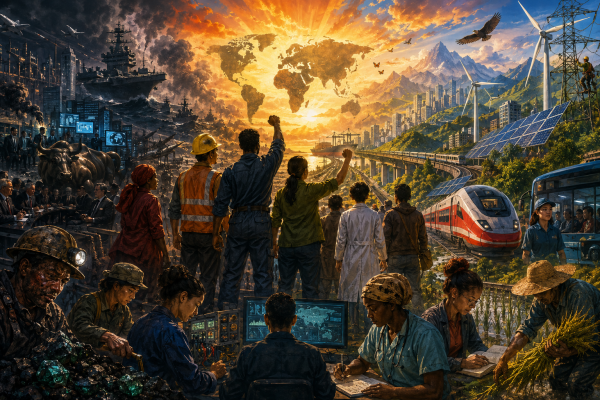
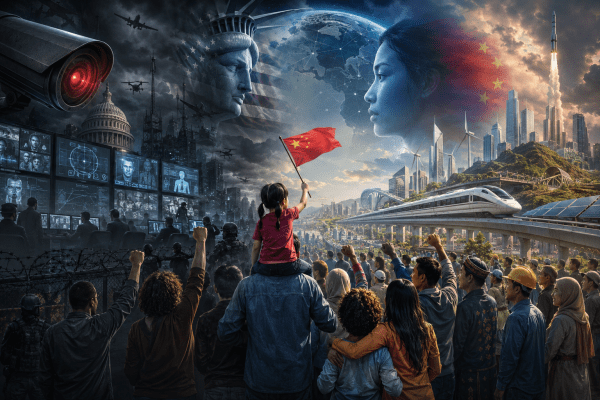
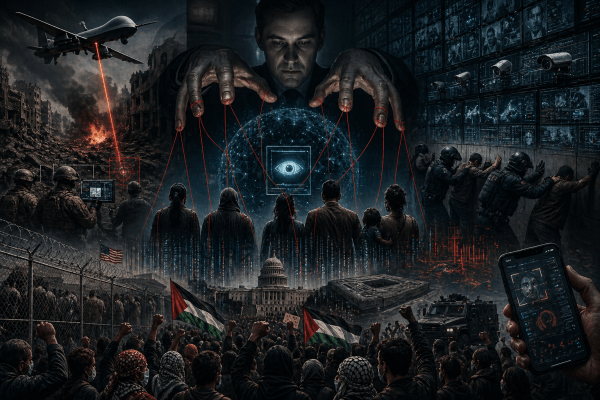
The Atlantic neoliberal order is disintegrating, revealing the ravages inflicted on workers and the environment by a relentless pursuit of profit. As BRICS+ nations seek to reclaim industrial sovereignty and labor rights, they face a chaotic multipolar reality where exploitation continues under different guises. Amid profound instability, the laboring class must transition from mere instruments of production to conscious political actors capable of reshaping development. This moment offers a critical opportunity: to reclaim the narrative and construct a world centered on human dignity and ecological balance. The question now is whether history will be rewritten by workers or remain dominated by elites.
Empire on Extension Cord: Big Tech, Cold War 2.0, and the AI Grid Crisis of American Capitalism
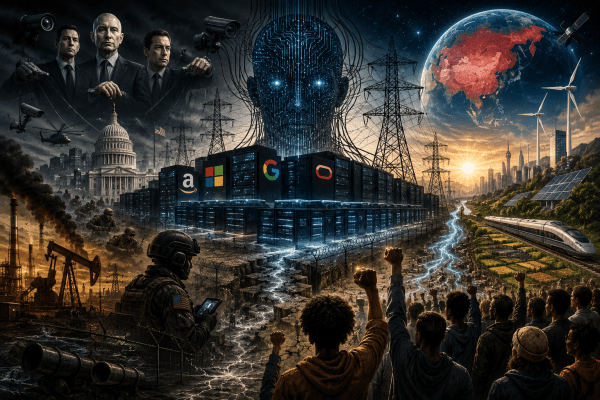
The Harvard policy brief on AI and the electric grid inadvertently exposes the contradictions of a decaying American empire desperate to maintain technological supremacy through monopolistic control. Beneath the façade of innovation lies a stark energy crisis, with the rising demand from AI data centers straining an already fragile grid. As the U.S. grapples with fragmented privatization while competing against China’s centralized planning, the notion of the “clean cloud” is shattered by its heavy reliance on fossil fuels and depleted resources. This crisis symbolizes an empire’s struggle, revealing a society entangled in a web of profiteering that prioritizes corporate gain over public need, leaving ordinary citizens to pay the price for elite ambition.
Françafrique Forward: Macron, Ruto, and the Nairobi Trap of Imperial Recalibration
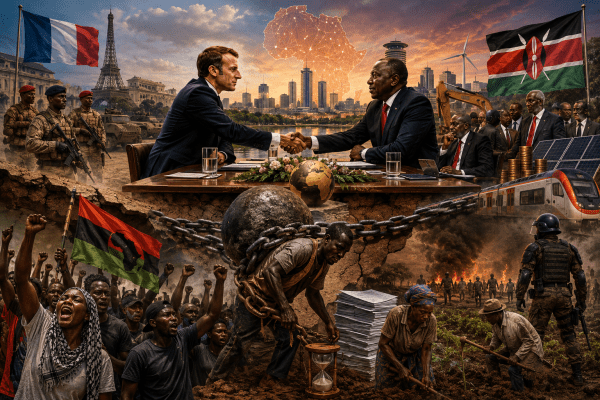
The Africa Forward Summit in Nairobi is nothing more than a polished façade for France's enduring imperial ambitions in Africa, cleverly cloaked in the language of innovation and partnership. While hailed as a diplomatic reset as it moves outside Francophone Africa for the first time, the summit simply signals France’s desperation to regain footholds after being ousted from the Sahel. As Kenya grapples with its own debt crisis, the summit reflects a deeper reality: a struggle for sovereignty masked by corporate rhetoric. Opposing forces are mobilizing against this repackaging of imperialism, unearthing the true narrative of resistance against old empires in new guises.
The Corridors of Defiance: How the War on Iran Accelerated the Multipolar Reorganization of Western Asia
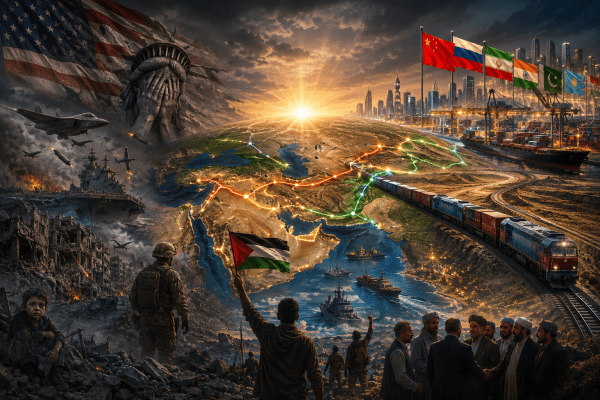
The 2026 U.S.-Israeli assault on Iran was a strategic miscalculation, intended to reassert imperial dominance in Western Asia but instead revealing the fragility of Atlantic hegemony. As the old security architecture eroded, alternative infrastructures and regional alliances emerged, facilitating trade and cooperation beyond Western control. The ongoing crises connected Gaza, Yemen, and the vital sea lanes, illustrating that military aggression has backfired, prompting regional states to recalibrate and seek resilience against imperialism. This war exposed a transformative geopolitical landscape, where logistics and diplomatic maneuvers are increasingly driven by necessity, carving out a multipolar future and undermining the sheer authority once held by the empire.
Empire’s Digital Panic: China, Xinjiang, and the War Over Who Controls the Future
The Associated Press investigation reveals a shocking truth: Silicon Valley's complicity in building the surveillance apparatus that the West now demonizes in China. While framing China as a "digital police state," the report subtly shields the very imperial system enabling such technologies. It highlights a deeper confrontation—one where the U.S. grapples with losing its monopoly on development and technology. As the New Cold War intensifies, the true danger emerges: not the surveillance itself, but the realization that a socialist-oriented state can achieve modernization and stability without Western control. The empire's fear lies in losing its grip over a future it desperately seeks to define and dominate.
The Devil’s Republic: Illuminati Panic and the Hidden Architecture of American Repression
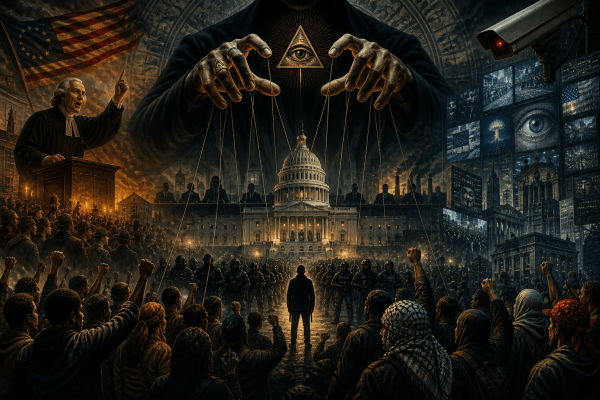
The American ruling elite has a long history of morphing political dissent into a narrative of demonic threat, consolidating their power through fear tactics akin to those seen during the Illuminati panic of the 18th century. This episode illuminated how conspiracy theories, fueled by elite anxieties, have criminalized immigrants and suppressed dissent. The manipulation of societal fears allows the state to transform opposition into an existential threat, justifying repression and surveillance. Today's conspiracism, though often dismissed as irrational, reveals a deeper urgency: a misdirected anger at real systemic injustices commodified into scapegoating narratives, obscuring the true architecture of capitalist power while paralyzing collective political action.
Empire at the Strait: Trump, Hormuz, and the Cracking Architecture of U.S. Global Domination
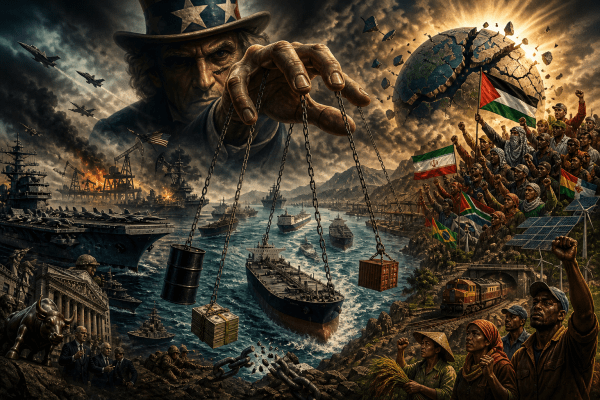
The New York Times' framing of the U.S.-Iran crisis reduces a complex imperial conflict to President Trump's tactical blunders, obscuring the underlying mechanisms of coercion, sanctions, and military dominance. Amid imperial overreach, this portrayal erases the historical context of U.S. intervention and manipulates language to soften aggression. In reality, the struggle over the Strait of Hormuz is not just about a president's strategies but exposes America's waning grip on global power, as sanctioned countries adapt and resist. As movements unite against militarized imperialism and eco-crises, the narrative reveals a world shifting away from U.S. dominance, even as empires fail to retreat gracefully.
The Colorblind Con Job: How the Supreme Court Makes Black Power Disappear
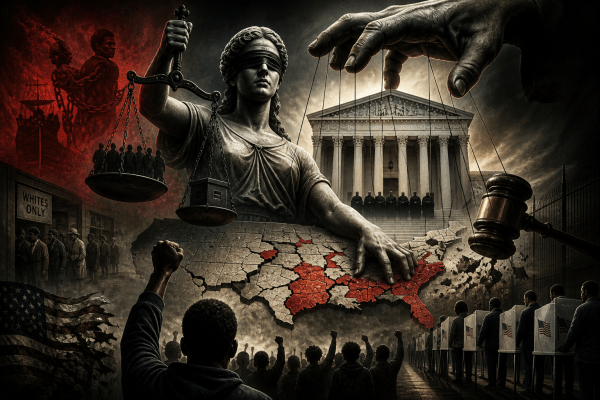
In a provocative dissection of the U.S. Supreme Court's ruling against Louisiana's majority-Black district, the article exposes a chilling truth: the very mechanisms meant to ensure voting rights are systematically undermined. NPR's portrayal of this as a mere legal setback pales in comparison to the deeper rot at the heart of American democracy, which has long grappled with the notion of Black political power. This ruling is emblematic of a historical pattern where rights are granted under duress, only to be stealthily reclaimed when they threaten the status quo. It’s not just about losing a voting bloc; it’s about the ongoing struggle for true representation in a system designed to contain it.
Palantir and the Digital Leviathan: Silicon Power, State Violence, and the Technofascist War on Humanity
Palantir's recent manifesto is more than corporate bravado; it reveals an unsettling convergence of warfare, surveillance, and governance. The media's alarmism obscures a deeper truth: Palantir stands as a linchpin in an expansive control apparatus, integrating deportation, military actions, and state surveillance into a seamless framework of power. Critics timidly label this brewing authoritarianism but fail to pinpoint the machinery at work. As anti-immigrant systems and military strategies fuse, resistance is evolving. It’s time to unite disparate struggles against this creeping technofascism, transforming scattered dissent into a powerful, coordinated force ready to dismantle the system that seeks to dominate us all.
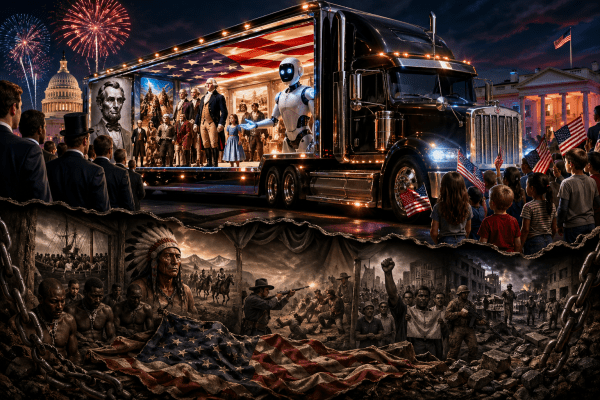
Freedom Trucks and Forgotten Crimes: Trump, PragerU, and the Rolling War Over America’s Past
The Freedom Trucks, a mobile spectacle promoted by Trump’s campaign and supported by federal and corporate funding, embody a calculated effort to sanitize American history. Behind the facade of patriotic education lies a strategic apparatus that whitewashes the nation's origins: the triumph of freedom inescapably intertwined with slavery and genocide. As kids engage with AI-enhanced exhibits glorifying historical figures, the truth becomes obscured within a mythic narrative designed for obedience, not inquiry. In response, educators and activists are building a counter-history rooted in truth, pushing back against this historical manipulation. As the ruling class desperately rewrites the past, the need for authentic resistance grows ever urgent.