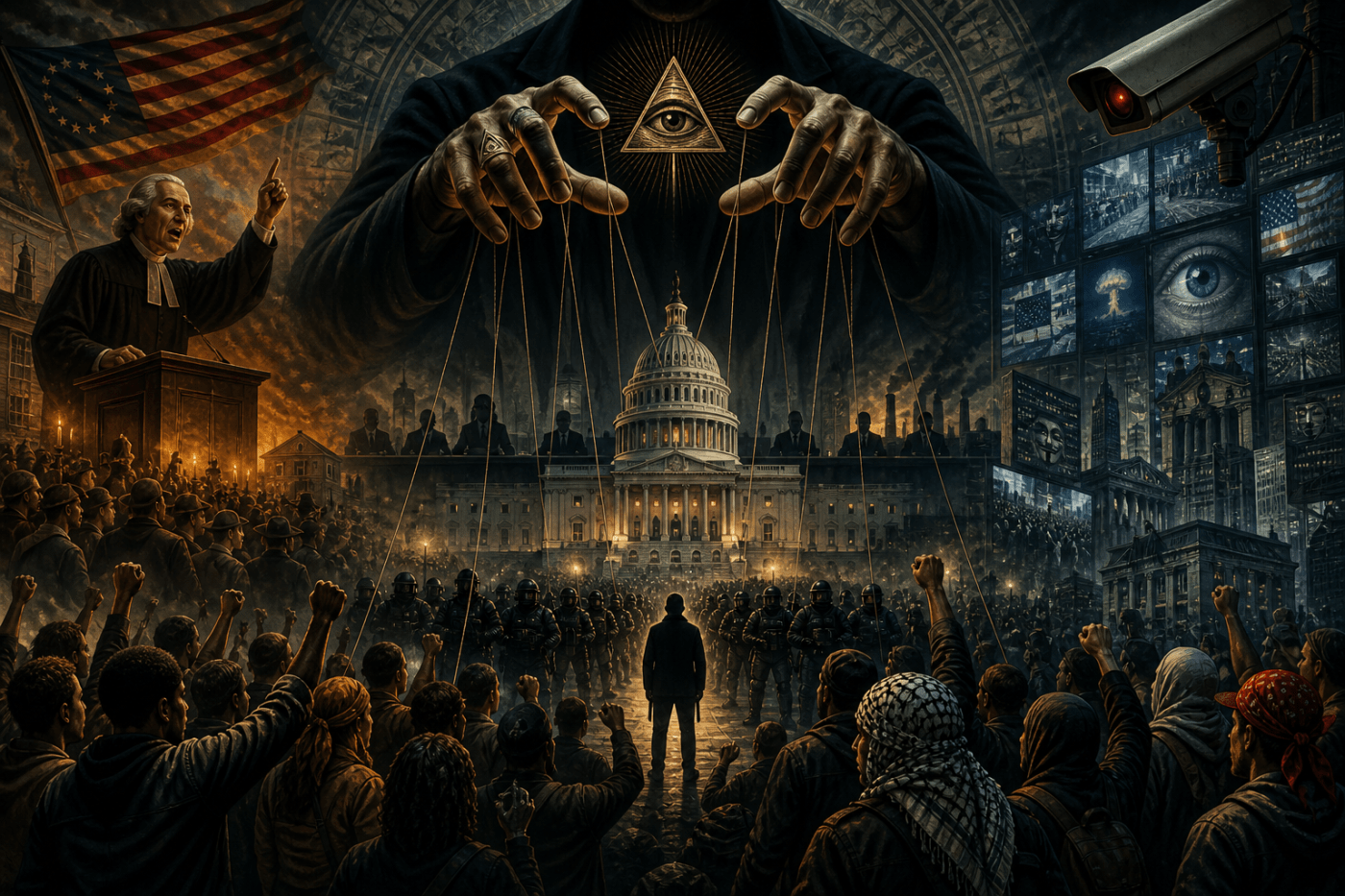
From the pulpits of the Federalist elite to the pages of modern corporate media, American ruling blocs have repeatedly transformed political dissent into demonic contamination in order to discipline society and consolidate power. Excavating the eighteenth-century Illuminati panic reveals how fear, conspiracy, religion, and moral hysteria fused with state authority to criminalize immigrants, opposition media, and democratic unrest. Reconstructing the broader historical terrain exposes the material relationship between conspiracism, class insecurity, counterinsurgency, surveillance, and the recurring manufacture of internal enemies throughout U.S. history. Reframing the panic through historical materialism ultimately reveals that the true hidden architecture behind social domination was never a mystical secret society, but the visible machinery of capitalism, empire, and organized class power itself.
By Prince Kapone | Weaponized Information | May 6, 2026
The Republic and Its Demons
In “The Illuminati in the United States”, published by History Today in December 2020, historian S. Jonathon O’Donnell revisits the late eighteenth-century American panic surrounding the Bavarian Illuminati and its alleged infiltration of the young republic. The article centers on Federalist clergy such as Timothy Dwight and Jedidiah Morse, who warned that atheistic revolutionaries and secret conspirators threatened Christianity, government, patriotism, and civilization itself. O’Donnell frames the episode as one of the earliest examples of American political demonology, linking the panic to broader traditions of conspiracy thinking, religious fear, and moral hysteria in U.S. history. The article ultimately argues that the true danger was never the Illuminati themselves, but the reactionary political culture generated by those who imagined hidden demonic enemies operating within society.
History Today occupies the political-economic terrain of liberal public history. Published by History Today Ltd., the magazine functions as a commercial intellectual outlet aimed primarily at educated middle-class readers, academics, teachers, students, and culturally engaged professionals. Its funding structure rests on subscriptions, institutional partnerships, advertising, and archival content distribution. The publication’s ideological orientation is not overtly partisan in a conventional sense, but rather characteristic of liberal historical journalism: cautious, institutionally respectable, anti-extremist, and committed to presenting historical analysis through the language of moderation, pluralism, and civic reason. This positioning shapes the article’s framing. The danger of conspiracism is treated primarily as a cultural and moral pathology rather than as a phenomenon deeply entangled with political power, institutional repression, and elite anxieties.
O’Donnell himself writes from the professional-managerial world of academia. As a scholar associated with American Studies and religious history, his framing privileges discourse, symbolism, and political culture. The article is carefully written, academically grounded, and rhetorically restrained. Yet this restraint also functions as an ideological boundary. The analysis remains largely confined to the terrain of demonology, rhetoric, and belief. The panic becomes a story about dangerous ideas circulating through sermons, pamphlets, and partisan newspapers rather than a closer excavation of how such narratives interact with structures of political authority and institutional power.
The article relies heavily on narrative framing. From the opening invocation of apocalyptic sermons and the Book of Revelation, the piece constructs the Illuminati scare as a recurring American tendency toward irrational demon-making. The framing is effective, elegant, and accessible, but it also channels the reader toward a specific conclusion: that conspiracy panics emerge primarily from cultural fear and moral hysteria. This framing narrows the scope of interpretation by emphasizing psychological and symbolic dimensions over material political dynamics.
A second propaganda device present is appeal to authority. The article repeatedly invokes respected institutional figures—Timothy Dwight, Yale, clergy, university professors, published intellectuals, and European writers like John Robison and Augustin Barruel—to establish the legitimacy and seriousness of the panic itself. O’Donnell also leans on his own academic positioning and the authority of professional historical narration to guide the reader through the episode. The article’s tone signals credibility through institutional literacy and scholarly composure.
The article also employs concision as a narrative device. Complex political developments, including the Alien and Sedition Acts, immigration fears, partisan conflict, and religious panic, are compressed into smooth interpretive transitions that privilege readability over deeper excavation. This creates a clean moral narrative in which fear escalates, panic spreads, repression follows, and reason eventually reasserts itself. The compression itself subtly depoliticizes the machinery of repression by rendering it as part of a broader atmosphere of hysteria rather than as a structured exercise of state and elite power.
Another major device is omission. The article describes conspiracy rhetoric, demonology, and political scapegoating in considerable detail, yet leaves many dimensions of coercion and institutional discipline underdeveloped within the text itself. The focus remains overwhelmingly on ideas, sermons, narratives, and moral fear. Repressive consequences appear largely as downstream effects of irrational belief rather than as political instruments that interacted with concrete struggles over authority, citizenship, dissent, and governance.
The article additionally utilizes fear as both subject matter and narrative energy. O’Donnell reconstructs the emotional intensity of the panic through vivid descriptions of apocalypse, hidden enemies, atheism, revolution, and social collapse. The prose carefully immerses the reader in the emotional atmosphere of Federalist anxiety. Although the article critiques these fears, it nevertheless depends on their dramatic force to structure the narrative itself.
Finally, the article illustrates the historical use of demonizing the opposition and political code words. Terms like “Illuminati,” “Jacobin,” “atheist,” and “foreign agitator” functioned as ideological shorthand for dangerous internal enemies. O’Donnell effectively demonstrates how political opponents became transformed into existential threats to religion, morality, and civilization. The article repeatedly shows how these labels condensed broad social anxieties into simplified enemy categories capable of mobilizing fear and social discipline.
The result is a polished and compelling excavation of an early American conspiracy panic, but one carefully bounded within the conventions of liberal historical writing. The article dissects the language of fear, traces the circulation of conspiratorial narratives, and warns against political demonology, while maintaining the interpretive distance and institutional caution characteristic of mainstream public intellectual history.
The Hidden Hand and the Visible State
The Illuminati panic did not emerge from the fever dreams of isolated preachers wandering through theological darkness with Revelation in one hand and sulfur in the other. It emerged from a republic gripped by instability, elite anxiety, partisan warfare, and the spreading aftershocks of the French Revolution. When Timothy Dwight delivered his famous July 4, 1798 sermon, warning that hidden conspirators threatened religion, government, and civilization itself, he was speaking inside a nation already convulsing with political conflict. The French Revolution had terrified conservative elites throughout Europe and the United States because it demonstrated that monarchy, aristocracy, and inherited hierarchy were not eternal facts of nature but historical arrangements vulnerable to mass upheaval. As contemporary debates surrounding the French Revolution reveal, Federalists increasingly associated democratic radicalism with mob rule, atheism, social disorder, and the collapse of elite authority itself.
Within this atmosphere, the Bavarian Illuminati became less an actual organization than a symbolic vessel into which ruling-class fears could be poured and redistributed. Historically, the group itself was comparatively small. Accounts of the original Bavarian Illuminati identify it as an Enlightenment-era secret society founded by Adam Weishaupt in Ingolstadt in 1776 and suppressed by Bavarian authorities during the 1780s. Yet through texts like John Robison’s Proofs of a Conspiracy and Augustin Barruel’s Memoirs Illustrating the History of Jacobinism, the Illuminati were transformed into the alleged masterminds behind the French Revolution and an international assault on Christianity, monarchy, and civilization. These works circulated widely among Federalist clergy and political elites in the United States, where men like Jedidiah Morse warned from the pulpit that hidden atheistic conspirators were infiltrating American society and corrupting the republic from within.
But the panic was never merely rhetorical theater. It translated rapidly into institutional repression. The Sedition Act of 1798 criminalized criticism of the federal government itself, outlawing what authorities deemed “false, scandalous and malicious” writings against state officials. Simultaneously, the broader Alien and Sedition Acts expanded state authority over immigrants, political opposition, and the press. The state was not simply combating imagined secret societies; it was disciplining visible political enemies. Federalist panic about hidden infiltration became the ideological justification for restricting dissent and consolidating power.
The repressive consequences were concrete. Judicial records surrounding Sedition Act prosecutions show that opposition editors and Republican critics such as Matthew Lyon and James Callender were prosecuted, fined, and imprisoned. The panic surrounding foreign radicals and Illuminati subversion therefore served an immediately practical political function: it delegitimized dissent while constructing the state as the guardian of civilization against internal contamination. At the same time, the Naturalization Act of 1798 extended residency requirements for citizenship from five years to fourteen years, directly targeting immigrant political participation at a moment when Irish and French migrants were increasingly associated with Jeffersonian opposition politics.
The article under excavation correctly identifies this moment as an early American conspiracy panic, but it leaves major realities underdeveloped. Most importantly, it largely treats conspiracism as irrational demonology while leaving unresolved the relationship between paranoia and actual institutional power. This distinction matters because the history of the United States is filled not only with imaginary conspiracies, but with documented conspiratorial operations carried out by the state itself. The FBI’s own released COINTELPRO files reveal decades of covert operations directed against Black liberation organizations, antiwar movements, socialists, Puerto Rican nationalists, Indigenous militants, and other dissident formations. Surveillance, infiltration, provocateurs, psychological warfare, fabricated media narratives, and political sabotage were not fantasies invented by paranoid minds. They were operational mechanisms of state power.
Few examples illustrate this more clearly than the assassination of Fred Hampton, where coordinated intelligence operations involving informants and law enforcement culminated in Hampton’s killing during a Chicago police raid in 1969. This history complicates liberal dismissals of conspiracy itself. The issue is not whether conspiracies exist. States, corporations, intelligence agencies, and ruling elites demonstrably coordinate clandestine operations all the time. The deeper question is how such coordination functions within broader systems of political and economic power.
This is precisely where Marxist and revolutionary analyses of conspiracism become useful. Hampton Institute’s essay “Beneath Conspiracy Theories, the Class War” argues that conspiracy narratives often emerge from distorted perceptions of real domination. People sense exploitation, manipulation, and elite coordination operating around them, but lacking a structural understanding of capitalism, they frequently personalize these forces into hidden cabals, secret societies, or mystical puppet masters. The problem is not that ordinary people falsely perceive domination. The problem is that domination is misunderstood through mystified forms.
Similarly, conspiracism ultimately substitutes mythology for political economy. Instead of examining labor exploitation, imperial expansion, class dictatorship, financial concentration, and state power, conspiracy theories reduce history to the manipulations of hidden individuals operating behind the curtain. The result is not clarity but confusion. Capitalism itself disappears behind caricatures of omnipotent secret groups.
This argument is echoed in the pamphlet “How to Overthrow the Illuminati”, which describes conspiracism as a distorted anti-capitalism. Modern capitalism is abstract, sprawling, and difficult to visualize. Workers experience domination through banks, debt, logistics systems, bureaucracies, media institutions, employers, landlords, and state agencies rather than through direct personal rule by monarchs or feudal lords. Conspiracy narratives simplify these diffuse systems into stories about hidden puppet masters because systems are harder to narrate than villains.
Aufheben’s analysis of conspiracy theory pushes the point further by arguing that conspiracism often grows during periods of political defeat and social fragmentation. As collective struggle weakens and structural explanations recede from public life, social crises become increasingly personalized. Economic instability, war, inequality, corruption, and alienation are transformed into evidence of secret manipulation by omnipotent enemies. Structural contradictions become converted into occult storytelling.
Yet dismissing all conspiracy analysis as irrational also obscures reality. Michael Parenti’s work on “Conspiracy and Class Power” correctly argues that conspiracies do occur, but they occur inside systems of organized class domination rather than outside them. Intelligence agencies coordinate covert operations. Corporations collude. Financial institutions organize policy influence. States conduct clandestine warfare. Media systems manufacture ideological narratives. These are not supernatural conspiracies floating above capitalism; they are mechanisms embedded within capitalism itself.
This larger historical pattern did not disappear with the eighteenth century. Narratives about hidden enemies undermining religion, sovereignty, morality, and civilization continue to shape modern political life in the United States. Migrants, Muslims, “globalists,” communists, Black radicals, queer communities, antiwar movements, and foreign adversaries are repeatedly recoded into existential threats contaminating the nation from within. The names evolve. The symbols shift. But the political architecture remains remarkably familiar.
The real significance of the Illuminati panic therefore lies not in whether the Illuminati secretly controlled history. They did not. Its significance lies in how conspiracy narratives can convert social anxiety into political discipline, transform dissent into contamination, and fuse fear with state power. The conspiracy itself may have been imaginary. The machinery constructed around it was not.
When Capitalism Puts on a Devil Mask
The enduring power of the Illuminati myth does not come from the existence of the Illuminati themselves. It comes from the fact that capitalism is a system so vast, opaque, and socially disorienting that millions of people can feel its violence every day without fully grasping the machinery producing it. Workers experience domination everywhere around them but rarely encounter capital in its totality. They encounter fragments: the landlord demanding rent, the boss cutting wages, the bank denying loans, the media manufacturing panic, the algorithm disciplining thought, the politician demanding sacrifice, the police protecting property, the corporation poisoning rivers, the military announcing another war for “security” and “freedom.” The system appears everywhere and nowhere at once. In this environment, conspiracy narratives emerge as distorted attempts to narrate a world that feels controlled by unseen forces.
This is why conspiracism persists across centuries of capitalist development. It provides a simplified map of domination. Rather than confronting capitalism as a historical system rooted in property relations, class power, imperial accumulation, and state violence, conspiracism personalizes social power into hidden puppet masters manipulating history from the shadows. The Illuminati become the explanation for exploitation. “Globalists” become the explanation for deindustrialization. Secret cabals become the explanation for war, austerity, and inequality. Structural domination is transformed into moral theater populated by villains. The capitalist system itself disappears behind the smoke machine.
Yet beneath many conspiracy theories there often exists what the Hampton Institute correctly identifies as a distorted intuition of class domination. Ordinary people sense that the world is structured through profoundly unequal relations of power. They sense that vast institutions operate above them and beyond their democratic control. They feel the growing concentration of wealth, the opacity of financial systems, the manipulation of media narratives, the violence of imperial wars, and the expanding reach of surveillance infrastructures into everyday life. But lacking a historical materialist framework capable of explaining these realities structurally, social contradictions become personalized into secret societies, occult networks, or mythical puppet masters. Capitalism itself becomes difficult to visualize, so the system is translated into villains.
This distortion is not simply intellectual error. It is also a symptom of social alienation. Under capitalism, most people are systematically excluded from meaningful control over the institutions governing their lives. Scientific knowledge, economic planning, technological systems, finance, and political administration increasingly appear as distant domains controlled by experts, corporations, bureaucracies, and elites. As Hampton Institute observes, many people become drawn toward conspiracism precisely because it offers the illusion of recovering agency inside an otherwise incomprehensible world. Conspiracy narratives simplify complexity into emotionally satisfying stories with identifiable enemies, secret motives, and hidden plots. The world begins to feel narratable again.
This is one reason conspiracism flourishes during periods of instability and systemic crisis. As inequality deepens, institutions lose legitimacy, wars expand, ecological catastrophe intensifies, and social fragmentation accelerates, populations search for explanations powerful enough to account for the deterioration surrounding them. Yet capitalism itself is notoriously difficult to perceive as a total system. Its power is diffuse, decentralized, and embedded across countless institutions operating simultaneously through markets, media, logistics, finance, property relations, digital infrastructures, militarized states, and ideological apparatuses. Conspiracism solves this narrative problem by condensing structural domination into hidden enemies and omnipotent masterminds. It converts political economy into mythology.
But liberalism responds to this confusion with its own mystification. Liberal intellectual culture often dismisses conspiracism as irrationality, ignorance, psychological pathology, or mass delusion while simultaneously obscuring the very real conspiratorial operations routinely carried out by states, corporations, and ruling institutions. The same liberal order that mocks conspiracy theories also produced COINTELPRO, Operation CHAOS, black sites, mass surveillance systems, covert destabilization campaigns, propaganda operations, intelligence infiltration, and coordinated counterinsurgency against revolutionary movements. Liberalism condemns conspiracism while quietly normalizing institutional conspiracy whenever it appears beneath official authority.
This contradiction reveals the deeper ideological crisis beneath modern political culture. Right-wing conspiracism correctly senses that power is concentrated, coordinated, and frequently hidden from democratic accountability, but it misidentifies the source of that power. Instead of locating domination within capitalism, imperialism, class dictatorship, and the state, it relocates power into occult elites, ethnic scapegoats, satanic cabals, or supernatural enemy networks. Liberalism moves in the opposite direction. It acknowledges inequality abstractly while sanitizing the extent to which ruling institutions consciously organize coercion, propaganda, and repression. One side mystifies capitalism into demons. The other launders domination into administration.
The Illuminati panic of the 1790s reveals an early form of this contradiction. Federalist elites confronted profound instability generated by revolutionary upheaval, democratic expansion, immigration, partisan fragmentation, and ideological polarization. But instead of confronting these tensions openly as struggles over political power and social order, they translated the crisis into a battle against hidden contamination. The republic was not described as experiencing conflict rooted in competing class interests, political transformations, or democratic unrest. It was said to be under attack by satanic infiltrators conspiring against civilization itself.
This transformation was politically useful because demonology performs an essential function during periods of systemic insecurity. Once political opponents become associated with hidden subversion, foreign infiltration, moral corruption, or civilizational collapse, repression can be recoded as defense. Censorship becomes protection. Surveillance becomes vigilance. State violence becomes salvation. The enemy ceases to be a rival political tendency and instead becomes an existential infection threatening the social body itself.
The language changes across history, but the underlying structure remains remarkably stable. In one era the contaminating force is the Illuminati. In another it becomes Catholics, anarchists, communists, Black radicals, immigrants, Muslims, “globalists,” or foreign agents. Contemporary Christian nationalism reproduces this same architecture of apocalyptic politics almost perfectly. Modern conspiratorial movements like QAnon fuse religious nationalism, hidden enemies, moral panic, civilizational decline, and fantasies of national purification into a single ideological framework. The names evolve according to the anxieties of the period, but the political function remains constant because fear organizes social discipline more efficiently than consent alone.
Yet conspiracism ultimately traps people inside political paralysis because it imagines power as omnipotent, invisible, and nearly supernatural. If history is secretly controlled by all-powerful cabals operating beyond public reach, then collective struggle begins to appear futile. Politics turns into endless detective work, symbolic exposure, and paranoid interpretation rather than organized mass struggle capable of confronting institutions materially. The people cease to see themselves as historical actors and instead become spectators trapped inside someone else’s hidden script.
This is why conspiracism, despite often expressing real anxieties and genuine distrust toward ruling institutions, ultimately becomes politically disempowering. Conspiracy theories can provide temporary psychological comfort by making the world appear secretly ordered and understandable, even if malevolent. But this false clarity comes at the cost of effective political analysis. The structural realities of capitalism disappear behind mythology. Workers are transformed from agents of historical struggle into passive audiences awaiting revelation from self-appointed truth-tellers.
Historical materialism breaks decisively from both liberal dismissal and conspiracist fantasy. The issue is not whether coordination among elites exists. It clearly does. The issue is understanding how such coordination functions within broader systems of class power. Capitalism is not itself a conspiracy secretly engineered by hidden puppet masters. It is a historical social system that evolved through conquest, enclosure, colonization, wage labor, and the accumulation of capital across centuries of material development. Yet capitalism absolutely generates conspiratorial behavior within its institutions because ruling classes routinely coordinate in defense of property, profit, empire, and social order.
The bourgeoisie does not require an omnipotent secret society ruling the world from underground chambers because capitalism itself already centralizes wealth, concentrates institutional power, disciplines labor, organizes ideological narratives, militarizes states, and structures global inequality through ordinary social relations. The hidden pyramid already stands above society in plain sight. Banks, corporations, intelligence agencies, media conglomerates, militaries, logistics systems, and political institutions collectively perform the functions conspiracy theories imagine belonging to occult cabals.
The real lesson of the Illuminati panic therefore lies not in whether secret societies ruled history. They did not. Its significance lies in how ruling societies repeatedly transform systemic contradictions into invisible enemies, convert political conflict into moral contamination, and fuse fear with institutional power during periods of instability and decline. The conspiracy itself may have been imaginary. The social anxieties generating it were profoundly real. Beneath the demon mask stood the machinery of class society itself.
From Exposure to Organization
The contradictions exposed by the Illuminati panic are not trapped in the eighteenth century like insects preserved in amber. The fusion of moral panic, hidden enemies, political repression, surveillance, media discipline, and civilizational fear continues to shape the contemporary political landscape, and a number of organizations and campaigns have emerged in direct response to these structures of repression and ideological warfare.
The Black Alliance for Peace (BAP) has become one of the clearest anti-imperialist formations confronting the relationship between militarized state power abroad and repression at home. BAP explicitly frames domestic policing, surveillance, border militarization, and anti-Black repression as extensions of the same permanent war system driving U.S. imperial operations globally. Through campaigns like “U.S. Out of Africa” and anti-war organizing initiatives, the organization links militarism, media propaganda, sanctions, counterinsurgency, and racialized state violence into a unified critique of empire. The organization is fiscally sponsored through Community Movement Builders, while its own public materials emphasize grassroots anti-imperialist organizing rather than state or corporate sponsorship.
BAP has also increasingly positioned itself against the ideological architecture of permanent emergency politics. In its recent boycott campaigns and antiwar statements, the organization has connected global militarism, sanctions regimes, political repression, migrant criminalization, and ideological panic into a broader critique of U.S. imperial power. The organization’s framing directly intersects with the historical dynamics exposed in this WPE: the manufacturing of internal enemies, the use of fear to consolidate authority, and the transformation of dissent into national-security threat narratives.
CODEPINK continues to organize against sanctions, militarism, surveillance, and the expansion of Cold War politics directed toward countries such as Iran, China, Cuba, Venezuela, and the DPRK. The organization openly campaigns against the ideological production of foreign enemies and challenges the bipartisan normalization of permanent war. Through initiatives like its campaigns against covert warfare and sanctions operations in Latin America and the Caribbean, CODEPINK directly contests the fusion of propaganda, militarism, and state secrecy.
The organization has also become a revealing contemporary case study in how anti-imperialist organizations themselves become targets of demonological narratives. Calls by U.S. senators for investigations into CODEPINK, alongside accusations that the group functions as a foreign influence operation, mirror the recurring political logic explored throughout this WPE: opposition to empire is frequently reframed as subversion directed by hidden external enemies. CODEPINK publicly states that it is funded primarily through individual donations and nonprofit grants rather than foreign governments, while its own financial disclosures identify grassroots donor support as the bulk of its funding base.
Campaigns focused specifically on surveillance, digital repression, and political monitoring have also expanded rapidly in recent years. Coalitions of digital rights and civil liberties organizations have increasingly challenged university surveillance systems, predictive monitoring technologies, algorithmic repression, and the growing fusion of campus administration with security-state logics. These campaigns are rooted in concerns that modern political repression no longer operates solely through visible censorship, but through data collection, algorithmic flagging, digital profiling, and preemptive monitoring infrastructures.
At the same time, contemporary activist education around repression and infiltration has expanded significantly. Security culture trainings for activists and organizers increasingly draw direct historical lines between COINTELPRO-era infiltration tactics and contemporary digital surveillance systems. Organizers are revisiting older traditions of anti-repression strategy developed during the Black liberation, antiwar, socialist, Indigenous, and anti-colonial movements of the twentieth century.
Broader antiwar and anti-imperialist coalitions are also re-emerging internationally. Recent anti-militarist organizing connected to the Munich Security Conference protests brought together grassroots organizations opposing NATO expansion, militarization, sanctions regimes, and escalating global conflict. These formations increasingly frame surveillance, propaganda, censorship, and enemy-manufacturing as structural features of modern imperial governance rather than isolated political excesses.
Simultaneously, legal scholars and civil liberties researchers have continued documenting the relationship between surveillance and political repression. Policy research on state surveillance of activists and civil rights organizations demonstrates how modern repression increasingly functions through integrated intelligence systems capable of discouraging political participation through intimidation, monitoring, and data collection rather than overt criminalization alone. Likewise, research on the digital repression of social movements documents how contemporary states and institutions deploy technological systems to raise the costs of activism, weaken movements, and shape political behavior.
Together, these organizations and campaigns reveal that the core contradictions examined in this WPE remain profoundly alive: the construction of hidden enemies, the fusion of fear with political authority, the criminalization of dissent, the expansion of surveillance infrastructures, and the ideological management of crisis. What changes across history are the technologies, symbols, and institutional forms through which these mechanisms operate. What remains remarkably consistent is the political utility of fear in stabilizing systems of power under conditions of instability and decline.
 Weaponized Information
Leave a comment