Public Money, Private Command: The State Returns to Rescue Capital

Washington's recent equity stakes in key corporations like Intel signal capitalism's failure rather than a shift towards socialism. While the government assumes control over critical industries, it simultaneously excludes workers from labor and decision-making roles. The stated objective is national security, but this forms part of a broader imperial strategy that intertwines military needs with corporate interests. The public funds the industrial system while remaining marginalized, illustrating a profound contradiction: social production is maintained under corporate control. As America grapples with its economic decline, the push for a more equitable structure is vital. It's time for public investment to translate into worker empowerment and community authority.

Un-American by Choice: W.E.B. Du Bois and the Revolution Liberal Memory Could Not Bury

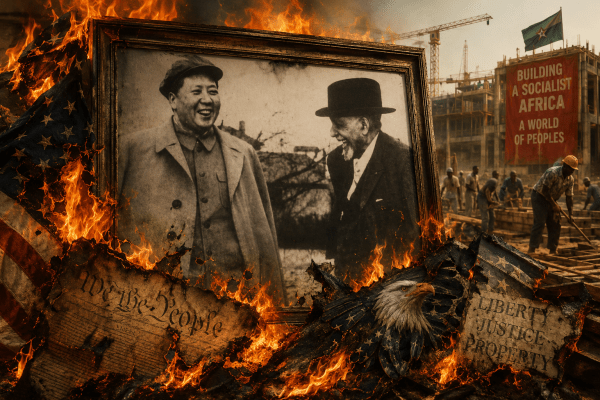
For generations, the American academy celebrated W.E.B. Du Bois while burying the revolutionary conclusions that defined the final decades of his life. In this Weaponized Intellects review of Bill V. Mullen's Un-American, we excavate the real Du Bois: communist, anti-imperialist, Pan-African internationalist and unapologetic ally of socialist revolution. Mullen powerfully restores Du Bois to the global struggle against capitalism and colonialism, yet retreats into familiar anti-Stalinist assumptions when revolution becomes embodied in the Soviet Union and the People's Republic of China. The result is both an indispensable recovery and a revealing ideological battleground over the meaning of socialism, state power and the unfinished project of world revolution.

Beyond Hegemony, Beyond Illusion: Samir Amin, Multipolarity, and the Unfinished Road to Socialism

What happens when one of the twentieth century's greatest Marxist theorists is tested against the world that emerged after unipolarity began to fracture? This Weaponized Intellects review excavates Samir Amin's Beyond US Hegemony? as both a product of its historical moment and a living revolutionary framework, measuring its arguments against China's socialist transition, Russia's anti-hegemonic resurgence, the rise of BRICS, and Amin's own later theoretical development. The result is neither celebration nor dismissal, but a critical reconstruction that distinguishes multipolarity from socialism and argues that only organized popular power can transform the decline of empire into genuine human emancipation.

The Rose That Grew From Concrete: Tupac Shakur, Revolutionary Memory, and the Industry That Sold It Back

Dean Van Nguyen's "Words for My Comrades" passionately reclaims Tupac Shakur as a pivotal voice in the Black revolutionary movement, tracing his roots back to the powerful yet fragmented legacy left by the Panthers. While capitalism commodifies Tupac's image, the essence of his revolutionary spirit remains alive, urging listeners to confront issues of systemic oppression and identity. Van Nguyen illuminates the contradictions in Tupac's life, linking them to a larger inheritance shaped by state repression and cultural rebellion. Ultimately, Tupac's significance lies not in providing a finished political framework but in sparking inquiry into collective struggle and revolutionary continuity, creating pathways toward genuine transformation.

The Foreign Enemy Fraud: From Russiagate’s Thought Police to Chinagate’s Electoral Cage

David Corn's resurrection of Russiagate in response to Trump's accusations of Chinagate exposes the absurdity of electoral politics in a billionaire-dominated America. By framing the discourse as a conflict between foreign adversaries—Russia or China—Corn obscures the true culprits: a corrupt ruling class manipulating the political system to protect its interests. Both narratives serve to distract the populace from the reality of a plutocracy masquerading as democracy. The ongoing chaos is but a struggle within the elite, each side reinforcing the structures of oppression while preventing real power from reaching the working class. True resistance demands unity against this imperial façade.

China’s Missing Protests: How Bloomberg Turns Workers’ Grievances into Investor Intelligence

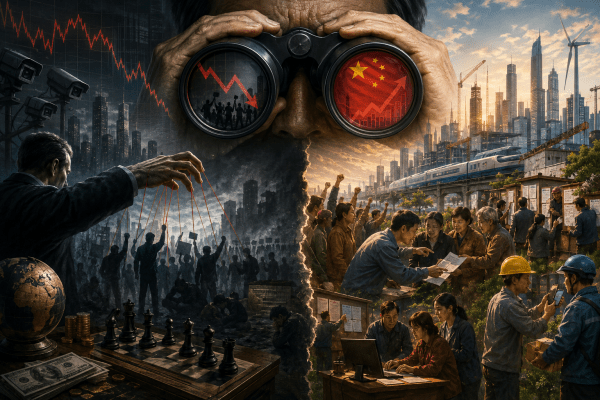
Bloomberg turns a decline in documented protests into evidence of a hidden political crisis, relying on a US-backed monitoring project whose methods cannot support such sweeping conclusions. By collapsing wage disputes, housing conflicts, petitions, and local administrative complaints into the single category of “dissent,” the article strips Chinese grievances of their concrete class content. It also ignores the institutions through which millions of people pursue redress and reduces China’s political system to a Cold War caricature. The result is not a serious account of Chinese society, but investor intelligence: workers appear only as risks to accumulation, while the real struggle over socialism’s direction disappears.

When the Numbers Revolt: The World Stops Buying the American Empire

The world is turning its back on the American Empire as perceptions shift dramatically in favor of China, a shift underscored by a recent Pew survey revealing greater global trust in China over the U.S. The BBC attempts to downplay this trend, attributing it to America's chaotic leadership under Trump, but the truth lies in a stark reality: nations are weary of U.S. interference and long for a relationship defined by trade, not military might. This reversal signals not just a popularity contest but a fundamental reevaluation of power dynamics. The challenge now is to harness this anti-imperialist sentiment into a mass movement against war with China.

The Guardrails Are a Cage: AI, Surplus Humanity, and the Technofascist State

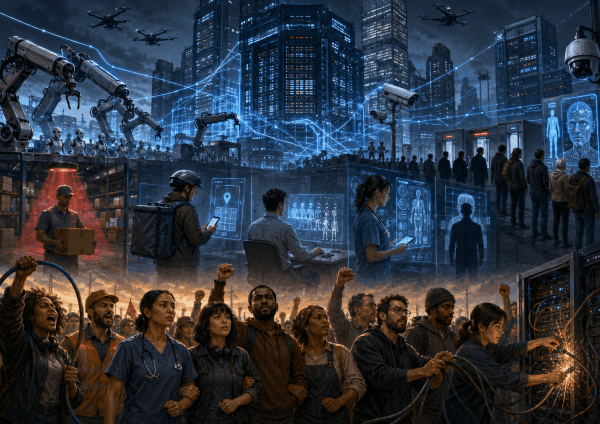
Hundreds of economists warn that artificial intelligence could displace millions of workers, but their petition mistakes a ruling-class offensive for a technical oversight. AI is already being used to reduce workforces, intensify surveillance, automate discipline, exclude applicants, restrict public benefits, and strengthen military and counterinsurgency systems. The real danger is not that machines may escape human control, but that monopoly capital is using them to reduce its dependence on labor while expanding the apparatus needed to manage those it renders surplus. Against this technofascist future, workers are organizing to seize control over deployment, data, productivity, and power.

The Palestine Exception: Why Washington Is Trying to Break the ICC

The Guardian's coverage of Marco Rubio's claim that the International Criminal Court (ICC) threatens U.S. sovereignty highlights the deeper issue of imperial exemption rather than genuine sovereignty. The U.S. has long opposed ICC jurisdiction that could implicate American or allied personnel, reacting strongly against Palestinian efforts to document crimes under occupation. The article critiques the liberal institutionalism of the response, noting a lack of representation for affected parties. It underscores that U.S. sanctions targeting Palestinian organizations and ICC officials are a means to maintain impunity. Oppressed nations seek accountability, using available legal systems to challenge the dominance of imperial powers and protect their sovereignty against external coercion.

The Viceroy’s Ledger: How Washington Seized Venezuela’s Present and Mortgaged Its Future

The New York Times paints Marco Rubio as Venezuela's imperial viceroy, wielding control over its government through military force, financial manipulation, and a façade of diplomacy. This orchestrated colonial domination, disguised as governance, reveals a grotesque power dynamic where a nation’s sovereignty is traded for political tapestries spun by Washington. While Rubio's grip tightens, the real resistance lies among Venezuelans and anti-imperialist allies in the U.S. They must dismantle U.S.-imposed sanctions and return Venezuela’s wealth to its people. The struggle against colonial rule continues, as the masses can't be merely passive subjects in the rewriting of their national story.

Website Powered by WordPress.com.

Up ↑