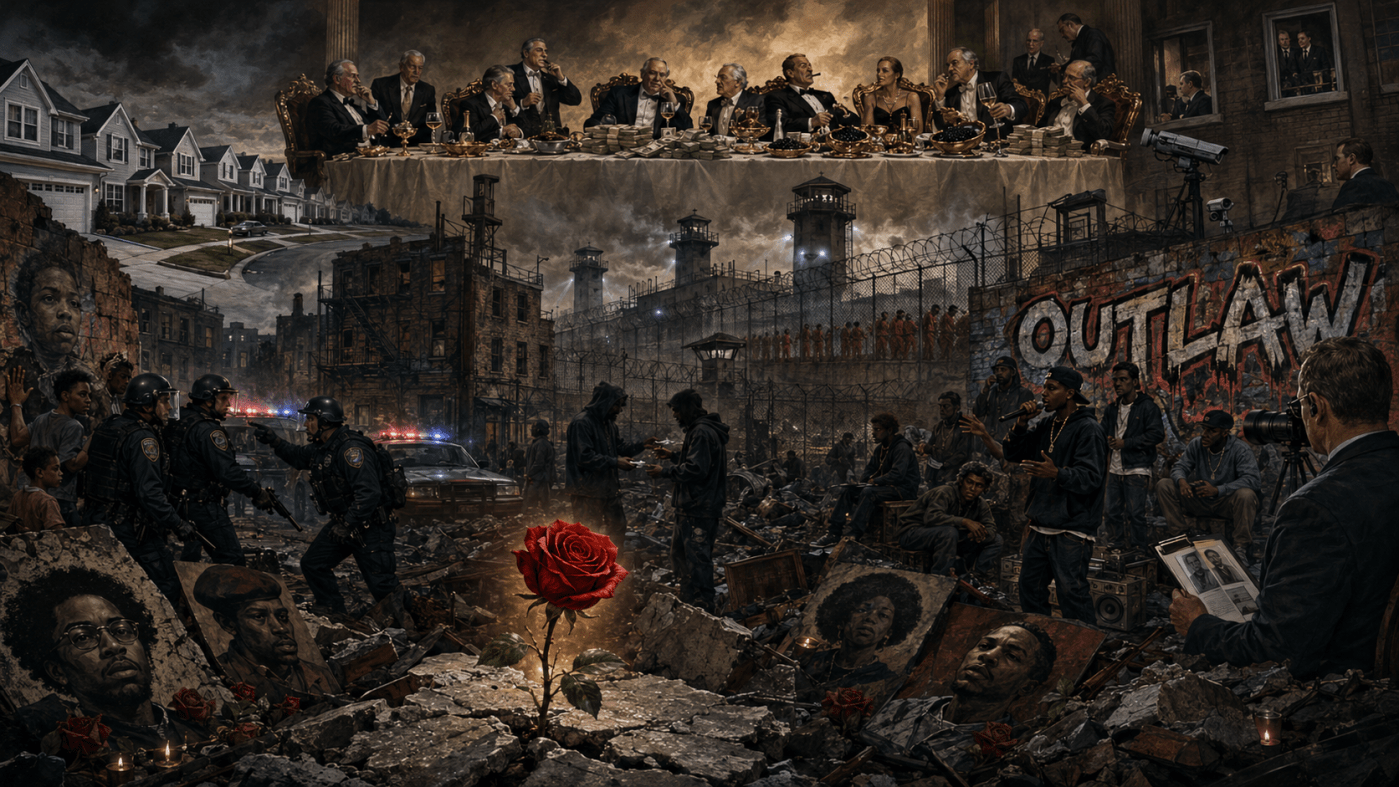
Dean Van Nguyen restores Tupac Shakur to the Black revolutionary movement that made his voice possible, uncovering the Panthers, political prisoners, anti-colonial theory and family memory buried beneath the marketable outlaw icon. But Tupac emerged after state repression had shattered the organizations capable of joining that inheritance to disciplined political development, leaving revolutionary consciousness to travel through music in a form at once powerful, contradictory and unfinished. His life became a battlefield where lumpen rebellion struggled toward liberation while patriarchy, fatalism, celebrity and capitalist ownership pulled it back toward the order it opposed. Tupac’s greatest revolutionary value was not that he supplied a finished program, but that he could open a door from the injuries of the street toward Malcolm, the Panthers, socialism and organized struggle—a door the culture industry has spent decades trying to turn into a merchandise counter.
By Prince Kapone | Weaponized Information | July 17, 2026
The Revolutionary Icon and the Industry of Forgetting
Capital has never feared the rebel image as much as the rebel relationship. A raised fist can be printed, packaged and shipped. A dead revolutionary can be reduced to a photograph, a slogan or a mood. The danger begins when the image sends people backward into the history that produced it and forward toward forces capable of changing the world. Dean Van Nguyen’s Words for My Comrades enters the struggle over Tupac Shakur at precisely this point: not to prove that Tupac was secretly respectable, nor to polish him into a flawless revolutionary, but to restore the political road leading through him.
Van Nguyen names the threat directly: “There’s a risk that his image becomes as flat as the two-dimensional posters fans hang on their walls.” This flattening is not simple forgetfulness. It is ideological production. Tupac’s face remains recognizable because recognition is profitable. His defiance, sexuality, wounded masculinity, outlaw posture and early death all circulate easily. The history behind them does not. Afeni Shakur, the Panther 21, political prisoners, Marxist study, Black national liberation, community survival programs and state counterinsurgency are harder to convert into harmless decoration because they explain what the rebellion was against and where it might lead.
The market does not empty Tupac of politics altogether. It selects the politics it can use. Anger survives as attitude. Resistance survives as personality. The outlaw survives as a consumer identity. What disappears is the chain connecting personal rebellion to collective history, collective history to political education and political education to organization. A Tupac reduced to temperament can belong to everyone because he obligates no one. A Tupac restored to the movement that formed him begins asking dangerous questions about capitalism, colonial domination, police power, political prisoners and revolutionary continuity.
This is the first measure of Van Nguyen’s achievement. He refuses to begin with the finished celebrity. He begins with the forces that made Tupac historically possible. The author writes that “The Black Panthers was an intellectual movement rooted in Marxist-Leninist theory.” That sentence tears through decades of liberal memorialization. The Panthers were not a style later softened into charity work. Their survival programs, political education, armed patrols and anti-imperialist commitments belonged to a theory of social transformation. They identified capitalism as inseparable from Black oppression and treated the poor, the criminalized and the abandoned as potential revolutionary subjects rather than damaged populations awaiting professional management.
Van Nguyen then adds the qualification that governs the entire book: “Tupac’s ideas somewhat diverged.” The divergence matters, but it should not be read as a simple failure of intellectual development. Tupac did not inherit the Panthers at the height of their organizational coherence. He inherited their surviving language after raids, assassinations, infiltration, imprisonment, exile and internal fracture had broken the institutions that once joined theory to disciplined practice. His politics therefore emerged through a different form: family memory, political prisoners, music, street codes, outlaw symbolism, personal loyalty and cultural revolt.
The book’s decisive historical formulation is that Tupac “grew up in the rubble of 1960s radicalism.” Rubble is not an empty field. It is evidence that a structure once stood there and that some force brought it down. It contains fragments that can still be recognized, recovered and used. Tupac found names, arguments, prisoners, stories, enemies and unfinished commitments inside that wreckage. He inherited the movement’s memory without inheriting its full organizational body.
Yet this inheritance should not be understood only through loss. Rubble can become a political archive. A generation may first encounter the remains of a defeated movement through culture before it encounters them through theory. A lyric can send the listener toward Afeni. Afeni can lead toward the Panther 21. The Panthers can open the road toward Malcolm X, Marxism-Leninism, anti-colonial struggle and the national question. Tupac’s revolutionary significance lies partly in this initiating power. He did not need to contain a finished political system in order to direct people toward one.
This is where conventional judgments of Tupac become inadequate. The liberal critic asks whether his conduct matched his message. The cultural critic asks whether the music remains artistically important. The political purist asks whether his ideas were coherent enough to qualify as revolutionary. Each question catches part of the truth and misses the historical function. Tupac reached people whom respectable institutions, academic Marxism and much of the organized Left had ceased to reach. He carried fragments of Black revolutionary history into prisons, neighborhoods, bedrooms, cars and headphones where no political school was waiting.
That reach does not abolish contradiction. It explains why contradiction mattered so much. Tupac could awaken interest in revolution while reproducing forms of patriarchal, individualist and outlaw politics that required revolutionary criticism. He could name the colonial condition without fully theorizing sovereignty. He could honor political prisoners while moving inside an industry governed by capitalist ownership. He could speak to the lumpenized youth of the empire because he knew their language, but that language could lead toward either political transformation or the glorification of survival within the same order.
The book should therefore be classified as useful but politically limited. Van Nguyen recovers a revolutionary genealogy that bourgeois culture worked to suppress. He shows how Tupac’s political voice emerged from that genealogy and how the entertainment industry narrowed, marketed and reproduced it. But the book does not consistently follow its own evidence toward the full organizational and strategic conclusions the history demands. It often arrives at memory, hope and cultural endurance where a revolutionary analysis must continue toward political formation, collective ownership and the reconstruction of organized power.
This limitation becomes visible in Van Nguyen’s treatment of Black Lives Matter. He writes that “Black Lives Matter meant a variety of things to those who embraced it.” The observation is disciplined. A mass slogan can carry several political directions at once. It can name a shared injury without producing a shared theory of power. It can draw revolutionaries, reformers, nonprofit institutions, spontaneous rebels and newly politicized people into one field without resolving their strategic differences.
Tupac’s image operates in a similar way. Socialists, Black nationalists, gang formations, entrepreneurs, prison organizers, advertisers and billionaires can all invoke him. The symbol alone does not settle the politics. Its meaning depends upon the history and direction attached to it. Does Tupac become a model of individual authenticity, outlaw entrepreneurship and doomed masculinity? Or does he become an entry point into the Black revolutionary tradition, the colonial contradiction, political prisoners, socialist analysis and organized struggle?
Van Nguyen closes the problem in a line that contains both the purpose and danger of his book: “History fades; symbols remain strong.” History does not fade naturally. Institutions erase it, markets simplify it and defeated movements sometimes fail to transmit it with sufficient force. Symbols survive because they are portable. They can cross generations and borders, but they can also be emptied and refilled by whoever controls their circulation.
Words for My Comrades attempts to take control of that circulation away from the commodity form and return Tupac to the history that gave his image weight. Its first task is to make the symbol testify. Its deeper test is whether that testimony opens a road beyond the symbol itself.
Tupac matters because revolutionary memory passed through him after the state had shattered much of the machinery that once carried it. He was not the party, the program or the finished theory. He was a cultural force capable of placing people at the entrance to all three. The struggle over his meaning therefore concerns more than one artist’s reputation. It concerns whether rebellion remains a marketable identity or becomes the beginning of revolutionary consciousness.
Before Tupac: The Movement That Made His Voice Possible
Before Tupac Shakur became a voice, there was a chorus. It spoke through Southern kitchens, crowded tenements, prison visiting rooms, storefront political schools, union workplaces, rented halls and breakfast tables where children ate because revolutionaries had decided that hunger was neither natural nor private. Dean Van Nguyen’s greatest historical service is to place Tupac inside that collective sound before celebrity isolates him from it. The young artist did not invent his political language in a recording studio. He inherited a struggle already carried through families, organizations, prisons and neighborhoods marked by the collision of Black resistance with the American state.
Afeni Shakur stands at the beginning because she understood her own life as part of a social pattern. “Their lives and my life are not really that different,” she says of the people around her. The sentence refuses the machinery of exceptional biography. Bourgeois storytelling searches backward for the unique wound that produced the extraordinary person. Afeni points toward shared conditions: racist violence, unstable housing, exhausting labor, family rupture and the disciplined humiliations imposed upon Black working-class life.
Once suffering is treated as individual misfortune, the available remedies become endurance, charity, personal improvement or escape. Once it appears as a common and organized condition, another set of questions becomes unavoidable. Who arranged life this way? Which institutions reproduce the arrangement? Who benefits from it? The path from Afeni’s personal pain toward revolutionary politics begins with this recognition that misery had a structure. It possessed landlords, employers, police departments, courts and political defenders. What had been made by social power could be confronted by organized social power.
The Black Panther Party developed that recognition beyond moral outrage. Van Nguyen writes that its founders sought “a new kind of Black politics, one that embraced inner-city youth as a revolutionary proletariat.” The phrase cuts against the criminal categories imposed upon poor Black youth and against a respectable Left that could recognize workers only when they appeared in approved industrial costume. The Panthers looked at those whom bourgeois society had abandoned, policed and imprisoned and saw a potentially revolutionary social force.
They did not confuse oppression with automatic consciousness. Poverty can produce solidarity, but it can also produce desperation, internal violence and individual escape. Police occupation can create resistance, but it can also create fear. The Panthers therefore built political institutions intended to transform shared injury into shared understanding. Their newspapers connected neighborhood conditions to capitalism and imperialism. Their patrols exposed the police claim to act without witnesses. Their political education located everyday suffering inside a structure larger than any individual officer, landlord or employer.
The survival programs joined this analysis to immediate need. Huey Newton explained that “These programs satisfy the deep needs of the community but they are not solutions to our problems.” Liberal memory usually cuts this sentence in half. It praises the breakfast, removes the revolution and presents the Panthers as an early nonprofit organization with unusually militant branding. But the programs were not designed to administer poverty indefinitely. They helped people survive conditions that only political transformation could abolish.
This was the meaning of survival pending revolution. The Panthers refused the false choice between feeding a child today and changing the system tomorrow. A starving child cannot eat a theory. Yet a breakfast program stripped of theory can become a permanent service managing the hunger it claims to oppose. Revolutionary mass work meets immediate needs while explaining why those needs remain unmet under the existing order. It makes organization materially credible because people encounter it not as a speech descending from above but as a force operating inside their lives.
That relationship with the people made the Panthers more dangerous to the state than their weapons alone. The FBI did not direct its counterintelligence machinery against them because leather jackets offended democratic sensibilities. The Party was building political education, community institutions and an organized interpretation of police power. It taught that brutality was not merely misconduct by individual officers but part of a larger structure of class and colonial rule.
The assassination of Fred Hampton exposed the state’s response to that possibility. Attorney Jeffrey Haas described the police operation with brutal economy: “It was not a shoot-out, it was a shoot in.” The official phrase “shoot-out” manufactures reciprocity. It suggests two armed sides meeting in equal combat. “Shoot in” restores the material relation: agents of the state entered a home and fired upon a revolutionary leader whose organization had begun joining Black militants, Puerto Rican organizers and poor white workers around common interests.
Hampton’s murder reveals why organized political development frightened the state more than generalized anger. Anger can be redirected, exhausted or criminalized. Organization can accumulate. It can reproduce knowledge, train new leadership and expose interests hidden beneath racial division. Hampton’s work threatened to turn scattered grievances into a political bloc. The raid was therefore not an excess at the margins of democratic government. It was counterrevolution carried out through police weapons, intelligence files, informants and a cooperative press.
The Panther 21 defeated the prosecution in court, but the acquittal could not restore what repression had already damaged. The liberal imagination treats the courtroom verdict as the final measure of justice: the innocent are released, the system corrects itself and the story ends. Political repression operates on a different timetable. Detention removes organizers from communities. Surveillance produces mistrust. Prosecution drains resources. Informants fracture relationships. Media criminalization isolates militants before jurors hear a word of testimony. The state can lose the case and still achieve much of its political objective.
What followed was not one clean defeat but a prolonged fragmentation. Some militants maintained community work. Others entered underground struggle. Many were killed, imprisoned, exiled or broken under pressure. Revolutionary commitments survived inside households, prison correspondence, fugitive networks and the political upbringing of children. What weakened was the common organizational structure capable of joining those commitments into a coherent strategy.
Hip-hop emerged from related conditions of abandonment, though not from political emptiness. The Bronx had been subjected to disinvestment, landlord arson, unemployment and the withdrawal of public resources. Black and Puerto Rican organizers, tenant movements, socialist traditions, the Young Lords, Panther politics and revolutionary spoken-word culture had already shaped the terrain. Young people built new forms from the records, equipment, language and public space available to them. The neighborhoods capitalism treated as disposable produced a culture that would later become globally profitable.
The collective character of this creation preceded the industry’s individual-star system. DJs, dancers, MCs, graffiti writers, crews and neighborhood audiences made a social world before executives discovered a market category. Hip-hop’s political inheritance was therefore not imported later by a few conscious artists. It existed within the culture’s social origins, even when it remained uneven, implicit or contested.
Jamal Joseph describes Tupac’s role in this history: “Tupac came and really infused revolutionary consciousness in that.” The wording is exact. Tupac did not invent the revolutionary current in hip-hop. He intensified it, personalized it and carried it into a mass cultural sphere. The Panther movement, radical poetry, political prisoners and anticolonial language entered his work in forms recognizable to young people who might never encounter them through a party newspaper or university classroom.
His importance rested partly in this capacity for translation. Tupac could move from police terror to poverty, from reproductive oppression to war spending, from the humiliation of the individual to the abandonment of an entire people. He did not speak to the oppressed as an outside instructor explaining their lives back to them. He spoke from inside the contradictions produced by those lives. This gave his music an initiating power that political language loses when it becomes detached from the people it claims to address.
That power was visible in songs such as “Brenda’s Got a Baby,” where the destruction of a young Black girl appears not as evidence of personal irresponsibility but as the outcome of poverty, sexual violence, family collapse and social abandonment. Tupac forces the victim back into view after the system has hidden itself behind her. The song does not supply a revolutionary program. It performs another necessary political act: it teaches the listener to locate private suffering inside public structures.
The movement that made Tupac’s voice possible therefore reached beyond him through that voice. Afeni carried collective history into his formation. The Panthers supplied a language of capitalism, colonial domination and resistance. The Bronx supplied a popular form built by people excluded from official culture. Tupac brought these inheritances into contact with a generation living through the consequences of revolutionary defeat.
Culture did not replace the destroyed organizations. It kept routes toward them open. A listener could encounter the anger first, then the names, then the prisoners, then the movement and the theory that made the names intelligible. Tupac’s political function cannot be reduced to the correctness of every statement he made. He mattered because he helped make buried revolutionary history audible to people the formal Left often failed to reach.
That transmission remained contradictory, but it was real. The Panthers’ language passed through a young artist shaped by the very destruction he was trying to understand. The voice carried both the movement’s memory and the injuries left by its defeat. To recover Tupac historically is to trace that voice back to the organized struggle that formed it—and to recognize how far it could carry the struggle’s unfinished questions.
How Van Nguyen Knows What He Knows
Every political biography carries a theory of history, whether the author declares it or hides it beneath the chronology. One kind begins with the exceptional man and searches childhood for the first spark of genius. Another begins with the society, the class forces, the political organizations and the inherited struggles that make a particular life intelligible. Dean Van Nguyen works mainly in the second tradition. He reconstructs Tupac through migration, racial terror, wage labor, Black nationalism, Marxism, state repression, political imprisonment, family fracture, hip-hop and capital.
The method first appears in Afeni Shakur’s explanation of her son’s name. She wanted Tupac to understand that “he was part of a world culture and not just from a neighborhood.” Van Nguyen’s decision to open through this statement places the local inside a larger anti-colonial history. Tupac’s political formation begins in the neighborhood, but it does not end there. His name carries Indigenous resistance, African liberation and an international tradition of revolt into a Black child’s life inside the United States.
This is Van Nguyen’s genealogical method. He follows ideas as they travel through families, movements, prisons, songs, remembered conversations and political names. Afeni transmits a map of comrades and enemies. Political prisoners become part of an extended revolutionary kinship. Music carries arguments once circulated through newspapers, study groups and Panther political schools. The method allows the book to recover continuity where official history presents isolated personalities and spontaneous explosions.
Genealogy is especially useful when the state has broken the institutions that once preserved revolutionary knowledge. A political tradition may survive unevenly through stories, recordings, letters and names long after its organizations have been weakened. Van Nguyen makes that survival visible. He shows how culture can become an archive through which people encounter a history that schools, newspapers and respectable politics have buried.
The form also creates a danger. Once the narrative accumulates revolutionary names, family connections and prophetic scenes around Tupac, inheritance can begin to look like destiny. His name, charisma, suffering and death risk forming a story in which the revolutionary icon appears prewritten. Material history offers no such script. Conditions create possibilities. Institutions, markets, choices and conflicts determine which possibilities develop. Van Nguyen is strongest when he keeps those pressures in view and weakest when the drama of biography pulls collective history toward the singular man.
His class analysis reaches its clearest point in the statement that “capitalism was at the root of Black oppression.” This proposition separates the book from accounts that treat racism as a free-floating prejudice or a moral defect in American democracy. Van Nguyen’s narrative repeatedly locates racial domination in labor, housing, policing, prisons, property and political power. Black suffering is not accidental to the economic order. It has been one of the historical means through which that order accumulated wealth and disciplined labor.
This framework also explains why representation cannot substitute for liberation. A corporation may promote Black executives while exploiting Black workers. A record label may sell revolutionary imagery while controlling the artist’s labor and catalog. Changing the personnel who administer a relation does not abolish the relation itself. Van Nguyen’s best political-economic passages expose this distinction, particularly when he follows contracts, ownership and the movement of value through the music industry.
The analysis weakens when capitalism becomes primarily a synonym for greed, wealth worship or commercial corruption. Those are visible effects of the system, but the system does not depend upon every owner being unusually wicked. The respectable label executive and the violent label executive occupy the same basic relation if both control the work of others. A politically sympathetic owner remains an owner. Van Nguyen’s evidence often points toward this structural conclusion more clearly than his language states it.
His treatment of violence displays a similar strength. Robert F. Williams argued that Black people “must defend themselves, even if it is necessary to resort to violence.” Van Nguyen includes this argument within a history of constitutional abandonment and organized white terror. The passage does not establish a general cult of force. It identifies the conditions under which armed self-defense becomes rational: the state claims authority over violence while refusing to protect the people it has placed beneath racial rule.
The book is careful not to flatten all violence into one moral category. White supremacist terror, police raids, armed self-defense, underground operations, gang conflict, rebellion and interpersonal abuse emerge from different relations and carry different political meanings. This distinction matters because bourgeois language regularly hides institutional violence beneath words such as law, security and order, then discovers “violence” only when the oppressed answer.
Van Nguyen is much clearer about resistance to the existing state than about the power required to replace it. The book reconstructs police occupation, surveillance, prosecution and assassination in material detail. It gives less attention to revolutionary sovereignty, the institutions through which the oppressed would govern, or the political form capable of joining self-defense to a struggle for state power. This limit belongs partly to Tupac’s own political development, but it also marks the horizon of the biography.
The colonial vocabulary opens the possibility of going further. Van Nguyen defines the internal colony as “oppression and exploitation within the borders of the United States.” That language directs attention beyond unequal treatment toward a historical relation involving conquest, containment, labor extraction, police authority and denied sovereignty. It places Black oppression inside the structure of the settler state rather than treating it as an unfortunate contradiction within an otherwise neutral republic.
Van Nguyen records Akinyele Umoja remembering Tupac’s position in direct terms: “We’re still not free as a people, we’re still colonized, and we need to challenge things.” The testimony shows that colonial language formed part of Tupac’s political world. It does not by itself prove that Tupac possessed a complete theory of internal colonialism, nor that Van Nguyen has fully reconstructed one. It establishes a line of consciousness whose implications the book only partly develops.
Those implications are considerable. If Black people constitute an internally colonized population, the political question extends beyond civil inclusion. It reaches nationhood, land, autonomy, self-determination and the relationship between national liberation and socialist revolution. Van Nguyen records Black nationalism, New Afrikan politics, Pan-Africanism, Marxism-Leninism and broad antiracist struggle as currents moving through Tupac’s formation. He rarely forces their strategic differences into sustained confrontation.
This is where biography both helps and restricts the analysis. It can faithfully show that several traditions entered Tupac’s life without pretending he resolved them. Yet a political history must eventually distinguish among the ideas it records. Otherwise, the internal-colony thesis, Marxism, nationalism and internationalism can become another collection of meaningful references orbiting the artist rather than competing theories of liberation.
The structure of Van Nguyen’s archive raises a final methodological question. He draws from court records, government documents, interviews, memoirs, songs, performances, journalism and later recollections. This range allows people targeted by the state to speak against official accounts. It also creates unequal forms of evidence. A participant’s memory, an FBI document, a lyric and a disputed allegation cannot be treated as if they establish the same kind of truth.
Lyrics reveal political imagination, emotional truth and public performance. They do not automatically prove conduct. State records may expose institutional intention while containing lies produced by the agencies that created them. Later recollections can recover what official archives excluded, but memory is shaped by trauma, loyalty and time. Van Nguyen often marks uncertainty responsibly. At other moments, the momentum of the narrative places legend, testimony and verified fact too close together.
His method nonetheless reveals what celebrity culture works hardest to conceal: Tupac was made through collective history. The book shows how revolutionary knowledge can survive defeat by moving through forms that do not resemble formal theory. It also shows, sometimes despite itself, that transmission changes what is transmitted. Ideas carried through family memory and popular culture can reach people excluded from conventional political education, but their strategic content may become unstable along the way.
This is the book’s epistemological achievement and its limit. Van Nguyen reconstructs the road through which revolutionary history reached Tupac and, through him, reached beyond the original movement. He does not always distinguish the doorway from the destination. The archive recovers the fragments. Biography shows how one life gathered and redistributed them. Revolutionary criticism must still determine which fragments open toward organized liberation and which remain trapped inside the mythology of the exceptional rebel.
The Politics That Survived and the Organization That Did Not
Revolutionary history becomes useful only when it refuses to flatter its own martyrs. The ruling class has no objection to a defeated movement remembering courage while forgetting strategy. Courage can be framed, merchandised and separated from the decisions that determined whether it accumulated into power or burned itself out in isolation. Dean Van Nguyen’s book becomes most valuable where the political inheritance surrounding Tupac begins to fracture—where liberation collides with patriarchy, armed struggle with strategic isolation, and lumpen rebellion with the unresolved question of revolutionary transformation.
The first fracture existed inside the Black Panther Party itself. Van Nguyen states plainly that “Panther women undeniably experienced sexism.” Women organized survival programs, conducted political education, defended offices, raised children under surveillance, visited prisoners and held chapters together while the state jailed, killed and exiled leading militants. Yet revolutionary commitment did not automatically abolish the patriarchal relations reproduced inside daily life.
This was more than hypocrisy among individual men. An organization formed inside a patriarchal society carries that society’s habits into its own ranks unless it develops the political means to confront them. A man can analyze capitalist exploitation and still treat women’s labor as naturally available. He can denounce the domination of his people while exercising domination inside the home or organization. The contradiction does not discredit revolutionary politics. It proves that liberation must be organized through intimate and internal relations as seriously as through public confrontation with the state.
Tupac inherited this unresolved terrain. His strongest work defended poor women, reproductive freedom and Black mothers abandoned by the same society that criminalized them. He also moved through a culture in which hardness became evidence of authenticity and masculine injury could be converted into aggression. The contradiction cannot be separated into two convenient personalities—the sensitive poet and the violent outlaw—because both emerged from the same historical formation.
The problem becomes sharper when Van Nguyen turns toward armed struggle after the Panthers’ fragmentation. He does not repeat the state’s claim that revolutionary violence arose from irrational hatred. He reconstructs police raids, assassinations, imprisonment and covert warfare. But he also writes that the fighting became “increasingly ad hoc and desperate.”
Those words distinguish courage from strategy. “Ad hoc” describes action no longer governed by an organization capable of selecting objectives, measuring consequences, reproducing leadership and sustaining a political relationship with the people. “Desperate” describes a balance of forces in which defeat begins determining the movement’s methods. Militants may remain personally committed while their actions become increasingly detached from any expanding revolutionary capacity.
Bourgeois historians use this degeneration to condemn armed resistance in general. Revolutionary romanticism commits the opposite error when it treats every armed act by a militant as revolutionary by definition. A weapon does not carry a political line. Force can defend the people and expose the state. It can also substitute action for organization, isolate cadres and turn sacrifice into a procession toward prison or death.
This distinction is essential to understanding the outlaw politics Tupac inherited. The lumpenized youth of the colony confront police occupation, unstable labor, prison, neighborhood violence and social abandonment. Their refusal of bourgeois respectability can contain revolutionary potential because the existing order has given them little reason to respect it. But refusal alone does not determine the direction of that potential. The outlaw may become an organizer and guerrilla, or he may reproduce capitalist competition through hustling, accumulation and domination on a smaller scale.
Revolutionary But Gangsta is therefore not a finished identity. It is a problem of transformation. The gangster becomes revolutionary only when rebellion acquires political education, collective discipline and a program extending beyond individual survival. Rage must discover its historical cause. Militancy must enter an organized relationship with the people. The outlaw must break not only with bourgeois legality but with the capitalist and patriarchal relations operating inside outlaw life itself.
The Code of Thug Life emerged from this contradictory ground. It sought to restrain neighborhood conflict, protect civilians and establish rules among people the state recognized only as criminal objects. Such an effort should not be dismissed. Communities attempting to limit destructive violence are already exercising more responsibility than the institutions that profit from their fragmentation.
Van Nguyen nevertheless measures the code against the political program that preceded it: “The Panthers’ Ten-Point Program envisioned a restructuring of society.” That comparison reveals the difference between revolutionary program and social regulation. The Ten-Point Program connected employment, housing, education, police violence, imprisonment, land and peace to a struggle over political power. It identified the conditions that had to be transformed.
By contrast, Van Nguyen writes that “The Code of Thug Life is not a sophisticated document.” Its weakness does not lie in academic simplicity. The code is politically limited because it governs conduct inside structures it does not propose to abolish. It can regulate the behavior of the street formation, but it cannot reorganize the property relations, police institutions and colonial conditions producing the street formation.
The code therefore occupies an unstable position. It is more than spontaneous gangsterism because it attempts collective restraint. It is less than revolutionary organization because it leaves the social order intact. It may become a bridge toward political consciousness if joined to study, mass work and disciplined organization. Left alone, it risks becoming an ethical code for surviving more efficiently inside the same machinery.
Van Nguyen captures the historical pressure behind this retreat: “If collapsing the system feels too big, maybe thriving within it is the only option.” The sentence explains how revolutionary horizons contract. When collective transformation disappears from practical view, adaptation begins to present itself as realism. The community tries to reduce casualties. The hustler seeks individual security. The artist seeks ownership of his own brand. Politics does not vanish; it narrows toward survival within the available order.
The Los Angeles rebellion exposed the same contradiction on a mass scale. The fury was justified by police terror, racist courts and accumulated humiliation. For a moment, bourgeois property lost its sacred aura and the police lost control of the streets. But Van Nguyen refuses to confuse this rupture with revolution: “There was no intention that a domino effect would occur.… It was just fury.”
Fury can interrupt rule. It cannot alone create the authority that follows the interruption. A rebellion may expose the state’s weakness, but without organization the people confront the same landlords, employers, police and courts after the fires recede. Revolution begins where the rupture is consolidated into institutions capable of defending communities, distributing resources, resolving contradictions and exercising political power.
Tupac’s cultural politics occupied the distance between rebellion and that consolidation. “I rap about the oppressed taking back their place,” he said. “I rap about fighting back.” The intention is unmistakable. He rejected the industry’s effort to classify his work as gangster spectacle and understood his art as part of a struggle by people denied power and dignity.
Yet “fighting back” remains politically open. It can mean collective organization, self-defense, rebellion, revenge, artistic testimony or personal confrontation. Tupac’s strength was his ability to make the need for resistance emotionally undeniable. His limitation was that the forms of resistance moving through his life did not always converge into a stable strategic direction. The same voice could direct listeners toward political prisoners and revolutionary history while also dramatizing fatalism, personal vengeance and outlaw identity.
The contradiction between women’s liberation and patriarchal harm forces this problem beyond symbolism. Van Nguyen refuses to erase Tupac’s sexual-assault conviction, but his analysis reaches a limit when he admits: “The truth is that I don’t have good answers as to how much asterisking we do.” The honesty is preferable to denial. It is still inadequate as a political conclusion.
An asterisk preserves the heroic narrative while acknowledging an inconvenient fact. Patriarchal harm cannot be reduced to a notation beside great art. Nor can the racist history of prosecution be ignored. The same state that criminalizes Black men has repeatedly abandoned, disbelieved and punished Black women. One structure cannot be invoked to erase the violence reproduced through another.
Revolutionary accountability must reject the two solutions bourgeois society repeatedly offers: punishment administered by a violent carceral state and impunity administered by celebrity, friendship or political usefulness. It must begin with the safety and dignity of the harmed person, establish facts without allowing fame to determine truth, and create consequences directed toward responsibility and transformation. These standards cannot be invented only after the accused becomes too valuable to confront. They must belong to the organization’s political culture from the beginning.
The absence of such an organization around Tupac mattered. There were political relatives, artistic collaborators, friends, managers and an expanding audience. None possessed the authority of a revolutionary formation capable of defending him from the state while demanding discipline from him. The music industry had no interest in resolving the contradiction. It could sell tenderness on one track and violent masculinity on the next. Political consistency was unnecessary so long as both generated attention.
That logic intensified under Death Row. Van Nguyen observes that “His social justice bent is suppressed on All Eyez on Me.” The word “suppressed” does not require a conspiracy in which executives dictated every lyric. Tupac entered the label carrying trauma, ambition, political commitments and outlaw mythology already in contradiction. Death Row amplified the elements most compatible with its commercial identity and violent internal culture.
The political confusion became visible in the Outlawz, whose names came from “political figures from all over the ideological map.” Revolutionary and reactionary figures could be placed beside one another because the names functioned as outlaw signs rather than theoretical commitments. Political history became a symbolic arsenal severed from political line.
This is how capital metabolizes contradiction. It does not need to create every weakness in the artist. It selects, enlarges and monetizes weaknesses already present. Van Nguyen describes the wider transformation bluntly: “Profit is no longer a happy side effect of making music—profit becomes the point.” Once accumulation becomes the governing purpose, anger is evaluated by its commercial yield. Militancy remains useful as branding. Revolutionary conclusions become dangerous when they direct the audience toward ownership, organization and collective power.
Tupac was not simply a pure revolutionary corrupted by a record company. Nor was he merely a gangster decorated with Panther references. He was a contested political formation in motion. His life showed the possibility that lumpen rebellion could open toward revolutionary history and the danger that the same rebellion could be captured by individualism, patriarchy, fatalism and capitalist spectacle.
Van Nguyen’s evidence demands that revolutionaries hold both sides together. The Code of Thug Life represented a real attempt at collective regulation, but not a program for liberation. Tupac’s music carried genuine revolutionary consciousness, but consciousness without disciplined organization remained vulnerable to contradiction and capture. The outlaw contained political potential, but potential required transformation.
That is the lesson capital would prefer to bury beneath the mythology of the doomed rebel. Tupac’s contradictions were not proof that revolutionary politics had failed inside him. They were evidence of unfinished political development under conditions where the organizations capable of carrying that development forward had been broken. The task is neither to worship the contradiction nor to condemn the people produced by it. The task is to build the political force through which rebellion can become discipline, the gangsta can become a revolutionary, and survival can become a struggle for power.
When the Dead Artist Becomes a Dataset
Dean Van Nguyen’s history reaches the present at the point where cultural ownership becomes ownership over the human trace itself. The record industry once required the artist’s living labor: the body in the studio, the voice before the microphone, the performer moving through tours, interviews and negotiations. Digital capital increasingly seeks something more compliant. A voice can be isolated from the person, converted into data and made to perform after death. The artist who once contradicted managers, revised his politics and resisted contractual control returns as a programmable asset.
Van Nguyen locates an earlier stage of this process in the production of the “Holler If Ya Hear Me” video. Tupac recorded closing audio declaring, “Revolution is the only way.” Interscope cut that declaration from the finished video. The detail matters because the label did not remove Tupac’s anger from the product. Police confrontation, militant atmosphere and social rage remained commercially usable. The sentence naming revolution as the conclusion did not.
The episode demonstrates a form of cultural control more effective than complete censorship. A corporation need not prohibit rebellion when it can separate rebellious feeling from political direction. Anger can attract an audience. Despair can deepen identification with the artist. Even hostility toward the police can become part of a profitable brand. The danger begins when the work directs the listener beyond recognition of suffering toward a theory of the system and the necessity of organized transformation.
Van Nguyen later states the structural problem directly: “This entanglement of music with big business places obstacles in the way of people who want to make politically radical music.” The obstacle cannot be reduced to one nervous executive ordering a line removed. It includes the ownership of labels, catalogs, distribution channels, promotional machinery and the systems that determine whether music becomes publicly visible.
Streaming was once presented as the great escape from these gatekeepers. Artists could supposedly reach listeners directly, and listeners could wander through an unlimited cultural commons. The promise concealed a change in the form of concentration rather than its abolition. A 2022 study by Britain’s Competition and Markets Authority found that the three largest record companies controlled more than 70 percent of streams in the United Kingdom. The study also found that the vast majority of artists remained far below the level of streams required to produce substantial income.
The listener encounters abundance; the artist confronts hierarchy. Millions of tracks may exist on a platform, but discovery depends upon playlists, recommendation systems, licensing arrangements, promotional spending and catalog power. The old radio programmer visibly selected the acceptable record. The platform buries selection inside a technical process presented as personal taste. Corporate power becomes less theatrical and more intimate: the gatekeeper now speaks in the listener’s own voice.
This does not mean that revolutionary culture has vanished. Van Nguyen writes that “while capitalism’s hold on hip-hop remains ironclad, overt socialist ideas are passed around the underground.” That underground is politically important. It preserves historical memory, circulates analysis excluded from dominant institutions and demonstrates that capitalist ideology never achieves complete command over cultural production.
But survival underground should not be mistaken for control. Capital can tolerate subcultures, particularly when it can observe them, measure them and convert their innovations into future markets. Yesterday’s radical form becomes tomorrow’s branding language. A socialist lyric may enter a corporate catalog without altering the ownership of the catalog. The company can distribute anti-capitalist music, collect its share and present the transaction as proof of cultural openness.
The question is therefore larger than whether radical artists can speak. It concerns the material conditions under which speech circulates and produces value. Boots Riley supplies the clearest line in Van Nguyen’s final chapter: “The people should control the profits that they create.” This proposition moves the argument beyond personal authenticity. The artist’s political sincerity does not determine the social relation. Ownership does.
The labor producing a record extends far beyond the famous voice. Musicians, producers, engineers, designers, technicians and other workers build the finished commodity. Their work may disappear beneath the star’s name while labels, publishers and rights holders retain control of the revenue. A socialist cultural politics must therefore reach past the demand that one artist receive a better contract. It must ask who owns the studio, the catalog, the distribution infrastructure and the systems governing access to the audience.
Tupac’s posthumous existence brings this contradiction into harsher focus. In April 2024, Drake released “Taylor Made Freestyle,” which used artificial-intelligence imitations of the voices of Tupac Shakur and Snoop Dogg. The synthetic Tupac was made to address Kendrick Lamar in a commercial rap feud. Tupac’s estate threatened legal action, and Drake removed the track from his public social-media accounts. As Reuters reported, the conflict raised unresolved questions about voice imitation, artistic expression and the rights surrounding digital replicas.
The political offense exceeded unauthorized impersonation. Tupac’s voice was detached from his judgment, historical context and political development, then drafted into an exchange he did not create. A dead revolutionary artist became available for ventriloquism. The technology preserved the recognizable surface of the voice while eliminating the person capable of refusing its use.
Van Nguyen names the emerging horizon: “We are increasingly hurtling toward a dystopian future where nobody is allowed to die.” Under the traditional music business, death increased the value of the catalog. Under synthetic production, death may no longer end the artist’s labor. Existing recordings can become training material from which performances are manufactured indefinitely. Cadence, tone and verbal habit become raw materials for commodities the artist never made.
This is not resurrection. Resurrection would return agency to the dead. Digital replication transfers agency to whoever controls the model, the archive or the platform. A voice can be made to endorse products, enter conflicts or recite politics contrary to the historical person whose sound gives the replica value. The revolutionary dead risk becoming perfectly disciplined employees of the industries that once struggled to control them while alive.
The legal system has begun responding because the property implications have become impossible to ignore. The U.S. Copyright Office’s report on digital replicas concluded that existing protections were inadequate and recommended a federal right against unauthorized replicas. It also warned that performers could lose control over their personas through contracts negotiated under unequal bargaining power.
Such protections are necessary, but the property framework remains limited. An estate may prevent one use while licensing another. A performer may formally sign away future control because access to the industry depends upon accepting the terms offered. The legal system then describes the result as consent between equal parties. The contract records the agreement; it does not erase the power relation that produced it.
The same digital order that turns artists into reusable archives also enlarges the capacity to classify political populations. The counterinsurgency apparatus Van Nguyen reconstructs relied upon informants, intercepted communications and physical files. Contemporary agencies operate amid enormous databases generated through digital life. A Justice Department inspector-general review documented improper FBI Section 702 queries involving people arrested during the unrest of May and June 2020.
A later inspector-general assessment found that the FBI had implemented reforms mandated by Congress. The correction matters, but so does the infrastructure that made the violations possible. Compliance rules may narrow official access without dismantling a system in which communications, associations and cultural behavior accumulate as searchable data.
The artist and the protester occupy different positions, but the underlying relation is recognizable. People produce voices, images, networks and information through their social activity. Institutions gather these traces, convert them into controlled assets and use them to generate profit, prediction or state power. The producer of the data rarely governs the machinery built from it.
Van Nguyen’s argument therefore survives the present stress test, but present conditions extend it beyond the record label. Tupac’s struggle over artistic control now reaches voice models, digital replicas, platform visibility and the ownership of political memory. Capital no longer needs to wait for the revolutionary icon to flatten into a poster. It can animate the image, make it speak and circulate the performance without the person.
The answer cannot stop at protecting celebrity estates or improving royalty percentages. Riley’s proposition must be taken literally: the people who create value should control it. Cultural workers require collective power over recordings, catalogs and synthetic uses of their labor. Movements require control over their own archives before corporations convert revolutionary history into datasets, advertising aesthetics and endlessly renewable intellectual property.
Interscope once cut a revolutionary conclusion from Tupac’s closing audio. Artificial intelligence now makes it possible to preserve the voice while inventing the conclusion. The first form of control edited the living artist. The second manufactures obedience from the dead. That is the new frontier Van Nguyen’s political history compels us to confront.
What Revolutionaries Should Take from Tupac—and Leave Behind
A revolutionary judgment of Tupac Shakur cannot be reduced to deciding whether he was sufficiently pure, theoretically complete or personally consistent. Such judgments turn politics into a tribunal of character and history into a search for saints. Tupac’s importance lies elsewhere: in the political motion his voice could initiate among people whom respectable institutions, conventional education and much of the organized Left had failed to reach.
He understood himself as part of an unfinished transmission. “It was like their words with my voice,” Tupac said. “I tried to be the new breed, the new generation.” The statement should be taken literally. He did not simply repeat the Panthers in musical form. Their language passed through a different historical moment and a different social figure: the child of revolutionary defeat, shaped by poverty, prison, fractured organizations, street culture and the expanding machinery of the entertainment industry.
The words changed as they entered that voice. They became more intimate, contradictory, accessible and unstable. Tupac could translate police occupation, poverty and abandonment into language that reached lumpenized youth without first demanding that they master a theoretical vocabulary foreign to their immediate lives. That was not a minor cultural achievement. Revolutionary politics cannot transform people it cannot address.
His political function should therefore be measured partly by where the voice could lead. Tupac was not the destination. He could become a doorway into Afeni Shakur, Malcolm X, the Black Panther Party, political prisoners, internal colonialism, socialism and anti-imperialist struggle. The spark mattered because it could awaken questions larger than the artist who produced it.
This is what revolutionaries should take from Tupac: the ability to speak from inside the contradictions of the oppressed without treating them as objects of pity or raw material for academic theory. He did not approach the poor, the imprisoned and the outlaw from a safe distance. He recognized their anger, tenderness, confusion and desire for dignity because those forces moved through him as well.
That proximity gave him reach. It also carried dangers. The language of the street can open toward revolutionary consciousness, but it can also remain trapped in individual survival, masculine domination, fatalism and outlaw entrepreneurship. Tupac’s contradictions demonstrate why cultural identification must develop into political education and why rebellion requires an organization capable of challenging what the rebel reproduces within himself.
The same judgment applies to hip-hop’s wider history. Van Nguyen writes that “the originators could only watch on as others got rich.” The culture developed collectively among people abandoned by capital, then entered an industry that separated creators from ownership. Executives, labels and distributors accumulated the value produced by neighborhoods they had neither built nor defended.
Revolutionaries should reject every account that treats this dispossession as an unfortunate imperfection in an otherwise democratic market. The theft was not only cultural. It was a class relation. Labor created the music; ownership controlled its circulation and claimed its profits. The radical history of the culture was then selectively preserved according to commercial usefulness.
Tupac’s image became one of the most valuable products of that process. His defiance could be reproduced endlessly because defiance sells. But the commercial afterlife should not be mistaken for political victory. A revolutionary artist does not defeat the industry by becoming one of its most profitable dead.
Nor should individual wealth be accepted as collective liberation. Van Nguyen explains the historical appeal with unusual clarity: “Without a revolution looming, capitalism is an attractive vehicle…to escape poverty.” The sentence does not excuse capitalist aspiration. It locates its power. When social transformation disappears from practical view, individual ascent begins to look like the only serious option.
The talented rapper seeks ownership of a label. The hustler seeks control of the market. The worker is encouraged to dream of becoming an employer. Capitalism turns the desire to escape exploitation into the desire to occupy a better position within it. The exceptional survivor then becomes proof that the structure is open, even while millions remain trapped beneath the success story.
Tupac’s life exposed the fraud. Fame enlarged his audience but did not abolish corporate ownership, contractual dependence, surveillance, prosecution or the pressure to make his contradictions profitable. The artist could become wealthy without gaining control over the full machinery governing his labor and image. The system permitted escape into celebrity while keeping the structure of cultural production intact.
What must be left behind, then, is the mythology that the exceptional rebel can liberate the people through personal success, moral authenticity or cultural force alone. A song can awaken consciousness. It can restore names, expose suffering and direct listeners toward histories the state has buried. It cannot independently construct the institutions required to sustain that awakening.
The task is not to diminish the spark because it is not yet a fire. The task is to build the political conditions under which it can spread.
Jamal Joseph provides the correct method of inheritance: “What can we learn from you in terms of what you did right? And most importantly, what you did wrong?” This is revolutionary memory without worship. It refuses the liberal habit of treating previous movements as primitive failures and the nostalgic habit of protecting every martyr from criticism.
What Tupac did right was make revolutionary feeling available to people who had been abandoned politically as well as economically. He carried Black radical memory into mass culture, named injuries the official order concealed and made resistance feel possible to listeners trained to experience their suffering as private shame.
What he did wrong cannot be dismissed as the harmless excess of genius. His political eclecticism, patriarchal conduct, fatalism and movement between collective liberation and outlaw individualism reveal the contradictions that arise when revolutionary consciousness develops without sufficient discipline or organization. These failures must be studied because the same conditions continue producing them.
Words for My Comrades should therefore be weaponized as a history of political transmission. Van Nguyen restores the movement behind the artist and demonstrates how revolutionary ideas survived state repression by moving through family, music and popular memory. His book becomes less convincing when the enduring symbol begins carrying political hope that only organized people can fulfill.
Tupac should not be preserved as a flawless martyr or dismissed as a confused celebrity. He should be understood as a revolutionary cultural force whose greatest use may lie in sending people beyond himself. The voice can open the door. Political education must widen it. Organization must carry people through.
The final question is not whether another Tupac will appear. Capital can always produce another outlaw image, another marketable rebel and another dead artist whose contradictions become catalog assets. The question is whether revolutionaries can build institutions capable of meeting the people whom such voices awaken.
The spark must find study. Study must find discipline. Discipline must find collective struggle. Only then can the words inherited from a defeated movement become more than memory. They can become organized power in the hands of a new generation.


Leave a Reply