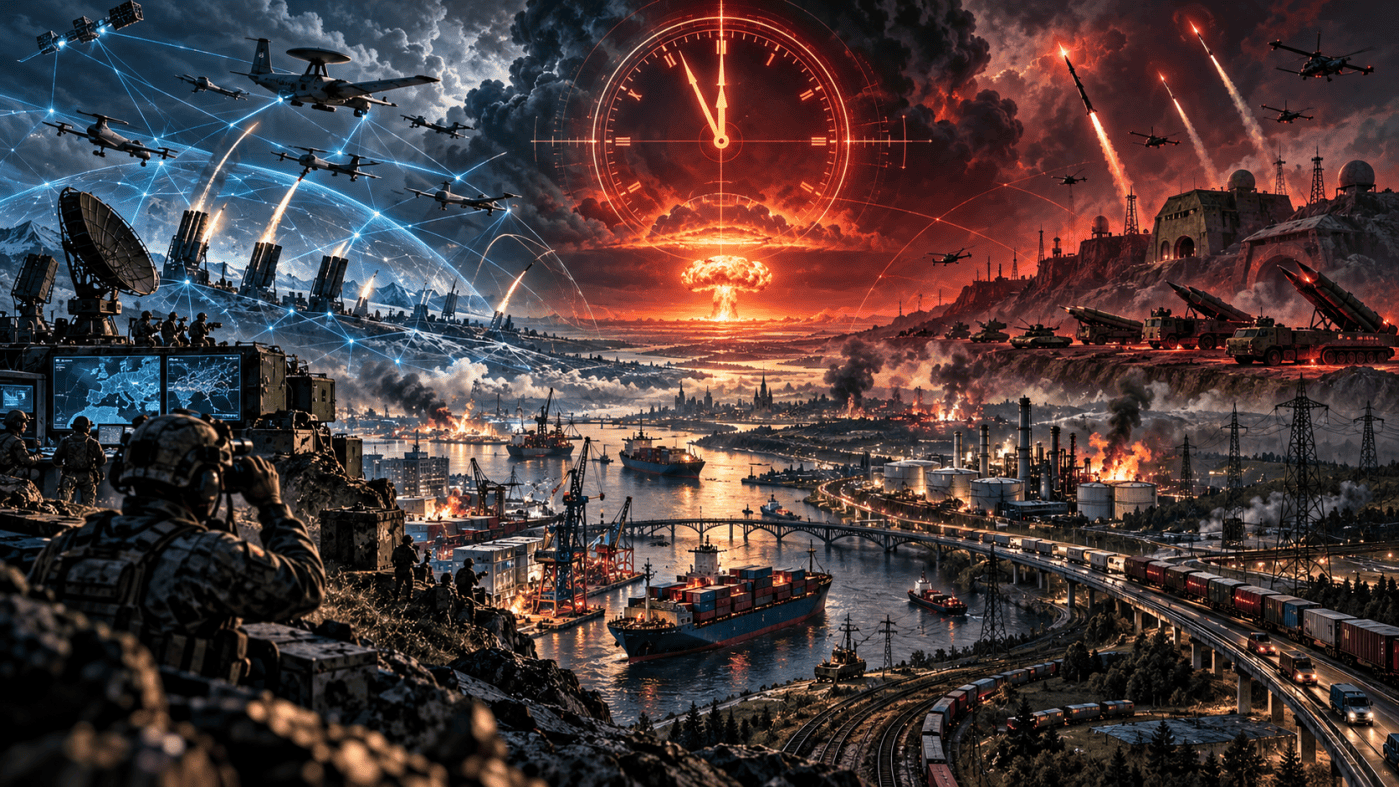
Bloomberg presents NATO’s new “Theory of Victory” as a technological answer to a possible Russian attack, but this war plan didn’t fall out of the sky: it arrives after decades of military expansion, continental war planning and a steady transfer of more of the Atlantic burden onto Europe. Drones, artificial intelligence and automated targeting are being wired into that older structure to shrink the distance between seeing and killing, while public budgets, civilian infrastructure and private industry are bent toward the requirements of permanent military readiness. Russia’s restored military power now feeds the confrontation in return, but it doesn’t erase the historical imbalance from which the conflict developed; every round of buildup leaves behind more weapons, more institutions and more reasons for the next round. The contradiction becomes most dangerous where NATO’s hunger for machine-speed advantage meets the hard limits of nuclear stability, because the faster the kill chain moves, the less time remains to recognize the mistake that could end the world.
Prince Kapone | Weaponized Information | October 6, 2026
Tomorrow’s Invasion Pays Today’s Bill
Bloomberg reporter Andrea Palasciano’s October 5 article, “NATO Drafts Plan to Defeat a Russian Attack With Drones and AI,” begins doing political work before the first paragraph even starts. Inside the story, Russia is possibly considering an incursion. By the time that possibility reaches the headline, it has stiffened into “a Russian attack.” A small grammatical trick carries a heavy load: something that might happen begins to feel like something already approaching, and everything NATO builds around that possibility starts looking less like a political choice than sandbags stacked against an oncoming flood.
That slide from possibility to necessity holds the article together. Bloomberg refers to “numerous recent reports” that Moscow is considering action against NATO, but it never establishes those reports before making the scenario the floor beneath the entire story. Uncertainty gets buried in the body copy, where NATO Secretary General Mark Rutte says there are no indications that Russia is preparing a conventional attack. Certainty gets the headline, the generals, the drones and the war plan. Fear doesn’t have to prove tomorrow. It only has to make paying for tomorrow’s war feel sensible today.
Then the fear gets dressed up as innovation. Gen. Alexus Grynkewich’s coming “Theory of Victory” promises low-cost drones, minimally crewed systems and AI-enabled targeting before NATO moves to destroy Russian command and control. Put “drones and AI” in the headline and continental war planning suddenly sounds half like a battlefield doctrine, half like a Silicon Valley product launch. The political argument is quietly narrowed into a technical one: which mixture of old weapons and new machines will win fastest? Even the disagreement Bloomberg mentions stays safely inside the weapons cabinet — tanks or newer technology — as though the public’s proper role is to debate what goes in the shopping cart, not ask why the cart keeps getting bigger.
NATO also gets the privilege of explaining NATO. Senior officials, diplomats, Grynkewich’s spokesman and Rutte dominate the story’s source structure, so the institution preparing the war plan largely supplies both the description of the danger and the language through which its own response is judged. “Purely defensive” is asked to carry an especially ridiculous amount of weight. NATO can describe its political purpose that way, but Bloomberg’s own account says the plan moves from stopping an incursion to gaining freedom of maneuver and destroying Russian command and control. One polite adjective is made to cover an entire battlefield.
The article’s most revealing admission almost slips by in work clothes. Bloomberg says the initiative is also supposed to reassure the public and show allied populations what sits behind the surge in defense spending. There the political function walks straight into daylight. The “Theory of Victory” is more than a plan for fighting a hypothetical war; it is a story told to the people being asked to finance the preparations. Tomorrow’s invasion explains today’s bill, technological spectacle makes the spending look modern and unavoidable, and the public argument begins only after the most important assumption has already been slipped through the door: this is the future Europe must prepare to purchase.
The Battlefield Was Built Before the Battle
NATO’s preparation for a large European war with Russia reaches much further back than an October 2026 “Theory of Victory.” British records from the 1990s show that officials already understood eastward enlargement could antagonize Moscow, especially as the alliance moved toward territory Russia considered strategically sensitive. British military planners were also running war scenarios involving Russia before the first major post-Cold War enlargement was complete. Those documents don’t turn everything that followed into destiny. They show that Western governments knew early on that moving the alliance east could change Russia’s security calculations and carry military consequences.
The shift toward preparing for high-intensity interstate war also began before Russia’s full-scale invasion of Ukraine. Russian military analyst Igor Istomin traces a sequence through NATO’s post-2014 buildup, its classified 2019 military strategy, the Deterrence and Defence of the Euro-Atlantic Area concept and the Warfighting Capstone Concept adopted before 2022. His reconstruction follows expanding forward forces, command structures, reinforcement plans and military-mobility requirements. The 2022 war poured fuel on the process, but pre-2022 war planning was already in motion.
By the 2023 Vilnius summit, NATO had approved a new family of regional plans for collective defense. NATO said those plans would shape force posture, command arrangements, readiness, exercises and future capability requirements. A possible future war was already being turned into standing military demands: which forces must exist, where they must move, what weapons they need and what roads, networks and supply systems must carry them.
The drone-and-AI layer was being fitted onto that structure before Bloomberg published its article. NATO’s Eastern Flank Deterrence Line was testing autonomous systems and digital interoperability in 2025, while the later Eastern Flank Deterrence Initiative brought together low-cost uncrewed systems, minimally crewed platforms, layered defenses and AI-enabled targeting. NATO’s Allied Command Transformation was already demonstrating AI-linked battlefield connectivity along the eastern flank. None of this machinery floats in the cloud. It needs communications networks, trained operators, repair crews, electricity, ammunition and factories alongside the software tying it together.
The deeper technological change is about command speed. NATO’s Next Generation Targeting program seeks to pull national sensor data together, use AI to filter and rank possible targets, match those targets with available weapons and cut information-to-decision time by more than half. NATO says human judgment remains the final authority. Even on those terms, however, algorithms increasingly shape what commanders see before anything reaches the firing stage: they sift the flood of information, narrow the target set and arrange possible engagements in order of priority.
At the same time, NATO is redistributing more of the military burden onto Europe. Secretary General Mark Rutte put it plainly in September when he said NATO had to become “more European” in order to remain transatlantic. European governments are being pushed to spend more, manufacture more and field more conventional military power. The process isn’t uniform. Poland has simultaneously sought a larger U.S. presence while expanding its own armed forces and military industry. Europe can become more heavily armed while American military power remains planted on the same soil.
The preparation reaches well beyond military bases. NATO’s September 2026 resilience requirements bring energy, food, water, telecommunications, transportation, healthcare, finance and government continuity into planning for military operations. Germany’s OPLAN Deutschland shows what that means once the abstractions hit pavement. The Bundeswehr says the plan could involve as many as 800,000 NATO personnel moving through Germany within six months, carried by roads, railways, logistics firms and other civilian systems, with preparations ideally beginning before a formal wartime emergency.
Russia is changing its forces too. Moscow has called for expanded unmanned systems, military robotics and greater use of artificial intelligence in command and weapons systems, including at a December 2025 military leadership meeting. European governments meanwhile accuse Russia of sabotage, cyber operations and other hostile activity below the threshold of conventional war. That is an active military confrontation, but an active confrontation is still different from a decision to invade NATO. Estonia’s 2026 intelligence assessment said Russia had no intention of attacking NATO during the coming year even while warning that Russian military capability could grow. Rutte likewise said on September 30 that NATO saw no imminent conventional threat.
The hardest limit appears where rapid conventional war approaches nuclear command. Russia’s revised nuclear doctrine says nuclear use may be considered when attacks on vital governmental or military facilities undermine the ability of Russian nuclear forces to respond. The available evidence doesn’t show NATO planning to attack Russian nuclear command networks, and a battlefield headquarters isn’t the same thing as strategic nuclear infrastructure. But a doctrine built around rapidly breaking command systems makes that distinction deadly serious if networks overlap, signals are misread or targets are misidentified. Research on military AI and escalation warns that faster decision cycles can leave less time to interpret ambiguity, challenge automated recommendations or catch a mistake before somebody acts on it.
By the time NATO’s “Theory of Victory” reaches the public, much of the material preparation is already standing: regional war plans, eastern-flank forces, automated targeting systems, larger European military commitments and civilian networks being prepared to carry the weight. The unresolved danger sits inside the doctrine’s promise of speed. The system is being built to shorten the time between seeing an enemy and striking it, while the nuclear boundary makes time itself one of the few things that can keep a conventional war from turning into something far worse.
The Faster the Kill Chain, the Shorter the Fuse
NATO’s technological promise rests on a brutally simple ambition: steal time from the enemy. See sooner. Sort faster. Decide quicker. Strike before the other side can recover. Artificial intelligence enters this battlefield less like some science-fiction warrior than like machinery for squeezing the distance between information and violence. Sensors pour data into the system, software sifts the flood, targets rise toward the top, weapons are matched to them, and commanders receive a battlefield already arranged into priorities. A human may still give the final order, but the machine increasingly decides what reaches that human in time to become an order at all.
That is what “decision advantage” looks like once the jargon is stripped off. Militaries have always wanted speed; the new systems try to manufacture it on an industrial scale. Seconds become a strategic resource. The side that processes the battlefield faster hopes to keep its opponent permanently off balance, always answering yesterday’s strike while tomorrow’s is already moving. From inside military logic, the promise is intoxicating. Delay becomes weakness. Hesitation becomes vulnerability. The ideal commander is the one who never has to wait.
But this machinery is being bolted onto an older structure of power. Washington is pushing more of Europe’s conventional military burden onto European governments while keeping the wider Atlantic system intact. Those governments are being told to build more weapons, field more forces, strengthen transport corridors and shoulder a larger share of the bill. Their ruling classes gain more military capacity, more industrial investment and more room to maneuver inside the alliance. Carrying more weight, however, doesn’t mean commanding the load. A worker can haul twice as much freight and still answer to the same foreman.
The arrangement becomes clearer once the rising cost of sustaining Atlantic military power is brought back down to earth. The United States has commitments far beyond Europe and can’t reproduce every layer of conventional force forever with American troops, American stockpiles and American money alone. So more of the burden moves outward. Europe becomes more heavily armed, more militarily productive and better prepared to sustain a continental war, while the larger command structure remains transatlantic. A reduction in one column of American troop numbers can live quite comfortably beside a deeper European commitment to the same strategic order.
Russia meets that order as a recovered capitalist state rather than the battered state that emerged from the Soviet collapse. NATO expanded eastward during a period when Moscow had lost enormous economic, political and military capacity. Russian recovery came later, after the military geography around it had already hardened. The state rebuilt strategic industries, restored military power and tightened control over nationally important capital. That gave Russia the capacity to resist subordination to the Atlantic order. It also left Russia capitalist. Its resistance can weaken monopoly Western command without turning the Russian state into an instrument of working-class emancipation. Multipolarity can crack the monopoly of one center of power; it doesn’t abolish class rule inside the states doing the cracking.
Once confrontation becomes permanent enough to plan around, it starts reorganizing production around itself. Military planners name the capabilities they want. Governments turn those demands into budgets. Budgets become contracts, factories, software systems, ammunition lines and infrastructure. Private capital doesn’t have to invent the conflict in some smoke-filled room to profit from it. The state creates the demand, absorbs huge portions of the risk and builds a market around military necessity. Capital then develops its own material stake in keeping that demand alive. That relationship is more concrete — and more dangerous — than the cartoon where a handful of arms dealers secretly pull every geopolitical string.
The promise of “cheap” autonomous warfare can hide this expansion in plain sight. A cheaper drone doesn’t automatically produce a cheaper military. Lower unit costs can mean more sensors, more interceptors, more surveillance systems and more expendable machines piled on top of the artillery, aircraft, armor, ammunition and command networks already there. The battlefield gets denser. So does the industrial apparatus needed to manufacture, repair, power, connect and replace everything moving through it. The robot arrives advertised as efficiency and quietly drags another warehouse in behind it.
Then the battlefield reaches backward into ordinary life. Rail lines that carry workers become routes for troops. Communications networks that hold civilian society together acquire military functions. Hospitals that keep people alive in peacetime are folded into plans for wartime casualties. Energy grids, roads, ports and logistics systems become part of the rear. At that point “defense spending” stops being a number on a government spreadsheet and becomes a fight over what society produces, what governments fund and whose needs get pushed to the front of the line. Workers build the weapons, run the trains, maintain the grids, staff the hospitals and pay into the budgets holding the whole structure up. The war plan reaches their lives long before the war reaches their streets.
Russia’s response feeds back into the machinery already facing it. NATO adds capabilities; Moscow adjusts its forces. Those adjustments become new evidence in Western threat assessments, and those assessments justify another round of buildup. Plans harden into institutions. Institutions demand factories, deployments and permanent budgets. The history remains asymmetrical because the Atlantic system expanded during Russia’s weakness, before the Russian state had recovered the power it possesses now. But Russia’s later response is no ghost. It becomes a real force inside the contradiction, helping reproduce the confrontation from the other side. Every turn leaves more steel in the ground than the one before it.
That’s why Bloomberg’s story can sound so reasonable without telling the whole truth of the process. Russia has military power. Russia has used military force. NATO planners prepare for what Russia might do next. Those are real facts, and they are enough to hold the frame together. The ideological trick begins when those facts are severed from the machinery that produced the present relationship. A possible future Russian attack then walks onto the stage as the natural first cause, while decades of military expansion, force planning, industrial buildup and strategic reaction fade into scenery. The effect puts on the clothes of the cause and hopes nobody notices the change backstage.
Here the obsession with speed crashes into something no engineer can code away. Conventional warfare rewards the ability to break the enemy’s command before the enemy recovers. Nuclear stability demands something harsher and slower: command systems that survive, signals that can still be understood, and enough time for leaders to distinguish an attack they can absorb from one they believe threatens their ability to retaliate. The faster the targeting system becomes, the harder those two logics grind against one another.
NATO wants to remove time from war because time gives the enemy room to think, regroup and answer. Nuclear weapons turn that same stolen time into danger. A commander forced to decide in minutes instead of hours has less room to test bad information, question a machine-ranked threat or recognize that an attack may be something other than the opening move of annihilation. The technology promises more control by accelerating violence, then discovers its limit exactly where speed begins to destroy control.
That is the contradiction buried under all the shiny talk about drones and artificial intelligence. The cheap machine still needs a factory. The algorithm still lives inside property and command. The European buildup still rests on workers, budgets and civilian infrastructure. Russia still answers military pressure with military pressure. And above the whole damn arrangement hangs a nuclear ceiling that doesn’t care how elegant the software looks on a general’s screen. The “Theory of Victory” promises to shorten the road from detection to destruction. Between nuclear powers, it may also shorten the road from decision to catastrophe.
The Supply Line Has a Working Class
NATO can fill its briefings with autonomous systems and machine-speed targeting, but its war plans still have to pass through human hands. Weapons cross docks because workers move them. Ammunition gets loaded because workers load it. Military vehicles travel through civilian transport networks because somebody keeps those networks running. The supply line has a working class, and organized workers already sit at some of the points where the machinery is most vulnerable to human refusal.
Dockworkers have made that relation explicit. Unions representing workers across more than forty Mediterranean and European ports — including CGT Ports and Docks, ENEDEP, LAB, Liman-İş, ODT, USB and ORSA Porti — have called an October 30 mobilization against war and the militarization of ports. Their declaration ties military logistics directly to working conditions and to the civilian purpose of the ports themselves. Participating unions are choosing tactics under their own legal and organizational conditions, including strike action where possible. The leverage here isn’t symbolic. Generals may need the ports, but generals don’t load the ships.
The fight also runs through budgets and workplaces. The International Movement Against War has carried opposition to militarization into trade-union branches, workplace meetings and coordinated mobilizations, including the dockworker action, a November youth strike and a later weekend against militarization and conscription. That puts the argument where it belongs. Rearmament stops being some distant quarrel among ministers and generals when workers confront it as a claim on wages, public money, working time and the institutions that keep ordinary life standing.
The nuclear limit creates another place where organized pressure can be applied. The International Campaign to Abolish Nuclear Weapons is organizing around the Treaty on the Prohibition of Nuclear Weapons and its first review conference beginning November 30. Its work on artificial intelligence and nuclear danger cuts straight into the contradiction developed here: faster targeting can leave less time to recognize an error before escalation outruns political control. ICAN has also condemned Russian nuclear threats while opposing NATO states’ continued reliance on nuclear deterrence, keeping the focus on the danger created by the weapons and doctrines themselves rather than pretending nuclear brinkmanship becomes harmless under the right flag.
The larger security order is contested too. The No to War – No to NATO Network has organized against European rearmament while keeping common-security alternatives alive in a political field increasingly reduced to arguments over how much to spend and which weapons to buy. Permanent military confrontation survives more easily when people are taught that no other form of security can even be imagined.
There is nothing autonomous about the society required to sustain autonomous warfare. States take the money. Corporations manufacture the systems. Workers load the ships and keep the transport networks moving. Governments ask civilians to absorb the cost while military planners work to squeeze more and more time out of the act of war. The contradiction sits right there in the open: the faster the machine is built to move, the more it still depends on people whose labor, resources and consent can’t simply be programmed away.


Leave a comment