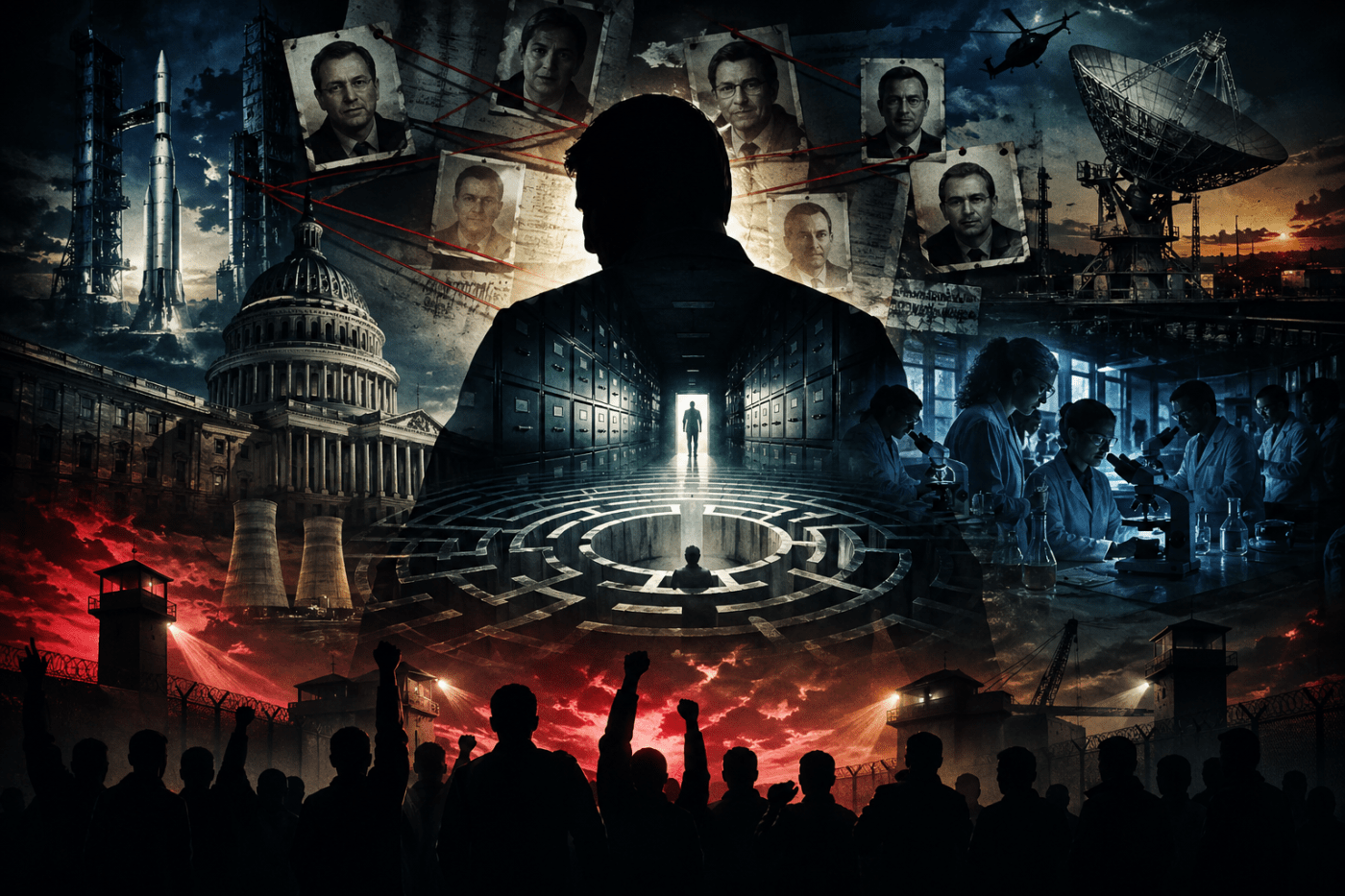
A sensational headline turns scattered deaths and disappearances into a national mystery, exposing how media manufactures fear from fragments. A closer investigation dismantles the narrative, revealing unrelated cases, inflated categories, and a congressional inquiry built on unconfirmed reporting. Beneath the spectacle lies a deeper contradiction: a militarized scientific apparatus that produces secrecy, confusion, and disposable labor within the machinery of empire. The only way forward is not chasing conspiracies, but organizing against the system itself—demanding accountability, transparency, and an end to the fusion of science, war, and state power.
By Prince Kapone | Weaponized Information | April 29, 2026
When Uncertainty Becomes the Product
“Missing Scientists Deadline Passes With No FBI Answers, Leaving 13 Families and a Nation in the Dark”, written by Jim Manzon and published by IBTimes UK on April 28, 2026, presents itself as a report on a congressional deadline that came and went without clear answers from the FBI, NASA, the Department of Energy, and the Department of War. The article tells the reader that thirteen people linked in some way to nuclear, rocket, aerospace, or sensitive scientific work have died or vanished, and that Congress is now demanding answers from the state agencies responsible for national security. On the surface, it is a story about missing people, grieving families, official silence, and public concern. Beneath that surface, however, the article performs another function: it turns uncertainty itself into the main commodity. It does not prove a conspiracy. It does not establish a pattern. It does not demonstrate a coordinated attack. What it does is arrange fear, mystery, state secrecy, and congressional theater into a narrative that asks the reader to feel that something sinister must be happening because the state has not explained everything.
This is where the excavation must begin. IBTimes UK is not a public-interest research institute or a scientific journal. It is a commercial digital publication owned by IBTimes LLC, part of the IBT Media universe, operating in the attention economy where clicks, anxiety, speculation, and dramatic headlines are not accidents but business logic. The outlet’s political-economic location matters because this article is not merely “informing” the public. It is competing for attention in a media environment where mystery must be sharpened, official ambiguity must be dramatized, and the reader must be pulled into the story before the next advertisement, sponsored retirement quiz, or miracle health gimmick appears under the fold. Jim Manzon’s author archive likewise shows a generalist production pattern across trending politics, crime, technology, UFO-adjacent intrigue, markets, and sensational public controversy. That does not make the reporting automatically false, but it does tell us what kind of machine is speaking. This is not a specialist national-security investigation built from patient documentation. It is a fast-moving digital news product assembled around anxiety.
The article’s most important propaganda device is fear. The phrase “thirteen families and a nation in the dark” is not neutral description. It expands private grief into national dread. Families searching for answers become the emotional gateway through which the reader is invited into a larger atmosphere of suspicion. The article then leans heavily on arguing from ignorance: because the FBI has not publicly explained the matter, because agencies have not fully satisfied Congress, because the deadline passed without a dramatic revelation, the absence of information becomes the fuel for speculation. This is an old trick. When evidence is thin, make silence sound loud. When facts are scattered, make the gaps do the shouting.
The structure also depends on narrative framing. The article gathers names from different locations, professions, timelines, and circumstances, then arranges them into “clusters” around New Mexico and California. Once the word cluster appears, the reader is nudged toward pattern recognition before causation has been established. A retired officer, a lab worker, a contractor, a physicist, a Caltech scientist, and a person with some connection to aerospace are pulled into the same symbolic basket. The basket is then labeled “missing scientists.” That label does enormous work. It gives coherence to what may be coincidence, bureaucracy, tragedy, crime, mental health crisis, workplace secrecy, or ordinary investigative delay. The article does not need to prove the pattern if it can make the pattern feel plausible.
There is also source hierarchy at work. Congress, the FBI, NASA, the Pentagon, Trump, and agency spokespeople become the official terrain of the story. The reader is moved from family anguish to Capitol Hill pressure to federal silence and back again. This gives the piece a feeling of seriousness, even when the evidentiary basis remains fragile. The article also practices card stacking. It includes official denials and family pushback against wild theories, but the headline, pacing, and accumulated list of names keep suspicion alive. The denial becomes part of the drama. The family’s plea for restraint becomes another paragraph in the mystery. Even skepticism is absorbed into the spectacle, like a courtroom objection in a television trial where the audience has already decided somebody must be hiding something.
Finally, the article relies on vagueness. “Linked to nuclear, rocket, and aerospace research” sounds precise, but it stretches across different kinds of work, different degrees of proximity to classified programs, and different levels of relevance to national security. The phrase allows the article to borrow the aura of the bomb, the rocket, the secret lab, and the classified file without doing the hard work of proving that each person stood in the same relation to state power. This is how propaganda often operates in respectable clothing. It does not always shout. Sometimes it whispers, stacks, implies, and lets the reader’s fear complete the sentence. The result is not yet an explanation. It is an atmosphere. And in the imperial media marketplace, atmosphere is often more profitable than truth.
]
From Mystery to Material Reality
The spectacle tells us there are “missing scientists.” The investigation, however, begins by stripping that phrase down to what can actually be proven. What we find is not a coordinated campaign of disappearances, but a set of disparate cases—some tragic, some criminal, some unexplained, and some already resolved—gathered together and given the appearance of unity. The House Oversight Committee, led by Chairman James Comer and Subcommittee Chairman Eric Burlison, did indeed send letters to federal agencies requesting information on individuals “linked” to sensitive scientific and defense work. But even in that official document, the committee admits it is responding to “recent unconfirmed public reporting”. The state itself is not beginning from a position of established fact, but from a media narrative that has already taken shape in the public imagination.
That distinction matters, because when the list of names is examined closely, the uniform category of “scientists” begins to dissolve. According to a detailed review by PolitiFact, several of the individuals cited in circulating reports did not hold scientific roles at all. Melissa Casias, for example, worked as an administrative assistant at Los Alamos, while Anthony Chavez was a construction foreman at the same facility. These are workers, not physicists guarding the secrets of the atom. Yet once placed inside the category of “nuclear-linked deaths,” their roles are elevated rhetorically to reinforce the sense of a targeted pattern. The category expands until it becomes elastic enough to include anyone who passed through the orbit of the national security apparatus.
When we examine specific cases, the supposed pattern fragments further. The death of Nuno Loureiro, a nuclear fusion physicist, was tied to a campus shooting in Massachusetts, with a named suspect identified by authorities. The killing of Carl Grillmair, a Caltech-affiliated astrophysicist, likewise resulted in an arrest. Other cases cited in the broader narrative show no confirmed evidence of foul play. Local investigators reported no suspicious findings in the deaths of individuals such as Melissa Casias and Jason Thomas. These are not fragments of a unified campaign. They are separate events, occurring under different conditions, with different causes, and at different stages of investigation.
Even the central figure driving congressional attention—retired Air Force Major General William Neil McCasland—does not fit neatly into the narrative of active, high-value targets. According to reporting cited in the same PolitiFact investigation, McCasland had retired more than a decade earlier, and his wife publicly stated that any classified information he once held would have been outdated. The suggestion that he was a critical node in an ongoing intelligence struggle collapses under the weight of time. Yet his disappearance, precisely because it remains unresolved, is elevated into the symbolic center of the story. Uncertainty, once again, becomes the organizing principle.
What the article also leaves largely unexamined is the institutional terrain in which these individuals worked. The New Mexico “cluster” is not a mysterious coincidence; it is the geographic heart of the United States nuclear weapons complex. Los Alamos National Laboratory openly states its mission is to design and sustain the U.S. nuclear deterrent, while Sandia National Laboratories describes itself as the engineering arm of that same enterprise. These are not neutral scientific environments. They are pillars of a militarized research system built around war preparation, weapons development, and strategic dominance. To say that people connected to these institutions have died or gone missing without acknowledging the nature of the institutions themselves is to describe the smoke while ignoring the fire.
The same applies to California. NASA’s Jet Propulsion Laboratory is not simply a site of planetary exploration; it is a federally funded research center managed by Caltech and embedded in the broader U.S. aerospace and defense ecosystem. JPL operates at the intersection of civilian science, military contracting, and state research priorities. Workers move through these spaces as employees, contractors, administrators, and engineers, each occupying different positions within a complex hierarchy. To flatten that hierarchy into a single category of “scientists” is to erase the real structure of labor inside the national security state.
At the level of politics, the congressional response cannot be separated from a broader escalation in national-security discourse. Just days after launching the inquiry into these cases, the same Oversight leadership opened an investigation into scientific collaboration with China, raising concerns about intellectual property, technology transfer, and strategic competition. This is not incidental timing. It situates the “missing scientists” narrative within a wider climate of geopolitical tension, where suspicion of foreign adversaries is already being cultivated. Before any evidence of external involvement has been publicly established, the political field is being prepared for that possibility.
What emerges, then, is a different picture from the one suggested by the headline. We are not looking at a confirmed campaign targeting elite scientific personnel. We are looking at a collection of unrelated incidents, some resolved and some not, drawn into a single narrative through media amplification, congressional opportunism, and the structural opacity of the national security apparatus. The real common thread is not a hidden enemy, but the system itself: a system in which scientific labor is organized through secrecy, stratified by clearance, and embedded within institutions whose primary function is not discovery, but power. It is this system—its silences, its hierarchies, and its contradictions—that turns ordinary tragedies into national mysteries.
The Fog Is the System, Not the Clue
Now we can drop the polite fiction. There is no “silent scientist war” hiding behind the curtain waiting to be discovered like a plot twist in a cheap thriller. What we are looking at is something far more real, far more dangerous, and far more ordinary: a system that produces opacity as a matter of routine, then feeds that opacity back to the public as mystery. The confusion is not a bug. It is the product.
Start with the basic contradiction. The same state that organizes scientific labor inside weapons laboratories, aerospace facilities, intelligence-linked research centers, and contractor networks also claims to be the guardian of transparency and public safety. It builds institutions where knowledge is classified, compartmentalized, and buried under layers of clearance, then acts surprised when the public cannot see clearly inside them. This is not incompetence. This is design. The national security state does not simply keep secrets—it manufactures the conditions in which secrecy becomes the normal state of affairs.
Into that fog step the media merchants. They do not need to invent facts; they only need to arrange uncertainty. A death here, a disappearance there, a congressional letter, a quote from a politician, a grieving family, a vague reference to “sensitive research”—stitch them together and you have a narrative that feels like a pattern. Not because the pattern exists in reality, but because the conditions of empire make it believable. When everything is hidden, anything can be imagined. And imagination, in this system, is not a neutral act. It is guided, nudged, and monetized.
This is Cognitive Warfare at the level of everyday news. The population is not simply informed; it is managed. Fear circulates faster than evidence. Suspicion fills the gaps where explanation should be. The public is trained to oscillate between blind trust in official institutions and total paranoia about hidden forces. Both positions serve the same function. If you trust completely, you do not question power. If you distrust everything, you cannot organize against it. Either way, the structure remains untouched.
Look again at the terrain we uncovered. These individuals did not exist in a vacuum. They were workers—some highly trained, some administrative, some technical—embedded inside a militarized scientific apparatus. Los Alamos, Sandia, JPL, the Air Force Research Laboratory—these are not temples of pure knowledge floating above society. They are factories of state power. They produce weapons, surveillance systems, strategic technologies, and the infrastructure of global dominance. To work inside them is to labor within the machinery of empire, whether one recognizes it or not.
And here is the uncomfortable truth the article cannot say: when human beings are inserted into a system organized around secrecy, hierarchy, and war, their lives become secondary to the function of that system. Not because someone is necessarily targeting them, but because the system itself does not prioritize their humanity. Workers become roles. Roles become functions. Functions become expendable. When something goes wrong—whether it is violence, mental strain, institutional failure, or simple bureaucratic neglect—the system does not reveal itself. It closes ranks. It speaks in fragments. It delays. It deflects. It produces exactly the kind of silence that later gets repackaged as mystery.
This is where Technofascism reveals its teeth. Science, media, and the security state are no longer separate domains. They are fused. Knowledge production serves military strategy. Media production serves perception management. Political institutions serve narrative control. The result is a world where even death cannot be understood clearly, because the structures that surround it are designed to obscure rather than illuminate. The worker disappears, and what remains is not clarity, but spectacle.
And once spectacle takes hold, the system gains another advantage. It redirects attention away from material questions. Instead of asking why scientific labor is organized through secrecy, why research is tied to weapons development, why institutions operate without democratic oversight, the conversation drifts toward ghosts, conspiracies, and shadowy enemies. The public is invited to hunt for villains in the dark while the architecture of power stands in plain sight, untouched.
So the real story is not hidden behind the deaths. It is standing right in front of us. A militarized research system produces opacity. A profit-driven media system converts that opacity into fear. A political system amplifies the fear to justify further control. And the working people inside that system—scientists, technicians, administrators, contractors—are left navigating a structure that will not fully explain itself even when their lives are on the line.
The question, then, is not who is secretly eliminating scientists. The question is why we continue to accept a world where knowledge is owned, hidden, and weaponized; where workers are placed inside institutions they cannot fully see; and where every unanswered question becomes an opportunity for the system to tighten its grip. The fog is not a clue. The fog is the system. And until that system is confronted, the mysteries will keep multiplying—not because the truth is unknowable, but because it is being systematically buried.
From Suspicion to Struggle
If the system produces fog, then the task is not to wander inside it chasing shadows—it is to organize in the open, on the terrain where power can actually be confronted. The people most immediately affected here are not abstract “national security assets,” but families searching for answers and workers laboring inside institutions that do not fully account for their safety or their humanity. Solidarity begins there. It begins with the simple demand that no worker—whether scientist, technician, or administrative staff—should disappear into silence, and no family should be left to navigate grief through rumor, speculation, and bureaucratic indifference. That demand is not conspiracy. It is accountability.
But accountability does not come from the same institutions that produce opacity. It is forced from below. One place to begin is the growing anti-nuclear and anti-war movement, where organizations like Defuse Nuclear War are actively working to reduce the risk of nuclear confrontation and challenge the expansion of the U.S. nuclear weapons complex. This coalition, which includes over 200 organizations and is coordinated through RootsAction, provides a concrete platform for connecting the conditions of scientific labor inside weapons laboratories to the broader struggle against militarization. Their publicly documented coalition structure and organizing campaigns demonstrate a grassroots model rooted in mass participation rather than state sponsorship, offering an avenue for collective pressure that does not depend on the very agencies under scrutiny.
At the same time, the broader antiwar movement must be mobilized to confront the political climate that turns uncertainty into geopolitical weaponry. Organizations such as CODEPINK have built sustained campaigns against militarism, weapons spending, and Cold War escalation. Their work—documented through public filings and independent nonprofit transparency records—shows an organizing model based on member contributions and grassroots activism, not imperial state funding. This matters, because any movement capable of confronting the contradictions exposed in this story must remain independent of the very power structures it seeks to challenge. The struggle is not to refine imperial narratives, but to break their hold altogether.
The tactical direction must be clear and grounded. First, demand independent, publicly accessible investigations into each case—separate from sensational media framing and insulated from geopolitical scapegoating. Second, organize within and alongside scientific and technical workers to challenge the conditions of secrecy and hierarchy that define their labor, pushing for transparency, workplace protections, and democratic oversight. Third, reject attempts to turn these cases into justification for xenophobia, war escalation, or a new wave of Cold War paranoia; the reflex to blame foreign enemies without evidence only strengthens the very apparatus that obscures the truth. Fourth, build local and national campaigns linking these issues to the broader struggle against nuclear weapons, militarized research, and the fusion of science with imperial power.
This is not a call for passive concern. It is a call to transform confusion into clarity and clarity into action. The families deserve answers. The workers deserve protection. The public deserves truth. But none of these will be handed down from above. They will be won through organized pressure, collective struggle, and a refusal to be distracted by the spectacle of mystery when the structure of power is already visible. The task is not to solve the riddle the system presents. The task is to dismantle the conditions that make such riddles possible in the first place.


Leave a Reply