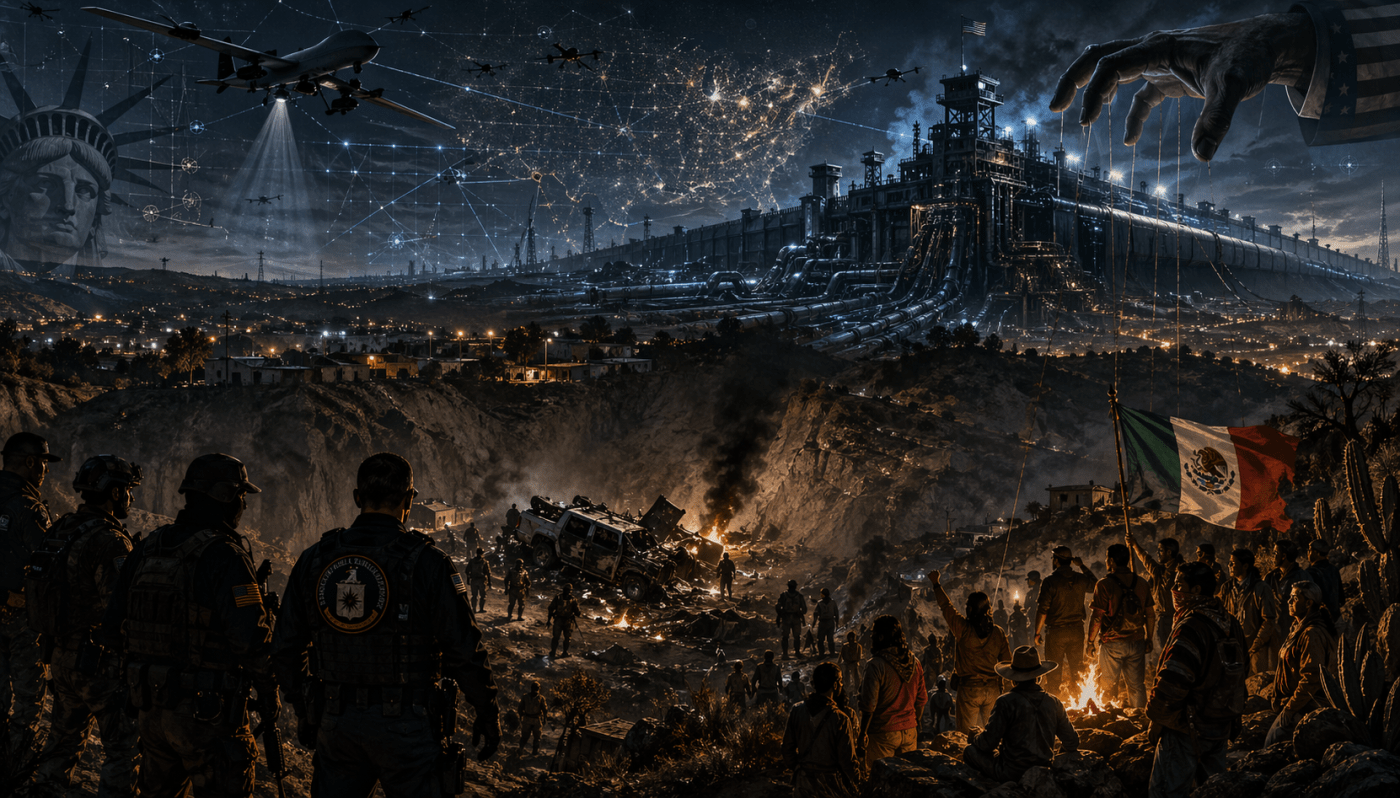
What appears as a tragic incident in Chihuahua is exposed as a carefully managed narrative that obscures the presence of foreign power operating inside Mexico. The factual record reveals a dense security architecture where intelligence, surveillance, and training pipelines blur the line between cooperation and control. Stripped of illusion, the episode reflects a deeper contradiction in which sovereignty is formally asserted but materially pressured by an expanding imperial system. From this reality emerges a clear line of struggle, where organized movements on both sides of the border confront militarization, defend territory, and resist the normalization of external domination.
By Prince Kapone | Weaponized Information | April 22, 2026
When Liberal Empire Whispers About Sovereignty
Thomas Graham’s April 21, 2026 Guardian report arrives draped in the respectable clothing of liberal alarm: two US officials attached to the embassy die after a Chihuahua anti-drug operation, they are reported to be CIA agents, Mexican authorities open an investigation, and President Claudia Sheinbaum says neither she nor her cabinet had prior knowledge of the operation. The piece presents itself as sober reportage on a potentially unlawful security incident, one in which the central drama lies in conflicting official accounts, the uncertain scope of US involvement, and the question of whether Mexico’s constitution and national security law were violated. That is the article’s declared terrain, and it is important to begin there, because the Guardian does not come to the reader dressed as a war drum or a tabloid thug. It comes as the calm voice in the room, the polite cousin of empire, the one that lowers its voice just before delivering the same old lesson: power may trespass, but it must do so tastefully.
Graham’s framing is careful in the way a locksmith is careful. He does not burst through the door; he turns the key slowly. The article gives us a ravine, a wrecked vehicle, conflicting state statements, an investigating president, an unresponsive embassy, and the insinuating presence of the CIA hovering over the whole affair like cigar smoke in a government corridor. What it does not do is explode the contradiction that is already sitting in its own paragraphs. Instead, it organizes that contradiction into a manageable liberal puzzle. The issue becomes whether the Americans were merely “working together” with local authorities, whether they had arrived after the operation for “training purposes,” whether federal approval was missing, whether the CIA had strayed beyond intelligence sharing. This is narrative framing in its pure professional form: not a crude lie, but a disciplined narrowing of the field of meaning. The reader is ushered into a chamber of procedural uncertainty, where the great question is not what kind of political relationship makes such an incident possible, but whether the paperwork was in order when the boots touched the ground.
The article’s first major propaganda function is omission masquerading as balance. Graham includes Sheinbaum’s insistence that there are no joint operations on the ground without federal approval, and he notes the sensitivity of US law enforcement activity in Mexico, yet the structure of the piece treats these not as signs of a deeper contradiction but as inputs in a dispute among officials. The result is that sovereignty is acknowledged but domesticated. It appears not as a living political struggle, but as a legal concern under review, like a filing cabinet that may have been opened by the wrong clerk. This is how liberal imperial journalism launders power. It does not deny the violation outright. That would be too vulgar, too Fox News, too drunk on its own flag. It simply arranges the facts in such a way that the violation becomes one interpretive option among several. The effect is to cool the political temperature of the event while preserving the appearance of seriousness. Empire, after all, need not always shout. Sometimes it clears its throat and asks for an internal review.
A second device is source hierarchy. The article lives almost entirely inside the speech of officials: the president, state prosecutors, the embassy, unnamed reporting about CIA affiliation, and the background hum of Trump-era pressure. Authority flows downward from institutions, and the reader is taught to experience the event through the contradictions of elite voices rather than through the material meaning of those voices. Even the most politically explosive detail—that the dead men were reported to be CIA operatives—is introduced through a mediated chain of attribution and then folded back into official silence. That is classic professional discipline. You let the scandal enter the room, but only through the servants’ entrance. You allow the fact enough oxygen to electrify the piece, but not enough to reorganize its center of gravity. In this way the article performs a kind of source management that is more elegant than crude censorship and often more effective. The important thing is not to erase the uncomfortable fact, but to subordinate it. The CIA appears, but only as a question mark with credentials.
A third device is vagueness, that beloved perfume of respectable newspapers. The report is full of formulations that preserve dramatic charge while avoiding full commitment: “reported to be CIA agents,” “working together,” “a much greater role,” “whether it goes beyond intelligence sharing.” These phrases are not useless; they tell us quite a bit. But they also do ideological work. They suspend the event in a fog of managed uncertainty where implication can thrive without resolution. This is not accidental. Vagueness is often the preferred style of imperial media when the underlying issue is explosive enough to interest the public but too sensitive to narrate bluntly. The reader gets the aroma of clandestine overreach, but not the meal. Like a restaurant for the liberal conscience, the portion is small, expensive, and designed to leave you feeling refined rather than full.
A fourth device is appeal to legality. Graham repeatedly returns the story to the question of whether Mexican law was violated and whether Sheinbaum had been informed, which on the surface seems not only fair but necessary. Yet this legal framing also performs a narrowing function. It invites the reader to understand the matter primarily as a possible breach of rules rather than as an expression of structured power. That is the magic trick. Once the event is converted into a question of compliance, the horizon of judgment shrinks. If the proper authorization had existed, the reader is subtly encouraged to imagine, then perhaps all would have been in order. The issue becomes the management of sovereignty rather than its substance. Liberal legality is often empire’s favorite tailor: it does not ask who owns the body, only whether the suit fits.
The Guardian’s own self-presentation helps explain the tone. The paper speaks from inside a consciously liberal moral architecture, one that prides itself on insulation from proprietorial pressure and on the dignity of editorial independence. Graham himself is presented by the Guardian as a freelance journalist based in Mexico City, a positioning that lends the piece both proximity and field authority. None of this makes the article false. It makes it legible. The report belongs to that old and durable family of liberal texts that can perceive contradiction, can even register imperial discomfort, but cannot quite step outside the grammar that makes empire appear reformable so long as its procedures are corrected by the proper people.
So what does the piece finally accomplish? It does not celebrate the incident. It does not sneer at Mexican sovereignty. It does something more refined and therefore more useful. It stages the affair as a troubling breach inside an otherwise governable order. It transforms a politically charged question of foreign power, covert presence, and state authority into a measured dispute over approval, coordination, and institutional boundaries. That is the article’s ideological achievement. It gives the reader enough friction to feel informed, enough tension to feel serious, and enough restraint to prevent the story from breaking open into its full political meaning. In the liberal press, that is often how empire speaks when it wishes to seem embarrassed by itself. Not with a bayonet, but with a raised eyebrow.
What the Incident Says, and What It Refuses to Say
The reporting establishes a controlled surface narrative—clean, procedural, almost bureaucratic in its clarity. Mexico opened an investigation into whether its constitution and national security law were violated after two U.S. embassy officials died following an anti-drug operation in Chihuahua. President Claudia Sheinbaum stated directly that neither she nor her cabinet had been informed in advance. The operation itself targeted a clandestine drug lab in the municipality of Morelos, and the aftermath ended in a crash into a ravine that killed two Mexican officials alongside the Americans. What follows in the reporting is not resolution but recalibration. Early accounts place U.S. personnel inside the operation; later statements reposition them as peripheral actors—trainers, advisors, providers of drone-related support. At the federal level, Mexican authorities restate a principle that is neither symbolic nor negotiable: foreign agents do not conduct field operations on Mexican soil without explicit federal authorization. Cooperation exists, but it is bounded, centralized, and governed by national law—not improvised through regional or informal arrangements. Yet even within this controlled narrative, the presence of CIA-linked personnel, identified across reporting, exposes a contradiction that the surface framing cannot contain.
That contradiction sharpens the moment the legal framework is treated as material reality rather than diplomatic language. Mexico’s National Security Law, amended in 2020, establishes a strict operational boundary for all foreign agents. Their role is confined to information exchange. All intelligence must be reported to Mexican authorities. All activity must conform to protocols defined by Mexican institutions. Immunity is not granted for violations of domestic law. These are enforceable conditions, not rhetorical guidelines. The law is the line. And that line was drawn through conflict. The 2020 reform emerged directly from disputes over U.S. agencies operating in Mexico without full oversight, particularly in the aftermath of high-profile incidents that exposed the depth of unilateral action. The restriction of DEA, CIA, and FBI activity was not a theoretical adjustment—it was a defensive response by the Mexican state to a pattern of encroachment. The present investigation, then, is not simply about whether a law was violated; it is about whether a historically contested boundary is being crossed again under new conditions.
The incident in Chihuahua rests on top of a deeper and more durable security architecture that rarely appears in official narratives but defines the terrain in practice. The CIA has maintained a long-running covert campaign inside Mexico through vetted Mexican units, embedding itself within counter-narcotics operations over decades. This architecture is not episodic; it is institutional. Intelligence flows, training pipelines, surveillance capabilities, and operational coordination have been constructed in ways that blur the line between cooperation and integration. The existence of this system explains why the presence of U.S. personnel in Chihuahua is not anomalous—it is structurally produced. At the same time, U.S. policy has been expanding the legal justification for more aggressive forms of involvement. In January 2025, the Trump II administration initiated the designation of cartels as foreign terrorist organizations, extending the legal framework used for global counterterrorism into the sphere of organized crime in Mexico. This shift is not semantic. It authorizes new forms of surveillance, intelligence operations, financial targeting, and potential cross-border action under the logic of counterterrorism. The terrain is being redefined from cooperation between states to intervention justified by security doctrine.
Recent developments confirm that this is not a singular rupture but a recurring pattern of friction and recalibration. In February 2025, Sheinbaum acknowledged the existence of U.S. drone flights over Mexican territory, situating them within cooperative frameworks while simultaneously asserting that such activities remain subject to Mexican authority. The admission reveals both the scale of surveillance activity and the necessity of publicly reasserting sovereignty. Later, in reporting on “Project Portero”, Sheinbaum rejected U.S. claims of a bilateral anti-cartel initiative, stating that no such agreement had been formalized by Mexico. These moments are not miscommunications; they are confrontations over jurisdiction. They reveal a persistent divergence between how Washington frames its operational reach and how Mexico defines its sovereign limits. At the same time, the Mexican state continues to execute its own strategy. Official briefings document sustained campaigns against clandestine laboratories and synthetic drug production, demonstrating that Mexico is not dependent on external enforcement but actively engaged in its own national security operations.
When placed within the full institutional context, the Chihuahua incident reveals a structured relationship organized through formal agreements and sustained through asymmetrical power. The Bicentennial Framework for Security, Public Health, and Safe Communities codifies cooperation across intelligence sharing, disruption of criminal networks, control of synthetic drugs, firearms interdiction, and judicial coordination. It is presented as a partnership grounded in mutual respect for sovereignty. Yet U.S. policy documents such as the State Department action plan define these same areas as shared national security priorities requiring deep integration of systems, data, and operations. This dual structure produces a consistent dynamic: cooperation that expands U.S. operational presence while formally affirming Mexican sovereignty. The contradiction is not accidental—it is built into the framework itself.
This dynamic is the continuation of a longer trajectory. From the Mérida Initiative onward, the United States has embedded itself within Mexico’s security apparatus through funding streams, training programs, intelligence sharing systems, and logistical coordination. These mechanisms have created enduring channels through which U.S. agencies influence, shape, and participate in Mexican security operations. The Chihuahua incident is not an isolated breach of protocol; it is a moment where the accumulated weight of that presence exceeds the limits imposed by law and political authority. The investigation now underway is not simply about an event—it is about the boundaries of a system that has been expanding for years.
The significance extends beyond the bilateral relationship into a continental configuration of power. U.S. and joint policy frameworks link Mexico to a wider system encompassing weapons trafficking from the United States into Mexico, precursor chemical flows tied to global supply chains, illicit financial networks, cross-border commerce, and public health strategies addressing drug consumption. Within this system, security is not confined to territory—it is distributed across networks that operate at regional and global scales. The question raised by Chihuahua is therefore not limited to what occurred in a single municipality. It is a question about how authority over intelligence, surveillance, and force is organized across North America, and about which institutions ultimately determine how far that authority can extend.
What emerges from this accumulation is not a breakdown of cooperation, but the exposure of its underlying structure. The legal boundary exists, has been contested, and continues to be pressed against by a security architecture that extends beyond formal agreements and into embedded operational practice. The presence of foreign personnel, the expansion of surveillance, the reclassification of cartels under counterterrorism doctrine, and the repeated disputes over authorization are not disconnected developments—they are expressions of a single, evolving system. The Chihuahua incident does not stand apart from that system; it reveals it. The question is no longer whether a protocol was violated on a given day, but how a framework built on asymmetrical power produces conditions where such violations become both possible and recurring. To understand this fully requires moving beyond the surface of law and policy into the structure that gives them their form.
When Sovereignty Becomes Conditional: Empire, Cartels, and the Quiet Expansion of Power
Let’s speak plain. What happened in Chihuahua was not some bureaucratic mix-up or a tragedy born of confusion. It was power moving the way power has learned to move—quietly, inside the house, without knocking. Foreign personnel embedded in a live operation. Lines of authority blurred after the fact. Federal command stepped around like a puddle in the street. And when the whole thing starts to smell, the language changes—“training,” “support,” “advisory.” That is not explanation. That is cleanup. Nothing malfunctioned except the story they needed you to believe.
If you want to understand why this keeps happening, you have to stop staring at the incident like it fell from the sky and start looking at the structure that produced it. This is the colonial contradiction still breathing, still working. On one side, a nation trying to stand on its own feet—law, territory, authority. On the other, a power that has never learned how to live without leaning on its neighbors’ backs. That contradiction didn’t disappear when the flags changed—it got dressed up, modernized, made respectable. What we are looking at is colonialism without the old uniform: sovereignty on paper, constraint in practice.
This is imperialism in its late hour, when it doesn’t always march in—it seeps in. It builds channels: intelligence, training, surveillance. It lays pipes through institutions until it can circulate through another country like blood through a borrowed vein. Mexico is told it is sovereign—and formally, yes, it is. It has its constitution, its courts, its officials. But sovereignty that must constantly guard itself against its “partner” is already under siege. What exists is not sovereignty in full—it is sovereignty with conditions attached, sovereignty that has to ask how far it can go before someone else redraws the line.
The so-called narco war is the engine that keeps this machine running. Drugs move north, guns move south, and money moves everywhere, stitching together legal markets and underground economies into one system that doesn’t recognize borders the way ordinary people do. The violence is real—people bleed, communities break—but its role inside the larger structure matters even more. It manufactures crisis. And crisis, like a good excuse, is always ready when power needs it. The “cartel threat” becomes the all-purpose justification—expand surveillance, deepen coordination, move a little further in each time, always in the name of necessity.
This is not accidental drift. It is recalibration. As global dominance begins to slip, the United States tightens its grip closer to home. The hemisphere is being reorganized into something like a fortified zone—a Fortress America, where trade, security, and politics are fused into a single chain of control. In that chain, Mexico is not just another link—it is a central hinge. Its geography, its labor, its infrastructure—too valuable to let go, too complex to fully dominate. So the strategy becomes pressure without rupture. Expansion without declaration. Chihuahua is not an exception—it is the method.
The shift toward a counterterror logic sharpens the knife. Once cartels are folded into the category of “terrorism,” the rules change without anyone voting on it. Terrorism is not just a label—it is a legal weapon. It widens surveillance, lowers the threshold for intervention, and makes cross-border action sound like self-defense. Under this logic, “support” and “operation” begin to blur into each other. That is why, after the fact, nobody can quite say who was doing what in Chihuahua—because the system no longer needs those lines to stay clean.
But this is not a simple story of one side acting and the other side receiving. Mexico is not standing still. It is moving, trying to carve out space in a tightening structure. There are real efforts to assert control—over security, over territory, over foreign presence. These are not illusions. They are attempts at partial escape from a long-standing dependency. But the chains are not only political—they are economic, institutional, historical. The economy is deeply tied northward. The security apparatus has been trained and shaped through years of integration. The ruling class is divided, pulling in different directions. Sovereignty here is not a fixed possession—it is a contested terrain.
And those internal divisions are not a weakness in spite of the system—they are part of how the system works. Empire does not always break states apart; sometimes it moves through their cracks. Federal authority says one thing. Local actors do another. Institutions connect to networks that stretch beyond the nation. When operations happen without federal approval, that is not just a procedural slip—it is the structure revealing itself. Sovereignty is fragmented, and what is fragmented can be entered.
President Sheinbaum is trying to push against that reality. Her insistence on federal control is not symbolic—it is a real struggle to reclaim authority over a system that has been gradually opened from within. But that struggle unfolds inside a web of dependency that does not loosen easily. This is what anti-imperialist sovereignty looks like under pressure: it advances and meets resistance; it asserts and gets pulled back; it moves forward with one hand while the other is held in place.
That is why Chihuahua matters—not because it is unusual, but because it is ordinary. A boundary is crossed. Then it is denied, softened, reframed. Then negotiated. Then accepted. And once accepted, it becomes the new baseline. This is how power expands when it wants to avoid headlines—step by step, adjustment by adjustment, until what once seemed unthinkable becomes routine. Sovereignty is not abolished in one stroke—it is reshaped piece by piece.
And let’s not dress it up as cooperation between equals. This is management. Neocolonial management in a time when empire is under strain. The language of partnership is a polite cover for a relationship where one side can project force and the other must negotiate how that force enters its own house. The media plays its part—it describes the scene, quotes the officials, and leaves the machinery untouched.
But the machinery is the story. A system where crisis justifies presence, presence enables expansion, and expansion redraws the limits of sovereignty. A system reorganizing an entire region under one dominant power, even as that power faces challenges beyond its borders. And in the middle of it, Mexico—pushing, resisting, negotiating—caught in the tension between autonomy and the structures that bind it.
Empire does not always arrive with boots and banners. Sometimes it arrives with agreements, training programs, and the soft language of “support.” It settles in, grows quietly, and waits for the boundaries to shift. And when those boundaries finally move, the question is no longer whether sovereignty was crossed. The question is who now defines it—and on whose terms it continues to exist.
From Exposure to Struggle: Linking Sovereignty to Organized Resistance
The system exposed in Chihuahua is already being resisted. Not in theory, not in commentary—but on the ground, by organized forces that understand exactly what is at stake. Across Mexico, Indigenous nations, campesino communities, and working-class formations are confronting militarization, territorial dispossession, and foreign security penetration as one unified process. The struggle is not framed as “crime control” or “policy disagreement.” It is understood for what it is: a fight over land, autonomy, and sovereignty in the face of a system that seeks to manage all three.
At the center of that resistance stands the Congreso Nacional Indígena, a national articulation of Indigenous peoples, communities, and organizations built explicitly to coordinate resistance and rebellion. Its current political line leaves no ambiguity—it identifies militarization, organized crime, capitalist megaprojects, and external domination as interconnected fronts of a single war against the people. Through its nationwide assemblies, forums, and coordinated actions, the CNI is not appealing for reform—it is organizing sustained resistance rooted in territory and collective power.
Linked directly to this current is the Asamblea Nacional por el Agua, la Vida y el Territorio, which is actively coordinating defense struggles across the country. Their declarations and alerts show communities organizing against militarization, criminalization, and resource extraction simultaneously—not as separate issues, but as a unified system of dispossession. This is not NGO advocacy. This is coordinated territorial defense, with communities building the capacity to resist both state and external pressure in real time.
At a more localized level, formations like Pueblos Unidos de la Región Cholulteca y de los Volcanes are confronting the same system at the point where it hits hardest—land, water, and survival. Their struggle ties multinational capital, state policy, and external influence into one chain of dispossession, and their response is direct: organize, defend territory, and refuse incorporation into a system that treats their land as a resource to be managed from above.
Solidarity cannot stop at the border. Inside the United States, there are formations that understand that the expansion of this security apparatus abroad is inseparable from repression at home. The Party for Socialism and Liberation has built an active anti-imperialist and anti-war infrastructure rooted in working-class organization, explicitly opposing U.S. intervention and militarization. At the same time, projects like the Mexico Solidarity Project are working to build political alignment between struggles in Mexico and movements in the United States, exposing intervention and supporting sovereignty from the north side of the border.
The line of struggle that emerges is concrete.
First: break the information blockade. The expansion of U.S. security power depends on narrative control. Every drone flight, every joint operation, every “training mission” must be documented, exposed, and circulated outside the imperial media apparatus. This means building and strengthening independent platforms that track militarization and connect it directly to the broader system of control. Information here is not passive—it is a weapon.
Second: align materially with territorial defense movements in Mexico. This means more than amplification. It means building direct relationships with formations like the CNI and ANAVI—supporting their campaigns, translating and circulating their positions, and ensuring their struggles are not isolated. The defense of sovereignty is already being carried out by these communities. The task is to reinforce that struggle, not speak over it.
Third: organize against militarization and surveillance inside the United States as part of the same fight. The apparatus expanding into Mexico does not stay there. It is developed, tested, and then turned inward. Organizing against police militarization, surveillance expansion, and counterterror frameworks domestically is not separate work—it is the same struggle on a different front. Linking these fronts is essential for building real counter-power.
Fourth: reject the narco-war narrative as justification for endless intervention. The crisis is real, but the use of that crisis to expand control must be confronted directly. This requires political education rooted in material reality—showing how the same system that fuels the crisis uses it to justify deeper penetration. If that narrative is not broken, the expansion will continue with public consent.
The situation is clear. Sovereignty will not be defended by statements or investigations. It will be defended by organized people, acting collectively, across borders, against a system that is already in motion. The forces resisting that system exist. The question is whether they remain isolated—or whether they are connected into a conscious, coordinated struggle capable of meeting power with power.


Leave a Reply