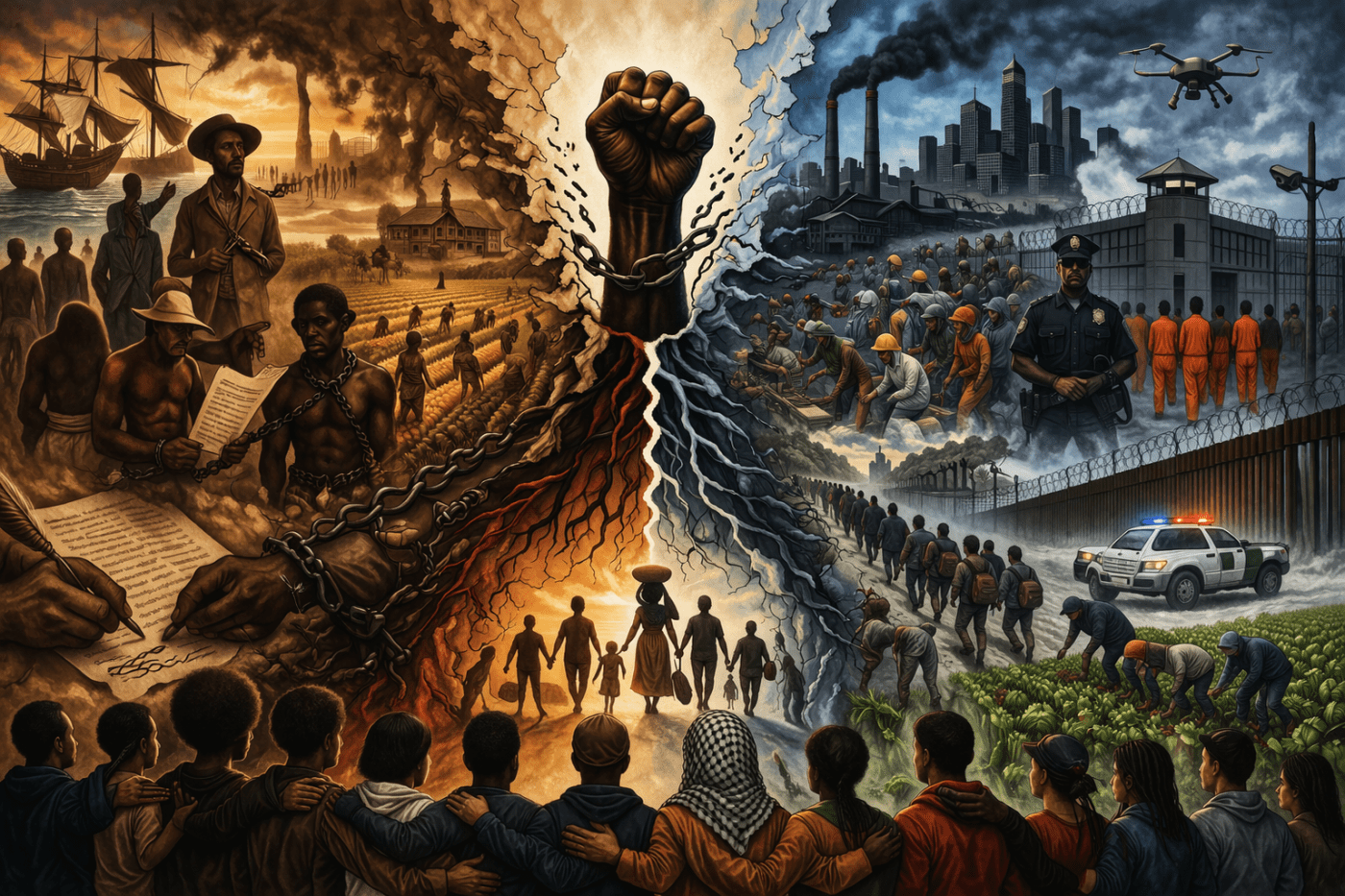
What appears as a conflict between race and class is, in reality, the internal structure of empire reproduced within the United States. By tracing the evolution from indentured contracts to slave codes, we uncover how law organized labor into fundamentally different relations of exploitation and domination. The system then expanded into a total regime that fractured culture, suppressed unity, and bound sections of the working population to the colonial order. From Reconstruction to the modern prison and border regime, these divisions were continuously rebuilt to stabilize capitalism. What emerges is not two separate struggles, but a single structure demanding a unified, revolutionary response.
By Prince Kapone | Weaponized Information | April 6, 2026
The Contradiction Beneath the Name: Race, Class, and the Empire Within
There is a familiar story told about the United States, repeated so often it begins to feel like common sense. It tells us that there is a tension between race and class, that one speaks to identity while the other speaks to economics, that one divides what the other might otherwise unite. From this view, the task is to reconcile them—to either transcend race in favor of class, or to correct class analysis by incorporating race. But this framing, for all its popularity, begins from a mistake. It treats as separate what was historically produced together. It mistakes the symptom for the structure. And in doing so, it obscures the very foundation upon which the society was built.
The contradiction is misnamed because it is misunderstood. What appears as a tension between race and class is, in reality, the domestic expression of a deeper historical process: the internalization of empire. The global division between oppressor and oppressed nations—so central to the development of modern capitalism—did not remain at the level of overseas colonies. In settler formations such as the United States, that division was reproduced within the borders of the state itself. Here, the language of “race” emerged not as an accidental cultural prejudice, but as the ideological form through which national domination was organized and justified. Race, in this sense, is not a biological fact or a mere social construct floating above material life. It is the political language of a system that required some populations to be ruled, contained, and exploited as if they were foreign within the own land they were transferred to.
To say this plainly is to depart from both liberal and economistic explanations. Liberalism reduces the problem to attitudes, to bias, to the unfinished moral project of equality. It sees discrimination where there is domination, exclusion where there is structure, and prejudice where there is policy. Economism, on the other hand, flattens the terrain in the opposite direction. It treats class as primary and race as derivative, a secondary feature that will dissolve once the underlying economic relations are transformed. But neither approach can explain why the categories we call racial have been so durable, so deeply embedded in law, labor, and life itself. Neither can explain why exploitation in the United States has always taken different forms, followed different trajectories, and produced different outcomes for different populations.
The answer lies in the way the system was constructed. From its inception, capitalist development in North America was organized through a colonial division of labor. Different populations were inserted into the emerging economy under different conditions, governed by different legal regimes, and assigned different historical futures. Some were positioned, however precariously, for eventual incorporation into the social body of the settler nation. Others were fixed into conditions of permanent subordination, their labor extracted through coercion, their mobility restricted, their social reproduction disrupted, and their very existence defined through exclusion. This was not a deviation from the logic of capitalism. It was the form that capitalism took in a settler-colonial context.
To understand this process, we must abandon the abstraction of class as a uniform category and instead examine how class itself was formed. Class, in the United States, has never existed as a simple relation between labor and capital. It has been structured through a hierarchy that reflects the underlying colonial order. The worker is not just a worker; the worker is situated within a system that assigns different rights, different protections, and different possibilities depending on their position within that order. Some labor under conditions that allow for limited bargaining, partial recognition, and eventual stabilization. Others labor under conditions that deny these possibilities altogether, rendering them perpetually vulnerable, expendable, and subject to intensified forms of control.
This is why the language of race persists with such force. It does not explain the system; it conceals it. It translates a relation of domination between nations into a relation between individuals. It transforms a structural arrangement into a moral problem. It invites reform where transformation is required. And in doing so, it performs one of the oldest tricks of power: presenting design as accident, and necessity as nature.
The task, then, is not to choose between race and class, nor to simply combine them, but to reconstruct the historical process through which both were produced. This requires a method that moves from appearance to structure, from ideology to material relations. It requires us to examine the laws that defined labor, the contracts that bound it, the codes that enforced it, and the institutions that reproduced it over time. Only then can we see how what appears as a divided society was, in fact, deliberately structured through that division.
This analysis unfolds in stages. It begins with the legal foundations of the system, where the distinction between contractual labor and hereditary bondage reveals the emergence of qualitatively different relations of production. It then moves into the lived reality of those relations, showing how slavery operated not merely as a labor regime, but as a total system of domination that extended into culture, community, and consciousness itself. From there, it examines how European labor was gradually incorporated into the settler order, not as an act of generosity, but as a strategy of stabilization, binding sections of the working population to the preservation of the system. It follows the reconstitution of these relations after formal emancipation, as new legal mechanisms reimposed labor discipline under different names. And finally, it traces their persistence into the present, where modern forms of labor control continue to reflect the same underlying structure.
What emerges from this investigation is a different way of understanding both race and class. Race is revealed as the ideological expression of a colonial relation, a way of naming and managing populations subjected to domination within an imperial system. Class is revealed not as a uniform relation, but as one shaped and differentiated by that domination from the very beginning. The contradiction between them dissolves once their common origin is understood. What remains is the recognition that the struggle against exploitation in the United States cannot be separated from the struggle against colonial domination, because the two have always been bound together.
If this is true, then the implications are not merely theoretical. They are practical, political, and urgent. A movement that ignores the colonial foundation of the system will misidentify its enemy and misjudge its terrain. A movement that treats all workers as occupying the same position will fail to grasp the forces that divide them. And a movement that seeks unity without confronting the structure of domination that underlies that division will reproduce the very conditions it claims to oppose. To move forward requires clarity, and clarity begins with naming the system for what it is: not simply a capitalist society marked by racial inequality, but a settler-colonial formation in which imperial relations have been internalized, shaping the very structure of class itself.
Where the Contract Ends and the Code Begins: Law as the Architecture of Colonial Labor
Having already named the contradiction, now we must ground it. Not in abstraction, but in the cold language of law where the system reveals its design without apology. For before ideology gives it meaning, before culture gives it justification, the structure of society is first written in statutes, contracts, and codes. It is here—at the level of legal form—that we can see, with precision, how the emerging capitalist order in North America differentiated labor, assigned destiny, and constructed the foundation of what would later be mystified as race.
In the early colonial period, labor was not yet fully stratified along the lines that would later define the system. European indentured servants, enslaved Africans, and Indigenous laborers were all subjected to coercion, violence, and extraction. But this apparent similarity conceals a decisive divergence. The distinction was not initially one of color, nor of culture, but of legal form—of whether labor was governed by contract or by code.
Indentured servitude, however brutal in practice, was structured as a contractual relation. Servants were bound for a fixed period—often described in agreements as service “for the terme of foure years”—after which they were entitled to what were called “freedom dues,” typically consisting of land, provisions, or tools necessary for subsistence. The significance of this arrangement lies not in its fairness, for it was deeply exploitative, but in its structure. The servant entered into a defined legal relation with a beginning and an end. Their labor was extracted within a temporal framework that, at least in principle, allowed for transition out of servitude and into the lower strata of colonial society. This is not the story of liberation. It is the story of bounded exploitation.
Even the violence imposed upon indentured servants operated within limits shaped by this contractual form. Colonial legal records reveal that “immoderate correction” could be subject to scrutiny, indicating that the servant, though subordinated, remained within the domain of legal personhood. The master could discipline, punish, and extract labor, but the servant was not reducible, in law, to a mere thing. Their condition was one of severe exploitation, but not of total alienation from the legal order.
The slave codes represent a rupture so profound that it cannot be understood as a mere intensification of this earlier system. In 1662, Virginia law declared that “all children borne in this country shall be held bond or free only according to the condition of the mother.” With this single provision, labor ceased to be a temporary condition and became a hereditary status. The extraction of labor was no longer limited to the individual; it was extended across generations. Reproduction itself was subsumed into the logic of accumulation. The enslaved woman’s body became, in effect, a site of production, ensuring the continual regeneration of a bound labor force.
The transformation did not end there. In 1667, another statute made clear that “the conferring of baptisme doth not alter the condition of the person as to his bondage or freedom.” Any remaining ambiguity about the possibility of incorporation was eliminated. Neither conversion, nor assimilation, nor transformation of belief could alter one’s status. The enslaved were not simply workers under harsher conditions; they were placed outside the framework of legal redemption altogether.
By 1705, the legal structure of slavery had been consolidated into a comprehensive code that explicitly distinguished between “white Christian servants” and enslaved Africans. The law granted masters sweeping authority, including provisions under which the death of an enslaved person resulting from “correction” would not be treated as a felony. In other clauses, those who resisted or attempted escape could be subjected to extreme violence, including death, without the protections afforded to other classes of persons. The distinction here is not subtle. The law did not merely regulate labor; it reorganized the very category of the human within the system.
What emerges from this comparison is not simply a difference in degree, but a difference in kind. Indentured servitude extracted labor from individuals within a contractual framework that recognized, however minimally, their legal standing and eventual exit from servitude. Slavery, by contrast, constituted a regime in which individuals and their descendants were transformed into inheritable property, stripped of juridical personhood, and fixed into a condition of permanent subordination. The contract presupposed a future beyond exploitation. The code abolished that future entirely.
This is the point at which the colonial contradiction becomes visible in its most concrete form. The differentiation between contract and code was not accidental, nor was it simply the product of evolving prejudice. It was a structural solution to the problem of labor control in a settler-colonial context. By establishing one regime of labor that allowed for incorporation and another that enforced permanent exclusion, the colonial order created the conditions for both accumulation and stability. The system did not merely exploit labor; it organized labor along lines that would become the foundation of an internal imperial hierarchy.
What is later called race emerges from this process, not as its cause, but as its ideological expression. The law had already divided populations, assigned them different relations to labor, and fixed them within a hierarchy of power. Race becomes the language through which this division is naturalized, justified, and reproduced. It tells a story about inherent difference where the real difference lies in the structure of the system itself.
To read these contracts and codes side by side is to witness the moment in which U.S. capitalism takes on its distinctive form. Not as a neutral system of exploitation later distorted by inequality, but as a formation built from the outset on a differentiated organization of labor rooted in colonial domination. The contract and the code do not merely describe this system. They constitute it. And in doing so, they reveal that the foundation of the American social order lies not in a universal relation of class, but in a class structure shaped, from the beginning, by the primacy of the colonial contradiction.
From Labor to Life Itself: Slavery as a Total Regime of Colonial Domination
If the previous section revealed the distinction between contract and code, then this section must follow that distinction into its full development. For law, though decisive, is only the skeleton of a system. It defines relations, but it does not exhaust them. What slavery produced was not simply a different legal status, but a different mode of life—one in which domination extended beyond labor into the total organization of existence. Here, the qualitative distinction between indenture and slavery reveals itself in its fullest form. One was a system of coerced labor. The other was a regime that sought to control, fragment, and ultimately reconstitute a people.
The enslaved African did not enter a world where labor was merely intensified. They entered a world in which their social being was systematically dismantled and reorganized under the demands of accumulation. On the plantation, individuals were not simply exploited; they were deliberately separated, mixed, and reordered in ways that prevented the formation of stable linguistic, cultural, and communal bonds. People drawn from different regions of Africa, speaking different languages, were placed together not by accident, but as a strategy. Communication itself became a problem to be managed. Unity became a threat to be preempted.
This fragmentation was reinforced through the suppression of culture. Practices that carried memory—language, music, religion, forms of gathering—were regulated, restricted, or outright prohibited. In many colonies and later states, laws and informal codes worked in tandem to prevent the enslaved from assembling, from learning to read, from transmitting knowledge in ways that could sustain collective identity. The goal was not only to discipline labor, but to sever continuity—to interrupt the reproduction of a people capable of understanding itself as such.
Where the indentured servant’s condition was defined by time, the enslaved person’s condition was defined by totality. There was no sphere of life untouched by domination. Family relations were unstable, subject to sale and separation. Movement was restricted through passes and patrols. Surveillance was constant, enforced not only by overseers and masters, but by a broader apparatus that included militias and, eventually, more formalized systems of policing. The enslaved were not simply workers under supervision; they were a population under occupation.
Even the act of seeking freedom was transformed into a crime of a different order. The runaway servant might be punished, their term extended, their body disciplined. But the runaway slave was hunted. To flee was not to violate a contract, but to challenge a property relation. The response was accordingly absolute: capture, mutilation, death, all justified within the framework of law. Patrol systems emerged to enforce this order, marking one of the earliest institutional forms of organized policing in the colonies. Discipline was not episodic. It was ambient, continuous, and designed to prevent not only escape, but the very possibility of collective resistance.
What emerges from this is a system that cannot be understood through the lens of labor exploitation alone. Slavery operated as a total regime of domination in which labor was only one dimension of a broader process. The enslaved were not simply denied wages or subjected to longer hours. They were denied the conditions necessary for autonomous social reproduction. Their labor produced wealth, but the system worked simultaneously to prevent the reproduction of their independence, their unity, and their historical continuity. This is what distinguishes a colonial labor regime from even the harshest forms of coerced labor within the oppressor nation.
The contrast with indentured servitude becomes sharper in this light. The servant could be beaten, overworked, even killed, but their condition did not require the systematic destruction of their culture or the permanent fragmentation of their community. Their identity was not targeted for elimination. Their future, however constrained, remained open to transformation. After the completion of their term, they could enter into the lower strata of settler society, carrying with them their language, their customs, and the possibility—however limited—of stability.
This divergence was not incidental. It was necessary. The emerging colonial order required a labor force that could be both intensely exploited and permanently controlled. It also required a segment of the laboring population that could be incorporated into the system in order to stabilize it. These two requirements produced two different regimes of discipline. One aimed at extraction within limits. The other aimed at domination without end.
Here, the colonial contradiction asserts itself with full force. The enslaved population was not merely a class of workers subjected to extreme exploitation. It was a colonized population, governed through a system that combined economic extraction with social, cultural, and political domination. The plantation was not simply a workplace; it was a site of colonial rule. The enslaved were not simply laborers; they were a people held in conditions of enforced non-sovereignty within the borders of an expanding settler state.
At the same time, the differentiation of European labor moved in the opposite direction. While early servants experienced harsh conditions, the system increasingly shifted toward their incorporation. They were not subjected to the same totalizing regime of control. Their culture was not systematically suppressed. Their future was not foreclosed. Over time, their position within the system was elevated relative to that of the enslaved, binding them—contradictorily but materially—to the maintenance of the colonial order.
The result is a system in which labor is not only exploited, but structured through a hierarchy rooted in colonial domination. One segment of the laboring population is integrated, however partially, into the oppressor nation. Another is constituted as an internal colony, subjected to a regime of total control. The difference between them is not merely how much they are exploited, but how they are positioned within the system as a whole.
It is from this material reality that the language of race emerges. Not as an explanation, but as a justification. It gives ideological form to a system that has already divided populations, assigned them different relations to labor, and structured their lives accordingly. Beneath that language lies the deeper truth: that what we are dealing with is not simply a society marked by inequality, but a colonial formation in which domination and exploitation are fused into a single, total regime.
From Rebellion to Realignment: The Making of the Settler Labor Bloc
If slavery represents the consolidation of a colonial labor regime, then the parallel development of European labor must be understood not as a separate story, but as its necessary counterpart. For the system being constructed required not only a permanently subordinated population, but also a stabilizing force within the laboring classes themselves. The problem confronting the colonial ruling class was not simply how to extract labor, but how to prevent the emergence of unified resistance among those being exploited. The answer was not found in eliminating exploitation, but in reorganizing it—dividing labor along lines that would bind one segment, however precariously, to the preservation of the system.
In the early period, this division was not yet secure. European indentured servants and enslaved Africans labored under harsh conditions that, at times, produced moments of shared antagonism toward the colonial elite. The uprising known as Bacon’s Rebellion in 1676 stands as one of the clearest expressions of this unstable terrain. Servants, enslaved Africans, and frontier settlers converged in opposition to the colonial government, exposing the latent danger of cross-racial class solidarity. Whatever its limitations and contradictions, the rebellion revealed a fundamental truth: that the lines dividing labor were not yet fully fixed, and that under certain conditions, they could be crossed.
For the ruling class, this was not merely a disturbance to be suppressed. It was a warning. The possibility that exploited populations might unite posed a direct threat to the entire colonial project. The response that followed was not simply repression, but restructuring. The differentiation between European and African labor, already emerging in law, was hardened, expanded, and embedded more deeply into the fabric of society. What had been a developing distinction became a governing principle.
European labor, though still subjected to exploitation, was gradually repositioned within this emerging order. The contractual framework of indenture, with its defined term and eventual exit, provided the foundation for this shift. Upon completion of service, former servants could acquire land, tools, or other means of subsistence, allowing them to enter into the lower strata of settler society. Over time, this process contributed to the formation of a population that, while not free from exploitation, was materially and politically distinct from those held in permanent bondage.
This incorporation was neither universal nor equal. Many former servants remained poor, landless, and vulnerable. Yet the direction of the system was clear. European labor was being integrated into the settler project, granted a recognized—if subordinate—place within the social order. Legal distinctions reinforced this trajectory, elevating European labor above enslaved Africans and granting them rights and protections, however limited, that were systematically denied to others. This was not an act of generosity. It was a strategy of control.
By creating a differential structure of rights, access, and possibility, the colonial system bound sections of the laboring population to its own reproduction. The European laborer, though exploited, now occupied a contradictory position. They remained subject to the demands of capital, yet they also stood to gain—relatively—from the continued subordination of the enslaved population. This relative advantage did not eliminate class antagonism, but it refracted it, redirecting potential unity into division.
The result was the gradual formation of what can be understood as a settler labor bloc: a segment of the working population whose material conditions and legal status tied them, unevenly but effectively, to the maintenance of the colonial order. Their incorporation did not resolve the contradictions of exploitation, but it altered their position within them. They were no longer simply subjects of domination; they became, in part, participants in a system that depended on the domination of others.
This process cannot be reduced to ideology alone. It was not simply that European laborers came to see themselves as different from Africans. It was that the system made them different, assigning them distinct legal statuses, economic trajectories, and social possibilities. The category that would later be called “white” emerges here not as a natural identity, but as a political and material position within the colonial hierarchy. It is the product of a historical process in which certain laboring populations were incorporated into the oppressor nation, while others were constituted as an internal colony.
The significance of this development lies in its structural consequences. By integrating one segment of the laboring population while permanently subordinating another, the colonial system resolved a key problem of stability. It prevented the formation of a unified class opposition and created a layered social order in which divisions among the exploited were built into the very foundation of the system. The contradiction between labor and capital did not disappear; it was reorganized through the colonial contradiction.
From this vantage point, the emergence of racial hierarchy appears not as an afterthought, but as a central mechanism of rule. It is through this hierarchy that the system manages its internal contradictions, distributing privilege and deprivation in ways that sustain accumulation while preventing unified resistance. The settler labor bloc becomes both a product of this process and a condition for its continuation.
Thus, the events that follow Bacon’s Rebellion are not simply a chapter in colonial history. They mark a turning point in the development of U.S. capitalism, where the differentiation of labor along colonial lines becomes a durable structure. The incorporation of European labor and the permanent subordination of African labor are not parallel processes; they are interdependent. Together, they form the basis of a system in which class itself is shaped by the logic of colonial domination.
Freedom Without Land, Labor Without Rights: The Reconstruction of Domination After Emancipation
If the previous period established the architecture of colonial labor, the end of formal slavery did not dismantle that structure—it forced its reorganization. Emancipation did not mark a rupture in the logic of the system, but a crisis within it. The question confronting the ruling class was immediate and dangerous: how to maintain a disciplined, dependent labor force once the legal foundation of chattel slavery had been abolished. The answer, as history makes painfully clear, was not to abolish the colonial relation, but to reconstruct it through new forms.
In the aftermath of the Civil War, the possibility of a radically different social order briefly emerged. Freedpeople sought land, autonomy, and the material basis for true independence. The demand for “forty acres and a mule” was not symbolic—it was a concrete recognition that without control over land and production, freedom would remain hollow. For a moment, the horizon of Reconstruction opened toward a transformation that might have broken the colonial structure at its root.
That moment was swiftly contained. Land redistribution on a meaningful scale was blocked, reversed, or never fully implemented. The vast majority of formerly enslaved people were left without the means of independent subsistence, forced instead into new labor arrangements that reproduced dependency under altered conditions. Sharecropping and tenant farming emerged as dominant forms, binding Black labor to the land through systems of debt, credit, and contractual obligation that were, in practice, nearly impossible to escape.
Alongside these economic mechanisms, a new legal regime took shape. The Black Codes, enacted across the former Confederacy, sought to regulate the movement, labor, and behavior of the newly freed population. Vagrancy laws criminalized unemployment, allowing authorities to arrest individuals who could not prove they were under contract to a white employer. Once arrested, they could be fined, and upon inability to pay, leased out to private parties—a system that would evolve into convict leasing, where incarcerated labor was exploited under conditions often indistinguishable from slavery.
Here, the continuity becomes unmistakable. The formal abolition of slavery did not eliminate coerced labor; it displaced it into new institutional forms. The prison, the labor contract, and the debt system became the mechanisms through which labor discipline was reimposed. The language changed—from slave to vagrant, from master to employer—but the underlying relation persisted: a population denied full autonomy, compelled to labor under conditions shaped by coercion rather than choice.
At the same time, the position of European-descended labor continued to evolve within the settler order. The post-war period saw the consolidation of a working class that, while still subject to exploitation, operated within a different legal and political framework. Labor laws, union formations, and political participation—however contested—were accessible in ways that were systematically denied to Black workers. The contradiction here deepened: one segment of the working population was struggling within the system for improved conditions, while another was being structurally confined to its most coercive forms.
This divergence was not incidental. It was the continuation of the same colonial logic that had shaped the earlier period. The system required both exploitation and division. It required a labor force that could be disciplined through economic means and another that could be controlled through a combination of economic and extra-economic coercion. The former could be negotiated with, to a degree; the latter had to be contained.
The violence that accompanied this restructuring—lynching, terror campaigns, the suppression of Black political participation—must be understood within this context. It was not random brutality, nor merely the expression of prejudice. It was a mechanism of enforcement, ensuring that the reconstituted labor regime remained intact. Where law alone was insufficient, violence completed the work.
What we see in this period, then, is not the resolution of the colonial contradiction, but its transformation. The overt legal framework of slavery gives way to a more complex system in which domination is dispersed across multiple institutions—law, labor markets, credit systems, and the carceral state. The form changes, but the function remains: to secure a labor force that is both exploitable and controlled, and to maintain a division within the broader working population that prevents unified resistance.
This is why emancipation, in the absence of structural transformation, could not fulfill its promise. Freedom without land, without resources, without protection from coercion, becomes a condition that can be manipulated and constrained. The transition from slavery to sharecropping to convict leasing is not a series of disconnected developments, but a continuous process in which the system adapts to preserve its underlying relations.
The language of race, once again, serves to obscure this continuity. It frames the emerging order as one of inequality rather than domination, of discrimination rather than structure. It invites reforms aimed at inclusion without addressing the mechanisms that reproduce exclusion. Meanwhile, the material conditions of labor remain shaped by the same fundamental logic: a differentiated system in which one population is integrated into the lower tiers of the national body, and another is maintained in a position of constrained, controlled existence.
Thus, the period following emancipation does not represent a departure from the earlier system, but its evolution. The colonial relation persists, reconfigured through new forms that align with the changing needs of capital. To understand this is to see that the contradiction between race and class has not diminished over time—it has been continually reproduced, embedded within each new phase of development, and carried forward into the present.
The Afterlife of the Code: Colonial Labor in the Age of Industry, Borders, and Prisons
If the end of slavery gave way to the reorganization of domination, then the rise of industrial capitalism and the modern state did not abolish this structure—it extended and refined it. The colonial relation, once anchored in plantation economies and rural labor regimes, adapted to new conditions, embedding itself within factories, cities, borders, and institutions that would come to define the modern United States. The form changed, but the logic endured: a differentiated system of labor control in which exploitation and domination remained fused.
Industrialization transformed the terrain of labor, drawing populations into expanding urban centers and new forms of production. European-descended workers entered factories, mills, and mines, confronting the brutal conditions of wage labor under capitalism. Their struggles—over hours, wages, safety, and organization—gave rise to unions, political movements, and legal reforms that, however limited, altered their position within the system. These developments did not eliminate exploitation, but they did create a framework within which certain rights could be contested and, at times, won.
For Black workers and other colonized populations, the trajectory was markedly different. The transition into industrial labor was mediated through the same structures of control that had defined earlier periods. Exclusion from unions, confinement to the most precarious and dangerous jobs, and continued vulnerability to legal and extralegal coercion ensured that their position remained distinct. Migration from the rural South to northern cities did not dissolve the colonial relation; it relocated it. The ghetto emerged not simply as a site of poverty, but as a mechanism of containment, concentrating labor while restricting mobility and access to resources.
At the same time, new populations were drawn into the orbit of this system through processes that mirrored earlier forms of incorporation and exclusion. Migrant labor, particularly from Latin America, became a central component of the U.S. economy, especially in agriculture, construction, and service industries. Here again, we see a dual structure. On the one hand, labor is incorporated to meet the needs of capital. On the other, it is subjected to legal precarity, surveillance, and the constant threat of removal. The border becomes not merely a line on a map, but a regulatory mechanism that produces a workforce that is both essential and expendable.
The expansion of the carceral state represents another critical development in this process. What began as post-emancipation systems of control—vagrancy laws, convict leasing—evolved into a vast network of policing, incarceration, and surveillance that now plays a central role in the regulation of labor and population. Prisons function not only as sites of punishment, but as institutions that manage surplus populations, extract labor, and reinforce the broader structure of control. The continuity with earlier forms is unmistakable. Where the plantation once organized labor through direct ownership, the prison organizes it through confinement and legal coercion.
Across these developments, a pattern emerges. The system continually produces and reproduces a hierarchy within the laboring population, assigning different groups to different positions within the overall structure. Some are incorporated into the formal economy with access—however limited—to rights and protections. Others are confined to its margins, their labor extracted under conditions of heightened vulnerability and control. The distinction is not simply economic. It is political, legal, and social, reflecting the enduring influence of the colonial relation.
The language of race continues to operate as the ideological cover for this system, but its function remains the same: to obscure the material basis of the division. It presents disparities as the result of historical residue or individual failure, rather than as the outcome of an ongoing process of structured differentiation. It invites solutions that focus on representation and inclusion, while leaving intact the mechanisms that produce inequality in the first place.
Yet the system’s stability is never absolute. The very processes that divide also generate new contradictions. Industrial labor struggles, civil rights movements, anti-colonial struggles abroad, and contemporary movements against policing and incarceration all reveal moments in which the underlying structure becomes visible and contested. These struggles do not arise in isolation; they reflect the pressures and tensions inherent in a system that must continually balance exploitation with control, incorporation with exclusion.
To understand the present, then, is to recognize it as the latest phase in a long historical process. The colonial labor regime established in the early period has not disappeared. It has been transformed, dispersed across new institutions, and adapted to new conditions, but its core logic remains intact. The plantation, the sharecropping system, the ghetto, the border, and the prison are not separate phenomena. They are successive configurations of a single structure, each reflecting the changing needs of capital and the persistent necessity of managing a divided labor force.
In this light, the contradiction between race and class appears not as a puzzle to be solved, but as a condition to be understood. It is the product of a system that has, from its inception, organized labor through a colonial hierarchy, and that continues to reproduce that hierarchy in new forms. The task is not to reconcile these categories, but to uncover the structure that binds them together—and to recognize that any struggle against exploitation that does not confront this structure will remain incomplete.
When the Mask Falls: From Misnamed Contradiction to Revolutionary Clarity
What began as a question—race or class—now reveals itself as something altogether different. The contradiction dissolves once its historical foundation is laid bare. There is no separate problem of race alongside class, nor a secondary contradiction that can be postponed until after the primary struggle is resolved. What we have instead is a single, integrated system in which class itself has been formed through the logic of colonial domination. The division that appears on the surface is not an accident of history. It is the method through which the system has secured its development, stabilized its rule, and reproduced itself across generations.
To grasp this is to move from confusion to clarity. The categories that dominate public discourse begin to lose their mystifying power. Race is no longer an independent variable, an inexplicable residue of prejudice lingering from a less enlightened past. It is revealed as the ideological expression of a material relation—the relation between oppressor and oppressed within a system that has internalized the structure of empire. Class, in turn, can no longer be understood as a uniform condition shared equally by all workers. It is a differentiated formation, structured by the same colonial hierarchy that gave rise to race as a category in the first place.
This clarity forces a reckoning with the history of struggle itself. The failures of past movements to achieve lasting transformation cannot be explained simply by repression, though repression has been relentless. They must also be understood in terms of misrecognition—of an inability or unwillingness to confront the full structure of the system. Movements that sought unity without addressing the colonial foundation of class found themselves fractured along the very lines they ignored. Movements that framed the problem solely in terms of race, detached from its material basis, were drawn into battles over recognition that left the underlying relations intact. In both cases, the system was able to absorb, redirect, or neutralize the challenge.
The lesson is not that unity is impossible, but that it must be forged on a different basis. A genuine unity of the working population cannot be built on abstraction, nor on the erasure of real differences, but on a concrete understanding of how those differences were produced. It requires recognizing that the privileges extended to segments of the laboring population are not signs of inclusion into a just order, but instruments of division within an unjust one. It requires confronting the fact that the incorporation of some workers into the settler project has historically been tied to the continued subordination of others.
This is not a moral argument. It is a structural one. The system does not persist because individuals hold the wrong beliefs, but because it organizes material life in ways that reproduce its own conditions. To challenge it effectively requires more than changing attitudes or redistributing opportunities within its existing framework. It requires dismantling the mechanisms through which labor is differentiated, controlled, and divided. It requires addressing not only exploitation in the abstract, but the specific forms of domination that shape how exploitation is experienced and resisted.
At this point, the path forward comes into view with greater precision. The struggle against capitalism in the United States cannot be separated from the struggle against its colonial foundation, because the two are historically and structurally inseparable. To confront one without the other is to fight with half a strategy, leaving intact the very divisions that weaken collective resistance. The task is not to add an analysis of race onto a class framework, nor to subordinate class to race, but to reconstruct our understanding of both in light of the system that produced them.
This reconstruction has practical consequences. It demands that movements rooted in the working class engage directly with the reality of internal colonialism, not as an auxiliary issue, but as a central terrain of struggle. It calls for forms of organization that can bridge the divisions produced by the system, not by ignoring them, but by addressing their material basis. It requires solidarity that is not rhetorical, but grounded in shared struggle against a structure that exploits and dominates in different, but interconnected, ways.
The stakes are not confined to theory. The system we are analyzing continues to operate, to evolve, and to intensify. The mechanisms of control—whether through labor markets, borders, policing, or surveillance—remain active, shaping the lives of millions. The divisions within the working population persist, reproduced through new forms even as older ones are dismantled. Without a clear understanding of the structure that underlies these conditions, resistance will remain fragmented, reactive, and ultimately limited in its capacity to transform the system.
But clarity changes the terrain. When the contradiction is correctly understood, the possibilities for action expand. What once appeared as separate struggles—against exploitation, against racism, against repression—can be seen as different fronts in a single, unified conflict. The challenge is to translate this understanding into practice, to build movements capable of confronting the system in its totality rather than in isolated parts.
In the end, the task is as straightforward as it is difficult. It is to strip away the language that obscures reality, to uncover the structure that lies beneath, and to act on that knowledge with precision and determination. The contradiction between race and class, once properly understood, is no longer a barrier to unity. It is the key to it. For in revealing how the system divides, it also reveals how those divisions might be overcome—not through denial, but through struggle aimed at the very foundations of the order itself.
 Weaponized Information
Leave a comment