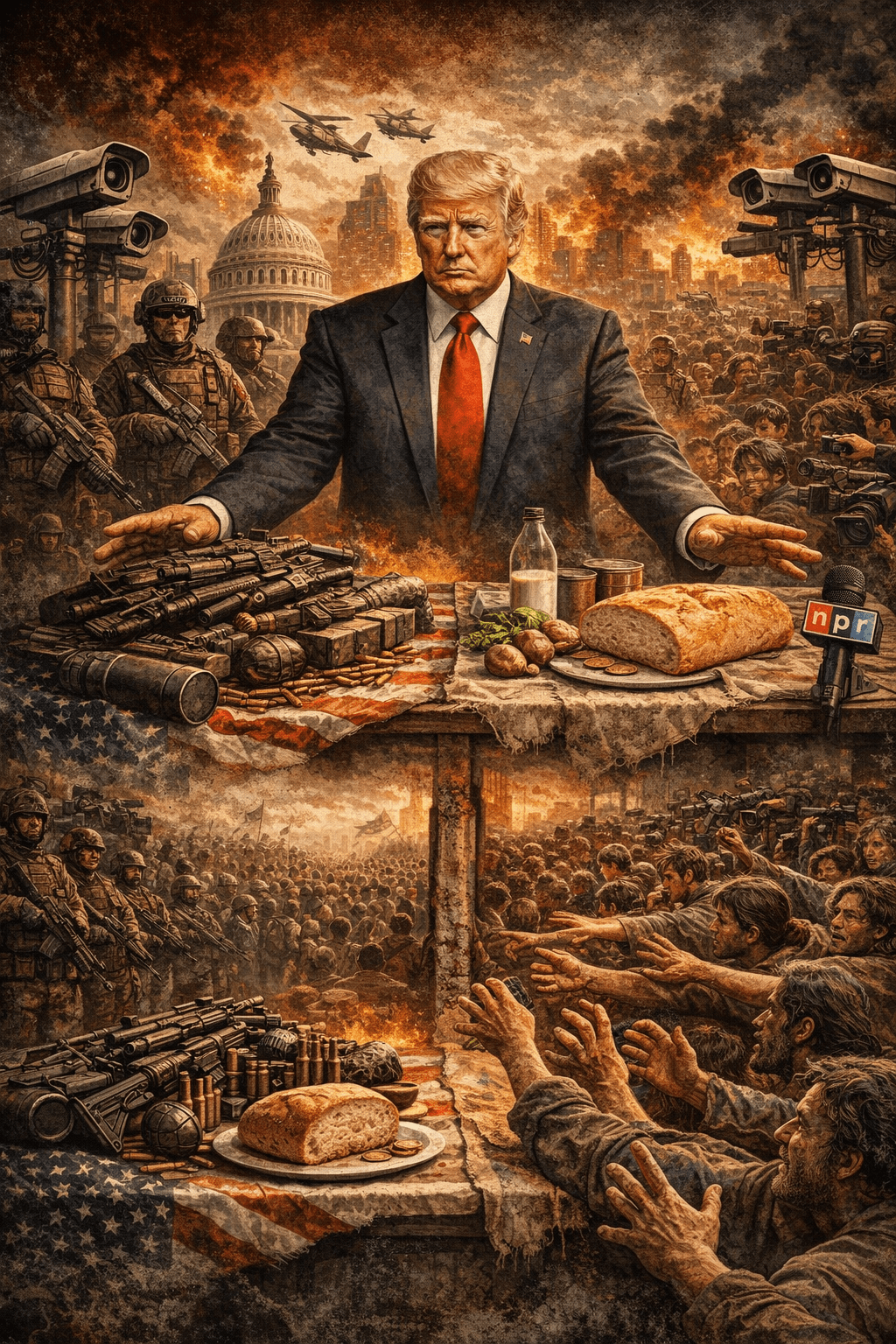
As military spending surges and social programs are cut, liberal media reframes a structural shift toward austerity, repression, and permanent war as mere “budget priorities,” masking the deeper reorganization of power under crisis. Beneath the surface, the abandonment of the social contract reveals a system that can no longer sustain even minimal concessions to the population. This rupture takes form as technofascism at home and hyper-imperialism abroad, binding domestic discipline to global domination. What emerges is not policy failure, but a coherent strategy for managing imperial decline.
By Prince Kapone | Weaponized Information | April 6, 2026
The Budget as Bedtime Story for Empire
“Trump budget seeks $1.5 trillion in defense spending alongside domestic program cuts”, NPR’s repost of an Associated Press wire report published on April 3, 2026, arrives dressed in the plain clothes of democratic normalcy. It tells the reader that Donald Trump wants more for the Pentagon, less for domestic programs, and that Congress will now do the familiar Washington dance of bargaining, posturing, and deciding how much social life can be shaved down to keep the imperial machine well-oiled. That is the surface presentation. But propaganda is not always loud, red-faced, and pounding the table. Very often it is calm, procedural, and professionally indifferent. It wears reading glasses, speaks in budget categories, and asks the public to mistake organized violence for fiscal prudence. This article does exactly that. It takes a historic escalation in militarist priority and folds it neatly into the furniture of routine governance, as if empire were simply another line item to be discussed between coffee breaks on Capitol Hill.
That is part of what makes the piece effective. NPR, as a liberal-institutional voice of respectable America, and the AP, as the great wire service of stripped-down official narration, form a very useful relay system for ruling-class common sense. Between them, they produce a tone that says: do not panic, do not think too hard, adults are handling the numbers. The violence is translated into administration. The class project is translated into “values.” The war budget becomes a budget preference. The cutting of social life becomes a tough choice. The expansion of detention, border enforcement, and militarized state power becomes a matter of “security infrastructure.” This is how empire likes to speak when it wants to appear civilized. It does not announce that it is sacrificing bread for bombs. It tells you it is responsibly managing competing priorities in a dangerous world.
The fact that this is Associated Press wire copy matters too. The article comes to us without the theatrical imprint of a heavily branded opinionist. It is not a rant. It is not even especially colorful. It is anonymous in the way institutions are anonymous. And that anonymity is one of its ideological strengths. When no singular personality seems to be arguing, the system itself can pose as neutral description. It becomes harder to see that choices are being narrated from inside a class standpoint. The budget is not treated as the weapon of a state with definite imperial and domestic priorities; it is treated as the ordinary expression of executive preference inside a democratic process. Nobody appears to be selling the story because the story has already been laundered into common sense.
So the first operation of the article is narrative framing. It presents the budget as a dispute over priorities, as though we are watching an unfortunate but understandable balancing act between defense needs and domestic aspirations. But that frame already rigs the game. It converts a political-economic declaration into a technical disagreement. It narrows the field of vision from social order to budget arithmetic. The reader is invited to think in terms of percentages, appropriations, partisan disagreement, and legislative process, rather than in terms of what is actually being declared: that war, militarization, deportation machinery, and carceral state expansion rank above housing, public health, social provision, and the fragile means by which ordinary people reproduce life. In the article’s telling, the state is merely choosing between options. In reality, it is revealing what kind of society it intends to defend and what kind of society it is willing to abandon.
The second operation is omission, and omission is often the most elegant weapon in the liberal propagandist’s toolkit. The piece briefly notes the Iran war, but only as nearby weather, not as a structuring force. It does not explore how active imperial warfare helps generate the very budget logic it is describing. It does not ask how a ruling bloc engaged in military escalation abroad simultaneously moves to deepen coercive capacities at home. It does not name the class content of this transfer of wealth from care to command, from social need to organized force. It does not dwell on the fact that when a state prepares for wider conflict, it also prepares to discipline its own population into accepting sacrifice, fear, and scarcity. The article notes the war the way a clerk notes a stain on the carpet: briefly, and without asking what caused it.
Then comes the language itself, the sweet perfume sprayed on a prison bus. “National security infrastructure.” “Immigration enforcement.” “Violent criminals.” These are not neutral phrases. They are deodorized terms for coercive state growth. A detention bed sounds less obscene when it is tucked inside administrative language. A deportation regime sounds more reasonable when described as enforcement. A swollen military budget sounds almost protective when wrapped in security rhetoric. This is the old trick of imperial prose: give brutality a bureaucratic name and it begins to pass for necessity. The article reproduces that language without breaking it open. It lets the words do their work. And words, when disciplined by power, are little policemen.
Just as important is the article’s source hierarchy. The legitimate interpreters of the budget are state officials, party leaders, committee chairs, administration spokesmen, and congressional figures. These are the voices through which the event is explained and emotionally processed. Those who will actually absorb the cuts appear only as abstractions or targets of policy. The poor do not speak. Tenants do not speak. Migrants do not speak. Sick and elderly people do not speak. Communities facing eviction, utility shutoffs, disinvestment, criminalization, or intensified surveillance do not speak. Their role in the article is to be managed, referenced, or defended against. The powerful narrate the meaning of the budget; the people live under it in silence. That silence is not accidental. It is part of the ideological order. Empire prefers the masses as scenery.
The piece also performs the very liberal magic trick of false balance. Republicans praise the spending request. Democrats criticize it. The article places these reactions beside one another in orderly symmetry, producing the impression of a healthy civic disagreement. But this symmetry conceals more than it reveals. It makes the spectacle look balanced while preserving the deeper premise that the legitimacy of a $1.5 trillion war budget is not itself under indictment. The debate is staged within accepted imperial boundaries. One side says more bombs. The other says perhaps fewer cuts. And the reader is gently nudged into believing this is the full horizon of democratic thought. In that sense the article does not merely report a budget conflict; it polices the range of imaginable opposition to it.
Even the brevity of the piece functions ideologically. Concision is not always innocence. Sometimes it is the shield that protects power from totality. By compressing war funding, deportation expansion, social cuts, debt pressures, and congressional maneuvering into a quick institutional digest, the article makes it difficult for the reader to sit with the enormity of what is being proposed. This is budget coverage for people on the move, for people with jobs, kids, bills, exhaustion, and no time to trace the architecture of empire before dinner. The ruling order depends on this rushed intelligibility. If the whole structure were allowed to stand up in the light—war abroad, austerity at home, border militarization, social abandonment, elite consensus, and the culture-war language used to justify it—the proposition would appear for what it is: not merely controversial, but obscene.
So what NPR and the AP give us here is not a howl of reaction but something more polished and more useful: a bedtime story for empire, read in a calm voice so that the public drifts past the meaning of what it has heard. The article does not invent the budget. It does something more subtle. It domesticates it. It takes a declaration that the state will feed force and starve need, and retells it as routine government business. That is the labor of liberal propaganda at its finest. It does not always ask you to love the empire. Sometimes it asks for something much smaller and much more important: that you accept its priorities as normal, its language as sensible, its violence as administrative, and its theft from the poor as merely one more regrettable necessity in a complicated world.
The Long Arc of War Spending and the Quiet Starvation of Social Life
Strip away the polite language of “priorities,” and the FY2027 budget reveals itself as a document of allocation in its most naked sense: what will be fed, what will be starved, and what must be disciplined to make the arrangement hold. The White House proposal is explicit in its scale. It calls for $1.5 trillion in national defense spending, a staggering figure that represents a 44 percent increase over the prior level. This is not a marginal adjustment. It is a leap. And it is paired, not accidentally but structurally, with a 10 percent reduction in non-defense discretionary spending, the part of the federal budget that touches housing, education, environmental protection, research, and the thin layer of public provision that still cushions working-class life.
The internal architecture of the military expansion tells its own story. The administration proposes to split the increase into $1.1 trillion in base discretionary funding and $350 billion in additional mandatory funding, routing a significant portion of the buildup through mechanisms that are less exposed to the ordinary constraints of the annual appropriations process. Even within the official narrative, the war state is being insulated. And alongside this expansion, the domestic coercive apparatus is maintained and extended. The budget preserves $10 billion in Immigration and Customs Enforcement funding while relying on prior authorizations that support detention capacity of up to 100,000 adults and 30,000 family-unit beds. The line between external militarism and internal enforcement is not blurred—it is fused.
Even the smaller line items reveal the priorities embedded in the whole. The proposal includes a 13 percent increase for the Department of Justice, a $10 billion National Park Service construction and beautification fund for Washington, D.C., and additional funding for aviation safety and air traffic control hiring. At the same time, it imposes sweeping reductions across the civilian state: 19 percent cuts to the Department of Agriculture, 13 percent to Housing and Urban Development, and roughly 12 percent to Health and Human Services, along with targeted eliminations and reductions affecting environmental, energy, and scientific programs. The contrast is not subtle. The state invests in force, spectacle, and control, while withdrawing from care, shelter, and long-term human development.
But even this stark picture, drawn from the administration’s own document, understates the scale of what is being proposed. The article treats the $1.5 trillion figure as a dramatic escalation, but does not situate it within the already unprecedented baseline from which it rises. According to SIPRI data, the United States was already spending $997 billion on its military in 2024, accounting for 37 percent of global military expenditure and 66 percent of NATO spending. This is not a state catching up to rivals. It is a state extending dominance from an already overwhelming position.
Nor is this expansion an isolated national phenomenon. It unfolds inside a global surge in militarization. SIPRI reports that world military spending reached $2.718 trillion in 2024, the highest level ever recorded, ten consecutive years of increase and a 37 percent rise since 2015. The U.S. budget proposal is therefore not simply a domestic policy choice. It is a decisive contribution to a broader escalation in global military competition, one that is reshaping the allocation of resources across the entire international system.
What the article also leaves in shadow is that this expansion is built on a long, steady upward trajectory rather than a sudden rupture. The Costs of War project at Brown University documents how recent legislation alone has already committed $156 billion in additional Pentagon and military-related spending across FY2025–FY2029, while total U.S. “national defense” spending has already been pushed above $1 trillion in FY2026. The proposed budget does not inaugurate militarization; it accelerates a process that has been intensifying for years.
At the same time, the civilian side of the state has been undergoing a long contraction that is far less visible in headline figures. The most revealing measure is not total federal spending, which is shaped by automatic programs like Social Security and Medicare, but discretionary spending—where political choices are most directly expressed. According to the Center on Budget and Policy Priorities, non-defense discretionary spending fell to a record low of 3.1 percent of GDP in 2019 and stood at only 3.2 percent in 2025. This is the portion of the budget that funds housing assistance, public education, environmental protection, scientific research, and a wide array of programs that sustain everyday social life. Its compression is not incidental. It reflects more than a decade of austerity policy anchored in the Budget Control Act of 2011 and subsequent spending caps.
The specific programs targeted in the current proposal underscore what that contraction means in practice. The administration’s cuts reach into anti-poverty infrastructure through programs like Community Services Block Grants, into energy survival support through LIHEAP, into housing rights enforcement through the Fair Housing Initiatives Program, and into public health system quality through the Agency for Healthcare Research and Quality. These are not abstract line items. They are mechanisms through which millions of people secure heat, housing access, basic services, and marginal protection against systemic inequality. Their reduction is not symbolic; it is material.
Even when examined through the narrow lens of economic efficiency, the allocation pattern fails its own justification. The Costs of War project finds that $1 million in military spending generates roughly 5 jobs, while the same amount invested in education produces about 13 jobs. In other words, even within a conventional Keynesian framework, the war economy is a less effective generator of employment than civilian social investment. The preference for militarization cannot be explained by its efficiency in meeting social needs.
It is here that a deeper political-economic pattern emerges—one that the article does not name but that has been analyzed for decades. In the tradition of Monthly Review, the postwar United States developed what has been called military Keynesianism: a system in which military spending functions as a mechanism for sustaining demand, absorbing surplus, and stabilizing accumulation without expanding democratic control over public investment. This framework situates the expansion of the war state not as an aberration, but as a structural response to stagnation tendencies within monopoly finance capitalism. The state directs resources into sectors that reinforce both corporate power and geopolitical dominance, while avoiding the redistributive implications of large-scale civilian provisioning.
The current budget proposal sits squarely within that trajectory. It arrives in the midst of an active war, as Reuters reports that the administration’s defense priorities emphasize weapons systems, shipbuilding, missile defense, and industrial expansion, and at a moment when fiscal pressures are intensifying, with CBO projecting a $1.9 trillion deficit for FY2026 and overall debt exceeding $39 trillion. The response is not to rebalance toward social investment, but to deepen the existing pattern: expand the war state, maintain and extend coercive domestic capacities, and decimate the civilian side of the budget.
Placed against the longer historical record, which can be traced through OMB’s budget tables comparing defense and non-defense spending as shares of GDP, the present moment appears less as a break than as an intensification. The ratio shifts, the totals grow, the rhetoric sharpens, but the underlying movement remains consistent. Resources flow upward into military and security apparatuses while the infrastructure of social life is pared down. The FY2027 proposal does not invent this pattern. It pushes it further, under conditions in which its consequences are becoming harder to disguise.
When the Social Contract Becomes a Casualty: Austerity, War, and the Two Faces of Imperial Crisis
At first glance, it looks like bookkeeping—numbers shuffled from one column to another, a little more for the Pentagon, a little less for the people. But budgets, like confessions, reveal more than they intend. What we are witnessing is not a set of difficult choices but the exposure of a deeper fracture: a system that can no longer afford the illusion that it works for those who live under it. The old arrangement—where accumulation marched alongside a minimum of social stability—has begun to crack under the weight of its own contradictions. Stagnation settles in, productive capacity thins out, and the empire finds itself challenged on terrain it once ruled without question. In such a moment, the ruling class is no longer concerned with sharing growth. It is preoccupied with managing decline—its own, not yours.
And so the mask slips. The concessions that once gave the system a human face—public housing, education, healthcare, the faint promise that tomorrow might be better than today—are no longer treated as obligations. They are treated as expenses, and expenses, as every good capitalist knows, are meant to be cut. Austerity is not an unfortunate turn of events or a bad policy choice. It is the system telling the truth about itself. When profitability tightens and competition sharpens, the first thing sacrificed is not power, but people. The social contract is not renegotiated—it is quietly buried, with bipartisan eulogies about “fiscal responsibility.”
But burying the contract does not bury the consequences. A population stripped of stability does not become docile; it becomes volatile. When wages stagnate, when housing disappears into speculation, when survival itself becomes a daily calculation, the question of obedience is no longer settled in advance. The same process that preserves capital by withdrawing support from the masses simultaneously dissolves the conditions that made that preservation politically manageable. What was once secured through a careful mixture of concession and coercion must now be secured by force more nakedly applied. The velvet glove frays, and the iron hand becomes policy.
This is where the transformation of the state reveals itself, not as theory but as lived reality. As the institutions that sustain life are hollowed out, the institutions that manage its breakdown are fortified. Police budgets swell while schools decay. Surveillance expands while privacy contracts. Prisons multiply while hospitals close. The state does not retreat—it reorganizes. Its center of gravity shifts from provision to punishment, from welfare to warfare, from social reproduction to social control. This is not a drift into authoritarianism, as the polite commentators would have it. It is a rational reconfiguration for a system that can no longer afford to govern through consent.
And let us be clear: no single politician authored this transformation. It has been drafted over decades, signed into law by both wings of the ruling class, and implemented piece by piece under the respectable language of security, reform, and modernization. The militarization of the police did not begin yesterday. The erosion of civil liberties was not smuggled in overnight. The expansion of surveillance was not an accident of technological progress. What we are witnessing now is the consolidation of a long project—the knitting together of these threads into a more coherent fabric of control. The difference today is not direction, but density.
Yet this internal tightening cannot be understood in isolation. The same knife that cuts social spending at home sharpens itself on the global stage. The contraction of the welfare state is bound, dialectically, to the expansion of the warfare state. As resources are withdrawn from the population, they are redirected toward the maintenance of an international order that no longer maintains itself. Trade routes must be secured not because they are stable, but because they are threatened. Financial hierarchies must be enforced not because they are accepted, but because they are contested. Military expansion is not the expression of confidence; it is the compensation for its absence.
What we are looking at, then, is not a series of disconnected policies but a single contradiction unfolding in two directions at once. Domestically, the crisis of imperialism expresses itself as austerity, surveillance, and repression—a mode of governance that disciplines a population it can no longer materially satisfy. Externally, that same crisis expresses itself as intensified militarization, economic coercion, and strategic domination—a desperate effort to hold together a global hierarchy that is beginning to slip. The empire tightens its grip at home because its grasp abroad is weakening. The two movements are not parallel. They are one and the same.
In this light, the language we use is not ornamental—it is necessary. Technofascism names the internal form this reorganization takes: a state that fuses advanced technological systems with coercive power to manage a population rendered increasingly surplus to its needs. It is governance without concession, control without pretense, efficiency in repression paired with austerity in life. Hyper-imperialism names its external counterpart: the intensified, coordinated enforcement of global domination through military alliances, financial instruments, and the strategic policing of the world’s economic arteries. Together, they form a single structure—two faces of the same necessity.
Seen this way, the budget ceases to be a neutral ledger and becomes something closer to a battlefield map. Every increase in military allocation marks a front to be defended. Every expansion of surveillance marks a population to be managed. Every cut to social spending marks a retreat from the promise—however limited—that life would be sustained rather than disciplined. What appears as imbalance is, in fact, coherence. The system is not confused about its priorities. It is clarifying them.
And those priorities no longer include the broad integration of society. Instead, what emerges is a stratified landscape: sections of the working class pushed into deeper precarity, others absorbed into the machinery of administration and control, and still others cast aside as surplus—managed through incarceration, exclusion, and slow social death. The population is not abandoned wholesale; it is reorganized according to utility. Some are needed to labor, some to oversee, and some simply to be contained. The social body becomes a problem to be solved rather than a community to be sustained.
This is not a temporary deviation, nor a pendulum swing that will correct itself with the next election cycle. It is a structural transition. A system that once stabilized itself through expansion—through new markets, new industries, new concessions—now seeks stability through enforcement. A state that once balanced the provision of life with the management of dissent now leans decisively toward the latter. And a global order that once rested on uncontested dominance now requires constant intervention to prevent its unraveling. Austerity at home and militarization abroad are not unfortunate companions. They are the twin expressions of a system confronting the limits of its own reproduction—and choosing, with cold clarity, to preserve itself at any cost.
From Diagnosis to Direction: Organizing Against Austerity and War
If the previous sections have done their work, then one conclusion should stand out with uncomfortable clarity: what we are facing is not a policy mistake that can be corrected by better leadership, but a structural reorganization that will not reverse itself. A system that has chosen austerity over provision and coercion over consent will not be persuaded back into benevolence. It must be confronted, resisted, and ultimately replaced. The task, then, is not to appeal to the conscience of a ruling class that has already made its decision, but to organize the forces capable of imposing a different one.
The first step is to strip away the ideological fog that isolates struggles which are, in reality, inseparable. The fight against cuts to housing, healthcare, and education is the same fight as the struggle against militarization, surveillance, and endless war. These are not parallel issues competing for attention; they are expressions of a single process. Every dollar withdrawn from social life and redirected toward coercion links the two. To oppose austerity while ignoring militarism is to fight the symptom while leaving the mechanism intact. To oppose war abroad while ignoring repression at home is to mistake geography for difference. The line of struggle must be drawn across both.
From this follows a second necessity: organization that matches the scale of the system it confronts. Fragmented resistance—isolated campaigns, short-lived mobilizations, single-issue movements—cannot effectively challenge a structure that coordinates capital, state power, and technology into a unified apparatus. What is required instead is convergence: the deliberate linking of labor struggles, anti-war movements, community defense initiatives, tenant organizing, and campaigns against surveillance and policing into a common front. Not a rhetorical unity, but a material one, rooted in shared strategy and mutual support.
Such convergence must begin where the contradictions are most sharply felt. In workplaces where wages stagnate while productivity rises, organizing must move beyond defensive bargaining toward collective control over conditions of labor. In communities facing displacement, eviction, and austerity, tenant unions and mutual aid networks must evolve into durable structures capable of resisting removal and asserting claims over land and housing. Where policing and surveillance intensify, community-based forms of defense, legal support, and rapid-response networks must be built to protect those targeted by the expanding apparatus of control. These are not ends in themselves, but foundations—sites where power can be accumulated and coordinated.
At the same time, the global dimension of the struggle must be made explicit. The same system that imposes austerity domestically enforces dependency and underdevelopment abroad. Solidarity with nations and movements resisting sanctions, military intervention, and economic coercion is not an abstract moral stance; it is a recognition of shared opposition to a common structure. When supply chains are disrupted, when financial systems are contested, when imperial control is resisted at its points of extraction, the pressures that produce austerity at home are also affected. Internationalism, in this sense, is not a slogan—it is a strategic necessity.
This also requires a clear break with illusions about the neutrality of existing political institutions. The gradual construction of the surveillance state, the militarization of policing, and the erosion of civil liberties have proceeded under multiple administrations and across party lines. The expectation that these same institutions will serve as vehicles for fundamental transformation rests on a misunderstanding of their function. Engagement may at times be tactically useful, but it cannot be the horizon of strategy. Power must be built in forms that do not depend on the permission of the structures they seek to change.
Political education becomes central in this context. The connections between austerity, militarization, and global domination must be made legible to those living their consequences. Not through abstraction, but through concrete explanation rooted in everyday experience: why rents rise while budgets for policing expand, why public services contract while military spending grows, why instability abroad is tied to insecurity at home. When these links are understood, what appears as a series of isolated grievances begins to cohere into a systemic critique. And from that critique, coordinated action becomes possible.
None of this suggests an easy path forward. A system that has reorganized itself around control will not hesitate to deploy that control against those who challenge it. Repression is not a possibility—it is a certainty. But repression also clarifies. It reveals the stakes of the struggle and exposes the limits of accommodation. In doing so, it creates conditions under which broader layers of the population can come to recognize their position within the system and their interest in transforming it.
The convergence of austerity at home and militarization abroad marks a turning point. It signals that the old mechanisms of stability are no longer available, and that new forms of struggle must rise to meet a new configuration of power. The question is not whether this transformation will produce conflict—it already has—but whether that conflict will remain fragmented and reactive, or whether it will be organized, strategic, and directed toward a different social order.
The system has clarified its priorities. The task now is to clarify ours.
 Weaponized Information
Leave a comment