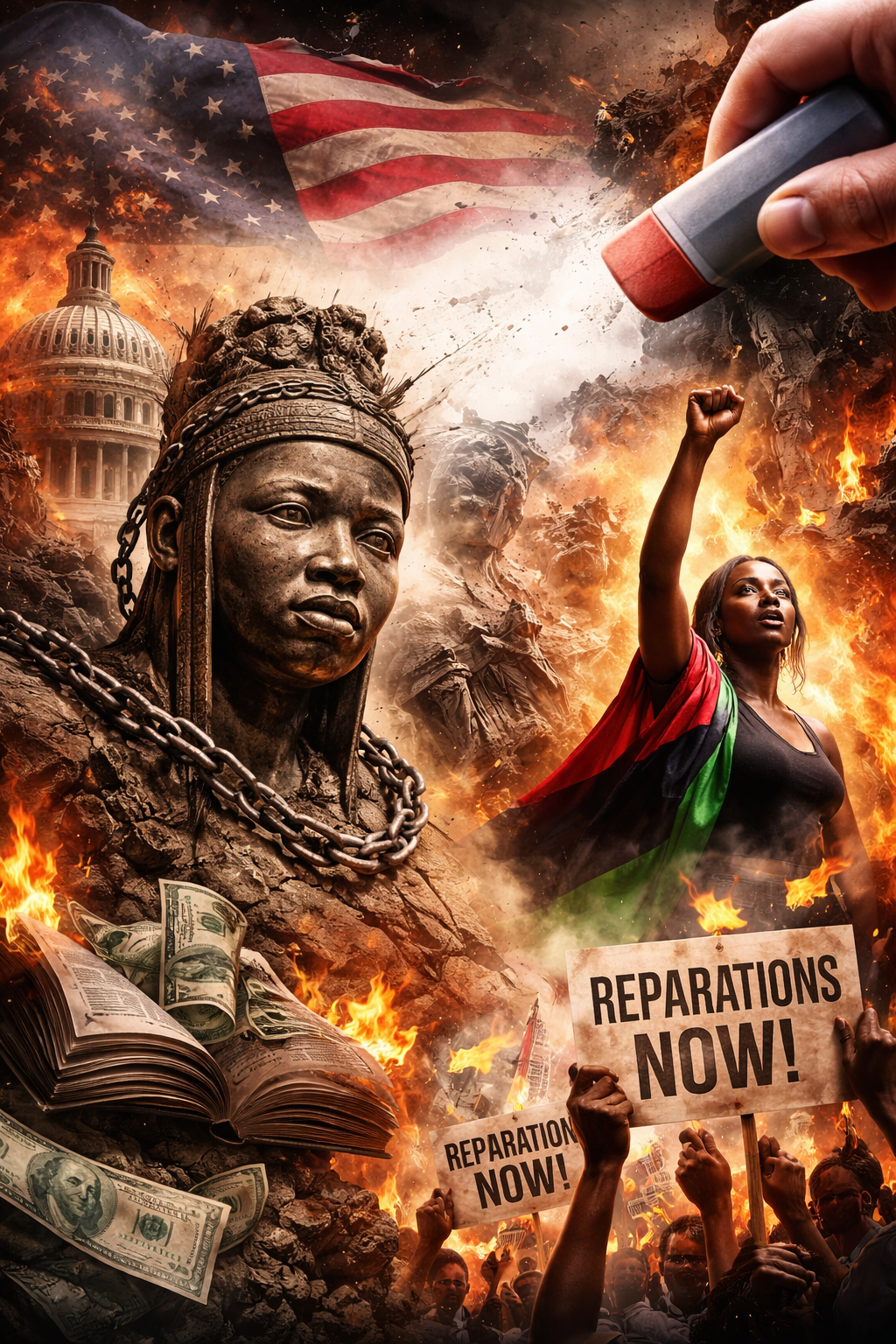
From Reuters’ managed neutrality to Washington’s cultural rollback and Ghana’s UN challenge, the struggle over memory reveals a deeper battle between imperial erasure and a growing global demand for reparatory justice.
By Prince Kapone | Weaponized Information | March 27, 2026
The Cropped Memory of Empire
“Ghana’s president, in New York, says US is ‘normalizing’ the erasure of Black history”, the March 24, 2026 Reuters dispatch by Catarina Demony, arrives in the tidy clothes of neutral journalism. On the surface, it reports three things: Ghanaian President John Dramani Mahama denounced the Trump administration for normalizing the erasure of Black history, the White House answered with its usual self-congratulatory boasting, and Ghana advanced a UN resolution on slavery reparations. That is the basic story. But Reuters does not simply report conflict. It packages conflict for institutional consumption. It gives empire a clean mirror and calls that objectivity. So the article comes not as open reaction barking Confederate nostalgia, but as a disciplined wire brief, the preferred style of ruling-class narration when it wants ideology to pass as professionalism.
Demony’s role here is not incidental. Reuters presents her as a breaking-news correspondent, trained to compress upheaval into official statements, rebuttals, and a few lines of background. Her bio shows she is not ignorant of the subject. She has worked across journalism and NGOs and even produced a documentary on transatlantic slavery. That makes the form more revealing. The problem is not ignorance; it is the Reuters method itself, which takes a historical crime spanning centuries and reduces it to a polite exchange between officials. One man says Black history is being erased, another side says America is doing great, and somewhere in the background a reparations resolution drifts by like diplomatic weather. The plantation burns, and the copy desk informs us there is disagreement over fire management.
The first propaganda move is source hierarchy. Presidents, ministers, and spokespersons are treated as the proper owners of speech. The descendants of the enslaved, the colonized, and the dispossessed appear only as an implied backdrop, never as active makers of history. That is not a small stylistic choice. It is a political arrangement. It tells the reader that slavery, erasure, and reparations are to be understood through official voices and institutional mediation. Black history itself is made to appear less as a field of struggle than as a topic under discussion among dignitaries. That is one of bourgeois journalism’s slickest tricks: it can disappear the masses without ever announcing their disappearance.
The second move is narrative framing. The headline does not center the reparations resolution or the world-historical significance of naming transatlantic slavery as a crime demanding redress. Instead, it centers Mahama criticizing the United States. The focus shifts from the historical wound to Washington’s discomfort. What should be a story about slavery, memory, and restitution becomes a story about whether a foreign leader has been bold enough to embarrass the empire in public. That is how imperial media protects the center. Even when accused, the empire remains the main character.
Then comes omission. Reuters notes that Ghana is proposing a resolution on slavery and reparations, but leaves the reader with only a skeletal sense of what that means. Reparations float through the article as a disputed diplomatic idea rather than a deeply rooted anti-colonial demand with history, structure, and mass political content. The broader architecture is missing. The organized struggle is missing. The historical continuity is missing. Omission here is not empty space; it is active political work. It narrows Ghana’s intervention into a moment of rhetoric instead of allowing it to appear as part of a larger current of historical reckoning.
The piece also leans on appeal to authority. Mahama matters because he is a president. The White House matters because it is the White House. Ghana’s foreign minister matters because he is a minister. Institutional voice becomes the scaffolding of truth. Reuters does not ask whether the claims have equal weight in reality; it asks only whether the speakers hold offices recognized by respectable discourse. So the White House can answer a charge of historical erasure with absurd self-praise, and the article places that response beside Mahama’s warning as though symmetry itself were a substitute for judgment. One side names a campaign of erasure, the other recites campaign mythology, and bourgeois balance nods gravely at both.
That symmetry is reinforced by card stacking. Reuters gives enough detail to suggest that a rollback is happening in the United States, mentioning museums, monuments, slavery exhibits, and Confederate statues, but not enough to expose the machinery behind that rollback. It tells us Ghana’s resolution has support from the African Union, CARICOM, and Brazil, but not enough to show the larger political significance of that alignment. The truth is not denied. It is rationed. Enough to maintain credibility, not enough to sharpen consciousness.
And finally there is concision itself. In Reuters form, brevity is not just style; it is often ideological discipline. A few clipped paragraphs flatten slavery, segregation, erasure, and reparations into manageable institutional dispute. History is miniaturized. The crime is shrunk to fit the wire. And when the crime is made small, the demand for justice can be made to look small too. That is what makes the piece instructive. It does not lie in some crude, cartoonish fashion. It performs the more refined labor of imperial journalism: framing, omission, compression, and balance used to dull the edge of truth. The article gives us the surface of the struggle while sanding down its blade. That is how empire likes its memory—cropped, curated, and safe for circulation.
What the Wire Could Not Contain
Reuters accurately reported that John Dramani Mahama came to New York to denounce the U.S. campaign against Black historical memory, that he tied this to the Trump administration’s assault on cultural institutions, and that Ghana was at the United Nations to push a resolution naming transatlantic slavery as the gravest crime against humanity and calling for reparations. Ghana’s presidency had already announced before the vote that Mahama would present the measure at the General Assembly, and the UN in Ghana later confirmed that the resolution passed on March 25 by a vote of 123 in favor, 3 against, with 52 abstentions. That tally matters. It shows this was not some theatrical complaint hurled into diplomatic air, but a concrete international confrontation in which the United States stood in a tiny minority against a broad bloc of states prepared to condemn slavery in the hardest possible terms.
But the Reuters brief left out the deeper architecture behind Ghana’s move. Mahama had formally notified the UN in September 2025 of the draft resolution in his capacity as the African Union’s Champion on Reparations, which means the initiative was not improvised at the podium but prepared through an organized diplomatic process. The African Union had already elevated reparations to a continental strategic priority by making 2025’s theme “Justice for Africans and People of African Descent Through Reparations”, explicitly linking the demand to colonialism, apartheid, genocide, and diaspora unity. And CARICOM’s Ten Point Plan for Reparatory Justice shows that reparations here do not mean a vague moral apology floating above material life, but a structured political program including formal apologies, repatriation, cultural restoration, public health repair, literacy initiatives, and technology transfer. Reuters mentioned support from the African Union and CARICOM, but stripped away the political substance that would have shown the reader this was part of a mature Afro-diasporic and Global South project, not a burst of ceremonial indignation.
The Reuters piece also named the erasure campaign in the United States without exposing its machinery. Trump’s March 27, 2025 executive order on “Restoring Truth and Sanity to American History” openly targeted public history, federal monuments, and museum narratives in the name of purging what it called divisive ideology, while the White House’s later directive to the Smithsonian ordered an internal review of exhibitions and materials, including pressure around narratives presented to the public. In education, the U.S. Department of Education instructed federally funded schools to end race-conscious policies and warned that noncompliant institutions risked federal investigation and the loss of funds. And where Reuters referred generally to banned books, PEN America documented 6,870 book bans in the 2024–25 school year across 23 states and 87 districts, with nearly 23,000 bans since 2021, including 590 bans in Department of Defense schools. So Mahama’s warning was not rhetorical excess. It rested on a measurable campaign to discipline museums, schools, libraries, and the public archive itself.
Set in fuller view, the struggle is bigger than one speech and bigger than one vote. UN reporting on the resolution explicitly tied it to the enduring legacies of slavery, structural racism, racial inequality, and the long-standing recognition in international debate that slavery and the slave trade were crimes against humanity. The African Union’s reparations line and CARICOM’s programmatic framework together show an emerging political bloc trying to move memory out of the museum and into the terrain of obligation, restitution, and institutional repair. At the same time, the U.S. state is working to recode national memory around “unity,” “sanity,” and American innocence, while administrative threats against schools and the nationwide spread of book bans turn that cultural line into material coercion. What Reuters presented as a dispute over rhetoric is, in fact, part of a wider clash between a rising demand for reparatory justice from Africa and the diaspora and an imperial counter-movement determined to sanitize the history that made its wealth possible.
Memory as Battlefield, Reparations as Threat
The real story here is not a disagreement between a Ghanaian president and the White House. It is a confrontation between two historical projects moving in opposite directions. On one side stands a growing bloc of nations and peoples insisting that the modern world was built through slavery, colonial plunder, and racialized dispossession—and that this history is not a closed chapter but an open ledger. On the other side stands an imperial formation that cannot sustain its legitimacy if that ledger is read aloud in full. The clash is not about tone. It is about whether history will remain a museum exhibit or become a political claim.
What Reuters presents as a matter of rhetoric is, in material terms, a struggle over the narrative foundations of capitalism itself. To name transatlantic slavery as the gravest crime against humanity is not merely to describe the past; it is to destabilize the mythology that wealth in the Atlantic world arose from ingenuity, thrift, and democratic virtue. It reveals instead a system built on organized theft of land, labor, and life. Once that truth is established at the level of international recognition, it ceases to be symbolic. It begins to carry consequences—legal, economic, and moral—that threaten the sanctity of accumulated capital.
Ghana’s intervention must be understood in that light. It is not simply an appeal to conscience. It is an attempt to convert memory into power. Reparations, in this sense, is not a sentimental exercise in apology. It is a demand that the historical processes of accumulation be reopened, examined, and contested. It asks a simple but dangerous question: if wealth was produced through dispossession, by what right is it still held without repair? That question cuts through centuries of ideological insulation. It moves from remembrance to redistribution.
The U.S. response, then, is not accidental or merely reactionary. The effort to erase, sanitize, or discipline Black history is a structural necessity for a white ruling class that depends on the myth of innocence. You cannot sustain a social order rooted in inequality while teaching, in full clarity, that those inequalities are the direct inheritance of slavery, segregation, and colonial domination. The classroom, the museum, and the archive become dangerous sites. They are not neutral spaces of learning. They are factories of consciousness. Control them, and you shape what the population understands as natural, inevitable, or deserved.
This is why the attack on history takes institutional form. It moves through executive orders, administrative directives, curriculum changes, and cultural policy. It is not simply about suppressing uncomfortable facts. It is about reorganizing the narrative of the nation so that exploitation appears as progress and domination appears as development. The goal is not just to forget, but to replace—to substitute a purified story of national greatness for a history of conquest and extraction. Memory is not erased in silence; it is overwritten.
At the same time, the push for reparations signals a shift in the terrain of struggle. For decades, reparations existed largely as a moral argument, acknowledged in academic circles and activist spaces but contained at the margins of official politics. What we are witnessing now is its transformation into a geopolitical question. When states align around reparatory justice, the demand moves from protest to negotiation. It becomes part of the language of international relations. That shift is significant because it forces imperial powers to confront not just criticism, but coordinated pressure.
The contradiction sharpens here. Empire seeks to maintain the appearance that it has already resolved the question of racism, that whatever injustices existed have been overcome through civil rights reforms and democratic evolution. Yet at the same time, it dismantles the very institutions that teach how those injustices were structured and sustained. It wants the prestige of redemption without the burden of accountability. It wants history as celebration, not as indictment.
Reparations disrupts that arrangement. It refuses closure. It insists that the past is not past because its effects remain materially present—in wealth gaps, in global inequalities, in the underdevelopment of formerly colonized regions, and in the social position of Black people within imperial societies. To acknowledge this is to admit that the system is not merely imperfect, but foundationally unjust. And once that admission is made, the demand for repair becomes not a radical excess, but a logical necessity.
This is why the struggle over Black history cannot be separated from the struggle over political economy. To erase the history is to secure the wealth. To expose the history is to put that wealth into question. The archive becomes a battlefield because it holds the evidence of how the world was made. And those who control that evidence control the limits of what can be imagined, demanded, and won.
So what appears on the surface as a cultural dispute is, at its core, a class struggle over memory and material reality. The ruling class seeks to contain history within safe boundaries, to turn it into heritage, spectacle, and sanitized narrative. The oppressed seek to weaponize history, to turn it into a basis for claims, organization, and transformation. Between these two projects there can be no lasting compromise. One demands forgetting as a condition of stability. The other demands remembering as a condition of justice.
The lesson is clear. Memory without power becomes ritual. Reparations without struggle becomes performance. But when memory is organized—when it is tied to political demands, institutional pressure, and international alignment—it becomes something else entirely. It becomes a force capable of unsettling the foundations of empire itself.
From Memory to Organization
If memory is a battlefield, then the question is not whether we feel strongly about it, but whether we are organized around it. The UN vote, the open refusal of the United States to support reparations, and the coordinated rollback of Black historical truth inside institutions all point in one direction: this is a material struggle. It is about power—who controls history, who controls resources, and who gets to define reality. That means the response cannot remain at the level of commentary. It must become organized pressure rooted in existing formations that already understand the stakes.
One of those formations is the Black Alliance for Peace, which openly defines itself as an anti-imperialist, anti-war organization linking domestic repression to U.S. global militarism. Its work is grounded in independent political organizing rather than reliance on imperial philanthropy, operating through fiscal sponsorship structures tied to grassroots Black-led institutions. This matters because the struggle over Black history is inseparable from the struggle against the imperial system that produced that history. You cannot defend truth about slavery while remaining neutral on the military and economic machinery that continues to reproduce its global consequences.
But this terrain is broader than any single organization. The Black Is Back Coalition for Social Justice, Peace and Reparations explicitly defines itself as an “organization of organizations” exercising united political will in anti-imperialist resistance, bringing together multiple Black-led formations across the United States. This is not a symbolic coalition. It is a political instrument designed to consolidate forces around self-determination, reparations, and opposition to imperialism in all its forms. Its roots are tied directly to the African People’s Socialist Party, which helped found the coalition in 2009 as part of a broader struggle against colonial domination and for African liberation. That lineage matters because it locates the reparations question not in liberal reform, but in a long continuity of anti-colonial resistance.
The African People’s Socialist Party itself represents a crucial node in this terrain. Emerging from the unfinished struggles of the 1960s, it has consistently framed reparations through the theory of African Internationalism—as a question of colonial domination, stolen labor, and the material foundation of global capitalism, not moral recognition alone. Its political work has emphasized that the conditions facing African people in the United States are not accidental disparities, but the outcome of an ongoing colonial relationship that links Africans inside the U.S. to the broader exploitation of Africa and the African world. That analysis cuts directly against the ideological project of erasure now being advanced by the state. If history is taught honestly, it reveals not isolated injustice but a global system of parasitic accumulation. And once that system is exposed, it does not invite passive acknowledgment—it invites organized resistance that threatens the very stability of the system that depends on that structure remaining invisible.
This is why the attack on Black history must be confronted at the institutional level. Schools, libraries, museums, and universities must become sites of organized struggle, not passive recipients of administrative directives. Campaigns should demand full transparency on curriculum changes, public exposure of censorship practices, and active defense of materials addressing slavery, segregation, and colonialism. The goal is not only to preserve access to truth, but to force the state into the open, to make its project of historical revision visible and contestable.
At the same time, this struggle must be tied to the fight against imperial war. Organizations like CODEPINK, a grassroots anti-war movement with publicly documented nonprofit status, offer a vehicle for linking domestic ideological control with global military policy. The same state that rewrites history at home enforces that history abroad through sanctions, bases, and intervention. To separate these fronts is to misunderstand the system. The rewriting of the past and the policing of the present are part of the same imperial process.
Reparations must also be brought down from the level of international diplomacy into concrete local struggle. Municipal governments, universities, and public institutions should be forced to take positions—recognizing slavery as a crime against humanity, committing to reparatory policies, and conducting public accounting of their historical ties to slavery and segregation. The work of the National African American Reparations Commission provides a programmatic framework for this, translating the demand for reparations into actionable political agendas rooted in material change.
Finally, the struggle must be international in practice. The reparations push emerging from Africa and the Caribbean is not separate from the conditions inside the United States. It is part of the same historical process expressed at different points in the system. Building ties between U.S.-based organizations and African and Caribbean initiatives—sharing strategy, coordinating campaigns, and deepening political education—turns solidarity into a force that can act across borders.
The task, then, is not to ask the empire to remember correctly. It is to organize in such a way that forgetting becomes impossible. Defend Black history as a weapon. Advance reparations as a material demand. Build institutions that can sustain the struggle independently. Because what is at stake is not simply how the past is told, but whether the world built on that past will be allowed to stand without repair.
 Weaponized Information
Leave a comment