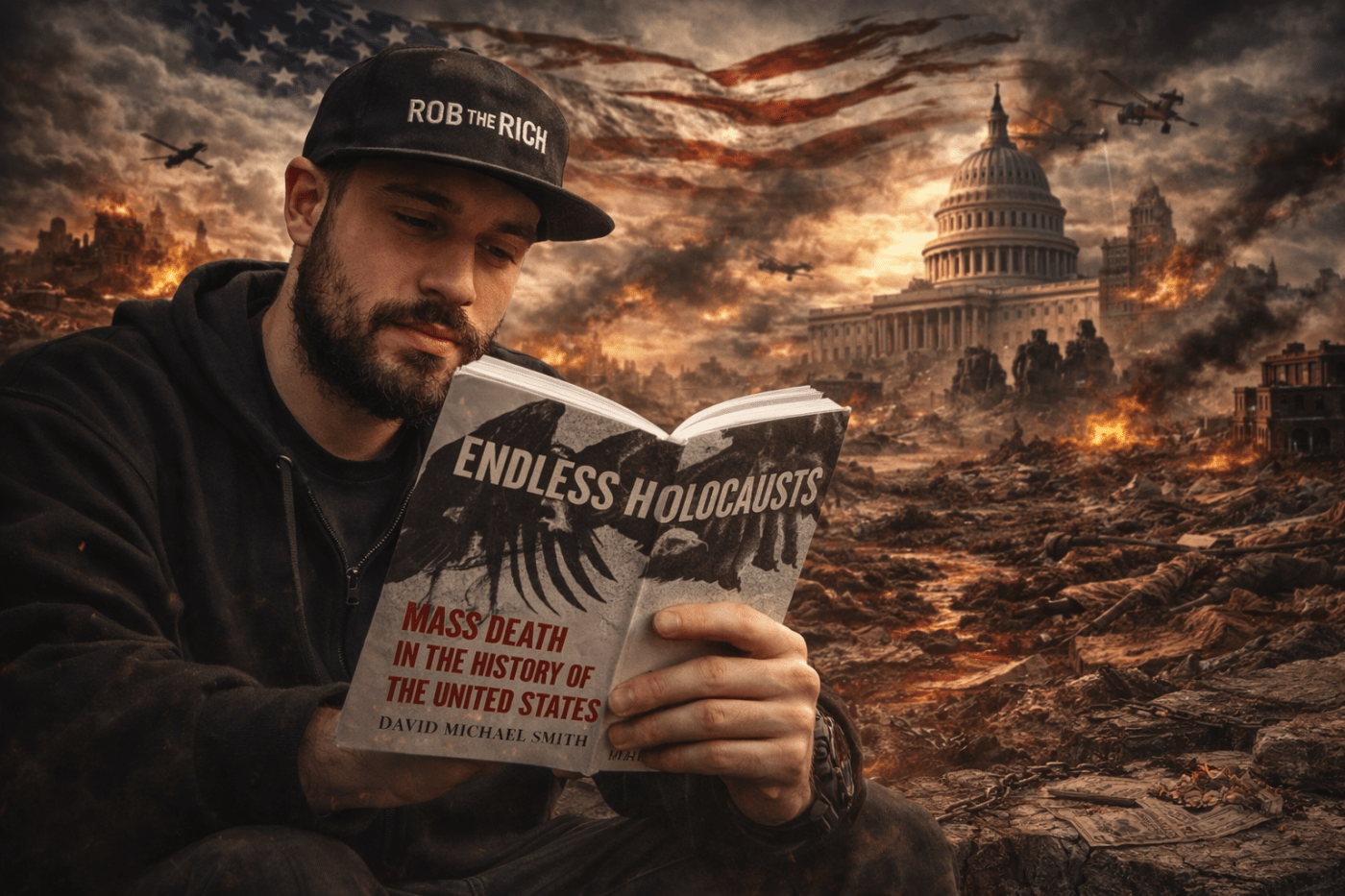
This Weaponized Intellects Book Review dismantles the myth of American innocence by tracing a continuous line from settler genocide and racial slavery to industrial exploitation and global war. It argues that these are not separate injustices but interconnected expressions of a single imperial system, one that reproduces itself through organized violence, ideological cover, and the systematic devaluation of human life.
By Prince Kapone | Weaponized Information | Weaponized Intellects Book Review | March 21, 2026
The Republic of Innocence Built on a Mountain of Bones
Every empire worth its stolen gold learns early that it cannot rule by the gun alone. It must also rule by story. It must teach the conquered, the exploited, the half-fed, the overworked, and even the beneficiaries of conquest to look at a blood-soaked order and call it civilization. It must drape theft in principle, massacre in destiny, and domination in virtue. The United States has done this with uncommon talent. It has wrapped itself in the hymns of liberty so thoroughly that millions have been trained to hear the clank of chains as the music of freedom. Its official historians have long spoken of the republic as though it descended from the clouds carrying democracy in one hand and moral uplift in the other, when in fact it climbed into power through land seizure, slave labor, industrial slaughter, colonial war, and a social order that has treated human life as cheaper than machinery and more disposable than packaging. The stars and stripes have flown for so long over this graveyard that many have mistaken the graveyard itself for the nation’s natural landscape.
David Michael Smith’s Endless Holocausts walks straight into that patriotic fog with a crowbar. The force of the book does not lie in rhetorical shock for its own sake, nor in some adolescent taste for provocation. Its force lies in a far more dangerous act: naming the historical pattern plainly. Smith’s claim is that the rise, expansion, and maintenance of the United States empire have required recurring systems of mass death, not as unfortunate side effects, not as tragic deviations from a noble project, but as constitutive features of the project itself. That is the real scandal here. The scandal is not the word “holocausts.” The scandal is that the word fits too well. Smith is trying to break the polished glass of national mythology and force the reader to look at what has been done in order to make “America” possible: the annihilation of Indigenous nations, the terror and attrition of slavery, the grinding up of workers in mines and mills, the incineration of whole peoples abroad, and the quieter but no less criminal forms of what Engels called social murder at home. The republic of virtue, it turns out, has had a butcher’s ledger from the beginning.
This is where the book’s intervention matters, and also where a Weaponized Information reading has to begin. Smith is not merely adding more atrocity data to the archive of dissent. He is trying to identify a structure. He understands that many of the dead were not killed by bayonet, firing squad, bomb blast, or concentration camp alone. They were also killed by poisoned water, forced removal, labor regimes, preventable disease, prison, hunger, racist abandonment, and the calmly administered sentence of an economic order that counts profit as sacred and people as expendable. That move is important because it brings into focus a truth that bourgeois morality works day and night to conceal: capitalism does not only kill spectacularly; it kills administratively. It kills through paperwork, price systems, legal categories, municipal neglect, and the smug little shrug of every ruling-class official who treats a preventable death as regrettable but necessary. The beauty of liberal ideology is that it can watch a million avoidable deaths march by in orderly formation and still insist that no one in particular is responsible. Smith refuses that alibi. Good. He should. Empire’s favorite trick is to turn policy into weather and then ask us why we are angry at the rain.
But what gives this book its true weight is not simply that it denounces mass death. Plenty of people denounce mass death once the bodies are old enough to be called history. What gives the book weight is that it tries to trace continuity across terrains that liberal scholarship usually keeps in separate boxes. Indigenous genocide is put in one course, slavery in another, labor history in another, foreign policy in another, public health in another, as though the rulers of this country had the courtesy to compartmentalize their crimes for the convenience of future academics. Smith’s argument cuts against that fraud. He insists that these are not detached episodes but interconnected chapters in the making of a single imperial formation. On that score, the book deserves serious engagement. It is trying to narrate the United States not as a flawed democracy that occasionally loses its moral bearings, but as a settler-imperial order whose development has always depended on organized vulnerability for the many and organized impunity for the few. That is the right battlefield. And it is on that battlefield that this review begins: not with pious handwringing over whether the language is too strong, but with the harder question of whether the book has successfully grasped the anatomy of a system that reproduces itself through conquest, expropriation, racial hierarchy, class discipline, and premature death.
The task, then, is not to praise the book for being morally serious, as though moral seriousness were rare among the dead. The task is to test its usefulness. Does Smith merely compile horrors, or does he reveal the machinery that manufactures them? Does he penetrate beyond the language of national hypocrisy into the deeper material logic of settler colonialism, racial capitalism, and imperial accumulation? Does he show how the bloodletting at home and the bloodletting abroad belong to the same metabolism of power? Those are the questions that matter for us, because we are not in the business of building a better conscience for empire. We are in the business of understanding the enemy well enough to help bury it. Endless Holocausts deserves to be read in that spirit. Not as a museum catalog of sorrow. Not as a sermon for guilty liberals. But as an attempt, uneven and important, to count the dead in a country that has built entire institutions to make sure the dead never speak in one voice.
Where the Republic Began: Land, Elimination, and the Making of a Settler Empire
If the United States is to be understood honestly, the story cannot begin with parchment in Philadelphia or powdered wigs debating liberty. It begins instead with land — vast stretches of land already inhabited, cultivated, governed, and defended by Indigenous nations whose existence stood as the first obstacle to the colonial project. The early chapters of Endless Holocausts confront this reality with the bluntness it deserves. Smith places the destruction of Indigenous societies at the foundation of American power, arguing that the United States did not inherit empty territory but rather constructed its territorial empire through processes of systematic elimination. The language of frontier mythology has long disguised this process as heroic exploration, brave settlement, or unfortunate but inevitable conflict. Smith strips away that mythology and restores the historical logic beneath it: a settler order cannot grow unless the people who already live on the land are displaced, confined, or destroyed. The violence was therefore not episodic but structural, not accidental but necessary for the formation of the new colonial state.
Smith recounts the demographic catastrophe that followed European colonization of the Americas, where entire civilizations collapsed under the combined pressures of warfare, displacement, forced labor, and disease. The sheer scale of this destruction is staggering, though bourgeois historiography has spent generations attempting to soften the picture by attributing most of the deaths to pathogens rather than policy. But pathogens do not build forts, draft removal treaties, or march armies across continents. Disease spread through worlds already destabilized by invasion, trade disruption, forced migration, and deliberate starvation campaigns. Colonization created the conditions in which epidemics became weapons of historical consequence. What emerges from Smith’s account is not simply tragedy but the deliberate reorganization of a continent for the purposes of settler accumulation. Villages burned, food systems shattered, and populations driven from ancestral territories so that the colonial economy could expand across the land like a creeping enclosure.
What is particularly valuable in Smith’s treatment is his recognition that the violence did not end with the closing of the frontier, because the frontier itself was not a line on a map but a social relation. Removal campaigns, reservation systems, broken treaties, and military pacification were all instruments designed to achieve the same goal: the elimination of Indigenous sovereignty as a political force capable of obstructing settler expansion. This process unfolded through wars both famous and forgotten — from the brutal campaigns against the Powhatan Confederacy and the Pequot War in the seventeenth century to the forced removals of the nineteenth century and the relentless military operations against Plains nations. Each wave of conquest produced new lands for settlement and new profits for the colonial ruling class. The American republic did not stumble into these outcomes by mistake. It legislated them, financed them, and celebrated them as milestones of national progress.
Yet the deeper importance of this chapter lies not only in its recounting of destruction but in its exposure of the ideological machinery that made the destruction appear legitimate. The settlers developed a political theology in which expansion became synonymous with freedom and Indigenous resistance was recast as savagery. The rhetoric of civilization masked what was, in material terms, a massive transfer of land and resources from Indigenous societies to the emerging settler bourgeoisie. By the time the United States formally consolidated itself as a nation-state, the conquest of Indigenous land had already become the central economic engine of the republic. Farms, railroads, mining operations, and entire cities stood upon territory cleared through violence. In this sense the Indigenous holocaust was not merely an early chapter in American history; it was the condition that made the later chapters possible. Without that land base — and the agricultural and mineral wealth embedded within it — the industrial rise of the United States would have been inconceivable.
We must recognize that this history is not simply about cruelty but about structure. Settler colonialism operates according to a distinct political logic: the colonizer does not merely exploit Indigenous labor but seeks to replace Indigenous society altogether. That replacement requires permanent expansion, which in turn requires permanent forms of coercion. The American state developed precisely within that context. Its military institutions, land laws, and ideological narratives all evolved in tandem with the conquest of the continent. What Smith’s chapter ultimately reveals is that the United States did not become an empire after it finished colonizing its own territory. The colonization of that territory was already an imperial act. The conquest of Indigenous nations formed the laboratory in which the American ruling class learned the methods of dispossession, racial hierarchy, and territorial domination that would later be exported across the globe.
Seen from that angle, the Indigenous holocaust is not merely the opening scene of the American story. It is the template. The same empire that extinguished nations across North America would later perfect those techniques in the Philippines, Vietnam, Iraq, and beyond. Empire learns by doing, and the United States learned its earliest lessons in counterinsurgency, population control, and territorial seizure on the very soil it now calls home. Smith’s account, despite its limitations, forces readers to confront a truth that polite textbooks avoid: the American republic was born not only in declarations of liberty but in campaigns of elimination. The land beneath the nation’s monuments carries that memory, whether the nation chooses to remember it or not.
The Machinery of Racial Capital: Slavery and the Long African Catastrophe
Once the land had been seized, the next question facing the settler order was brutally simple: who would work it. Vast territories had been wrested from Indigenous nations, plantations were spreading across the Atlantic world, and European colonists quickly discovered that the agricultural riches of the Americas required a labor force that could be disciplined with total violence. It is here that Endless Holocausts turns to the second foundational catastrophe in the making of the United States empire — the centuries-long destruction of African life through the transatlantic slave trade and the plantation system it supplied. Smith situates this history not as a peripheral injustice that stained an otherwise noble experiment, but as one of the central engines through which American wealth was accumulated. The plantations of the Caribbean and the American South did not merely produce cotton, tobacco, sugar, and rice. They produced capital. And that capital flowed through the veins of the emerging Atlantic economy, fertilizing the rise of banks, shipping industries, insurance firms, and the commercial infrastructure of modern capitalism.
The scale of the catastrophe defies easy comprehension. Millions of Africans were captured through wars and raids fueled by European demand for labor. Families were torn apart, societies destabilized, and entire regions of the African continent were drawn into a brutal commerce in human beings. Those who survived the violent capture were forced onto slave ships for the Middle Passage — one of the most horrifying transportation systems ever constructed by human civilization. Packed into floating prisons, chained together in conditions of suffocation and disease, countless captives died before even reaching the Americas. Smith reminds the reader that the death toll did not begin on the plantations; it began in the hold of the ship. The Atlantic Ocean itself became a vast graveyard of the enslaved, its waters absorbing the bodies of those who perished in transit or were thrown overboard when they became sick or rebellious cargo.
Those who survived the crossing entered a labor regime designed not merely for productivity but for domination. The plantation was a factory of coerced agriculture where the whip served as management technique and human life was reduced to an expendable input in the production process. Enslaved workers were driven to exhaustion under brutal schedules, deprived of basic medical care, and subjected to physical punishments intended to crush resistance before it could organize itself. Smith emphasizes that the system tolerated — and often anticipated — high mortality rates. When laborers died, they could be replaced through the continuing trade in enslaved Africans. Plantation accounting therefore treated death as a manageable cost of doing business. What appears in liberal memory as a moral tragedy was, in the cold arithmetic of plantation capitalism, simply a calculation of profit margins.
Yet the violence of slavery cannot be reduced to economic extraction alone. The plantation order required the construction of an ideological framework that justified permanent domination over a racialized population. European settlers and their American descendants elaborated a doctrine of white supremacy that transformed economic exploitation into a supposed law of nature. Africans and their descendants were cast as inferior beings whose enslavement could be presented as natural, beneficial, or even divinely sanctioned. This ideological apparatus proved extraordinarily durable. It not only rationalized the institution of slavery itself but also survived its formal abolition, mutating into new systems of racial control that continued to regulate Black life long after the Civil War. In Smith’s telling, the end of legal slavery did not dissolve the machinery of racial domination; it simply altered its institutional form.
The decades following emancipation therefore became another arena of organized violence. White supremacist terror swept across the South as newly freed Black communities attempted to assert political and economic autonomy. Lynchings, massacres, and paramilitary campaigns were deployed to destroy Reconstruction governments and restore the political supremacy of the white planter class. The legal system followed suit, constructing the architecture of Jim Crow segregation and convict leasing, which effectively re-enslaved thousands through the prison system. Smith’s analysis underscores an essential truth: the African American holocaust did not end with the abolition of slavery because the social order that required racial hierarchy remained intact. Black life continued to be governed by a regime that treated freedom as conditional and survival as precarious.
The deeper significance of this chapter lies in how it reveals the fusion of race and capital at the heart of the American system. Slavery was not a backward relic lingering on the margins of modernity. It was one of the laboratories in which modern capitalism learned how to discipline labor, extract wealth, and organize large-scale production. The plantation anticipated the factory. The overseer anticipated the industrial manager. And the racial ideology that justified the plantation economy became one of the central pillars through which the ruling class maintained social control long after emancipation. The Black worker, denied land and opportunity, was funneled into the lowest strata of the labor market where exploitation could continue under new legal arrangements.
In that sense the African catastrophe described by Smith is not merely a historical crime but a structural foundation of the American political economy. The profits generated by enslaved labor helped finance the development of Northern industry, the growth of global trade networks, and the consolidation of the United States as a rising economic power. Capital accumulated through slavery circulated through the banks of New York and London, funded railroads and factories, and accelerated the transformation of the United States into an industrial giant. The wealth of the republic was therefore inseparable from the suffering of those who had been enslaved to build it. The great contradiction of American democracy emerges clearly here: a nation proclaiming liberty while its economic foundations rested upon one of the most comprehensive systems of unfreedom the modern world had ever seen.
Smith’s chapter ultimately forces the reader to confront the continuity between slavery and the later forms of racial domination that shaped American life. The plantation order may have formally collapsed, but the racial hierarchy that sustained it proved far more resilient. Segregation, economic exclusion, discriminatory policing, and mass incarceration would all emerge as successors to the earlier regime of forced labor. The machinery changed shape, but the underlying logic remained: the American system required a population whose vulnerability could be exploited and whose resistance could be violently contained. By situating the African American holocaust alongside Indigenous genocide, Smith begins to reveal the architecture of a settler empire built upon two great pillars — the seizure of land and the exploitation of racialized labor. Together they formed the twin engines that powered the rise of the United States.
The Republic of Industry and the Quiet Killing of Workers
By the time the United States emerged from the nineteenth century as a continental power, the conquest of land and the regime of racial slavery had already created the material foundations of a new economic order. Railroads stretched across the continent, mines plunged into mountains and deserts, factories rose along the rivers of the Northeast and the Great Lakes, and the United States began its transformation into one of the most formidable industrial economies the world had ever seen. Official history celebrates this transformation as the triumph of ingenuity, entrepreneurship, and national progress. Smith’s third chapter invites the reader to examine the same story from the factory floor rather than the boardroom. When viewed from below, the rise of American industry looks less like a miracle and more like a long procession of funerals.
The industrial revolution in the United States unfolded through labor regimes that treated workers as disposable components in an enormous machine of accumulation. Mines collapsed, boilers exploded, railroads derailed, and factory equipment mangled the bodies of those forced to operate it for twelve or fourteen hours a day. Entire industries were built on conditions that today would be recognized as lethal. Workers inhaled coal dust until their lungs hardened into stone, handled chemicals that poisoned their blood, and endured machinery designed with little regard for safety. Smith argues that the scale of these deaths has rarely been acknowledged in the grand narratives of American progress, even though the evidence has always been present. The cemeteries that surround the old mill towns and mining regions of the country testify to the cost that industrial capitalism imposed on the people who actually built it.
What makes this chapter particularly unsettling is Smith’s insistence that these deaths were not simply accidents in the early days of industrialization. They were the predictable outcome of a system that prioritized profit over human survival. Employers resisted safety regulations, suppressed unions that attempted to demand better conditions, and treated workplace injury as a regrettable but acceptable byproduct of production. In many cases companies understood perfectly well that their operations were killing workers, yet the costs of reform were deemed greater than the value of the lives being lost. The logic of the market therefore produced a quiet but relentless form of violence: thousands of deaths each year that could be attributed not to natural disaster but to decisions made in corporate offices and legislative chambers.
The violence did not stop at the factory gate. Whenever workers attempted to organize against these conditions they encountered another face of the industrial order — armed repression. From the coalfields of Appalachia to the rail yards of the Midwest, labor struggles were repeatedly met with police, private militias, and federal troops. Strikes were broken with gunfire, organizers were imprisoned, and entire communities were placed under martial law to protect corporate property. The American state, which in theory represented the collective will of the nation, frequently acted instead as the enforcement arm of industrial capital. In this sense the worker holocaust described by Smith was not merely the product of dangerous workplaces but of a political system that consistently sided with employers when the question of human life collided with the question of profit.
Smith also draws attention to a less visible dimension of industrial violence: the slow deaths produced by occupational disease. Many workers did not die dramatically in explosions or collapses but instead succumbed to illnesses caused by long-term exposure to toxic environments. Coal miners developed black lung, chemical workers suffered organ failure, and generations of laborers were slowly poisoned by substances whose dangers were well known to the companies that used them. These deaths unfolded over years rather than moments, which made them easier for society to ignore. Yet they represented a form of systemic killing no less real than the more spectacular disasters that occasionally captured headlines. Industrial capitalism did not simply break bodies; it eroded them gradually, transforming entire regions into landscapes of premature mortality.
From the standpoint of Weaponized Information, this chapter exposes an essential dimension of the American project: the transition from colonial conquest to industrial exploitation did not reduce the level of violence within the system. It reorganized it. The early republic had expanded through wars of dispossession against Indigenous nations and through the coerced labor of enslaved Africans. The industrial republic expanded through the disciplined exploitation of a multiethnic working class whose survival depended on selling labor in markets structured entirely by capital. The methods of domination changed, but the underlying principle remained constant: wealth would be extracted even if the process shortened the lives of those who produced it.
In that sense the worker holocaust becomes a bridge between the earlier forms of colonial violence and the later forms of imperial power that the United States would project across the world. The factories and mines that consumed workers’ lives generated the industrial output that allowed the country to build railways, arm armies, and eventually extend its influence far beyond the continent. The deaths that occurred in American workplaces therefore cannot be separated from the broader rise of the United States as a global power. They were part of the same historical process. The steel that built the railroads and battleships was forged in mills where workers collapsed from exhaustion, and the wealth that financed expansion was accumulated through labor systems that treated human life as expendable.
Smith’s analysis thus reveals a continuity that official history prefers to conceal. The American economy did not evolve from brutality toward benevolence as it matured. It simply developed new ways of converting human vulnerability into profit. The plantation whip gave way to the factory foreman, the auction block to the labor market, and the slave patrol to the police force that guarded industrial order. Beneath these changing institutions lay the same fundamental calculus: the lives of workers could be sacrificed so long as the machinery of accumulation continued to operate. The republic of industry, like the republic of conquest before it, rested on a foundation that was measured not only in dollars and steel but also in human lives quietly lost in the pursuit of progress.
When the Frontier Went Overseas: The Birth of the American World Empire
By the late nineteenth century the United States had largely completed the violent project that had defined its first centuries: the conquest of a continent. Indigenous nations had been militarily subdued or confined to reservations, the plantation economy had consolidated its wealth, and industrial capitalism had begun to transform the country into one of the great manufacturing centers of the modern world. Yet a system built on expansion cannot simply stop expanding without running into crisis. Capital seeks new markets, new resources, new labor pools, and new territories in which to operate. Smith’s fourth chapter traces the moment when the American ruling class resolved this contradiction by pushing the frontier outward beyond the continent itself. The wars and interventions that followed marked the birth of the United States as a fully fledged imperial power operating on the global stage.
The turning point came at the end of the nineteenth century with the Spanish-American War. Presented to the American public as a humanitarian intervention to liberate Cuba from Spanish tyranny, the conflict quickly revealed its deeper purpose. The United States emerged from the war not merely as a victorious republic but as a colonial administrator controlling territories across the Caribbean and the Pacific. Puerto Rico, Guam, and the Philippines passed into American hands, while Cuba became a protectorate subject to Washington’s political and economic supervision. What appeared at home as a short victorious war was in fact the opening move in a much larger project: the transformation of the United States from a continental empire into a global one.
Nowhere was the brutality of this transition more visible than in the Philippines. When Filipino revolutionaries who had fought against Spanish rule refused to accept a new colonial master, the United States responded with a counterinsurgency campaign that cost hundreds of thousands of lives. Entire villages were burned, civilians were driven into concentration camps, and military commanders openly described their mission as the pacification of a rebellious population. Smith presents this conflict as one of the earliest laboratories in which the United States perfected the methods of modern imperial warfare: population control, collective punishment, and the systematic destruction of communities suspected of supporting resistance movements. The techniques developed in the Philippine War would echo through the twentieth century, reappearing in later campaigns from Southeast Asia to the Middle East.
At the same time that American troops were establishing colonial rule in the Pacific, Washington was expanding its influence across Latin America and the Caribbean. Military occupations, naval interventions, and covert political manipulation became routine instruments of U.S. policy. The Caribbean basin was transformed into what many contemporaries openly called an American lake, with U.S. forces intervening repeatedly in countries such as Haiti, the Dominican Republic, Nicaragua, and Honduras. These operations were justified in the language of stability and civilization, but their underlying purpose was to secure economic and strategic advantages for American corporations and geopolitical planners. Banana plantations, mining operations, and financial interests all benefited from the new imperial order enforced by American gunboats.
What Smith’s analysis makes clear is that these wars were not aberrations but extensions of a pattern already familiar from the earlier history of the United States. The same mentality that had justified the conquest of Indigenous lands now justified the domination of foreign territories. The ideological vocabulary changed slightly — “manifest destiny” gave way to “civilizing missions” and “democratic tutelage” — but the underlying logic remained intact. The United States portrayed itself as the guardian of order in regions it claimed were incapable of governing themselves. This paternalistic rhetoric served as a convenient cover for the expansion of American capital and the strategic projection of military power into areas of growing economic importance.
From the standpoint of dialectical and historical materialism, the significance of this moment lies in the continuity between the internal colonialism that created the United States and the external imperialism that followed. The techniques of conquest had been refined during centuries of war against Indigenous nations. By the time the United States turned outward, its military and political institutions were already well practiced in the arts of territorial expansion and population control. The frontier did not disappear at the Pacific Ocean. It simply moved overseas. In this sense the American empire was not born in a sudden burst of imperial ambition at the turn of the twentieth century; it was the logical extension of a settler state whose development had always depended on the expansion of power beyond existing borders.
Smith’s narrative also highlights the ideological transformation that accompanied this expansion. American leaders began to speak openly of the country’s global mission, arguing that the United States had a responsibility to bring order, development, and democracy to supposedly backward regions of the world. This rhetoric helped secure domestic support for imperial ventures by presenting them as acts of benevolence rather than domination. Yet beneath the lofty language lay the familiar mechanics of empire: military occupation, economic penetration, and political manipulation. The United States was entering the twentieth century with a growing network of overseas possessions, strategic bases, and dependent governments. The stage was set for the far larger global interventions that would follow in the decades ahead.
The importance of this chapter therefore extends beyond the specific conflicts it recounts. It reveals the moment when the United States began to export the practices of conquest that had defined its earlier development. The elimination of Indigenous sovereignty had provided the territorial foundation for the nation’s rise. The industrial exploitation of workers had generated the economic power necessary to sustain expansion. Now those forces combined to produce a new imperial formation capable of projecting violence across oceans. The republic that had once justified expansion across a continent was learning how to justify expansion across the world. In the chapters that follow, Smith shows how this transformation would shape the twentieth century, as the United States assumed the role of global hegemon and extended its influence into nearly every region of the planet.
The Age of Total War and the Architecture of Global Power
By the time the twentieth century reached its middle decades, the United States had moved decisively beyond the tentative imperial experiments of the Spanish–American War era. What had begun as scattered overseas acquisitions and regional interventions was transformed by the cataclysms of global war into something far larger: a planetary system of power anchored in military force, financial dominance, and industrial capacity. Smith’s next section follows this transformation through the world wars, tracing how the United States emerged from these conflicts not merely victorious but structurally positioned to shape the international order itself.
The First World War marked the moment when American power began to operate on a truly global scale. At first the United States entered the conflict cautiously, presenting its participation as a reluctant defense of democracy against authoritarian aggression. Yet behind this rhetoric lay deeper structural realities. American industry had already become one of the central engines of the world economy, supplying weapons, food, and raw materials to the Allied powers long before U.S. troops set foot on European soil. When Washington finally joined the war in 1917, it did so as a rising economic colossus capable of tipping the balance of the entire conflict. The war accelerated the shift of global financial power from the old European empires to the United States, whose banks and corporations emerged from the conflict as major creditors to the war-ravaged economies of Europe.
Yet Smith’s narrative refuses the comfortable mythology that presents this transformation as the benign rise of a democratic power. The consolidation of American influence after the war rested on the same combination of coercion and hierarchy that had characterized earlier imperial expansions. U.S. troops were deployed across multiple regions in the years following the armistice, intervening in revolutionary upheavals and labor conflicts from Eastern Europe to the Caribbean. The language of stability and reconstruction masked a deeper objective: ensuring that the political and economic systems emerging from the ruins of war remained compatible with the interests of American capital.
The Second World War intensified these dynamics on an unprecedented scale. Unlike the earlier conflict, which had merely begun to shift the center of gravity of global power, the Second World War shattered the old imperial order almost completely. Europe’s colonial powers were exhausted, their economies devastated and their authority weakened. In the vacuum that followed, the United States emerged as the dominant industrial and military force in the capitalist world. Smith shows how American leaders moved rapidly to institutionalize this advantage by constructing a new architecture of global governance designed to stabilize the postwar system under U.S. leadership.
The institutions created during this period — the United Nations, the International Monetary Fund, the World Bank, and a growing network of military alliances — formed the skeletal framework of what would become the American-led international order. These bodies were presented as mechanisms for collective security and economic cooperation, and in many respects they did help prevent the kinds of catastrophic conflicts that had devastated the first half of the century. Yet they also embedded structural inequalities into the global system, concentrating decision-making power in the hands of the most powerful states while binding much of the world to economic rules favorable to Western capital.
At the same time, the United States was constructing a physical infrastructure of empire unlike anything that had existed before. Military bases, logistical hubs, intelligence networks, and naval fleets were deployed across multiple continents, allowing Washington to project power with a speed and scale that previous empires could scarcely have imagined. This vast apparatus was justified as a defensive shield against the perceived threat of rival powers, yet it also functioned as the backbone of a global system in which American political and economic influence reached into nearly every corner of the planet.
What emerges from Smith’s analysis is not simply the rise of a powerful nation but the consolidation of a new phase of imperialism. Earlier empires had relied on direct colonial rule over distant territories. The American system that took shape after the Second World War operated differently. It combined formal alliances, economic institutions, covert operations, and selective military interventions to maintain a hierarchy of power without always requiring direct territorial control. This arrangement allowed the United States to exert enormous influence while maintaining the ideological appearance of a world composed of independent sovereign states.
Yet the contradictions of this system were visible from the beginning. The same period that witnessed the rise of American global leadership also saw the explosive growth of anti-colonial movements across Asia, Africa, and Latin America. Millions of people who had endured centuries of imperial domination were now demanding independence and self-determination. The United States found itself in a delicate position: publicly supporting the principle of national freedom while quietly maneuvering to ensure that newly independent states remained within an economic and strategic order favorable to Washington.
Smith’s chapter therefore captures a historical pivot. The United States had entered the twentieth century as a rising imperial power experimenting with overseas expansion. By the middle of the century it had become the central pillar of a global system of political and economic control. The wars that devastated much of the world simultaneously cleared the path for this transformation. What emerged from the ashes was not the end of empire but its reconfiguration into a new form — a networked structure of military, financial, and institutional power that would dominate the international landscape for decades to come.
Cold War Firestorms: Counterrevolution as Global Policy
By the middle of the twentieth century the United States had constructed a global architecture of power that rested on military reach, financial supremacy, and institutional authority. Yet this new imperial system did not emerge into a passive world. Across Asia, Africa, and Latin America, peoples who had endured generations of colonial domination were rising in waves of anti-imperialist struggle. National liberation movements, socialist revolutions, and radical democratic experiments were spreading across the Global South. For Washington’s strategic planners this was not merely a political inconvenience. It was a systemic threat to the global order that American power had begun to construct after the Second World War. Smith’s next chapter therefore moves into the Cold War period, where the defense of empire took on the language of anti-communism and the machinery of counterrevolution.
In the official narrative presented to the American public, the Cold War was a defensive struggle between freedom and totalitarianism. The United States portrayed itself as the guardian of democracy facing an expansionist Soviet bloc determined to impose authoritarian rule across the globe. Yet Smith’s historical excavation shows that the reality on the ground was far more complex. Many of the conflicts that defined the Cold War were not initiated by Soviet expansion but by popular movements within colonized or semi-colonial societies seeking to break free from systems of exploitation tied to Western capital. These movements threatened not only geopolitical alignments but the economic structure of global capitalism itself. In response, the United States increasingly positioned itself as the chief organizer of international counterrevolution.
The methods used to carry out this project varied widely but shared a common objective: preventing governments that challenged Western economic interests from consolidating power. Sometimes this meant direct military intervention. In Korea and Vietnam the United States deployed massive conventional forces in wars that cost millions of lives and devastated entire societies. In other cases the strategy relied on covert action. Intelligence agencies orchestrated coups, funded opposition groups, and destabilized governments considered politically unreliable. From Iran in 1953 to Guatemala in 1954 and Chile in 1973, Washington demonstrated a willingness to overturn democratic processes when the outcome threatened the geopolitical or economic priorities of the American empire.
What Smith emphasizes throughout this section is the scale of violence that accompanied these operations. The Cold War was not merely a diplomatic rivalry between superpowers. It was a sprawling series of proxy conflicts, counterinsurgency campaigns, and authoritarian regimes sustained by external support. In Southeast Asia alone the wars associated with the Cold War left millions dead and vast landscapes poisoned by chemical warfare. Similar patterns appeared in Latin America, where military dictatorships backed by Washington carried out campaigns of torture, disappearance, and mass repression against political opponents. These episodes reveal the darker underside of a geopolitical system that publicly celebrated democracy while frequently supporting regimes that ruled through fear and violence.
The ideological justification for these policies rested on the doctrine of containment — the belief that any expansion of socialist or nationalist movements aligned with the Soviet Union had to be halted before it could spread further. Yet in practice the targets of containment were often governments pursuing independent paths of development rather than strict alignment with Moscow. Land reform programs, nationalization of natural resources, and efforts to reduce foreign corporate influence were frequently interpreted by American policymakers as dangerous signs of communist infiltration. As a result, the boundaries between anti-communism and the defense of economic privilege became increasingly blurred.
This period illustrates the fusion of ideological warfare with material interests. The Cold War narrative provided a convenient framework through which imperial intervention could be presented as a moral necessity. By casting complex social struggles in the binary language of freedom versus communism, U.S. officials were able to mobilize domestic support while delegitimizing revolutionary movements abroad. Yet beneath this ideological theater lay a more familiar pattern: the protection of a global economic system that concentrated wealth and power in the hands of a small number of dominant states and corporations.
Smith’s chapter also reveals the profound human cost of this system. The conflicts that unfolded across the Global South were not abstract geopolitical contests but lived realities for millions of people. Villages were bombed, political leaders assassinated, and entire societies destabilized in the name of strategic stability. These experiences left deep scars that continue to shape political life in many regions today. By documenting these histories, Smith challenges readers to reconsider the conventional narrative of the Cold War as a noble defense of democracy. Instead it appears as a period in which the preservation of empire justified a wide range of violent interventions.
As the Cold War progressed, however, the very strategies designed to stabilize the global order began to generate new contradictions. Anti-colonial movements continued to grow, revolutionary governments survived despite external pressure, and the legitimacy of Western interventionism was increasingly questioned by emerging nations. The American empire remained extraordinarily powerful, but the effort to maintain global dominance through counterrevolutionary warfare was creating political, economic, and moral tensions that would reverberate long after the Cold War itself came to an end. Smith’s narrative leaves the reader at this critical juncture, where the machinery of empire appears both formidable and increasingly strained by the forces it seeks to contain.
The Machinery of Death in the Age of Humanitarian Empire
When the Cold War finally staggered to its end at the close of the twentieth century, many commentators declared that a new age had dawned. The ideological rivalries that had divided the world for decades appeared to have dissolved. The Soviet Union collapsed, Eastern Europe abandoned its socialist governments, and the United States stood alone as the dominant military and economic power on the planet. In the celebratory language of the era, history itself was supposed to have reached its final chapter. Liberal capitalism had triumphed, and the world was expected to settle into a stable order guided by markets, democracy, and international cooperation. Yet as Smith makes clear in the later chapters of Endless Holocausts, the disappearance of the Cold War did not bring an end to imperial violence. In many ways it simply removed the last structural constraint on the exercise of American power.
Throughout the 1990s and the early years of the twenty-first century, the United States refined a new vocabulary through which military intervention could be justified. The language of anti-communism that had dominated the Cold War was gradually replaced by the rhetoric of humanitarian responsibility, global security, and the defense of human rights. Wars were no longer presented as struggles between competing ideological systems but as necessary actions to prevent atrocities, protect civilians, or stabilize dangerous regions of the world. This transformation in language did not mark a retreat from imperial policy; rather it signaled the emergence of what might be called the humanitarian face of empire.
Smith’s analysis shows how this new framework allowed the United States and its allies to continue projecting military power across the globe while presenting those actions as acts of moral obligation. Interventions in places such as the Balkans, the Middle East, and parts of Africa were frequently framed as efforts to stop ethnic cleansing, protect democracy, or dismantle dangerous regimes. Yet behind the moral rhetoric lay a familiar geopolitical logic. Strategic regions rich in resources, transportation corridors, or political influence repeatedly became the focus of military campaigns, sanctions, and covert operations. The humanitarian narrative served as a legitimizing discourse through which these interventions could be sold to domestic audiences and international institutions.
The attacks of September 11, 2001 accelerated this transformation dramatically. In the aftermath of those events the United States launched what became known as the “War on Terror,” a global military campaign that expanded the reach of American power into dozens of countries. Wars in Afghanistan and Iraq were presented as defensive measures against terrorism, but they also reflected broader ambitions to reshape political and economic structures across entire regions. Military bases multiplied, intelligence operations expanded, and a network of security partnerships stretched across continents. Under the banner of counterterrorism the American empire entered a new phase of permanent warfare.
Smith’s argument in these chapters is stark. The pattern that began with the conquest of Indigenous lands and the destruction of slave societies had not disappeared; it had simply adapted to new historical conditions. The instruments of violence were more technologically sophisticated and the rhetoric more carefully managed, but the structural logic remained recognizably imperial. Military intervention, economic coercion, and political manipulation continued to shape the global order in ways that produced widespread suffering, displacement, and death. The term “endless holocausts,” which gives the book its title, refers not to a single catastrophic event but to a recurring pattern of mass destruction embedded within the history of American expansion.
What makes Smith’s study particularly unsettling is the continuity he reveals between past and present. The wars of the twenty-first century cannot be understood as isolated responses to specific crises. They are part of a longer historical trajectory in which the United States repeatedly turns to violence when confronted with challenges to its strategic or economic dominance. The language changes — from manifest destiny to anti-communism to humanitarian intervention to counterterrorism — but the underlying structure of imperial power persists across generations.
This section of the book exposes the ideological sophistication of modern empire. Contemporary imperial warfare rarely announces itself openly. It arrives wrapped in the language of responsibility, security, and global order. Media narratives focus on the alleged crimes of targeted governments while minimizing or ignoring the structural forces driving intervention. As a result, wars that devastate entire societies are often presented as unfortunate but necessary steps toward a more stable world.
Smith’s historical excavation strips away that narrative veneer. By tracing the continuity of violence from the earliest phases of American expansion to the wars of the present, he forces the reader to confront the possibility that these conflicts are not aberrations but structural features of a system built on domination. The empire may speak the language of humanitarianism, but the material consequences remain deeply destructive.
As the book approaches its conclusion, the reader is left with a sobering recognition. The United States did not simply inherit a violent world and struggle to manage it responsibly. It helped shape that world through centuries of expansion, intervention, and coercion. Understanding this history is not merely an academic exercise. It is a necessary step toward confronting the political structures that continue to generate conflict and suffering across the globe. Smith’s final chapters therefore push beyond historical documentation and toward a deeper question: whether a global system built on such foundations can ever escape the cycle of violence that has defined it for so long.
Empire Without End: The Historical Pattern Behind the Violence
By the time Smith arrives at the closing movement of Endless Holocausts, the reader has already traveled across centuries of American expansion. The narrative has passed through the annihilation of Indigenous nations, the brutal economies of slavery, the conquest of continental territory, the rise of overseas empire, the counterrevolutionary wars of the Cold War, and the humanitarian language of modern interventionism. What emerges from this long historical arc is not a series of disconnected tragedies but a structural pattern. Violence is not the accidental byproduct of American power. It is one of the principal mechanisms through which that power has been built, maintained, and repeatedly renewed.
Smith’s concluding analysis therefore steps back from the individual case studies that fill the earlier chapters and examines the broader logic connecting them. Across different centuries and ideological contexts, similar justifications appear again and again. Expansion is framed as progress. Military campaigns are presented as reluctant acts of necessity. Economic domination is described as development. Whether the rhetoric invokes civilization, democracy, anti-communism, or humanitarian protection, the narrative always performs the same political function: it transforms acts of domination into stories of moral responsibility.
One of the most unsettling insights that emerges from this examination is the degree to which violence has been normalized within the political culture of the United States. Wars that result in enormous human suffering abroad are often treated domestically as episodes of strategic management rather than moral crises. Casualty figures disappear behind abstractions like “collateral damage,” and the destruction of entire societies becomes a footnote in the language of geopolitical stability. Smith argues that this normalization is not simply the result of ignorance or indifference. It is the product of a long historical process in which imperial expansion was woven into the very identity of the nation.
From the earliest settler colonies onward, the United States defined itself through movement across space — the continual pushing of frontiers, the acquisition of new territories, the absorption of new regions into an expanding economic system. Each phase of this expansion required forms of violence that were then justified through moral narratives. Over time those narratives became embedded in national mythology. Generations grew up learning that American power was fundamentally benevolent, even when historical evidence pointed in a very different direction. This ideological inheritance helps explain why the patterns documented in Smith’s book can persist across centuries with relatively little public scrutiny.
Yet the final chapter is not written as an exercise in despair. Smith does not argue that the cycle of violence is inevitable or that the structures of empire are immune to challenge. Instead he emphasizes the importance of historical clarity. Empires endure in part because their histories are obscured, fragmented, or sanitized. By reconstructing the full trajectory of American expansion — by placing its wars, conquests, and interventions within a single continuous narrative — the possibility emerges of confronting the system as a whole rather than reacting to its individual episodes in isolation.
From the perspective of Weaponized Information, this is precisely where the political significance of Smith’s work becomes most visible. The book does not merely catalogue atrocities. It exposes the structural relationship between imperial power and mass death, forcing readers to recognize that what often appears as a series of unfortunate accidents is in fact the predictable outcome of a system organized around domination. When the global order is maintained through military superiority, economic coercion, and political manipulation, violence becomes an ordinary instrument of policy rather than an exceptional event.
Smith’s historical excavation therefore raises a question that reaches far beyond the boundaries of the United States itself. If the existing international system rests on such foundations, can it be reformed through minor adjustments, or does it require a deeper transformation? The book does not pretend to offer easy answers. Instead it provides the historical evidence necessary for a serious conversation about the future of global politics. Understanding how the current order came into being is the first step toward imagining alternatives that might move humanity beyond the cycles of domination and destruction that have defined so much of the modern age.
In this sense the final pages of Endless Holocausts function less as a conclusion than as an invitation. They challenge readers to look at the long record of imperial violence without the comforting filters that usually accompany discussions of American power. Once that history is confronted honestly, the possibility emerges of building political movements capable of resisting it. The empire may present itself as the natural center of the modern world, but Smith’s narrative reminds us that all empires are historical creations. And what has been constructed through centuries of power can, under the right conditions, be dismantled by the collective struggle of those who refuse to live under its shadow.
Weaponized History: What Endless Holocausts Reveals About the American Empire
When a book attempts to recount centuries of violence carried out under the banner of a single state, the danger is that the reader becomes overwhelmed by the accumulation of tragedy. The massacres blur together, the wars pile up, and the historical narrative risks becoming a catalogue of horror rather than an explanation of how such horror becomes possible. The strength of David Michael Smith’s Endless Holocausts is that it refuses to let the violence float in abstraction. Each chapter ties the destruction back to specific structures of power — economic interests, political institutions, ideological narratives, and military systems that together form the machinery of empire. By the time the reader reaches the closing pages, the argument is unmistakable: mass death has not been a tragic anomaly in the history of the United States. It has been a recurring instrument of expansion.
From the standpoint of Weaponized Information, the significance of Smith’s work lies precisely in this structural clarity. Too often discussions of imperial violence treat each conflict as a discrete event. The destruction of Indigenous nations is placed in the distant past, the horrors of slavery are confined to the nineteenth century, the atrocities of Vietnam are framed as the product of Cold War paranoia, and the wars of the twenty-first century are explained as responses to terrorism or humanitarian crises. Each episode is isolated from the others, allowing the broader system that generates them to disappear from view. Smith’s narrative shatters that illusion by tracing a continuous historical line through these events, revealing the deep institutional continuity beneath the shifting language of American power.
What becomes visible through this approach is the adaptability of empire. The justifications change as political conditions evolve, but the underlying logic persists. In the nineteenth century the conquest of Indigenous lands was justified through the doctrine of manifest destiny. In the twentieth century interventions were framed as part of the global struggle against communism. In the twenty-first century the same patterns of military expansion are explained through the language of humanitarian protection and counterterrorism. Each ideological framework presents American violence as reluctant, necessary, and ultimately benevolent. Yet the material consequences remain strikingly consistent: societies shattered by war, populations displaced, and political systems reshaped to accommodate external power.
Smith’s contribution therefore extends beyond documenting historical crimes. He forces readers to confront the ideological mechanisms that allow those crimes to be normalized. Empires survive not only through armies and economic leverage but through narratives that justify their actions. These narratives operate in textbooks, news media, political speeches, and popular culture, gradually shaping the collective memory of a nation. By placing centuries of imperial violence into a single continuous frame, Endless Holocausts disrupts that narrative architecture. It compels readers to reconsider familiar historical events and to ask uncomfortable questions about the moral foundations of the global order in which they live.
At the same time, the book’s sweeping scope invites critical engagement. No single study can fully capture the complexity of a history that spans continents and centuries. Some readers may wish for deeper exploration of particular regions or conflicts, while others may debate aspects of Smith’s interpretation. Yet these debates should not obscure the central achievement of the work. By assembling such a vast body of historical evidence into a coherent narrative, Smith has produced a powerful indictment of imperial mythology. The book demonstrates that the violence often dismissed as exceptional or accidental is in fact woven into the structural fabric of American expansion.
For readers approaching the subject through the lens of anti-imperialist analysis, Smith’s study provides a crucial historical foundation. The struggles unfolding in the present — conflicts over resources, sovereignty, and geopolitical influence — cannot be understood without recognizing the longer trajectory that produced them. The contemporary world system did not appear suddenly in the late twentieth century. It emerged through centuries of conquest, colonization, and economic domination. By excavating that history, Endless Holocausts equips readers with the analytical tools necessary to interpret current events with greater clarity.
This is precisely the purpose of weaponized historical analysis. History becomes politically meaningful when it exposes the structures that shape the present. Smith’s work performs that function with remarkable force. The narrative he constructs does not allow the reader to retreat into the comforting belief that the violence of empire belongs to another era. Instead it reveals a pattern that continues to influence global politics today. The challenge, once that pattern is recognized, is to imagine forms of political organization capable of breaking it.
In the end, Endless Holocausts stands as both a historical account and a provocation. It invites readers to examine the record of American power without the filters that usually accompany national history. Whether one agrees with every aspect of Smith’s interpretation or not, the evidence he assembles demands serious engagement. The book reminds us that the past is not a distant landscape safely separated from the present. It is the terrain upon which the present has been built. Understanding that terrain is the first step toward transforming it.
 Weaponized Information
Leave a comment