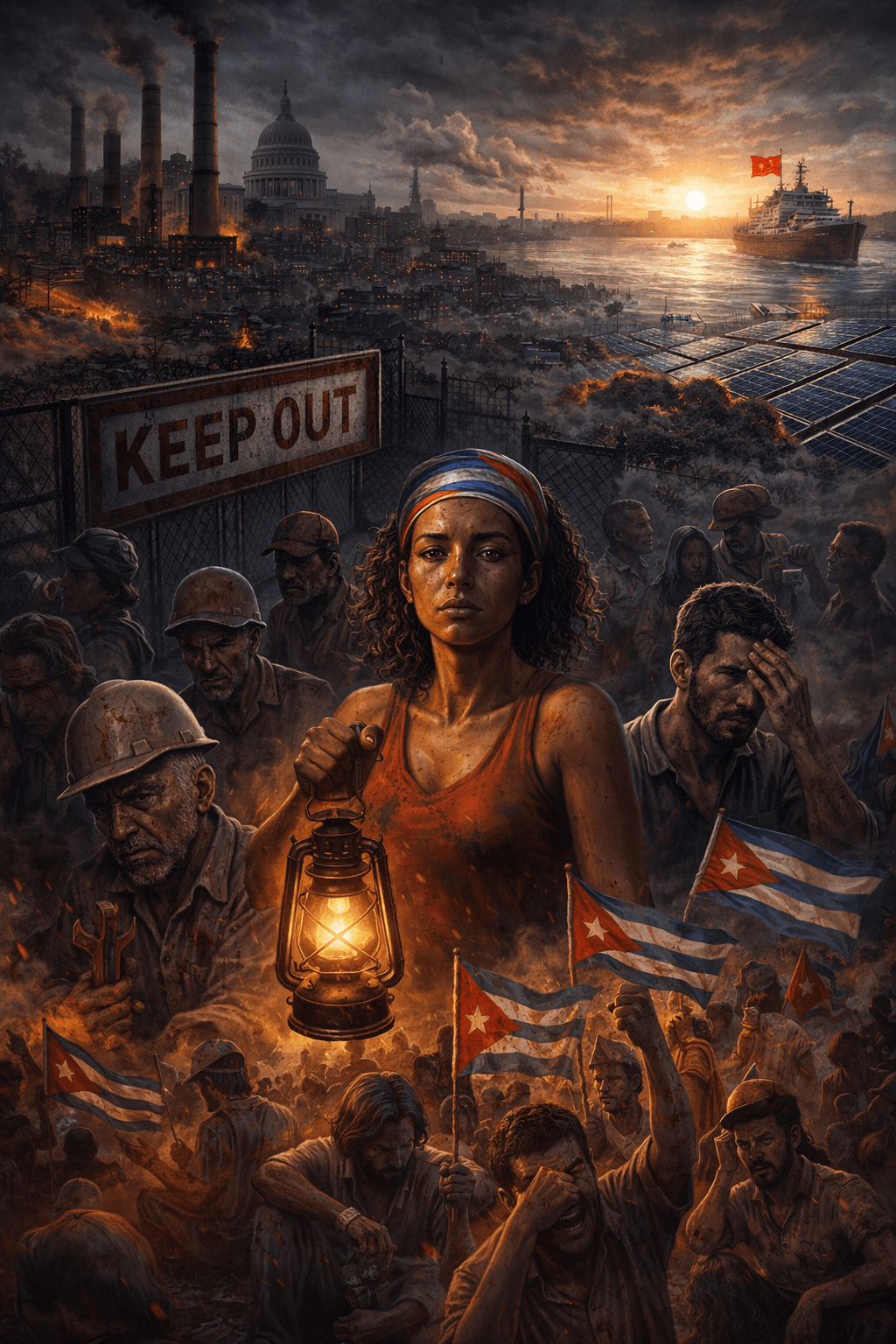
As U.S. imperialism tightens its grip on the hemisphere through economic warfare, Cuba stands at the front line—where the struggle between domination and sovereign development, between imperial command and emerging multipolar possibility, is being fought in real time.
By Prince Kapone | Weaponized Information | March 17, 2026
When a Siege Learns to Speak the Language of Concern
There is a certain talent imperial journalism cultivates with almost priestly discipline: the ability to describe suffering in exquisite detail while stepping delicately around the hand tightening the noose. That talent is on full display in “Trump has choked off Cuba’s oil supply. China is stepping in with solar”, by Rebecca Tan and Rudy Lu, published by The Washington Post on March 17, 2026. The article presents Cuba as a country staggering through blackouts, fuel shortages, and an increasingly fragile electrical system, while China appears as a power arriving with solar panels, technicians, and financing in hand. The central movement of the piece is plain enough: a stricken island, an aggressive Washington, an opportunistic Beijing, and a population left to live in the dark while great powers maneuver over its future.
But the real work of the article is not simply to report those elements. Its real work is to arrange them. And arrangement, as every serious reader of empire learns sooner or later, is never innocent. The story begins where liberal journalism so often prefers to begin: with crisis already in motion. Cuba is introduced not first as the object of an external campaign, but as a place of breakdown, disconnection, and collapse. The blackouts come first. The humanitarian strain comes first. The national emergency arrives on the page already breathing hard. Only afterward do the actions of Washington enter the narrative field, and even then they enter as one pressure among others, as part of an already turbulent scene, not as the decisive force whose weight helps produce the very disorder now being solemnly observed. This sequencing matters. It teaches the reader, quietly and efficiently, to experience the wound before being invited to notice the knife.
The prose then performs another familiar trick of respectable power: it takes force and dresses it in the tailored suit of policy. The United States is said to be “pressuring” Cuba, “ratcheting up pressure,” attempting to force negotiations, seeking concessions, making threats. All of this is narrated in the idiom of statecraft, as though the strangulation of a nation’s access to energy were merely one more hardball maneuver in the chess match of diplomacy. In this verbal universe, pressure remains pressure even when millions of people are the ones who feel it in their refrigerators, hospitals, kitchens, buses, and workplaces. The article does not need to deny suffering; it simply places the source of that suffering inside a neutral vocabulary where coercion can continue to look like strategy and punishment can pass itself off as negotiation. That is one of the oldest magic acts in the imperial book: the club disappears, and in its place we are shown a “policy option.”
The piece also knows how to handle obscenity without letting it disturb the furniture. Trump’s remark that he could “take Cuba,” that he could do “anything” he wants with it, is presented in direct form, a piece of naked domination dropped into the article with minimal friction. Yet even here the statement is not allowed to reorganize the narrative around itself. It is not treated as a revelation of political logic. It is not unfolded as an expression of a larger relation. It appears, flashes, and then is absorbed back into the article’s measured cadence, as though an openly predatory declaration were simply one more contribution to the atmosphere. The result is instructive. What might have appeared as a rupture instead becomes texture. What might have forced a reckoning is rendered as color. Empire speaks crudely for a moment, and the article, with all the poise of a seasoned maître d’, ushers the vulgar guest back into polite company.
China’s role is handled with equal care, though by opposite means. On the one hand, the article plainly allows the reader to see that Chinese-backed solar projects are delivering something tangible. Panels are installed. parks are built. megawatts appear. numbers rise. There is movement, equipment, labor, construction. The text cannot avoid this because the material presence is too visible to be wished away. Yet this relief is never permitted to stand in simple form. It must be shadowed, accompanied, disciplined. So alongside the language of energy assistance comes the language of strategic interest, security ties, alleged spy stations, geopolitical levers, and broader Chinese ambitions in the region. The pattern is subtle but steady: help is acknowledged, but never left unaccompanied by suspicion. The reader is allowed to register usefulness, but only under supervision. Aid may appear on stage, but a watchman must remain in the wings.
This is where the article’s balancing act becomes especially revealing. It repeatedly presents U.S. pressure and Chinese support as overlapping forces acting upon Cuba, as though the essential story were one of rival external influences converging on the same small nation. That framing produces a neat picture, almost elegant in its symmetry. One side squeezes, the other side supplies; one side threatens, the other side installs; both are said to pursue interests; all roads lead back to competition. But this symmetry is manufactured through arrangement rather than discovered through honesty. Cuba is positioned less as a historical subject living through imposed conditions than as a stage on which others perform. The island becomes scenery for the great-power drama. Its people appear mostly as those who endure consequences. Its state appears mostly as that which responds under duress. The narrative thereby shifts the center of gravity away from lived social reality and toward the spectacle of international rivalry, which is of course the preferred cinematic genre of imperial commentary. Human beings sit in the dark, and the headline still finds a way to flatter geopolitics.
The article further stabilizes its narrative through quantification. Numbers circulate through the piece like clerks in a ministry: export values, park totals, electricity shares, megawatts generated, proportions of the energy mix. This is not incidental. Numbers give the text an air of composure, of technical grasp, of being responsibly in command of a volatile situation. They do important ideological labor. They reassure the reader that the crisis is measurable, trackable, being translated into a language legible to experts and managers. Once rendered numerical, catastrophe can be made to feel administratively intelligible. The problem may be grave, but it is now charted. The darkness may be widespread, but it has percentages. Misery enters the spreadsheet and emerges as information. This is one of bourgeois journalism’s favorite consolations: if we can count the suffering, perhaps we need not yet ask too sharply why it is being imposed.
And then, just as the pressure of the piece might otherwise force harder questions, the narrative eases itself toward the horizon of technical futurity. Batteries. storage systems. improved capacity. the next stage of development. The ending looks forward, not backward. It gestures toward what Cuba “needs next,” toward what innovation and further investment may yet accomplish. This maneuver does not deny the crisis. It domesticates it by relocating the reader’s attention toward eventual fixes. Structural antagonism recedes; practical problem-solving advances. The crisis is thus granted an exit ramp, not through political clarification, but through technological anticipation. One can almost hear the quiet sermon beneath the prose: yes, things are severe, but solutions are coming, projects are advancing, the machinery of adaptation is in motion. In this way the article leaves the reader not with a sharpened sense of the relation being narrated, but with a tempered sense of manageable complexity.
What emerges from the whole is not crude propaganda in the old cartoon style, where villains twirl mustaches and editors foam at the mouth. It is something more refined, and therefore more useful to the people who run the world. The article is careful, measured, informed, outwardly humane. It shows hardship. It cites many voices. It avoids frenzy. And precisely through that calm professionalism, it teaches the reader how to inhabit the scene without breaking with its governing assumptions. Cuba is to be pitied, perhaps even sympathized with, but not understood in a way that would rupture the grammar of acceptable discourse. Trump may sound excessive, but not revelatory. China may be helpful, but never innocently so. The crisis may be dreadful, but it remains an event to be managed interpretively rather than a relation to be named plainly. That is the genius of this kind of article. It does not silence reality. It arranges reality into a form that can be safely consumed by readers of empire who like their conscience troubled, but not radicalized.
Behind the Blackouts Stands a Long War on Daily Life
The article under excavation is not wrong to describe Cuba as living through a severe energy emergency. But what it leaves fragmented, we have to reconnect. Cuba has been enduring deepening blackouts, fuel shortages, and breakdowns across an aging electrical system, and the United Nations Special Rapporteur Alena Douhan reported in November 2025 that blackouts in some places lasted up to 18 hours a day. That is not a mere inconvenience. It means spoiled food, interrupted water pumping, halted transportation, weakened hospitals, and the general wearing down of social life by organized scarcity.
To understand the energy crisis concretely, we must also look inside the system itself. Cuba’s electricity grid relies heavily on oil-based thermoelectric generation, much of it sustained by aging and outdated plants that are decades old and operating under degraded conditions. These facilities have suffered from chronic fuel shortages and restricted access to supplies, while long-term underinvestment has further eroded their performance. As a result, repeated breakdowns at thermoelectric plants have triggered nationwide blackouts, revealing a power system strained by both internal deterioration and the external pressures of economic blockade. Chronic, artificially-induced shortages of spare parts and maintenance capacity have reduced efficiency and reliability, while the country’s domestic reserves include heavy crude oil with high sulphur content, an energy structure that has long imposed technical constraints and reinforced dependence on imported petroleum products. This is not simply mismanagement. It is a historically inherited energy structure under conditions where modernization is systematically obstructed.
To say this crisis is only about malfunction, however, is to speak like a man admiring a burning house while refusing to mention the arsonist. The United Nations General Assembly again voted overwhelmingly in October 2025 for an end to the U.S. economic, commercial, and financial embargo against Cuba. Year after year, Washington stands nearly alone in defending a policy that much of the world regards as illegitimate, cruel, and historically exhausted.
The UN resolution adopted in 2024 and the 2025 General Assembly proceedings make plain that this blockade remains active, enforced, and economically consequential. It operates through extraterritorial pressure—punishing third parties, deterring trade, and narrowing the material room within which Cuban society must function.
This pressure becomes most visible in the energy sector through the mechanisms of global trade itself. Fuel shipments to Cuba have been disrupted and reduced under U.S. sanctions pressure, as tanker operators face the risk of blacklisting, seizure, and restricted access to global markets. Sanctioned vessels have been forced into evasive “shadow fleet” operations, while even state suppliers reconsider deliveries amid fears of U.S. retaliation. Financial institutions hesitate to process payments, insurance coverage becomes difficult or impossible to secure, and transactions are delayed or blocked. Fuel does not simply fail to arrive—it is prevented from arriving through a system designed to make normal trade prohibitively risky.
The U.S. Treasury’s Cuba sanctions framework lays out restrictions that directly impact Cuba’s ability to access international financial systems. This translates immediately into energy vulnerability. Without stable access to foreign currency, fuel purchases become inconsistent. Without credit, bulk purchasing becomes difficult. The energy crisis is therefore also a financial crisis—an electricity shortage rooted in monetary restriction.
This constraint has deepened over time. For years, Cuba’s energy system was partially stabilized through regional integration. Venezuela served as Cuba’s primary oil supplier—providing roughly half of the island’s fuel needs under cooperative arrangements, forming part of a broader framework of Latin American solidarity. But this system was forcibly disrupted. Following the U.S. attack against Venezuela, the kidnapping of President Nicolas Maduro, and the tightening of sanctions, Venezuelan oil shipments to Cuba were halted. With Venezuela’s oil exports simultaneously constrained by sanctions and tanker seizures, the result was not simply a decline in supply, but the dismantling of a regional energy lifeline. What had once functioned as an alternative system of exchange was reabsorbed into a structure increasingly dictated by U.S. coercive power over global energy flows.
The effects of these overlapping pressures extend beyond energy itself. Tourism, a major source of foreign exchange for Cuba, has struggled to recover to pre-pandemic levels, with visitor numbers far below earlier projections and less than half of 2019 levels, limiting the country’s ability to earn the hard currency needed to import fuel.This is not a coincidence—it is a chain of cause and effect. Fewer tourists mean fewer dollars; fewer dollars mean fewer fuel imports; and fewer imports mean longer nights without power. The blackout is not the beginning of the crisis—it is its final symptom. The real crisis is an economy being slowly suffocated.
Douhan’s findings confirm that these sanctions impact nearly every sector of life, from food security to healthcare. Oxfam’s research further shows how these pressures fall heavily on households and caregiving labor. The blockade is not an abstract policy. It is a system that penetrates daily life.
At the same time, the much-discussed solar expansion must be understood in its real conditions. China dominates global solar supply chains, making it a central actor in Cuba’s transition. But solar energy is intermittent, dependent on storage systems that remain expensive and difficult to scale. Grid infrastructure must be adapted to integrate distributed generation. This is not a simple substitution of technologies. It is a long-term transformation being attempted under severe external constraint.
What emerges, then, is not a simple story of failure or recovery. It is a system under pressure from multiple directions: an oil-dependent electricity system dominated by thermoelectric generation, restricted access to global fuel markets under U.S. sanctions and blockade measures, financial isolation imposed through the U.S. sanctions regime, declining tourism revenues limiting foreign exchange inflows, and an incomplete and constrained transition toward renewable energy. The blackout is not an isolated malfunction. It is the visible result of these forces acting together.
That is the terrain the article only partially reveals. It shows the darkness. The broader record reveals the machinery producing it.
Fortress America and the Energy Battlefield
The blackout in Cuba is not a mystery, and it is not simply the result of internal failure. What we saw in the previous section makes that clear. An aging thermoelectric system, already strained by decades of use, is now operating under conditions where fuel is restricted, spare parts are difficult to obtain, financial channels are blocked, and regional support systems have been weakened. The result is not accidental. It is the predictable outcome of economic warfare acting on a historically constrained energy infrastructure.
U.S. imperialism has not merely “pressured” Cuba. It has targeted the material foundation of Cuban society—its ability to generate electricity, move goods, preserve food, and sustain life. When oil shipments are obstructed through sanctions on shipping, banking, and insurance, the consequence is not abstract leverage. It is darkness. It is hospitals operating under strain. It is water systems failing. It is workers reorganizing their lives around instability. This is what economic warfare looks like when it reaches the level of social reproduction.
And Cuba is not being treated this way in isolation. The same system that restricts fuel to Havana has, over time, constricted the regional energy arrangements that once provided partial stability. The weakening of Venezuelan oil flows—driven by sanctions and economic siege—did not simply affect Caracas. It destabilized an entire network of cooperation that had allowed countries like Cuba to secure energy outside direct imperial control. What we are seeing is not a single-target operation, but the dismantling of an alternative regional system.
This is where the broader strategy comes into view. Across the hemisphere, pressure is being applied in different forms—against governments, against resources, against political processes—to ensure alignment with U.S. interests. Energy sits at the center of this effort because it is the condition of all other activity. A country that cannot reliably produce electricity cannot sustain industry, transportation, healthcare, or daily life. Control energy, and you control the limits within which a society can exist. This is not simply foreign policy. It is the enforcement of domination at the level of life itself.
In this light, the intensification of pressure on Cuba takes on a clear meaning. The United States is attempting to secure its position in a hemisphere where its dominance is no longer guaranteed. The tightening of sanctions, the restriction of fuel, and the open threats of takeover point toward a broader orientation—one aimed at locking down the region politically and economically as global conditions shift. Cuba stands directly in the path of that consolidation.
Cuba occupies a decisive position in this struggle. It is not simply another country facing hardship. It is a long-standing example of anti-imperialist resistance, a society that has survived decades of blockade while attempting to organize its development outside the direct control of U.S. capital. Its continued existence under these conditions carries political weight. It demonstrates that submission is not inevitable. For an empire seeking to reassert control, that example is dangerous.
But the story does not end with pressure. Even under conditions of severe constraint, new elements are entering the field. The expansion of solar infrastructure in Cuba, supported through Chinese partnership, is one such development. On its own, it does not resolve the crisis. Solar generation is intermittent. Storage systems remain expensive. The grid itself requires adaptation. The country remains, for now, heavily dependent on fossil fuels. But something important has changed.
Energy is beginning to arrive, however partially, through channels not controlled by the United States. This alters the structure of dependence. When a portion of electricity can be generated without relying entirely on fuel constrained by sanctions, the total grip of imperial control loosens. Not completely, not cleanly, but materially. A country under siege gains room to maneuver. It can stabilize parts of its system. It can plan beyond immediate survival. It can act, even if only within a narrow margin, outside imperial command.
At the same time, the pressures created by this siege do not leave the internal structure of Cuban society unchanged. The restriction of fuel, the scarcity of foreign exchange, and the limits placed on participation in global markets generate a need for resources that cannot always be met internally. Under these conditions, the Cuban state has expanded certain economic channels, including greater space for investment from Cubans residing abroad. This is often portrayed externally as reform or retreat. In reality, it is adaptation under pressure—a response to material constraints imposed from outside.
But this adaptation carries its own contradictions. The Cuban diaspora is not a uniform or neutral economic actor. It includes workers, small business layers, and professionals, but also elements historically tied to counterrevolutionary politics and integration into U.S. capital. To open space for this capital is therefore to introduce new tensions—pressures toward inequality, differentiation, and external influence that must be managed within the broader socialist project. What appears as economic flexibility is, at the same time, a site of struggle over the direction of development itself.
This reveals the deeper logic of imperial strategy. The objective is not only to break Cuba through deprivation. It is also to reshape it through necessity—to create conditions in which survival requires partial accommodation to external capital. In this sense, the blockade operates not only as a tool of destruction, but as a mechanism of transformation, pushing the Cuban economy toward forms of integration that can erode its autonomy over time.
What we see, then, is a layered contradiction. On one side, U.S. imperialism intensifies its economic assault, seeking to restrict the material conditions of life and reassert control over the hemisphere. On the other, new forms of cooperation—uneven, limited, but real—begin to open pathways for development outside that control. And within Cuba itself, adaptations to survive these pressures introduce new internal tensions that must be navigated carefully.
The energy crisis is therefore not just a technical problem. It is a battlefield. It is where imperialism attempts to enforce its power by restricting the conditions of existence, and where a society under siege struggles to maintain and expand its capacity to live and develop on its own terms. The outcome will not be determined by any single factor, but by how these external pressures and internal contradictions are resolved in the course of struggle.
The blackout shows us the pressure. The emerging alternatives show us the possibility. The internal adjustments show us the tension. Together, they reveal a society fighting not only to survive, but to determine the terms of its own future under conditions designed to deny it that choice.
Break the Blockade, Defend Sovereignty, Build the Future
If Cuba were only a distant island in crisis, this could be treated as a matter for commentary and concern. But what we have seen makes that position impossible to maintain. The blackout is not distant. It is the product of a system that operates globally—including within the United States itself. The same structures that deny fuel to Cuba deny housing, healthcare, and stability to millions at home. This is not two separate realities. It is one system expressing itself in different forms. To stand with Cuba is therefore not charity. It is a clear recognition of a shared struggle against imperial domination.
Across the United States and beyond, that struggle already has organized expression. Groups like the National Network on Cuba, CODEPINK, the ANSWER Coalition, and IFCO/Pastors for Peace have built sustained campaigns against the blockade, combining political pressure, public education, and material aid. IFCO/Pastors for Peace continues to organize delegations that break the isolation imposed by U.S. policy, building direct relationships between people that no sanction can fully sever.
These are not symbolic efforts. They are concrete fronts in a struggle to dismantle the machinery of economic warfare. Campaigns to end the blockade, to restore fuel access, to normalize trade, and to defend Cuba’s right to development are not abstract demands. They are demands that, if won, would immediately impact the conditions of life—stabilizing energy supply, strengthening public services, and expanding the space for sovereign planning. The fight against the blockade is therefore inseparable from the fight to keep the lights on, to keep hospitals functioning, to keep food moving, and to keep daily life intact.
At the same time, the struggle must also be understood internationally. Across the Global South, countries are exploring forms of cooperation that reduce dependence on Western-controlled financial and energy systems. Initiatives associated with BRICS and broader South-South integration efforts represent attempts—uneven, incomplete, but real—to build alternative pathways for development. For countries like Cuba, these pathways are not ideological luxuries. They are material lifelines that expand the possibility of survival and long-term planning under conditions of external pressure.
For those living in the imperial core, the responsibility is clear. It is not enough to oppose war in the abstract while ignoring the forms of economic warfare carried out in our name. It is not enough to criticize policy without organizing against it. The blockade persists not only because of state power, but because of political passivity where resistance should be. That must change. Workers, students, and communities must connect their own struggles—against austerity, against privatization, against exploitation—to the broader fight against imperialism abroad.
This means building organizations that can sustain pressure over time. It means joining existing movements, strengthening them, and expanding their reach. It means confronting the narratives that justify sanctions and exposing their real consequences. It means supporting independent media that challenge imperial propaganda, contributing to material aid efforts that reach those under siege, and participating in campaigns that directly target the institutions responsible for enforcing the blockade.
It also means understanding the stakes clearly. The struggle over Cuba is not only about one country. It is about whether nations can determine their own path, whether development can take place outside imperial control, and whether the working classes of the world can move beyond a system that enforces scarcity in order to maintain power. Cuba’s endurance under siege is part of a larger global movement—one that stretches across continents and connects struggles that are often treated as separate but are, in reality, deeply linked.
The empire organizes globally. It coordinates its economic, political, and military power across regions. The response must be equally coordinated. Solidarity must become strategy. Outrage must become organization. The defense of Cuba must be understood not as a single issue, but as part of a broader fight for a world in which sovereignty is real, development is not punished, and the working class is no longer forced to survive under systems designed to keep it subordinate.
The blockade can be ended. The pressure can be resisted. The future is not fixed. But none of this will happen on its own. It depends on whether people act—collectively, consciously, and with the same determination that has allowed Cuba itself to endure. The choice is not abstract. It is immediate. Stand with empire, or stand with those fighting to build something beyond it.
 Weaponized Information
Leave a comment