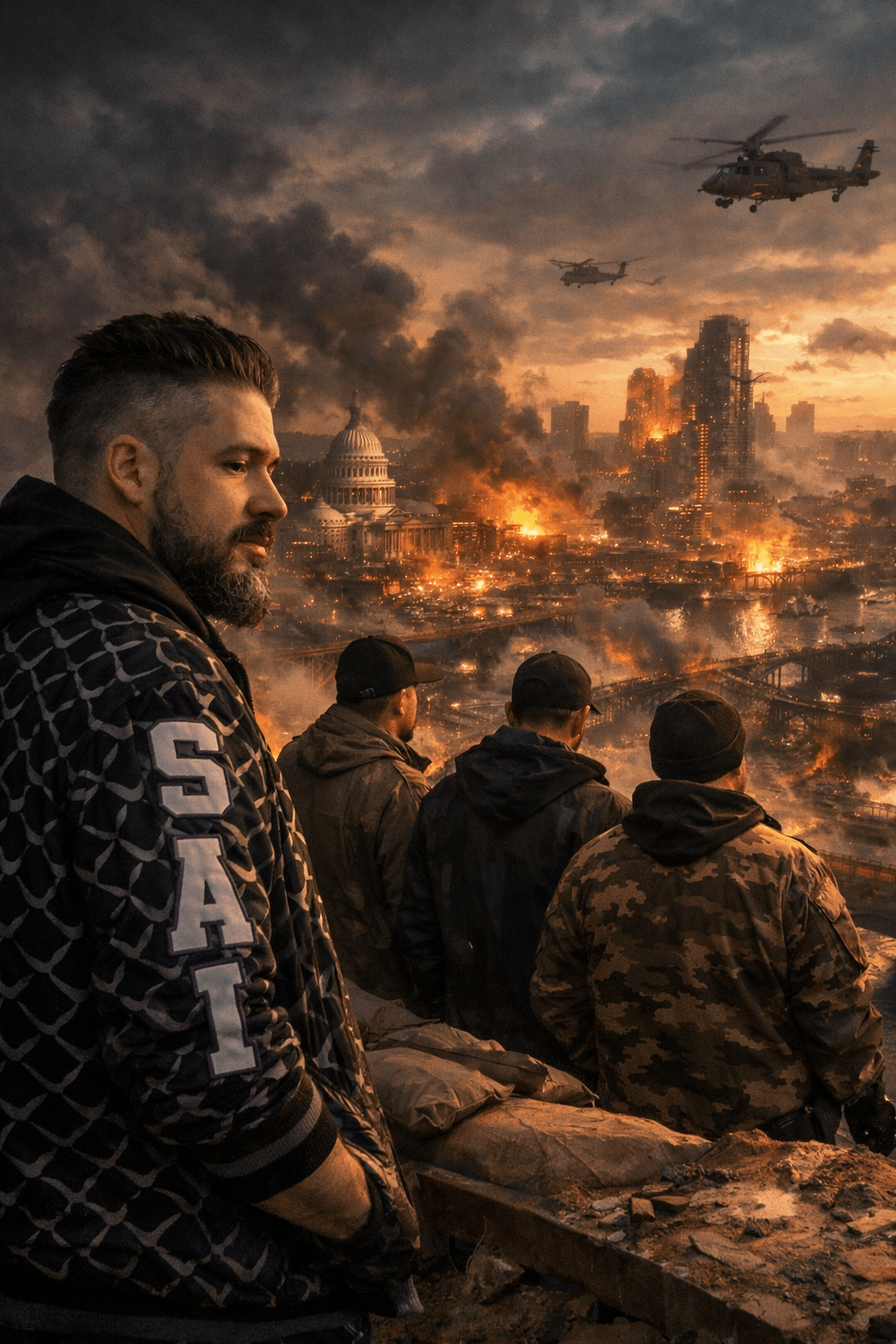
When Emmanuel Todd wrote After the Empire, Washington still believed it ruled a permanent unipolar world. Todd saw something different: an empire sustained less by production than by financial tribute and military spectacle. Two decades later the contradictions he described—economic dependency, micromilitarism, and ideological decay—have matured into the turbulent transition now reshaping global power.
By Prince Kapone | Weaponized Information | Weaponized Intellects Book Review | March 15, 2026
The Empire That Smiled While Its Foundations Cracked
When Emmanuel Todd published After the Empire in the early years of the twenty–first century, the American ruling class was strutting across the world stage like a prizefighter who believed the match had already been won. The Soviet Union had collapsed, the Cold War had ended, and Washington proclaimed the arrival of what it liked to call the “unipolar moment.” The message from the imperial press corps was simple: history had crowned its champion. American power would now organize the planet indefinitely, and anyone who doubted this arrangement was politely informed that they were living in the past.
Todd looked at this triumphal parade and did something unusual for a Western intellectual—he read the balance sheet instead of the headlines. Beneath the fireworks and speeches he saw a structure beginning to hollow out. The United States still possessed unmatched military power, yes, but its economic foundations were shifting in ways that few were willing to confront. Factories that had once formed the steel spine of American industry were closing or migrating abroad. The country that once exported automobiles, machinery, and steel now increasingly imported the goods that sustained its own daily life. What flowed outward instead were dollars, financial instruments, and aircraft carriers.
The picture that emerged was less flattering than the mythology of the “indispensable nation.” The American economy was gradually transforming into something closer to a gigantic mechanism of consumption. Goods arrived from across the oceans; capital flowed in from foreign investors eager—or compelled—to park their wealth in dollar-denominated assets. Washington spent more than it produced, and the rest of the world quietly financed the difference. Todd’s diagnosis was blunt: the empire had begun to live on the labor of others while insisting that this arrangement represented universal progress.
Now, most geopolitical commentary prefers the drama of generals and presidents, the theatre of summits and wars. Todd takes a different route. He reads history through the slower and more stubborn indicators of social life—demography, literacy, education, family structures, and patterns of economic production. These are not the variables that make good cable television, but they reveal the deeper motion of societies. And those indicators told him something uncomfortable. The United States remained militarily formidable, yet the social and economic foundations that once sustained that power were gradually weakening.
During the Cold War, these contradictions were easier to hide. The rivalry with the Soviet Union forced Washington to maintain a vast industrial base, to fund scientific research, and to cultivate alliances that stabilized the Western economic system. But once that rivalry vanished, the discipline it imposed disappeared as well. Manufacturing drifted overseas. Finance grew fat and arrogant. Wall Street replaced the factory floor as the symbolic center of American capitalism. The empire still spoke the language of production, but it increasingly lived on speculation and debt.
Todd suggests that the burst of American military activism after the Cold War should be understood against this background. When an empire’s economic foundations weaken, it often compensates with demonstrations of force. Aircraft carriers appear where factories once stood; military alliances expand where industrial networks have thinned. Violence becomes a kind of advertisement—proof that the empire still matters. From this perspective, the wars and interventions that defined the early twenty–first century look less like expressions of confident supremacy and more like the nervous movements of a system trying to preserve its authority through spectacle.
None of this means that the United States suddenly ceased to be powerful. Empires rarely collapse in a single dramatic moment. They linger, sometimes for decades, in a strange condition where military strength survives long after the economic and social structures that created it have begun to erode. The rulers continue to speak as if nothing has changed, while the world quietly rearranges itself around them. Todd’s opening argument invites the reader to consider that the American order had already entered such a phase at the turn of the millennium.
This is the thread that runs through the entire book. Todd is not simply announcing the decline of American power; he is asking what happens when an empire loses its center of gravity. If the political authority of Washington rests increasingly on force while the material foundations of that authority disperse across the globe, then the international system begins to move in unpredictable ways. The rest of After the Empire explores that unfolding contradiction—how a superpower that still commands armies and dollars might nonetheless find itself presiding over a world that no longer revolves around it.
Inventing a Global Enemy to Keep the Empire Employed
Once the Soviet Union disappeared, the American empire faced a strange problem. The generals still had their bases, the intelligence agencies still had their budgets, the weapons manufacturers still had their assembly lines, but the grand enemy that justified this machinery had evaporated. A system built for planetary confrontation suddenly found itself without a planetary adversary. In such moments, history teaches us that empires do not quietly retire their instruments of power. They search for a new villain. And so the age of “global terrorism” was born.
Todd approaches this subject with the calm patience of a historian who has seen this play before. He does not deny that violent groups exist or that political violence erupts across regions. What he questions is the strange miracle through which scattered militant networks were suddenly elevated into a unified civilizational threat capable of justifying wars across continents. The story told to the public was simple enough: a shadowy enemy lurked everywhere, irrational and fanatical, determined to destroy “freedom.” The cure, conveniently, was the permanent deployment of American military power across the map.
But when Todd steps back from the theater of slogans, the picture changes. Terrorism, he argues, was never the kind of centralized geopolitical force that the Soviet Union had been. It had no industrial base, no coherent territorial system, no economic structure capable of rivaling a superpower. To treat it as the organizing principle of global strategy required a remarkable act of exaggeration. Yet that exaggeration served a purpose. By transforming terrorism into a universal enemy, Washington solved the problem of empire without a rival. The war could now be everywhere and nowhere at once, stretching indefinitely across time and geography.
In other words, the War on Terror functioned less as a campaign against a defined threat and more as a mechanism for preserving the political architecture of American primacy. Military bases expanded across new territories. Intelligence networks deepened their reach. Governments that might otherwise have drifted toward autonomy were folded back into the security orbit of the United States. The language of emergency became the glue holding together a sprawling imperial system that had lost the ideological clarity of the Cold War.
Todd’s insight here cuts deeper than a simple critique of American propaganda. He suggests that a declining empire often requires instability in order to maintain its relevance. If the world appears dangerous and chaotic, then the empire presents itself as the indispensable guardian of order. But if the world becomes stable and self-governing, the need for imperial supervision begins to fade. Thus the paradox: the power that claims to guarantee global security may also benefit from the perception that security is always under threat.
One does not need a degree in philosophy to see how convenient such a narrative can be. When fear becomes permanent, so does the authority of those who promise protection. The machinery of surveillance grows. Military budgets swell. Civil liberties shrink quietly under the polite language of national security. The empire, meanwhile, presents its expanding reach as a reluctant duty rather than a political strategy. The system insists it is acting only in the universal interest while material interests quietly accumulate behind the curtain.
Todd reads this ideological transformation as a sign of deeper insecurity. The American order could once claim that its leadership rested on economic dynamism and technological innovation. Now it increasingly defined itself through the management of threats. Instead of exporting tractors and steel mills, it exported doctrines of counterinsurgency and drone warfare. Instead of building the infrastructure of development abroad, it built a vast security apparatus designed to patrol a world that was portrayed as permanently unstable.
The irony, of course, is that such a strategy risks producing the very chaos it claims to prevent. Military interventions fracture societies. Occupations breed resistance. Sanctions suffocate economies and radicalize politics. Each crisis becomes the justification for the next intervention, until the cycle begins to resemble a snake eating its own tail. The empire moves restlessly from one battlefield to another, announcing that stability will finally arrive just after the next operation.
Todd’s point is not that the United States consciously planned every aspect of this cycle. History rarely operates with such tidy intentions. Rather, the logic of empire pushed the system in that direction. A global military infrastructure requires a global narrative of danger to justify its existence. The myth of universal terrorism supplied precisely that narrative. It allowed Washington to maintain the posture of a civilization under siege while continuing to expand its strategic reach across regions that had little to do with the original events that supposedly triggered the war.
Seen in this light, the War on Terror becomes something larger than a particular set of military campaigns. It becomes the ideological bridge between the confident imperial order of the late twentieth century and the more anxious, militarized order that followed. Todd’s argument suggests that the United States did not simply fight terrorism; it reorganized its global role around the permanent management of insecurity. The empire that once promised prosperity now promised protection—and demanded obedience in return.
This shift marks an important turning point in Todd’s broader analysis. If the first chapter exposes the economic hollowing of American power, this one reveals the ideological adaptation that followed. The empire could no longer rely solely on the magnetism of its prosperity, so it increasingly relied on the gravity of fear. A world convinced that danger lurks everywhere will accept the constant presence of the imperial policeman. But such a world is also one where the policeman must never allow the streets to become truly quiet.
When the World Graduates from the Imperial Classroom
The empire likes to imagine itself as a teacher. It tells the rest of the world that history moves forward under its guidance, that the nations of the Global South are students in a long course called “development,” and that Washington sits at the front of the classroom with chalk in hand explaining the lessons of democracy, markets, and civilization. Emmanuel Todd takes this flattering image and flips the blackboard around. What if the real problem for the empire is not that the world refuses to learn—but that it has learned too much?
Todd’s chapter on democracy begins with an observation so simple it almost sounds mischievous: the spread of literacy, education, and social development across the globe gradually erodes the need for imperial supervision. For centuries, colonial rule rested on a certain asymmetry. The metropole possessed the administrative capacity, the technological knowledge, and the bureaucratic machinery to govern territories whose populations were deliberately kept in conditions of dependency. The colonized were told they were not ready to run their own affairs. Meanwhile the empire quietly made sure they remained unready.
But the twentieth century began to break this arrangement apart. Schools multiplied across Asia and Africa. Universities expanded. Literacy climbed steadily. Families that once raised six or seven children saw birthrates fall as education and urban life transformed social expectations. These changes did not occur because the imperial powers suddenly discovered their humanitarian conscience. They occurred because colonized peoples fought for them—through revolutions, independence movements, and decades of political struggle that forced the doors of modern education and statehood open.
Todd reads these demographic and educational transformations as signals of a deeper historical shift. Societies with high literacy rates and complex social structures do not remain easily governable from the outside. Once a population can read, organize, and educate its children, it begins to produce its own administrators, engineers, economists, and political thinkers. In short, it becomes capable of managing its own future. For an empire accustomed to acting as global tutor, this is a dangerous development. The students have started writing their own textbooks.
Here Todd introduces his quiet reversal of the dominant Western narrative. For decades Washington has presented itself as the great promoter of democracy. Yet if democracy means the emergence of politically conscious societies capable of making independent decisions, then the spread of democracy inevitably weakens imperial authority. Nations that can govern themselves are less inclined to accept lectures from abroad—especially when those lectures arrive accompanied by aircraft carriers and economic ultimatums.
The contradiction becomes clear when one observes how the empire reacts when democracy produces outcomes it does not like. Elections are applauded when they deliver friendly governments; they are treated as unfortunate mistakes when they empower leaders who pursue independent paths. Suddenly the vocabulary of democracy gives way to the language of “stability,” “security,” and “responsible governance.” In other words, democracy is welcome so long as it does not disturb the hierarchy of empire. The moment it does, the lesson plan changes.
Todd’s demographic lens reveals why this tension continues to grow. As societies mature—educationally, economically, and politically—they develop the internal capacity to resist external management. They build their own bureaucracies, cultivate their own experts, and pursue their own development strategies. The imperial center, which once justified its dominance as a necessary service to “backward” regions, suddenly finds itself confronting a world filled with competent actors who do not particularly appreciate being supervised.
This is where the empire’s ideological narrative begins to strain. It claims to be spreading democracy, yet the success of that project undermines its own authority. The more the rest of the world learns to stand on its feet, the less convincing Washington’s claim to global guardianship becomes. Todd’s argument cuts through the sentimental language of Western liberalism with a certain quiet ruthlessness: development abroad does not naturally reinforce imperial leadership—it dissolves it.
One might say the empire suffers from a pedagogical crisis. For decades it taught the virtues of sovereignty, political participation, and national development. Now that the pupils have taken those lessons seriously, they are beginning to ask uncomfortable questions. Why should the United States dictate economic policy in Latin America? Why should African resources flow outward while development lags at home? Why should Asian economies organize themselves around the financial priorities of Wall Street? These are not the questions of ignorant populations. They are the questions of societies that have matured.
Colonialism was never merely a political arrangement but a system designed to prevent the colonized from controlling their own development. Todd’s demographic analysis points toward the moment when that system begins to crack. The spread of education, literacy, and social organization gradually equips the former periphery with the tools needed to escape the imperial classroom altogether. The empire may still stand at the podium, but the students are already leaving the lecture hall.
For Todd, this transformation carries enormous geopolitical consequences. A world populated by politically conscious and socially developed nations will not easily submit to a single center of authority. It will seek balance, autonomy, and new forms of cooperation that bypass the old imperial structures. What looks to Washington like disorder may in fact be the birth of a more plural world—one in which the empire’s claim to universal leadership appears less like common sense and more like an outdated syllabus.
Thus the spread of democracy, far from stabilizing the American order, quietly undermines it. The empire that once presented itself as the teacher of modernity now faces a generation of students who have learned enough to challenge the curriculum. And as any schoolteacher knows, the moment the class begins to question the authority of the instructor, the lesson is already over.
An Empire Without Colonies, Yet Everywhere
When people hear the word empire, they imagine old maps painted in bright imperial colors. They picture British governors ruling India, French officers marching through Algeria, Spanish fleets hauling silver across the Atlantic. Emmanuel Todd asks us to throw away that map. The American empire does not look like Rome, and it does not resemble the British Raj. It has no viceroys sitting in colonial palaces, no formal declaration that half the world belongs to Washington. Instead it operates through something more subtle and, in some ways, more efficient: a system of indirect command.
This is why so many observers insist that the United States cannot be an empire. They look for colonies and find none. They search for imperial decrees and see only treaties and alliances. But this is a bit like saying a bank robber cannot be guilty because he used a credit card instead of a crowbar. Power has simply modernized its tools. The American system rules less through territorial occupation and more through the management of networks—military, financial, and ideological—that shape the behavior of states without needing to formally annex them.
Todd sketches the architecture of this arrangement with careful precision. At its foundation stands the most extensive military infrastructure ever assembled: hundreds of bases scattered across continents, fleets patrolling the oceans, satellites orbiting above every corner of the planet. This military presence does not need to govern populations directly in order to exert influence. Its very existence establishes a strategic perimeter inside which Washington retains the ability to intervene whenever the system threatens to drift beyond its control.
But military reach alone does not explain the peculiar resilience of the American order. Alongside the soldiers stands another instrument of empire: finance. The U.S. dollar operates as the central currency of global trade and investment. Governments accumulate American treasury bonds. Corporations borrow and invest in dollars. Financial crises that erupt thousands of miles away still end up echoing through Wall Street. In this sense the empire possesses a gravitational center. Capital flows toward the United States even when production occurs elsewhere.
Then there is the softest instrument of all: ideology. Hollywood films, advertising, universities, think tanks, media conglomerates—the cultural apparatus of American capitalism spreads a certain vision of modern life across the globe. The empire does not simply sell goods; it sells aspirations. The dream of prosperity, consumer abundance, and technological progress arrives packaged with the quiet assumption that the United States represents the natural leader of this world. Many people absorb the dream without noticing the politics hidden inside it.
Put these elements together and a strange kind of empire emerges. It does not require governors in colonial uniforms because it organizes the behavior of states through alliances, markets, and narratives. Countries remain formally sovereign, yet their strategic choices often unfold inside boundaries defined elsewhere. They host American bases in the name of security. They structure their financial systems around the dollar. They measure success according to standards established in Washington, New York, or Silicon Valley.
Todd insists that this system once possessed a certain internal coherence. After the Second World War, American industry was strong enough to supply goods to allies rebuilding from devastation. The dollar functioned as a stable anchor for international finance. U.S. leadership appeared, at least to many in Europe and parts of Asia, as the organizing principle of a prosperous Western order. The empire did not need to shout about its authority; it could simply deliver economic growth and technological dynamism.
But an architecture built on several pillars becomes unstable when those pillars begin to weaken. The military machine remained enormous, even expanded, while the productive core of the American economy gradually migrated abroad. The financial system continued to dominate, yet it increasingly revolved around speculation and debt rather than industrial production. And the ideological glow that once surrounded American leadership dimmed as wars multiplied and economic crises exposed the inequalities beneath the promise of prosperity.
This is where Todd’s analysis becomes particularly sharp. An empire sustained by indirect control must maintain the credibility of the networks through which it operates. Alliances must appear mutually beneficial. The dollar must remain trustworthy. The cultural narrative must continue to persuade people that the system works in their interest. When those assumptions begin to fray, the machinery of indirect rule becomes harder to operate. The empire may still possess enormous military force, but the invisible threads that once held the system together start to loosen.
In the old colonial world, domination required the physical presence of soldiers and administrators. In the modern American system, domination often occurs through subtler channels: investment agreements, security partnerships, financial obligations, cultural influence. This arrangement can be remarkably efficient when the empire’s economic and ideological power remains convincing. Yet it also means that the system depends heavily on perception. If the rest of the world begins to doubt the stability or legitimacy of the imperial center, the networks that sustain its influence may gradually reorganize themselves.
Todd’s portrait of American empire therefore carries a quiet warning. Power that relies on networks rather than direct rule can expand rapidly, but it can also unravel in unexpected ways. A single rupture in finance, a crisis of legitimacy, or a strategic miscalculation can ripple across the entire structure. What once appeared as a seamless web of alliances and markets can suddenly reveal itself as a fragile system held together by confidence—and confidence, as every banker knows, can evaporate faster than it was created.
Thus the American empire does not resemble the empires of old, but neither is it something entirely new. It is a modern adaptation of a familiar principle: control the flows of money, weapons, and ideas, and the world will often move in the direction you prefer. Yet as Todd suggests, this arrangement carries its own contradictions. When the economic center of gravity begins to shift elsewhere, the empire may discover that its invisible networks were not chains after all, but threads—strong enough to guide the world for a time, yet vulnerable to the slow pressure of historical change.
The Tribute Machine: How the Empire Eats Without Producing
Now we arrive at the chapter where Todd stops circling the beast and finally drives the spear straight into its ribs. Everything that came before—the myth of terrorism, the illusion of universal leadership, the strange architecture of an empire without colonies—was preparation for this revelation. The real secret of the American order, Todd argues, is not its strength but its dependency. The empire at the center of the global system increasingly survives by drawing in the surplus produced elsewhere.
This is not the old colonial tribute where caravans of silver sailed toward Madrid or London. Modern empire is more sophisticated. Instead of bullion, the tribute arrives through financial flows. Dollars circulate across the globe as the currency of trade and investment. Countries accumulate American debt instruments as reserves. Corporations and governments park their wealth inside U.S. financial markets. In short, the world produces and the United States consumes—and the accounting is settled through the mysterious alchemy of global finance.
Todd describes this with a calm precision that borders on mischief. The United States imports far more than it exports. Its trade deficits balloon year after year. Yet instead of collapsing under the weight of this imbalance, the American economy continues to function because the rest of the world willingly sends capital back to the imperial center. The dollars used to purchase foreign goods return to Wall Street in the form of loans, investments, and treasury purchases. It is a loop—an economic circulation in which the empire’s deficit becomes the engine of global finance.
One could say that the United States has perfected a curious form of parasitism. It absorbs the labor of distant factories while offering the rest of the world something in exchange: access to its financial markets and the promise of military protection. The arrangement works as long as the participants believe that the dollar remains stable and that the American security umbrella is worth the price. But the moment those beliefs begin to wobble, the whole structure reveals its fragility.
Todd’s contribution is to show that this tribute system carries within it the seeds of instability. A country that produces less than it consumes must constantly attract external capital. That means maintaining the confidence of foreign investors, governments, and financial institutions. It means preserving the dollar’s privileged role in global trade. It means convincing the rest of the world that parking its wealth in the United States remains the safest and most profitable option available.
But confidence is a slippery thing. It rests not only on financial calculations but on political credibility. If the imperial center begins to look erratic—militarily overextended, economically hollowed out, socially fractured—then the willingness of others to finance its deficits may gradually erode. The tribute machine depends on trust. And trust, once shaken, can flee faster than capital itself.
Todd does not claim that the system will collapse overnight. Empires rarely die that quickly. Instead he describes a slow tension building inside the global economy. The United States continues to consume the world’s surplus, yet the productive dynamism that once justified this arrangement increasingly resides elsewhere. Factories hum across Asia. Industrial networks expand across Eurasia. Meanwhile the imperial center grows ever more reliant on financial instruments and speculative markets to maintain its economic momentum.
There is a certain irony in this arrangement. The empire that lectures the world about fiscal discipline survives by running the largest deficits in human history. The country that preaches free markets protects its financial privileges through the political authority of the dollar and the strategic reach of its military alliances. It is capitalism wearing the uniform of empire and calling the whole performance “global stability.”
Todd’s argument here is devastating precisely because it strips away the mythology of American economic leadership. The empire does not dominate the world by producing more efficiently than everyone else. It dominates by sitting at the center of a financial vortex that pulls in the wealth generated by others. The tribute flows not through colonial taxation but through the circuits of global finance.
And yet, as every worker knows, a system that eats without producing eventually faces a reckoning. The question Todd leaves hanging in the air is not whether the tribute machine can function—it clearly has—but how long the rest of the world will continue feeding it. Empires, like parasites, depend on the health of the host. If the host begins to weaken or rebel, the relationship changes.
This chapter therefore stands as the economic heart of After the Empire. Here Todd reveals the structural contradiction at the center of American power: a military superpower sustained by a global economy it increasingly depends upon rather than controls. The empire still commands the battlefield, but in the quiet arithmetic of production and trade, its position grows more precarious with each passing year.
When the Sermon Stops Convincing: The Slow Death of Imperial Universalism
Every empire needs a story about itself. Not the real story—the one written in the ledgers of banks, the minutes of corporate boards, and the quiet agreements between generals and ministers. No, empires need a moral story. They must explain to the world why their dominance is not domination at all but a kind of service to humanity. The British called it civilization. The French called it the mission civilisatrice. The United States calls it democracy, human rights, and the rules-based order. Todd’s sixth movement in After the Empire begins with a simple observation: the sermon has begun to lose its congregation.
For most of the twentieth century, American power traveled with a certain ideological glow. Washington presented itself as the leader of a universal project. The language was noble: liberty, development, modernity. This was not merely propaganda; many people genuinely believed it. The United States emerged from the Second World War with enormous industrial capacity, a booming middle class, and an image—carefully curated—of democratic vitality. For millions across Europe and parts of Asia, American leadership appeared to represent stability and opportunity after the devastation of global war.
But universalism is a fragile mask. It works only as long as the empire can plausibly claim that its leadership benefits others. When the gap between rhetoric and reality widens, the mask begins to slip. Todd argues that by the end of the twentieth century, the contradictions of the American system were becoming harder to hide. The same power that spoke endlessly about democracy supported dictatorships when convenient. The same government that invoked international law bypassed it whenever its interests demanded. The same economy that promised shared prosperity exported crises and austerity to the rest of the world.
Sooner or later people notice when the sermon and the practice diverge. The language of universal values begins to sound less like principle and more like performance. Todd does not frame this as a sudden ideological collapse. Instead, he describes a slow erosion of credibility. The United States continues to speak the vocabulary of universalism, but the audience listening to that vocabulary grows more skeptical with each passing episode of imperial contradiction.
Consider the peculiar pattern that repeats itself across decades. Elections are celebrated when they produce governments aligned with Washington’s strategic interests; they are quietly undermined when they produce governments that insist on national independence. Economic liberalization is praised as the path to prosperity—until a country attempts to use that prosperity to pursue policies outside the orbit of American financial priorities. The empire applauds sovereignty until sovereignty becomes inconvenient. Then suddenly the vocabulary changes: stability, security, responsible leadership. Democracy, it turns out, must sometimes wait for a more suitable electorate.
Todd’s point is not that hypocrisy is new in international politics. Empires have always wrapped their ambitions in moral language. What concerns him is the cumulative effect of these contradictions. The more often the imperial center invokes universal principles while acting in openly particular ways, the more the ideology of universalism begins to dissolve. Eventually the world hears the speech and thinks less of philosophy and more of public relations.
The bourgeois order has always been skilled at presenting its own interests as the interests of humanity as a whole. The American empire perfected that trick during the Cold War. But tricks have a shelf life. As global society becomes more educated, more connected, and more aware of the mechanics of power, the ideological sleight of hand becomes harder to perform. People begin to notice that the universal language of the empire often arrives attached to sanctions, drone strikes, or financial discipline packages written in Washington.
The result is not immediate rebellion but gradual disillusionment. Governments start hedging their alliances. Populations grow less enthusiastic about lectures from abroad. Institutions once dominated by the West find their authority questioned. The empire still speaks in the voice of universal leadership, but the echo that returns sounds thinner than it once did.
This is what Todd means when he describes a movement away from universalism. The United States does not abandon the language of global values; it clings to it even more tightly. But the belief that once animated that language is fading. The ideological center that held the Western order together is beginning to loosen, and without that shared belief the empire increasingly relies on something cruder: hierarchy.
In place of universal principles emerges a world structured more openly around power. Alliances become instruments of pressure. Economic relationships become mechanisms of leverage. Countries that once accepted American leadership as the natural expression of modernity begin to treat it as one strategic option among others. The empire still claims to represent the future of humanity, but the world starts behaving as though it has alternative plans.
Imperial ideology works best when the dominated internalize it. When they begin to question it, the empire must either reform itself or fall back on force. Todd suggests that the United States increasingly chooses the latter path. As the credibility of universalism weakens, the empire compensates with displays of coercive authority—sanctions regimes, military interventions, and diplomatic ultimatums designed to remind the world who still holds the largest stick.
But sticks are a poor substitute for legitimacy. They can command obedience for a time, yet they rarely inspire loyalty. Todd’s analysis here exposes one of the deepest contradictions of modern imperial power: the system continues to speak the language of universal values even as the conditions that once made that language persuasive steadily erode. The sermon continues, but fewer and fewer people are convinced that the preacher believes his own words.
When the Empire Cannot Punch Up, It Kicks Down
By the time Todd reaches the question of war, the mask is already slipping. The empire that once justified its leadership through prosperity and universal values now finds itself leaning more and more heavily on force. But force, like everything else in politics, reveals its own logic. An empire confident in its structural strength confronts rivals head-on. An empire uncertain of its footing looks for easier targets. Todd poses the question plainly: when faced with the choice between confronting the strong or attacking the weak, which path does the American system choose?
The answer is written across the geopolitical landscape of the late twentieth and early twenty-first centuries. The United States possesses the most formidable military machine ever assembled—aircraft carriers floating like small islands, fleets of bombers, a web of bases stretching from Okinawa to Ramstein to Diego Garcia. Yet the wars that showcase this power rarely occur against industrial rivals or major economic competitors. Instead, they unfold in countries whose military capabilities bear little resemblance to those of the empire confronting them.
Todd calls this pattern micromilitarism, and the term is both precise and devastating. These are wars designed not to defeat a strategic peer but to demonstrate imperial vitality. They are spectacles of overwhelming force directed at opponents who cannot seriously threaten the empire’s core interests. The goal is less about achieving decisive geopolitical outcomes than about maintaining the appearance of unstoppable power. If the empire cannot easily discipline the strong, it reminds the world that it can still crush the weak.
History provides many examples of this behavior. Late empires often compensate for structural decline through displays of military aggression. The violence becomes a kind of advertisement—proof that the imperial center still commands fear. But like all advertising, it reveals something about the insecurity of the seller. An empire that truly feels secure does not need constant demonstrations of its strength. It can afford restraint. The empire that must repeatedly prove itself is the one beginning to doubt its own authority.
The pattern Todd describes has a tragic human dimension. The wars fought to maintain imperial prestige are rarely fought on the soil of the empire itself. They occur in regions already burdened by poverty, political fragmentation, and the lingering scars of colonial rule. Cities are bombed, infrastructures collapse, and entire societies are thrown into chaos—all in the name of defending a global order that claims to represent stability. The irony would be funny if it were not so deadly.
The violence of empire is often justified as humanitarian intervention. The bombs fall in the name of freedom; the sanctions are imposed in the name of human rights. Todd’s analysis strips away the polite language and examines the strategic calculus beneath it. When the empire confronts states capable of serious resistance—large industrial economies or nuclear powers—it tends to rely on diplomacy, economic pressure, and cautious maneuvering. But when it confronts weaker states, the gloves come off.
This asymmetry tells us something important about the real balance of power. The United States may dominate the battlefield against smaller nations, yet it cannot easily impose its will on every major actor in the international system. The gap between military supremacy and political control becomes visible in these selective confrontations. The empire can invade Iraq; it cannot dictate economic policy to China. It can bombard Afghanistan; it cannot reorganize the Eurasian landmass according to its preferences.
There is a dark humor in this arrangement. The system that claims universal leadership ends up proving its strength by attacking the most vulnerable members of the global order. The spectacle is meant to inspire awe, but it often produces the opposite effect. Around the world, observers notice the pattern: overwhelming power deployed where resistance is weakest, caution exercised where resistance is strongest. The empire roars loudly at the edges while speaking softly at the center.
Imperial violence often reveals the limits of imperial power. When a dominant system begins relying heavily on force, it signals that the political and economic mechanisms of control are no longer sufficient. Todd sees precisely this dynamic emerging in the American order. The reliance on micromilitarism reflects a deeper structural imbalance: the empire’s military capabilities remain extraordinary, but its ability to shape the global economy and political system is increasingly contested.
The danger, of course, is that such demonstrations of power can spiral beyond their original purpose. Wars launched to reinforce imperial credibility may instead accelerate the erosion of that credibility. Occupations generate resistance. Sanctions provoke alternative alliances. Each intervention designed to display control can produce new forms of instability that require further interventions. The empire begins chasing its own shadow across the globe, fighting small wars to preserve a big reputation.
Todd’s argument lands like a steel hammer: the more the United States relies on these demonstrations of force, the clearer it becomes that military supremacy alone cannot sustain an imperial order. Guns can destroy cities, but they cannot rebuild legitimacy. An empire that repeatedly proves it can defeat the weak may eventually discover that the strong are quietly reorganizing the world without it.
History Knocks on the Eurasian Door
Empires have a peculiar habit of confusing victory with permanence. After the Soviet Union collapsed, Washington behaved as though Russia had exited history entirely—packed its bags, folded its flag, and accepted permanent relegation to the geopolitical sidelines. Western commentators spoke of a “post-Russian world” with the casual confidence of people who mistake the silence of a wounded animal for the absence of the animal itself. Todd, writing at the dawn of the new millennium, refused to join the celebration. Empires, he reminded us, have buried rivals before only to discover later that geography, resources, and historical memory are stubborn things. Russia had been knocked down, but it had not been erased.
Todd’s argument rested on a simple observation that many Western strategists preferred to ignore. Russia remained the largest country on earth, stretching across the Eurasian landmass like a continental hinge. It possessed vast energy reserves, enormous agricultural potential, and a military inheritance that even the most enthusiastic Cold War victor could not wish away. More importantly, it retained something less visible but equally decisive: a political culture forged through centuries of state formation under pressure. Nations built under such conditions do not dissolve quietly. They regroup.
From the comfortable vantage point of the early 2000s, this claim sounded almost eccentric. Russia’s economy was weak, its political institutions fragile, its population struggling through the chaotic aftermath of post-Soviet “shock therapy.” Western advisors flew into Moscow with PowerPoint presentations explaining how the country should privatize its industries, liberalize its markets, and integrate politely into the American-led order. For a moment, it appeared as though Russia might indeed accept the role of a secondary power orbiting the Atlantic system.
Todd saw the moment differently. He treated Russia not as a defeated empire but as a civilization temporarily disoriented by the collapse of its political system. The demographic and social indicators he studied suggested that Russian society still possessed the intellectual and administrative capacities required for recovery. The state, though weakened, had not disintegrated. And the geopolitical position of the country—bridging Europe and Asia—ensured that it would remain a decisive factor in any serious reconfiguration of global power.
This insight forms one of the most striking passages in After the Empire. Todd argues that the illusion of American omnipotence rests partly on the assumption that Eurasia will remain fragmented. If Russia reconstitutes itself as a coherent state and begins cooperating economically with other major powers across the continent, the geopolitical landscape changes dramatically. The world ceases to revolve around a single Atlantic center. Instead, a continental balance begins to emerge across the Eurasian heartland.
Reading this chapter today carries a certain historical irony. What once appeared speculative now reads like an early sketch of a geopolitical drama that would unfold over the following decades. Russia did not quietly disappear into the margins of global politics. It reorganized its state, consolidated its political leadership, and reasserted itself as a major actor in Eurasian affairs. Energy pipelines, military alliances, and diplomatic initiatives began weaving new patterns across the continent. The assumption that history had ended with the collapse of the Soviet Union gradually gave way to the recognition that history had simply changed direction.
Todd’s analysis also exposes the deeper strategic anxiety that accompanies this reemergence. For an empire accustomed to unchallenged primacy, the return of a continental counterweight creates a new political geometry. Decisions that once appeared straightforward—military interventions, alliance expansions, economic sanctions—now carry broader consequences. Each move risks triggering reactions across a much larger chessboard. The world that Washington hoped to manage unilaterally begins to behave more like a system of competing centers.
Here the dialectic of imperial decline becomes visible. The United States retains enormous military and financial resources, yet the environment in which those resources operate has changed. Russia’s reappearance does not mean the restoration of the old bipolar Cold War order. Instead it signals the gradual emergence of a more complex balance in which multiple actors possess the capacity to influence the trajectory of global events. The empire that once imagined itself as the director of history must now share the stage with rivals who refuse to play supporting roles.
History has returned through the back door of the Eurasian continent. The Western narrative of permanent victory depended on the belief that the geopolitical center of gravity would remain firmly anchored in the Atlantic world. Todd suggests otherwise. If Eurasia begins to reorganize itself—economically, politically, and strategically—the Atlantic order loses its monopoly over the direction of global development.
The attempt to treat Russia as a permanently defeated power contained both tragedy and farce. The tragedy lay in the economic devastation inflicted during the chaotic years following the Soviet collapse. The farce appeared in the triumphant declarations that Russia had exited the stage of world history altogether. Todd’s chapter quietly dismantles that illusion. Geography, resources, and political memory have a way of interrupting ideological fantasies.
The reemergence of Russia therefore serves as more than a regional development. It becomes a symbol of a broader transformation. The world that once seemed neatly arranged around American supremacy begins to acquire new centers of gravity. Eurasia, long treated as a strategic chessboard upon which the empire could move its pieces, begins to act more like a player in its own right. And when the chessboard starts making moves of its own, the empire must confront a reality it has spent decades trying to deny: history has not ended, and it no longer takes orders from Washington.
Europe Between Two Worlds
If Russia’s return reopens the Eurasian chessboard, then Europe sits right in the middle of it like a nervous landlord whose tenants have started rearranging the furniture. Todd turns his attention to the European question with the quiet irritation of someone who has watched the continent misread its own position for too long. Europe, he argues, possesses enormous economic and technological capacity, yet it behaves politically like a junior partner in an arrangement that no longer serves its long-term interests. The old Atlantic order promised stability after the Second World War, and for a while it delivered. But history does not freeze simply because treaties are signed and bureaucracies built. The question Todd raises is blunt: can Europe ever grow out of the strategic shadow of the United States?
For decades the European project presented itself as the civilized alternative to the brutal politics of empire. The European Union would transcend nationalism, reconcile old enemies, and build a cooperative economic zone that replaced war with regulation. It was a noble vision, and one that appealed to a continent exhausted by the catastrophes of the twentieth century. But noble visions have a habit of colliding with geopolitical reality. Europe’s economic integration did not bring with it an equivalent political or military autonomy. NATO remained the backbone of continental security, and NATO—let us speak plainly—is an American structure wearing a European uniform.
Todd observes that this arrangement places Europe in a peculiar position. Economically it is powerful enough to operate independently. Politically it speaks the language of multilateralism and international law. Yet strategically it often behaves as though its foreign policy must be synchronized with Washington’s priorities. The result is a kind of geopolitical adolescence: a continent old enough to know better, yet reluctant to act as though it has fully come of age.
The irony becomes clearer when one remembers that Europe itself once produced the great imperial powers of the modern world. Britain, France, Spain, and the Netherlands carved empires across the globe long before the United States discovered its own imperial ambitions. Yet in the postwar order, these former masters of colonial administration accepted a subordinate role within the American security architecture. Todd suggests that this arrangement persisted not because Europe lacked the capacity for independence but because the Atlantic system provided a comfortable equilibrium—economic growth without the burdens of strategic autonomy.
But comfort rarely survives the shifting tectonics of world power. As the global balance begins to tilt toward Eurasia, Europe finds itself caught between two gravitational pulls. To the west lies the Atlantic alliance, anchored by American military power and financial networks. To the east lies the vast continental space stretching through Russia toward Asia, where energy, industry, and new economic corridors promise alternative possibilities. Europe’s future, Todd implies, will depend on how it navigates this crossroads.
Here the contradictions inside the European project come into sharper focus. The European Union prides itself on political unity, yet its member states often disagree profoundly on strategic questions. Some countries cling tightly to the Atlantic alliance, fearing that distance from Washington would expose them to geopolitical uncertainty. Others flirt with the idea of a more autonomous European role, imagining a continent capable of mediating between great powers rather than serving as the forward base of one of them. The debate rarely produces decisive answers, but it reveals a growing awareness that the old equilibrium may not hold forever.
Todd does not romanticize Europe as a heroic counterweight to American power. He recognizes the internal divisions that complicate any attempt at autonomy. Germany’s economic dominance within the European Union, France’s lingering ambitions for strategic leadership, the smaller states’ anxieties about security—all these factors create a mosaic of competing priorities. Yet the very existence of these debates signals something important. Europe is beginning, however hesitantly, to reconsider the assumptions that once defined its place in the Atlantic order.
The continent that once exported imperial rule now struggles to define its own sovereignty within a system shaped by another empire. Meanwhile the rhetoric of post-national unity collides with the stubborn realities of national interest. Beneath the polished language of European integration lies an unresolved question: who ultimately sets the direction of the continent’s political life?
From Todd’s perspective, the European dilemma illustrates a broader transformation of the global system. As American supremacy becomes harder to sustain, the structures built around that supremacy begin to wobble. Alliances once taken for granted start to look less inevitable. Regions that once accepted a subordinate role begin to explore alternative arrangements. Europe’s uncertain search for autonomy therefore reflects the larger shift taking place across the international landscape.
History rarely moves in straight lines. The end of colonial empires did not produce immediate independence for every society; it opened a long struggle over the meaning of sovereignty in a changing world. Europe now finds itself participating in that same struggle from a different vantage point. It must decide whether it will remain an extension of the Atlantic system or evolve into a more independent pole within a multipolar order.
Todd leaves the question unresolved, and wisely so. Europe’s future is still being negotiated in the corridors of Brussels, Berlin, Paris, and countless other capitals. What matters for his argument is the recognition that the continent stands at a strategic crossroads. The American empire may continue to exert enormous influence, but the conditions that once made that influence uncontested are fading. Europe, like the rest of the world, must now learn to operate in a landscape where the old center of gravity no longer holds the entire system in place.
The Long Endgame of the American Order
Empires rarely announce their decline with a trumpet blast. They drift into it. One day they are the unquestioned center of the world system; the next they are explaining, with increasing irritation, why the world should continue to behave as though nothing has changed. Emmanuel Todd closes After the Empire by examining this peculiar historical phase—the moment when imperial power remains enormous but the structure that once made it coherent begins to come apart. It is the endgame of a world order, not the dramatic fall of a regime but the slow rearrangement of global gravity.
Todd’s point is easy to misunderstand if one is addicted to the Hollywood version of history. Empires do not collapse like movie villains falling from skyscrapers. They persist, sometimes for generations, after the economic and ideological foundations of their dominance have begun to erode. The Roman Empire spent centuries defending borders it could no longer fully control. The British Empire maintained naval supremacy long after the industrial balance had shifted toward the United States and Germany. In each case the outward symbols of power remained formidable, while the deeper currents of history quietly moved elsewhere.
The American order, Todd suggests, has entered a similar phase. The United States still commands the world’s most sophisticated military apparatus. The dollar still sits at the center of international finance. American cultural influence continues to shape global media, technology, and consumption. Yet beneath these impressive structures lies a growing imbalance. Production has dispersed across the globe. Industrial capacity has migrated to new regions. Political authority that once appeared natural now requires constant reinforcement through diplomacy, pressure, and occasionally force.
This imbalance produces a strange geopolitical rhythm. The empire remains powerful enough to intervene almost anywhere, yet it finds it increasingly difficult to translate those interventions into durable political outcomes. Military victories fail to produce stable settlements. Economic pressure provokes unexpected resistance. Alliances that once appeared automatic begin to require negotiation. The machinery of global leadership continues to operate, but it creaks under the weight of contradictions that did not exist—or were less visible—during the height of American economic dominance.
Todd interprets this moment not as the immediate collapse of U.S. power but as the transition toward a different international configuration. The world that emerged after the Second World War was organized around a single economic and strategic center anchored in the Atlantic system. That structure allowed Washington to coordinate markets, security arrangements, and political alliances across large parts of the globe. But as economic development spreads and new centers of production and influence emerge, the logic of that system begins to weaken.
In such conditions, international politics becomes more plural. Regions develop their own priorities. States experiment with new partnerships. Economic corridors appear that bypass the old imperial routes. The global order gradually shifts from a hierarchy dominated by one power toward a more complex landscape of competing and cooperating actors. The process rarely unfolds neatly. It produces friction, rivalry, and moments of instability as the old structures resist their own transformation.
Historical systems often outlive the conditions that produced them. They persist like ghosts, repeating familiar rituals even as the material world that sustained them has changed. Todd’s “endgame” captures precisely this phenomenon. The American empire continues to perform the role of global organizer, yet the economic and social dynamics of the twenty-first century are already pushing the world toward a different equilibrium.
This shift does not guarantee a peaceful outcome. Periods of imperial transition have historically been turbulent. As the authority of the old center weakens, competing powers test the limits of the emerging order. Alliances are renegotiated, trade patterns reorganized, and regional conflicts take on broader significance. The end of one imperial system rarely produces immediate harmony; it produces a struggle over what will replace it.
The decline of an empire also opens new possibilities for those who once lived under its shadow. When the central power can no longer dictate the rules of global development, societies on the periphery gain greater room to maneuver. They may form new economic partnerships, pursue independent political strategies, or experiment with alternative models of development. The same instability that troubles imperial planners can create opportunities for those seeking greater autonomy.
Todd’s conclusion therefore reads less like a prophecy of catastrophe and more like a diagnosis of historical transition. The American order is not disappearing overnight. Its military reach, financial networks, and cultural influence remain immense. But the conditions that once made that order appear permanent are gradually dissolving. Power is dispersing across regions and institutions that no longer orbit a single center.
The real question, Todd suggests, is not whether the United States will remain powerful—it almost certainly will—but whether the world will continue to organize itself around that power. If the economic and political center of gravity continues to shift outward, the empire may find itself presiding over a system that increasingly moves according to its own internal dynamics. In that sense, the endgame of the American order is not the fall of a superpower but the emergence of a world that no longer revolves exclusively around it.
What Todd Saw — And What He Could Not Yet Name
A good book about empire should function like a crowbar. It should pry open the polished façade of official narratives and expose the beams and bolts holding the structure together. Emmanuel Todd’s After the Empire does precisely that. Long before the political class in Washington began whispering about “great power competition,” Todd was already dissecting the deeper contradictions of American hegemony. He understood that the United States could remain militarily supreme while simultaneously losing the economic and ideological foundations that once made that supremacy stable. In this sense, the book was not simply a commentary on the post–Cold War order. It was an early autopsy of the system that order had created.
Todd’s strongest insight lies in his refusal to treat empire as a purely military phenomenon. Too many analysts stare at aircraft carriers and missile inventories as though these instruments alone determine the balance of power. Todd looked instead at the slow-moving indicators of social life: education levels, demographic trends, industrial capacity, and the distribution of production across the world economy. From these indicators he derived a conclusion that sounded radical when the book appeared but now feels almost obvious: the material center of the global system was gradually shifting away from the United States.
He also understood that empires compensate for structural weakness through political theatrics. Military interventions, ideological crusades, and grand declarations of universal values often appear most frequently when the underlying foundations of dominance are beginning to erode. This was the significance of his critique of the War on Terror and what he called “micromilitarism.” Washington was not simply projecting power abroad; it was staging demonstrations of relevance. The empire needed to show that it still mattered.
Where Todd proves particularly prescient is in his analysis of economic dependency. He recognized that the American system had evolved into something historically unusual: a superpower sustained by global financial flows rather than by unmatched productive capacity. The United States imported goods from the world while exporting dollars, debt instruments, and security guarantees. As long as the rest of the world accepted this arrangement, the system could continue. But the arrangement depended on confidence—and confidence, once shaken, rarely returns in the same form.
Yet Todd’s analysis also carries certain limitations, and these limitations reveal the boundaries of his intellectual framework. His method relies heavily on demographic sociology and macroeconomic indicators. While these tools illuminate structural trends, they sometimes leave the deeper mechanisms of imperial exploitation in the shadows. Empires do not simply absorb tribute through financial systems; they enforce that tribute through political pressure, sanctions regimes, military alliances, and the quiet coercion of global institutions. The machinery of imperial extraction is not merely economic—it is profoundly political.
This is where a more explicitly anti-colonial analysis sharpens the picture. The wealth circulating through the imperial center does not appear by magic. It is generated by workers in factories across Asia, by miners digging cobalt and lithium in Africa, by agricultural laborers harvesting crops in Latin America. These workers operate within a global hierarchy shaped by centuries of colonial domination and capitalist expansion. Todd observes the circulation of wealth, but he does not always trace the full chain of exploitation that produces it.
There is also the question of resistance. In Todd’s narrative, the transformation of the global system appears primarily as the result of structural evolution—demographic change, economic development, the maturation of societies. But history rarely unfolds so gently. The erosion of imperial authority has been accelerated by countless struggles: anti-colonial revolutions, labor movements, nationalist uprisings, and political projects determined to escape the gravitational pull of Western capital. The world did not simply grow up; it fought its way out of the imperial classroom.
None of this diminishes the significance of Todd’s work. If anything, it highlights its value as a starting point rather than a final verdict. After the Empire exposed the contradictions of American hegemony at a moment when much of the Western intellectual establishment was busy celebrating the supposed end of history. Todd reminded readers that the global order was not a permanent structure but a historical arrangement shaped by material conditions. Once those conditions began to change, the order built upon them would inevitably shift as well.
The point is not merely to interpret the world, but to change it. Todd does not present himself as a revolutionary theorist, yet his analysis inadvertently arms those who wish to challenge the imperial system. By revealing the fragility hidden beneath the spectacle of American power, he demonstrates that empire is not destiny. It is a structure built by human decisions, sustained by political arrangements, and therefore vulnerable to historical change.
In that sense, Todd saw something important before many others did: the American century was already entering its twilight long before the official guardians of the empire were willing to acknowledge it. What he could not yet fully name was the political struggle that would accompany that twilight—the contest over what kind of world would emerge once the imperial center lost its unquestioned authority.
 Weaponized Information
Leave a comment