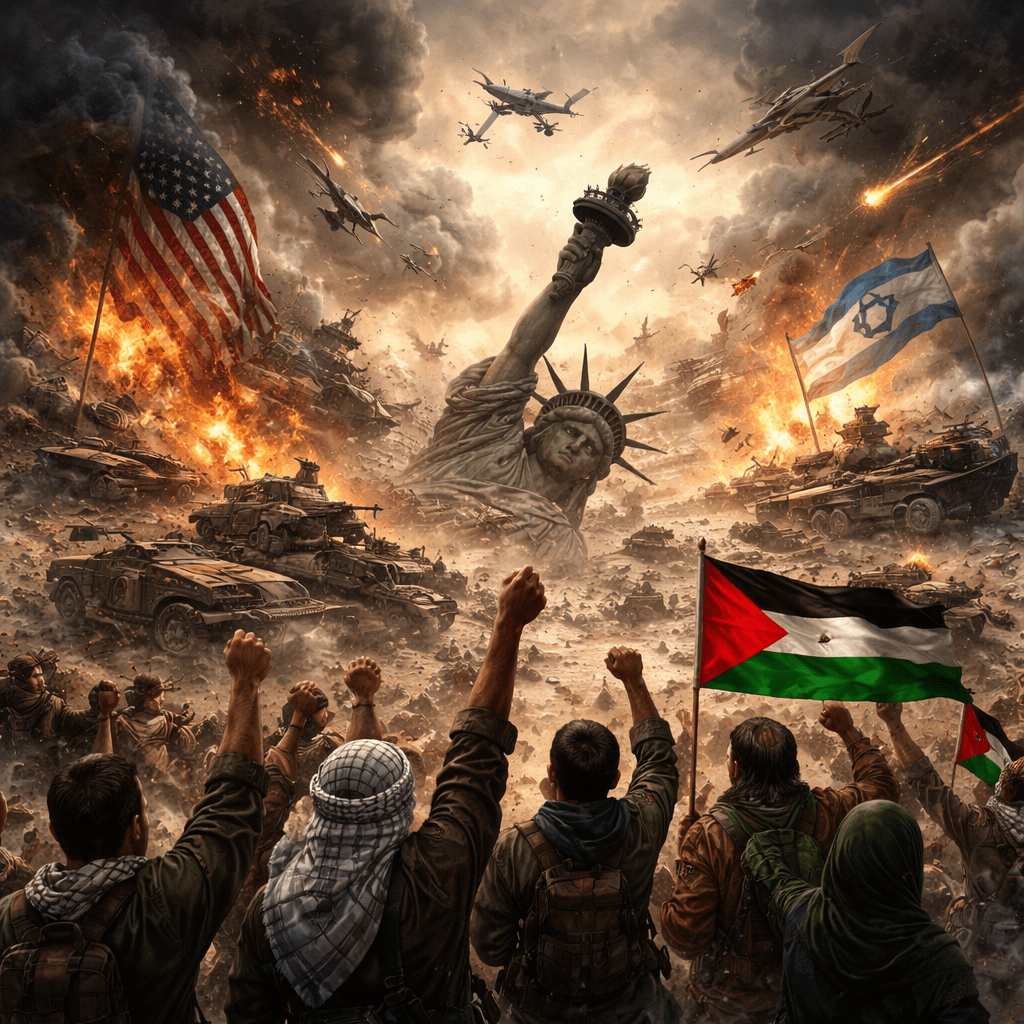
A Weaponized Propaganda Excavation of how the New York Times launders imperial war through the language of strategic error.
By Prince Kapone | Weaponized Information | March 12, 2026
The Tears of the Arsonist
There is a familiar ritual in the house organs of empire. First the bombs fall, then the panic sets in, and then some respectable publication arrives to tell us that the real problem was not the fire, but the poor planning of the men who brought the gasoline. That is the moral universe of the New York Times piece, “How Trump and His Advisers Miscalculated Iran’s Response to War.” The article wants to appear sober, grave, even self-critical. It speaks in the tone of the disappointed administrator, the seasoned insider, the custodian of imperial realism who is troubled not by conquest itself but by its messy execution. One can almost hear the sigh in the background: if only these people had managed the war better, if only they had anticipated the consequences, if only the machinery of domination had been calibrated with greater care. In this little drama, the United States is not introduced to us as an aggressor power prosecuting a war alongside Israel against a sovereign state. No, it appears instead as a large, anxious manager whose spreadsheets were inadequate, whose assumptions were faulty, whose planners underestimated the turbulence that would follow the latest application of organized violence.
That is the first trick, and it is not a small one. The article does not openly preach war fever; it performs something more sophisticated and therefore more useful. It converts war into error. It takes an event that belongs to the realm of power, domination, force, and state violence and translates it into the language of policy miscalculation. The headline itself does the work with the efficiency of a seasoned bureaucrat. Trump and his advisers did not unleash a criminal assault, did not participate in a reckless act of regional escalation, did not hurl millions into greater insecurity. They “miscalculated.” That word is a laundering machine. It removes blood and leaves behind arithmetic. It takes what should be judged politically and morally and recasts it as a technical problem. The bombs disappear into a management seminar. What remains is the image of officials around a table who got the forecast wrong. In this way, the reader is gently instructed to think like an imperial planner: not “Should this war have been launched?” but “Why did the planners fail to anticipate the market and military response?”
The article never says this directly, of course. Bourgeois propaganda, especially in its more polished forms, rarely arrives dressed as crude command. It operates by arranging emphasis, tone, sequence, and sympathy. Notice how the piece unfolds through the anxieties of the state. We are ushered into the interior of Washington. We are told what advisers worried about, what officials missed, what briefings were given, what talking points were coordinated, what the White House feared about prices, what Pentagon men did or did not anticipate, what lawmakers heard behind closed doors. The story is built from the viewpoint of those who govern, those who command fleets, those who issue threats, those who monitor shipping lanes as though the sea itself were part of their inherited estate. Even the article’s apparent criticism remains a criticism from within that elite field of vision. It is the criticism of a disappointed steward, not the condemnation of the bombed, the displaced, the terrorized, or the workers whose lives are always placed on the altar of strategy. The piece teaches the public how to inhabit the mind of empire, how to feel its frustration, how to share its bewilderment, how to grieve over its lack of foresight.
This is why the article leans so heavily on anonymous officials. These unnamed voices do not merely provide information; they establish the story’s center of gravity. They give the narrative its emotional atmosphere. Through them, the reader is made privy to private conversations, internal concerns, disagreements among officials, and confidential assessments of what went wrong. It is an old formula. Anonymous authority is treated as credibility. The state speaks without accountability, and journalism calls this access. The effect is to make the reader feel that they are receiving a candid inside account, a rare glimpse behind the curtain. But the curtain is part of the stagecraft. The article does not escape official framing by quoting anonymous insiders; it sinks deeper into it. The unnamed official is one of the empire’s favorite literary devices. He arrives without a face, without a public record in the piece, without responsibility, but with plenty of interpretive power. He tells you how to understand events while remaining safely unexamined himself. That is not transparency. That is ventriloquism with a press badge.
The emotional center of the article is also carefully managed. The crisis that emerges most vividly in the piece is not the terror of war itself but disruption: halted shipping, market instability, oil spikes, gasoline prices, nervous policymakers, jittery investors, scrambling administrators. The suffering that commands the most sustained narrative attention is the suffering of the imperial system when its circulation is interrupted. The article is not indifferent in the flat and simple sense; it is selective in the way ruling-class narratives are selective. It teaches us what counts as a crisis. A bombed region becomes legible to the reader primarily when it disturbs commodity flows, unsettles energy prices, or threatens electoral messaging at home. One might say the article humanizes petroleum more consistently than it humanizes the people living under fire. The tanker, the market, and the strategic waterway receive dramatic narrative life, while the actual social body of the region enters mostly as backdrop, as setting, as the terrain across which U.S. policy blunders unfold.
Then there is the rhythm of urgency in the language itself. The administration is “scrambling.” Shipping has “come to a standstill.” Oil prices have “spiked.” Officials are adjusting “on the fly.” Plans are being hastily revised. This language is not accidental. It builds a story of shock, improvisation, and unstable fallout. The reader is carried through a rapidly intensifying chain of disruptions, all tied to the administration’s inability to foresee the scale of Iran’s response. The narrative energy depends on surprise. The war is represented as an operation whose aftereffects exceeded the expectations of its authors. That sense of surprise is politically useful because it narrows the frame of inquiry. If the central issue is that Iran reacted more forcefully than expected, then the reader’s attention is directed toward the failure of prediction. The deeper architecture of the conflict recedes into the background. Surprise becomes a political anesthetic. It obscures the degree to which imperial power regularly behaves as though the peoples it threatens will either submit quietly or respond only within acceptable limits.
The piece also personalizes what is in fact a far larger structure of power. Trump says one thing, Rubio another, Hegseth something narrower, some officials are pessimistic, others stay quiet, the press secretary insists there was a game plan, the president grows frustrated, advisers try not to contradict him too directly. All this may be true as description, but truth in fragments can still serve falsehood in total. The article gives us a theater of personalities and policy factions. It is a familiar Washington script: the impulsive president, the disciplined secretary, the worried adviser, the market-sensitive technocrat, the hawkish outside voice. This style of narration has two advantages for imperial ideology. First, it makes the war seem like the product of temperaments and tactical disputes rather than the normal functioning of a violent world order. Second, it suggests that a better arrangement of personnel, a more coherent message, a more disciplined chain of command, might have produced a more successful outcome. In this way, structure is smuggled out the back door while personality enters through the front dressed as explanation.
One also notices the article’s peculiar distribution of agency. American officials deliberate, calculate, warn, debate, brief, reassure, coordinate, and seek off-ramps. Iran, by contrast, appears primarily in the register of response, threat, disruption, defiance, and danger. The article’s grammar quietly sorts the world into managers and managed, narrators and narrated, those whose intentions are explored and those whose actions are observed mainly as consequences for others. Iran is presented less as a society with its own political rationality than as a force whose behavior upset the assumptions of Washington. Even where its actions are described as strategic, they are filtered through the perspective of U.S. planners trying to regain control of events. This asymmetry is not merely stylistic. It is one of the classic signatures of imperial writing. The empire gets interiority. Its adversaries get function.
Perhaps most revealing of all is the article’s register of seriousness. It wants the reader to feel that they are consuming hard-headed realism, not cheap chauvinism. That is the specialty of elite propaganda in periods of crisis. It does not always shout. Sometimes it frowns. Sometimes it confesses limited error. Sometimes it adopts the weary tone of institutional self-correction. But the boundaries remain carefully policed. The question is never whether the imperial right to strike, intimidate, and discipline whole regions is itself the source of recurring catastrophe. The question is whether the imperial center properly assessed the costs of acting on that assumed right. The newspaper thus performs its customary service to power: it allows a measure of criticism in order to preserve the deeper consensus. One may scold the empire for clumsiness, recklessness, or poor preparation, but one must not drag its underlying entitlement into the dock.
So what stands before us in this article is not journalism floating above ideology, but ideology in its most respectable tailoring. The piece does not ask the reader to wave a flag or chant for war. It asks for something more useful: identification with imperial management. It invites us to worry alongside the planners, to absorb their categories, to feel the tremors of the market as the primary drama, to read aggression as miscalculation, and to treat the turbulence of the powerful as the center of world history. This is how the propaganda of a declining empire often speaks when it wishes to appear mature. It does not say, “We are righteous.” It says, “We were insufficiently prudent.” It does not say, “They must be crushed.” It says, “Their response was more severe than anticipated.” It does not say, “We have no right to set the region on fire.” It says, “The operation lacked a clear off-ramp.” Such is the elegance of imperial self-pity. The arsonist stands in the ashes, coughing delicately, and the newspaper rushes forward to explain that he has misjudged the wind.
The Facts Beneath the Narrative
The New York Times article recounts a series of events that unfolded rapidly after the United States and Israel launched military strikes against Iran. According to the report, the Trump administration expected the campaign to achieve decisive results while causing only temporary disturbances to global energy markets. Officials believed that even if tensions escalated, disruptions to oil flows through the Persian Gulf would likely be short-lived. Yet within days of the attack those expectations unraveled. Iranian missile and drone strikes targeted American installations and regional allies, commercial shipping slowed across the Gulf, and oil prices surged as traders reacted to the possibility that one of the world’s most important energy corridors might be compromised, a development widely reported across regional outlets such as Al Jazeera’s regional war coverage.
The article further describes how policymakers in Washington scrambled to respond. Embassies across the region were partially evacuated, emergency economic measures were discussed to stabilize fuel prices, and senior officials debated whether the military campaign should continue or be curtailed. Pentagon briefings indicated that the United States had already expended billions of dollars in munitions within the opening days of the war. At the same time the article acknowledges that Iran launched sustained missile and drone attacks against American bases and Israeli targets across the region, revealing a level of resistance that many in Washington had not anticipated when the operation began, developments also documented in regional reporting such as Middle East Eye’s coverage of Iranian strikes across U.S. military installations.
Yet while the New York Times recounts these developments, it leaves much of the broader battlefield out of view. The article speaks of attacks on “U.S. sites” but offers little explanation of what those sites actually represent. In reality the Persian Gulf is encircled by one of the most extensive overseas military infrastructures ever assembled by the United States. For decades Washington has built a chain of air bases, naval ports, intelligence facilities, and logistics hubs stretching across the Gulf states. These installations serve as the operational backbone of American military power in West Asia, a military architecture documented in regional analyses such as Press TV’s investigation of the U.S. military network in the Persian Gulf.
At the center of this network stands Al-Udeid Air Base in Qatar, the largest American military installation in the region and the forward headquarters of United States Central Command. Housing more than ten thousand personnel and the 379th Air Expeditionary Wing, the base functions as a command hub for air operations across the Middle East, as detailed in regional reporting such as Al Jazeera’s reporting on the strategic role of Al-Udeid Air Base. Nearby in the United Arab Emirates lies Al-Dhafra Air Base, where reconnaissance aircraft such as the U-2 Dragon Lady, E-3 AWACS command aircraft, and Global Hawk surveillance drones monitor the region’s skies and coastlines, a role examined in independent regional analysis such as The Cradle’s investigation into the U.S. intelligence infrastructure across Gulf bases. Bahrain hosts the headquarters of the United States Fifth Fleet, the naval command responsible for American operations across the Persian Gulf, the Red Sea, and the Arabian Sea, a presence discussed in reporting such as Middle East Eye’s examination of the Fifth Fleet’s role in Gulf security. Kuwait provides additional logistical infrastructure through installations such as Camp Arifjan and Ali Al-Salem Air Base, which support transport aircraft, aerial refueling missions, and military supply chains throughout the theater, a network documented in Telesur’s analysis of the expansion of U.S. bases across West Asia.
Taken together, these bases form a dense lattice of military power surrounding Iran. From them American forces monitor maritime traffic, coordinate intelligence operations, deploy aircraft, and sustain naval patrols across one of the most strategically vital regions of the world economy. Their presence reflects decades of policy aimed at ensuring that the energy resources of the Persian Gulf remain firmly integrated into the global system dominated by Western powers, a strategic orientation analyzed in Global South scholarship such as the Tricontinental Institute’s research on energy imperialism in West Asia.
Regional reporting suggests that many of these installations became primary targets once the conflict escalated. Iranian missile and drone strikes reportedly hit multiple American facilities across the Gulf, including installations in Qatar, Bahrain, Kuwait, and the United Arab Emirates. Among the most consequential reported losses was the destruction of an AN/FPS-132 early-warning radar system at Al-Udeid Air Base, a billion-dollar component of the missile detection network designed to track long-range ballistic launches, an incident described in regional military reporting such as Press TV’s report on the destruction of U.S. radar infrastructure. Damage was also reported at command and surveillance infrastructure at Al-Dhafra Air Base, while naval support facilities associated with the Fifth Fleet and logistical hubs used by American warships were struck during the exchanges, developments tracked by outlets such as Al Jazeera’s regional military reporting on Gulf base strikes.
The strikes also exposed another dimension of the conflict that the New York Times article barely mentions: the economic mathematics of missile warfare. Defensive systems such as Patriot and THAAD rely on interceptor missiles that cost several million dollars each. Many of the drones and missiles used in modern conflicts cost a fraction of that amount. Each interception therefore consumes vastly greater financial resources than the offensive weapons it seeks to destroy. When attacks occur in large numbers, defending forces can rapidly exhaust stockpiles of interceptors while attackers continue launching comparatively inexpensive systems, a dynamic examined in military-economic analysis such as The Cradle’s analysis of the asymmetrical economics of missile interception.
All of these developments unfold within a region whose strategic importance extends far beyond its military installations. The Persian Gulf sits at the heart of the global energy system. Vast quantities of oil flow through its waters each day before passing through the narrow Strait of Hormuz into international markets. Roughly one-fifth of the world’s petroleum trade moves through this maritime chokepoint, a fact widely documented in international energy research such as the global energy analysis of the Strait of Hormuz. When conflict threatens the stability of that corridor, the consequences ripple through global supply chains, financial markets, and national economies across multiple continents.
The confrontation between the United States and Iran also rests on a long historical foundation that predates the present war by generations. One of the most significant turning points occurred in 1953 when a covert operation organized by American and British intelligence services overthrew Iranian Prime Minister Mohammad Mossadegh after he moved to nationalize the country’s oil industry. Declassified documents released decades later confirmed the role of foreign intelligence agencies in orchestrating the coup, evidence widely discussed in historical investigations such as the National Security Archive’s declassified documentation of the 1953 coup and in Global South historical analysis such as Telesur’s analysis of the overthrow of Iran’s elected government.
Over the decades that followed, relations between the two states deteriorated through cycles of sanctions, diplomatic breakdowns, and military confrontation. Economic restrictions targeted Iran’s banking system and oil exports, while regional conflicts repeatedly brought the two countries into indirect conflict. By the time the present war erupted, the relationship had already been shaped by more than seventy years of geopolitical rivalry and unresolved grievances, a trajectory examined in historical and geopolitical studies such as Tricontinental’s research on the historical evolution of U.S.–Iran relations.
When the events described in the New York Times article are placed within this wider framework, the unfolding crisis begins to look less like an unexpected miscalculation and more like the eruption of tensions embedded in the political economy of the region itself. The Persian Gulf is not simply another theater of war. It is the central crossroads of global energy flows, a heavily militarized zone where strategic geography, military power, and historical memory intersect. The missile strikes, disrupted shipping routes, and frantic policy debates described in the article are therefore not isolated anomalies. They are the visible expression of deeper forces that have shaped the region for generations.
When the Empire Meets Its Limits
Once the facts are laid out in their proper order, the polite language of “miscalculation” begins to look less like analysis and more like damage control. Washington and Tel Aviv did not simply misread a few intelligence estimates. They acted on an assumption that has guided American war-making for generations: that imperial power can strike first and strike hard without facing serious retaliation. For decades that assumption appeared to hold. The United States unleashed war against countries whose defenses were shattered within days, whose skies were dominated from above, and whose ability to respond was limited to scattered resistance. War became something that happened far away, something inflicted upon weaker nations while the empire watched from a safe distance.
That history created habits of thought inside the institutions of American power. Strategists grew accustomed to believing that overwhelming military force would produce predictable outcomes: intimidation followed by capitulation. Air campaigns would destroy infrastructure, sanctions would strangle economies, and governments targeted by Washington would eventually bend under the pressure. The machinery of war appeared so technologically superior that resistance seemed futile. In this worldview the United States did not simply possess military power — it possessed a kind of historical inevitability.
The confrontation with Iran disrupted that comfortable mythology. Iran is not one of the small and defenseless states that have filled the casualty lists of American interventions over the past several decades. It is a country with eighty million people, a long civilizational history, and a military doctrine shaped by decades of preparing for confrontation with far stronger adversaries. Iranian planners understood from the beginning that they could never match the United States weapon for weapon. Instead they built something far more unsettling for an empire accustomed to impunity: the capacity to impose costs.
That capacity became visible the moment the war escalated. The American base network that stretches across the Persian Gulf — the same infrastructure that Washington spent decades constructing as the backbone of its regional dominance — suddenly found itself exposed to retaliation. Air bases that once served as launchpads for American operations became targets. Radar systems designed to watch the skies were themselves struck. Naval infrastructure that sustained fleets across the Gulf faced disruption. The carefully constructed architecture of military power that had surrounded Iran like a steel ring was now part of the battlefield.
This is the reality that the New York Times article struggles to explain with the soft language of policy error. What Washington encountered was not a minor miscalculation but the limits of a system built on one-sided war. When the empire wages war against nations that cannot meaningfully strike back, victory appears inevitable. When it confronts a state that has spent decades preparing for exactly such a confrontation, the outcome becomes far less certain.
Geography sharpens this contradiction. The Persian Gulf is not merely another region of the world; it is one of the central arteries of the global energy system. Oil flows through these waters in enormous quantities before passing through the narrow Strait of Hormuz toward international markets. When military conflict threatens that corridor the consequences travel far beyond the battlefield. Energy markets react instantly. Shipping slows. Insurance costs skyrocket. Governments from Asia to Europe begin calculating how long their economies can withstand disruptions in fuel supplies.
The crisis therefore exposes a deeper contradiction inside the imperial order. The United States has attempted for decades to dominate the Persian Gulf precisely because it sits at the heart of the global energy system. Yet the very geography that makes the region so valuable also makes it dangerously unstable when war erupts. A military confrontation in such a space cannot be neatly contained. The arteries of global commerce become entangled in the conflict, and the economic shockwaves spread across the world.
History adds another layer to this confrontation. Iran’s political culture has been shaped by a long memory of foreign intervention, most famously the 1953 coup that removed its elected government after it attempted to nationalize its oil resources. That episode taught a generation of Iranians that powerful states were willing to overthrow governments when strategic interests were threatened. The lesson did not disappear with time. It shaped the country’s defensive strategy, its political imagination, and its determination to resist external domination.
When viewed through this historical lens, Iran’s response to the present war appears less like reckless escalation and more like the predictable reaction of a nation determined not to repeat the humiliations of the past. A state that believes its sovereignty has repeatedly been challenged will prepare accordingly. Missiles, drones, and asymmetric naval capabilities become tools through which it attempts to deter the overwhelming military power of its adversaries. These weapons do not erase the imbalance between Iran and the United States, but they complicate the ability of a superpower to operate without consequence.
For observers across the Global South the significance of this moment is difficult to miss. For generations nations subjected to intervention and sanctions were told that resistance to imperial power was futile. The machinery of empire appeared unstoppable, backed by unmatched military technology and global financial influence. Yet history rarely moves in straight lines. When states develop the capacity and the will to respond, the old pattern of effortless domination begins to fracture.
That fracture is precisely what unsettles the architects of American strategy today. The war has revealed that the age of risk-free empire is fading. Military superiority remains immense, but it no longer guarantees the clean and consequence-free campaigns that once defined U.S. power. When adversaries possess the ability to retaliate, war becomes a far more dangerous enterprise — not the spectacle of domination that Washington has grown accustomed to staging, but a confrontation in which every strike carries the possibility of escalation.
For the workers and ordinary people of the Middle East the stakes of this confrontation are immediate and profound. They are the ones who live beneath the flight paths of bombers, beside the ports where warships dock, and along the roads where military convoys travel. Their cities become staging grounds for geopolitical contests, their economies tremble under the weight of sanctions and war, and their lives are shaped by decisions made in distant capitals. The language of “miscalculation” attempts to soften that reality, but the truth is far harsher. The struggle unfolding in the Persian Gulf is part of a much larger contest over sovereignty, resources, and the right of nations to determine their own futures.
And in that contest one lesson is becoming increasingly clear: the era in which imperial power could strike without consequence is beginning to encounter its limits. The world that allowed decades of one-sided war is slowly giving way to a more contested international order. When that transformation becomes visible, the polite vocabulary of miscalculation can no longer hide what is actually happening. Empire is discovering that the world it once dominated so easily is beginning to push back.
From Exposure to Organization
Every war produces two kinds of truth. The first is the truth spoken by governments and newspapers — the official narrative that tries to explain events in a way that preserves the legitimacy of those who hold power. The second truth emerges from the cracks in that narrative, from the lived experience of ordinary people and the political movements that refuse to accept the empire’s version of history. The confrontation unfolding in West Asia has already begun to produce that second truth. Beneath the headlines about oil markets and military calculations lies a much larger political awakening: the growing realization across the world that the era of uncontested imperial dominance is fracturing.
For working people in the United States and Europe, the war exposes a familiar pattern. Governments claim that military force is necessary to protect security or stabilize global markets, yet the consequences fall squarely on the shoulders of ordinary citizens. Billions of dollars are poured into missiles, air defenses, and overseas bases while schools close, hospitals struggle for funding, and entire communities are told there is no money for housing, infrastructure, or social programs. The empire’s wars are financed by the public but designed to protect a global system that benefits corporations, energy conglomerates, and the military-industrial complex.
Across the Global South the lesson is even clearer. Nations that attempt to chart independent paths have repeatedly faced sanctions, coups, or military pressure. From Latin America to Africa to West Asia, the struggle for sovereignty has often meant confronting the economic and military machinery of powerful states determined to maintain control over resources and strategic territory. What is unfolding in the Persian Gulf resonates deeply in these regions because it echoes a history that many societies know all too well.
Yet the response to imperial war is not limited to governments and armies. It is also unfolding in the streets, on university campuses, inside labor unions, and across the networks of grassroots movements that have spent years organizing against militarism. Anti-war coalitions in the United States have already begun mobilizing demonstrations demanding an end to escalation in West Asia. Organizations such as the ANSWER Coalition and CodePink have called for mass protests, public teach-ins, and coordinated actions aimed at exposing the human and economic costs of another expanding war.
These movements do not emerge from thin air. They are part of a long tradition of resistance inside the imperial core itself. During the Vietnam War millions of Americans refused to accept the official narrative that justified the bombing of Southeast Asia. Students, workers, and soldiers alike challenged the war machine, forcing a national reckoning with the costs of imperial ambition. The same spirit animates today’s movements, which recognize that the wars conducted abroad inevitably return home in the form of militarized policing, surveillance, and the diversion of public resources into endless conflict.
Labor organizations have also begun to raise questions about the economic priorities revealed by the war. Workers understand that the enormous military expenditures pouring into the Persian Gulf are part of the same system that demands austerity in their own communities. When billions can be mobilized overnight to finance airstrikes and naval deployments, the claim that society cannot afford healthcare, education, or living wages begins to ring hollow. The struggle against imperial war therefore intersects directly with the broader fight for economic justice.
International solidarity movements are likewise gaining momentum. Across Latin America, Africa, and Asia, civil society groups have condemned the expansion of the war and called for respect for national sovereignty. These voices are part of a growing multipolar political landscape in which many countries reject the idea that global order should be dictated by a single military superpower. Diplomatic forums, regional alliances, and independent media networks increasingly provide platforms through which alternative perspectives can challenge the narratives produced by Western governments and corporate media.
Independent journalism plays a critical role in this struggle. The dominant media institutions often frame conflicts through the lens of state power, focusing on strategy, markets, and geopolitical calculations while marginalizing the perspectives of those who live under the shadow of war. Alternative media platforms, investigative journalists, and grassroots researchers help expose the broader political and economic structures that drive these conflicts. Their work ensures that the public conversation does not remain confined to the narrow parameters set by official narratives.
Political education is another essential front. War thrives on ignorance — on the belief that distant conflicts are disconnected from the lives of ordinary people. Teach-ins, public forums, and community discussions help break that illusion. They connect the dots between military spending, corporate profit, global resource extraction, and the social conditions experienced by working people around the world. When these connections become visible, the logic of endless war becomes harder to justify.
The struggle against imperial militarism therefore requires organization across multiple fronts. It demands solidarity between workers in the imperial core and those living in regions directly affected by war. It requires alliances between labor movements, anti-war coalitions, student organizations, and independent journalists committed to exposing the structures of power that drive global conflict. And it calls for a political vision capable of imagining a world in which security is not defined by military domination but by cooperation, sovereignty, and social justice.
History shows that such transformations rarely occur without sustained pressure from below. Empires do not voluntarily relinquish power; they are compelled to do so by movements that refuse to accept the inevitability of domination. The events unfolding in the Persian Gulf remind us that the global order is not fixed. It is contested terrain shaped by the actions of states, the pressures of economic systems, and the struggles of ordinary people determined to claim control over their own futures.
For those who oppose imperial war, the task is clear. Expose the narratives that justify aggression. Support movements demanding diplomacy instead of escalation. Build alliances that link the fight for peace with the fight for economic justice. And recognize that the struggle unfolding today is part of a much larger historical process — the gradual dismantling of a world system built on the assumption that a single power has the right to dominate the rest.
 Weaponized Information
Leave a comment