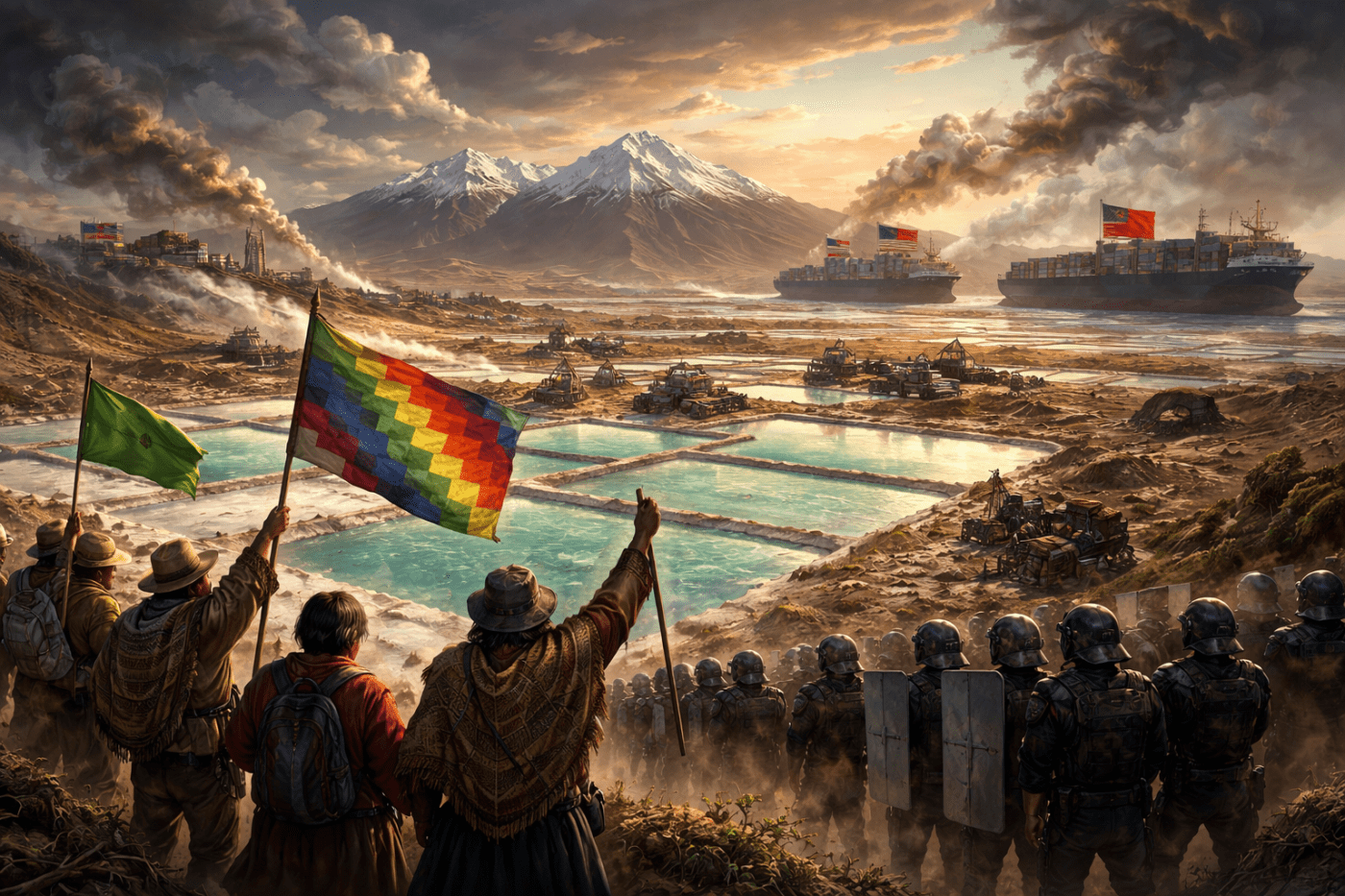
Beneath the investor narratives of strategic minerals and geopolitical competition lies a deeper struggle over land, labor, and sovereignty.
As the global economy reorganizes itself around electrification and battery technology, the salt flats of the Andes have become a new frontier in the long history of resource extraction in Latin America — where communities, states, and corporations contest who will control the mineral foundations of the energy transition.
By Prince Kapone | Weaponized Information | March 9, 2026
When the Lithium Story Enters the Pink Pages
There is a particular kind of confidence that comes with writing for the house paper of finance capital. It is the confidence of a person who knows that the boardrooms, ministries, investment desks, and policy shops are already leaning in before the first sentence has finished clearing its throat. That is the atmosphere surrounding Thea Riofrancos’s March 8, 2026 Financial Times opinion essay, “Latin America’s lithium triangle is now in the hands of the right.” Riofrancos is an associate professor of political science at Providence College whose work centers resource extraction and green capitalism. The piece appears in the FT’s opinion and energy coverage at a newspaper owned by Nikkei and written for an audience trained to see the world through the movement of capital, the management of states, and the strategic anxieties of industrial powers.
The article’s central maneuver is elegant in the way ruling-class narratives often are: it takes a sprawling regional and historical question and folds it neatly into a story of political turnover. By the time the opening movement is complete, the reader is invited to believe that the decisive fact about the lithium triangle is that it has experienced a “stunning reversal of political fortune.” That phrase does a great deal of work. It tells the reader where drama lives, what counts as change, and what kind of intelligence is being offered. The real event, in this telling, is not the long social life of what the author calls “the opaque realm of resource extraction,” not the old conflict over land and development, not the stubborn fact that mineral wealth has always attracted outside appetite like meat draws flies. No, the real event is that governments have moved from left to right, and that this electoral shift may now alter the administration of a strategic resource zone. In one stroke, the mine, the salt flat, the water table, the village, and the laboring body are pushed into the background, while cabinet composition and investor mood walk to center stage.
From there the essay proceeds with the smooth manners of a text that wants to sound worldly without ever surrendering its class instinct. The lithium triangle is presented not as lived territory but as a strategic field. Governments become vectors of alignment. States become policy atmospheres. The future becomes a question of whether right-leaning presidents will “entice foreign investment,” how closely they may tilt toward Donald Trump, and whether China’s economic gravity will continue to complicate the preferred script. This is the article’s second move: it shifts from political reversal to geopolitical chessboard. Once that frame is set, the reader is encouraged to see the region as a zone suspended between Washington and Beijing, as though the highest form of understanding available is to identify which outside pole gains leverage over the next tranche of lithium output. It is a familiar trick. The people who actually inhabit a place are acknowledged, but the place itself is narrated from above, as a contest surface upon which larger powers test one another’s reach.
The third move is subtler and, in its own way, more revealing. The article repeatedly uses the language of openness, attraction, and confidence to describe what the right is expected to do. It speaks of “enticing” capital, favoring firms, pursuing bilateral deals, restoring a friendlier investment terrain. Notice the moral weather created by those verbs. Foreign investment appears not as a social relation with winners and losers, but as a kind of pragmatic rainfall for which the responsible government prepares the sky. The right is thus coded less as reaction than as normalization, less as class project than as administrative realism. Even when the article notes contradictions, it does so in a way that leaves the investment horizon fundamentally intact. The market is not interrogated; it is assumed. The argument does not ask whether this road is just, democratic, or socially coherent. It asks how smoothly traffic may move along it. That is how class ideology often works in polished prose: it appears not as propaganda shouted through a megaphone, but as common sense wearing a tie.
Yet the piece is too careful to present this realignment as simple or total. So it adds a measured dose of uncertainty, the sort of ambiguity that flatters the publication and the author alike. Appearances may be deceiving, we are told. China’s pull may remain stronger than the rhetoric of free markets suggests. Chile’s incoming direction remains not fully formed. Bolivia may restore relations with the United States while still honoring agreements signed with Chinese and Russian firms. This softening language performs an important ideological function. It gives the article the air of nuance while preserving its underlying map. Complexity is admitted, but only inside the established frame. The story still begins from electoral change, still orients toward investor expectation, still treats global powers as the decisive poles of motion. The uncertainty is real enough at the level of surface description, but it never grows sharp enough to threaten the narrative architecture itself. In other words, the article widens the hallway a little, but it still makes the reader walk in the same direction.
Then, almost as a gesture of balance, the social question enters. Environmental defenders, Indigenous communities, and local resistance appear near the end, after the article has already established what it considers the main event. This placement matters. The struggles from below are not treated as constitutive of the story’s meaning; they are presented as pressures that governments and extraction regimes will have to manage. Their function in the article is secondary, almost atmospheric. They arrive not as political subjects capable of redefining the terms of the debate, but as complicating factors in a broader tale about strategic minerals, rightward governance, and great-power rivalry. That ordering is not accidental. It tells us whose anxieties the article is structured around and whose intelligence counts as primary. Capital and states speak in the opening paragraphs; the people who must live with the consequences arrive later, like unpaid workers summoned to clean up after the meeting has ended.
The irony here is difficult to ignore. Riofrancos’s own scholarly work has been among the most incisive critiques of “green extractivism”—the tendency for the energy transition to reproduce the colonial geography of resource extraction under a new ecological banner. Yet when translated into the idiom of the Financial Times, that critique becomes muted. Structural questions about extraction recede into the background while electoral shifts and investment climates take center stage. The transformation illustrates something important about elite media itself: even critical voices are subtly reshaped by the ideological gravity of the platform on which they appear.
What emerges from a close reading, then, is not merely an argument about lithium. It is a worldview in miniature. Political turnover is elevated over structural continuity. Geopolitical competition is privileged over social conflict. Investor climate is treated as the practical horizon of policy. Community struggle is acknowledged only after the strategic map has already been drawn from above. The article does not need to sneer at the region to domesticate it. It performs a more refined operation. It narrates the lithium triangle as a zone to be interpreted through state alignment, mineral strategy, and market access, while everything messier and more human is tucked respectfully toward the back of the room. That is how elite opinion often launders power: not by lying crudely, but by teaching the reader which realities deserve the front page of consciousness and which are left standing in the hallway, cap in hand, waiting to be called.
The Lithium Triangle Beneath the Headlines
The Financial Times article invites the reader to view the lithium triangle through the drama of electoral change and geopolitical competition. But the ground beneath that narrative is older, denser, and far less polite than the investment columns suggest. According to the 2026 United States Geological Survey Mineral Commodity Summary, Argentina now possesses the largest measured lithium resources in the world at approximately 28 million tonnes, followed by Bolivia with roughly 23 million tonnes and Chile with about 13 million tonnes. Taken together, the three countries form the largest concentration of lithium resources known on Earth: about 64 million tonnes in total, or roughly 43 percent of the global figure. That geological reality has quietly transformed the Andean salt flats into one of the most coveted territories in the modern industrial economy. The geological map does not vote in elections, but it does determine where the industrial world will point its drills.
Yet resources do not automatically become supply. The same USGS data reveals a striking asymmetry between geological endowment and actual output. In 2025, Chile produced roughly 56,000 metric tons of lithium content, China about 62,000, and Argentina around 23,000—up sharply from 13,800 the year before. Bolivia, despite possessing one of the largest lithium resource bases on Earth, does not appear among the major producing countries at all. The lesson is simple enough: lithium supply is shaped not by geology alone, but by the political economy of contracts, infrastructure, technology, and state strategy.
Lithium’s sudden celebrity status is not the result of political fashion but of a deeper technological transformation underway in the global economy. Electric vehicles, battery storage systems, and renewable energy infrastructure all rely heavily on lithium-based chemistry. As these technologies expand, so too does the hunger for the mineral that sits quietly at their electrochemical core. The International Energy Agency has projected dramatic increases in lithium demand as electrification spreads across transportation and power systems. What appears in newspapers as a story about politics is therefore anchored in something far more stubborn: the industrial metabolism of a world reorganizing itself around energy transition and digital infrastructure.
Yet even here the newspaper narrative leaves out an essential fact. Lithium extraction is only the first step in a much larger industrial chain. The mineral must be processed, refined, integrated into cathodes, assembled into batteries, and then embedded within vehicles, energy systems, and consumer technologies. The highest-value stages of this chain rarely occur where the raw material is mined. Studies by UNCTAD and the Economic Commission for Latin America and the Caribbean suggest that countries exporting raw lithium often capture only a small fraction of the final value generated in the battery chain, while the highest rents remain concentrated in refining, advanced materials, battery manufacturing, and electric-vehicle production. Raw material flows outward while technological rents accumulate elsewhere. In this sense, the lithium boom already sits inside an older structure of unequal exchange familiar to the Global South.
China’s role in the battery economy illustrates how this unequal structure operates in practice. The issue is not merely that China refines large quantities of lithium, but that it dominates key downstream stages of the battery supply chain, including processing, components, and cell manufacturing. This means that even when lithium originates in South American salt flats, the decisive stages of transformation often occur thousands of miles away inside refineries, battery factories, and industrial ecosystems far removed from the sites of extraction. The geopolitical anxiety surrounding lithium is therefore not only about the mineral itself but about control over the industrial chain that converts raw material into technological power.
Latin American policymakers have long recognized this dilemma. The United Nations Economic Commission for Latin America and the Caribbean has argued that lithium could become a foundation for regional industrial development if governments move beyond simple raw-material export and invest in domestic processing, battery manufacturing, and technological capacity. In other words, the mineral itself is not the final prize. The real prize lies in the industrial chain that surrounds it. If the region remains confined to extraction alone, the lithium boom risks repeating the historical pattern in which natural wealth leaves the continent while value creation occurs elsewhere.
Meanwhile the territory itself is far from empty. The salt flats where lithium extraction occurs are fragile ecosystems and homelands of Indigenous communities who have lived with these landscapes for centuries. Lithium brine extraction typically requires pumping enormous volumes of underground brine into evaporation ponds—often cited at roughly 500,000 gallons of brine movement for every tonne of lithium produced in conventional pond systems. Different studies measure this impact somewhat differently, sometimes emphasizing brine pumped from underground basins and sometimes the resulting pressure on surrounding freshwater systems, but the broader point remains unchanged: in the high deserts of the Andes, where water is already scarce, lithium extraction places severe pressure on fragile hydrological systems. Indigenous organizations and community councils across northern Chile and Argentina have raised concerns about water depletion, environmental damage, and exclusion from decision-making processes that directly affect their lands. For these communities the lithium boom is not an abstract question of industrial policy. It is a question of survival, territory, and political voice.
Human-rights organizations have documented similar tensions across the entire lithium triangle. Investigations into the salt flats of Argentina, Bolivia, and Chile show that expansion of mining projects is increasingly colliding with Indigenous territorial rights and fragile ecosystems. Communities have pursued legal challenges, public protests, and regional organizing networks to defend water systems and demand consultation rights. The expansion of lithium extraction therefore unfolds not only as an industrial project but as a growing social conflict over land, environment, and sovereignty.
These conflicts are not isolated episodes. They sit inside a long historical trajectory in which Latin American societies have repeatedly attempted to assert greater public control over natural resources. Nationalization campaigns around oil, copper, and other strategic sectors have marked the region’s political history for generations. Governments across the ideological spectrum have experimented with different formulas for balancing foreign investment, public ownership, and domestic development. Lithium enters this history as the latest chapter in a much older debate about whether mineral wealth will serve external accumulation or national and regional development.
The existing presence of multinational corporations underscores how little of this terrain is actually new. Companies such as Albemarle, Livent, and SQM have operated in lithium extraction for years, long before the current cycle of political change captured headlines. The lithium triangle did not suddenly open when right-wing governments appeared. It has been integrated into global mining capital for decades, though the scale and strategic importance of the sector have grown dramatically with the rise of battery technologies.
Another fact rarely acknowledged in investor narratives is that the rightward drift in parts of Latin America did not appear spontaneously out of the electoral soil. The region has experienced what Vijay Prashad described as “the angry tide of the Latin American far right” in response to earlier waves of progressive and nationalist governments. But these shifts have also unfolded within a geopolitical environment in which Donald Trump openly attempted to influence electoral climates in the hemisphere through threats, coercive signaling, and political endorsements. In Honduras, Trump publicly backed Nasry Asfura, warned there would be “consequences” if voters chose Xiomara Castro’s preferred successor Rixi Moncada, and was accused by President Castro of interference, manipulation, and blackmail in the country’s election. In Argentina, Trump went even further, explicitly threatening to pull U.S. assistance if Javier Milei’s coalition lost, declaring that Washington would not be “generous” with Argentina if Milei failed to prevail. These interventions did not determine the elections by themselves, but they did show the U.S. president openly attempting to shape the political atmosphere around strategic states in the hemisphere.
These developments are not occurring in a historical vacuum. The United States has a long record of intervening in Latin American politics whenever nationalist or left-wing governments attempted to restructure control over strategic resources. Declassified archives have documented U.S. involvement in the destabilization of Chile’s elected government in the early 1970s and the broader Cold War system of repression coordinated through Operation Condor. That network connected military dictatorships across the Southern Cone in a transnational campaign against labor organizers, students, and political movements seen as threats to the regional order. The shadow of that history continues to shape how power moves through the hemisphere today.
Taken together, these omitted facts complicate the simple storyline offered in the investor press. Lithium extraction in the Andes sits at the intersection of geological fortune, industrial transformation, corporate power, environmental fragility, Indigenous rights, and a long tradition of geopolitical intervention in Latin America. Elections may shift the tone of policy, but the deeper structure of the conflict lies elsewhere. Beneath the headlines about political reversal lies a far more enduring question: who will control the mineral foundations of the next industrial era, and whose development those minerals will ultimately serve.
From Salt Flats to the World System
Once the empirical terrain is laid bare, the political narrative advanced in the pages of the Financial Times begins to look less like analysis and more like stagecraft. The article is not wrong in the narrow sense that elections have consequences or that investors watch governments closely. But it is profoundly incomplete about the structure within which those elections occur. Lithium did not become strategic because voters changed their minds in Santiago, Buenos Aires, or La Paz. Lithium became strategic because the industrial metabolism of global capitalism has entered a new technological phase. The electric motor, the battery pack, the server farm, the data center, the grid-scale storage facility—these are the engines of the emerging industrial regime. And every one of them runs through the chemical corridors of lithium. In that sense, the salt flats of the Andes are not merely landscapes; they are pressure points in the circuitry of the twenty-first century world economy.
This is where the historical materialist lens sharpens the picture. Capitalism has always reorganized geography according to its technological needs. When silver financed empire, Potosí became the center of gravity. When nitrates fed European agriculture, the Atacama became a battlefield. When copper electrified the industrial world, Chile’s mines turned into the arteries of global industry. Now lithium enters the stage as the mineral companion of electrification and digital infrastructure. Each new technological wave redraws the map of extraction, and each wave produces its own frontier zones where the interests of industrial powers collide with the realities of land, labor, and sovereignty.
In this sense the lithium triangle is not an isolated curiosity. It is the latest chapter in a long story about how peripheral regions are pulled into the orbit of global accumulation. Marx once wrote that capital comes into the world “dripping from head to toe, from every pore, with blood and dirt.” The polite language of supply chains and investment flows does not change the underlying fact that these chains begin in specific territories inhabited by specific people whose land, water, and labor become the first inputs of industrial transformation. The lithium boom therefore belongs to the same lineage as earlier extractive frontiers: wealth flows outward while power gathers elsewhere, unless something interrupts that pattern.
The question, then, is not simply who governs the lithium triangle today, but what role the region will play within the global division of labor that is now reorganizing itself around electrification and digital infrastructure. If extraction remains the dominant role assigned to the region, the outcome will be familiar: raw materials exported, technological rents captured abroad, and local societies left to negotiate the environmental and social costs of production. The mineral changes, the rhetoric evolves, but the structure remains recognizable to anyone who has studied the long history of resource economies in the Global South. This pattern has long been recognized within the traditions of dependency theory and world-systems analysis, which have shown how peripheral economies are often locked into supplying raw materials while the higher-value stages of industrial production concentrate in the core of the world economy. This hierarchy is reinforced by the structure of the battery supply chain itself, where the higher-value stages of processing, active materials, and battery manufacturing remain concentrated outside the territories where the raw material is extracted.
Yet the present moment also introduces a new dimension. The global order that governed earlier extractive cycles is no longer as stable as it once was. The rise of China as an industrial and technological power has fractured the old monopoly over refining, manufacturing, and technological integration. What once appeared as a single channel of dependence has widened into a more complicated landscape in which multiple external powers compete for access to strategic inputs. This does not automatically liberate resource-producing countries, but it alters the balance of possibility. Where once there was only one door through which minerals could travel, there are now several—and the existence of those doors changes the bargaining terrain.
This widening field of maneuver explains why the struggle over lithium cannot be reduced to a question of electoral ideology. Governments in the region face a structural dilemma: whether to remain primarily exporters of raw material or attempt to climb the industrial ladder through domestic processing, regional industrialization, and stronger public control over strategic sectors. That dilemma has haunted Latin American development for generations. The difference today is that the stakes are tied to the technological foundation of the next industrial epoch. Lithium is not merely a commodity; it is a gateway into the industrial ecosystems that will power transportation, energy systems, and digital infrastructure for decades to come.
Seen from this angle, the political shifts highlighted in the Financial Times article acquire a different meaning. The consolidation of right-wing governments in key parts of the lithium triangle is not simply a matter of ideological preference or electoral mood. It intersects with a broader geopolitical contest over whether Latin America will function as a strategic resource reservoir for industrial powers or assert a more autonomous developmental trajectory. Right-wing administrations historically aligned with oligarchic and transnational interests often promise policy stability for foreign capital, streamlined regulation, and rapid extraction. These promises are rarely framed as class projects; they are presented instead as pragmatic realism, the supposedly inevitable logic of markets. But beneath the technocratic vocabulary lies a familiar political economy: minerals extracted locally, value captured elsewhere, and development measured primarily by the satisfaction of external investors.
The social and ecological contradictions of lithium extraction sharpen this dilemma further. The salt flats where lithium brines accumulate are not empty spaces waiting to be industrialized. They are ecosystems whose water systems sustain fragile desert environments and Indigenous communities that have inhabited the region for centuries. When extraction expands rapidly under the pressure of global demand, the result is not merely economic growth but an intensification of conflicts over water, land rights, and political authority. The people who live closest to the resource often become the first to experience the costs of its transformation into global commodity.
This is why the community struggles that appear only briefly in the investor narrative are, in fact, central to the political economy of lithium. They represent a different understanding of development—one that asks whether the wealth drawn from a territory will sustain the communities who inhabit it or simply feed distant circuits of capital accumulation. In that sense the salt flats have become more than mineral deposits. They are sites where competing visions of the future confront one another directly: extraction organized around global supply security on one side, and development grounded in territorial rights, ecological limits, and social sovereignty on the other.
The conflict over lithium therefore condenses several historical contradictions into a single landscape. It reflects the enduring tension between center and periphery in the world economy. It reflects the struggle between national development and externally managed extraction. It reflects the collision between industrial expansion and ecological limits. And it reflects the political question that haunts every resource-rich region: whether the wealth beneath the soil will deepen dependency or open the door to a more autonomous path of development.
When viewed from this wider perspective, the lithium triangle appears less like a chessboard for great-power competition and more like a frontier in the reorganization of the global political economy. The article in the Financial Times captures the movement of pieces on the board, but it leaves the structure of the board itself largely unexamined. To understand what is truly unfolding in the Andes, one must move beyond the polite language of markets and geopolitics and confront the deeper logic of the system: a world economy in transition, a region struggling over the meaning of its natural wealth, and a mineral whose importance now links remote salt flats to the technological future of the entire planet.
Where the Salt Flats Answer Back
If the previous sections have traced the mineral logic of lithium through the circuits of capital and empire, the final question is simpler and more dangerous: what forces exist capable of interrupting that logic? History gives us a clue. Every extractive frontier eventually produces its own counter-movement. The mine creates the miner; the plantation produces the rebel; the port gives birth to the dockworkers’ union. In the high deserts of the Andes, the lithium boom is already generating its own answer. It comes not from the boardrooms where the mineral is priced nor from the ministries where contracts are signed, but from the territories where the brine is pumped, the water tables sink, and the consequences of extraction become immediate and unavoidable.
Indigenous communities across the salt-flat regions of Chile and Argentina have begun organizing around the most elemental issue of all: water. In the Atacama and surrounding basins, lithium extraction depends on pumping underground brine into evaporation ponds that stretch like artificial lakes across the desert floor. The process requires vast quantities of water in ecosystems where water is already scarce. Communities whose survival depends on fragile hydrological systems therefore confront extraction not as a technical matter but as a question of life itself. Their mobilization has taken many forms—community assemblies, public campaigns, legal challenges, and international appeals asserting the right to consultation and environmental protection. These movements insist on a principle that modern resource governance has long tried to forget: that the people who inhabit a territory possess the authority to decide how that territory is used.
In Argentina the same struggle has moved through the courts as well as the streets. Communities in the Salinas Grandes and Laguna de Guayatayoc basin have pursued legal action demanding recognition of their territorial rights and protection of the ecosystems on which their livelihoods depend. The legal terrain is not neutral, of course; courts often reflect the balance of political forces that surround them. But even within that constrained arena these campaigns reveal something important. The populations most directly affected by extraction are not passive observers of the lithium boom. They are political actors seeking to reshape the terms under which development proceeds.
The struggle has also begun to take regional form. The Observatorio Plurinacional de Salares Andinos has emerged as a cross-border network connecting organizations concerned with the protection of Andean salt flats and wetlands. Its work reflects an understanding that the ecosystems sustaining lithium deposits do not obey the boundaries drawn on political maps. The hydrology of the Andes, like the migration routes of capital, moves across national frontiers. Effective resistance therefore requires coordination across those same frontiers. What begins as a local defense of territory gradually grows into a regional conversation about ecological limits, resource governance, and the rights of communities whose lands have long served as extraction zones for distant economies.
Environmental justice networks have likewise entered the debate, connecting lithium extraction to a broader critique of the global energy transition. Their argument is direct enough to make technocrats uncomfortable: a transition away from fossil fuels cannot be called just if it reproduces the same colonial geography of sacrifice zones that characterized the fossil era itself. If the Global North reduces its emissions while the ecological costs of mineral extraction are displaced onto Indigenous territories and peripheral regions, the structure of the system remains unchanged. The energy source may shift from oil wells to lithium brine, but the hierarchy governing whose land absorbs the damage remains intact.
None of this implies that electrification itself should be abandoned. Modern societies will require batteries, energy storage systems, and new technologies to move beyond fossil fuels. The question is not whether the energy transition occurs but how it is organized. If electrification reproduces the same colonial geography of sacrifice zones—where peripheral regions supply raw materials while wealth accumulates elsewhere—the transition will merely exchange one extractive regime for another. A just transition would instead link mineral extraction to local development, democratic resource governance, and ecological protection.
These movements represent more than a defense of landscape. They point toward a deeper political question that the lithium boom has forced onto the global stage: who will govern the material foundations of the energy transition? If that transition is organized solely by the demands of industrial supply chains and corporate profit, it will likely replicate the old pattern of extraction and dependency that has marked the history of resource economies across the Global South. If, however, communities, workers, and states assert greater democratic control over strategic minerals, the transition could become an opportunity to reconfigure development itself—linking extraction to domestic industry, ecological stewardship, and social need rather than external accumulation.
For movements in the Global North, the implications are equally clear. The demand driving lithium expansion originates largely in industrial economies whose consumers, technology firms, and automakers require enormous quantities of battery materials. Solidarity with territorial struggles in the Andes therefore cannot remain symbolic. It must involve confronting the political economy of supply chains that connect distant consumption to local extraction. Labor movements, environmental organizations, and anti-imperialist networks in wealthier economies possess a particular responsibility here: to challenge corporate narratives that portray the energy transition as a purely technological solution while ignoring the social relations embedded in its mineral foundations.
None of this suggests that lithium extraction will disappear or that modern societies can simply abandon the technologies that depend upon it. The point is not to romanticize pre-industrial landscapes or to deny the material requirements of contemporary life. The point, rather, is that the organization of extraction, industry, and development is a political choice rather than an inevitability dictated by markets. Who controls the resource, how the benefits are distributed, what ecological limits are respected, and which communities participate in decision-making—these are questions that belong to democratic struggle, not to the quiet negotiations of corporate boardrooms.
The salt flats of the Andes therefore stand at the intersection of two possible futures. In one future the lithium triangle becomes another chapter in the long history of resource frontiers: minerals exported, ecosystems strained, local communities marginalized, and technological wealth accumulated elsewhere. In the other future the region uses its geological fortune as leverage to reshape development on more sovereign and socially grounded terms. Which of these paths emerges will not be decided by headlines in the financial press. It will be decided by the balance of forces between those who treat the earth as a warehouse of inputs and those who insist that the land, the water, and the mineral wealth beneath them belong first to the peoples who live there.
The lithium boom may have begun as a story about batteries and markets, but it is already becoming something else. It is becoming a struggle over the political meaning of the energy transition itself. And in that struggle the salt flats are not silent landscapes. They are speaking back.
 Weaponized Information
Leave a comment