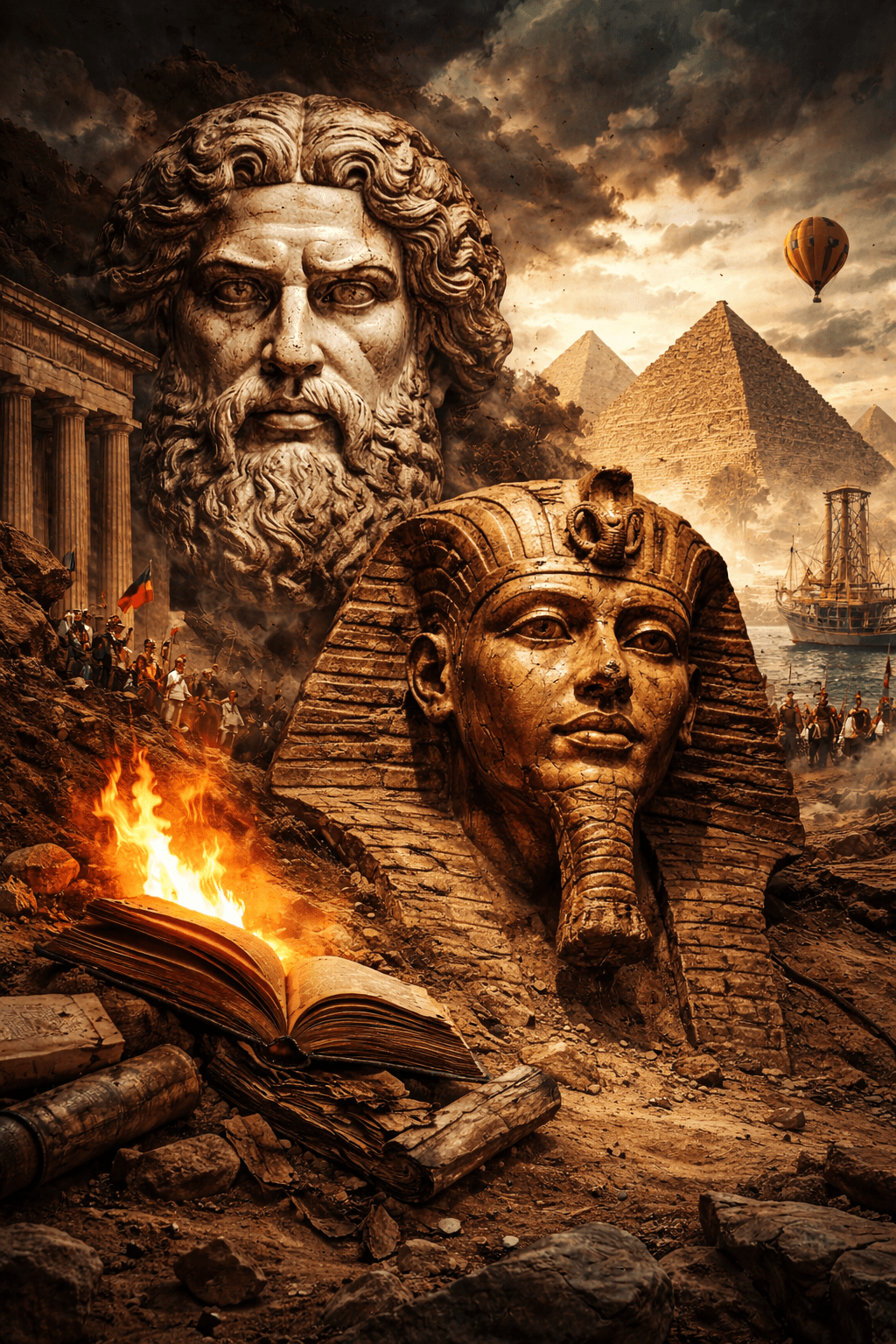
In this Weaponized Intellects book review of Black Athena (Vol. 1), we follow Martin Bernal’s argument that Greece was cut off from its Afroasiatic roots at the very moment Europe was rising to imperial power. We trace how the Ancient Model of Mediterranean entanglement was pushed aside and replaced by the Aryan Model, then cemented into academic common sense. We situate that shift inside the consolidation of Western European empire and its need for a clean civilizational origin story. What is really at stake is not ancient pottery or linguistics, but who gets to claim authorship of history in a world still organized around Western power.
By Prince Kapone | Weaponized Information | February 22, 2026
Why Origins Matter in an Imperial World-System: Method and Stakes
Why should revolutionaries in 2026 care about a 1987 book on ancient historiography? Why should organizers, anti-imperialists, and students of political economy spend time on debates about Herodotus, Phoenician settlement, or nineteenth-century philology? Because Black Athena is not ultimately about pottery shards or verb endings. It is about how a ruling civilization manufactures continuity. It is about how power reorganizes the past in order to naturalize the present. And that question remains urgent in a world still structured by Western European imperial formations, even in their reorganized and liberalized forms.
Martin Bernal’s project is historiographical. He traces how the “Ancient Model” of Mediterranean entanglement was displaced by the “Aryan Model” between 1785 and 1850, and how that model hardened into academic orthodoxy through 1985. He does not write as a political economist. He does not frame his argument in terms of imperial world-systems or colonial contradiction. He reconstructs debates, disciplines, and evidentiary standards with meticulous care. Our task in this review is not to superimpose a ready-made theory onto his work. It is to extract the structural implications already embedded in his chronology and place them within a broader analysis of Western European imperial consolidation.
The methodology here is therefore double. First, we follow Bernal closely—his sequence, his documentation, his distinctions between Enlightenment skepticism, Romantic nationalism, philology, racial theory, archaeology, and institutional reproduction. We resist the temptation to flatten his argument into slogan. Second, we situate each stage of his reconstruction within the transformation of Western European power between the late eighteenth and twentieth centuries. Not to accuse every classicist of conscious imperial service, but to ask a structural question: why did a model that severed Greece from Afroasiatic entanglement become compelling precisely when Western Europe was reorganizing the globe under its command?
This is where the colonial contradiction enters—not as a rhetorical flourish, but as an analytical frame. On one side stands Europe’s material expansion: colonial administration, Atlantic slavery, industrial extraction, financial centralization, and later liberal universalism. On the other stands Europe’s civilizational claim to be the author of democracy, rationality, and scientific modernity. Greece functions as the keystone of that claim. If Greece is autonomous, internally generated, and racially aligned with a northern Indo-European lineage, then European global dominance can appear as historical unfolding. If Greece is deeply entangled with Egypt and the Levant, then Europe’s authorship looks less pure and more derivative—less destiny, more contingency.
For revolutionaries, this distinction is not cosmetic. Imperial power does not rest on force alone. It rests on narrative continuity. It rests on a story in which “the West” appears as the natural custodian of progress and universality. That story is taught in classrooms, embedded in curricula, and repeated as cultural common sense. When Bernal exposes the fabrication of Ancient Greece as a racially autonomous origin, he does more than correct an academic error. He cracks a civilizational alibi. He shows that the temporal foundation of Western European authority was reorganized at the very moment that authority expanded across continents.
Our review therefore proceeds chronologically, in step with Bernal’s reconstruction from the dominance of the Ancient Model to the installation and institutionalization of the Aryan Model between 1785 and 1985. We do not romanticize Africa or invert hierarchy for symbolic satisfaction. We do not reduce Western imperialism to settler colonialism alone, though settler formations are one of its expressions. We treat Western European imperialism as a total project—mercantile, industrial, colonial, financial, and ideological—and we ask how the reorganization of antiquity functioned within that project.
If empire governs territory, labor, trade routes, and knowledge, it also governs time. Black Athena reveals how the governance of time was stabilized through a purified origin story. To contest imperial power today is not only to contest sanctions, militarism, and financial coercion. It is to contest the narratives that render domination ancestral and inevitable. Bernal excavates the archive. Our task is to orient that excavation within the ongoing struggle over historical authorship in an imperial world-system that still claims to be the heir of Greece.
Origins as Alibi: Why Empire Needed “Pure” Greece
Martin Bernal opens Black Athena with a question that sounds academic until you realize it is a question about power: why does Ancient Greece matter so much to modern Europe? Not as a hobby, not as a museum preference, but as an inheritance claim. Greece is treated like the birth certificate of “the West,” the authorized origin of reason, philosophy, democracy, science—an immaculate conception story that lets Europe say, with a straight face, that it did not merely conquer the world, it led it. Bernal’s first move is to show that this elevation is not innocent. It is ideological labor. And when an empire depends on a story, it will police that story like a border.
Bernal’s central intervention is disarmingly simple: the story modern Europeans tell about Greek origins is not the story ancient Greeks told about themselves. For centuries, Greek writers spoke openly of debts to Egypt and the Levant—of instruction, settlement, religious transmission, technical borrowing, and long contact across the eastern Mediterranean. This older understanding, which Bernal calls the “Ancient Model,” treated Greece as a product of entanglement rather than a sealed European miracle. Greece was formed through encounter. It was not born “pure.” What matters for Bernal is not just that this Ancient Model existed, but that it remained broadly accepted in Europe for a long time. Its disappearance was not the natural result of one decisive discovery. It was a political reorganization of the past.
Bernal locates the rupture with unusual precision. Between roughly 1785 and 1850, the Ancient Model becomes intolerable and the “Aryan Model” is installed in its place. Greece is recast as racially European, linguistically Indo-European, culturally autonomous. Egypt and Phoenicia are pushed to the margins—not necessarily refuted, but demoted, domesticated, stripped of the right to be foundational. Bernal insists that this transformation tracks the rise of Romantic nationalism, “scientific” racism, and intensifying anti-Semitism, along with a broader ideological shift in Europe’s self-conception. And here is where Weaponized Information has to sharpen the stakes without forcing them: this is also the period when Western Europe is consolidating the modern imperial world order—expanding colonial rule, tightening Atlantic extraction, reorganizing global labor, and building a civilizational hierarchy that needs a pedigree.
The problem for empire is not simply prejudice. The problem is legitimacy. Western Europe was remaking the planet through conquest and coercion, and it required a narrative in which that domination appeared as history’s natural direction rather than a violent rupture. Empire cannot comfortably rule as a borrower. It prefers to rule as an origin. A Europe that admits its foundational civilization was shaped by Africa and the Semitic East starts to look less like the author of “universal reason” and more like a latecomer claiming ownership of a shared human inheritance. That is an ideological crisis for any ruling civilization. So the past is reorganized until it behaves.
Bernal is careful, and that care is part of why the book hits like a hammer. He is not asking the reader to swap one mythology for another, to replace a white idol with a different idol painted darker. He is asking us to recognize how historical models are manufactured and stabilized—how “method” can be recruited as a mask for power, how professional consensus can become a substitute for proof, how entire fields can learn to treat certain questions as unserious because the answers would be politically disruptive. The Aryan Model did not triumph because it simply explained more. It triumphed because it aligned with the imperial common sense of its time. Scholarship, as Bernal shows, often follows the flag—not because every scholar salutes, but because the institutions, incentives, and inherited assumptions do the saluting for them.
This is why Black Athena begins where it does: not with archaeology or longuistics, but with ideology as a material force in history. Bernal wants the reader to see that the fight over Greek origins is really a fight over civilizational authorship—over who is allowed to appear as the source of thought, order, and progress. If Greece is a Mediterranean formation shaped by Afroasiatic currents, then Europe’s story of self-generation collapses. The “West” stops being an eternal subject and becomes what it actually is: a historical project, forged through struggle and conquest, forever insisting that its power is inheritance rather than theft. Bernal does not steal Greece from Europe. He does something more dangerous. He returns Greece to history—where empires do not like their property to breathe.
A Mediterranean Before Europe: The Ancient Model of Entanglement
Before Greece was drafted into service as Europe’s civilizational passport, it lived in a different historical imagination. Bernal patiently reconstructs what he calls the “Ancient Model”—the understanding, widely accepted among the Greeks themselves and among early modern European scholars, that Greek civilization emerged through sustained contact with Egypt and the Levant. Herodotus did not blush when he spoke of Egypt as a source of religious and cultural knowledge. Later Greek writers acknowledged Phoenician transmission of the alphabet. Myths, cult practices, artistic motifs, and technical forms circulated across the eastern Mediterranean in ways that made isolation a fantasy. The Mediterranean was not a wall; it was a corridor.
Bernal insists on something that modern orthodoxy would prefer to forget: for centuries, European scholars did not find this embarrassing. Renaissance humanists, Enlightenment thinkers, and classical commentators could accept Egyptian instruction and Phoenician influence without imagining that Greece ceased to be great. The Ancient Model did not depict Greece as inferior. It depicted Greece as connected. Civilization was not a racial essence; it was a process of transmission and adaptation. That assumption—so simple it feels obvious—was not dismantled by a flood of new refutations. It was displaced.
What the Ancient Model preserved was a Mediterranean world of interaction rather than hierarchy. Egypt was not an exotic preface to Europe’s true beginning; it was a partner in a long civilizational conversation. Phoenicia was not a marginal trader dropping off goods at a European shore; it was a formative presence in the development of writing and religious forms. This older picture did not require a north-to-south ladder of progress. It did not need a racialized map of intellectual capacity. It operated within a pre-imperial frame, before Western Europe had fully reorganized the globe under its command.
And this is where the colonial contradiction begins to hum beneath the surface. The Ancient Model flourished in periods when Europe’s global supremacy was not yet consolidated in its modern, racialized form. As long as Europe’s expansion was uneven, contested, and not yet fully rationalized as a civilizational destiny, it could tolerate ancestry that crossed the Mediterranean. But once Western European power hardened into a global system—once extraction, slavery, and colonial governance required a stable hierarchy of peoples—entanglement became politically dangerous. A civilization claiming universal authority could not comfortably admit formative debts to regions it was subordinating.
Bernal does not preach this conclusion; he documents the shift. The Ancient Model begins to look naïve only after a new common sense takes hold—one in which races are imagined as distinct historical agents and Europe is imagined as history’s engine. Under that regime, mixture becomes contamination. Transmission becomes weakness. Borrowing becomes humiliation. The very features that once made Greece admirable—its openness, its synthesis, its absorption of external currents—now threaten the story Europe needs to tell about itself.
The significance of the Ancient Model, then, is not merely antiquarian. It reveals that Europe’s later certainty about Greek autonomy is not timeless. It is constructed. There was a time when Greek indebtedness to Egypt and Phoenicia was part of the scholarly mainstream. Its erasure marks a transformation in European self-understanding. Bernal’s excavation exposes the hinge: Greece was not always imagined as Europe’s sealed origin. That imagination had to be built. And it was built at a moment when Western Europe was expanding outward, reorganizing the planet, and quietly revising its own past to match its new position in the world.
Egypt Before the Fall: The 17th–18th Century Triumph
If we move too quickly from antiquity to Romantic linguistics, we miss the most destabilizing part of Bernal’s argument: Egypt did not simply fade from Europe’s imagination. It stood at the center of it. Long before the Aryan Model hardened into orthodoxy, early modern Europe treated Egypt not as a peripheral curiosity but as the wellspring of ancient wisdom.
Bernal devotes substantial attention to what he calls the “Triumph of Egypt” in the seventeenth and eighteenth centuries. Hermeticism, Neo-Platonism, Rosicrucianism, and strands of early modern mysticism all positioned Egypt as the cradle of primordial knowledge. Renaissance scholars traced philosophical traditions back through late antiquity to Egyptian priesthoods. Even as Christianity reshaped Europe’s intellectual landscape, Egypt retained symbolic authority. It was ancient, it was learned, and it was foundational.
This admiration was not confined to esoteric circles. Enlightenment thinkers, Protestant intellectuals, and even political reformers engaged seriously with Egypt as a source of civilizational depth. In Protestant countries especially, Egypt sometimes functioned as a counterweight to Rome—a pre-Christian antiquity that could be mined without reinforcing papal authority. Freemasonry drew heavily on Egyptian symbolism. Mythology was read allegorically as encoded Egyptian science. Egypt was not racialized as a backward continent in this period; it was revered as a repository of ancient rationality.
Bernal emphasizes that well into the eighteenth century, educated Europeans could accept that Greek religion, philosophy, and science bore Egyptian influence. The Ancient Model was not marginal. It was intellectually respectable. Egypt was not treated as an embarrassment to Greek greatness but as one of its formative partners.
Even the Napoleonic expedition to Egypt in 1798, often remembered as a military episode, had profound intellectual consequences. The massive scholarly documentation of Egyptian civilization reinforced its antiquity and sophistication. Europe was not discovering a primitive land; it was cataloging one of the oldest complex civilizations on earth. Egyptology was born not as dismissal but as fascination.
This makes the subsequent reversal far more significant. When the nineteenth century begins to downgrade Egypt’s role, it is not correcting a long-dismissed fantasy. It is repudiating a recently dominant intellectual current. The shift is not from ignorance to clarity. It is from admiration to containment.
And this is precisely why Bernal’s chronology matters. The Aryan Model did not rise in a vacuum. It replaced a living tradition in which Egypt occupied pride of place within the genealogy of civilization. The fall of the Ancient Model was therefore not the clearing away of error. It was the displacement of a once-powerful consensus.
When we understand this, the rupture after 1785 no longer appears gradual or inevitable. It appears as reversal. Europe did not slowly “learn better.” It changed its mind. And that change coincided with transformations in power that would soon reorganize not only antiquity, but the globe.
1785–1850: The Reversal — From Admiration to Autonomy
Once we grasp how central Egypt remained in seventeenth- and eighteenth-century European thought, the transformation after 1785 takes on its full weight. The Ancient Model did not quietly decay. It was overturned. What had been respectable—indeed, fashionable—became suspect. What had been foundational became decorative. Within a few generations, Egypt moved from progenitor to peripheral.
Bernal insists that this reversal cannot be explained by a sudden archaeological breakthrough or a decisive refutation of ancient testimony. The sources did not change dramatically. The intellectual climate did. Greek accounts acknowledging Egyptian instruction were increasingly dismissed as exaggeration or myth. Traditions once treated as historical memory were reclassified as cultural vanity. Egypt was not disproven; it was downgraded.
This is the period in which Europe’s self-understanding begins to shift decisively. The late eighteenth and early nineteenth centuries witnessed industrial acceleration, colonial expansion, and the consolidation of racial classification as administrative practice. Europe was no longer one civilization among others in a Mediterranean field of exchange. It was becoming the center of a rapidly expanding imperial order. In that context, a genealogy rooted in Afroasiatic entanglement grew awkward. A civilization projecting global authority required a narrative of internal origin.
What changes between 1785 and 1850, then, is not the existence of evidence but the threshold of credibility. Greek civilization is gradually re-situated within a northern lineage. Interaction gives way to descent. Cultural borrowing becomes superficial rather than structural. Egypt may still be ancient and impressive, but it ceases to be causally formative. Greece begins to appear as self-generated.
Bernal does not caricature this shift as a conspiracy. The scholars involved often believed they were refining method. But structural alignment matters more than intention. As Europe consolidated its material dominance across continents, its symbolic ancestry was reorganized accordingly. The Mediterranean web of exchange was thinned into a ladder of civilizational progression. Greece ascended the ladder. Egypt was left below it.
This is the hinge of the book. The fall of the Ancient Model was not the natural maturation of scholarship. It was a recalibration of antiquity that harmonized with a civilization entering its imperial century. Once this recalibration took hold, the machinery of Romantic nationalism and comparative philology would lock it into place.
Reason with a Ruler: Enlightenment Skepticism and the Downgrading of Ancient Memory
Bernal’s handling of the Enlightenment is surgical. He does not treat it as the moment Europe “proved” Greece was pure. He treats it as an earlier epistemic turn: the moment European scholars learned to treat ancient tradition—especially tradition about Egypt and Phoenicia—as a suspicious category of knowledge. Before Romantic nationalism turned ancestry into blood and philology turned descent into method, Enlightenment critique had already begun a quieter operation: training scholars to distrust precisely those strands of Greek testimony that kept Afroasiatic influence in the story.
Here the target was not Greece’s greatness but Greece’s memory. Greek writers could still be honored as pioneers of inquiry, but their claims about Egyptian instruction or Phoenician settlement were increasingly reclassified as myth, priestly manipulation, or patriotic exaggeration. The same texts that carried authority when discussing politics, war, and civic life suddenly became “unreliable” when they described Mediterranean indebtedness. Bernal’s point is not that skepticism is illegitimate; it is that skepticism became patterned. It clustered around the very claims that threatened an emerging European genealogy.
This epistemic turn mattered because it reorganized hierarchy inside the archive. Oral tradition, priestly transmission, and cross-cultural memory were increasingly treated as the kinds of things modern Europeans had outgrown. The Enlightenment installed an implicit ladder of credibility: the more “rational” a source looked to modern eyes, the more authority it received; the more it smelled of antiquity’s religious and foreign worlds, the more it was suspected. That ladder did not merely sort evidence—it sorted civilizations.
And this is where the imperial context presses in without needing conspiratorial villains. By the late eighteenth century, Europe’s expanding commercial and colonial power was hardening into civilizational confidence. Universal reason was being proclaimed at the same time that extraction and racial classification were being rationalized. Within that atmosphere, a Greece framed as an internally generated awakening of reason harmonized with Europe’s growing sense of historical entitlement. A Greece entangled with Africa and the Semitic East did not. So Enlightenment criticism did what empires often do: it did not always erase inconvenient ancestry outright. It made it methodologically unsafe.
This is why the question of language follows. Once Enlightenment critique had helped downgrade Mediterranean memory as a genre of evidence, the nineteenth century could step in with stronger machinery—Romantic nationalism to sacralize ancestry and philology to formalize descent. The Enlightenment did not build the Aryan Model by itself. It prepared the ground on which it could later appear “natural.”
Language as Destiny: Romantic Nationalism and the Philological Invention of Aryan Greece
If the period between 1785 and 1850 marks the rupture, then Romantic nationalism and comparative philology supply its machinery. Bernal is precise on this point: the Aryan Model did not emerge as a vague prejudice or a cultural mood. It was built through a new discipline that claimed scientific authority over origins. Language became the decisive instrument. Once Greek was securely classified within the Indo-European—or “Aryan”—family, the question of cultural indebtedness to Egypt or the Levant was quietly subordinated to linguistic genealogy. Descent replaced interaction as the governing principle of history.
Romanticism provided the emotional architecture for this shift. Against the Enlightenment’s Mediterranean cosmopolitanism, Romantic thinkers elevated the idea of deep ancestral spirit—Volk, blood, organic cultural growth. Nations were imagined not as historical formations shaped by exchange, but as living organisms unfolding from primordial roots. In this atmosphere, Greece could no longer be understood as a Mediterranean synthesis. It had to become Europe’s spiritual childhood. Its genius had to be endogenous. Borrowing looked like contamination. Hybridity looked like weakness.
Philology converted this emotional posture into method. By reconstructing proto-languages and tracing systematic sound correspondences, scholars claimed to map the prehistoric migrations of peoples. Greek, linked linguistically to Sanskrit, Latin, and Germanic tongues, was relocated into a northern genealogy. This linguistic alignment was then treated as civilizational alignment. If Greek was Indo-European in language, it was assumed to be Indo-European in cultural essence. The Mediterranean web of contact—so visible in ancient testimony—was downgraded in explanatory power. Language became destiny.
Bernal does not deny the legitimacy of comparative linguistics as a field. His argument is narrower and more devastating: linguistic affiliation was allowed to dictate historical causality beyond its evidentiary scope. Shared grammar became proof of shared civilizational origin—even as cultural parallels in myth (e.g., Greek gods echoing Egyptian or Levantine deities) were sidelined. Meanwhile, the absence of linguistic continuity with Egyptian or Semitic languages was taken as evidence against deep influence—even where religious forms, mythic structures, artistic motifs, and technical practices suggested otherwise. The hierarchy of evidence shifted. Philology sat at the top. Cultural transmission fell beneath it.
This reordering of causality coincided with Western Europe’s intensifying imperial expansion. As Britain industrialized and extended its reach across Asia and Africa, as France deepened its colonial ambitions, as racial classification hardened within Atlantic slavery and administrative governance, Europe required not merely power but pedigree. A northern Indo-European lineage supplied that pedigree. It framed European dominance not as recent accumulation but as the unfolding of an ancient civilizational arc. Greece, repositioned within this arc, became the ancestral proof of Europe’s inherent dynamism.
Once this linguistic scaffold was erected, the downgrading of Egypt and Phoenicia followed almost inevitably. If Greek civilization was fundamentally Indo-European in origin, then Afroasiatic contributions could be tolerated only at the margins. Influence might be acknowledged, but it could not be foundational. The structure had already been decided at the level of descent. Interaction would henceforth be interpreted within the limits set by lineage.
What Bernal exposes in this transition is not merely the rise of racial theory, though that is present. He reveals a deeper transformation: the replacement of a Mediterranean model of circulation with a genealogical model of purity. Romantic nationalism supplied the desire for rootedness. Philology supplied the technical vocabulary. Imperial Europe supplied the material confidence that made such a reclassification plausible. Together they produced a Greece that was no longer entangled, but self-generated—no longer a participant in a shared civilizational field, but the first chapter of a European destiny.
With that destiny secured linguistically, the work of historical narrowing could begin in earnest. Egypt would be honored yet neutralized. Phoenicia would be acknowledged yet contained. The Mediterranean would remain geographically intact but causally segmented. And the Aryan Model, armed with both method and empire, would move from hypothesis to orthodoxy.
Egypt Reduced to Ornament: How a Civilization Was Neutralized
Once philology had secured Greece within an Indo-European lineage, the next problem for the emerging orthodoxy was Egypt. Bernal shows that Egypt was not expelled through decisive refutation but through controlled diminishment. It could remain ancient, impressive, even mysterious—but it could no longer be formative. Nineteenth-century scholarship did not need to deny that Greeks traveled to Egypt or admired its antiquity. What had to be denied was structural influence. Egyptian religion might color Greek myth; Egyptian architecture might inspire decorative forms; Egyptian antiquity might impress the imagination. But Egyptian civilization could not shape Greek political thought, philosophy, or scientific inquiry. Influence was permitted only at the level of atmosphere, not foundation.
Bernal is meticulous in tracing how this narrowing occurred. Ancient Greek testimony acknowledging Egyptian instruction was reinterpreted as exaggeration, priestly myth, or naïve admiration. Claims once treated as plausible historical memory were now filtered through selective skepticism. Meanwhile, hypothetical northern migrations required no comparable evidentiary burden. Where Egyptian settlement demanded archaeological proof of extraordinary precision, Indo-European movement could be posited on linguistic reconstruction alone. This asymmetry is not incidental; it reveals the hierarchy already assumed.
What changed was not the availability of evidence but the political atmosphere in which evidence was judged. By the early nineteenth century, Africa was being incorporated into European imperial governance under racialized categories that framed it as backward, childlike, or stagnant. A Europe consolidating power across African territories could not easily admit that African civilization once stood as instructor to its symbolic ancestor. That admission would fracture the civilizational ladder underpinning colonial tutelage. If Greece learned from Egypt, and Europe learned from Greece, then the narrative of unilateral European superiority begins to wobble.
Bernal does not reduce this shift to crude malice. He shows something more enduring: how intellectual habits adapt to civilizational confidence. Egypt becomes safe once it is ancient but inert—brilliant but sealed off from Europe’s true genesis. Museums can display its artifacts; textbooks can praise its monuments; scholars can marvel at its longevity. What they cannot do, under the Aryan Model, is allow Egypt to be causally central. It is honored and neutralized at the same time.
In this maneuver we see the colonial contradiction at work not in rhetoric but in calibration. Western Europe’s expanding imperial apparatus required a stable story of origin. That story could tolerate Africa as a background civilization, but not as a progenitor. The whitening of Greece required the whitening of causality. Egyptian influence had to be rendered peripheral so that European civilization could appear self-generated. Bernal’s excavation of this process reveals how empires manage uncomfortable ancestry: they do not always deny it outright. They reduce it until it no longer threatens the hierarchy the present depends on.
Phoenicia Contained: The Semitic Presence That Had to Be Shrunk
If Egypt represented the southern challenge to Europe’s fabricated autonomy, Phoenicia represented the eastern one. Bernal shows that the Phoenicians were once acknowledged as formative actors in the Greek world—not merely traders hugging the coastline, but transmitters of writing, religious forms, artistic motifs, and maritime networks that stitched together the Mediterranean long before Athens crowned itself the cradle of reason. The alphabet alone should have been explosive enough to destabilize any story of pure European genesis. Yet the nineteenth-century reorganization of antiquity did not deny Phoenicia’s existence. It contained it.
The strategy differed subtly from the treatment of Egypt. Where Egyptian influence was narrowed through skepticism, Phoenician influence was compartmentalized. Yes, the Greeks may have adopted an alphabet. Yes, there were commercial interactions. But influence was recast as technical transfer rather than civilizational shaping. The Phoenicians became intermediaries—clever, mobile, commercially adept—but not originators of the intellectual and political life that would later define “the West.” Depth was drained from contact. Structural transmission was reduced to surface exchange.
Bernal situates this transformation within the broader intellectual climate of the nineteenth century, when modern anti-Semitism intensified across Europe. Semitic peoples were increasingly cast as derivative, mercantile, and spiritually limited in contrast to the supposedly creative dynamism of the Aryan race. This ideological sorting bled into classical scholarship. The Mediterranean was reorganized into a hierarchy of contribution that mirrored contemporary racial theory. Greece could borrow tools from Phoenicia but not its mind. The alphabet could travel; authority could not.
What makes this move historically significant is not the reduction of Phoenicia alone, but the reconfiguration of the entire eastern Mediterranean. A civilization consolidating imperial power across North Africa, the Near East, and Asia required a story in which cultural innovation flowed outward from Europe rather than inward toward it. To admit sustained, formative Semitic influence at the base of Greek civilization would complicate the narrative of European originality that underwrote colonial governance. Empire prefers inheritance to indebtedness.
Bernal exposes how this containment operated without overt proclamation. Questions simply ceased to be asked. Similarities between Greek and Near Eastern myth were treated as coincidence. Religious continuities were reframed as parallel development. Linguistic borrowings were acknowledged but stripped of cultural consequence. The Mediterranean, once understood as a dense field of circulation, was segmented into zones of origin and zones of reception. Greece was elevated into the origin zone. The Semitic world was repositioned as supplier.
Here again the colonial contradiction surfaces in structure rather than slogan. Western European imperialism did not merely conquer territories; it reorganized civilizational authorship. By shrinking Phoenicia’s role, the Aryan Model ensured that Europe’s symbolic ancestor would not share foundational lineage with the regions Europe was subordinating. The alphabet could remain, but the ancestry had to be severed. Bernal’s work forces us to see that this was not an accidental oversight. It was a recalibration of historical causality designed to secure a hierarchy that extended far beyond the ancient Mediterranean.
Orthodoxy as Infrastructure: How a Fabrication Became Common Sense
By the late nineteenth and early twentieth centuries, what began as a contentious reorganization of Greek origins hardened into disciplinary common sense. Bernal shifts from tracing arguments to tracing institutions. The Aryan Model no longer needed fiery polemic or racial manifestos; it had syllabi, journals, departments, and professional training. Classicists were socialized into assumptions that felt neutral because they were inherited. Specialization fragmented the field into philology, archaeology, ancient history, and comparative religion—each with its own gatekeeping standards. Synthesis, the very terrain where Afroasiatic entanglement would become unavoidable, was quietly discouraged as speculative or unserious.
Bernal is unsparing in his description of how authority reproduces itself. Once the Indo-European framework became foundational, alternative models were not debated on equal footing; they were framed as eccentric. Graduate students learned which questions secured careers and which questions ended them. Conferences and publications reinforced boundaries. A model initially justified by appeals to method became insulated by professional inertia. In this way, the whitening of Greece was not merely asserted; it was administered.
What is striking in Bernal’s long arc—from 1785 to 1985—is the endurance of the structure even as Europe’s political regimes shifted dramatically. High imperialism gave way to world wars. Fascism rose and fell. Formal colonial empires fractured. Postwar liberalism adopted a softer language of universality. Yet the civilizational architecture remained largely intact. Greece continued to function as Europe’s autonomous origin. Egypt and Phoenicia remained peripheral in foundational narratives. The rhetoric evolved; the hierarchy endured.
From a Weaponized Information standpoint, this persistence reveals something crucial about imperial power. Empire is not sustained by guns alone; it is stabilized by memory. When a fabricated origin story is embedded in educational systems and cultural institutions, it no longer appears as ideology. It appears as fact. The colonial contradiction—Europe’s expansion over territories and peoples it simultaneously categorizes as derivative—requires such stabilization. If Europe’s global authority is to appear natural rather than contingent, its ancestry must appear self-generated rather than entangled.
Bernal does not argue that every scholar consciously defended empire. His indictment is structural. Institutions reproduce what they are built upon. When a model harmonizes with a civilization’s self-conception during its ascent, it becomes difficult to dislodge even after the overt language of race softens. By 1985, the Aryan Model no longer needed to speak in nineteenth-century racial terms; its assumptions had already been woven into the fabric of classical education. Greece’s autonomy had become common sense.
This is why Bernal’s intervention matters beyond the archive. He is not merely correcting footnotes. He is exposing how historical time is governed—how a civilization reorganizing the world can reorganize its past and then embed that reorganization so deeply that it survives regime change. The fabrication of Ancient Greece was not a single moment of distortion. It was an infrastructure of memory, built to support a Europe that claimed authorship of civilization while extending its power across the globe.
When the Earth Refused the Story: Archaeology and the Management of Evidence
If philology supplied the grammar of the Aryan Model and institutions secured its reproduction, archaeology posed a quieter but persistent problem. Bernal shows that the material record did not always cooperate with the story of an autonomous, north-born Greece. Egyptian objects appear in early Greek contexts. Near Eastern motifs echo through cult practice and myth. Technical continuities in metallurgy, architecture, and artistic forms complicate any neat narrative of isolated development. The Mediterranean, as uncovered in the soil, looks less like a civilizational ladder and more like a zone of circulation.
Yet evidence alone does not overturn orthodoxy. Bernal is careful not to romanticize archaeology as an automatic corrective. Instead, he demonstrates how inconvenient findings were managed. Artifacts pointing south or east were localized, treated as isolated episodes rather than systemic connections. Chronology became a shield: influences that threatened Greek autonomy were often dated later, safely after Greece had already achieved its supposed civilizational maturity. The interpretive frame remained intact even as anomalies accumulated around it.
What stands out is the asymmetry in evidentiary standards. Hypothetical Indo-European migrations—central to the Aryan Model—could be inferred from linguistic reconstruction with relatively thin material support. By contrast, Egyptian or Phoenician settlement required extraordinary archaeological proof before it could be granted structural significance. Absence of evidence for northern invasions was treated as the normal silence of prehistory; absence of overwhelming proof for Afroasiatic colonization was treated as decisive refutation. The burden of proof mirrored the hierarchy the model was designed to preserve.
From the standpoint of the colonial contradiction, this pattern is revealing. Western Europe’s imperial order depended on a stable civilizational map in which Europe occupied the generative center. Archaeology threatened to blur that map. But imperial knowledge systems are resilient. Rather than allowing the ground to redraw the narrative, interpretation disciplined the ground. Material culture was permitted to decorate the story, not to direct it. The model came first; the shards were made to fit.
Bernal’s argument here is not that archaeologists conspired in bad faith. It is that interpretation operates within horizons shaped by broader civilizational confidence. When a society believes it stands at the apex of history, it reads the past accordingly. The Mediterranean’s entanglements become peripheral noise in a narrative already committed to European originality. Evidence can accumulate without consequence if the framework governing it remains unchallenged.
What Black Athena exposes in this section is the subtle governance of contradiction. Empires are rarely undone by a single fact. They endure by absorbing, reclassifying, and containing facts that threaten coherence. Archaeology did not lack data suggesting Afroasiatic interaction. It lacked a sanctioned synthesis that would integrate that data into a new model. Bernal provides the intellectual breach. He shows that the earth itself has been testifying to Mediterranean interdependence all along. What changed was not the soil, but the story imposed upon it.
After Empire, the Story Remains: From High Imperialism to Liberal Consensus
Bernal’s time frame does not end with Romantic nationalism or the height of nineteenth-century imperial confidence. He follows the Aryan Model through world wars, fascist regimes, decolonization, and the postwar liberal order. What is striking is not dramatic revision, but continuity. The overt language of race that animated some early formulations softens, retreats, or becomes professionally embarrassing. Yet the structure remains intact. Greece continues to function as Europe’s autonomous origin. Egypt and Phoenicia remain acknowledged but non-foundational. The civilizational ladder survives its most explicit architects.
This endurance is not accidental. Western European imperialism did not collapse in 1945; it reorganized. Formal colonial administrations gave way to new forms of economic dominance, financial leverage, and geopolitical alignment. The vocabulary of civilizational hierarchy became subtler, couched in development theory, modernization discourse, and liberal universalism. But the underlying claim—that Europe is the primary author of rationality, democracy, and scientific advancement—remained structurally useful. Greece still anchored that claim. The origin story did not need racial bombast; it needed quiet continuity.
Bernal demonstrates how even well-intentioned scholars working in a postcolonial age often reproduced the inherited framework. Afroasiatic influence could be conceded in limited, carefully bounded ways, but the overarching narrative of Greek autonomy was rarely dismantled. The Mediterranean remained segmented into zones of innovation and zones of reception. Professional caution replaced ideological fervor, yet the hierarchy endured. The fabrication no longer needed defenders in jackboots; it had tenure.
From a Weaponized Information standpoint, this is the most revealing phase. The colonial contradiction does not disappear when empires adjust their form. Western European power, even as it loses direct territorial control in many regions, continues to assert intellectual and moral authority. That authority rests in part on a story of civilizational authorship. Greece’s whitened autonomy functions as a stabilizer in textbooks, curricula, and cultural memory. The claim that “Western civilization” is uniquely self-born and uniquely progressive does not require explicit racial theory; it requires a seamless ancestral chain.
Bernal’s long arc from 1785 to 1985 shows that the Aryan Model is not simply a relic of nineteenth-century excess. It is a durable architecture that survived the overt dismantling of racial science because it had already been institutionalized as common sense. The imperial project changed scale and rhetoric; its temporal foundation remained. Greece, recast as Europe’s uncontaminated childhood, continued to legitimize a civilization that still positioned itself as the guardian of universality.
In this persistence lies the deeper lesson. Empire governs not only through force or finance but through narrative continuity. When a civilization can extend its authority backward into antiquity, it gains a powerful shield against critique. Bernal’s excavation reveals how that shield was forged and how it endured. Even as the formal trappings of colonial rule receded, the origin story that supported them remained embedded in the cultural bloodstream. The fabrication had become tradition.
The Colonial Contradiction and the Governance of Time
By the time we reach this point in Black Athena, the question is no longer whether the Aryan Model displaced the Ancient Model. Bernal has demonstrated that thoroughly. The deeper question is what that displacement accomplished in the larger historical arc of Western European ascendancy. What emerges across his documentation is not simply a history of racial thought but a reorganization of historical time itself. Greece was not merely whitened; it was repositioned as the uncontested origin of a civilization that, by the nineteenth century, was reorganizing the globe. The fabrication did not just rearrange antiquity. It stabilized authority.
Western European imperialism expanded through conquest, extraction, administrative innovation, and financial centralization. It reorganized trade routes, labor regimes, and political boundaries across continents. But it also required something less visible and no less essential: a temporal foundation. Empire cannot present itself as a late arrival claiming dominion over older civilizations. It must appear as the bearer of a civilizational trajectory that naturally culminates in its own supremacy. The Aryan Model provided that trajectory. By securing Greece as an internally generated European achievement, it extended Europe’s lineage backward and converted expansion into inheritance.
This is the colonial contradiction in its temporal form. On one side stands Europe’s material expansion into regions it classifies as peripheral or backward. On the other stands its claim to universal authorship—its insistence that democracy, philosophy, rational inquiry, and scientific modernity originate within its own ancestral line. If Greece is deeply entangled with Egypt and Phoenicia, that claim fractures. Europe becomes a participant in a shared Mediterranean development rather than the sole progenitor of civilization. The hierarchy that underwrites imperial governance begins to look contingent rather than structural.
Bernal’s excavation shows that the reorganization of Greek origins coincided with Europe’s transformation into a global imperial center. That simultaneity is the hinge. The whitening of Greece did not simply reflect racial arrogance; it resolved a structural tension. A civilization extending its authority across Africa, the Near East, and Asia could not comfortably admit formative debts to those same regions. To preserve the coherence of imperial ideology, antiquity had to be redrawn. The Mediterranean was segmented. Afroasiatic entanglement was minimized. Northern lineage was elevated. The past was disciplined to harmonize with the present.
When viewed in this light, the fabrication of Ancient Greece becomes part of a broader imperial strategy: the governance of time. Empire governs territory and labor, but it also governs historical narrative. By securing a purified origin, Western Europe fortified its claim to universality. The story of progress could flow from Greece to Rome to modern Europe without interruption, presenting global expansion as the unfolding of a civilizational arc rather than a rupture imposed by force. Conquest appeared as maturation. Domination appeared as diffusion.
Bernal does not name this as colonial contradiction; that is our analytical frame. But his evidence makes the structure visible. The Aryan Model provided temporal continuity during the consolidation of Western European imperial hegemony. It framed Europe as the author of its own greatness and, by extension, the natural arbiter of global order. To expose that fabrication is not merely to correct a historical error. It is to reveal how deeply empire embeds itself in memory. When the governance of time is challenged, the inevitability of rule begins to unravel.
Why This Matters: The Struggle Over Time in an Imperial World-System
What, then, is at stake in Bernal’s excavation beyond the academy? Not pride. Not symbolic representation. Not the cosmetic rearrangement of civilizations in a textbook chart. What is at stake is the architecture of legitimacy within a world-system still structured by Western European imperial ascendancy. Bernal shows that the fabrication of a racially autonomous Greece coincided with the consolidation of that ascendancy. The implication is unavoidable: the organization of antiquity was part of the organization of global authority.
Western European imperialism has taken multiple forms—mercantile monopoly, plantation slavery, industrial extraction, formal colonial administration, financial dominance, and liberal universalism—but across these transformations it has maintained a civilizational claim. That claim rests on authorship: Europe as the origin of democracy, philosophy, rational inquiry, and scientific modernity. Greece functions as the keystone in that arch. Remove its insulation from Afroasiatic entanglement and the story shifts. Europe becomes a historical formation among others, shaped by exchange rather than self-generation. Empire’s aura of inevitability weakens.
This is why Bernal’s work must be read through the colonial contradiction rather than through racial sentiment alone. The issue is not that nineteenth-century scholars held prejudices. The issue is that a civilization reorganizing the planet required a reordered past. When Europe extended its administrative reach across Africa and Asia, it simultaneously extended its temporal reach backward into antiquity. Conquest in space was paired with consolidation in time. A self-generating Greece stabilized a self-authorizing empire.
The lesson for revolutionary analysis is sober, not romantic. No ruling order governs by force alone. It governs through narratives that naturalize its position in history. If empire can persuade the world that it is the heir of an uninterrupted civilizational ascent, then its authority appears structural rather than contingent. Bernal cracks that continuity. He does not replace it with inversion or mythic counter-claims. He restores complexity. He reopens entanglement. He returns Greece to the Mediterranean.
And that return matters. Because when civilizational authorship is exposed as constructed, the present ceases to look inevitable. The colonial contradiction—Europe’s material expansion paired with its claim to universal moral authority—becomes visible as contradiction rather than destiny. Empire seizes territory, labor, trade routes, and knowledge. But as Black Athena makes unmistakably clear, it also seizes time. To contest imperial power is not only to contest markets or militaries. It is to contest the stories that render domination ancestral.
Bernal does not finish the political argument for us. That is not his task. His task is excavation. Ours is orientation. If the past has been reorganized to legitimize rule, then restoring its entanglements becomes more than academic correction—it becomes structural demystification. The struggle over Greece is one episode in a larger struggle over historical authorship in a world still shaped by Western European imperial formations. The archive has been reopened. The civilizational alibi has been weakened. What remains is to recognize that history itself is a terrain of power—and to fight on it accordingly.
 Weaponized Information
Leave a comment