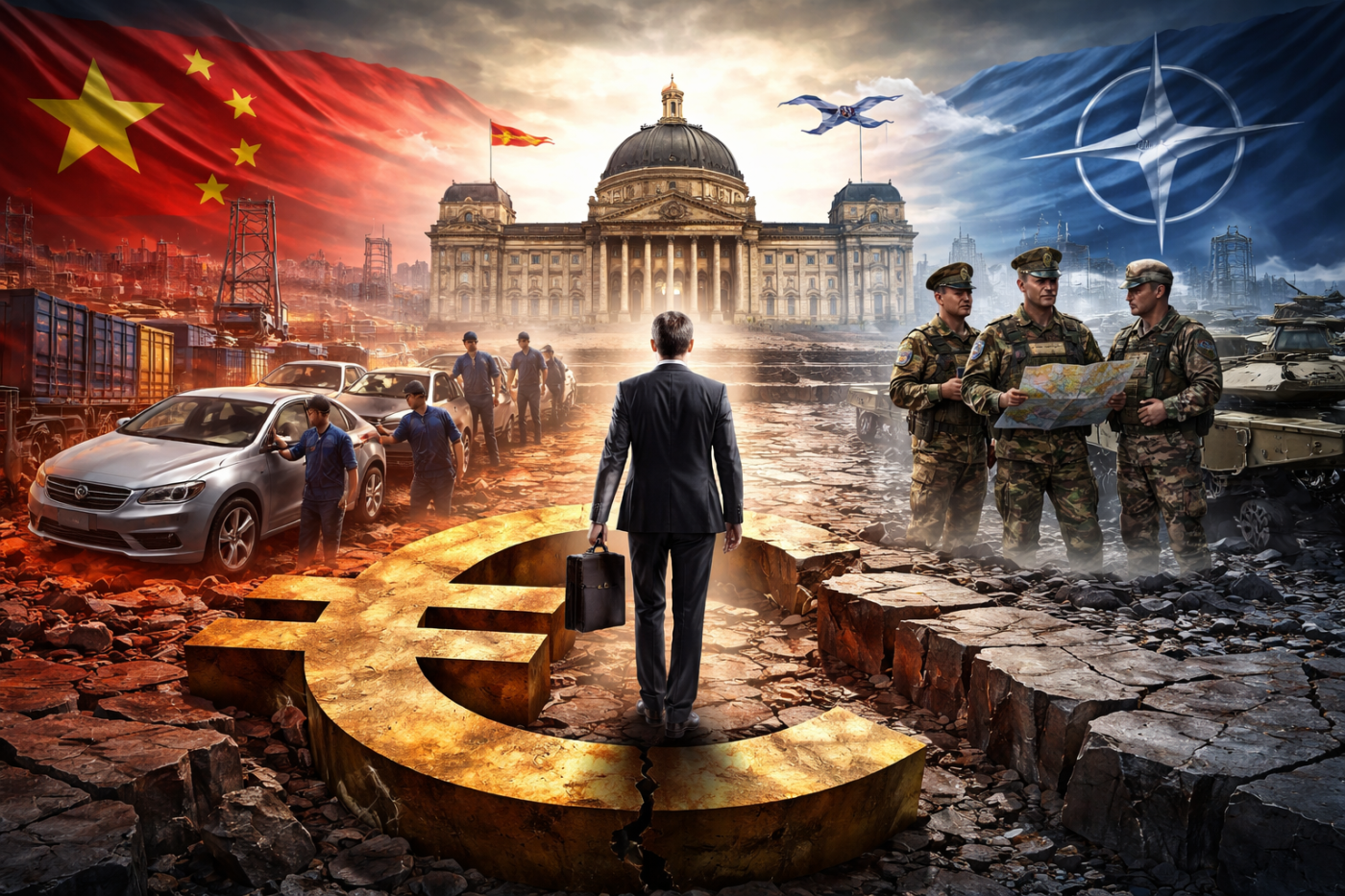
A romance metaphor conceals structural strain. The trade ledger exposes export contraction and rising militarization. Industrial rivalry is recoded as security doctrine. Workers and colonized nations confront the costs—and the opening.
By Prince Kapone | Weaponized Information | February 19, 2026
When the Empire Calls It Heartbreak
Our excavation begins with a February 19, 2026 piece from The Economist, titled “How Germany Fell Out of Love with China”. The article presents itself as sober reporting on a cooling relationship between Berlin and Beijing: a delayed chancellor’s visit, a swelling trade deficit, falling German exports, rising Chinese imports, corporate anxiety, rare-earth export controls, and mounting security concerns tied to espionage and China’s relationship with Russia. It frames the shift not as rupture but as maturation—Germany, we are told, has simply outgrown its earlier optimism. What appears on the surface as a measured recalibration, however, deserves to be read closely, line by line, because in its language, omissions, and metaphors we can observe how economic rivalry is being quietly translated into strategic doctrine.
The Economist wants us to think we are reading a love story. Not a treaty, not a tariff schedule, not an industrial autopsy—an affair. Germany, we are told, once adored China. Angela Merkel flew to Beijing with planes full of business chiefs, Olaf Scholz did the same, and the relationship hummed along like a well-oiled export machine. Now comes Chancellor Friedrich Merz, ten months into the job, finally heading to Beijing on February 24th with 30 corporate passengers in tow. The delay, the article suggests, has been “noticed in Beijing”—as if nations keep score like jilted lovers. And the headline makes the thesis explicit: Germany has “fallen out of love.”
This is the first trick. The romantic metaphor is not decoration; it is a shield. It turns structural competition into mood, and mood into policy. When you call a shift in global industrial power “disillusionment,” you invite the reader to feel sympathy for the disappointed party rather than to examine the material forces rearranging the world economy. The metaphor makes Germany appear less like a capitalist state defending its industrial advantage and more like a sober adult waking up from a youthful mistake. In other words: it launders class interest into common sense.
Beneath the romance, the article’s real message is narrower and sharper: Chinese industry is beating German industry at its own game, and Berlin is panicking. The Economist dresses this up as a dawning maturity—Merz will “derisk” Germany from “dependencies” on China, confront “choke-points,” and insist on “fair competition.” But the emotional staging matters. “Fell out of love” is meant to soften what is actually being proposed: a hardening posture built on the securitization of trade.
The article’s second move is to convert industrial rivalry into a security emergency. We are told that Merz’s trip is shaped by a “darkening mood” at home. Germany’s government believes Putin could not prosecute the war in Ukraine without China’s help. Intelligence services—“spooks,” in the Economist’s coy phrasing—are “increasingly” warning of Chinese cyber-attacks and espionage. The wording is important: it is ambient, insinuating, atmospheric. No concrete incidents are described in the text we are given, no timeline is offered, no benchmark is set. The point is not to prove a case; it is to build a climate.
Once the climate is established, every economic interaction can be treated as a vulnerability. The Economist highlights China’s “exploitation of choke-points” and describes export controls on rare earths and chips as a threat that could “halt production lines.” German importers become “nervous wrecks,” supplies arrive by “drip-feed,” and the reader is trained to interpret trade as blackmail. Notice what this framing does: it takes a world of competing state-capitalist projects and reduces it to a morality tale—China presses buttons, Germany suffers. The historical and reciprocal context is not the concern of the romance genre. In a love story, the only context that matters is betrayal.
A third move follows naturally: panic as a policy lubricant. The article describes “China shock 2.0” and relays fears that Germany’s industrial heart is being hollowed out. In Baden-Württemberg—where an election looms—politicians warn of becoming the “Detroit of Europe.” These metaphors are not neutral. They are emotional accelerants meant to make hardening policy feel like self-defense. When panic becomes the soundtrack, “derisking” becomes a form of therapy—something a prudent nation does to protect itself from future heartbreak.
Yet even within the article, the narrative can’t fully contain reality. German industry is split. Some firms “cry foul” about subsidies and an undervalued yuan, while others, like BASF, double down on China. Some “localise,” reinvesting profits and relying on Chinese supply chains and R&D. Volkswagen, the article notes, is accelerating plans to use China as an export hub—while “slashing jobs in Germany.” These details matter because they reveal a contradiction that the romance metaphor tries to hide: capital does not “fall out of love” so much as it reorganizes its attachments. Firms hedge, relocate, adapt—and workers get handed the bill.
The Economist also tells us that Germany’s China policy is “neither here nor there,” split between liberals who want low barriers, climate officials who want Chinese green tech, and “securocrats” who want to foreground China’s support for Europe’s adversaries. This is not the language of romance; it is the language of a ruling class arguing over strategy. But the article returns, again and again, to the moral and emotional register—love, fear, blackmail, shock—because that register does political work. It teaches the public to accept a shift in policy as natural, adult, inevitable.
And then comes the final ideological flourish: the sigh of the official who laments that “going tit-for-tat with a Leninist one-party state is hard.” Here the argument snaps into place. What began as an economic story ends as a civilizational one. Chinese competition is no longer just competition; it is competition backed by a state with an illegitimate form. German anxiety is no longer just anxiety; it is anxiety justified by the opponent’s political character. The reader is guided to the intended conclusion: tougher posture is not merely strategic—it is morally appropriate.
This is the propaganda function of the piece. It does not tell the reader to hate China in crude terms. It invites the reader to accept that Germany’s industrial crisis, supply vulnerability, and political division can be managed only by securitization—by translating economic rivalry into threat. It normalizes the pivot from integration to discipline, from trade to screening, from market competition to security language. And it does so with the soft glove of romance, the nervous laugh of “spooks,” and the hard edge of “Leninist” contempt.
The task of a Weaponized Propaganda Excavation (W.P.E.) is to refuse the romance and interrogate the mechanics. “Fell out of love” is a euphemism for a ruling class confronting new limits. “Derisking” is a euphemism for coercive economic reorganization. “China shock 2.0” is not an act of nature; it is a name for the moment when German capital discovers that the world it profited from has changed shape. The rest of the essay will move from this excavation of metaphor and mood to the ledger beneath it—what the article says, what it omits, and what its silences prepare us to accept.
The Ledger Beneath the Sentiment
Strip away the romance, and you can hear the cash register and the alarm bell ringing at the same time. The article tells us that China has been Germany’s biggest trading partner, but the relationship is no longer being narrated as “partnership.” It is being narrated as exposure. That shift in tone follows the numbers: the Economist itself says the trade relationship has become “wildly unbalanced,” with a deficit around €90bn—roughly 2% of German GDP. You don’t need poetry to explain why that number produces speeches about “fair competition.” A deficit of that size is a bruise on national pride, and a flashing sign over factory gates.
The direction of travel matters. The picture painted across trade reporting is consistent: German exports to China have been falling while imports from China have been rising, widening the imbalance. And this is not confined to the German border. The Economist emphasizes that Chinese firms are taking market share in third countries; major business reporting describes the same pressure—Chinese competitors undercutting German rivals “at home and abroad”. That is the hard floor beneath the newspaper’s soft headline: interdependence remains enormous, but German export dominance is weakening.
If you want to understand the contradiction, start with scale. Even amid political hardening, total Germany–China trade still sits in the mid-€200bn range. The machine is still running; it’s just not running in Germany’s favor the way it used to. Longer-run summaries underline how sharp the slide feels from the German side, with exports to China described as dropping heavily over recent years while imports surge, producing deficit magnitudes that reach the high-€80bn range—close enough to the Economist’s €90bn to see the same structural story from two angles. Add to that the broader market reality that Chinese competitors are described as more agile and heavily supported, and you have the basic conditions for the article’s “China shock 2.0” mood. The point here is not to moralize the numbers. The point is to mark the terrain: giant trade volumes, shifting balances, and rising political tension inside the same relationship.
That tension shows up inside German industry itself. The Economist notes that some sectors are crying foul, but others are digging deeper into China. That is not speculation; it is corporate strategy in public view. BASF has continued building out major new production capacity in China at Zhanjiang, framing it as “local-for-local,” and BASF itself describes Zhanjiang as its largest single investment project, with total planned capital expenditure around €8.7bn. In other words, while politicians talk about “derisking,” portions of German capital are doing what capital always does: going where profit is thickest and competition is fiercest.
The article points to the same split through the auto giants. It says Volkswagen is accelerating plans to use China as an export hub while cutting jobs in Germany; that claim is in the text itself, and the broader labor context is not hard to find—major reporting notes that Germany’s manufacturing base has shed jobs in recent years under multiple pressures. The Mittelstand anxiety the Economist describes—family firms fearing hollowing-out—fits what business and policy coverage has been tracking: the political tone toward China hardens, but many German firms continue investing and operating in China, because the market and the supply chains are still central to their balance sheets. That is the contradiction in plain clothes: the state speaks like a bouncer; capital keeps buying drinks at the same bar.
The rare-earth story sits in the middle of this contradiction like a knife on the table. The Economist says China imposed controls on rare earths and chips that threatened to halt production lines and that the “drip-feed” of supplies turned importers into nervous wrecks. German officials have publicly described these curbs as a major concern, with reporting noting Germany’s economy ministry raising alarm about China’s rare-earth export restrictions and senior German figures criticizing tightened limits. Analysts also describe the bottlenecks as persistent, with licensing and export-control frictions expected to continue into 2026. This is the material basis of the “choke-point” language: not a mystery plot, but a supply chain built on concentration and then shocked by restrictions.
The deeper context is older than today’s headlines. China’s dominance in rare-earth production and, more importantly, processing is widely reported—one summary notes China produces roughly about 60% of global supply and processes close to 90%. German reporting has highlighted how that concentration leaves industries exposed, with coverage describing dependence and substitution difficulty when flows tighten. Put simply: the vulnerability did not arrive with a single decree; the decree merely revealed a long-built structure. You can call that blackmail if you want, but the more sober description is exposure—an industrial dependency that was profitable yesterday and frightening today.
The Economist’s “derisking” agenda then appears not only at the German border but at the EU level, where policy hardening is increasingly explicit. The article mentions screening, procurement content rules, and the impulse to keep Chinese firms out of sensitive networks. European reporting has described German planning around excluding Chinese components from future telecom networks, including 6G, as part of a broader security-driven posture. Germany has also moved on 5G, with reporting describing policies to remove Huawei and ZTE components from key parts of its networks under explicit security framing. On procurement, EU debates about local-content and “buy-European” approaches have been tracked in major business coverage as part of a broader push for protective industrial policy, including a turn toward more restrictive measures. Even the article’s wind-power example—security concern around a Chinese turbine supplier—matches the wider pattern of screening controversies in strategic sectors that have been echoed in reporting that references the case. The supplier-swap episode has been reported as tied to security concerns and screening pressures, whatever the official public wording claims about “commercial grounds.”
Over all of this hangs the security layer—the atmosphere the Economist builds first and explains least. The article invokes espionage and cyber-attacks in broad strokes, and it treats China’s support for Russia as a background truth. Public security commentary in Germany has indeed raised alarms about growing espionage and sabotage risk; one report quotes officials warning of increasing danger of espionage and sabotage. Industry associations have also tried to quantify the damage: Bitkom has published estimates of economic harm and explicitly states that “the trail leads to” Russia and China in its summary framing. That helps explain why the Economist can invoke “spooks” and expect the reader to nod along—because the narrative is already circulating in official and industry channels.
On the China–Russia linkage, we should be precise about what can be grounded without inventing what cannot. A baseline indicator of the relationship’s scale is public: reporting on customs figures states that China–Russia trade totaled about $228bn in 2025. China, for its part, consistently denies supplying lethal weapons and emphasizes “normal trade” alongside claims of control over dual-use exports; one official press conference transcript states that China does not provide weapons and strictly controls dual-use exports. German leaders have also publicly urged China not to supply weapons, with earlier reporting noting that Scholz pressed China not to send weapons to Russia. The key point for our purposes is not to settle the entire war ledger inside this paragraph; it is to map the function of the security discourse in the Economist’s text: it is invoked broadly, it is treated as self-evident, and it becomes the moral scaffolding for “derisking.”
Finally, one textual fact matters because it tells us how the propaganda works. The Economist invokes espionage and cyber threats without giving incident counts, without attribution detail, and without concrete Germany-specific numeric measures—then it uses that same ambient threat atmosphere to justify hardening policy posture. The reader is left with a feeling rather than a dossier. That is not a minor stylistic choice; it is the mechanism. The mood does political work, and the ledger is made to follow it.
From Trade Imbalance to Imperial Recalibration
What the Economist presents as heartbreak is, in material terms, a moment inside the crisis of imperial hierarchy. Germany’s discomfort with China is not sentimental. It is structural. For decades, the German export model sat near the top of the global value chain—high-margin automobiles, precision machinery, chemicals flowing outward into expanding markets. China was the workshop; Germany was the engineer. That arrangement produced trade surpluses, domestic stability, and political confidence.
That hierarchy has narrowed. China has moved up the chain—into EVs, renewables, advanced manufacturing—precisely the sectors Germany once treated as secure terrain. The result is not merely competition; it is compression. When a former periphery begins producing at the level of the core, margins shrink. Export dominance erodes. Trade deficits widen. The €90bn imbalance is not simply an accounting problem—it is a signal that the ladder has shortened.
This is what we call the Crisis of Imperialism: the erosion of unquestioned industrial supremacy inside the Western core. It does not announce itself with collapse. It appears first as anxiety. As declining exports. As import surges. As headlines about “China shock 2.0.” It appears as structural convergence between what used to be separate tiers of the global economy.
The response to this crisis is not retreat. It is recalibration. And recalibration requires narrative discipline. Economic rivalry must be translated into strategic vulnerability. Industrial competition must be reframed as national security risk. Interdependence must be redescribed as exposure. Once this translation occurs, policy space opens for screening regimes, telecom exclusions, procurement shifts, and bloc consolidation.
Notice how the article performs this transition. The trade deficit establishes grievance. Rare-earth licensing establishes dependency. Intelligence warnings establish atmosphere. The China–Russia linkage establishes moral polarity. None of these elements, individually, are fabricated. But together they create a coherent arc: Germany is not losing market share; it is defending sovereignty. That is imperial recalibration in prose.
Recalibration does not mean decoupling. German capital remains deeply integrated in China. BASF invests billions. Automakers localize production. The machine continues to turn. But integration is no longer narrated as destiny; it is narrated as managed risk. The state steps in—not to dismantle interdependence—but to discipline it. This is managed multipolarity: acknowledging that China cannot be subordinated, while tightening the boundaries of engagement.
At the continental level, this becomes Bloc Cohesion Doctrine. “Buy-European” procurement, telecom exclusions, tighter screening—these are not isolated policies. They are consolidation measures. When a core power feels compression, it seeks density. Europe must coordinate more tightly. Supply chains must be internalized where possible. Strategic sectors must be insulated. The bloc must harden.
The rare-earth episode illustrates the dynamic with precision. The dependency was built over decades through Western capital allocation and environmental outsourcing. When licensing tightens, the exposure becomes visible. Instead of interrogating the long history of offshoring decisions, the moment is reframed as geopolitical leverage. Crisis becomes coercion. Structural vulnerability becomes external aggression. The narrative converts self-created exposure into external threat.
And yet the recalibration remains partial. German firms still chase Chinese growth. Trade volumes remain massive. China remains Germany’s largest trading partner. This is not Cold War severance. It is calibrated containment—economic entanglement alongside technological fencing. The imperial core adjusts without surrendering.
The Russia linkage completes the arc. China’s trade with Russia provides a geopolitical tint that deepens the securitized framing. The article does not need to prove direct weapons transfers; the association itself thickens the atmosphere. Industrial rivalry is now embedded within strategic rivalry. Competition becomes alignment risk. The recalibration acquires moral urgency.
What appears, therefore, as Germany “falling out of love” is in fact a ruling-class adaptation to multipolar compression. The export model no longer guarantees surplus dominance. The industrial ladder is crowded. The bloc must tighten. Policy must harden. Language must shift.
This is not collapse. It is transition. And transitions are rarely gentle for those below. When imperial hierarchies narrow, consolidation occurs upward while discipline travels downward. The recalibration is strategic at the top and material at the base. That is the stage on which the rest of this story unfolds.
Organizing at the Fault Line
Having mapped the recalibration, we must ask a harder question: who pays for it, and who organizes within it? Because policies do not hover in the clouds. They land in factories, in municipal budgets, in energy bills, in wage negotiations. “Derisking” is not a neutral verb. It is a redistribution of risk. And like all redistributions under capitalism, it tends to travel downward.
The trade imbalance, the rare-earth vulnerability, the telecom exclusions, the procurement shifts—none of these remain abstract once they move from policy white papers into production schedules. When German exports to China fall and imports surge, it is not an academic correction; it is a restructuring pressure inside the industrial base. When Volkswagen pivots to using China as an export hub while trimming jobs at home, that is not geopolitical poetry. That is a line worker in Wolfsburg recalculating next month’s rent.
Here the contradiction sharpens. Capital remains global in appetite. BASF invests billions in Chinese capacity. Multinationals localize “in China, for China.” Yet political rhetoric turns protective, securitized, vigilant. The state does not dissolve integration; it disciplines it. It seeks to maintain profit flows while insulating strategic sectors. But insulation costs money. And money, in late-stage European capitalism, is rarely extracted from corporate balance sheets without resistance. More often, it is drawn from public budgets or social spending.
The rare-earth episode offers a small preview of this dynamic. When licensing constraints tighten and production risks rise, firms do not absorb the shock silently. They lobby. They pressure. They demand state coordination, subsidies, or diversification funds. “Strategic autonomy” becomes a fiscal project. And fiscal projects require either borrowing, taxation, or cuts elsewhere. This is the terrain where securitization quietly meets austerity.
At the EU level, the hardening of screening regimes and “buy-European” procurement rules reflects not merely fear of China, but an attempt to consolidate continental capacity. Technology sovereignty is presented as prudence. Network exclusions are framed as hygiene. Industrial policy is reintroduced under the banner of resilience. Yet every such move carries distributive consequences. Smaller firms must adapt. Consumers absorb higher costs. Workers face restructuring as supply chains are reoriented.
The security discourse compounds this pressure. When espionage and sabotage are invoked as ambient threats, policy space narrows. Debate becomes suspicion. Critique becomes vulnerability. The language of security compresses democratic deliberation, because urgency overrides nuance. Once economic rivalry is narrated as strategic threat, opposition to militarized budgets or hardened trade blocs can be cast as naivety.
It is here that labor and civil society confront their real dilemma. The German worker does not benefit automatically from either unrestricted integration or sudden decoupling. Under integration, exposure can mean offshoring and competitive erosion. Under securitized recalibration, exposure can mean rearmament budgets, fiscal tightening, and redirected subsidies that privilege strategic sectors over social needs. The ruling class may be divided in strategy, but it remains unified in preserving profitability.
This is why the fault line must be organized consciously. Trade unions such as IG Metall sit directly at the intersection of export decline and industrial policy. They can either be drawn into nationalist narratives of external blame or insist on transparency about how restructuring decisions are made. They can demand that industrial transition funds prioritize employment guarantees and re-skilling rather than shareholder insulation. They can insist that rare-earth diversification and semiconductor strategy not become a pretext for cutting labor protections.
Peace networks and anti-militarization coalitions confront a parallel task. As security language thickens, so too does the justification for expanded defense budgets and intelligence authority. The line between economic “derisking” and broader strategic alignment is not always explicit, but it is materially connected. If vulnerability is framed as existential, rearmament appears reasonable. The question is whether Europe’s industrial repositioning must be accompanied by permanent militarized posture, or whether security can be redefined in social rather than purely strategic terms.
There is also the international dimension. German and Chinese workers are not natural enemies. They are positioned against one another by overcapacity collisions and global market restructuring. A “China shock 2.0” narrative can easily drift into civilizational framing if left unchecked. But the underlying dynamic is structural competition within a global capitalist system. Cross-border labor dialogue—however modest—serves as a counterweight to nationalist simplifications. When rivalry is framed solely as external aggression, solidarity becomes nearly impossible.
The Global South watches this recalibration with a different lens. When Europe tightens procurement rules and screens investment more aggressively, it signals consolidation within the core. When rare-earth dependencies are reframed as vulnerabilities, diversification efforts may extend outward into Africa and Latin America. These moves are not abstract; they shape extraction regimes, debt negotiations, and infrastructure projects. Sovereignty debates in Berlin reverberate in Bamako and Bogotá.
The strategic question, then, is not whether recalibration is happening. It is whether it consolidates upward or redistributes downward. If left to corporate and security elites, recalibration becomes bloc discipline: hardened networks, protected sectors, and tightened alliances. If contested from below, recalibration can open space for alternative priorities—industrial transition with worker guarantees, supply diversification without austerity, technological development without surveillance creep.
Organization does not emerge from rhetoric alone. It grows where material pressures converge. Export decline, job restructuring, rare-earth bottlenecks, fiscal reprioritization—these are the pressure points. The task is to translate them into democratic leverage rather than nationalist resentment. The ruling class recalibrates to preserve its position in a shifting hierarchy. Workers and communities must recalibrate to preserve dignity and social stability within that shift.
The romance is gone; the ledger remains. And on that ledger, every policy adjustment leaves a mark. The only question is who writes the next line.
 Weaponized Information
Leave a comment