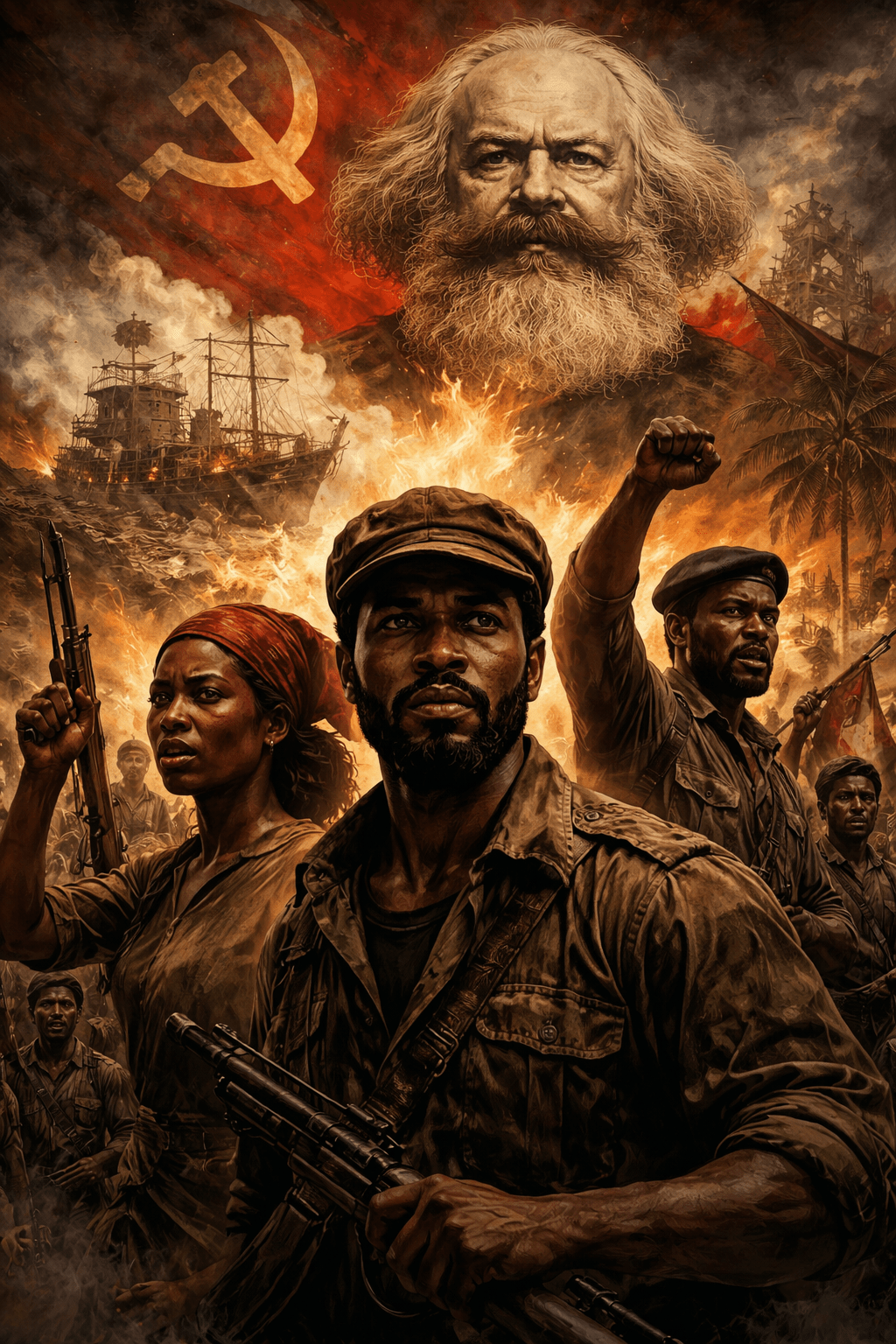
Black Marxism and the Colonial Blindspot Inside Western Marxism
Cedric J. Robinson did not write Black Marxism to abandon Marxism, but to indict the version of it that emerged safely inside empire. By tracing capitalism’s formation through slavery, racial domination, and colonial war, Robinson forces historical materialism to confront what Western Marxism systematically erased. The tragedy is not the book itself, but how it was later misread—detached from political economy and repurposed to justify fragmentation and retreat. This review reclaims Black Marxism as a necessary stress test of Marxism, not its negation, and situates it within the ongoing struggle to build revolutionary clarity around race, class, and empire.
February 2026
Black Marxism Is Not an Exit Ramp from Marx — It’s a Wrecking Ball Aimed at Western Marxism
Black Marxism begins in a place that still unsettles a lot of people: Europe. Not because Robinson is paying homage to the Western canon, and not because he believes Europe is the natural center of history. He starts there because the figure of the “Negro” was first manufactured there—long before ships crossed the Atlantic, before plantations spread like scars across the Americas. Europe had to invent a way of seeing the world, and itself, before it could conquer the rest of it. Robinson opens the book at the scene of the crime, not the celebration.
This is where so many readers go wrong. Black Marxism is constantly misread as a rejection of Marxism itself, as if Robinson were issuing a license to abandon political economy, organization, and class struggle in favor of cultural fragments and academic rebellion. That reading tells you more about the reader than the book. Robinson is not tearing down Marxism; he is taking aim at Western Marxism—the version that grew comfortable inside empire, that treated Europe’s history as the universal template, and that learned to talk endlessly about class while stepping carefully around slavery, colonialism, and conquest.
Robinson’s real provocation is simple and devastating: what kind of “scientific socialism” can describe factories in Manchester with precision but treat plantations, slave ships, and colonies as footnotes? What kind of proletariat is imagined when millions of racialized laborers are written out of the story—or folded in only after the fact? If Marxism claims to explain capitalism as a world system, then it has to account for the world as it was actually built: through racial hierarchy, colonial terror, and permanent war against the non-European majority.
That’s why Robinson refuses the comforting story that racism is just a modern deviation, an unfortunate byproduct that capitalism picked up along the way. He shows that Europe was already a deeply hierarchical civilization before capitalism reached maturity—structured by inherited status, religious exclusion, and ethnic domination. Capitalism did not abolish these arrangements; it industrialized them and shipped them overseas. Racial capitalism didn’t fall from the sky in 1492. It was assembled out of older materials and then weaponized on a planetary scale.
This is where Robinson becomes especially dangerous to liberal Marxists and postmodern critics alike. Against class reductionism, he insists that race cannot be treated as a cosmetic layer to be peeled away after the revolution. Against culturalism, he refuses to let race float free of material exploitation and imperial power. His argument cuts both ways: racial domination is structural to capitalism, and capitalism reorganizes racial domination in ever more efficient forms. You don’t get to choose one and ignore the other.
Robinson also makes a move that Western Marxism has always struggled with: he treats Europe and the “Negro” as co-produced inventions. The creation of whiteness required just as much ideological labor as the creation of Blackness. Europe had to rewrite history, police boundaries, and burn enormous psychic energy convincing itself that it was the sole author of civilization. This wasn’t an intellectual mistake; it was a ruling-class project. Knowledge production became an arm of conquest, a way of making domination feel natural, ancient, and inevitable.
And this is where the book’s afterlife becomes politically dangerous. Because Black Marxism is written with such clarity, it has been repeatedly misused as a weapon against Marxism itself—especially by academic currents eager to escape discipline, organization, and the hard work of confronting imperial power. Robinson’s critique of Western Marxism gets flattened into a dismissal of Marxism altogether. The result is fragmentation dressed up as radicalism: everyone gets their own theory, nobody builds power, and empire keeps collecting the surplus.
But Robinson never abandons historical materialism. He stretches it. He forces it to walk into places Western Marxism refused to go: the slave ship, the plantation, the colony, the ghetto. He insists that the cultures carried by enslaved and colonized peoples—languages, cosmologies, memories of resistance—were not residues of a lost past, but living resources that shaped rebellion in ways European theory could not always recognize. The Black radical tradition does not wait for permission from Europe. It fights because survival demands it.
So let’s be clear about what this review is doing from the outset. We are not here to “move beyond Marx.” We are here to rescue Marxism from the parochialism of the imperial core and force it to confront the colonial foundations of capitalism honestly. Black Marxism is not a break with scientific socialism; it is a demand that scientific socialism stop lying to itself. If the book has been misread as an exit from Marxism, that is not Robinson’s triumph—it is the empire’s counteroffensive. Our task is to take the book seriously enough to correct the distortion, sharpen the weapon, and return it to the struggle where it belongs.
Europe Was Not Innocent: Feudal Power, Chartered Violence, and the Myth of Organic Capitalism
Robinson opens Part II by returning us to Europe, but not the Europe of textbooks or polite Marxist timelines. This is not a continent sleepwalking from feudalism into capitalism as if history were a well-mannered escalator. Robinson’s Europe is violent, hierarchical, already racializing long before “race” had a modern name. And yet, here is where we have to slow down, dig in, and be precise—because this is also where Robinson’s analysis is most often misread, and where it needs to be sharpened rather than smoothed.
Robinson is right to reject the fairy tale that capitalism emerged as a clean rupture from feudalism. Europe did not abandon hierarchy; it refined it. Lords did not vanish; they reorganized themselves as monarchs, merchants, financiers, and chartered elites. But where Robinson leans toward civilizational continuity, we have to insist on something more concrete and more dangerous: capitalism was not the organic outgrowth of feudalism any more than democracy was the organic outgrowth of monarchy. It was engineered—through violence, contracts, and state power—by feudal rulers themselves.
The first capitalist enterprises were not born in free markets; they were born in royal chambers. Feudal monarchs chartered the first corporations, granted monopolies, licensed plunder, and sanctified theft as policy. Joint-stock companies were not accidents of commerce; they were instruments of statecraft. The crown did not lose control to capital—it midwifed it. When Queen Isabella and King Ferdinand contracted Columbus, this was not exploration; it was a joint venture. A speculative investment backed by the cross, the sword, and the ledger.
Robinson’s treatment of Portugal gestures toward this reality but does not fully confront it. Portugal was not simply an early capitalist outlier; it was a feudal monarchy experimenting with new techniques of accumulation under royal command. The caravels were extensions of the crown. The forts were state infrastructure. The violence was authorized, rationalized, and celebrated. Capital accumulation did not creep out from below—it was unleashed from above. This matters, because it demolishes the idea that capitalism evolved naturally out of feudal relations. It was imposed through force, not discovered through exchange.
The same applies to piracy, privateering, and maritime warfare. Figures like Drake were not criminals operating outside the system; they were contractors of empire. Pirates became “privateers” the moment the crown needed deniability and profit. Theft became patriotism when the loot flowed back to the state and its financiers. This was not lawlessness—it was legalized plunder. Capital learned early that violence works best when it wears a uniform or carries a charter.
Robinson’s larger point still stands: Europe was already practiced in domination before it crossed the Atlantic. Feudal hierarchy, religious exclusion, and ethnic stratification provided the social grammar for later racial rule. But what completes the picture is recognizing how these older hierarchies were fused with emerging capitalist imperatives through the state. Capitalism did not abolish feudal power; it weaponized it globally. The monarchy did not stand in capitalism’s way—it opened the gates.
This is where Western Marxism historically faltered. By treating capitalism as an inevitable stage of development, it mistook conquest for progress and coercion for evolution. It naturalized what was, in fact, a massive political project: the construction of a world economy through state-backed violence. Robinson exposes this blind spot, even if he does not always press it to its full material conclusion.
The danger in stopping at civilizational analysis is that it can make capitalism seem like a cultural inheritance rather than a system of organized theft. That mistake has consequences. It opens the door for later readers to slide away from political economy altogether, to treat race as memory instead of machinery, and to confuse historical insight with strategic clarity. Robinson gives us the raw materials to avoid that trap—but only if we refuse to romanticize Europe’s past or mystify capitalism’s birth.
What this section ultimately forces us to confront is uncomfortable but necessary: capitalism was not born in freedom, and it cannot be dismantled through critique alone. It was constructed through charters, armies, navies, and mass death. Any Marxism that forgets this—any Marxism that treats Europe as a neutral starting point rather than a launching pad for global plunder—has already surrendered the fight. Robinson is not asking us to abandon Marxism here. He is warning us what happens when Marxism forgets how capitalism actually came into being.
Capitalism Did Not Replace Feudalism — It Armed It and Sent It Abroad
Having torn away the myth of capitalism’s “organic” birth, Robinson pushes the argument forward to its most unsettling implication: capitalism did not abolish feudal domination—it reorganized it on a planetary scale. This is where his intervention becomes decisive, because it forces Marxism to abandon the comforting fiction that history naturally trends toward emancipation. What replaced feudalism was not freedom, but a more efficient architecture of rule.
Robinson insists that capitalism inherited feudal Europe’s habits of hierarchy, exclusion, and coercion, then retooled them for expansion. The lord–serf relation did not disappear; it was translated into planter–slave, metropole–colony, creditor–debtor. What changed was not the logic of domination but its reach. Capitalism universalized inequality by exporting Europe’s internal stratifications outward, fastening them to global circuits of labor extraction and wealth transfer.
This is where Robinson decisively breaks with classical developmental Marxism. He rejects the notion that capitalism rationalized society by dissolving feudal irrationalities. Instead, capitalism required those irrationalities—status, stigma, inherited degradation—to stabilize accumulation. Free labor was never the universal norm; it was the exception. Unfree labor, coerced labor, racialized labor were not transitional leftovers. They were foundational.
The colony, in Robinson’s telling, is not capitalism’s margin—it is its laboratory. Techniques of surveillance, punishment, and labor discipline were refined in the plantation and the mine long before they were normalized in European factories. Racial differentiation functioned as a technology of control, fragmenting labor, suppressing solidarity, and justifying permanent violence. Capitalism did not accidentally become racial; it needed racial ordering to survive.
At this point, Robinson’s analysis converges with—but also quietly corrects—Marx. Where Marx anatomized exploitation within the factory, Robinson forces us to confront exploitation across the world-system. Surplus was not merely extracted at the point of production; it was transferred across oceans through conquest, slavery, and colonial monopolies. The wage relation in Europe was subsidized by terror elsewhere. Capitalism’s internal “freedoms” were purchased through external unfreedom.
Yet Robinson’s framing introduces a productive tension. By emphasizing continuity between feudal and capitalist domination, he risks allowing capitalism to appear as an extension of European culture rather than as a historically specific system of accumulation enforced by states, armies, and markets. This is not a fatal flaw, but it is a fault line. If we lose sight of political economy—of how value moves, who captures it, and through what mechanisms—racial capitalism can slip into a story of memory rather than a map of power.
This tension has mattered enormously in how the book has been received. Read carefully, Robinson is not abandoning materialism; he is expanding its field of vision. Read carelessly, his argument can be stripped of its economic backbone and repackaged as cultural critique alone. The difference is not academic—it is political. One reading leads to struggle against imperial accumulation. The other leads to seminars about identity while empire continues uninterrupted.
What Robinson gives us here, if we are willing to take it seriously, is a correction to Western Marxism’s chronic amnesia. Capitalism did not civilize Europe and then accidentally brutalize the world. It was born in brutality and refined through conquest. The factory did not replace the plantation; it depended on it. The market did not tame violence; it organized it.
This is why Robinson’s critique still bites. Any Marxism that treats capitalism as a progressive stage rather than a reorganized war against labor is already disarmed. Any theory that imagines class struggle without empire, or exploitation without racialization, is not incomplete—it is wrong. Robinson does not ask us to choose between class and race. He shows us how capitalism fused them into a single machinery of domination.
What comes next will test whether this insight remains historical—or becomes revolutionary. Because recognizing capitalism’s continuity with feudal domination is one thing. Tracing how that domination collided with African resistance, memory, and revolt is another. It is there, in that collision, that the Black Radical Tradition begins to take shape—not as identity, but as insurgent historical consciousness forged against a world system built to erase it.
Africa as Absence, Africa as Engine: Capital Accumulation and the Architecture of Erasure
Having dismantled the myth of Europe as capitalism’s innocent birthplace, Robinson turns to the space that European history required but could not acknowledge: Africa. This is not a narrative of discovery, nor even conquest, but of erasure. Africa enters Robinson’s account not as a peripheral victim of capitalism, but as a condition of its possibility—rendered invisible precisely because its labor, land, and people were made indispensable to accumulation.
Robinson is careful here. He does not argue that Africa was somehow external to the development of capitalism, waiting passively to be absorbed. On the contrary, he insists that Africa was violently integrated into the emerging world system at its inception. What distinguishes Africa’s position is not exclusion from capitalism, but its forced inclusion under terms that denied historical agency, political subjectivity, and civilizational legitimacy. Africa was present everywhere in the making of the modern world—yet absent from the stories Europe told about itself.
This absence was not an oversight. It was a requirement. European political economy, including its radical critiques, depended on a narrative in which capitalism emerged from internal European contradictions alone. To acknowledge Africa as foundational would have shattered the illusion that capitalism represented progress, rationality, or historical advancement. It would have exposed accumulation not as development, but as organized theft—sanctioned by violence and justified by racial mythology.
Robinson traces this erasure through the categories of Western thought themselves. Africa appears not as a historical actor, but as a problem: a site of savagery, stagnation, or lack. This was true not only of liberal philosophy, but of much of Marxism as it developed in Europe. The colonial world entered Marxist analysis largely as an afterthought—an arena of primitive accumulation that preceded “real” capitalist development, rather than a continuous and structuring relation.
What Robinson exposes here is not moral failure but epistemic structure. Western Marxism inherited the same spatial imagination as bourgeois political economy. Europe was history. The rest of the world was background. Even when Marx recognized slavery as central to industrial capitalism, even when he wrote that labor in a white skin could not emancipate itself while labor in a black skin was branded, the broader architecture of Marxist theory remained tethered to a European developmental arc.
Robinson’s intervention is to rupture that arc. Africa was not a prelude to capitalism; it was its engine. The transatlantic slave trade was not a transitional phase; it was a central mechanism of accumulation. Colonial domination was not an external supplement to capitalist development; it was one of its primary organizational forms. To speak of capitalism without Africa is to speak of smoke without fire.
At the same time, Robinson resists reducing Africa to victimhood. He insists that African societies were not blank slates onto which European domination was written. They possessed political systems, social orders, spiritual traditions, and resistance practices that both shaped and constrained colonial exploitation. This insistence is crucial, because it prevents Africa from being absorbed into Western Marxism as merely a site of suffering rather than struggle.
Yet here a tension begins to sharpen. Robinson’s emphasis on Africa’s erasure and cultural autonomy powerfully indicts Eurocentric theory, but it also risks sliding away from the concrete mechanics of exploitation. The danger is not in recognizing culture, memory, or consciousness, but in allowing them to substitute for analysis of imperial accumulation, labor extraction, and global surplus transfer. Robinson opens this contradiction deliberately. He does not resolve it. He forces the reader to confront it.
This section therefore marks a decisive turning point in the book. Africa is restored to history—not as an appendix to Europe, but as a foundational terrain of modern capitalism. At the same time, Marxism itself is placed on trial. Can it absorb this reality without dissolving into Eurocentric abstraction? Can it account for racial domination as structural rather than residual? What follows will test whether the critique of Western Marxism can be transformed into a revolutionary theory adequate to the colonial world—or whether it will fracture under the weight of its own omissions.
Slavery as System, Resistance as Historical Force
With Africa restored to the architecture of capitalism, Robinson turns to the institution that bound that architecture together: racial slavery. He is unequivocal. Slavery was not an archaic remnant destined to be swept away by capitalist progress, nor a moral deviation from an otherwise rational system. It was a modern institution, consciously organized to meet the labor demands of a world economy in formation. The plantation was not capitalism’s shadow; it was one of its most advanced laboratories.
Robinson insists that racial slavery cannot be understood simply as coerced labor within capitalism, but as a social order that fused economic extraction with total domination. The enslaved were not merely workers deprived of wages. They were rendered property, stripped of juridical personhood, and subjected to a regime of violence designed to reproduce both labor power and racial hierarchy across generations. This was not incidental brutality. It was structural necessity.
Against Marxist accounts that treat slavery as a pre-capitalist form destined to disappear, Robinson demonstrates that racial slavery expanded alongside capitalism and helped stabilize it. The wealth extracted from enslaved African labor did not sit outside European development; it financed it. Plantations fed ports, ports fed banks, banks fed industry. Capital accumulation in the metropole was inseparable from unfree labor in the colony.
But Robinson’s most decisive intervention comes not in his account of exploitation, but in his insistence on resistance. The enslaved were never passive instruments of accumulation. From the earliest moments of capture to the daily rhythms of plantation life, resistance was constant, adaptive, and creative. Revolt, sabotage, flight, cultural preservation, and collective refusal were not exceptions to the system—they were part of its daily contradiction.
Robinson challenges a Marxism that recognizes resistance only when it takes the form of wage struggle or class-conscious organization. Enslaved Africans, denied legal recognition as workers, nevertheless generated forms of opposition rooted in communal memory, spiritual practice, and collective survival. These were not pre-political gestures. They were political responses shaped by the material conditions of racial domination.
In this way, Robinson reframes resistance as productive. Resistance did not merely negate domination; it produced culture, consciousness, and social cohesion under conditions designed to annihilate them. The songs, rituals, kinship networks, and moral codes forged in bondage were not residues of a lost African past, but new historical formations created in struggle. Black culture, in this sense, was not ornamental—it was infrastructural.
Yet Robinson is careful not to romanticize this process. Resistance did not abolish exploitation on its own. Revolts were crushed, maroon communities hunted, and rebellions drowned in blood. What mattered was not victory in isolation, but continuity. Through resistance, enslaved populations preserved historical memory and political imagination in a world that sought to erase both. This continuity would become decisive later.
Here, Robinson quietly advances a critique of Western Marxism’s fixation on formal organization as the sole marker of revolutionary capacity. Black resistance under slavery could not take the shape of unions or parties, yet it sustained collective consciousness under total domination. To dismiss these practices as pre-political is to mistake form for substance and to confuse legality with legitimacy.
At the same time, a tension deepens. Robinson’s emphasis on cultural production risks drifting away from a fully articulated analysis of surplus extraction and imperial integration. The danger is not that culture is foregrounded, but that economy recedes into the background. This is not a flaw so much as an unresolved question: how to theorize resistance without detaching it from the global circuits of capital that necessitated slavery in the first place.
What this section ultimately establishes is the historical groundwork for Black radicalism. Slavery did not merely produce suffering; it produced antagonism. It generated a population whose experience of capitalism was not mediated through citizenship or wage labor, but through racial terror and dispossession. From this condition emerged not assimilationist demands, but a radical critique of the system itself. The implications of that critique will only become clearer as Robinson follows its evolution beyond the plantation.
The Black Radical Tradition as Counter-History
Having established slavery as a modern system of accumulation and resistance as a continuous historical force, Robinson turns to what is arguably the book’s central intervention: the existence of a Black radical tradition. This tradition, he insists, did not emerge as a derivative of European socialism, nor as a belated awakening to class struggle. It arose organically from the material conditions of racial capitalism and the long memory of African resistance carried into the New World.
Robinson is explicit that Black radicalism is not simply Marxism with color added. It is a counter-history forged in opposition to a world that defined Black people not as workers within civil society, but as property, surplus population, and colonial subjects. Because Black life under capitalism was structured through exclusion rather than incorporation, Black resistance did not seek reform of the system’s terms. It questioned the system’s legitimacy at its root.
This is where Robinson’s break with Western Marxism becomes unavoidable. Classical Marxist narratives often assume that revolutionary consciousness develops through the maturation of capitalist relations—through wage labor, industrial concentration, and political inclusion. Robinson shows that for Black populations, capitalism matured as terror, displacement, and premature death. The revolutionary impulse that emerged from this experience did not wait for capitalism to fulfill its promises; it rejected those promises as fraudulent.
The Black radical tradition, as Robinson reconstructs it, is therefore marked by a different relationship to history. It does not treat capitalism as a necessary stage toward liberation, nor Europe as the bearer of universal reason. Its intellectual lineage stretches backward through African political cultures, maroon societies, and insurgent communities that preserved collective values against annihilation. These were not survivals of a pre-modern past; they were adaptations forged under extreme pressure.
Crucially, Robinson refuses the liberal caricature that frames Black radicalism as reactive or purely moral. The tradition he describes is strategic, historically conscious, and grounded in material struggle. Revolts, conspiracies, mutual aid networks, and clandestine organizing were not expressions of despair. They were attempts to reclaim agency within a system designed to erase it.
This is also where Robinson implicitly challenges Marxism’s Eurocentric epistemology. If historical materialism is confined to European trajectories—feudalism to capitalism to socialism—then Black radicalism appears anomalous, premature, or insufficiently developed. Robinson flips the lens. He suggests that it is Marxism, as filtered through European experience, that is historically partial. The Black radical tradition exposes capitalism not as a universalizing force, but as a racialized world system from its inception.
Yet Robinson does not abandon materialism. He does not claim that culture alone drives resistance, nor that ideology floats free of economic conditions. What he insists upon is that consciousness is shaped by how capitalism is lived. For Black populations, capitalism was encountered not as opportunity but as conquest. The resulting radicalism was therefore anti-systemic rather than reformist, international rather than national, and collective rather than individual.
At the same time, a contradiction sharpens. By emphasizing the autonomy of the Black radical tradition, Robinson risks overstating its separation from broader class struggle. The danger is not that Black radicalism is mischaracterized, but that its entanglement with global capitalism and imperial power becomes under-theorized. The tradition did not develop in isolation; it developed inside the circuits of empire that made slavery profitable and racial hierarchy functional.
Still, the force of Robinson’s argument remains intact. The Black radical tradition emerges here not as an identity politics avant la lettre, but as a historical response to a specific mode of domination. It is a tradition born not from exclusion alone, but from continuous resistance to a system that revealed capitalism’s true character earlier and more brutally than it did for Europe’s working class.
This insight will become decisive as Robinson moves forward. If Black radicalism is rooted in a different historical experience of capitalism, then its relationship to Marxism cannot be one of simple adoption or rejection. The question becomes whether Marxism can be stretched, disciplined, and re-grounded to account for this reality—or whether it remains trapped in a civilizational narrative that Black struggle has already surpassed.
Marxism at the Color Line — Stretching a Science Beyond Its Western Frame
At this stage of the book, Robinson turns explicitly toward Marxism itself—not to discard it, but to interrogate the historical form in which it developed. His target is not historical materialism as a science of social motion, but the Western Marxist tradition that universalized Europe’s experience and mistook that partial history for a general law of emancipation.
Robinson’s critique is surgical. He does not argue that Marx misunderstood capitalism; he argues that Marxism, as it crystallized in Europe, underestimated how deeply capitalism was fused with racial domination from its inception. The industrial proletariat of the metropole was never capitalism’s universal subject. It was a historically specific formation, produced alongside colonies, plantations, and enslaved labor regimes that made European accumulation possible.
This is where Robinson’s intervention has been most irresponsibly misread. Liberal and academic critics have treated this argument as a rejection of Marxism itself—as if exposing Eurocentrism were equivalent to abandoning class analysis. Robinson does nothing of the sort. His claim is narrower and sharper: Marxism, when confined to European developmental narratives, cannot fully explain a world system built through conquest, enslavement, and racial hierarchy.
In Robinson’s account, the problem is not that Marx centered class, but that Western Marxism naturalized a particular pathway to class consciousness. It assumed that exploitation would generate solidarity through shared conditions of wage labor and political inclusion. But for Black populations, capitalism did not integrate; it expelled. It did not proletarianize in the classical sense; it rendered surplus, disposable, and terrorized.
The consequence of this mismatch was not theoretical confusion alone, but political failure. Western Marxism repeatedly failed to recognize Black struggle as revolutionary unless it mirrored European forms—party structures, labor unions, parliamentary engagement. When Black movements did not conform to these expectations, they were dismissed as nationalist, irrational, or insufficiently class-conscious.
Robinson exposes this failure not by moral indictment, but by historical demonstration. He shows that Black resistance—from maroon communities to anti-colonial revolts—was often more consistently anti-capitalist than the reformist currents dominant in the imperial core. These struggles did not demand inclusion in civil society; they sought to destroy the social relations that defined Black people as exploitable objects in the first place.
What Robinson is pushing toward here is not a new Marxism, but a re-grounding of Marxism in the full history of capitalism as a global system. This requires recognizing that racial domination is not an ideological residue, nor a superstructural add-on, but a material technology of accumulation. Capitalism did not become racial after expanding outward; it expanded outward through racialization.
At the same time, Robinson leaves unresolved a key tension. By framing Marxism primarily as a European intellectual tradition, he risks collapsing its revolutionary applications into its Western academic distortions. The danger is subtle but real: Marxism appears as something that must be corrected from the outside, rather than as a living science that has already been transformed through anti-colonial struggle.
Yet even this tension is productive. Robinson forces Marxism to confront a historical reality it cannot evade: that the most sustained, successful, and world-altering challenges to capitalism have emerged not from the metropole, but from the colonized world. Any Marxism unwilling to learn from these struggles is not incomplete—it is obsolete.
Read carefully, this section does not pit Black radicalism against Marxism. It pits Black radicalism against a Marxism that refused to break with Europe’s civilizational self-image. The question Robinson leaves hanging is not whether Marxism is salvageable, but whether it can be disciplined by the history of those whose exploitation made capitalism possible in the first place.
History in Revolt — Black Radical Thought as Material Practice
Having forced Marxism to confront its Western limits, Robinson turns to what he insists has always existed alongside—and often against—those limits: a Black radical tradition forged not in seminar rooms, but in struggle. This tradition, Robinson argues, did not emerge as a derivative of European socialism. It arose from the lived experience of racial slavery, colonial domination, and perpetual exclusion from the promises of Western modernity.
Robinson is careful here. He does not present Black radicalism as a unified doctrine or a single ideological lineage. Instead, he traces a constellation of thinkers, movements, and insurgent practices bound together by a shared historical condition: capitalism encountered not as wage labor alone, but as captivity, dispossession, and terror. What unified these struggles was not theory first, but antagonism—an unrelenting opposition to a system that defined Black existence as exploitable surplus.
Figures such as W.E.B. Du Bois, C.L.R. James, and Richard Wright enter Robinson’s narrative not as isolated intellectuals, but as nodes where historical forces converged. Their ideas were shaped by concrete struggles: Reconstruction and its betrayal, Caribbean plantation economies, imperial war, mass migration, and anti-colonial revolt. Thought, in this tradition, was never detached from movement. It was a weapon sharpened by defeat and redeployed in resistance.
Du Bois’s conception of the “general strike” of enslaved people during the Civil War, James’s analysis of the Haitian Revolution, and Wright’s exploration of Black life under racial capitalism all share a common refusal: they reject the notion that Black struggle must wait for European proletarian maturity. In Robinson’s reading, these thinkers understood something Western Marxism often missed—that Black resistance was not peripheral to capitalism’s development, but central to its crisis.
Robinson’s most important move here is methodological. He treats Black radical thought as historical materialism in practice, even when it did not always wear Marxist language explicitly. This is not idealism. It is an insistence that theory arises from social relations, and that those forced into the most violent forms of exploitation often develop the clearest understanding of the system they confront.
This is precisely why Black radicalism has so often been mischaracterized as cultural, spiritual, or merely oppositional. When struggle does not pass through European institutions—factories, parties, parliaments—it is dismissed as pre-political. Robinson rejects this dismissal outright. Maroon communities, slave revolts, anti-colonial wars, and urban rebellions were not spontaneous outbursts; they were organized responses to material domination.
At the same time, Robinson resists romanticization. He does not claim that Black radicalism was always coherent, unified, or victorious. It was fragmented, contested, and repeatedly crushed. But its persistence across centuries reveals something essential: capitalism never succeeded in fully absorbing Black labor into its ideological order. The promise of inclusion rang hollow where the reality was permanent dispossession.
The danger emerges when this tradition is abstracted from its material roots. Detached from political economy, Black radicalism can be rebranded as culture, identity, or moral critique—safe for academic consumption and harmless to capital. Robinson himself gestures toward this risk, even if he does not fully theorize its consequences. The tradition he documents was born in conflict with the state, property, and empire. Removed from that conflict, it becomes a shadow of itself.
What this section ultimately establishes is continuity. Black radical thought was not an alternative to historical materialism; it was one of its most rigorous applications under conditions Marx himself never directly experienced. It grasped capitalism not only as exploitation, but as racialized domination enforced through law, violence, and colonial power.
The implication is unavoidable. Any Marxism that cannot account for this history—any Marxism that treats Black struggle as secondary, cultural, or merely reactive—has misunderstood both capitalism and resistance. Robinson is not asking Marxism to apologize. He is demanding that it grow up.
Nation, Class, and the Colonial Break — Black Radicalism Against False Universals
Robinson now turns to a question that Western Marxism has consistently mishandled: the emergence of Black nationalism not as an ideological detour, but as a historical response to colonial domination. For Robinson, nationalism among colonized peoples was not the product of false consciousness or backward sentiment. It was the political form imposed by material conditions in which class struggle unfolded under racialized empire.
In the European experience, Marxism could imagine class struggle developing within a national framework that capitalism itself had helped consolidate. Robinson insists that this template collapses in the colonial world. For Black populations, nationhood was never a settled terrain inherited from bourgeois development. It was something denied, fragmented, and violently suppressed. Under these conditions, appeals to abstract proletarian universalism rang hollow.
Black nationalism, as Robinson reconstructs it, was not a rejection of class struggle but an attempt to give it a viable political form. It named a collective condition produced by slavery, segregation, and imperial rule—conditions that fractured the working class along racial lines and foreclosed access to the institutions through which European workers organized. To demand that Black workers subordinate this reality to a supposedly color-blind class politics was not internationalism; it was evasion.
This is where Robinson’s critique of orthodox Marxism becomes sharpest. He argues that many Marxists treated nationalism as a stage to be overcome rather than as a terrain of struggle. In doing so, they failed to grasp that colonial capitalism did not merely exploit labor—it produced peoples as racialized populations, governed through exclusion, surveillance, and force. Class struggle, in this context, could not unfold without confronting the national question directly.
Robinson is careful not to sanctify nationalism. He distinguishes between revolutionary nationalisms that aimed at collective liberation and bourgeois nationalisms that sought accommodation within the imperial order. The former mobilized mass struggle against colonial power; the latter often reproduced class hierarchy under a new flag. The difference was not cultural authenticity, but political orientation and material alignment.
This distinction matters because Black radical movements repeatedly faced the danger of cooptation. National consciousness could be redirected toward elite integration, symbolic representation, or state management without transformation of the underlying relations of exploitation. Robinson does not deny this danger. He insists, however, that it cannot be used to dismiss nationalism wholesale without erasing the conditions that produced it.
The deeper target of Robinson’s argument is a Marxism that universalizes European experience while demanding that the colonized transcend their history prematurely. Internationalism, he reminds us, is not declared—it is built. It emerges from solidarities forged in struggle, not from theoretical decrees issued in advance of material unity. To insist otherwise is to mistake abstraction for science.
At the same time, Robinson leaves a tension unresolved. By foregrounding nationalism as the dominant political expression of Black radicalism, he risks obscuring how colonial capitalism also bound Black struggle to global circuits of accumulation and imperial power. The challenge is not to choose between nation and class, but to understand how national liberation movements confronted capitalism as a world system—even when their immediate horizon was national.
This unresolved tension is not a flaw so much as a fault line. It exposes the limits of any analysis that treats nationalism and class as mutually exclusive rather than dialectically related. Robinson’s contribution is to force Marxism to confront the colonial break: the moment when universal categories fail unless they are reconstructed from the standpoint of the oppressed.
What emerges is a warning and a challenge. A Marxism that dismisses Black nationalism as parochial cannot explain colonial history. But a nationalism that loses sight of imperialism and political economy risks becoming administratively Black while remaining structurally capitalist. The task is not moral judgment, but revolutionary clarity.
Robinson does not resolve this contradiction for us. He hands it to history. And history, as always, will demand more than slogans.
Stretching Marxism Without Breaking It — The Achievement and the Limit of Black Marxism
Robinson now arrives at the point where his intervention has been most misunderstood. Black Marxism does not present itself as a rejection of Marxism, nor as a replacement theory rooted in cultural particularism. It is, rather, a sustained critique of Western Marxism’s failure to account for the colonial constitution of capitalism and the racialized ordering of the modern world. The problem Robinson identifies is not Marxism as a method, but Marxism as it was historically practiced and theorized within Europe.
This distinction is crucial. Robinson never argues that class struggle is irrelevant, nor that political economy can be displaced by culture or identity. His charge is sharper and more uncomfortable: Western Marxism universalized its own experience while mistaking that partial history for the total movement of capitalism. In doing so, it treated colonial domination as secondary, episodic, or derivative—rather than as constitutive.
Black radicalism, in Robinson’s account, forced Marxism to confront this blind spot. It did so not by abandoning historical materialism, but by applying it to terrains Marxism had neglected: slavery as a mode of accumulation, race as a structuring relation of labor, and empire as the condition of possibility for European development. If Marxism appeared stretched by this encounter, it was because it had been artificially narrowed by Eurocentric assumptions.
And yet, Robinson’s formulation leaves open a door through which later distortions would rush. By framing Black radicalism as emerging largely outside Marxism, and by emphasizing its cultural and historical autonomy, Robinson made it possible for readers to interpret his work as a repudiation of Marxism altogether. This was never his argument—but it became a convenient one for academics eager to discard class analysis while retaining radical language.
The irony is stark. A book written to expose the limits of Western Marxism would be used to justify its most liberal mutations: identity politics severed from political economy, race detached from imperial accumulation, and resistance reduced to symbolic affirmation. In these readings, Black Marxism becomes a license to abandon the discipline of historical materialism rather than deepen it.
Robinson cannot be blamed for these abuses, but neither can they be ignored. His reluctance to fully re-anchor Black radicalism within a reconstructed Marxism leaves unresolved questions about organization, strategy, and the seizure of power. Culture, memory, and tradition illuminate the terrain of struggle—but they do not substitute for analysis of capital, the state, and imperial force.
This is the limit of Black Marxism as a theoretical work. It names the failure of Western Marxism with devastating clarity, but it stops short of rebuilding Marxism on anti-colonial foundations in a systematic way. It opens the door—but does not walk through it.
And yet, this limit is inseparable from the book’s achievement. Robinson forces Marxism to reckon with histories it cannot absorb as footnotes. He demonstrates that any universal theory that cannot explain slavery, colonialism, and racial domination is not universal at all. He insists that Marxism must be reconstructed from the standpoint of the colonized—or it will remain an ideology of partial truth.
Read this way, Black Marxism is not a break with historical materialism, but a challenge to renew it. Not by softening its categories, but by sharpening them against the realities of empire. Not by abandoning class struggle, but by situating it within the world system that made race a technology of accumulation.
What Robinson offers, then, is neither a final theory nor a new orthodoxy. He offers a provocation—one that demands completion. Whether that completion leads toward revolutionary synthesis or academic dilution depends not on the text itself, but on the politics of those who inherit it.
The book ends without closure because the struggle it describes has not ended. The question it leaves us is not theoretical but practical: will Marxism be reconstructed through the struggles of the colonized, or will it continue to decay as a language of critique safely housed within empire?
Race, Class, Empire — What Black Marxism Arms Us to See
Black Marxism ultimately belongs not to the library, but to the struggle over how race and class are understood inside capitalism. Robinson does not give us a detachable “Black theory,” nor does he dissolve class into culture. What he gives us is something far more dangerous: a demonstration that capitalism was never a race-neutral system that later acquired racial features, but a world order built through colonial domination, racial differentiation, and coerced labor from its very inception.
This insight is foundational for any serious Race/Class analysis today. Race cannot be reduced to class, because race was forged as a technology for organizing labor, distributing violence, and stabilizing empire. But neither can race be separated from class, because racial domination has always functioned to structure exploitation, surplus extraction, and global accumulation. To separate the two is to misunderstand both.
Robinson’s enduring contribution is to force Marxism to confront this reality without retreating into liberal moralism. He insists that Black struggle was never a plea for inclusion into Western modernity, but a challenge to the civilization that produced slavery, colonialism, and capitalism as a unified historical process. Black radicalism emerges not as identity politics avant la lettre, but as an insurgent critique of empire rooted in material struggle.
At the same time, this book teaches us what happens when critique is severed from revolutionary discipline. Detached from anti-colonial Marxism, Robinson’s work has too often been repurposed as an argument against organization, against class analysis, and against the necessity of confronting imperial power directly. In these hands, Black Marxism becomes a justification for fragmentation rather than a weapon for unity.
That outcome is not inevitable—but it is instructive. It reveals how easily revolutionary insights can be neutralized when removed from a materialist framework. It shows how the academy can absorb radical language while disarming radical politics. And it underscores why Marxism, if it is to remain a science of liberation, must be continuously re-grounded in the struggles of the oppressed rather than the preferences of intellectuals.
For Race/Class 101, the lesson is clear. The central contradiction of capitalism cannot be grasped without understanding the colonial dimension of class formation. The working class is not homogeneous. It has been historically stratified by race, nation, and imperial privilege. Any politics that pretends otherwise—whether in the name of class reductionism or cultural particularism—reproduces the very divisions it claims to overcome.
Robinson does not resolve these contradictions for us. He exposes them. He forces us to abandon comforting abstractions and confront the historical record as it is: uneven, violent, racialized, and global. That is his achievement. The task he leaves unfinished is ours—to integrate this insight into a revolutionary practice capable of confronting capital, empire, and the state.
Black Marxism is therefore not a doctrine to be memorized, nor a license to abandon Marxism. It is a stress test. It asks whether Marxism can be reconstructed from the standpoint of the colonized, or whether it will remain trapped within the historical limits of Europe. It asks whether race will be treated as a deviation, or as a structuring relation of capitalist modernity.
Handled carefully, this book sharpens our analysis and deepens our capacity to fight. Handled carelessly, it becomes another artifact of academic radicalism—quoted, celebrated, and safely ignored. The difference lies not in how eloquently we interpret Robinson, but in whether we use his insights to build revolutionary clarity in a world still organized by colonial power.
That is the final verdict. Black Marxism remains essential—not because it abandons historical materialism, but because it forces us to complete it. Not because it fragments struggle, but because it demands a unity forged through anti-colonial class struggle. And not because it offers comfort, but because it refuses to let Marxism evade the histories written in blood at the foundation of the modern world.
 Weaponized Information
Leave a comment