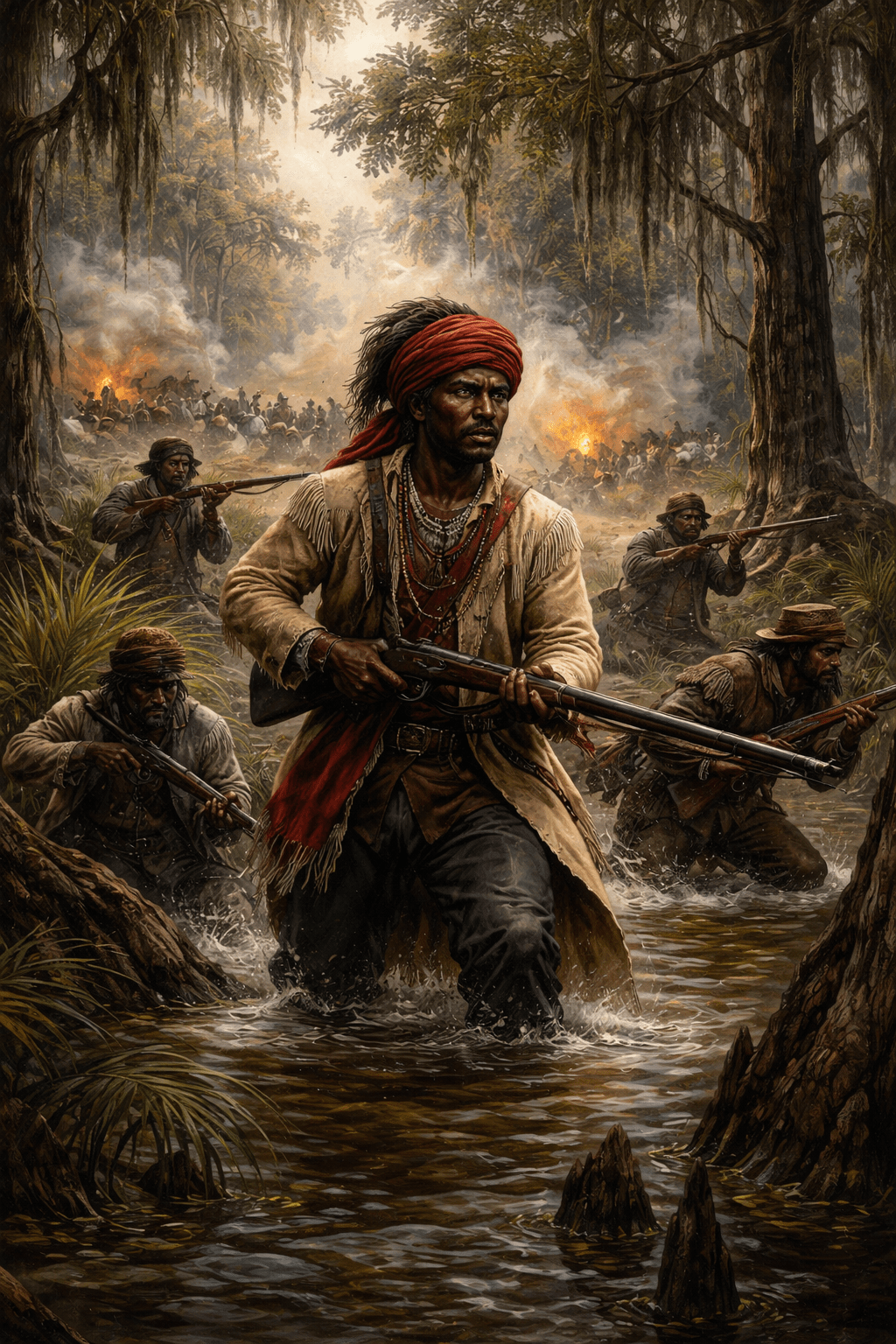
Long before emancipation was declared from Washington, enslaved Africans and Indigenous Seminoles built an armed republic in the Florida swamps. Their alliance waged the longest and most successful slave insurgency in U.S. history. The United States responded with invasion, removal, and counterrevolution. John Horse’s life exposes empire not as destiny, but as a structure contested from below.
Prince Kapone | Weaponized Information | Black History Matters Series | February 9, 2026
The Man the Empire Couldn’t Categorize
The United States has a habit of cleaning up its own crime scenes. It renames invasions as “expansion,” slave patrols as “law enforcement,” and counterinsurgency as “peacekeeping.” And when the oppressed fight back hard enough to leave a scar, the empire files the memory down until it looks harmless. That is what happened to John Horse (Juan Caballo). In the textbooks, he drifts by as a curious frontier character. In reality, he was something far more dangerous: a Black guerrilla commander shaped by slavery, sharpened by alliance with the Seminole Nation, and disciplined enough to turn geography itself into a weapon against the United States.
This is not a folktale. It is a study in how power works—and how it can be broken. John Horse’s life moves through the fault lines of nineteenth-century America: enslavement, maroon flight, Indigenous alliance, protracted war against U.S. forces, forced removal westward, renewed slave-catching pressure in Indian Territory, and finally a mass escape into Mexico, where slavery had been abolished. Every one of those stages reveals something simple and structural. The U.S. state was fighting to secure land and protect slave property. Black and Indigenous people were fighting to live as human beings on land they could defend.
Let’s be clear about the stakes. The Seminole Wars were not minor “Indian uprisings.” They were wars fought in large part because Florida had become a corridor of Black flight. Enslaved Africans escaped plantations in Georgia and the Carolinas and found refuge among the Seminoles. They did not live as passive dependents. They formed armed communities, farmed land, and defended themselves. As the Association for the Study of African American Life and History notes, U.S. campaigns in Florida were inseparable from the effort to crush these Black sanctuaries. In plain speech: slave power wanted its “property” back, and it was willing to burn the peninsula to get it.
John Horse came of age in that fire. He was neither plantation laborer nor tribal ornament. He became a translator, a negotiator, a fighter—someone who could move between Black maroon settlements and Seminole leadership, someone who understood both the plantation’s cruelty and the swamp’s possibilities. Empires fear this kind of person. They prefer clean categories: slave or citizen, savage or civilized, rebel or loyal subject. John Horse was none of these in the way Washington wanted. He was a borderland insurgent. And borderlands are dangerous places for empires because they expose how thin sovereignty really is.
The pattern is not complicated. The United States expanded southward under the banner of “security” and “civilization.” In practice, that meant destroying any community that made slavery unstable. Treaties were signed and broken. Promises were made and revoked. When negotiation failed to discipline Black freedom, the army moved in. Reconstruction had not yet arrived, but counterrevolution was already well-practiced. What the state could not assimilate, it attempted to remove. What it could not remove, it attempted to crush.
And yet, there is a lesson here that refuses to die. John Horse and the Black Seminoles did not wait for moral reform in Washington. They built alliances. They fought in terrain the U.S. army could barely navigate. When removal west only recreated the threat of re-enslavement, they did something even more radical: they left the jurisdiction of the slave state entirely and crossed into Mexico. Freedom, in this case, was not granted. It was relocated and defended.
So the thesis we carry forward is straightforward and unsentimental: John Horse’s life reveals the United States not as a reluctant mediator of frontier conflict, but as an active counterrevolutionary force defending slave capital and settler expansion. And it reveals something else as well. The oppressed have always understood what the ruling class denies—that freedom requires land, arms, alliance, and the courage to move. John Horse could not be categorized because he did not accept the empire’s categories. He organized outside them. And that is precisely why his name still unsettles the official story.
Maroon Ground: The Geography of Black Seminole Freedom
Before there was a war, there was movement. Before there were treaties and bayonets and burning villages, there were enslaved Africans walking south into Florida. They did not walk because it was romantic. They walked because the plantation was a labor camp guarded by whips and patrols, and Florida—then a shifting imperial borderland—offered cracks in the wall. Spanish authorities had earlier promised freedom to fugitives willing to serve militarily, and long before U.S. annexation, Florida had already become a corridor of flight. By the early nineteenth century, what the slaveholding South called “runaways” had built something else: armed Black communities living among and alongside the Seminole Nation.
Historians of the borderlands and scholars of maroon societies have documented that these Black Seminole settlements were not scattered bands hiding in trees. They were structured communities with farms, livestock, and systems of mutual defense. The National Park Service acknowledges that African-descended people lived in Seminole territory in organized villages and often fought alongside Seminole forces. What Washington saw as disorder was in fact social order beyond plantation discipline. What slaveholders saw as theft was, in material terms, labor withdrawing itself from bondage.
This matters because it reframes the conflict. The presence of Black Seminoles destabilized the slave economy of Georgia and the Carolinas. Each person who reached Florida represented lost capital—lost field hands, lost future births, lost productivity calculated into ledgers. Planters did not fear abstract rebellion as much as they feared this steady leakage of labor. Florida was not simply a refuge; it was a political problem for the slaveholding class. The existence of Black maroon settlements proved that slavery was not inevitable. It could be escaped, defended, and reorganized into something else.
John Horse grew up in this environment of motion and resistance. Of mixed African and Seminole ancestry, he was raised within communities that understood both the plantation’s brutality and the swamp’s protective logic. Geography became curriculum. The rivers, hammocks, and Everglades were not scenery; they were tactical assets. The U.S. Army, trained for conventional campaigns, found itself stumbling through unfamiliar terrain while Black and Seminole fighters moved with precision. As scholars of the Second Seminole War note, the conflict became one of the longest and most expensive Indian wars in U.S. history. That endurance was not accidental. It was built on alliances forged in the material need to survive.
The Black Seminole settlements complicate another myth: that enslaved Africans in the United States lacked military organization before the Civil War. In Florida, armed Black men fought as part of Seminole resistance. They guarded villages. They conducted raids. They helped liberate others from nearby plantations. Some historians have argued that this conflict constitutes one of the longest sustained slave insurgencies on U.S. soil. Whether labeled as such or not, the reality is clear: Black people were not waiting passively for emancipation. They were building autonomous zones under constant threat.
The U.S. government understood the danger. Military reports repeatedly emphasized the problem of “Negro allies” strengthening Seminole resistance. Slaveholders pressured federal authorities to retrieve what they called property. The line between Indian removal and slave-catching blurred. When Andrew Jackson and later administrations pursued campaigns in Florida, they did so not only to claim land but to dismantle a living example of Black-Indigenous solidarity. This is the colonial contradiction in its raw form: settler expansion required the destruction of any community that fused land with Black freedom.
For John Horse, this was political education without a classroom. He witnessed firsthand how alliances formed, how treaties were manipulated, how military expeditions targeted not just warriors but entire settlements. He learned that the United States did not negotiate from weakness; it negotiated from calculation. And he learned something equally important: that collective survival required coordination across racial lines forged in common struggle. The Black Seminole experiment was not utopia. It existed under siege. But it proved a principle that empire fears—when the oppressed organize beyond imposed categories, they alter the balance of power.
This is not mere background, it is foundation. John Horse did not invent resistance. He inherited and sharpened it. The maroon ground of Florida was both refuge and battlefield. It demonstrated that land, once wrested from planter control, could become the base of a different social order. And it revealed why the United States was prepared to wage prolonged war to destroy it.
A War That Would Not End: The Second Seminole War and the Making of a Guerrilla Commander
By 1835, what slaveholders called a “problem” had become a war. The United States launched what is now known as the Second Seminole War (1835–1842), a campaign that would become one of the longest and most expensive Indian wars in U.S. history. Officially, it was about removal—enforcing treaties that aimed to relocate the Seminole Nation west of the Mississippi under the logic of the Indian Removal Act. In reality, it was also about dismantling Black autonomy in Florida. The existence of armed Black Seminole communities made removal urgent. You cannot expand slave territory while allowing free Black enclaves to flourish at the border.
This war did not resemble the set-piece battles of European armies. It was swamp warfare. U.S. troops marched in heavy columns, burdened by supply lines and rigid command structures. Seminole and Black fighters moved in small units, striking and disappearing into terrain the army could not master. As military records and historical analyses confirm, federal forces suffered from disease, ambush, and logistical breakdowns in the Florida Everglades. The empire had firepower. It did not have familiarity. And in guerrilla warfare, familiarity is power.
John Horse came into prominence in this crucible. Known to U.S. authorities as “John Horse” and to his people as Juan Caballo, he emerged as both translator and negotiator, but also as a commander within the Black Seminole ranks. He moved between languages and worlds—between Seminole leadership and U.S. officers, between African-descended fighters and Indigenous war chiefs such as Coacoochee (Wild Cat). That position made him indispensable and suspect in equal measure. Empires distrust intermediaries because intermediaries understand both sides of the battlefield.
The war exposed something the official story prefers to soften: Black men were not peripheral auxiliaries in this conflict. They fought. They strategized. They defended settlements. U.S. officers frequently reported that “Negro allies” strengthened Seminole resistance. The federal objective was therefore double: remove Indigenous landholders and neutralize Black combatants who represented a living repudiation of slave property law. In plain terms, the United States was fighting to protect an economic system dependent on bondage. Black Seminole resistance was fighting to prevent re-enslavement.
The tactical pattern was consistent. U.S. forces would press into Seminole territory, seize or destroy villages, and attempt to force surrender through attrition. Seminole and Black fighters would withdraw deeper into the swamps, regroup, and re-emerge unpredictably. The Everglades functioned as shield and sword. The longer the war dragged on, the clearer the contradiction became. The self-proclaimed beacon of democracy was pouring resources into a campaign to crush communities of people whose primary crime was refusing enslavement and removal.
Eventually, exhaustion and strategic recalculation produced negotiated surrenders. Many Seminoles and Black allies were coerced or convinced into removal westward to what would become Indian Territory (present-day Oklahoma). John Horse was among those who relocated. But removal did not resolve the contradiction; it displaced it. In the West, slave catchers and pro-slavery forces continued to assert claims over Black Seminoles, arguing that they were legally enslaved and therefore subject to seizure. The war in Florida had been about land and labor. The struggle in Indian Territory would be about whether freedom secured in battle could survive under the shadow of U.S. slave law.
John Horse was not simply carried along by history. He was forged by it. The Second Seminole War transformed him from borderland youth into seasoned guerrilla leader. He witnessed the limits of treaty promises, the duplicity of federal policy, and the relentless determination of slave power. He learned that the United States would negotiate only when compelled and would betray whenever advantageous. That education would shape his next decision—one that would carry him and his people beyond the reach of the slave republic itself.
Removal Without Freedom: Indian Territory and the Return of the Slave Catcher
The official narrative says the war ended when the Seminoles were removed west. But for Black Seminoles, removal was not peace—it was relocation under threat. After years of swamp warfare, many Seminoles and their Black allies were transported to what the United States designated as Indian Territory, in present-day Oklahoma. On paper, this was the fulfillment of federal treaty obligations. In practice, it placed Black Seminoles in proximity to slaveholding Creek and other pro-slavery interests who claimed them as property.
The contradiction sharpened immediately. The U.S. government had forced these communities west under the Indian Removal framework, yet it offered no meaningful protection against re-enslavement. Southern slaveholders argued that Black Seminoles were legally enslaved persons who had fled bondage in Florida and were therefore subject to reclamation. Federal officials vacillated. Some officers recognized that these men had fought as allies in wartime. Others deferred to the property claims of slaveholders. The message was consistent even when the language changed: Black freedom remained conditional.
John Horse understood the danger. He had seen how treaties were weaponized and reinterpreted. He knew that proximity to slave territory meant vulnerability. In Indian Territory, armed slave catchers could operate under the protection of U.S. law. The same republic that had waged war against Black autonomy in Florida was now presiding over an environment where Black Seminoles could be seized, sold, or coerced into dependency. Removal had shifted geography, not resolved power.
Tensions escalated into violence and political struggle. Black Seminoles resisted attempts to classify them as slaves. Seminole leaders who opposed re-enslavement found themselves under pressure from U.S. agents and neighboring slaveholding factions. The United States had achieved territorial expansion, but it had not extinguished the core problem: a community of Black fighters who had tasted autonomy and would not willingly return to bondage.
This stage of the story exposes a fundamental truth about settler colonialism and slave capitalism: incorporation is rarely neutral. The empire removes, reorganizes, and absorbs—but always in ways that secure labor and land for itself. Indian Territory was not a sanctuary. It was a rearranged frontier under federal oversight. For Black Seminoles, the risk of re-enslavement was not theoretical; it was immediate and material.
John Horse responded not with nostalgia for Florida nor with faith in federal protection, but with strategic clarity. If the United States remained structurally committed to slave property claims, then safety could not be found within its jurisdiction. The lesson of Florida and Indian Territory was the same: autonomy under U.S. sovereignty would always be precarious. The only durable freedom would require stepping beyond the slave republic entirely.
This was the crucial turning point. The war in Florida had shown that guerrilla resistance could delay and disrupt imperial expansion. Indian Territory revealed that federal treaties could not guarantee Black freedom inside a slaveholding nation. The next move would not be another swamp campaign. It would be something even more radical: a collective departure across an international border into a state that had already abolished slavery.
Crossing the Border: Mexico as Sanctuary and Strategy
When the plantation state refuses to let you live free inside its borders, the question becomes simple: stay and risk chains, or move and risk the unknown. By the late 1840s, John Horse and the Black Seminoles had learned enough about U.S. promises to know they were made of paper. Indian Territory offered proximity to slave catchers and little protection from re-enslavement. So they made a decision that unsettles the mythology of American inevitability. They left.
Mexico had abolished slavery in 1829. That was not an abstract moral declaration; it was a legal fact with material consequences. For Black Seminoles living under the threat of seizure in U.S. territory, Mexico represented something rare in North America at that time: a state that did not legally recognize their bodies as property. In 1850, John Horse led a group of Black Seminoles across the Rio Grande into northern Mexico, where they were granted land in exchange for serving as a frontier defense force against raids. Freedom here was negotiated, but it was anchored in a nation that had already rejected slave law.
This migration was not a desperate scatter. It was coordinated and collective. Families, fighters, and community leaders crossed together. They did not flee alone in the night; they relocated as a people. The Mexican government understood the value of seasoned borderland warriors. The Black Seminoles understood the value of jurisdiction. Under Mexican law, slave catchers from Texas had no authority. The U.S. legal claim to their bodies dissolved at the river.
For the United States, this was an embarrassment layered atop an earlier failure. After years of warfare in Florida and relocation west, Black fighters had not been subdued. They had escaped the slave republic altogether. The existence of a free Black Seminole settlement in Mexico exposed the limits of U.S. sovereignty. It revealed that the border was not just a line of control; it could also be a line of liberation.
In Mexico, John Horse—now known widely as Juan Caballo—continued to exercise leadership. The community established itself in Coahuila, farming, defending territory, and maintaining its distinct identity. They had not assimilated into plantation life nor dissolved into anonymity. They had carved out space under different legal conditions. The empire that had once hunted them could not simply reach across and drag them back.
The strategic brilliance of this move cannot be overstated. The U.S. slave system depended on containment. It relied on the assumption that enslaved and formerly enslaved people had nowhere else to go. John Horse disproved that assumption. He recognized that borders are political constructions, and he used one against the very state that had tried to crush him. If Florida had been guerrilla ground, Mexico became geopolitical leverage.
John Horse thus reframes the meaning of escape. This was not individual flight but collective repositioning. It was a calculation grounded in legal reality and military experience. The lesson is as sharp today as it was then: when a state is structurally committed to your subjugation, freedom may require stepping beyond its jurisdiction entirely. John Horse did not wait for the United States to become just. He found a place where its slave code did not apply.
The Longest Slave Insurrection the Republic Pretends Was Just a War
By the time John Horse settled in Mexico, the United States had already spent years trying to erase the meaning of what had happened in Florida. Official histories would later call it the “Second Seminole War,” as though it were simply a clash between sovereign nations over land. But strip away the diplomatic language and something far more dangerous becomes visible. What the U.S. military faced in the swamps was not just Native resistance. It was a multi-racial, anti-slavery insurgency that combined Indigenous sovereignty with Black flight from bondage. In plain terms: it was a prolonged slave revolt protected by guerrilla warfare.
For nearly a decade in the 1830s and early 1840s, U.S. forces poured money, troops, and political will into Florida. The cost ran into the tens of millions of dollars — one of the most expensive wars the United States had fought up to that point. Why such ferocity? Because the Seminole Nation had done what the plantation system could not tolerate. They accepted runaway Africans into their communities. They refused to return them. They created a frontier zone where the slave code stopped functioning.
John Horse stood at the center of that contradiction. Born into a world where Blackness was supposed to equal property, he became a military leader in a formation that liberated enslaved people during active conflict. Black Seminole fighters did not merely defend their villages. They raided plantations, disrupted slave patrols, and incorporated newly freed people into their ranks. That is not incidental to the war; that is its core.
Scholars today increasingly recognize the Seminole struggle as the longest sustained armed resistance involving enslaved Africans in U.S. history. It outlasted individual revolts. It outmaneuvered generals. It forced the federal government into terrain it could not easily conquer. The Everglades became a classroom in insurgent strategy. Regular troops accustomed to conventional battle found themselves bleeding resources against fighters who knew every waterway and shadow.
The United States eventually declared victory, but the definition of victory had shifted. The Seminoles were not annihilated. Many were forcibly removed. Others escaped. Black Seminoles carried their resistance west and then south into Mexico. If empire measures success by containment, then the persistence of John Horse and his people complicates the record. The slave republic did not extinguish the insurgency; it displaced it.
Why does this matter? Because how we name the conflict shapes how we understand it. If it was simply an “Indian war,” then it belongs to a chapter about frontier expansion. If it was also a slave insurrection, then it belongs to the history of class struggle and racial capitalism. It forces us to see that the United States was not merely expanding territory. It was defending a labor regime. The destruction of Seminole autonomy was inseparable from the protection of slave property.
John Horse’s life reveals that slavery was never uncontested. It was resisted in plantations, in courts, in maroon camps, and in swamps. The Seminole conflict shows that enslaved Africans were not waiting quietly for emancipation from above. They were fighting for it alongside Indigenous allies, reshaping geography into a weapon. The swamp was not wilderness. It was strategy.
When the United States later congratulated itself for ending slavery, it conveniently forgot the years it had spent hunting Black freedom fighters across Florida. It forgot the cost. It forgot the fear. It forgot that the slave system had been destabilized not only by legislation but by armed resistance. John Horse stands as living contradiction to the myth that freedom arrived as a gift. In Florida, it had to be defended with rifles, boats, and the refusal to surrender people back to chains.
Counterrevolution, Borders, and the Limits of Empire
If the Seminole struggle was in reality a prolonged slave insurrection, then we must honestly confront what followed: counterrevolution. The United States could not allow a permanent sanctuary for fugitive Black labor to exist inside its expanding borders. Florida was not simply a swamp to be mapped; it was a frontier of property enforcement. The destruction of Seminole autonomy was therefore not a side project of expansion — it was a core objective. Empire does not tolerate zones where its labor regime fails.
Removal to Indian Territory was supposed to solve the “problem.” The federal government imagined distance would dissolve insurgency. But John Horse and the Black Seminoles proved otherwise. In Indian Territory, slave catchers still roamed. Southern planters demanded the return of people they considered property. The U.S. government, committed to appeasing slaveholding interests, showed little willingness to protect Black freedom against private claims. The message was unmistakable: legal emancipation without jurisdictional security meant nothing.
This is where John Horse’s political intelligence becomes unmistakable. He recognized that counterrevolution did not always wear the uniform of open warfare. Sometimes it arrived through treaty revisions, property law, and administrative neglect. Sometimes it came disguised as compromise. The border between the United States and Mexico, in that context, became more than geography. It became a shield. By crossing into Mexico — a nation that had abolished slavery — the Black Seminoles stepped outside the immediate reach of U.S. slave law.
Empire defines itself by jurisdiction. To be within its borders is to be subject to its property codes, its enforcement mechanisms, its racial hierarchy. John Horse understood that escaping slavery required not only physical mobility but political relocation. The Rio Grande was not just a river; it was a line beyond which slaveholders could not easily assert legal ownership. In Mexico, the Black Seminoles negotiated land and military service on new terms. They did not dissolve into dependency. They established themselves as a community recognized by another sovereign state.
The significance here is not romantic exile. It is structural limitation. The United States could wage war in Florida. It could force removal westward. But it could not indefinitely project slave law into a neighboring nation that had rejected it. The move into Mexico exposed a truth often obscured in nationalist narratives: even powerful empires have borders that constrain them. Freedom, in this case, was secured not through assimilation but through exit.
Yet counterrevolution did not disappear entirely. Pressures continued. Political shifts in both countries complicated the stability of Black Seminole settlements. Some would later return to the United States under new arrangements, becoming scouts for the U.S. Army in Texas while attempting to preserve community autonomy. The terrain of survival remained complex. But the essential fact stands: John Horse refused to allow U.S. property law to define the horizon of Black existence.
All of this therefore clarifies a broader lesson. Counterrevolution is adaptive. It uses force, law, and diplomacy to reassert hierarchy. But insurgency can also adapt. It can shift terrain. It can exploit borders. It can negotiate from strength when backed by collective organization. John Horse’s leadership demonstrates that resistance is not only about confrontation; it is about repositioning when confrontation becomes untenable.
In the story of John Horse, empire appears formidable but not omnipotent. The United States expended enormous resources attempting to crush a coalition of Indigenous and African fighters. It achieved partial victories. But it failed to erase the memory — or the material fact — that enslaved people and their allies had carved out autonomous space and defended it for years. Counterrevolution may restore dominance, but it does not erase the precedent of rebellion.
Land, Alliance, and Armed Defense: What John Horse Teaches the Present
If we strip away folklore and patriotic distortion, John Horse leaves us with something sharper than legend: a manual written in mud, gunpowder, and political clarity. The Black Seminole struggle was not symbolic resistance. It was a land-based, armed, multi-ethnic insurgency against a slaveholding empire. It forces us to confront uncomfortable truths about how freedom is actually secured — and how fragile it becomes when separated from territory, organization, and defense.
The first lesson is about land. Freedom without land is a rumor. The enslaved who fled into Seminole territory were not simply seeking safer overseers. They were seeking jurisdiction — a place where U.S. slave law did not automatically govern their bodies. On the Sea Islands during Reconstruction, we would see the same dynamic. In maroon communities across the Americas, the same pattern. Land is not an accessory to freedom. It is its material base. Without territory, political rights float in the air. With territory, they gain roots.
The second lesson is about alliance. The Black Seminoles did not survive because of racial isolation. They survived because of principled coalition. The Seminole Nation had already integrated fugitives into its political and military structure. That alliance was not sentimental multiculturalism. It was strategic. Both groups understood that U.S. expansion threatened them. Both understood that survival required coordination. In an era when empire relies on dividing oppressed peoples into separate administrative categories, John Horse’s world reminds us that coalition is not optional — it is existential.
The third lesson is about armed self-defense. The U.S. state did not negotiate politely with maroon communities. It invaded them. It burned villages. It deployed regular troops. The Seminole Wars were not misunderstandings; they were campaigns of suppression. John Horse and his comrades did not carry weapons because they were enamored with violence. They carried weapons because the empire already had them. Self-defense was not ideology. It was condition. This reality unsettles reformist comfort, but it clarifies history: power rarely retreats without resistance.
The fourth lesson concerns mobility. When the Everglades became untenable and Indian Territory unsafe, John Horse crossed into Mexico. He understood that borders can be cages — but they can also be escape routes. Empire defines its jurisdiction as absolute. But sovereignty is uneven. Mexico’s abolition of slavery created a contradiction U.S. slaveholders could not fully overcome. By relocating, the Black Seminoles exploited that contradiction. The lesson is not romantic exile. It is strategic positioning.
There is also a lesson for those inside the colonizer nation who claim revolutionary intent. The Seminole struggle reveals that the United States has always practiced counterinsurgency at home long before it exported it abroad. Surveillance, treaty manipulation, forced relocation, divide-and-rule — these tactics did not originate in twentieth-century doctrine. They were refined in Florida swamps and Indian Territory. Anyone organizing within U.S. borders today must recognize that the machinery of repression has deep roots.
Finally, John Horse’s life exposes the myth that slave resistance was isolated and episodic. This was not a weekend rebellion. It was a decades-long campaign. Scholars often describe it as the longest and most successful slave insurrection in U.S. history. That phrasing matters. It reframes enslaved people not as passive recipients of emancipation but as active architects of prolonged warfare against bondage. When we understand this, the narrative of “gradual progress” begins to fracture.
The Everglades were not just wetlands. They were laboratories of insurgency. In that terrain, enslaved Africans, Indigenous Seminoles, and mixed communities forged a political formation that challenged U.S. expansion at its core. John Horse stands at the center of that formation not as a lone hero, but as a disciplined organizer navigating the contradictions of empire. His life insists on a sober conclusion: liberation requires land, alliance, mobility, and the capacity to defend what is built.
The Republic in the Swamp and the Memory Empire Tries to Bury
John Horse does not fit comfortably inside the American story. He complicates it. He disrupts it. He forces it to confess that the United States did not simply expand; it invaded. It did not merely settle; it crushed. And it did not abolish slavery out of moral awakening alone — it fought wars against enslaved people and their allies who had already begun abolishing it from below.
The Black Seminole experience was not an accident in the margins of history. It was a direct challenge to the foundation of U.S. racial capitalism. Enslaved Africans refused immobilization. Indigenous Seminoles refused removal. Together, they constructed a social formation that the United States could neither fully conquer nor absorb without immense cost. That fact alone reshapes the meaning of the Seminole Wars. They were not just Indian wars. They were slave wars. They were counterinsurgency campaigns against a multiracial republic-in-formation.
Empire prefers to remember Florida as frontier mythology — swamps tamed, territory civilized, progress secured. But the historical record tells a different story. It tells us that for decades, the U.S. military was outmaneuvered in terrain it could not dominate by people it considered inferior. It tells us that freedom was not granted to the enslaved by constitutional reflection, but wrested through escape, alliance, and force. It tells us that John Horse died not in chains, but in Mexico — outside the legal grasp of the slaveholders who had once claimed dominion over his body.
This ending is important. He did not die as a subject reconciled to the empire. He died as a man who had crossed its limits. That crossing is symbolic, but it is also material. It marks the boundary of U.S. slave jurisdiction. It reminds us that even expansive powers encounter constraints. The Rio Grande was not merely a border. It was a line where slave law stopped functioning automatically. John Horse lived long enough to see that boundary hold.
What remains now is memory — and memory is political. When we omit John Horse from textbooks, we are not correcting oversight. We are protecting narrative coherence. A United States that markets itself as the inevitable champion of liberty cannot easily incorporate a history in which enslaved Africans and Indigenous nations fought a protracted war against it. To remember the Black Seminoles honestly is to admit that American expansion was inseparable from the suppression of Black and Indigenous autonomy.
But memory can also be weaponized in another direction. Recalling John Horse restores a suppressed lineage of insurgency. It places Black resistance within a continuum that stretches from maroon communities to Reconstruction republics to twentieth-century liberation movements. It shows that the struggle for freedom in North America has always been tied to land, to alliance, and to the willingness to defend both.
John Horse represents a chapter the empire tried to close with removal orders and military campaigns. Yet the precedent remains. Enslaved people can organize. Indigenous nations can shelter them. Empires can be resisted in terrain they do not control. Borders can be crossed. Sovereignty can be contested. These are not romantic abstractions. They are historical facts carved into the Everglades and carried across the Rio Grande.
To conclude this essay is not to conclude the story. The Black Seminole experiment did not vanish; it dispersed, transformed, and echoed into later struggles. If history is indeed a battlefield, then John Horse stands not as a footnote, but as a commander in one of its longest campaigns. His life insists on a truth the empire would prefer forgotten: freedom is not bestowed by the powerful. It is built, defended, and, when necessary, carried across the border by those who refuse to remain property.
 Weaponized Information
Leave a comment