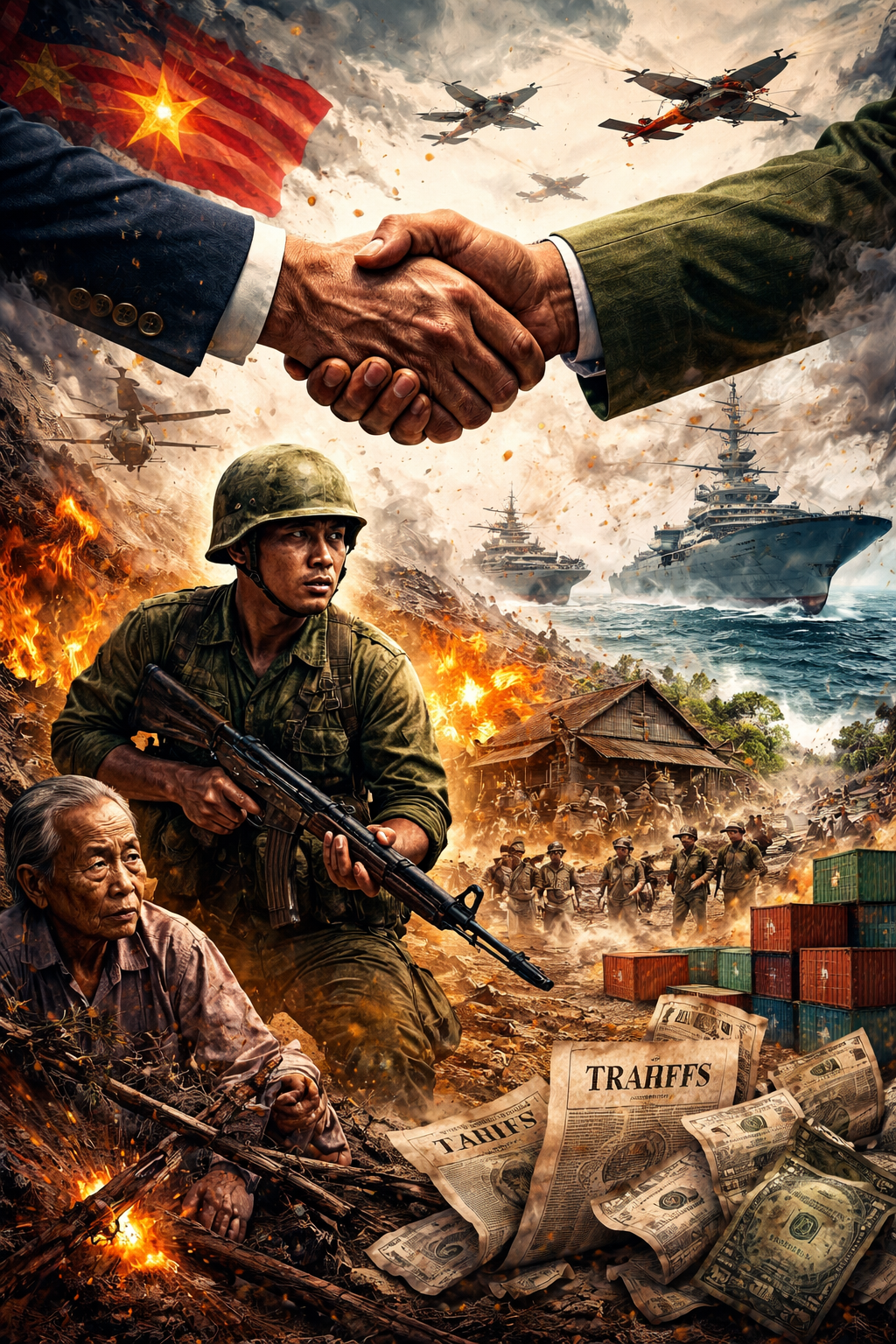
Corporate media reframes a nation’s hard-earned vigilance as psychological insecurity, quietly teaching readers to distrust the survival instincts of a people who have already endured invasion and annihilation. The buried history of bombardment, chemical warfare, and economic leverage resurfaces to show that Hanoi’s caution grows from lived material reality, not ideological stubbornness. Behind the language of cooperation stands a global structure where trade, security ties, and diplomacy double as instruments of discipline, narrowing the space for true sovereignty. From that recognition flows a call for working-class solidarity across borders against the same imperial machinery that destabilizes nations abroad while extracting wealth and security from communities at home.
Prince Kapone | Weaponized Information | February 3, 2026
When Empire Decides What Your Fear Is Allowed to Mean
The story we are handed — “An internal document shows the Vietnamese military preparing for a possible American war” — arrives in the calm, measured voice of establishment journalism. No shouting, no obvious flag-waving, just the steady tone of professional reporting. We are told that behind closed doors, Vietnamese military planners consider the United States a potential aggressor. Public partnership, private suspicion. That contrast is the hook. But the real work of the article is not exposing contradiction — it is teaching us how to interpret it.
The internal document is presented almost like a confession. Its existence is treated as evidence of Vietnam’s true mindset, as though contingency planning were the same thing as ideological revelation. There is no pause to note that militaries everywhere prepare for worst-case scenarios, or that defense planning is built on imagining danger before it arrives. Instead, the article quietly steers us toward a psychological reading. Vietnam is not described as cautious or strategic. It is described as uneasy, insecure, worried. A practical military exercise is reframed as an emotional condition.
From there, the lens shifts from power to personality. We are walked through supposed tensions inside Vietnam’s leadership — conservatives versus reformers, military voices versus diplomatic ones. The story reads like internal office politics scaled up to the level of the state. What drops out of sight is any sustained attention to the larger forces shaping these debates. Structural realities fade into the background, and the focus lands instead on who feels what, and which faction is more comfortable or more anxious. Geopolitics becomes a matter of temperament.
To stabilize this interpretation, the article leans heavily on a familiar cast of interpreters: think-tank analysts, policy scholars, NGO researchers. Their function is not to challenge the framing but to normalize it. Through them, vigilance becomes “insecurity,” and historical memory is recast as an inability to move on. Their institutional authority stands in for argument. The message is subtle but consistent: the people qualified to define what constitutes reasonable fear are those positioned within the same policy world that produced the relationship being discussed.
Language does much of the quiet work. U.S. actions and intentions are described in the vocabulary of “partnership,” “stability,” and “shared interests.” Vietnamese concerns, by contrast, are associated with suspicion of “color revolutions,” fears of outside influence, and worries about regime security. One side speaks in universal values; the other is portrayed as preoccupied with internal threats. The hierarchy of legitimacy is built into the word choice. One set of motives sounds principled, the other sounds defensive.
Then there are the silences. We hear from officials, analysts, and institutions, but not from workers, farmers, veterans, or ordinary Vietnamese people whose lives would be shaped by war, sanctions, or security agreements. Vietnam appears as ministries and factions, not as a society. The human terrain is replaced with an abstract political landscape. This absence helps keep the discussion at the level of strategy and psychology rather than lived experience.
By the end, something decisive has happened without ever being stated outright. The possibility that Vietnam’s planning could be a rational response to material conditions has been edged out of the frame. Instead, readers are guided toward a softer conclusion: this is a story about mistrust, nerves, and lingering anxiety. The United States remains largely external to the problem, positioned as a partner whose intentions are implicitly reasonable. When empire decides what your fear is allowed to mean, it doesn’t need to argue loudly. It only needs to narrate calmly — and let tone do the political work.
What the Article Tells You — and What It Carefully Leaves Out
The ABC/AP piece hangs its story on an internal Vietnamese defense planning document from August 2024. It presents this as evidence that Vietnam’s military is preparing for a possible future U.S. “war of aggression,” while also noting that Vietnamese planners judged the immediate risk of war to be low. It adds that officials in Hanoi are deeply concerned about externally backed “color revolution” scenarios — uprisings they believe foreign powers could exploit. All of this is framed as puzzling, even contradictory, because in 2023 Washington and Hanoi upgraded their relationship to a Comprehensive Strategic Partnership. The article suggests the tension can be explained by internal divisions inside Vietnam’s leadership.
What readers are not given is the material history that makes this kind of planning entirely intelligible. Vietnam did not wake up one morning and decide to be suspicious. It lived through decades of direct foreign military intervention, culminating in the war with the United States that ended in 1975. That war did not just rearrange diplomatic relations — it killed millions, shattered cities and villages, and tore through the country’s land and water. Historical estimates place Vietnamese civilian deaths in the millions, with vast additional losses among combatants, and the scale of destruction permanently shaped the country’s institutions and worldview. Strategic memory in Vietnam is not ideology; it is lived experience carried in family histories, local cemeteries, and state planning doctrines.
One of the war’s most enduring legacies is not buried in the past — it is still in people’s bodies and in the soil. The United States military’s spraying of defoliants like Agent Orange exposed large parts of the population and environment to toxic dioxin. Vietnamese official sources estimate that millions were exposed and that millions continue to suffer the health consequences decades later. Cleanup of contaminated land, removal of unexploded bombs, and care for affected communities are still ongoing. These efforts often rely on foreign funding and technical cooperation, and they become uncertain whenever U.S. policy priorities shift. For ordinary Vietnamese, “partnership” is measured not in press releases but in whether poisoned soil is actually cleaned and whether bombs are removed from fields.
The article also treats Vietnam as if it were a single mind, when even its own reporting admits there are internal differences over how far and how fast to align with Washington. These debates unfold within a hard economic reality: Vietnam is deeply tied to both major powers. China is its largest two-way trade partner, while the United States is one of its largest export markets. That dual dependence creates pressure from both directions. In such a situation, hedging, caution, and contingency planning are not symptoms of neurosis — they are standard tools of survival for a mid-sized country navigating between giants.
The piece also sidesteps the economic dimension of pressure that forms the backdrop to Vietnam’s contingency planning. In recent years, Vietnam itself has been subjected to escalating U.S. tariff threats and trade pressure framed in economic terms but deeply entangled with geopolitical alignment. These measures signal that access to the U.S. market can be conditioned on political positioning, not simply trade balances. This pattern is not unique to Vietnam. Analysts have described how the Trump administration has transformed tariffs into instruments of coercive statecraft, extracting strategic and economic concessions from partner countries in ways that resemble tribute more than reciprocal trade (analysis of Trump’s tariff regime as coercive geopolitical leverage). Reporting in The Guardian similarly notes that tariffs are increasingly being used as political weapons, replacing traditional diplomacy and pressuring states to align with U.S. foreign policy priorities rather than simply negotiate trade terms (analysis of tariffs supplanting diplomacy in U.S. statecraft). This coercive logic has extended into explicit attempts to shape other nations’ sovereign foreign policy decisions, as seen when President Trump threatened tariffs on any country that supplied oil to Cuba, a move widely understood as pressure on states such as Mexico to conform to Washington’s geopolitical stance (PBS reporting on tariff threats tied to Cuba oil shipments). In this environment, economic interdependence no longer appears neutral from Hanoi’s perspective. It looks like a channel through which political discipline can be applied — a reality that makes military and strategic contingency planning less a matter of ideology and more a response to a world where economic tools are routinely weaponized.
Nor does the article situate Vietnam’s planning against the backdrop of recent U.S. military behavior. According to a detailed review by the Council on Foreign Relations, the Trump administration’s second term has included expanded use of military force across multiple regions: direct strikes on Iranian nuclear facilities, missile attacks on Nigeria, intensified operations in Somalia and Yemen, continued strikes in Iraq and Syria, and a dramatic military operation in Venezuela that resulted in the kidnapping of that country’s president. Whatever language is used in diplomatic communiqués, cross-border force remains an active instrument of U.S. policy.
Finally, the soft language of “partnership” sits inside a harder strategic frame that treats Southeast Asia not as a community of sovereign nations with their own development priorities, but as terrain to be organized for U.S. primacy. In Washington’s own military testimony on Indo-Pacific posture, the region is narrated through the lens of “the balance of power,” China’s “coercive activity” in the South China Sea and toward the Philippines, the operational geography of the “First Island Chain,” and the U.S. “network of alliances and partners” as America’s strategic “center of gravity.” That is not neutral diplomacy; it is a blueprint for alignment, where cooperation is measured by how tightly a country can be stitched into an anti-China perimeter. The same logic appears in U.S. strategic documents that define security in the Indo-Pacific around strengthening deterrence and shaping the environment against a “pacing threat”. And when the economic screws are turned—through tariff regimes that hit export-dependent states like Vietnam with punitive rates—“partnership” starts to look less like mutual respect and more like conditional access under threat, the kind of leverage that disciplines sovereign policy choices by making livelihoods hostage to Washington’s demands. For Vietnam, then, the handshake comes with a map and a ledger: a security architecture that narrows strategic autonomy, and an economic architecture that can be weaponized the moment autonomy is exercised.
When these missing elements are placed back into the picture — the scale of past war and its lingering wounds, the ongoing struggle over war legacies, the internal debates shaped by economic dependence, the use of tariffs as political leverage, and the continued global reach of U.S. military force — Vietnam’s contingency planning no longer looks like a mystery. It looks like a historically grounded response to a world where power has repeatedly arrived by ship, plane, and decree. The next section turns from these facts to the wider system that keeps producing them.
Why This Keeps Happening: Power, Memory, and the Structure of Empire
When you lay the facts side by side, the story stops being about Vietnamese “insecurity” and starts being about the structure of the world Vietnam is forced to live in. A country that survived colonization, invasion, carpet bombing, chemical warfare, embargo, and isolation is now told that preparing for worst-case scenarios is a sign of paranoia. But the record we just reviewed tells a different story: a world order in which military force, economic coercion, and strategic encirclement are not relics of the past — they are routine instruments of power.
Vietnam’s planners do not operate in a vacuum. They operate in a system where the most powerful state on earth maintains hundreds of overseas bases, uses sanctions and tariffs as levers of political pressure, and has recently demonstrated a willingness to conduct cross-border military operations against sovereign governments. In such a system, “partnership” and “pressure” are not opposites; they are tools used at different moments to achieve the same strategic end: keeping the global balance of power tilted in one direction.
The contradiction at the heart of the ABC/AP narrative is not inside Vietnam — it is inside the global order itself. On one hand, smaller and mid-sized nations are encouraged to integrate into global trade, attract foreign investment, and participate in security cooperation frameworks. On the other, those same channels of integration can be turned into chokepoints: tariffs become threats, supply chains become leverage, and security ties become expectations of alignment. The same system that offers opportunity also builds dependency, and dependency always carries the shadow of discipline.
This is why memory matters. For a country like Vietnam, the past is not a museum exhibit; it is a strategic lesson written in burned villages and poisoned soil. When foreign military power once came to dictate the country’s political future, the cost was measured in millions of lives and generations of environmental damage. That experience does not vanish when diplomatic ties are normalized. It becomes part of how risk is calculated, how alliances are weighed, and how autonomy is defended. What outside observers call suspicion, those who have lived through invasion recognize as caution shaped by history.
The same pattern shows up in the economic realm. Trade tools that are presented as neutral market instruments can be deployed as mechanisms of political compulsion. When tariffs are tied to demands about migration, security policy, or diplomatic alignment, they cease to be about price and become about power. For countries navigating between larger rivals, this creates a landscape in which economic interdependence is both a source of growth and a potential instrument of pressure. Planning for disruption in such an environment is not alarmism; it is basic statecraft.
None of this means Vietnam is locked into a single path. The country is not a chess piece; it is a society with internal debates, competing visions, and active political forces. Some currents within its leadership see deeper alignment with Western capital and security frameworks as the road to stability and development. Others insist that sovereignty requires maintaining distance, diversifying partnerships, and guarding political autonomy even at economic cost. These debates are not signs of collapse — they are signs of a nation negotiating its place in a world where the rules are written by those with the greatest capacity to bend them.
From the standpoint of ordinary people — workers in factories, farmers in delta provinces, families still living with the health effects of war — the stakes of these strategic choices are not abstract. Military escalation, economic sanctions, and great-power confrontation do not land on the desks of diplomats; they land in workplaces, markets, and homes. When powerful states frame their global actions as maintaining order, those on the receiving end often experience that order as constraint, uncertainty, and vulnerability.
The ABC/AP story treats Vietnam’s planning as an oddity within an otherwise stable system. But the broader record shows a system defined by uneven power, recurring intervention, and the constant risk that smaller states will be pressured to sacrifice autonomy in exchange for access. Seen from this angle, Vietnam’s defensive calculations are not deviations from normality — they are responses to a normality built on hierarchy.
The real question, then, is not why Vietnam plans for danger. The real question is why a global order that repeatedly produces war, coercion, and instability is still described as a neutral backdrop. Until that structure is named and understood, every act of caution by a formerly colonized nation will be misread as fear, and every assertion of sovereignty will be treated as a problem rather than a right.
From Understanding to Solidarity: What This Means for Us
Once we strip away the propaganda varnish, what we are left with is not a story about one country’s “insecurities,” but about a global pattern that touches working people everywhere. When powerful states normalize military intervention, economic coercion, and political pressure as tools of foreign policy, smaller nations are forced into defensive postures — and ordinary people, both there and here, pay the price. The bombs fall abroad, but the costs also show up at home in the form of militarized budgets, gutted social programs, and an economy bent toward war rather than human need.
Solidarity begins with recognizing that the same structures squeezing Vietnamese sovereignty are tied to the pressures workers face in the imperial core. Trade wars framed as national defense often lead to higher prices, job instability, and scapegoating of migrants and foreign workers. Military escalation justified as “security” drains public wealth into weapons contractors while schools, healthcare, and housing remain underfunded. When we oppose intervention and coercion abroad, we are also defending our own communities from the domestic fallout of empire’s priorities.
There are already people organizing around these contradictions. Veterans’ groups speaking out against endless wars, anti-war coalitions demanding cuts to military spending, and environmental justice campaigns linking toxic legacies of war to ongoing health crises all form part of this landscape. Efforts to address the lingering damage from chemical warfare in Vietnam, including advocacy around Agent Orange victims and unexploded ordnance cleanup, remind us that war does not end when the shooting stops. Supporting these struggles is not charity; it is a commitment to repair and accountability.
Labor movements also have a role to play. When tariffs and sanctions are used as political weapons, they often trigger layoffs, supply shocks, and instability that fall hardest on workers. Building ties between unions and worker organizations across borders can help counter the narrative that workers in different countries are enemies. The real divide is not between Vietnamese workers and American workers, but between those whose labor sustains society and those who profit from division and militarization.
Political education is another front of struggle. Media narratives that frame defensive planning by smaller nations as paranoia rely on public ignorance about history and power. Study groups, teach-ins, and community forums that connect past wars, present policies, and everyday economic realities help people see the pattern. When we understand that intervention abroad and austerity at home are linked, resistance stops being a single-issue effort and becomes a broader movement for a different set of priorities.
None of this requires romanticizing any government or ignoring internal problems within other countries. Solidarity is not about endorsing every policy of another state; it is about defending the principle that people have the right to determine their own future without external coercion. That principle protects workers, farmers, and communities far more than it protects elites. When sovereignty is weakened through force or pressure, it is ordinary people who lose the most control over their lives.
The world we are moving through is unstable, not because smaller nations are cautious, but because the dominant powers refuse to accept limits. In that environment, the task for working people is not to cheer from the sidelines of great-power rivalry, but to build connections across borders that challenge the logic of domination itself. Peace, dignity, and genuine development are not gifts handed down from above; they are outcomes people organize for together.
Understanding the structure of power is the first step. Acting in solidarity with those navigating its pressures is the next. That is how analysis becomes movement, and how memory of past destruction can be turned into a force for a more just and stable world.
 Weaponized Information
Leave a comment