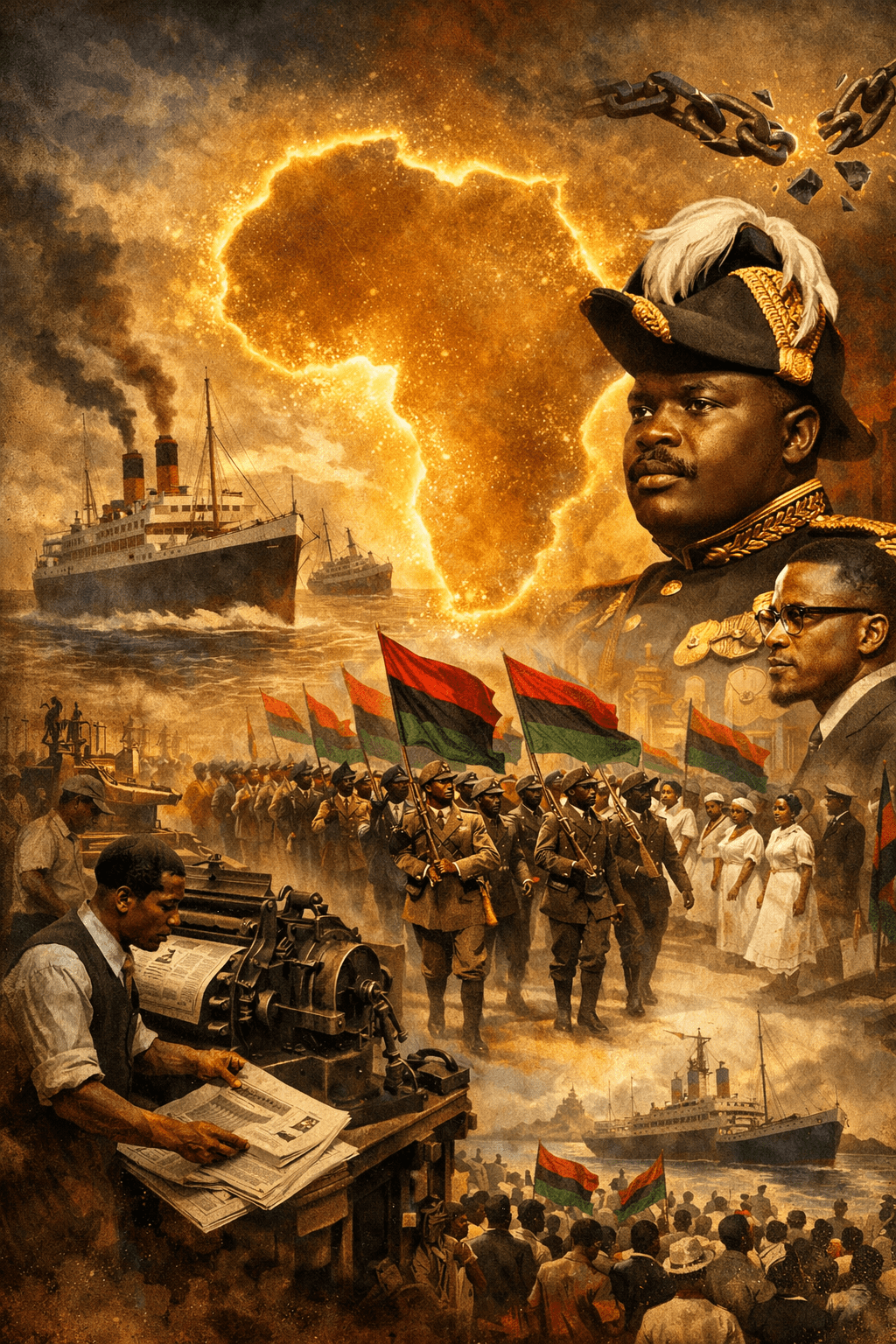
He turned a scattered people into a political community with a shared destiny. He transformed Black pride from sentiment into organized power. His movement terrified empire because it operated beyond white control. His legacy still shapes Black radical and internationalist struggle today.
Prince Kapone | Weaponized Information | Black History Matters Series | February 2, 2026
When a People Remember Themselves, Empire Starts to Tremble
There is a reason the name Marcus Garvey still travels—quietly, stubbornly—through Black political memory like a drumbeat you can’t quite silence. The official storybook likes to reduce him to a costume: the uniforms, the parades, the slogans, the old photographs. But behind that pageantry was something far more dangerous than style. Garvey helped ignite the first modern global mass movement of African people, and he did it by attacking the most foundational weapon of colonial rule: the theft of identity.
Colonialism does not only take land and labor. It takes history. It takes the mirror from a people and replaces it with a distortion. It teaches the oppressed to see themselves through the eyes of their captors—to accept humiliation as natural, and dependence as maturity. That is why Garvey mattered. He did not begin with a plea to the conscience of the oppressor. He began with the rebuilding of Black self-recognition. He said, in essence: you are not a permanent underclass begging for admission into someone else’s house. You are a people, with a homeland, a history, and a right to self-determination.
This essay is not written to turn Garvey into a saint, and it is not written to flatten his politics into a harmless cultural celebration. It is written to understand him as a political figure produced by a global colonial system—and as a builder who taught millions to think in global terms. Garvey’s vision of Pan-Africanism did not emerge from abstract ideology. It emerged from a world where Africa had been carved up by European empires, where the Caribbean remained a plantation afterlife, and where Black people in the United States lived under the boot of Jim Crow. In that world, “Black unity” was not a slogan. It was a threat to the entire imperial order.
Garvey’s greatest contribution was to make Africa politically real again in the minds of a scattered people. At a time when Africa was portrayed as backward and Africans as sub-human, he insisted on the truth colonialism tried to bury: that Africa was a continent of civilizations, kingdoms, intellectual traditions, and human dignity. This was not historical trivia. It was psychological liberation with political consequences. If Black people were a people, then the colonial lie—that they were born to be ruled—collapsed. And when that lie collapses, the whole structure built on it begins to shake.
The central argument of this essay is simple. Marcus Garvey built a mass movement that turned Black pride into organized power, and the scale of that project made him intolerable to the colonial state. The system did not move against him because it suddenly discovered fraud in a world built on theft. It moved against him because he was building an independent Black political identity on a global scale—an identity that refused to beg for dignity and instead demanded the right to shape history. In the language of the oppressed, Garvey taught a people to stand up straight. In the language of empire, that was insurrection.
A World Carved by Empire and Stamped with White Supremacy
Marcus Garvey did not step into a neutral world waiting for ideas. He was born in 1887 into a global order already divided by empire, organized around extraction, and justified by racism dressed up as science. Africa had been partitioned like spoils of war at European conference tables. The Caribbean, where Garvey was raised in Jamaica, remained trapped in the afterlife of plantation economies, where the end of slavery had not meant the end of exploitation. Black labor still powered imperial wealth, only now under the banners of “free trade” and colonial administration.
In the United States, the situation was no less structured. Reconstruction had been violently overturned, and Jim Crow segregation ruled the South while racial exclusion defined the North in quieter but no less effective ways. Lynching functioned as social control. Disenfranchisement erased political voice. Industrial capitalism absorbed Black workers at the bottom of the labor hierarchy, where wages were lowest and conditions were harshest. Across the Atlantic world, Black people were present everywhere as labor, yet absent everywhere as power.
This global condition was held together by more than guns and laws. It was secured by ideology. European colonialism insisted that Africa had no history worth naming, no civilization worth respecting, and no political future worth imagining. Blackness was cast as deficiency, as backwardness, as permanent tutelage. These lies did more than insult—they disciplined. If a people can be convinced they come from nothing, they can be more easily convinced they deserve nothing. The psychological assault was as important as the economic one.
Garvey’s politics must be understood as a response to this entire structure. He was not merely reacting to prejudice or discrimination in one country. He was confronting a world system that linked Caribbean plantations, African colonies, and American ghettos into a single chain of exploitation. The same empires that claimed to bring civilization abroad enforced racial hierarchy at home. The same ideology that declared Africa “dark” justified Black poverty in the so-called New World. Garvey saw these connections clearly, long before the language of “globalization” became fashionable.
The key point is this: Garvey’s Pan-Africanism was not sentimental attachment to a distant homeland. It was political analysis. If Black people were oppressed across continents under related systems of rule, then their liberation could not be confined to local reforms. It required a global vision to match a global structure of domination. Garvey inherited a world carved by empire, and he responded by imagining a people that could no longer be divided by the borders empire had drawn.
Turning Africa from a Colonial Caricature into a Political Homeland
One of Marcus Garvey’s most radical acts did not involve a protest, a court case, or even a speech against a specific law. It involved redefining how millions of people understood themselves. In a world where Africa had been reduced to a punchline in colonial propaganda, Garvey insisted on something revolutionary: Africa was not a void. It was a homeland. It was history. It was civilization. And it belonged, politically and spiritually, to the people whose ancestors had been torn from it.
This might sound simple today, but in Garvey’s time it was explosive. European empires had spent generations portraying Africa as a land without culture, without order, without achievement. These lies did not stay overseas; they shaped how Black people in the Americas and the Caribbean were seen—and how many were taught to see themselves. If Africa was backward, then Blackness could be framed as a permanent lack. If Africa had no great past, then Black people could be denied a claim to a dignified future. Colonial ideology worked by severing memory.
Garvey attacked that severing directly. Through speeches, newspapers, pageantry, and relentless messaging, he reintroduced Africa as a place of ancient kingdoms, intellectual traditions, and human accomplishment. This was not about nostalgia. It was about political reorientation. If Black people were part of a global African nation, then their struggle was not simply for better treatment within colonial states. It was for self-determination as a people. Identity, in Garvey’s hands, became a political category, not just a cultural one.
By teaching that people of African descent everywhere were Africans, Garvey challenged the fragmentation colonialism had imposed. Slavery and empire had scattered African peoples across continents, breaking communities and isolating struggles. Garvey’s Pan-African vision reassembled that broken map in the realm of consciousness. He argued that the plantation worker in Jamaica, the sharecropper in Mississippi, and the laborer in West Africa were linked by more than skin color—they were linked by a shared history of dispossession and a shared interest in liberation.
This redefinition of Africa was Garvey’s most powerful weapon. It gave Black pride a geopolitical dimension. Pride was no longer just a feeling; it pointed toward a program: economic development, political sovereignty, and the rebuilding of a continent as a center of Black power. Whether every detail of that vision was practical was less important than the shift it created. Garvey turned Africa from a colonial caricature into a political horizon. Once that horizon existed in the minds of millions, the idea that Black people were destined only to be minorities in someone else’s nation became far less convincing.
When Black Pride Took Organizational Form and Filled the Streets
Ideas become dangerous when they organize. Marcus Garvey’s vision of a global African people did not remain in speeches or newspaper columns. It took institutional shape in the Universal Negro Improvement Association (UNIA), which grew into the largest mass movement of people of African descent in the early twentieth century. What made the UNIA remarkable was not only its size, but its structure. It was not a debating society or a loose circle of intellectuals. It was a disciplined, dues-paying organization with branches across the Americas, the Caribbean, Africa, and beyond.
The UNIA built more than rhetoric; it built presence. Its parades filled city streets with uniforms, banners, and music, making Black political visibility unavoidable. Its newspaper, The Negro World, circulated globally, carrying news, analysis, and pride into homes that had rarely seen themselves reflected with dignity. The organization promoted businesses, factories, and commercial ventures, most famously the Black Star Line, an attempt to create independent shipping and economic networks. Whether every enterprise succeeded was secondary to the larger achievement: the demonstration that Black people could imagine and attempt economic life outside direct white control.
This scale of organization unsettled colonial authorities for a simple reason. The UNIA operated outside the usual channels through which Black leadership was managed and contained. It did not rely on white philanthropy, and it did not seek legitimacy primarily from liberal approval. Its legitimacy came from mass participation. Working people—porters, domestics, laborers, farmers—saw themselves not as scattered minorities but as members of a global movement. That shift from isolation to collective identity changed the psychological balance of power.
The UNIA’s pageantry, often mocked by critics, served a strategic purpose. Uniforms, titles, and ceremonies were tools for building discipline and dignity in communities long taught to feel inferior. Where the dominant society used spectacle to glorify empire, Garvey used it to glorify Black nationhood. The message was unmistakable: Black people could see themselves as a people with institutions, leadership, and a destiny that did not depend on permission from their former masters.
By transforming pride into organization, the UNIA crossed a line that empire could not ignore. A proud individual can be dismissed. A proud, organized mass movement is a different matter. It can coordinate, mobilize, and potentially challenge existing power structures. The UNIA showed that millions were ready to move in that direction. That realization—that Black unity could be institutional, international, and independent—was what made Garvey more than a charismatic figure. It made him a political problem for the colonial world.
Begging for Inclusion or Building Power: The Political Divide of the Era
Marcus Garvey’s rise did not occur in a political vacuum. He entered a landscape where many Black leaders were pursuing a different strategy—one centered on integration into existing Western societies through legal reform, moral appeal, and gradual advancement. This approach sought to prove Black worthiness within the framework of nations that had been built on Black exploitation. Its hope was that equal rights, once granted on paper, would eventually translate into equal conditions in life. For Garvey, this was a fragile foundation. Rights without power, he argued, could be withdrawn, ignored, or undermined whenever the balance of force demanded it.
Garvey’s position was sharper. He did not deny the importance of legal struggles, but he rejected the idea that dignity could be secured primarily by convincing former oppressors to change their hearts. His focus was not on acceptance but on autonomy. He urged Black people to think of themselves as a nation dispersed by history but united by destiny. Instead of appealing upward for recognition, he called for building inward strength—economic, cultural, and political—so that Black people could stand on their own foundation. This was a shift from dependency politics to self-determination.
The difference between these approaches was not merely tactical; it reflected contrasting understandings of power. Integrationist strategies often assumed that the structures of Western democracy, if corrected and purified, could deliver justice. Garvey questioned that premise. He saw those same structures as deeply entangled with colonial exploitation and racial hierarchy. To seek full belonging inside them without building independent capacity risked permanent subordination. For him, equality that depended on the goodwill of those who held power was equality on borrowed time.
This divergence produced tension within Black political life. Garvey’s mass appeal among working people was sometimes met with skepticism or hostility from more established Black elites who feared confrontation with white authority or doubted the feasibility of Garvey’s global vision. Yet Garvey’s popularity revealed a reality that could not be ignored: large numbers of ordinary Black people were tired of waiting for gradual acceptance. They were drawn to a message that treated them not as a problem to be solved, but as a people capable of shaping their own future.
In this sense, Garveyism represented a turning point. It reframed the central question from “How do we fit into their system?” to “How do we build power of our own?” That shift would echo through later movements, influencing currents that emphasized nationalism, cultural pride, and political autonomy. Whether embraced fully or modified in practice, the break Garvey articulated—between pleading for inclusion and organizing for self-determination—became one of the enduring fault lines in modern Black political thought.
When Black Unity Became a Crime in the Eyes of the State
Marcus Garvey’s fall from public prominence is often told as a cautionary tale about business failure or personal ambition. That version is convenient for the powerful because it hides the political core of what happened. The truth is simpler and more revealing: Garvey became a target because he built a mass Black movement that operated outside white control and imagined a future beyond colonial dependency. The Universal Negro Improvement Association (UNIA) had grown too large, too international, and too independent to be tolerated.
U.S. authorities, including the young J. Edgar Hoover, saw Garvey as a dangerous figure not because he commanded an army, but because he commanded loyalty and imagination. The UNIA’s ability to mobilize millions, publish a global newspaper, and promote economic self-reliance represented a form of power that did not pass through the usual channels of supervision. Black people were organizing themselves at scale, without seeking approval from the institutions that claimed to manage them. From the perspective of the state, this was not uplift—it was insubordination.
The legal mechanism used to remove Garvey from the stage was a mail fraud conviction tied to the Black Star Line, the shipping venture that symbolized Garvey’s push for economic independence. There were certainly administrative problems and mismanagement within the enterprise, but in a society built on corporate corruption and financial manipulation, it was selective outrage that landed Garvey in prison. The charge functioned less as a neutral enforcement of law and more as a political tool. It allowed the state to present repression as routine justice while dismantling a movement that challenged the racial order.
Garvey’s imprisonment and subsequent deportation in 1927 weakened the UNIA’s organizational strength and fragmented its international network. Yet the repression revealed as much as it suppressed. It showed that when Black political organization reached a certain scale, it would be met with coordinated state intervention. Surveillance, infiltration, and prosecution were not new inventions; they were early forms of a counterintelligence playbook later used against other Black movements. Garvey’s case stands as one of the first major examples of the U.S. government treating Black mass politics as a security threat.
In the end, the state did not defeat Garvey’s ideas; it disrupted his structure. The psychological and political seeds he planted could not be imprisoned or deported. They traveled through communities, families, and later movements, shaping the consciousness of future generations. The attempt to crush Garvey’s organization exposed a central truth of colonial societies: Black unity, when organized and self-directed, is viewed not as a civic contribution but as a danger to be contained.
Seeds That Outlived the Sower: Garvey’s Lineage in Black Radical and Left History
The repression of [“people”,”Marcus Garvey”,”pan-african leader”] did not erase him. It dispersed him. His organizational structure was battered, but the ideas he set in motion traveled through families, neighborhoods, churches, street corners, and political study groups. Garveyism became part of the underground current of Black political thought, surfacing again and again in new forms. Later movements would refine, revise, or even criticize Garvey, but they could not escape the terrain he had helped define: Black people as a global political community with a right to self-determination.
One of the clearest lines of continuity runs through [“people”,”Malcolm X”,”black liberation leader”]. Malcolm’s parents were Garveyites, and the language of Black pride, self-respect, and international consciousness was part of his upbringing long before he entered public life. When Malcolm later spoke of Africa, of global Black solidarity, and of the need for independence from white approval, he was extending a conversation Garvey had forced into the open decades earlier. The shift Malcolm made—grounding Black struggle in global anti-colonial movements—stands firmly on Garvey’s foundation.
Garvey’s influence also flowed into currents of the Black radical left that are often mistakenly portrayed as completely separate from Black nationalist traditions. Garvey openly expressed admiration for [“people”,”Vladimir Lenin”,”russian revolutionary leader”] and followed the Russian Revolution with interest, recognizing in it the overthrow of an empire and the assertion of self-determination by oppressed peoples. While Garvey was not a Marxist in the strict theoretical sense, his insistence that colonized and oppressed peoples had the right to control their own destiny placed him within a global anti-imperialist conversation that revolutionary socialists were also shaping. His movement demonstrated that mass political awakening among the colonized could destabilize imperial power at its roots.
This thread continues into the work of the [“organization”,”African People’s Socialist Party”,”revolutionary african org us”] and the leadership of [“people”,”Omali Yeshitela”,”african internationalism theorist”]. The APSP’s theory of African Internationalism argues that African people worldwide constitute a single oppressed nation whose liberation is central to overturning the global imperialist system. This perspective echoes Garvey’s central insight: that African people, though dispersed by slavery and colonialism, share a common historical condition and a common political struggle. Where Garvey built the largest mass movement of Black people in the early twentieth century, African Internationalism carries forward the principle that Black self-determination is not a cultural question but a revolutionary one tied to the global class struggle.
Garvey’s legacy therefore lives not only in cultural nationalism or symbolic pride, but in revolutionary praxis that links Black liberation to the transformation of the world system itself. His work helped normalize the idea that African people could think and act as a people on a global scale. Later generations—whether influenced by Marxism, Pan-Africanism, or anti-colonial nationalism—have drawn from that breakthrough. Garvey did not provide a finished blueprint for liberation, but he helped open a historical pathway where Black identity, mass organization, and anti-imperialist struggle could converge. That pathway remains one of the main roads along which Black radical politics continues to travel.
What Garvey Teaches Us About Power, Pride, and Political Organization
Marcus Garvey’s life is not important because it flatters the past. It matters because it clarifies the present. The first lesson he offers is psychological but not merely emotional: people cannot fight effectively if they have been taught to despise themselves. Colonialism understood this, which is why it attacked African history and identity so relentlessly. Garvey understood it too. By restoring a sense of collective worth and historical depth, he helped create the mental conditions necessary for political struggle. Pride, in this sense, was not vanity—it was a precondition for resistance.
The second lesson concerns organization. Garvey did not limit himself to speeches or symbolic protest. Through the UNIA, he built institutions: newspapers, businesses, meeting halls, international chapters. These structures gave ordinary people a place to participate, to learn, and to act collectively. Movements that rely only on moments of outrage tend to rise and fall quickly. Movements that build durable institutions can outlast repression and leadership changes. Garvey’s example shows that mass politics requires infrastructure as much as inspiration.
A third lesson involves scale. Garvey thought globally because the system he opposed operated globally. He refused to treat the struggles of African Americans, Caribbean workers, and colonized Africans as separate stories. Today, when economic exploitation and political domination also cross borders, that perspective remains relevant. Local battles matter, but without a broader understanding of how they connect, movements risk fighting the symptoms while the structure adapts. Garvey’s Pan-Africanism reminds us that liberation cannot be fully achieved within the narrow limits drawn by empire.
There is also a lesson about repression. Garvey’s downfall illustrates that when Black organization grows large and independent enough, it will be treated as a threat. The charges used against him were legal in form but political in function. This pattern has repeated across generations. Recognizing it does not mean abandoning struggle; it means preparing for the ways power defends itself. Movements must develop strategies that assume resistance from the state rather than surprise at it.
Finally, Garvey teaches that self-determination is not an abstract slogan but a practical orientation. It asks: who controls resources, institutions, and narratives? Who sets priorities? Who defines the future? For Garvey, dignity came from the ability of Black people to answer those questions for themselves, not from inclusion on someone else’s terms. That principle continues to resonate wherever communities confront systems that offer representation without power. His legacy challenges us to measure progress not only by visibility, but by control over the conditions of life.
The Man Who Taught a Scattered People to See Themselves as a Nation
The significance of [“people”,”Marcus Garvey”,”pan-african leader”] does not lie in nostalgia, pageantry, or the romance of a bygone era. It lies in the political transformation he set in motion. Garvey helped millions of people of African descent shift from seeing themselves as isolated minorities within hostile societies to understanding themselves as part of a global people with a shared history and a shared claim to the future. That shift in consciousness was not symbolic—it was structural. It changed how Black struggle could be imagined and organized.
Through the [“organization”,”Universal Negro Improvement Association”,”garvey movement org”], Garvey demonstrated that Black pride could move beyond sentiment and take institutional form. Newspapers, businesses, meetings, and international networks turned identity into organization and organization into power. Even where his projects fell short or encountered limits, the example remained: Black people could attempt large-scale, self-directed political and economic activity. They did not have to wait for permission to build.
Empire feared Garvey not because he preached hatred, but because he preached Black nationhood. A population that sees itself as a people with a destiny cannot be managed as easily as a population taught to compete for scraps. Garvey’s repression revealed how threatening that idea was to a world order built on racial hierarchy and colonial control. His removal from the center of the stage did not end the drama; it simply changed its form. The ideas he helped popularize resurfaced in later movements, in different languages and strategies, but with the same underlying insistence on dignity through self-determination.
Remembering Garvey, then, is not about repeating every detail of his program. It is about preserving the breakthrough he represented. He helped a scattered people remember themselves as historical actors, not historical accidents. He turned pride into a political force and identity into a collective project. That transformation remains unfinished, but it remains necessary. Garvey did not simply tell Black people to be proud—he gave them a framework in which pride could become organization, and organization could become struggle. In a world still structured by inequality, that lesson has not expired.
 Weaponized Information
Leave a comment