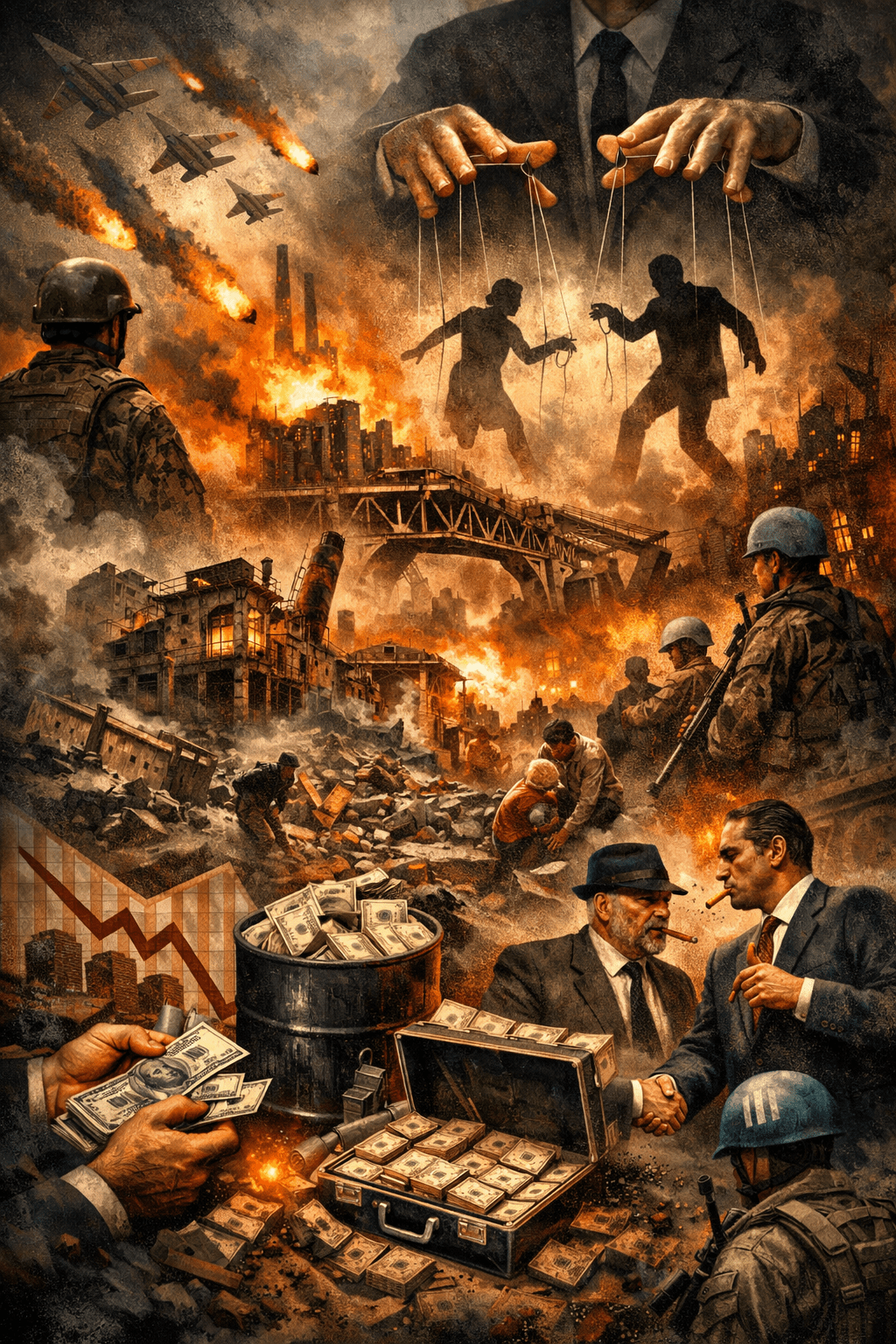
This review reads Michael Parenti’s To Kill a Nation as a field manual for modern empire, tracing how Yugoslavia was destroyed not by accident or ancient hatred but through a disciplined sequence of epistemological warfare, economic siege, political fragmentation, demonization, humanitarian pretext, and infrastructural annihilation, culminating in privatization, permanent dependency, and historical amnesia. By following Parenti’s analysis from media manipulation to postwar market discipline, the essay shows Yugoslavia as an early rehearsal for contemporary hyper-imperialism—one whose methods now reappear in sanctions regimes, regime-change operations, and coercive diplomacy from Eastern Europe to Latin America—making this book indispensable for understanding the U.S. assault on Venezuelan sovereignty and the wider consolidation of the American Pole.
By Prince Kapone | Weaponized Information | Weaponized Intellects Book Review | February 1, 2026
Credibility Is a Battlefield
Michael Parenti opens To Kill a Nation by refusing the ritual question liberalism always asks when empire goes to work: “who’s lying?” as if the answer is a matter of personal ethics, competing “narratives,” and which anchor looks more sincere on camera. He drags the problem back to earth. The real question is not whether the Western press is “free and independent,” but who owns it, what interests it serves, and what kind of world it is paid to make feel inevitable. He is blunt: the dominant media in the West is “owned and controlled by largely conservative corporate cartels” that adhere to the neoliberal ideology of finance capital, and that media rarely questions the underlying premises of war—only the operational trivia, like whether the bombs are “effective” or whether the refugee crisis is “under control.” This is not just commentary; it’s the opening move in a political education. If the people are trained to debate tactics while the rulers decide goals, then the rulers can commit murder with public consent and call it “values.”
From there Parenti sharpens the knife: the respectable public gets offended when you say leaders lie, especially in foreign policy—because admitting it would mean admitting you live inside a managed reality. But Parenti insists the lie is not a scandal; it is a governing technique. He says US presidents “never lie so much as when they talk about US foreign policy,” and he calls Clinton, in his public stances on Yugoslavia, a “professional liar.” He tells us to watch how power manipulates “images and labels” to “short-circuit our critical thinking” and make evidence itself irrelevant—then he delivers the hard lesson: “liars can be the best witnesses against themselves.” This is the method of the whole book: don’t beg empire for honesty; force it to convict itself with its own contradictions, its own actions, its own buried admissions. And he frames it as duty, not academic sport: the public has not been told “the whole story” of the attack on Yugoslavia, and getting closer to the truth is “the first duty of a democratic citizenry”—owed not only to ourselves, but to “the various nations still targeted by the Western militarists and free-marketeers.”
Parenti starts with the blunt material record: from March 24 to June 10, 1999, NATO launched “round-the-clock aerial attacks” on Yugoslavia, dropping “twenty thousand tons of bombs” and killing “upwards of three thousand” people, “women, children, and men”—all “out of humanitarian concern for Albanians in Kosovo,” or so we were told. He then widens the frame so the “exception” collapses into pattern: in that same short period Clinton bombed four countries—Sudan, Afghanistan, Iraq, Yugoslavia—while the US national security state ran proxy wars elsewhere and maintained roughly “three hundred major overseas bases,” always narrated as peace, democracy, security, and humanitarianism. The point is not that the empire is “inconsistent.” The point is that it is consistent in the only way that matters: it is consistent in power.
Parenti then does what bourgeois commentators never do: he tests the claim against the world. If humanitarianism were the motive, why the “markedly selective” interventions? Why no “humanitarian bombings” against the perpetrators and patrons of mass slaughter in places like Rwanda, Guatemala, or East Timor? Why no moves against Britain’s repression in Northern Ireland, or against the Czech mistreatment of the Roma? And he pushes deeper: in “most cases,” he argues, Washington not only tolerated atrocities but was “actively complicit,” often with regimes that were recipients of US aid and trade. This is the first major contradiction the book forces onto the table: humanitarian language is not the cause of war; it is the alibi that lets war pass through the moral checkpoint. Once you see that, you stop asking whether Yugoslavia was a “mistake,” and you begin asking the only question that threatens empire: what interests required this lie, and what kind of world order was being enforced by the bombs?
The Economic Siege That Preceded the Bombs
Having dismantled the moral alibi of “humanitarian intervention,” Parenti refuses to let the war be treated as an isolated eruption of violence. He pulls the reader backward in time and downward into political economy, insisting that the destruction of Yugoslavia did not begin in March 1999 with NATO aircraft, but years earlier through international finance. What Western officials later described as a sudden collapse into chaos was, in fact, the cumulative outcome of policies imposed under the banner of reform. By the early 1980s, Yugoslavia’s foreign debt had ballooned from roughly two billion dollars in 1966 to more than twenty billion dollars, placing the country firmly under the supervision of the International Monetary Fund and the World Bank. From that moment forward, economic life was no longer governed primarily by social need or domestic planning, but by the repayment schedules and conditionalities of foreign creditors.
Parenti details what those conditions meant in practice. IMF “stabilization” programs demanded wage freezes, deep cuts to public spending, reductions in social services, and the dismantling of state-owned enterprises. Credit was tightened, investment dried up, and unemployment surged. These were not side effects; they were the mechanism. Parenti emphasizes that Yugoslavia had been a society with extensive public ownership, guaranteed employment, and broad social provision. The shock imposed by austerity therefore did not merely slow growth—it tore at the foundations of everyday life. As living standards fell and regional inequalities widened, the federal state’s capacity to manage economic and political tensions eroded. What the West would later label “institutional weakness” was produced, step by step, through externally enforced deprivation.
It is here that Parenti introduces what he calls the “Third Worldization” of Yugoslavia, and he is precise about the term’s meaning. This was not a metaphor, but a description of position within the global system. Yugoslavia was being pushed out of the category of a semi-autonomous socialist society and into that of a dependent debtor nation—subject to capital flight, speculative pressure, and external supervision. Parenti notes that the social consequences were entirely predictable: as jobs disappeared and public guarantees collapsed, political legitimacy fractured along regional lines. Republic-level leaders increasingly sought solutions not through federal cooperation, but through alignment with Western institutions that promised loans, recognition, and relief—at a price. Economic discipline thus became political leverage.
Against this backdrop, Parenti dismantles the media cliché of “ancient ethnic hatreds.” He insists that nationalism did not explode because Yugoslavia was multiethnic, but because austerity destroyed the material basis of solidarity. The federation had functioned for decades with diverse populations precisely because social ownership and redistribution mitigated regional competition. Once those mechanisms were stripped away, scarcity intensified political rivalry. Western governments then treated the resulting tensions as evidence of inherent Balkan irrationality, rather than as symptoms of an economic siege they had helped impose. Cause was rewritten as character. Intervention was justified by conditions intervention itself had helped create.
By grounding the coming war in debt figures, policy mandates, and their social effects, Parenti advances the argument beyond questions of media distortion. The bombing of Yugoslavia was not a tragic overreaction to spontaneous violence; it was the culmination of a prolonged campaign that weakened the state, fragmented society, and prepared the terrain for open force. The fast war of missiles and humanitarian rhetoric could only proceed once the slow war of austerity and structural adjustment had done its work. With this economic groundwork laid bare, the analysis must now move forward again—from structural pressure to political strategy—to examine how these manufactured fractures were selectively encouraged, managed, and ultimately weaponized against the Yugoslav state itself.
From Economic Pressure to Political Fragmentation
Having demonstrated that Yugoslavia’s crisis was manufactured through debt, austerity, and externally imposed “reform,” Parenti now advances the analysis from economic pressure to political consequence. The social disintegration produced by IMF discipline did not remain an abstract condition; it reorganized power inside the federation. As federal revenues collapsed and unemployment deepened, the central state lost its ability to mediate between regions and classes. What followed was not an explosion of primordial loyalties, but a struggle over who would control what remained of political authority and material resources. Parenti insists that this moment is decisive: economic warfare does not simply weaken a society, it restructures the field on which political actors must operate.
In this newly constrained environment, republic-level elites began to pursue strategies that would have made little sense under conditions of social security and federal stability. Parenti shows how Slovenia and Croatia, the more developed republics, faced mounting incentives to detach themselves from a federation now burdened by debt and austerity. Secession increasingly appeared not as an act of liberation from oppression, but as an escape from redistribution. Crucially, Western institutions rewarded this orientation. Recognition, loans, and diplomatic legitimacy flowed toward leaders who embraced market reforms and distanced themselves from the socialist project. Political fragmentation was not merely tolerated by the West; it was selectively encouraged, structured by incentives that favored disintegration over cooperation.
Parenti is careful to underline that this was not a neutral process of “self-determination.” The West did not support all claims equally. It recognized some borders instantly while dismissing others as illegitimate. It framed some nationalisms as democratic awakenings and others as authoritarian threats. This asymmetry was not accidental. Once Yugoslavia’s economy was weakened, the next step was to dissolve its political coherence in ways compatible with Western strategic and economic interests. Fragmentation became policy. The federation’s collapse was not simply observed; it was managed through diplomatic recognition, conditional aid, and the constant moral signaling of international media.
At this stage in Parenti’s account, the narrative of “ethnic conflict” begins to function as an ideological shortcut. By reducing political struggles over resources, power, and external alignment to cultural animosity, Western commentators erased the role of economic restructuring and foreign intervention. Parenti stresses that this erasure served a purpose. If Yugoslavia could be portrayed as a society doomed by ancient hatreds, then the West’s own role in destabilizing it vanished from view. Structural adjustment disappeared from the story, replaced by caricatures of irrational Balkan violence. Politics was naturalized; responsibility was displaced.
What emerges in Parenti’s telling is a clear progression. First came economic strangulation. Then came political sorting, as elites recalibrated their strategies in response to scarcity and external reward. Finally came ideological reframing, which transformed these contingent struggles into timeless cultural pathologies. By the time Yugoslavia was publicly described as “ungovernable,” the conditions that made it so had already been engineered. This was not the collapse of a state that failed on its own terms; it was the controlled unravelling of a society whose continued existence no longer aligned with the priorities of empire. With the economic base shattered and the political field fragmented, the next phase became unavoidable: the elevation of some breakaways as legitimate and the criminalization of those who resisted the dismemberment of the state itself.
Recognition as a Weapon
Once political fragmentation was underway, Parenti shows that the decisive question was no longer whether Yugoslavia would hold together, but who would be rewarded for breaking it apart. This is where empire’s hand becomes unmistakable. Western governments did not sit back and neutrally observe the federation’s disintegration; they intervened through a powerful but rarely acknowledged instrument—diplomatic recognition. Parenti is explicit that recognition was not a legal formality or a gesture of respect for democratic will. It functioned as a weapon. Those who aligned themselves with Western economic and strategic priorities were elevated overnight as legitimate representatives of “new nations,” while those who resisted the dismantling of the federal state were marked as obstacles to peace.
Slovenia becomes Parenti’s first concrete illustration of this process. It was swiftly recognized, celebrated as reasonable, European, and pragmatic, and largely spared the moral hysteria later directed at other republics. This was not because Slovenia was uniquely virtuous, but because its leadership moved quickly to embrace market reforms and integration into Western economic structures. Recognition followed compliance. The message to the rest of Yugoslavia was unmistakable: sovereignty would be granted only to those willing to surrender it in advance. Self-determination was redefined to mean submission to the neoliberal order.
Croatia’s case sharpened the contradiction further. Parenti notes that Western governments rushed to recognize a state whose leadership rehabilitated reactionary symbols and tolerated ethnic exclusion, yet this was treated as an unfortunate but secondary concern. Democracy, we are reminded, was never the real criterion. Alignment was. The West demonstrated that it was willing to overlook repression, historical revisionism, and violence so long as the resulting state helped dissolve the socialist federation and open its economy to privatization. The moral vocabulary shifted effortlessly to accommodate the political objective.
Bosnia marked a qualitative escalation. Here recognition was coupled with international management. Parenti shows how Bosnia was transformed into a quasi-colonial protectorate, its sovereignty hollowed out under the guise of peacekeeping and humanitarian oversight. Political authority was no longer rooted in popular control or social reconstruction, but in externally imposed arrangements enforced by international administrators. This was not self-determination realized; it was self-determination suspended. The promise of independence became the reality of supervision.
Against this backdrop, the treatment of the Serbs—and especially of Republika Srpska—was not anomalous but structurally necessary. Parenti explains that once the rules of recognition were set, any force that insisted on preserving Yugoslavia’s territorial integrity or resisted externally dictated outcomes had to be delegitimized. Their political claims could not be debated; they had to be criminalized. Resistance to dismemberment was reframed as aggression. Defense of federal authority was recast as ethnic domination. By this point, the logic was locked in. Recognition had divided the political field into acceptable and unacceptable actors, and those on the wrong side of that line were being prepared, ideologically, for annihilation.
Parenti’s insight here is devastating in its simplicity. Empire does not always need to invade to destroy a state. Sometimes it only needs to decide which flags are allowed to fly and which voices are permitted to speak. Recognition, wielded selectively, can dissolve a country faster than artillery. With Yugoslavia now fractured into “good” breakaways and “bad” holdouts, the stage was set for the next and darker move: the transformation of political opposition into moral monstrosity, and the conversion of complex struggles over sovereignty into a crusade against absolute evil.
The Manufacture of the Enemy
With legitimacy allocated and withheld by external decree, Parenti shows that the next imperial task was psychological, not diplomatic. Political exclusion had to be completed by moral annihilation. The conflict could no longer appear as a struggle over sovereignty, resources, or external alignment; it had to be simplified into a confrontation between civilization and barbarism. This is where the language hardens, the tempo accelerates, and the media abandons even the pretense of inquiry. Parenti observes that Western reporters “seemed ready to believe anything” so long as it confirmed the assigned role of the Serbs as uniquely brutal, irrational, and historically predisposed to violence. Skepticism vanished. Proportionality disappeared. Explanation itself was treated as apology.
The mechanism Parenti dissects is not subtle. Atrocities are filtered asymmetrically. Violence committed by Western-backed forces is rendered incidental—“reprisal,” “spillover,” “chaos”—while violence attributed to Serbs is elevated into essence. One side’s crimes are individualized, contextualized, and quietly forgotten; the other’s are collectivized and eternalized. History is compressed into caricature. Complex political actors are flattened into moral archetypes. In this atmosphere, accusation no longer requires evidence; repetition performs the work of proof.
Parenti insists that this is not the byproduct of war reporting under pressure. It is the precondition for war itself. Demonization does a specific kind of labor: it forecloses causality. Once a people are defined as the problem, no inquiry into economic siege, diplomatic manipulation, or selective recognition is necessary. The slow violence that produced the conflict disappears from view, replaced by a story in which evil simply erupts. The public is no longer asked to understand; it is asked to consent. Bombs become instruments of moral hygiene.
What makes Parenti’s intervention especially sharp is his refusal to treat demonization as mere rhetoric. He shows how it reorganizes reality. Negotiation becomes appeasement. Self-defense becomes aggression. Any attempt to resist externally imposed outcomes is reclassified as proof of criminality. In this way, the ideological campaign does not merely accompany policy; it creates the conditions in which policy can proceed without restraint. Once an enemy is fully abstracted—once a people are transformed into a moral category rather than a political community—anything done to them can be framed as regrettable but necessary.
By the end of this phase, the transformation is complete. Yugoslavia is no longer a country undergoing externally intensified crisis. It is a stage upon which absolute evil performs. The enemy has been manufactured, stabilized, and circulated. With that work done, escalation no longer requires argument. It requires only a site where the abstraction can be anchored, localized, and dramatized. That site, Parenti shows, would soon be named Kosovo.
Kosovo and the Point of No Return
Once the enemy had been successfully manufactured, Parenti shows that the conflict required a final anchoring point—a place where abstraction could be turned into urgency, and moral theater into military inevitability. Kosovo became that hinge. It was not introduced to Western audiences as a continuation of the Yugoslav crisis, but as a rupture so extreme that all prior context could be discarded. Parenti is careful here. He does not deny that repression occurred, nor does he romanticize the Serbian state. What he does insist on is proportion, causality, and sequencing—precisely the elements that vanished from the official narrative once Kosovo was elevated into a symbol rather than examined as a concrete political struggle.
Parenti situates Kosovo within Yugoslavia’s long-standing internal tensions, noting that conflicts between Serbs and Albanians predated the 1990s and had periodically involved repression, resistance, and negotiated settlements. What changed in the late 1990s was not the existence of conflict, but its militarization and internationalization. The Kosovo Liberation Army, initially a marginal and violent separatist group, escalated its campaign through assassinations, ambushes, and attacks on police and civilians alike. Parenti underscores that this was not hidden at the time. Western governments themselves had previously designated the KLA as a terrorist organization. Yet this inconvenient fact was rapidly buried once Kosovo was selected as the moral fulcrum for intervention.
As violence intensified, Parenti shows how causality was deliberately inverted. KLA attacks were reframed as reactions rather than provocations. Serbian counterinsurgency operations—however brutal or indiscriminate—were stripped of political context and recast as evidence of genocidal intent. The dynamic of insurgency and response was erased, replaced by a one-directional story of state terror descending upon a passive civilian population. This narrative transformation was decisive. It converted a civil conflict with international dimensions into a humanitarian emergency demanding external force.
At the same time, Parenti tracks how the KLA’s image underwent a rapid rehabilitation. Once treated as extremists, its fighters were reborn in Western media as freedom fighters, resistance leaders, and representatives of popular will. Their funding sources, criminal ties, and role in escalating violence were quietly dropped from the story. What mattered was not who the KLA was, but what role it now served. It provided the ground force that NATO itself could not openly be, and the moral counterpart to air power. The war required a local proxy, and Kosovo supplied one.
By this point, Parenti makes clear, the trajectory was locked. Kosovo functioned as the point of no return because it fused demonization with immediacy. The enemy had been defined; now it was localized. The public no longer debated Yugoslavia’s future, the consequences of economic siege, or the legitimacy of secession. Everything narrowed to a single demand: something must be done, and it must be done now. With Kosovo elevated into an absolute moral crisis, the final barrier to open war collapsed. Diplomacy could proceed only as performance, because the decision to use force had already been made.
Diplomacy as Ambush
With Kosovo fixed in the Western imagination as an absolute moral emergency, Parenti shows that what followed was not a final effort to avoid war, but a carefully staged performance designed to legitimize it. The Rambouillet talks are presented to the public as a reasonable attempt at peace, tragically thwarted by Serbian intransigence. Parenti dismantles this story by doing something almost no mainstream account was willing to do at the time: he reads the terms. What he finds is not compromise, but coercion. The negotiations were structured so that refusal was not only predictable, but necessary.
Parenti emphasizes that the Rambouillet agreement went far beyond the question of autonomy for Kosovo. Buried within its provisions was a demand that NATO forces be granted unrestricted access to the entirety of Yugoslavia—its land, airspace, and infrastructure—along with immunity from Yugoslav law. This was not a peace proposal; it was an occupation ultimatum. No sovereign state, Parenti argues, could have accepted such terms without effectively dissolving itself. To do so would have meant surrendering not just authority over Kosovo, but authority altogether.
The ambush lay in the framing. When Yugoslavia rejected the agreement, Western leaders declared that diplomacy had failed and that force was the only remaining option. Parenti exposes the sleight of hand: diplomacy did not fail because compromise was impossible; it failed because compromise was never offered. The terms were designed to be rejected so that rejection itself could be weaponized as proof of barbarism. Law was transformed into a trap. Peace talks became a procedural box to be checked before unleashing war.
What makes Parenti’s analysis especially damning is his insistence that this was not an isolated maneuver, but a recognizable imperial technique. Ultimatums dressed as negotiations allow power to appear patient, reasonable, and reluctant, even as it closes off every avenue but violence. Once the weaker party refuses, the aggressor assumes the moral high ground. Bombing is no longer aggression; it is enforcement. The sequence is crucial. First comes demonization. Then comes the impossible demand. Only then does war appear as necessity.
By the time the Rambouillet talks collapsed, the outcome had already been scripted. Yugoslavia was condemned not for what it did, but for what it refused to become. The public was told that war was the tragic consequence of failed diplomacy, when in fact diplomacy had been engineered to fail. Parenti’s conclusion here is unambiguous and chilling: war was not the breakdown of negotiations. War was their purpose. With legality converted into justification and refusal converted into guilt, the stage was cleared for open violence to begin.
Precision Violence and the License to Kill
Once diplomacy had been publicly pronounced dead, Parenti shows how the war itself was introduced not as conquest, but as technique. NATO did not present its assault on Yugoslavia as destruction, but as management—“precision strikes,” “surgical bombing,” and “limited force” deployed in the service of humanity. Parenti punctures this language by cataloging what was actually targeted and what those targets meant for civilian life. Bridges, power plants, factories, water systems, television stations, passenger trains—these were not military accidents. They were the social infrastructure of a country, deliberately dismantled from the air. Precision did not mean restraint; it meant efficiency.
Parenti insists that the distinction between military and civilian targets collapses the moment a society’s basic systems are destroyed. Cutting electricity is not a tactical maneuver; it shuts down hospitals, water purification, food storage, and communication. Bombing factories is not symbolic pressure; it throws thousands out of work and cripples production. NATO spokespeople described these attacks as necessary to weaken the Serbian state, but Parenti exposes the sleight of hand. States do not exist apart from the people who live inside them. What was being weakened was not an abstract regime, but the material conditions of everyday life.
Here Parenti widens the frame again, refusing to let Yugoslavia be treated as an aberration. He places the bombing campaign within a long and familiar pattern of U.S. and NATO warfare: the systematic destruction of civilian infrastructure followed by claims of moral superiority and technical restraint. The rhetoric of precision functions as insulation. It allows mass violence to be discussed as engineering rather than killing, and civilian death to be dismissed as “collateral damage.” In this vocabulary, responsibility evaporates. Machines malfunction. Targets are misidentified. Tragedies occur without perpetrators.
The legal implications are no less damning. Parenti notes that NATO’s war violated international law at every decisive point—launched without UN authorization, justified retroactively, and shielded from accountability by the very powers that claimed to be enforcing global norms. The so-called “rules-based order” revealed itself as a hierarchy: rules for those without power, exemptions for those who wield it. Yugoslavia was not merely bombed; it was denied the right to appeal, to resist, or even to be judged by the standards imposed on others.
By the end of this phase, Parenti makes clear that the myth of clean war had done its job. The public debated tactics while the social fabric of a country was shredded. Precision became a moral credential, and immunity became a privilege of power. Those who defined the rules exempted themselves from them, and in doing so laid the groundwork for the next escalation. Once mass destruction can be carried out under the banner of legality and humanitarianism, the only remaining task is to ensure that the scale of violence is never questioned—only its justification endlessly repeated.
The Genocide Narrative as Escalator
With Yugoslavia already under bombardment, Parenti shows that the ideological work of war did not slow down—it accelerated. The function of the genocide narrative was not merely to justify the bombing after the fact, but to expand its scope and foreclose any remaining restraint. What began as a “humanitarian intervention” now required a far graver crime to sustain it. Thus genocide entered the script, not as a conclusion reached through investigation, but as an accusation deployed with strategic timing. Parenti is explicit: claims were inflated, evidence was selectively handled, and language was escalated precisely when NATO’s actions themselves were producing mass displacement and civilian suffering.
Parenti carefully unravels the causal inversion at the heart of this narrative. As NATO bombing intensified, hundreds of thousands of Kosovars fled their homes. Western officials and media immediately presented these refugees as victims of a premeditated Serbian campaign of ethnic cleansing, even when many refugees themselves reported that they were fleeing the air war. Cause and effect were reversed in real time. The bombing produced the refugee crisis, and the refugee crisis was then cited as proof that the bombing had been necessary all along. This circular logic insulated NATO from responsibility while transforming its consequences into moral evidence.
Numbers played a crucial role in this escalation. Parenti notes how early claims of tens of thousands, even hundreds of thousands, of murdered Kosovars circulated freely through the press, repeated without verification and treated as settled fact. These figures were not provisional; they were rhetorical. They established a scale of evil so vast that any skepticism appeared obscene. Yet when postwar investigations failed to substantiate these numbers, the narrative did not collapse. It simply moved on. The purpose of the genocide claim was never accuracy. It was momentum.
What Parenti insists upon—against enormous ideological pressure—is proportionality. He does not deny crimes, nor does he minimize suffering. He rejects, instead, the transformation of counterinsurgency violence into an extermination campaign by decree. By labeling the conflict genocide, Western leaders bypassed legal thresholds and moral hesitation alike. Genocide admits no negotiation, no ceasefire, no political context. It demands force, immediately and absolutely. In this way, the accusation functioned less as description than as authorization.
By the time the genocide narrative had fully taken hold, the war no longer required debate. Empirical scrutiny was dismissed as denial. Causality was treated as distraction. The humanitarian story no longer followed the violence; it outran it, clearing the path for continued destruction and preemptively absolving its authors. Parenti’s conclusion here is devastating: once atrocity language is severed from evidence and fused to power, it becomes a weapon in its own right—one capable of escalating war while claiming to prevent it. With that weapon deployed, the stage was set for the final inversion, where liberation itself would become the cover for a new round of cleansing.
Liberation That Cleanses
When NATO finally declared victory, Parenti shows that the moral logic of the war inverted itself almost instantly. The violence that had been framed as intolerable when attributed to Yugoslavia was suddenly rendered invisible once committed by Western-backed forces. Under NATO occupation, Kosovo did not enter an era of peace; it entered a new phase of sanctioned brutality. The Kosovo Liberation Army, now operating under the protective shadow of NATO troops, embarked on a campaign of expulsions, arson, and murder directed primarily against Serbs, Roma, and other minorities. Parenti is unsparing in his documentation. More than two hundred thousand Serbs were driven from Kosovo, hundreds were killed, and entire communities were erased—this time not in defiance of Western power, but under its supervision.
What makes this phase so revealing is not simply that atrocities occurred, but how they were explained away. Western officials described the violence as “revenge,” as if ethnic cleansing somehow ceased to be a crime once the perpetrators were aligned with empire. Parenti highlights reports from the United Nations and humanitarian agencies that described a “climate of violence and impunity,” including systematic looting, beatings, kidnappings, and killings carried out in full view of NATO peacekeepers. Yet these accounts rarely penetrated the dominant media narrative. Liberation had become a shield against scrutiny.
The fate of the Roma was particularly devastating, and Parenti insists that their erasure exposes the fraud at the heart of humanitarian war. Thousands of Roma homes were burned, entire neighborhoods destroyed, and families forced into exile or confinement in camps run by the very forces now celebrated as liberators. Their suffering could not be reconciled with the story NATO had told about itself, and so it was quietly sidelined. In Parenti’s telling, this silence is not accidental. The Roma had no strategic value, no lobby, no role in the new order being constructed. Their disposability revealed the true hierarchy of concern.
At this stage, Parenti’s argument reaches a moral breaking point. If the war had truly been fought to stop ethnic cleansing, then its continuation under occupation should have provoked outrage. Instead, it was met with indifference. This indifference, Parenti argues, is the clearest proof that humanitarianism was never the motive. What mattered was not the protection of civilians, but the installation of a compliant political arrangement. Once that goal was secured, violence ceased to be scandal and became background noise.
The postwar reality of Kosovo thus completes the inversion that began with demonization. Those once depicted as victims became perpetrators. Those once depicted as monsters were expelled or silenced. And those who claimed the authority to judge violence exempted themselves from its consequences. The war did not end ethnic cleansing; it reassigned who was allowed to carry it out. With this truth exposed, Parenti forces the reader to confront the deeper logic beneath the spectacle of liberation—one rooted not in morality, but in economic and political restructuring that would now proceed under the cover of peace.
Destroying a Society to Save the Market
With the moral spell of “liberation” broken, Parenti drives the analysis beneath the surface of events to the material logic that governed the war from the start. The bombing of Yugoslavia, he insists, was not simply punitive or symbolic; it was structurally purposeful. NATO did not target only military installations. It systematically dismantled the productive and social infrastructure that made Yugoslavia a functioning, sovereign society. Factories, refineries, power grids, bridges, transportation networks, and media facilities were struck again and again, not because they were incidental to war, but because they were essential to social reproduction. This was not collateral damage. It was strategy.
Parenti is explicit about what this kind of destruction accomplishes. When electricity is cut, hospitals fail, water systems collapse, and food distribution breaks down. When factories are bombed, tens of thousands lose their livelihoods overnight. When bridges and rail lines are destroyed, regional integration gives way to isolation and dependency. NATO framed these attacks as efforts to weaken the Serbian “regime,” but Parenti cuts through the abstraction. Regimes do not eat, work, or fall ill. People do. The war targeted the conditions that allow a population to sustain itself independently of foreign control.
This is where Parenti connects the air war to the earlier phase of economic siege. Structural adjustment had already weakened Yugoslavia’s economy; bombing finished the job. What debt and austerity could not fully dismantle, high explosives completed in weeks. The result was not simply devastation, but transformation. A society that had once maintained a large public sector, extensive social ownership, and relative independence from Western capital was reduced to rubble—physically and economically—making “reconstruction” under neoliberal terms appear not ideological, but inevitable.
Parenti situates this pattern within a broader imperial repertoire. Infrastructure destruction has long been a preferred method of disciplining resistant societies because it produces dependency without the costs of permanent occupation. Once a country’s productive base is destroyed, it must accept foreign loans, foreign contractors, and foreign conditions simply to survive. Reconstruction becomes privatization by another name. Aid becomes leverage. Sovereignty is traded for electricity, credit, and access to markets controlled elsewhere.
The rhetoric of precision and humanitarian restraint collapses completely under this lens. What NATO carried out was not a limited war, but a comprehensive assault on Yugoslavia’s capacity to exist as anything other than a subordinate economy. By reducing a society to ruins, empire does not merely defeat an enemy; it reshapes the future in advance. Parenti’s conclusion is unmistakable: the destruction of Yugoslavia was rational, not irrational. It followed the cold logic of a system that must break independent social formations in order to remake them in the image of the market. With the social body shattered, the final ideological task remained—to erase any memory that another way of living together had once existed at all.
Erasing the Memory of Coexistence
Having shown how Yugoslavia was dismantled economically and militarily, Parenti turns to a quieter but no less essential operation: the erasure of historical memory. Empire does not only destroy societies in the present; it rewrites the past to make that destruction appear inevitable. In the Western telling, Yugoslavia was a failed experiment from the start—an artificial state held together only by repression, doomed by irreconcilable ethnic antagonisms. Parenti treats this claim not as ignorance, but as ideological necessity. If Yugoslavia could be shown to have functioned, then its destruction would demand explanation. If it could be shown to have failed by nature, then empire could claim innocence.
Parenti insists on a simple corrective grounded in lived reality. For decades, Yugoslavia was a multinational society in which Serbs, Croats, Muslims, Slovenes, Macedonians, Albanians, Roma, and others lived, worked, intermarried, and organized together. This coexistence was not utopian, but it was real, sustained by a political economy that emphasized social ownership, employment guarantees, and regional redistribution. These material arrangements mattered. They dampened competition between groups and created shared stakes in collective institutions. Multiculturalism, in Yugoslavia’s case, was not a slogan—it was a social outcome.
The Western narrative required this history to disappear. Media accounts retroactively portrayed Yugoslavia as a cauldron of hatred, flattening decades of cooperation into a prelude to violence. Parenti argues that this distortion performed crucial ideological work. By denying that different peoples had lived together under conditions of relative equality, the West could present partition not as a political choice imposed from outside, but as the only imaginable solution. The destruction of federal institutions was reframed as conflict resolution. Disintegration was sold as peace.
This erasure also served a more dangerous purpose. If Yugoslavia “never worked,” then no alternative to capitalist integration had ever existed there in the first place. The memory of a society organized around social needs rather than private profit had to be scrubbed away. Parenti shows how this amnesia naturalizes neoliberal outcomes. Poverty becomes proof of backwardness. Dependency becomes destiny. Reconstruction under market discipline appears not as coercion, but as progress.
By restoring Yugoslavia’s suppressed history of coexistence, Parenti does more than correct the record. He reintroduces political possibility. The claim that different peoples cannot live together without empire’s supervision is revealed as a lie—one that must be constantly repeated to justify partition, occupation, and permanent intervention. Empire depends on forgetting. Remembering that Yugoslavia functioned, however imperfectly, threatens the entire logic of its destruction. And once that memory returns, the next question becomes unavoidable: if this outcome was not tragic necessity, then what, precisely, did victory deliver?
The End-State: A Disciplined Periphery
With the memory of coexistence erased, Parenti turns to the question empire never asks publicly but always answers in practice: what does victory look like? The result in Yugoslavia was not peace, stability, or prosperity, but a condition he describes with brutal clarity—systemic collapse managed from the outside. In the immediate aftermath of the war, Yugoslavia’s economy imploded. Gross domestic product plunged by roughly forty percent within a single year. Industrial output cratered. Inflation surged. Unemployment exploded. The country was left poorer, weaker, and more dependent than at any point in its modern history. This was not an unfortunate side effect of intervention; it was the outcome toward which every prior step had been moving.
Parenti insists that we read these results comparatively, not sentimentally. Yugoslavia’s postwar trajectory closely resembled that of other societies subjected to Western “liberation”: Russia after shock therapy, Eastern Europe after rapid privatization, Iraq under sanctions and bombing. In each case, social guarantees were stripped away, public wealth was transferred into private hands, and populations were disciplined through scarcity. What distinguished Yugoslavia was not the severity of its collapse, but the speed with which it was achieved. Bombing compressed what austerity had already begun. Destruction made dependency unavoidable.
This is the moment when the language of humanitarianism finally gives way to administrative realism. Reconstruction was offered, but only on terms set by foreign creditors, institutions, and contractors. Loans replaced sovereignty. Aid arrived tethered to conditions that demanded privatization, deregulation, and the rollback of social protections. The war had broken the country’s capacity to refuse. What was presented as assistance functioned as discipline. Yugoslavia was no longer treated as a political subject, but as a problem to be managed.
Parenti is explicit about the structural logic at work. Independent development models pose a threat not because they are perfect, but because they demonstrate that alternatives to market absolutism can exist. Yugoslavia’s original crime, in this sense, was not nationalism or repression, but deviation. It had maintained a large public sector, social ownership, and relative autonomy from Western capital. Its destruction sent a message far beyond the Balkans. No state, however small, would be allowed to persist outside the approved architecture of global capitalism.
In this light, the devastation of Yugoslavia cannot be understood as tragedy alone. It must be understood as success—success measured not in human terms, but in systemic ones. A society was reduced to a disciplined periphery, stripped of its capacity to chart its own future and folded into a hierarchy it had once partially escaped. Parenti’s indictment is unmistakable: this is what imperial victory looks like. And once that reality is acknowledged, the question of motive can no longer be avoided. If this was the outcome, then the war must be judged not by its rhetoric, but by the interests it ultimately served.
Privatization as the Hidden Constant
With the end-state now visible, Parenti finally names what had been present from the beginning but carefully concealed beneath layers of moral language: privatization. Not as a policy preference, not as an unfortunate necessity of reconstruction, but as the through-line that binds every phase of the war together. Yugoslavia was not destroyed because it failed; it was destroyed because it retained too much of what neoliberal empire cannot tolerate—public ownership, social guarantees, and economic decision-making insulated from foreign capital. The war did not interrupt a transition to the market. It completed one.
Parenti dismantles the liberal fiction that big capital is hostile to the state. On the contrary, capital depends on the state—just not a state that serves its own people. What capital demands is a state that subsidizes investors, enforces contracts, disciplines labor, and socializes risk while privatizing reward. Yugoslavia’s system, with its extensive public sector and worker-managed enterprises, represented an obstacle to this arrangement. It restricted access. It limited extraction. It demonstrated that production could be organized around social need rather than shareholder return. That deviation made it intolerable.
In the rubble left by bombs and sanctions, privatization could now be presented as common sense. Public assets were sold off at fire-sale prices. Foreign investors entered as saviors. Reconstruction contracts flowed outward while profits flowed away. Parenti is clear that this was not accidental sequencing. Destruction preceded privatization because destruction made resistance impossible. Once people are desperate for electricity, jobs, and basic stability, the terms of recovery cease to be negotiable. What appears as voluntary reform is, in fact, coerced surrender.
This is where Parenti’s analysis achieves its sharpest clarity. The war against Yugoslavia was not waged to stop ethnic violence, but to end an economic arrangement that lay outside the acceptable bounds of global capitalism. Culture, nationalism, and humanitarian concern functioned as cover stories for a far more prosaic objective: opening markets, dismantling public ownership, and securing access for capital on terms “entirely favorable” to those who already possessed it. Once this objective is acknowledged, the war’s otherwise incoherent features fall into place.
By naming privatization as the constant, Parenti universalizes the case. Yugoslavia ceases to be a Balkan anomaly and becomes a warning. Any society that insists on retaining control over its resources, protecting its population from market discipline, or pursuing development outside imperial supervision risks the same treatment. Bombs are not always required; sometimes debt and sanctions suffice. But when they do not, force remains available. The lesson is not hidden. It is simply unspoken. And with that lesson exposed, Parenti pushes the analysis to its final stage—showing that even after the shooting stops, the war does not end.
War Without End
Having traced the arc from demonization to destruction to privatization, Parenti refuses the comforting fiction that war ends when the bombs stop falling. For empire, armed conflict is only one phase in a longer campaign of control. After Yugoslavia’s cities were shattered and its economy broken, a quieter but no less decisive offensive continued—waged through sanctions, media pressure, political engineering, and economic conditionality. Parenti is explicit: the goal was not merely to defeat a government, but to ensure that no alternative political or economic project could reconstitute itself in the aftermath.
Sanctions remained in place long after NATO declared peace, deepening scarcity and amplifying social suffering. Parenti notes how these measures were presented as tools of accountability, even as they punished entire populations for the alleged crimes of their leaders. At the same time, Western governments and foundations poured resources into opposition parties, “independent” media outlets, and nongovernmental organizations designed to reshape the political landscape from within. Aid was not neutral assistance; it was leverage. Communities that aligned with Western preferences were rewarded, while those that did not were isolated and starved of resources. Politics was reorganized through dependency.
Media warfare continued as well. Parenti shows how the same outlets that had manufactured consent for bombing now worked to normalize the postwar order, presenting privatization, austerity, and foreign supervision as the only viable path forward. The devastation produced by intervention was quietly detached from its causes and reattached to the supposed failures of socialism, nationalism, or Balkan backwardness. In this way, the story completed its loop. The destruction inflicted by empire became proof of the necessity of empire’s ongoing presence.
What emerges from Parenti’s account is a model of imperial management that operates across time. First, delegitimize a target through moral abstraction. Then weaken it economically through debt and sanctions. When necessary, apply military force to finish the job. Finally, stabilize the outcome through political conditioning, economic restructuring, and narrative control. At no point is sovereignty allowed to reassert itself. Peace, in this framework, does not mean self-determination; it means compliance without resistance.
By ending the book this way, Parenti closes the circle he opened at the start. The battle over Yugoslavia was never confined to one country or one moment. It was an illustration of how modern empire governs—through a continuous fusion of coercion, ideology, and economic power. The war did not end because its objectives had not yet been fully secured. It simply changed form. And with that recognition, Parenti leaves the reader with an obligation rather than a conclusion: to recognize this pattern when it appears again, and to refuse the lies that make endless war appear as peace.
Parenti’s Weapon
Michael Parenti did not write To Kill a Nation to settle historical disputes or to correct journalistic excesses. He wrote it as an intervention—an act of political education aimed at breaking the spell that allows empire to function without resistance. By the time the reader reaches the end of the book, Yugoslavia has ceased to be a regional tragedy or a cautionary tale. It stands revealed as a rehearsal. The techniques Parenti dissects—demonization, selective recognition, economic siege, proxy forces, humanitarian alibis, legal ambushes, infrastructure destruction, postwar privatization, and permanent supervision—are not relics of the 1990s. They are the operating system of contemporary imperial power.
What gives Parenti’s work its enduring force is not simply that he was right about Yugoslavia, but that he understood what Yugoslavia represented. It was an early demonstration of how empire would adapt after the Cold War: less interested in territorial conquest than in disciplining sovereignty; less reliant on formal occupation than on economic dependency and narrative control. The destruction of Yugoslavia showed how a society could be broken without admitting that it had been conquered at all. In this sense, the book reads less like a postmortem than a field manual—one that exposes the logic of intervention precisely so it can be anticipated and resisted.
Read today, under the conditions of hyper-imperialist recalibration, Parenti’s analysis sharpens rather than fades. The same language of humanitarian concern, democracy promotion, and rule enforcement now accompanies sanctions regimes, hybrid warfare, financial strangulation, and outright coups across the Global South. The same causal inversions appear: economic warfare produces crisis, crisis is blamed on the target, and the resulting suffering is used to justify further coercion. Yugoslavia was not an exception to an otherwise lawful order. It was an early proof of concept.
This is why Parenti’s work matters so profoundly for understanding the present. What was done to Yugoslavia is being attempted, in updated form, against any state that insists on retaining control over its resources, its development path, or its political alliances. The names change. The maps change. The mechanisms do not. Empire still requires villains, still manufactures emergencies, still punishes deviation, and still calls the wreckage it leaves behind “peace.” Parenti gives us the tools to see through that choreography and to refuse its moral blackmail.
To commemorate Parenti is not to praise him, but to use him. His work demands application. It demands that we recognize Yugoslavia not as a closed chapter, but as an open warning—one that reaches directly into the present struggles over sovereignty, sanctions, and survival. Parenti did not write to explain the past. He wrote to expose the machinery of domination so it could be confronted. In that sense, To Kill a Nation is not history alone. It is a weapon—sharpened for those willing to wield it.
 Weaponized Information
Leave a comment