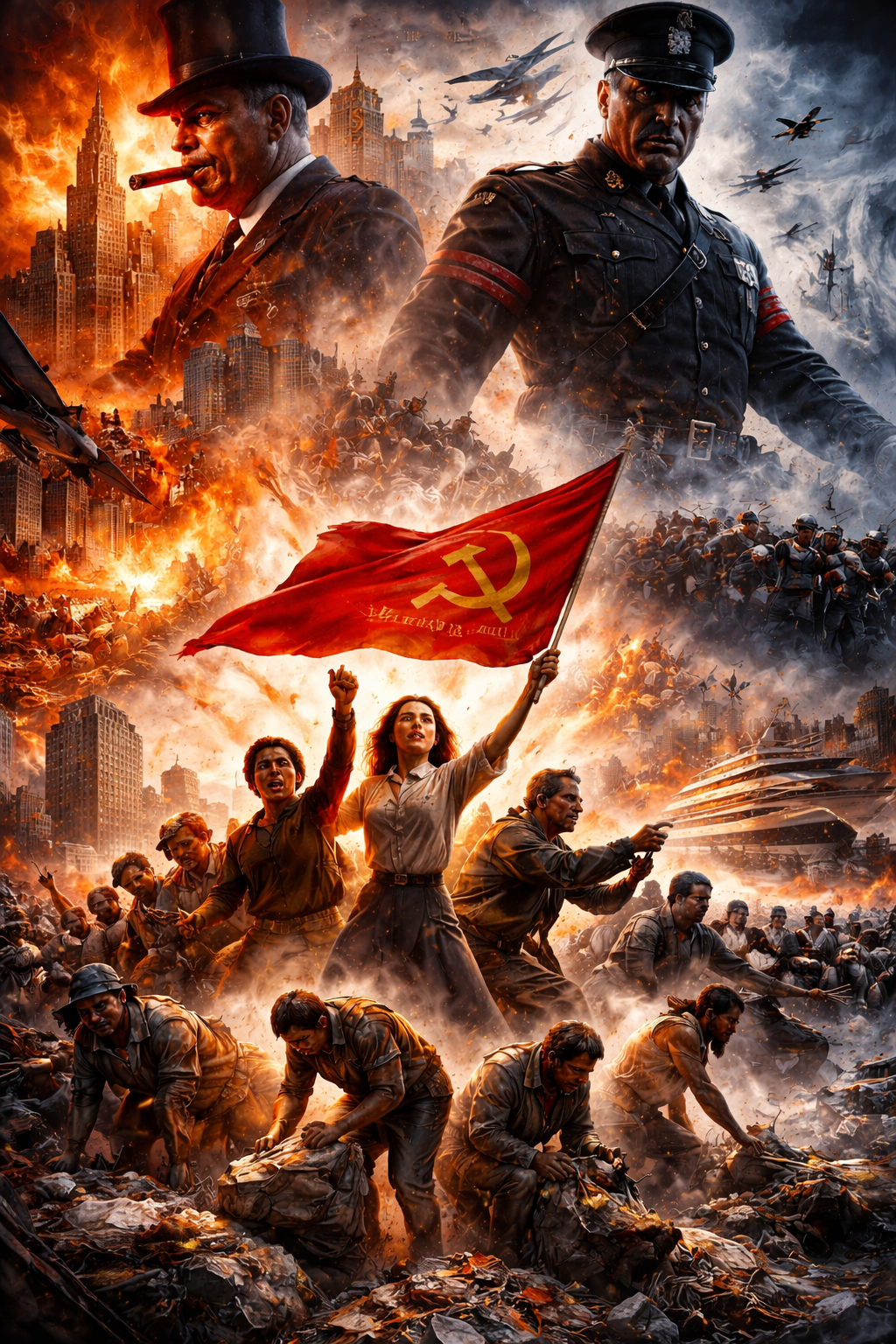
Fascism is not an aberration but a rational instrument deployed when capital loses democratic control. Socialist revolutions expanded freedom for the many and were met with siege, sabotage, and counterrevolution. The restoration of capitalism in the East revealed the market as a system of plunder, repression, and social decay. Anti-communism and class denial function as ideological weapons to prevent these lessons from being learned.
By Prince Kapone | Weaponized Informationem> | Weaponized Intellects Book Review | January 24, 2026
History Is Not Memory — It Is a Battlefield
Michael Parenti begins Blackshirts and Reds with an accusation, not a preface. The accusation is simple and devastating: what passes for history in capitalist society is not a record of what happened, but a managed inheritance of what may be remembered. The past is not neutral terrain. It is governed. Policed. Curated. And the first casualty of that governance is comparison itself. We are allowed to know that fascism was evil. We are not allowed to ask why it emerged, who funded it, or what it was protecting. We are allowed to know that communism “failed.” We are not allowed to ask what it replaced, what it achieved, or what was required to destroy it.
This asymmetry is not accidental. Parenti insists that historical memory functions like a border regime: some facts pass freely, others are detained indefinitely. Violence committed in defense of property dissolves into abstractions—markets, incentives, efficiency. Violence committed against property is personalized, dramatized, ritualized. The effect is ideological discipline. Capitalism appears as the background of reality, socialism as an intrusion upon it. One is judged by intentions and ideals, the other by consequences alone. Even before the argument begins, the verdict is already written.
The preface is therefore methodological. Parenti is not offering a balanced account between competing systems; he is breaking the rules that make balance impossible. He restores comparison as a scientific act. What happens to literacy, health, housing, employment, gender relations, and political participation when societies attempt to organize production for use rather than profit? What happens when those attempts are met with blockade, invasion, sabotage, and internal subversion? What happens after those societies are dismantled in the name of freedom? These are empirical questions, not moral performances. The refusal to ask them is itself a political choice.
Anti-communism, Parenti makes clear from the outset, is not merely an attitude toward a defunct system. It is a living ideology that structures how people interpret the world they inhabit. It teaches populations to experience exploitation without naming it, inequality without tracing it, and suffering without locating its source. It does not need communism to exist in order to function. It exists to ensure that communism never becomes thinkable again, even as capitalism steadily erodes the conditions of life.
This is why the book opens where it does. Before fascism can be understood, before revolution can be evaluated, before socialism can be judged, the reader must be disarmed of the habits of thought that make honest analysis impossible. Parenti is not asking for agreement. He is demanding intellectual defection—from the inherited reflexes of Cold War common sense, from the moral theater of liberal historiography, and from the comforting lie that history simply unfolded the way it had to. What follows is not a story about the past. It is an intervention in the present, written for anyone who suspects that the world did not end up this way by accident.
When Capital Decides Consent Is Too Expensive
Fascism enters Parenti’s analysis not as a rupture in modern politics but as a grim clarification of it. Once the ground rules established in the preface are accepted—that history is managed and comparison suppressed—the question of fascism becomes brutally concrete. Fascism does not arise because people suddenly abandon reason. It arises because ruling classes conclude that reasoned persuasion, parliamentary delay, and negotiated compromise no longer secure what matters most: property, hierarchy, and control over labor.
Parenti strips fascism of its theatrical mystique. The uniforms, salutes, myths, and racial fantasies are not the substance of the system; they are its delivery mechanism. Beneath them lies a cold calculation. When socialist parties grow, when unions organize at scale, when strikes threaten profits and land reform threatens ownership, liberal democracy becomes a liability. Elections are slow. Courts are uncertain. Rights are inconvenient. Fascism solves this problem by collapsing politics into command. It does not abolish capitalism—it rescues it from democracy.
This is why fascist movements did not seize power against elite resistance but through elite sponsorship. Industrialists, bankers, large landowners, and military hierarchies recognized a shared interest long before the masses did. Fascism smashed labor, outlawed left parties, and criminalized dissent while leaving ownership intact. The economy did not become collectivized; it became disciplined. Profits were protected, wages suppressed, and strikes treated as acts of war. The state expanded, but only as an enforcer for capital.
What unsettles liberal mythology is how smoothly this transition occurred. Fascism did not arrive as an alien force invading democracy; it emerged from within systems already accustomed to repressing workers, colonized peoples, and the poor. Emergency laws, police powers, and military repression were not invented by fascists. They were inherited, intensified, and normalized. Liberal institutions did not collapse under fascism—they adapted to it, often welcoming it as a restoration of order.
Parenti’s insistence on calling fascism “rational” is therefore deliberate provocation. Rational not in the sense of humane or enlightened, but in the narrow logic of class rule. Fascism worked for those it was designed to serve. It stabilized accumulation, crushed opposition, and reorganized society around obedience. Its irrational ideology—national rebirth, masculine authority, mythic enemies—was not a flaw but a tool, capable of mobilizing mass support while deflecting attention away from the relations of exploitation that remained untouched.
By the end of the chapter, fascism can no longer be safely historicized as a twentieth-century aberration. It stands revealed as a recurring option within capitalism itself, one that becomes thinkable whenever democracy begins to function too well for the wrong people. This realization does not yet indict liberalism outright, but it presses the analysis forward. If fascism is capitalism’s emergency measure, then the next question cannot be avoided: what happens when people refuse both fascism and the liberal order that repeatedly gives birth to it?
Freedom Measured from the Ground Up
Having exposed fascism as capital’s emergency solution, Parenti does not pivot to a sentimental defense of its opposite. He changes the scale of judgment. The problem, he argues, is not that revolutions are violent, but that violence has been counted selectively. The real scandal is not the force used to overturn entrenched privilege, but the quiet, normalized brutality that made revolt necessary in the first place. Once that baseline is restored, the moral arithmetic shifts.
Revolutions enter history under conditions already saturated with coercion. Hunger, illiteracy, landlessness, colonial domination, police terror—these are not unfortunate backdrops but governing realities. Parenti insists that freedom cannot be evaluated as an abstract principle floating above this terrain. It must be measured in lived consequences. Who gains access to food, housing, education, healthcare, and political voice? Who stops dying early? Who begins to count?
This is where liberal accounts falter. They treat pre-revolutionary societies as morally neutral starting points and revolutionary disruption as the first act of violence. Parenti reverses the frame. He shows that revolutions, whatever their contradictions, represented mass empowerment for people who had never possessed even formal freedoms. Literacy campaigns, public health systems, land redistribution, employment guarantees, and the political inclusion of women were not symbolic gestures. They were structural changes that altered everyday survival.
The question of violence returns here, sharpened rather than softened. Whose violence is visible? The firing squad is cinematic; the slow death of poverty is administrative. Counterrevolutionary terror, sanctions, and foreign-backed repression are recoded as order, stability, or unfortunate necessity. Revolutionary violence is individualized and moralized; systemic violence under capitalism dissolves into background noise. The asymmetry is not analytical—it is ideological.
Parenti does not deny suffering under revolutionary regimes. He refuses something more dangerous: the isolation of suffering from context. Pain must be measured comparatively. What was the level of deprivation before revolution? What improvements followed? What costs were imposed by external intervention and internal sabotage? To ask these questions is not to excuse error but to understand causation. Moral outrage that refuses comparison is not ethics; it is theater.
By the chapter’s end, revolution appears neither as romantic rupture nor as authoritarian deviation, but as a democratic process unfolding under extreme constraint. It expanded freedom where none had existed, while provoking an immediate and sustained counterattack from forces determined to restore privilege. This tension—between mass empowerment and elite retaliation—does not resolve itself here. It deepens. And it forces the next turn in the argument: if revolutions achieved real gains, why were they met not with reform but with relentless hostility, including from those who claimed to be on the left?
The Left That Learned to Fear Its Own Victories
The hostility that met revolutionary societies did not come only from bankers, generals, and foreign ministries. Parenti turns here to a more uncomfortable terrain: the left that flinched when confronted with the consequences of its own ideas. Having established that revolutions expanded freedom under conditions of inherited misery and external threat, he now examines how large segments of the Western left responded—not with solidarity, but with suspicion, fear, and moral distance.
This reaction, Parenti argues, rested on expectations no real revolution could ever satisfy. Socialism was imagined as a frictionless moral event rather than a struggle for survival. Any deviation from an idealized blueprint—centralization, emergency powers, restrictions on opposition—was treated not as a response to material pressure but as proof of inherent corruption. The fact that socialist states were encircled by hostile powers, subjected to economic warfare, infiltration, and military threat, was acknowledged abstractly and then ignored analytically.
What Parenti exposes is a politics of purity that quietly aligns with power. By demanding “pure socialism” untouched by compromise, the left absolved itself of responsibility for actually governing. Siege conditions were treated as moral failures rather than political realities. Survival itself became suspect. The result was an inverted radicalism: a posture that appeared critical but functioned as passivity, condemning real attempts at transformation while offering no viable alternative under real-world constraints.
Decentralization occupies a special place in this critique. In the abstract, it sounds democratic and humane. In practice, under conditions of sabotage and scarcity, it often meant fragmentation, vulnerability, and defeat. Parenti does not dismiss decentralization as an idea; he insists it cannot be fetishized. The question is not whether power should exist, but who wields it, against whom, and for what purpose. A state that refuses to defend a revolution does not remain virtuous—it disappears.
The tragedy Parenti identifies is not theoretical error but political consequence. Left anti-communism and Western Marxism helped normalize the narrative that socialism failed because it betrayed its own ideals, rather than because it was relentlessly attacked for threatening class power. This narrative did real work. It softened opposition to sanctions, intervention, and eventual dismantlement. It allowed people who considered themselves radical to watch counterrevolution unfold with folded arms and clean consciences.
By the close of the chapter, the analysis has shifted again. The problem is no longer whether socialism achieved gains or faced repression, but how its own potential defenders were ideologically disarmed. This internal fracture matters because it reappears wherever collective struggle threatens power. If the left cannot think seriously about survival, Parenti implies, it will always arrive late—just in time to explain why defeat was inevitable.
When Fantasy Replaces Political Economy
After dismantling left anti-communism as a politics of moral withdrawal, Parenti pivots to a different kind of evasion—one that dresses itself up as economic realism. This chapter is less accusatory and more surgical. Its target is not fear of socialism, but a fairy-tale version of capitalism that quietly took hold as socialist systems struggled with stagnation and reform. Communism, Parenti shows, came to be judged not against material history, but against an imaginary alternative that had never existed anywhere on earth.
He begins with the internal problems no serious analysis can deny. Productivity lagged. Incentive structures were often poorly designed. Enterprises were rewarded for meeting quotas rather than meeting needs. Managers hoarded resources, innovation slowed, and bureaucratic routines hardened into inertia. These were not secrets hidden from socialist societies; they were openly debated within them. The problem was not denial. It was that every attempt at reform took place inside a system under siege, where failure carried existential consequences.
Parenti’s key move here is to connect economic inefficiency to political pressure. Reforms that might have worked under stable conditions became risky under constant threat. Loosening controls invited capital flight before capital formally existed. Introducing market mechanisms empowered actors already positioned to convert public assets into private advantage. The state was blamed for stagnation, yet the very constraints that produced stagnation were imposed from outside. What critics labeled “irrationality” often reflected rational caution in a hostile environment.
Against this complex reality, a mirage took shape. Capitalism was imagined as dynamic, innovative, self-correcting—a system that rewarded talent and punished waste. Its own inefficiencies, crises, and brutalities were conveniently absent from the comparison. The market was romanticized precisely because it was not yet experienced. This was not analysis; it was projection. Capitalism became the answer not because it had proven itself, but because socialism was no longer allowed to be imperfect.
Parenti is especially sharp on how dissatisfaction mutated into reaction. Legitimate grievances—shortages, rigidities, frustration with bureaucratic arrogance—did not automatically generate emancipatory critique. In the absence of class analysis, they were easily redirected upward against the very idea of collective ownership. Anger at inefficiency slid into hostility toward egalitarianism itself. The demand was no longer for better socialism, but for something else entirely, even if no one could explain how that something else would work for the majority.
By the end of the chapter, the ground has shifted again. The issue is no longer siege alone, nor purity politics, but illusion. Socialism did not collapse because it failed to live up to capitalism’s real record; it was measured against capitalism’s mythology. That mythology would soon be tested in practice. And when it was, Parenti makes clear, the results would be anything but magical.
Counting the Dead Without Counting the Living
This chapter enters territory most writers tiptoe around, either out of fear or opportunism. Parenti does neither. He walks straight into the moral accounting room where numbers are weaponized and asks a simple question that almost no one else does: compared to what? The issue here is not whether repression existed—Parenti never denies it—but how suffering is counted, contextualized, and politicized depending on which system produced it.
The gulag becomes the centerpiece of this accounting drama, treated in Western discourse as a timeless, self-expanding machine of horror, detached from history and immune to comparison. Parenti disrupts this mythology by grounding it in archival data that had only recently become available when he wrote. The numbers fluctuate across periods, decline dramatically after the 1950s, and bear no resemblance to the inflated figures that circulate endlessly in popular culture. Repression is shown to be real, but bounded, historically specific, and often misrepresented beyond recognition.
What gives the chapter its bite is not statistical correction alone, but contrast. While socialist repression is frozen into moral eternity, capitalist violence is dispersed until it disappears. Millions die from preventable poverty, colonial extraction, famine induced by market discipline, and structural neglect, yet no ledger is ever kept. No monuments are built to those victims. No system is put on trial. The silence is not accidental; it is ideological.
Parenti sharpens the argument by turning to development itself. The societies accused of unparalleled cruelty were also the ones that dragged entire populations out of maldevelopment in a single generation. Life expectancy rose. Literacy became universal. Industrial capacity was built where none had existed. These achievements did not erase repression, but they complicate the moral narrative. A system that only destroyed could not have produced such transformations. The question, then, is not whether harm occurred, but what kind of historical tradeoff was being navigated under extreme conditions.
The most destabilizing move comes when Parenti asks where the terror went after socialism collapsed. If repression was inherent to collectivism, its removal should have brought relief. Instead, incarceration expanded elsewhere, police violence intensified, and new forms of social death proliferated under market rule. The instruments changed. The suffering did not. What vanished was the will to name it as systemic.
By the end of the chapter, moral certainty has been stripped of its innocence. The problem is no longer whether socialism can be indicted—any serious history indicts every system—but why only one system is ever placed in the dock. The selective outrage surrounding Stalin functions less as remembrance than as prophylactic. It ensures that whatever capitalism does, it will never be judged by the same standard. With that shield firmly in place, the stage is set for the next act: the market’s arrival as savior, and the catastrophe that followed.
When “Democracy” Arrived with Police Truncheons
The collapse of socialist governments is usually narrated as a liberation story, complete with ballots, dissidents, and Western applause. Parenti refuses that script. He shifts the camera away from speeches and ceremonies and toward what actually happened on the ground once the old order fell. What enters Eastern Europe under the banner of “free markets” is not pluralism, but a restoration project—one that moves quickly, decisively, and with little concern for popular consent.
The first order of business is repression, not reform. Left parties are banned or marginalized, unions are broken, and former communists are purged from public life regardless of their popular support. Elections continue, but only in one direction. The permissible political spectrum narrows to variations of market orthodoxy, while any attempt to defend social ownership or collective guarantees is treated as illegitimate by definition. Democracy survives as ritual, emptied of substance.
Parenti lingers on the return of old elites, a detail liberal narratives prefer to gloss over. Aristocrats, large landowners, and comprador classes dispossessed by earlier revolutions quietly reclaim property and privilege. Titles reappear. Assets are transferred back to families that had once ruled without accountability. What is sold as modernization reveals itself as regression—an undoing of decades of social leveling accomplished not through popular demand but through elite maneuver.
Western capital moves in with remarkable speed. State industries built by generations of collective labor are privatized at fractions of their value, often through opaque deals brokered by foreign advisers and domestic intermediaries. Public wealth becomes private fortune almost overnight. Parenti does not romanticize the socialist economies that preceded this moment, but he insists on clarity: this was not efficiency replacing waste. It was plunder replacing planning.
Figures lionized in the West as democratic heroes receive particular scrutiny. Parenti’s treatment of Václav Havel is emblematic—not a personal attack, but a political demystification. Moral authority and cultural prestige are shown to function as cover for policies that dismantled social protections and opened entire societies to foreign domination. The velvet glove matters because it disguises the iron hand.
By the end of this chapter, the reader is left with a stark inversion of expectations. The transition to capitalism did not expand political choice; it constrained it. It did not empower workers; it disciplined them. It did not decolonize Eastern Europe; it recolonized it economically. What was restored was not freedom in any substantive sense, but class rule under new management. Having traced the mechanisms of that restoration, Parenti now turns to its consequences—the social wreckage left in its wake once the market was fully unleashed.
The Market Eats What the State Once Held Together
Once the machinery of restoration is in place, Parenti shifts register. This chapter does not argue so much as inventory. It reads like a social autopsy, tracing what happens when collective structures are dismantled and market rule is allowed to operate without restraint. The promise had been efficiency and freedom. What followed was social disintegration.
Inequality explodes first. A thin stratum of speculators, intermediaries, and former party insiders turned businessmen accumulate staggering wealth, while the majority experience a sudden and unfamiliar precarity. Wages collapse. Savings evaporate. Pensions become meaningless. Entire populations accustomed to basic security are thrust into competition for survival in labor markets that have no use for them. The “transition” functions less as reform than as shock.
Crime fills the vacuum left by social collapse. Parenti is careful not to moralize this turn. Organized crime, corruption, and black markets flourish because they are structurally invited in. When public institutions are gutted and legal norms rewritten overnight, informal power rushes to take their place. Gangsters and oligarchs emerge not as anomalies, but as the market’s most disciplined students, mastering accumulation without constraint.
The burden of this unraveling falls unevenly, and Parenti insists on naming who pays first. Women are pushed out of stable employment and back into unpaid domestic labor or informal survival economies. Children lose access to healthcare, education, and nutrition. The elderly—once guaranteed dignity through pensions and social care—become disposable. The market sorts ruthlessly, and it sorts along lines of vulnerability.
Cultural decay follows material decay. Alcoholism, despair, and social isolation spread as collective purpose dissolves. The loss is not only economic but psychic. People discover, too late, that the institutions they were told were inefficient had in fact structured meaning, solidarity, and predictability. Parenti quotes the bitter refrain that echoes across the region: “We didn’t realize what we had.” It is not nostalgia speaking, but belated recognition.
This chapter closes without sentimentality. Parenti does not argue that socialist societies were ideal, only that they were coherent. The market, by contrast, proves incapable of reproducing social life without tearing it apart. Having followed capitalism’s arrival from promise to wreckage, the analysis now turns to a broader claim circulating triumphantly in the West: that Marxism itself has been disproven by history. Parenti takes that claim personally—and dismantles it with precision.
Marxism After the Funeral It Never Attended
The declaration of Marxism’s death arrives in Parenti’s book not as a discovery but as a ritual. It is announced loudly, repeatedly, and always at moments when capitalism has just finished dismantling something it cannot explain. This chapter refuses the ceremony. Rather than defending Marxism as doctrine or nostalgia, Parenti treats it as what it actually is: a method for understanding power, production, and social consequence—one that remains disturbingly effective precisely because the conditions it analyzed have intensified.
Parenti does not begin with slogans. He begins with basics that refuse to age. Societies are organized around material production. Wealth does not float freely; it is extracted, concentrated, and defended. Political power follows economic power with remarkable consistency. These propositions are not ideological preferences. They are empirical regularities. That they continue to describe the world with accuracy is what makes Marxism intolerable to respectable discourse.
What liberal thought presents as complexity, Parenti identifies as fragmentation. Economics is separated from politics. Politics is separated from class. Culture is separated from material life. Each discipline studies its corner carefully while refusing to ask how the pieces fit together. Marxism offends this arrangement by insisting on totality. It asks not only how things function, but for whom, and at whose expense. That insistence is what makes it dangerous.
The charge that Marxism was “mostly wrong” collapses under Parenti’s scrutiny. Capital has concentrated. Inequality has widened. Crises recur with greater frequency and global reach. Wealth produces poverty as reliably as it produces yachts. Even the celebrated productivity of capitalism reveals its underside in environmental destruction and social exhaustion. The system behaves exactly as Marx described—not in every detail, but in its governing tendencies.
What Parenti makes unmistakable is that Marxism’s supposed failure is measured against impossible standards. It is asked to predict every contingency while capitalism is forgiven for catastrophes it produces routinely. Marxism is judged by the moral purity of states that claimed it under siege; capitalism is judged by its intentions rather than its outcomes. The asymmetry is not accidental. It protects the present from interrogation.
By the end of the chapter, Marxism stands neither resurrected nor embalmed. It stands as an unfinished science of society—one that must be updated, contested, and sharpened, but not abandoned. Its value lies not in prophecy, but in its capacity to force questions other frameworks are designed to avoid. Having reestablished that capacity, Parenti moves to the final maneuver of ideological containment: the systematic effort to talk about everything except class.
Everything Matters—So Long as Class Does Not
Parenti saves his most surgical work for last. There is no thunder here, no dramatic reveal, only a slow tightening of the vise around the dominant intellectual reflex of the age: the refusal to name class while endlessly describing its effects. This chapter does not read like a conclusion. It reads like an exposure of how conclusions are avoided in the first place.
The displacement begins subtly. Inequality is discussed as lifestyle difference. Power becomes influence. Exploitation is rebranded as opportunity gaps, cultural mismatch, or unfortunate outcomes of globalization. Whole libraries are written about identity, discourse, representation, and consumption while the ownership of productive wealth quietly exits the frame. Parenti does not dismiss these categories outright; he shows how they are mobilized to crowd out the one relationship that structures them all.
What he calls the “ABC theorists”—Anything But Class—do not deny inequality. They theorize it endlessly. But by severing wealth from power, they convert structural domination into a mosaic of unrelated problems. Racism floats free of political economy. Ecological collapse is framed as ethical failure rather than capitalist compulsion. Work disappears as a site of struggle just as it becomes more insecure, more surveilled, and more extractive than ever.
Parenti insists on something unfashionable and therefore necessary: class is not a demographic identity. It is a relationship of power rooted in ownership and control. It shapes who decides, who benefits, and who absorbs risk when systems fail. To speak of class is not to flatten complexity, but to organize it. Without class analysis, critique becomes decorative—capable of naming harm but incapable of explaining why it persists.
The everyday nature of class struggle is what liberal theory works hardest to obscure. It is not confined to strikes or revolutions. It appears in rent hikes, layoffs, environmental poisoning, healthcare denial, and debt peonage. These are not policy accidents. They are outcomes of a system that treats human need as a secondary concern. To avoid class is therefore not neutrality; it is alignment with the existing distribution of power.
Parenti closes the book by collapsing the illusion of choice offered by contemporary discourse. One can talk endlessly about values, culture, and reform while leaving ownership intact—or one can confront the structure that makes reform perpetually reversible. There is no third option. By ending here, Parenti completes the arc of the book: from fascism as a class weapon, through the sabotage of socialist alternatives, to the ideological strategies that keep those lessons from being learned. What remains is not despair, but clarity. And clarity, as this book insists from beginning to end, is itself a form of struggle.
Where Parenti Stops: The Settler Empire and the Colonial Archive of Fascism
Let’s be clear about what Blackshirts and Reds accomplishes before we name what it does not. Parenti gives us something rare: a book that treats fascism, anti-communism, and “free-market democracy” as parts of a single class system rather than as moral categories floating above history. He shows how fascism is not an accidental madness but a rational class solution; how liberal democracy is elastic until property is threatened; how anti-communism is not a harmless opinion but an ideological police force; how counterrevolution is sold as “freedom” while it loots whole societies; how capitalism’s disasters are naturalized while socialism’s contradictions are dramatized and eternalized. In a culture trained to fear comparison, Parenti restores the right to compare — and that right is a weapon.
And that is why the only criticism I hold against this magisterial work matters as much as it does: Parenti never really centers the colonial contradiction. He shows how capital disciplines labor and crushes popular democracy, but in the U.S. case the terrain of “popular democracy” itself is built on a prior, foundational war — the war of conquest, dispossession, enslavement, and annexation that created a settler empire and a prison house of nations. In the United States, “race” has never been a neutral demographic description. It has been the political architecture of colonial domination — an ideological euphemism for nation. That means class struggle here is never simply class struggle in the abstract. It is class struggle inside a settler colonial state where the Euro-American nation was forged as the main base of reaction, and the colonized nations have historically been the vanguard of resistance.
This is not a side note. It changes how fascism must be understood on U.S. soil. The common liberal habit is to treat fascism as an emergency that arrives when democracy “breaks.” But for the colonized, the emergency has been the standing order. Long before Mussolini’s blackshirts marched, the settler state had already perfected the governing technologies of occupation: slave patrols, militias, lynch mobs, reservations, Jim Crow law, convict leasing, border terror, surveillance, prisons, counterinsurgency doctrine, and the selective suspension of rights whenever the colonized moved toward power. The United States did not have to import fascistic methods. It developed them domestically — as routine governance in its relationship to Black, Indigenous, and Chicano people. If we refuse to name that, we end up talking about fascism as a rare deviation rather than the imperial baseline that periodically expands outward.
Once we put the colonial contradiction at the center, the whole picture sharpens. In the US empire there are always two layers of rule. There is the managerial layer, where democracy is performed and negotiated among settlers and elites so long as ownership remains untouched. And there is the colonial layer, where the internal colonies are governed not primarily by consent but by coercion — by policing, imprisonment, dispossession, economic blockade, and periodic exemplary violence. When crisis deepens, when the imperial rent shrinks, when the settler bargain begins to break down, the colonial layer does not disappear. It expands. The methods long used against the colonized become the template for broader governance. What the colonized endured as normalcy begins to be introduced to wider sectors of the population as “necessity.” This is how emergency becomes structure.
That is why what we are living through now — what I have diagnosed as technofascism — has unique qualities compared to the classical forms Parenti focuses on. The core class logic Parenti traces still holds: capital prefers coercion to surrender, and liberalism retreats when property is threatened. But the U.S. variant emerges from a settler state with an already mature counterinsurgency archive, now fused to a new infrastructure of digital control. Technofascism is the integration of monopoly finance, Big Tech, and the security state into a single governing apparatus capable of mass surveillance, predictive policing, algorithmic propaganda, financial blacklisting, automated repression, and of course, kinetic violence. It is not simply the old fascism in new clothes. It is the settler empire’s colonial machinery upgraded, networked, and scaled — with drones overhead and databases beneath the floorboards.
This matters for organizing because a politics that treats “the working class” as an undifferentiated mass — or treats national oppression as a cultural distraction — will misread both the enemy and the terrain. In the United States, the ruling class has historically preserved its power by binding Euro-American workers to the settler project with wages, land, status, and the promise of standing above the colonized. That “whiteness contract” has never been total, but it has been powerful enough to repeatedly sabotage revolutionary possibilities. The tragedy of much of the U.S. left is that it has failed — time and again — to grasp that national liberation is not separate from class struggle but the decisive form class struggle takes inside a settler empire. Liberal multiculturalism offers representation without liberation; class-reductionism offers unity without truth. Both leave the colonial structure intact — and both, in their own way, disarm the very forces most capable of rupture.
So to honor Parenti’s work is not to dilute it but to extend it to the place it must go if it is to become fully usable here. Parenti teaches us to see how fascism serves class domination, how anti-communism polices the boundaries of thought, and how “free markets” arrive soaked in blood. The Weaponized Information task is to insist that in the United States, class domination has always been organized through colonial domination — that the state’s most fascistic features were pioneered against the internal colonies, and that today’s technofascism is the generalization of that colonial archive under conditions of imperial decline. If we want socialism in the belly of this beast, we need more than class clarity. We need anti-colonial clarity — the kind that recognizes the colonized as the vanguard of struggle and forces settlers to choose between loyalty to empire and defection into solidarity. Anything less is just another way of defending the prison while calling it freedom.
 Weaponized Information
Leave a comment