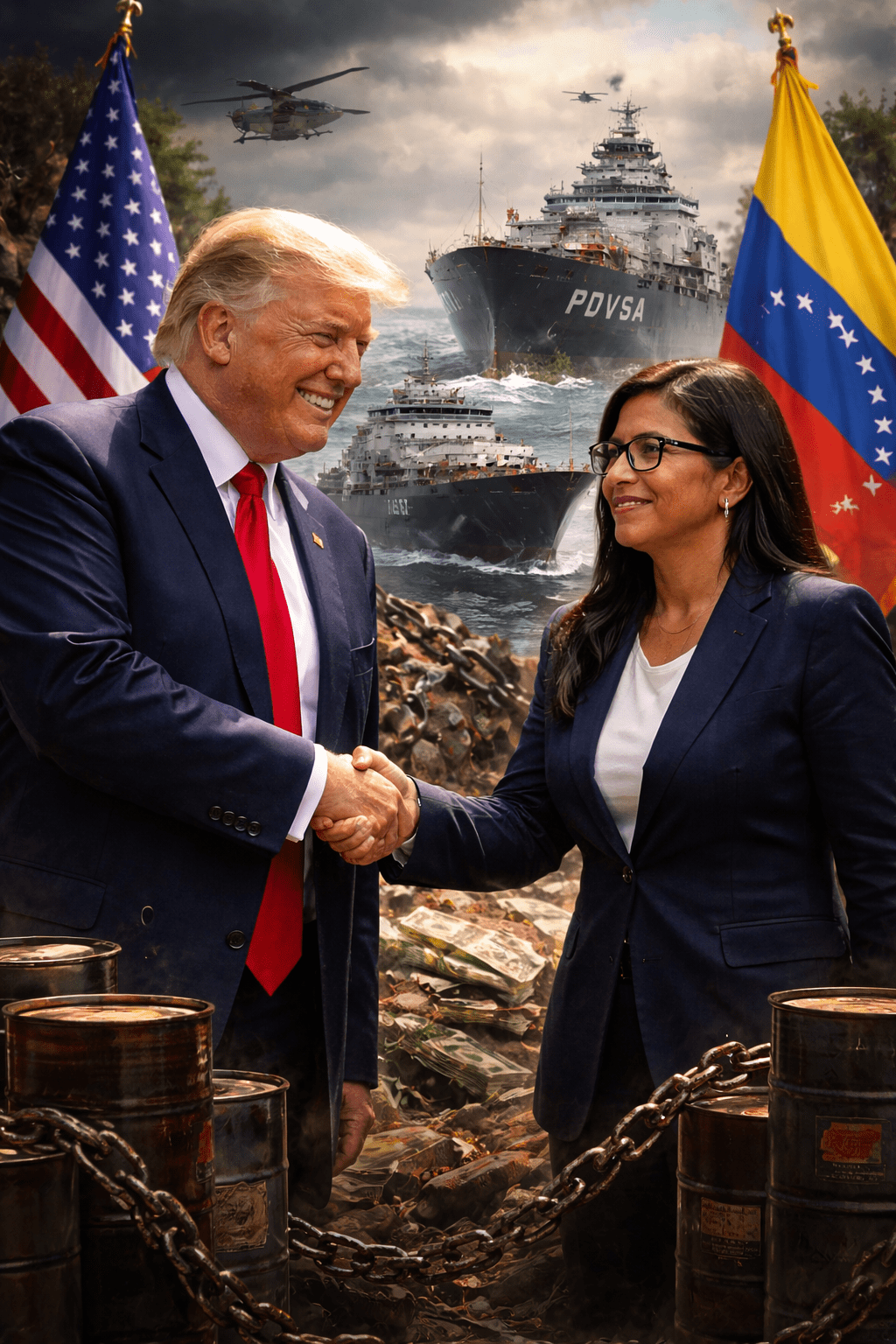
CNN wants the reader to see a new partnership forming in Caracas: a phone call, oil talk, CIA photo-ops, deportations back on schedule. But under siege, smiles are signals—and “warming relations” often means the empire believes it has found a manager, not a partner. We excavate the story’s framing and then trace the concrete leverage hiding underneath it.
When Empire Becomes a Phone Call: CNN’s Court Politics for a Captured Republic
The CNN analysis we are excavating—Stefano Pozzebon’s “Venezuela: Four signs that the Trump–Rodríguez relationship is warming up”—does not begin with Venezuela as a country, a people, or even a society struggling to breathe under pressure. It begins with an imperial assumption so familiar in Western corporate media that it barely needs to be stated: Venezuela’s future is not decided in Caracas, but in Washington. Not by institutions, not by law, not by the masses in motion—by one man’s mood, one leader’s access, one call, one compliment, one gift bag, one photo op. Politics is reduced to court intrigue. And once you accept that reduction, everything else in the article can be dressed up as “analysis,” when it is really a guided tour through submission.
Notice the story’s first trick: it replaces sovereign politics with personal proximity. The reader is invited to see Venezuela’s political horizon through a narrow keyhole—who spoke to Trump, who pleased Trump, who understands Trump, who has a “warmer personal relationship” with Trump. This is not an incidental stylistic choice. It is the article’s engine. By turning the struggle over a nation’s future into a contest for imperial favor, the piece quietly relocates legitimacy itself. The problem is no longer power—who holds it, how it is exercised, whom it serves—but access. The premise becomes: if you can get close enough to the emperor, the republic might live. If you cannot, you are finished. This is propaganda’s oldest alchemy: transform domination into intimacy, and suddenly the cage looks like a handshake.
The second trick is moral cosmetics—making coercion look like cooperation by changing a few verbs. In the article’s telling, the movement of high-level U.S. officials and the presence of U.S. power are narrated as the warming of “relationships,” the tightening of “coordination,” the resumption of “flights,” the restoration of “stability.” The language is administrative and soothing: engagement, readiness, momentum. You can almost hear the soothing voice of the accountant of empire, explaining that the ledger is being brought back into balance. When the piece describes the CIA director’s visit, it leans on atmosphere, posture, and optics—the detail that makes the encounter feel casual, almost friendly, as if intelligence power is just another diplomatic accessory, like a tie loosened after a long meeting. This isn’t neutrality. It is a narrative technique that scrubs domination into something resembling normal international business.
The third trick is the careful handling of violence—not outright denial, but controlled disappearance. The article references the raid on Caracas as “stunning” and mentions deaths in passing, but it does not let the reader stay with the meaning of force. It does not dwell. It does not weigh. It does not look directly at what this implies about sovereignty, legality, or the structure of power in the hemisphere. Instead, violence becomes a narrative speed bump that the story quickly drives over so it can return to the real subject: who is winning Trump’s attention. This is how propaganda works in mature form. It does not need to lie loudly. It can simply keep moving, refusing to stop long enough for the reader to feel what the facts would mean if they were allowed to stand upright.
A fourth device follows naturally: inevitability. The article is structured as a scoreboard—“four signs”—a neat numbered list that gives the impression of empirical certainty. Lists are the propaganda writer’s favorite instrument because they look like evidence. The reader is guided to interpret each numbered “sign” as a step in a linear process, a kind of political gravity pulling Venezuela toward Washington. Even the verbs reinforce this sense of momentum: “gaining,” “warming,” “resumes,” “signals.” History is presented as a one-way street. There is no room for rupture, refusal, or reversal—only adaptation to the imperial center. The list format turns complex struggle into a tidy checklist, and in doing so it makes subordination feel like a rational sequence of events rather than a contested terrain of conflict.
Alongside inevitability sits a fifth technique: simulated pluralism. The article stages a duel between two women—Rodríguez and Machado—framing them as opposing visions. But the drama is arranged so that both paths ultimately lead back to the same throne. The real protagonist is not either Venezuelan actor. It is Trump’s favor. Machado’s White House visit is narrated in the language of spectacle—medal, gift bag, photo session—less politics than theater. Her lack of “concrete support” is not treated as a revelation about imperial calculation; it is treated as a plot point in a story where the empire chooses its preferred administrator. This is how propaganda disarms outrage: it offers you a contest to watch while the terms of the contest remain untouched.
A sixth narrative move is the conversion of repression into pragmatism. Deportations are treated as an administrative issue—something resumed, something managed, something that earns friends in Trump’s circle. The human beings being transported are not framed as workers displaced by a larger system, nor as people caught in the violence of hemispheric order; they appear as units in a policy pipeline. This is a classic media technique: remove the social totality and present the machinery as common sense. When the machinery runs, it is “working.” When it stalls, it is “a problem.” The moral content of the machine is never interrogated. The piece makes order itself the highest good, even when order is maintained by force.
Taken together, these devices produce a single ideological effect: they normalize imperial supervision by narrating it as ordinary governance. The reader is not asked to think about what it means for a sovereign nation’s political fate to hinge on an imperial leader’s approval; the reader is asked to accept it as the natural condition of the hemisphere. The piece does not argue this openly. It doesn’t have to. It performs it. It performs a world in which power flows from Washington, legitimacy is granted by Washington, and “stability” is what happens when local leaders learn to manage their people in ways that satisfy Washington. That is the article’s real function. It is not to inform the public about Venezuela. It is to rehearse the public into accepting—calmly, pragmatically, almost politely—the conversion of sovereignty into a negotiable favor.
The Ground Beneath the Story: What the Cameras Don’t Show
If you listen only to the voices that float across television screens and front pages, you might think Venezuela’s present is being shaped by phone calls, smiles, reform bills, and diplomatic choreography. CNN tells us that Trump spoke with Delcy Rodríguez, that oil executives were summoned to the White House, that a new hydrocarbons law is on the table, that the CIA director paid a visit, that deportation flights have resumed, and that the United States has now “officially started selling Venezuelan oil.” These are the surface movements, the polite gestures of high politics. But history is not written by atmospherics. It is written by ships at sea, by accounts frozen or seized, by contracts enforced with warships, and by workers who wake up each day under siege conditions they did not choose.
Long before any leader exchanged pleasantries, U.S. naval power was already tightening a noose around Venezuela’s oil economy. Since late 2025, the Caribbean has been transformed into a militarized corridor. Under what Washington now calls Operation Southern Spear, U.S. Coast Guard and Navy forces have been intercepting and seizing tankers accused of moving Venezuelan crude in violation of sanctions. One after another, ships have been detained, including the Motor Vessel Sagitta, a Panamian tanker. These are not symbolic gestures. They are acts of force that send a clear message to shipowners, insurers, and port authorities around the world: load Venezuelan oil without Washington’s blessing and you risk losing your vessel. As a result, many tankers now sit idle in Venezuelan waters or turn back at sea, and traditional buyers have been forced to pull back, not because they no longer need the oil, but because the cost of defiance has been made painfully clear.
Naval pressure is only one arm of the vise. On January 9, 2026, Trump signed an executive order declaring a national emergency to “safeguard Venezuelan oil revenue.” Behind the bureaucratic language sits a blunt claim: that money generated from Venezuela’s natural resources now falls under U.S. custodial authority. The order defines these funds as “Foreign Government Deposit Funds,” places them in U.S. Treasury accounts, blocks any normal judicial process from touching them, and gives Washington the power to decide when and how they may be used. In plain terms, this is not cooperation. It is trusteeship. It is the assertion that a sovereign nation’s primary source of income must pass through imperial hands before it can return home.
Inside this tightening structure, oil still moves—but only through narrow corridors carved out by U.S. sanctions licenses such as OFAC’s General License 41 framework. Chevron Corporation, which operates in Venezuela through joint ventures with PDVSA, has historically been able to produce and export limited volumes under U.S. authorization, but Reuters reported that a broader U.S. license enabling Chevron’s operational activity and exports expired in March 2025 and that Chevron could not continue oil operations or exports under the narrower authorization described there. If Chevron is in fact lifting and exporting Venezuelan crude again at scale in January 2026, that would imply a newer U.S. authorization or arrangement beyond what is described in the Reuters reporting above; Bloomberg reported (Jan. 8, 2026) that Chevron loaded about 1.68 million barrels in the first week of January 2026, with cargoes bound for U.S. refiners including Phillips 66 and Valero and for processing at Chevron’s Pascagoula plant. Bloomberg also reported that Venezuelan crude-storage facilities were near full capacity, with more oil stowed in tank farms amid intensified U.S. efforts to impede Venezuelan oil sales abroad. What remains, then, is a two-track system: a blockade for everyone else, and a privileged channel for a sanctioned corporate partner operating under Washington’s umbrella.
At home, Venezuela is attempting to adapt its legal framework to survive under these conditions. The proposed reform of the hydrocarbons law did not fall from the sky in January 2026. Its roots lie in the Anti-Blockade Law published in October 2020 (Gaceta Oficial N° 6583 Extraordinario), when sanctions were already squeezing the economy. That law established a special, temporary legal framework meant to “contrarrestar, mitigar y reducir” the effects of unilateral coercive measures—and it has since been used as the umbrella for “Contratos de Participación Productiva” (CPP), which Delcy Rodríguez explicitly said are “previsto(s) en la Ley Antibloqueo”, alongside other flexible mechanisms aimed at keeping fields operating and drawing capital toward neglected infrastructure under siege conditions. As Venezuelan legal analysis notes, the CPP model has been treated as resting on the Anti-Blockade Law as a legal “fundamento” for these new contractual forms, precisely because the normal hydrocarbons framework was too rigid to function cleanly under sanctions pressure. The current reform effort seeks to fold those wartime survival tools into the main hydrocarbons legislation—something Rodríguez framed as part of a broader push to translate these “new models” into the formal structure of oil governance while tying production outcomes to social needs. It is not a story of liberalization for its own sake. It is the story of a besieged economy trying to keep its lifeblood flowing.
Revenues from the limited exports that still occur now move through channels designed outside Caracas. Reports indicate that roughly $300 million from recent oil sales has been deposited in a Qatari account tied to post-January 3 arrangements, with total deposits around $500 million so far. These funds are being distributed to Venezuelan banks to stabilize the foreign exchange market — a flow also reported in regional media based on official and market sources — but they travel through intermediaries aligned with U.S. power and under conditions shaped in Washington. The public language speaks of stabilization and benefit. The material reality is that Venezuela’s oil income is being routed through a financial maze where the keys are held elsewhere.
All of this unfolds against a longer history that the corporate press prefers to forget. Venezuela holds the largest proven crude reserves on Earth, and control over those reserves has always been bound up with the country’s struggle for sovereignty. When the industry was nationalized in 1976, oil ceased to be a foreign asset and became a national one. U.S. firms did not own Venezuelan oil; they operated under contracts. The claim now heard in Washington—that Venezuela somehow “stole” American oil—is a fiction without legal or historical foundation. What is being contested today is not theft, but who gets to command the future of a people whose land sits atop an ocean of energy.
Faced with sanctions, Venezuela and its partners built alternative trade routes: shadow tanker practices that tamper with tracking signals, ship-to-ship transfers on the open sea, barter-style crude swap arrangements with Iran, and financing/settlement workarounds designed to circumvent U.S. sanctions and keep sales moving to buyers like China via intermediaries and rebranding schemes. These networks kept crude flowing eastward even as Western markets closed. Today, those same networks are being hunted by naval and coast-guard enforcement efforts tied to sanctions and tanker interdictions and by the broader sanctions-compliance and monitoring architecture that pressures insurers, shippers, traders, and banks. The Caribbean has become a chessboard where oil, law, and military power collide.
This is the terrain on which every diplomatic exchange now takes place. This is the context behind every reform bill and every visit by a foreign intelligence chief. A phone call between presidents does not happen in a vacuum. It happens under the shadow of warships, seizures, custodial accounts, and blocked ports. CNN’s story of a relationship “warming up” floats above this ground, detached from the workers watching tankers sit idle, from the engineers keeping fields alive under siege, and from the dockworkers who know that the sea around them has been turned into a weapon. To understand Venezuela’s present, one must look not at the smiles for the cameras, but at the machinery of coercion now wrapped around its oil economy.
Oil, Empire, and the Old Crime of Trusteeship
Strip away the press releases, the cable news chatter, the staged handshakes, and what remains is a story as old as empire itself. A powerful state declares another nation incapable of governing its own resources, places itself in the role of “custodian,” and calls the seizure of wealth an act of protection. This is not diplomacy. It is not partnership. It is trusteeship—the colonial doctrine that says the strong must rule on behalf of the weak, because the weak are supposedly too irresponsible, too corrupt, too chaotic to rule themselves. In the 19th century, this language was used to justify the occupation of Egypt and the plunder of the Congo. In the 20th century, it rationalized coups from Iran to Guatemala. In the 21st century, it arrives in the Caribbean dressed as counter-narcotics and fiscal stewardship.
What Washington now calls “safeguarding Venezuelan oil revenue” is the modern form of an old imperial maneuver: converting economic siege into administrative control. The U.S. executive order that declares Venezuelan oil proceeds a national security matter and places them under Treasury custody is not an aberration. It is the logical extension of a sanctions regime that has already strangled trade, frozen assets, and criminalized third-party commerce. When sanctions fail to produce surrender, empire escalates. It moves from financial coercion to maritime enforcement. When markets refuse to comply, warships are sent to teach them discipline.
The CNN narrative wants us to believe this is about personalities, about Trump warming to Rodríguez, about reforms and intelligence cooperation and deportation flights. But empire does not move according to mood swings. It moves according to material interests. Venezuela sits atop the largest proven oil reserves on the planet, at a moment when U.S. hegemony is fraying, when China’s energy appetite grows, when Russia and Iran build parallel trade systems, and when the dollar’s dominance is increasingly contested. In this context, Venezuela’s real crime is not mismanagement or authoritarianism. Its crime is alignment. Its crime is insisting on a multipolar world where Washington is not the sole gatekeeper of energy and finance.
The siege of Venezuela must therefore be understood as part of a broader imperial recalibration. The era of soft power, NGO diplomacy, and color revolutions is giving way to a harder, more naked form of coercion. Naval encirclement replaces development aid. Custodial accounts replace trade agreements. Sanctions become blockades in all but name. This is not the behavior of a confident empire. It is the behavior of a declining one, forced to rely more openly on force because persuasion no longer works.
For the global working class and peasantry, the lesson is painfully clear. When a nation in the Global South attempts to use its resources for national development rather than imperial tribute, it will be disciplined. When it builds partnerships with other sovereign states outside Washington’s orbit, those partnerships will be criminalized. When it refuses to privatize its wealth for Western corporations, it will be labeled a threat to “hemispheric security.” The language changes. The script does not.
Venezuela today stands where Iran stood in 1953, where Iraq stood in 2003, where Libya stood in 2011. Each was told that its oil belonged to the world, meaning the West. Each was accused of endangering global stability. Each was subjected to sanctions, sabotage, and finally war. The difference is that Venezuela now operates in a world where U.S. power is no longer uncontested. China, Russia, Iran, and the broader multipolar bloc provide political cover, alternative markets, and strategic depth. This is why Washington is desperate to sever those ties. Not because Venezuela threatens the hemisphere, but because Venezuela threatens the monopoly.
From the standpoint of the colonized nations, what is unfolding in the Caribbean is not a bilateral dispute. It is a frontline in the struggle over the future of the international order. Will energy remain a tool of imperial discipline, or can it become a foundation for sovereign development? Will the seas be corridors of commerce, or battlegrounds of blockade? Will law serve the many, or be rewritten to legitimize the plunder of the few?
And from the standpoint of the workers of the Global North, the picture is no less stark. The same state that claims Venezuelan oil must be placed under “custodial protection” tells its own people there is no money for healthcare, housing, or education. The same Treasury that seizes foreign revenues to stabilize imperial power presides over decaying infrastructure and permanent austerity at home. Empire robs abroad and disciplines at home. It always has.
Venezuela’s resistance, then, is not only a national struggle. It is part of a planetary one. It is the refusal of a people to accept that their destiny must be managed from Washington. It is the insistence that oil belongs to those who live on the land from which it is drawn. And it is a declaration, echoed across the Global South, that the age of trusteeship is over—even if empire has not yet accepted the fact.
From Caracas to the World: Turning Imperial Coercion into Global Resistance
The siege of Venezuela is not an isolated crime. It is a warning shot fired across the bow of every nation that still believes sovereignty means something. It tells the world that if you refuse to kneel, your ports will be patrolled, your ships will be seized, your revenues will be frozen, and your leaders will be dragged away in the night. It tells the Global South that independence is tolerated only so long as it does not interfere with imperial accumulation. And it tells the workers of the imperial core that their rulers will burn entire regions before surrendering control of energy, finance, and trade.
But history does not belong to empires. It belongs to peoples in motion. And today, from the oil fields of the Orinoco to the factories of Guangdong, from the ports of Bandar Abbas to the docks of Rotterdam, new forces are already assembling against the old order.
Venezuela does not stand alone. It stands with the multipolar world that has emerged in defiance of sanctions and blockades. It stands with Iran, which built barter and shadow tanker networks to break Western energy control. It stands with Russia, which rerouted trade corridors eastward after NATO’s economic war. It stands with China, which constructed parallel financial rails beyond the dollar system. It stands with the BRICS bloc, which is building settlement mechanisms that bypass U.S. banks entirely. These are not abstractions. They are material systems of survival, forged under fire.
Across Latin America, popular movements already understand what is at stake. ALBA, CELAC, and the Bolivarian networks were built precisely to prevent a return to gunboat diplomacy. The peasant federations, oil workers’ unions, communal councils, and barrio assemblies that defend Venezuela’s revolution today are the same social forces that defeated the coup of 2002 and the sabotage of PDVSA. They know that oil is not a commodity. It is the lifeblood of national dignity.
In Africa and West Asia, anti-sanctions coalitions have become schools of resistance. From Tehran to Harare, from Damascus to Bamako, governments and popular movements have learned how to trade without dollars, ship without insurers, and build infrastructure without Western banks. Each sanction has produced a workaround. Each blockade has produced a corridor. Each seizure has produced a new alliance. Empire has taught the world how to live without it.
And in the Global North, the responsibility is just as heavy. The workers whose pensions are invested in oil multinationals, whose ports service imperial fleets, whose banks launder sanctioned assets, and whose taxes fund naval armadas must decide where they stand. You cannot claim solidarity with the oppressed while fueling the machine that crushes them. You cannot oppose austerity at home while supporting plunder abroad. Empire is one system. Resistance must be one movement.
The task before us is not symbolic. It is material. Dockworkers can refuse to service seized tankers. Bank workers can expose custodial theft. Energy workers can sabotage imperial extraction schemes. Journalists can break the information blockade. Lawyers can challenge sanctions as collective punishment. Students can organize against militarized foreign policy. Communities can build direct links with Venezuelan unions, communes, and cooperatives.
The people of Venezuela are not asking for charity. They are asking for space to breathe, to build, to trade, and to live without a gun pointed at their ports. They are asking for the same right every nation claims: the right to control their land, their labor, and their future.
Empire has declared that oil belongs to Washington. History is answering that oil belongs to the people. Between those two claims stands the battlefield of our time.
The blockade can be broken. The trusteeship can be defeated. The American Pole can be dismantled. But only if the working classes of the world recognize that Venezuela’s struggle is their own — and choose, consciously and collectively, to stand on the side of sovereignty against plunder, of liberation against domination, and of a multipolar future against an empire in decline.
 Weaponized Information
Leave a comment