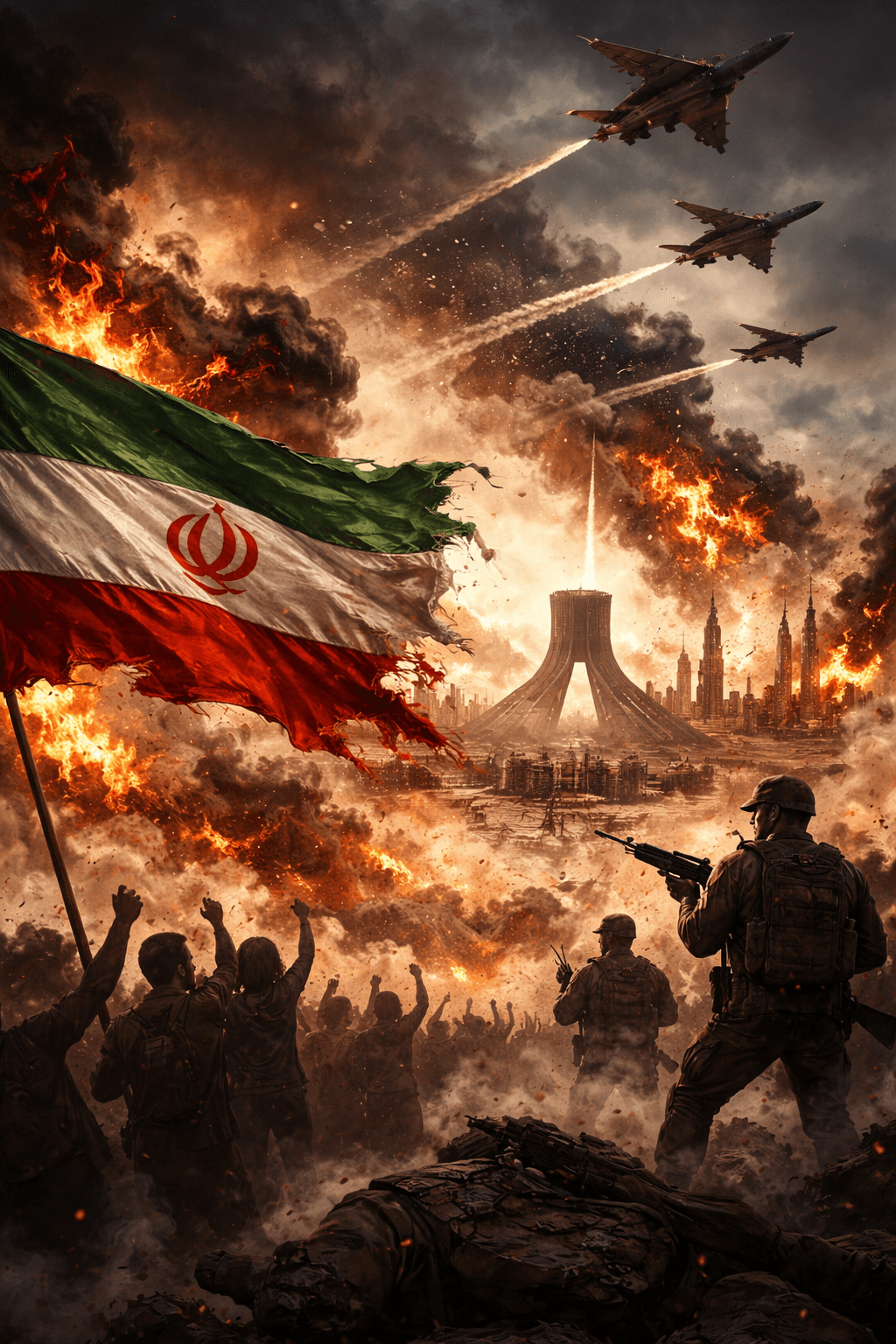
A forensic reconstruction of how sanctions, sabotage, terror proxies, narrative warfare, and regional forward bases have converged into a full-spectrum hybrid war against Iran — and why the January 2026 unrest is not a spontaneous crisis, but the latest front in a decades-long campaign to break an independent state.
By Prince Kapone | Weaponized Information | January 13, 2026
The Siege Reveals the War
The first thing empire tries to steal is language. It wants a war to look like “unrest,” an insurgency to look like “protest,” and a siege to look like a policy dispute. It wants fires in the night to pass for politics. It wants sabotage to be mistaken for dissent. It wants a nation under attack to be read as a nation in crisis. And so it tells the world that Iran is merely experiencing turbulence, as if history were a weather report and sovereignty were a seasonal inconvenience.
But what is unfolding across Iran is not turbulence. It is not disorder. It is not reform politics. It is war — a war conducted without a formal declaration, without a front line, and without the courtesy of honesty. It is a war waged through currency collapse and supply-chain strangulation, through cyber intrusions and infrastructure sabotage, through armed cells and information operations, through economic asphyxiation and narrative capture. It is a war that turns everyday life into a battlefield and survival into an act of resistance.
The sanctions are not background noise. They are the artillery. They pound wages into dust, turn savings into ash, and grind purchasing power into submission. They empty pharmacies, stall factories, choke imports, and make food a political question. They are designed not to persuade a government but to exhaust a society — to make the cost of independence unbearable and to turn daily life into a referendum on sovereignty.
The cyber operations are not technical curiosities. They are precision strikes on the nervous system of a modern state. Power grids flicker. Industrial systems stutter. Databases are breached. Communications are disrupted. The message is delivered in code and current: we can reach inside your house whenever we choose.
The arson is not random. The sabotage is not spontaneous. Fire stations are torched. Municipal buildings are attacked. Markets are burned. Transport is targeted. These are not the acts of a crowd blowing off steam; they are the tactics of an insurgency trying to paralyze a city. They aim at the arteries of social life — the places where a society keeps itself alive — because collapse is not an accident in hybrid war. It is the objective.
The blackout is not a communications story. It is a battlefield maneuver. When the internet goes dark, the country is cut off from itself and the world is invited to invent it. Verification disappears. Rumor multiplies. External actors rush in to become the voice of a nation they do not live in and do not answer to. In the fog of digital war, casualty counts become political weapons and viral clips become strategic munitions. The fight moves from streets and substations to screens and headlines.
And above it all hovers the open language of escalation. Foreign leaders speak of rescue with one hand on the trigger. Think tanks draft strike packages like menus. Sanctions are sharpened into ultimatums. Tariffs are turned into blockades by another name. The empire does not hide its intentions anymore; it markets them as concern and sells them as solidarity.
To call this moment “unrest” is to lie. To call it “reform politics” is to pretend that a boot on the neck is a conversation starter. What Iran is facing is a full-spectrum assault on its capacity to exist on its own terms — an attempt to discipline a society by making normal life impossible and then blaming the victim for suffocating.
The question, then, is not why there is pressure in Iran. The question is why there has been pressure for generations. Why a nation that insists on owning its resources, charting its development, and choosing its alliances is treated as a permanent problem. Why the same forces that turned oil into a colonial ledger and sanctions into a siege now speak the language of liberation while financing collapse.
The answer is older than the blackout and deeper than the present fires. It lies in a long memory of defiance — in the moment Iran refused to be a plantation and discovered that independence is a crime empire never forgives.
Oil and the First Act of Defiance
Long before sanctions became a science and cyberwar a doctrine, before NGOs learned to speak like battalions and algorithms learned to shape consent, Iran committed the original sin in the eyes of empire: it reached for its own oil. In 1951, under Prime Minister Mohammad Mossadegh, the country did what every colonized nation dreams of doing and every imperial system exists to prevent. It nationalized its resources. It told the Anglo-Iranian Oil Company — the ancestor of today’s BP — that the black wealth beneath Iranian soil belonged to the Iranian people. It declared that development would no longer be a colonial balance sheet.
For Britain and the United States, this was not a policy dispute. It was a contagion. If Iran could reclaim its oil, others might follow. If a country in the imperial periphery could write its own economic future, the plantation order would fracture. The response was swift, surgical, and instructive. In 1953, the CIA and MI6 engineered a coup d’état that toppled Mossadegh, smashed the nationalist government, and restored a monarchy willing to rule on behalf of foreign capital. Bribes replaced ballots. Street mobs were hired like extras. Generals were flipped. Newspapers were bought. The operation was so clean that for decades it passed for “instability,” as if the overthrow of a sovereign government were a natural disaster.
The lesson was carved into Iran’s political memory with the precision of a scar. Sovereignty would not be tolerated. Economic independence would be punished. Oil was not a national resource; it was an imperial entitlement. From that moment on, Iran was no longer a country with a future to be negotiated. It was a territory to be managed.
The coup did more than reverse a nationalization. It installed a doctrine. It taught the empire that control could be maintained without occupation, that a state could be bent through intrigue rather than invasion, and that democracy could be celebrated in speeches while being buried in practice. It taught Iran that the language of partnership concealed the machinery of domination, and that any attempt to step out of line would be answered not with debate but with regime change.
When the Shah returned to power on the back of foreign intelligence services, he did not come back alone. He brought with him the architecture of dependency: Western oil consortia, foreign advisors, security guarantees, and a political economy wired to export wealth and import obedience. The oil flowed again — not into schools and hospitals, but into imperial ledgers and royal coffers. Iran was reinserted into the global plantation.
What the coup created was not stability. It created a frozen contradiction: a modernizing society ruled like a colony. A population that could read and organize, work and build, but not decide. A nation whose resources were counted abroad while its people were managed at home. The seeds of revolt were planted in the very soil that had been stolen.
From the standpoint of empire, 1953 was a success story. From the standpoint of history, it was the opening chapter of a permanent war. The moment Iran claimed its oil, it placed itself on a collision course with a system that does not forgive disobedience and does not forget defiance. The siege that tightens today began the day Iran decided it would no longer be a plantation.
The Client State and the Colonial Order
The coup did not simply remove a prime minister. It installed a system. When Mossadegh was overthrown and the Shah was returned to the throne, Iran was folded back into an imperial order that knew exactly what it wanted from a country like Iran and exactly how to take it. The monarchy that ruled from 1953 onward did not govern as a national institution; it administered as a colonial relay. Power flowed upward and outward. Wealth moved offshore. Decisions were cleared through foreign embassies and corporate boardrooms. What the people called a state, empire treated as a concession.
Oil once again became the spine of dependency. Western consortia divided the fields. Contracts were written in languages the public did not speak. Revenues were managed through arrangements designed to guarantee that the greatest share of Iran’s wealth never stayed in Iran. Development was promised in glossy brochures, while extraction was enforced by treaty and decree. The plantation had been restored, modernized with pipelines and petro-dollars, guarded by advisers and arms.
To keep this order intact required more than economics. It required a security state. The Shah’s regime built its authority on a machinery of surveillance and repression that answered as much to foreign intelligence services as to any domestic constituency. SAVAK, trained and equipped by the CIA and Israel’s Mossad, became the regime’s iron fist. Parties were banned. Trade unions were crushed. Students were hunted. Clerics were monitored. Torture was routine. Prison became a political institution. Stability was achieved the way colonies have always achieved it: through fear.
Yet the regime wrapped this repression in the language of modernization. Tehran was filled with highways and hotels, towers and terminals. A consumer class was cultivated. The court staged itself as the vanguard of progress. But beneath the glass and neon lay a familiar arithmetic: a narrow elite enriched by foreign capital, a swelling urban population locked out of political life, and a countryside drained of resources and labor. The spectacle of development concealed a reality of dispossession.
What emerged was a society pulled in two directions at once. Education expanded while political participation vanished. Industry grew while sovereignty shrank. A new middle class learned to read the world while being told it could not shape it. The contradictions of colonial modernization piled up like dry timber. Every strike that was broken, every newspaper that was shut, every student that was jailed added fuel to a fire the regime could not see from its palaces.
From Washington and London, this was called success. Iran was stable. The oil flowed. The Soviets were kept out. The region was secure. But stability built on dependency is only the calm before a rupture, and order enforced by terror is only the pause between uprisings. The Shah’s Iran was not a nation at peace; it was a society under occupation by another name.
The coup had taught the empire how to rule without ruling. The client state showed it how to extract without annexing. Together they produced a colonial order that looked modern on the surface and rotten at the core. And from that rot grew a generation that no longer asked for reform inside the system, but for an end to the system itself.
When the break finally came, it would not be a negotiation over contracts or a reshuffle of cabinets. It would be a revolt against a plantation economy and a police state. It would be a rejection of the client order and the empire that built it. It would be the moment Iran tore up the ledger and reclaimed the country that had been signed away in 1953.
The Revolution That Ended Normal Relations
When the Shah’s order finally cracked, it did not do so politely. It did not collapse through parliamentary intrigue or elite bargaining. It was pulled down by a society that had reached the end of its tolerance for being ruled like a colony in its own homeland. The uprising that swept Iran in 1979 was not a palace coup or a reshuffling of managers. It was a national rupture — a collective refusal to live inside a system designed elsewhere and enforced at home by batons and prisons.
The revolution did not emerge from a vacuum. It rose out of decades of stolen wealth, broken unions, censored newspapers, tortured students, and a monarchy that spoke the language of modernization while governing like a foreign concession. By the late 1970s, the Shah’s regime had become a contradiction that could no longer be contained: a hyper-militarized state sitting atop a society that had outgrown its chains.
When the streets filled, they filled with more than anger. They filled with a political memory that ran back to Mossadegh and the stolen oil, to the coup that had buried democracy under royal decree, to the years when Iran’s future was negotiated in foreign capitals. The crowds were not asking for a better manager of dependency. They were demanding the end of dependency itself.
The collapse of the monarchy was swift because it had no social base left to defend it. The army fractured. The bureaucracy froze. The palace emptied. And in its place emerged a new political order that declared, in the plainest language possible, that Iran would no longer be a client state. The oil would remain nationalized. Foreign tutelage would end. Development would be planned at home. Sovereignty would not be outsourced.
For the first time since 1953, Iran was no longer governed as a concession. The revolution tore up the contracts, expelled the advisers, and dismantled the security architecture that had kept the colonial order intact. The state that emerged was not perfect, but it was independent. And in the imperial world system, independence is the one crime that is never forgiven.
What followed was not a cooling-off period or a chance at coexistence. It was a strategic recalculation. Washington did not see a government with which it disagreed. It saw a territory it had lost. London did not see a political transition. It saw an asset expropriated. The revolution was interpreted not as a domestic transformation, but as an international affront.
From that moment on, relations were no longer “normal” because nothing about the new Iran was acceptable to an order built on hierarchy and obedience. A country that had reclaimed its oil, expelled its overseers, and declared its right to chart its own course could not be allowed to stand as an example. The plantation had been burned. The workers had taken the fields. The ledger had been torn in half.
The empire does not negotiate with revolutions. It waits for the moment to strike. And that moment came quickly, carried across the border on tanks and artillery, under the banner of a neighboring state turned into an executioner.
The First War of Discipline
The revolution had barely settled before the punishment began. The new republic was still stitching together its institutions, still clearing the wreckage of the monarchy, still trying to turn a country that had been run like a foreign estate into a state that could stand on its own. It was in that moment of vulnerability that the empire moved. Not with diplomats. Not with loans. But with a neighboring army.
In 1980, Saddam Hussein’s Iraq crossed the border and launched a full-scale invasion of Iran. The war was sold to the world as a regional dispute, a clash of rival regimes, an ancient feud replayed in modern uniforms. In reality, it was the first great war of discipline against the post-revolutionary state — a proxy annihilation campaign designed to break Iran before it could consolidate its independence.
The calculus was simple. Iraq was armed, financed, and politically shielded by the United States and its allies. France supplied jets. Germany supplied chemical precursors. Washington provided intelligence. The Gulf monarchies opened their treasuries. The goal was not victory in the narrow military sense. It was exhaustion. Attrition. Collapse. The message was clear: this is the price of defiance.
The war became one of the bloodiest conflicts of the late twentieth century. Cities were shelled. Oil terminals were bombed. Tankers burned in the Gulf. Trench lines stretched for miles. And when conventional weapons failed to break Iran’s resistance, Iraq turned to chemical warfare. Mustard gas and nerve agents were deployed against Iranian troops and civilians alike. Entire villages were wiped out in clouds of poison. The bodies came back wrapped in plastic because there were not enough coffins.
The international response was not outrage. It was accommodation. Western governments knew what was happening. Their own intelligence services documented the chemical attacks. Their own companies supplied the materials. Yet there were no sanctions on Baghdad, no emergency summits, no humanitarian corridors. The same powers that today speak endlessly of human rights looked the other way while chemical weapons were normalized on the battlefield, because the victims were on the wrong side of empire.
For eight years, Iran fought a war of survival. It fought with a shattered economy, a newly formed military, and a population still recovering from revolution. It fought against a coalition disguised as a neighbor. And it fought under conditions designed to make surrender look like mercy. But the republic did not collapse. It adapted. It mobilized. It learned to fight a modern war while building a new state.
When the guns finally fell silent in 1988, there was no victory parade. There was no peace dividend. There were only hundreds of thousands of dead, cities in ruins, and a society marked by sacrifice. But there was also a lesson that would shape Iranian doctrine for decades to come: independence is not defended by goodwill. It is defended by deterrence.
The war ended without regime change, without partition, without recolonization. Iran survived the first great attempt to break it. And in surviving, it confirmed the empire’s worst fear — that a country could endure the full weight of proxy annihilation and still refuse to kneel.
From that moment on, the objective was no longer to defeat Iran on the battlefield. It was to find a new way to wage war without tanks and trenches. A war that could be fought through banks and ports, through courts and cables, through contracts and code. The era of open invasion gave way to the era of permanent siege.
The Nuclear File and the Birth of Permanent Siege
When the cannons finally went quiet in 1988, the war did not end. It changed form. The battlefield shifted from trenches to treaties, from front lines to bank ledgers, from artillery to legal text. Iran had survived the first great war of discipline, but survival only sharpened the empire’s resolve. A state that could endure eight years of proxy annihilation and still refuse subordination could not be confronted with the old instruments alone. A new weapon was required — one that could turn paperwork into punishment and compliance into captivity.
That weapon was the nuclear file.
Iran’s civilian nuclear program, permitted under international law and developed under international inspection, was transformed into an existential threat through repetition, insinuation, and selective outrage. Enrichment became a synonym for apocalypse. Research reactors were recast as bomb factories. Engineers were portrayed as saboteurs of civilization. The question was never whether Iran possessed a weapon — intelligence agencies repeatedly acknowledged that it did not — but whether the accusation itself could be made permanent.
What emerged was a new architecture of war: a siege system built from sanctions, banking restrictions, shipping interdictions, insurance blacklists, export controls, and secondary penalties. It was economic warfare codified into law, enforced through global financial plumbing, and marketed as diplomacy. The goal was no longer to defeat Iran in combat. It was to make normal life impossible.
The sanctions regime was designed with surgical intent. Currency access was severed. Oil revenues were frozen. Shipping lanes were choked. Pharmaceutical imports were obstructed. Industrial components were blocked. Inflation was engineered. Unemployment was induced. The economy was turned into a pressure chamber, and the population was locked inside it.
Compliance did not lift the siege. Negotiation did not lift the siege. Inspection did not lift the siege. When Iran signed agreements, dismantled centrifuges, shipped out enriched uranium, and opened its facilities to inspectors, the sanctions architecture remained intact, waiting for the next pretext. The file was not a problem to be solved. It was a mechanism to be preserved.
The nuclear narrative provided what the Iraq invasion had lost: a legal cover for permanent coercion. It allowed empire to punish without occupying, to starve without bombing, to strangle without declaring war. It allowed banks to replace bombers and compliance officers to replace generals. It made economic collapse look like international consensus.
What had once required an invading army could now be achieved through SWIFT terminals and insurance markets. What had once required chemical weapons could now be accomplished through blocked ports and frozen accounts. The siege was no longer episodic. It was structural.
And unlike the war with Iraq, this new form of warfare had no ceasefire clause. It had no armistice mechanism. It had no endpoint. The sanctions were not a means to an agreement. They were the agreement. They were the standing condition of Iranian existence inside a world system that had decided independence was incompatible with order.
By the time the post–Cold War order emerged, Iran was already living inside a prototype of what would become the empire’s preferred weapon: a permanent, deniable, technocratic war waged through markets, institutions, and narratives. The siege had become normalized. And the world was being trained to accept it as governance.
But history was about to accelerate. The collapse of the Soviet Union would give empire a freedom of movement it had never known — and turn Iran’s defiance from an irritation into a strategic obstacle.
The Unipolar Moment and the Road to Total War
The siege architecture built around the nuclear file did not emerge in a vacuum. It matured inside a world that had just been reorganized by collapse. When the Soviet Union dissolved, the global balance that had once restrained imperial ambition vanished with it. For the first time since the Second World War, the United States and its Atlantic partners stood alone at the summit of power, unchallenged by a rival system and unburdened by a counterweight. What followed was not a peace dividend. It was a doctrine of enforcement.
Washington named this new era with the candor of an empire that no longer felt the need for euphemism. It called it a New World Order. In practice, it meant a unipolar system in which economic rules, security arrangements, and political boundaries would be written in the interests of a single power center and imposed on the rest of the world through a combination of coercion, dependency, and force. Sovereignty would be tolerated only if it aligned with imperial design. Independence would be treated as sabotage.
Strategic planners moved quickly to map the terrain. Eurasia was identified as the decisive landmass of global power. Its energy reserves, transport corridors, and industrial bases were to be secured against the emergence of any rival pole. The Middle East was assigned a narrow and brutal role: it would remain a resource zone, an extraction basin, a reservoir of oil and gas whose flows would be managed in the interests of Western capital. Nationalist regimes that sought to use those resources for their own development were designated obstacles. They would be isolated, broken, or removed.
It was in this context that Iran’s defiance acquired a new strategic weight. The republic was no longer merely a troublesome survivor of a failed client order. It was now a standing contradiction inside a system that demanded total compliance. Its nationalized oil, its independent foreign policy, its refusal to host foreign bases, and its insistence on charting its own development path marked it as a structural problem for an empire that had just declared itself the arbiter of global order.
The policy machinery reflected this shift. Think tanks and defense planners began drafting blueprints for a century of dominance. The language of deterrence gave way to the language of preemption. The objective was no longer to contain adversaries, but to prevent their emergence altogether. Regions deemed critical to imperial interests were to be locked down. Political systems that resisted integration were to be transformed. The world was to be reorganized before it could reorganize itself.
The Middle East, sitting astride the world’s most concentrated energy reserves and the trade routes that connect three continents, became the central theater of this ambition. Control of its oil and gas meant leverage over every industrial economy. Denial of access to rivals meant the preservation of Western primacy. In this calculus, Iran was not simply another regional actor. It was a gatekeeper state, a corridor power, a potential partner of Russia and China, and a node around which an alternative order could coalesce.
By the late 1990s, this logic had hardened into doctrine. Regime change was no longer a contingency. It was a strategy. Lists were drawn. Targets were identified. The language of “rogue states” replaced the language of diplomacy. Countries that refused to submit to the Washington Consensus were recast as threats to global security. Their sovereignty was redefined as instability. Their independence was labeled extremism.
Iran sat at the top of this hierarchy of disobedience. It had survived the first war of discipline. It had adapted to the permanent siege. It had refused to surrender its oil, its alliances, or its political system. And now, in a unipolar world that recognized no limits, it stood as a reminder that empire’s reach was not yet total.
The stage was set for a new kind of war — one that would not rely on mass invasion alone, but on a fusion of military force, economic strangulation, information dominance, and proxy violence. A war that could be waged continuously, deniably, and across borders. A war that would turn entire regions into laboratories of collapse.
That war would soon be baptized with a name that promised security while delivering devastation. It would be called the War on Terror. And in its shadow, the modern regime-change system would be perfected.
The Hybrid War Assembly Line
The War on Terror did not arrive as a response to an attack. It arrived as a doctrine looking for a theater. It baptized a new form of imperial warfare with a name that promised protection and delivered conquest, and it gave the unipolar order a moral alibi for doing what it had already planned to do: reorganize entire regions by force. What had been drafted in policy papers now found its pretext. What had been rehearsed in sanctions regimes and proxy wars now acquired its global mandate.
Afghanistan was the opening act. Iraq was the demonstration. Shock and awe was sold as liberation. Occupation was sold as reconstruction. State institutions were dismantled in the name of democracy. Armies were disbanded. Borders were turned into seams. What followed was not peace but a new political economy of violence, where militias replaced ministries, warlords replaced administrators, and foreign contractors replaced public servants. The state was not reformed. It was hollowed out.
Libya proved the next evolution of the method. There was no occupation this time, only air power and proxy armies. A humanitarian resolution was turned into a license to destroy. NATO bombed the state into rubble. Jihadist militias were armed and unleashed. Muammar Gaddafi was hunted through the streets and executed on camera. The country that had once ranked among Africa’s most developed was reduced to a battlefield of rival warlords, open-air slave markets, and arms depots that fed insurgencies across the Sahel. It was the perfect proof of concept: you do not need to rule a country to control its fate. You only need to destroy it.
Syria completed the architecture. Here the regime-change machine ran at full capacity. Intelligence agencies opened arms pipelines. Salafist militias were cultivated as shock troops. Borders were turned into supply routes. Media outlets laundered the insurgency as revolution. Cities were encircled and starved. Infrastructure was bombed into submission. The objective was not a negotiated transition. It was the liquidation of the state.
Out of these wars emerged a reproducible model — an assembly line of collapse that could be deployed anywhere a sovereign government refused subordination. Sanctions would weaken the economy. Financial warfare would destroy the currency. Cyber operations would disrupt infrastructure. NGOs and exile networks would prepare the political terrain. Media ecosystems would manufacture legitimacy. Proxy forces would ignite the streets. And when the state responded, its self-defense would be reframed as tyranny.
This was hybrid war: a fusion of kinetic violence and technocratic coercion, of militias and markets, of bombs and bank accounts. It was war without uniforms and occupation without annexation. It turned law into a weapon, humanitarian language into a shield, and social media into a command-and-control system. It made collapse look like chaos and chaos look like destiny.
The genius of the model was its deniability. Every component could be presented as separate. Sanctions were diplomacy. NGOs were civil society. Militias were rebels. Media were observers. Cyber operations were accidents. The empire did not appear as an aggressor. It appeared as a bystander to a tragedy it had engineered.
By the time this machinery reached maturity, it no longer required a casus belli. It required only a target that refused to be integrated. A state that controlled its own resources. A government that rejected foreign bases. A society that insisted on choosing its alliances. In a unipolar order that recognized no limits, such a state was not merely inconvenient. It was intolerable.
Iran watched this system being built in real time. It watched Iraq dismantled, Libya erased, Syria dismembered. It watched jihadist networks turned into instruments of policy and humanitarian language turned into a weapon of war. And it understood what was being assembled: a machine designed to destroy disobedient states without ever declaring war on them.
The lesson was not subtle. The empire had perfected a method for turning sovereignty into a liability and independence into a death sentence. It had learned how to make collapse look organic and intervention look inevitable. It had built a regime-change factory and tested it across continents.
Iran was never outside this system. It was always in its sights. The only question was when the assembly line would be fully activated.
The Empire’s Regional Weapon
The hybrid war machine does not operate in abstraction. It requires forward bases, operational platforms, intelligence hubs, and strike capabilities embedded inside the target region itself. It requires a permanent instrument of escalation that can move faster than diplomacy, strike without attribution, and test red lines without triggering formal war. In West Asia, that instrument is Israel.
Israel does not function as a normal state inside the imperial system. It functions as a deployed weapons platform. It is the empire’s unsinkable aircraft carrier, its forward operating base, its regional enforcer. Where Washington requires deniability, Tel Aviv supplies action. Where the Pentagon needs distance, Israel provides proximity. Where escalation must be managed without fingerprints, Israel delivers the strike and leaves the smoke.
For decades, Israel has operated as the kinetic edge of the siege against Iran. Scientists have been assassinated in the streets. Industrial facilities have been sabotaged. Supply chains have been penetrated. Cyber weapons have been unleashed. Infrastructure has been targeted. Each operation is framed as self-defense. Each act is justified as preemption. Each escalation is presented as necessity. But taken together, they form a continuous campaign of undeclared war.
This is not rivalry. It is enforcement. Israel’s role is not to coexist with an independent Iran, but to discipline it. To raise the cost of resistance. To remind the republic that its borders are porous and its enemies are close. To demonstrate that sovereignty can be violated at will.
When Israeli aircraft strike Syrian territory, they are not merely hitting supply depots. They are asserting air dominance over an entire region. When Israeli operatives assassinate Iranian personnel, they are not just removing individuals. They are sending a message to the state itself: we can reach you anywhere. When Israeli cyber units disrupt Iranian systems, they are not experimenting. They are rehearsing.
This is how empire manages escalation. The United States remains formally distant, publicly cautious, rhetorically restrained. Israel moves aggressively, visibly, relentlessly. The ladder is climbed one rung at a time, each strike testing response thresholds, each operation probing deterrence limits, each assassination daring retaliation.
The relationship is not one of allies acting independently. It is one of division of labor. Washington supplies the financial siege, the diplomatic cover, the intelligence backbone, and the global enforcement mechanisms. Israel supplies the bombs, the bullets, the malware, and the assassins. Together they maintain a permanent state of pressure that never quite becomes war — until it does.
For Iran, this means there is no rear area. There is no sanctuary. There is no safe depth. The battlefield begins at the airport and ends at the research lab. It runs through ports and power plants, ministries and manufacturing centers. It reaches into emails and phones, offices and factories. It turns the entire country into contested terrain.
This is the reality of modern imperial warfare. It does not arrive with declarations. It arrives with drones and dossiers, malware and missiles, sanctions and snipers. It does not announce itself as conquest. It announces itself as necessity.
And by 2025, the tempo of this campaign had reached a breaking point. The shadow war could no longer remain in the shadows. The ladder was being climbed too fast. The messages were being written too clearly. The next phase would no longer be deniable.
The Year the Shadow War Broke Cover
By the time the calendar turned to 2025, the fiction of distance had collapsed. The siege had long been in place, the hybrid-war machinery fully assembled, and Israel’s forward campaign already normalized as background noise. What changed was not intent, but tempo. The pressure that had once moved by increments began to move by leaps. The deniable war shed its disguise. The ladder of escalation was climbed in daylight.
Across that year, the rhythm of confrontation accelerated. Strikes and sabotage no longer arrived as isolated incidents but as a sequence, each calibrated to test thresholds and read responses. Sensitive facilities were hit. Industrial nodes burned. Air defenses were activated. Attribution became a second battlefield, with claims and counterclaims traded as deliberately as missiles. The message, written in steel and smoke, was no longer subtle: the campaign had entered a new phase.
Israel widened the geography of operations and shortened the intervals between them. What had once been episodic became continuous. The objective shifted from symbolic disruption to strategic degradation. Each operation was a probe, each explosion a question posed to deterrence itself. How much pressure would be absorbed? How far would retaliation travel? Where did managed tension end and open war begin?
Iran read the signals and answered in kind. Postures hardened. Units repositioned. Regional networks were activated. Naval deployments shifted. The language of restraint gave way to the language of consequences. This was not bluster. It was doctrine speaking in public. Deterrence, forged in the crucible of the eight-year punishment war, was being put back on display.
Washington, for its part, stopped pretending the battlefield was elsewhere. The siege that had been waged through banks and ports acquired a kinetic edge. Targets were named. Options were briefed. The vocabulary of prevention replaced the vocabulary of pressure. What had been a campaign of coercion now carried the cadence of war planning.
The year’s most dangerous turn came when U.S. forces moved from enforcement to execution, striking Iranian nuclear and strategic sites under the banner of deterrence. The logic was familiar: call it defense, present it as necessity, and insist that escalation is the fault of the target. The effect was unmistakable. The shadow war had crossed a line that could not be uncrossed.
Iran responded with calibrated force, signaling that the era of cost-free violations was over. Retaliation was not designed to gratify anger; it was designed to restore balance. The exchange rippled across the region, pulling allies and adversaries into a posture of heightened readiness. Bases went to higher alert. Airspace tightened. The Gulf braced. The spring was wound.
The ceasefire that followed did not close the book. It froze a frame. The sanctions remained. The cyber campaign continued. The intelligence war never paused. The forward operations did not end; they retooled. What the truce produced was not peace but a pause inside an unfinished conflict — a holding pattern for a confrontation whose drivers had not been removed.
By December, the political atmosphere had changed everywhere. The language of inevitability crept into policy debates. Intervention scenarios circulated openly. Escalation management became a standing agenda item. The world was being conditioned to accept that another war in West Asia would be normal, necessary, and brief — as if wars obey timetables and empires keep promises.
Inside Iran, the pressure chamber tightened. The economy remained under siege. Infrastructure stayed under threat. The public lived with the knowledge that their country was being treated as a permanent target. The war had not ended; it had only shifted tempo.
When the new year arrived, it did not bring relief. It brought the next phase. The battlefield moved from the margins to the streets, from bases to bazaars, from runways to neighborhoods. The shadow war had broken cover. And the republic was about to face the insurrectionary front of a campaign that had been years in the making.
When the Siege Enters the Streets
January 2026 does not arrive like a new chapter. It arrives like the next page of a book that has been burning for years. The pressure that has been tightening around Iran — sanctions that starve wallets, sabotage that cripples infrastructure, cyberwar that scrambles systems, and forward strikes that probe defenses — now pushes into a second front: the neighborhoods themselves. The first spark is economic. Financial warfare has eaten away at wages, mangled supply lines, and turned ordinary life into a daily struggle with scarcity. The bazaar feels it first. Merchants step into the street over prices and costs, and the state moves to shield commerce. That is where a protest could have stopped. It does not.
The opening is seized by forces that are not looking for dialogue. Armed networks, long positioned for a moment like this, move into crowded streets and tense markets with a different plan. The shift is immediate. Fire stations are torched. Municipal buildings are attacked. Markets go up in flames. Transport lines are sabotaged. Gunmen open fire in city centers. Unarmed guards are hunted and beaten. The targets are not symbols of power alone; they are the organs of daily life. The goal is not to speak. It is to suffocate.
This is how hybrid war turns pressure into rupture. Sanctions weaken the body. Sabotage numbs the nerves. Cyberwar scrambles the signals. Then the street is lit — not with slogans alone, but with gasoline and bullets; not with petitions, but with arson and ambush. The state is forced to defend hospitals and power stations, mosques and metro lines, markets and ministries, while foreign commentators insist the only violence worth naming is the violence of defense. The trick is old: insurgency is dressed up as reform, and counterinsurgency is paraded as tyranny.
The communications blackout unfolds as a matter of survival, not spin. When coordination becomes a weapon and messaging becomes targeting, a country under attack does what every country under attack has always done: it tries to secure the channel. The aim is not to gag a people. It is to disrupt command and control, to break the feedback loop between street cells and their outside amplifiers, and to deny hostile networks the ability to move across a national grid in real time.
Outside Iran, the war finds its loudest voice. Exile platforms and regime-change outfits flood timelines with inflated numbers and decontextualized clips. Influencers compete for the most shocking claim. Think tanks call the moment an “opportunity.” Politicians speak of “rescue” with missiles in their pockets. Tariffs become ultimatums. Cyber options and strike packages are floated as if burning neighborhoods were an invitation to intervene.
Inside Iran, the reality is more concrete and more cruel. A society already under economic siege is now defending its streets from arson and gunfire. Firefighters are pulled toward burning stations. Transit workers guard depots. Shopkeepers stand watch over shuttered stalls. Security units stretch across city after city, trying to keep power on, water flowing, ambulances moving, and food circulating while armed groups work to turn daily life into a theater of collapse.
This is what the insurrection phase looks like in a modern regime-change campaign. It is not a single march or a single night. It is a rolling assault designed to exhaust a state and terrorize a population into submission. It feeds on the poverty sanctions manufacture and multiplies that pain with sabotage. It aims to make governance impossible and then blame the government for the disorder it is forced to confront.
The objective is not reform. It is fracture. It is to split society against itself, to drive the state into a permanent defensive crouch, and to parade the resulting chaos as evidence that independence does not work. Empire does not need to occupy a country to conquer it. It only needs to turn the streets into a battlefield and the truth into a rumor.
As time goes by, the rhythm becomes clear. What began as economic protest is overtaken by arson, ambush, and infrastructure terror. The republic is not facing a normal political dispute. It is confronting an attempt to convert years of economic warfare into political collapse. And to top it off — just as planned — recent reports confirm that the Trump regime has just decided on military intervention.
In the language of empire, this is called “unrest.” In the language of those who live inside it, it is war.
The Narrative Front
Every war needs a story. Not a chronicle of what is happening, but a script that tells the world what it is supposed to see. In hybrid war, this script is as important as any strike package. It decides who is a victim and who is a villain. It names “protest” and erases insurgency. It turns arson into anger and sabotage into spontaneity. It launders fifth-column violence through the language of rights and presents a state under attack as a state at war with its own people.
The blackout created the perfect terrain for this operation. When verification disappears, authority migrates to whoever can speak the loudest and publish the fastest. Exile platforms become dispatch centers. NGO tallies become casualty ledgers. Influencers become war correspondents. Clips without context become proof. In the fog of digital war, the empire does not need to win the argument; it only needs to flood the field.
This is how consent is manufactured in real time. A city burns and the headline blames “crackdowns.” A power station is torched and the caption reads “unrest.” Gunmen open fire and the chyron says “protests turn deadly.” The grammar is not accidental. It is designed to move responsibility from the perpetrators to the state, to convert counterinsurgency into repression, and to transform public defense into political crime.
The same ecosystem that has sold every regime-change war of the last quarter-century reappears on cue. Think tanks publish urgency. Editorial boards issue demands. Advocacy networks circulate talking points. Sanctions are framed as solidarity. Tariffs are repackaged as pressure for reform. Escalation is marketed as rescue. The public is invited to choose between “doing nothing” and doing what empire has always done: intervene.
This narrative machine does not operate at the margins. It is integrated into the architecture of power. It sits alongside intelligence briefings and policy memos. It echoes in legislative hearings and cable studios. It converts the language of human rights into a license for economic strangulation and kinetic force. It does not ask whether intervention will destroy a society. It asks only whether the optics are ready.
The inversion is complete when the target is accused of the very crimes being committed against it. A country under sanctions is blamed for inflation. A state under sabotage is blamed for blackouts. A society under insurgent attack is blamed for instability. The empire’s violence disappears into procedure. Its coercion dissolves into bureaucracy. Its war becomes a management problem.
This is the narrative front: the place where war is renamed and sold, where collapse is explained as inevitability, and where sovereignty is reframed as the source of suffering. It is the front that prepares publics for the next step — more pressure, more isolation, more strikes — by teaching them to see a nation defending itself as a nation that has failed.
Iran has been fighting on this front for decades. It has watched its reality edited into caricature and its resistance translated into pathology. It has learned that in the imperial dictionary, independence is extremism, deterrence is aggression, and survival is provocation.
The republic now confronts this battlefield as it confronts the streets: with the knowledge that the war is not only about territory and infrastructure, but about meaning itself. To hold the line at home, it must also break the spell abroad. Because in a hybrid war, the story is a weapon — and surrendering it is the first step toward surrendering the country.
Iran and the Multipolar Break
The empire’s war against Iran is not driven by temperament. It is driven by geometry. The map has shifted, the routes have multiplied, and the old gatekeepers no longer command every corridor. A world that once moved through a single choke point is now being rewired through many, and Iran sits where those lines converge. To control Iran is to throttle a region. To lose Iran is to lose a lever.
For decades, the Atlantic system governed the planet by controlling access: to capital, to insurance, to shipping, to payment rails, to spare parts, to technology. Sanctions were effective because the plumbing was centralized. Blockades worked because ports were policed by one alliance. Isolation was possible because finance answered to a single code. That world is ending.
Eurasia is knitting itself together. Rail lines stitch ports to factories. Pipelines braid fields to refineries. Fiber links data centers to markets. Energy flows east and south. Trade routes arc around old chokepoints. Payment systems diversify. Currency swaps bypass embargoes. The scaffolding of a new world economy is rising, and it is not built on permission from Washington.
Iran is not a passenger in this transformation. It is a junction. It is the land bridge between Central Asia and the Gulf, between the Caucasus and the Indian Ocean, between the Caspian basin and the Arab world. Its ports anchor maritime routes. Its railways tie continents together. Its energy fields power industries across borders. Its geography is not an accident; it is an asset.
This is why the siege has intensified as multipolarity has taken form. An Iran integrated into Eurasian trade networks is an Iran that can breathe under sanctions. An Iran linked to alternative payment rails is an Iran that can move oil without asking for licenses. An Iran embedded in regional security architectures is an Iran that cannot be isolated by decree. Independence becomes operational.
The partnerships tell the story. Energy cooperation that runs outside Atlantic supervision. Infrastructure projects that bind neighbors into shared development. Industrial agreements that shorten supply chains and harden them against interdiction. Financial arrangements that reduce exposure to secondary sanctions. Diplomatic blocs that turn unilateral pressure into a liability.
For the empire, this is not a market problem. It is a power problem. The rise of a multipolar order breaks the monopoly on coercion. It limits the reach of financial warfare. It dilutes the threat of isolation. It gives sovereign states room to maneuver. And it turns regime-change campaigns from inevitabilities into gambles.
Iran’s position in this emerging order is therefore intolerable to a system built on control of corridors and codes. A country that anchors alternative routes and aligns with alternative poles is not merely resisting pressure; it is helping to redesign the world in which that pressure once worked.
This is the deeper reason the siege persists. It is not about enrichment levels or inspection regimes. It is not about tariffs or talking points. It is about whether the future will be governed by one center or many, by permission or by partnership, by hierarchy or by sovereignty.
In that struggle, Iran is not a side issue. It is a test case. If it holds, the map changes. If it falls, the old order buys time. The war on Iran is therefore a war on the possibility of a world that does not answer to a single throne.
The republic understands this. It knows that survival is no longer only a matter of deterrence, but of integration — of anchoring itself so deeply into the fabric of a new order that strangulation becomes impossible. The siege, in other words, is colliding with a future that cannot be blockaded.
Sovereignty Under Fire
By the time the war reaches this stage, the language of neutrality has already been burned away. There is no middle ground between a country’s right to exist on its own terms and an empire’s demand that it submit. There is no procedural compromise between sovereignty and recolonization. There is only the question of whether a nation will be allowed to stand — and whether it will be allowed to defend itself when standing becomes an act of defiance.
Iran’s crime is not ideology. It is autonomy. It is the refusal to surrender its resources to foreign balance sheets, its security to foreign bases, its diplomacy to foreign diktats, and its future to foreign planning committees. It is the insistence that development is a national project, not a concession to be negotiated in Washington, London, or Tel Aviv. It is the belief that a people have the right to determine their own trajectory — even when that trajectory collides with imperial design.
Every instrument of the siege is designed to make that belief unsustainable. Sanctions aim to convince a society that independence is starvation. Cyber operations seek to turn modern life into an inconvenience. Sabotage turns public services into targets. Insurgency transforms neighborhoods into front lines. Narrative warfare tells the world that the resulting instability is proof that sovereignty has failed.
In this logic, self-defense becomes aggression. Deterrence becomes provocation. Counterinsurgency becomes repression. A state protecting power stations and water plants is accused of waging war on its own people. A government preventing arson and ambush is branded a tyranny. The empire does not need to prove its case. It only needs to repeat it.
But there is a difference between domination and order. There is a difference between discipline and justice. There is a difference between empire and peace. A world in which only one power writes the rules is not a stable world. It is a managed hierarchy. A world in which sovereignty is conditional is not a lawful world. It is a plantation.
Iran stands in open defiance of that hierarchy. It does so imperfectly, under enormous strain, and with contradictions of its own. But it stands. And in standing, it asserts a principle that reaches far beyond its borders: that nations are not estates to be administered, and peoples are not labor to be optimized.
The struggle now unfolding in Iran is therefore not only about one republic. It is about whether the era of unilateral coercion can survive the emergence of a world that refuses to be governed by threat. It is about whether the instruments of hybrid war — sanctions, sabotage, terror proxies, and narrative control — can continue to substitute for consent.
History is not made by those who wait for permission. It is made by those who insist on it. Iran has chosen to insist — and for that choice it is being punished in real time. But punishment is not proof of guilt. It is proof of power being challenged.
Sovereignty under fire is still sovereignty. A republic under siege is still a republic. And a people defending their country against collapse are not enemies of freedom. They are its last line of defense.
The Crime of Standing Upright
Empires do not go to war because they misunderstand the world. They go to war because they understand it too well. They read maps the way bankers read ledgers. They see corridors where others see countries, resources where others see homelands, labor where others see people. And when a nation steps out of its assigned role — when it refuses to be a plantation, a transit zone, a client state, or a military outpost — the empire does not negotiate. It disciplines.
Iran’s long confrontation with Atlantic power has never been about theology, centrifuges, or slogans. It has been about whether a country that sits at the crossroads of continents will be allowed to chart its own path through history. It has been about whether a people who reclaimed their oil, their state, and their sovereignty will be permitted to keep them. It has been about whether independence in the Global South is a right or a provocation.
From the coup against Mossadegh to the arming of Saddam, from permanent sanctions to cyber sabotage, from assassination campaigns to terror proxies, the method has evolved but the objective has not. The objective is to make sovereignty so expensive that surrender begins to look like relief. The objective is to fracture society until exhaustion passes for consent. The objective is to turn the daily struggle for survival into a referendum on independence itself.
The January 2026 unrest is unfolding inside that architecture. It is not an isolated eruption. It is a pressure point in a siege that has been under construction for decades. It is the collision of real social contradictions with a foreign strategy that feeds on rupture. It is the moment when economic warfare meets street politics, when sabotage meets scarcity, when narrative control meets lived reality.
And yet, the outcome is not written in advance. Empires assume inevitability because they mistake force for fate. They forget that history is not moved by balance sheets alone. It is moved by memory, by dignity, by the stubborn refusal of ordinary people to accept that their lives are entries in someone else’s ledger.
Iran’s survival is not a miracle. It is the result of a political culture forged under siege, a state built around resistance, and a society that understands the cost of collapse. It is the inheritance of 1953 and 1979 carried into the twenty-first century: the knowledge that foreign domination does not arrive as conquest alone, but as contracts, loans, “aid,” and “reform.”
This is why the empire never forgives independence. Because independence is contagious. Because a country that holds under pressure teaches others that pressure can be endured. Because a nation that refuses to be recolonized exposes the myth that empire is inevitable. Because sovereignty, once reclaimed, becomes a dangerous example.
Iran is paying the price of that example in real time. But it is also proving something more dangerous to imperial power than any missile or centrifuge: that a people who choose to stand upright can survive the storm designed to break them.
The siege continues. The war is not over. But neither is the republic.
And as long as Iran stands, the world remains open to a future that does not answer to a single throne.
 Weaponized Information
‘the above article is mostly true in terms of the imperialist powers’ objectives and strategies toward the Islamic Republic. It’s utility falls apart in the current uprisings against the regime. The public has had enough of the Mullahs and their regime. One cannot counterpose one evil regime as the solution. The people deserve freedom from imperialism’s depredations, but they also deserve a democratic republic
Jim Williams
LikeLike