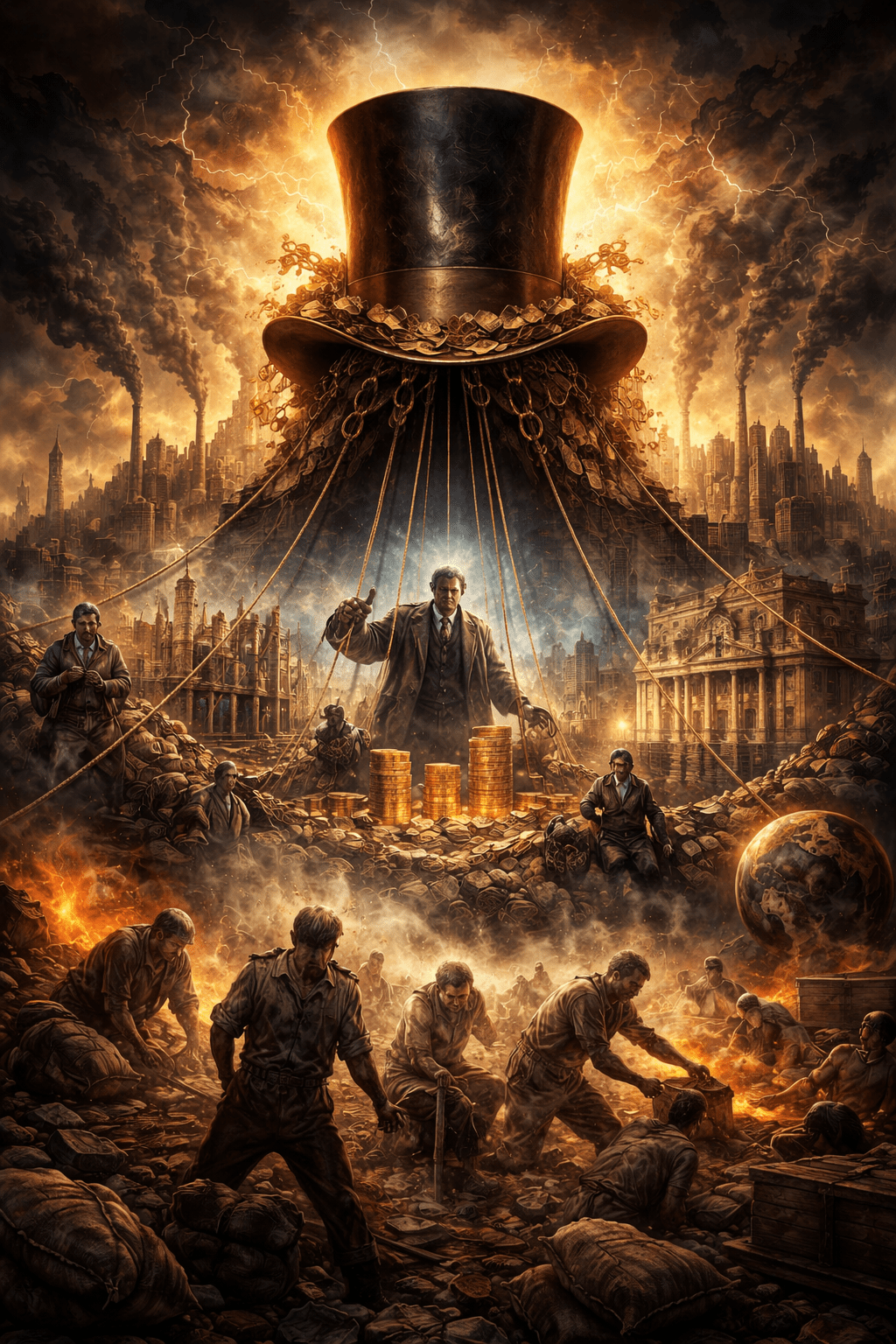
A Weaponized Intellects reconstruction of Capital, Volume III that follows Marx step by step through the world of profit, interest, rent, credit, and crisis—showing how capitalism perfects its rule not by hiding exploitation outright, but by dissolving it into normality, fairness, and common sense, until only class struggle can tear the veil away.
By Prince Kapone | Weaponized Information | Weaponized Intellects Book Review | January 10, 2026
When Surplus-Value Loses Its Name and Becomes “Profit”
Marx opens Capital, Volume III by posing a problem that looks technical but is politically explosive. If surplus-value arises only from living labor, why does profit present itself as the return on total capital? Why does the capitalist not see unpaid labor, but instead see a percentage yield on machinery, buildings, and wages taken together? Marx does not answer this by accusation or rhetoric. He answers it by following the form capital itself imposes on consciousness.
The decisive shift occurs with what Marx calls the cost-price. In the everyday calculation of the capitalist, constant capital and variable capital no longer appear as qualitatively different. Machinery, raw materials, and wages are reduced to a single outlay that must be recovered and exceeded. Once this reduction takes place, the distinction that mattered so much in Volume I—the difference between dead labor and living labor—vanishes from view. Surplus-value has not disappeared. It has changed its name.
Profit is surplus-value seen from the standpoint of capital. Nothing in production has altered. Workers still produce more value than they receive. The working day is still split between necessary labor and surplus labor. But this division no longer structures how the system presents itself. What confronts the capitalist is a simple comparison between total costs and total return. Exploitation does not announce itself as theft of time. It appears as successful investment.
Marx insists on the precision of this illusion. Profit does not appear to arise from labor because labor no longer appears as the source of value in capitalist calculation. Capital seems to expand itself. The factory, the machine, the advance of money all look productive in their own right. This is not because capitalists are foolish or malicious. It is because the social form of capital organizes perception in this way. The system teaches its own categories through daily practice.
This is the first major disappearance of exploitation in Volume III. It is not denied. It is not refuted. It is absorbed into normality. Surplus-value continues to flow, but it flows through a form that conceals its origin. Profit becomes the universal language of success, while labor retreats into the background as a mere cost of doing business. Capital’s domination deepens precisely because it now looks reasonable.
Marx’s discipline here is ruthless. He does not yet introduce competition, prices of production, or crisis. He stays with the form as it appears to the individual capitalist. Before capitalism can be exposed as a system of social domination, it must first be shown to function smoothly in its own terms. Volume III begins not with breakdown, but with normality—and that is what makes it dangerous.
By ending this opening movement here, Marx prepares the next problem without solving it prematurely. If profit appears to arise from total capital, then why do capitals with very different compositions earn similar rates of profit? The illusion has been established. Now it must be socialized. Only then can Marx show how exploitation disappears more completely as capitalism becomes more developed, more rational, and more ordinary.
When Competition Makes Exploitation Look Fair
Having established why profit appears to arise from total capital, 0 immediately sharpens the problem. If profit is calculated as a return on the whole capital advanced, then why do capitals with radically different compositions—some heavy in machinery, others heavy in labor—tend to earn similar rates of profit? If surplus-value comes only from labor, unequal exploitation should produce unequal profits. Yet capitalist reality stubbornly refuses this outcome. Marx does not resolve the contradiction by abandoning his theory. He follows competition as the mechanism that makes the contradiction appear resolved.
Competition enters not as an external disturbance but as the normal life of capital. Individual capitals confront one another as rivals compelled to move, invest, innovate, and expand or be eliminated. Through this struggle, surplus-value produced in different spheres is pooled and redistributed. Capital does not reward the amount of labor exploited in a single enterprise; it rewards participation in the social process of exploitation as a whole. Profit ceases to appear as the outcome of a particular labor process and reappears as the average return of capital as such.
Marx’s move here is exacting. He does not deny that different capitals extract different quantities of surplus-value. He shows that competition cancels these differences at the level of appearance. Capitals with high organic composition—heavy machinery, less labor—receive more profit than they themselves produce. Capitals with low organic composition—labor-intensive production—receive less. Exploitation is redistributed, not erased. What is equalized is not labor, but profit.
This equalization produces a powerful ideological effect. Capitalists now appear as equals. Profit seems to arise from the mere fact of owning and advancing capital, regardless of how much labor is actually exploited in any given workplace. The social character of exploitation is masked by the private experience of competition. Each capitalist fights others for market share, yet all benefit from the unpaid labor of the working class as a whole.
Marx is careful to discipline the reader here, because this is where many critics lose their footing. He does not retreat from the law of value. He deepens it. Value no longer regulates individual prices directly; it regulates the system behind their backs. The law of value operates socially, through competition, by redistributing surplus-value across capitals. What looks like deviation is, in fact, domination operating at a higher level.
This is the second disappearance of exploitation. In Part I, exploitation vanished into profit. Here, it vanishes into fairness. Equal rates of profit make capitalism look just. Differences between firms appear as differences in efficiency, risk, or innovation, not as different relations to labor. The antagonism between capital and labor is displaced by rivalry within capital itself.
Marx refuses to moralize this process. Competition does not deceive capitalists; it educates them. It trains them to see profit as the natural return on capital and to forget its origin in labor entirely. The system does not rely on lies. It relies on social practice repeated daily, enforced by survival, and confirmed by results.
By ending this section here, Marx sets up the decisive next step without crossing it. If competition equalizes profit rates, then individual commodity prices must systematically diverge from their individual values. The law of value has not disappeared—but it no longer appears where bourgeois economics expects to find it. To show how it continues to rule invisibly, Marx must now introduce the concept that vulgar critics most fear: prices of production.
Prices of Production: How the Law of Value Rules by Vanishing
With competition equalizing profit rates, Marx now confronts the consequence that bourgeois economics treats as either trivial or fatal: commodities no longer exchange at their individual values. If capitals of different compositions receive the same average rate of profit, then prices must systematically diverge from the labor-time embodied in each commodity. This is not a flaw in Marx’s analysis. It is the phenomenon he set out to explain. The task here is not to save appearances, but to explain why appearances look the way they do.
Marx introduces the concept of prices of production to resolve the contradiction without dissolving it. A commodity’s price of production is its cost-price plus the average profit. This price does not reflect the specific surplus-value produced in that enterprise, but the socially distributed surplus-value of capital as a whole. The market no longer mirrors labor directly. It refracts it through competition. Value does not disappear; it changes its mode of expression.
This is the point where vulgar critics flee, because Marx refuses the comfort of immediacy. If one expects the law of value to appear transparently in each price, one has already misunderstood capitalism. Marx shows that capitalism functions precisely because value does not appear where it is produced. Exploitation governs the system most effectively when it cannot be read off the surface of exchange.
Marx is relentless in clarifying what remains invariant beneath these transformations. Total value equals total price. Total surplus-value equals total profit. Nothing has been lost, added, or conjured out of thin air. The redistribution of surplus-value through prices of production conceals exploitation locally while preserving it globally. The law of value no longer disciplines individual producers directly; it disciplines capital as a social total.
This displacement has decisive ideological consequences. Once prices of production dominate exchange, labor-time becomes unreadable in everyday life. The worker sees wages and prices. The capitalist sees costs and returns. No one sees surplus labor directly. The system appears governed by technical necessity rather than social relations. Capitalism begins to look like an objective mechanism rather than a historical form of domination.
Marx insists that this invisibility is not accidental. It is the condition of capitalist stability. If commodities exchanged transparently according to the labor exploited in each workplace, the antagonism between capital and labor would be immediate and explosive. Prices of production diffuse responsibility. Exploitation is socialized, anonymized, and normalized.
This is why Volume III is so dangerous to bourgeois thought. It shows that capitalism does not violate the law of value in order to function. It fulfills it. The law of value operates most powerfully when it is least visible, regulating accumulation behind the backs of all participants. What appears as deviation is domination at a higher level of abstraction.
Marx ends this movement without reassurance. Prices of production do not resolve capitalism’s contradictions; they stabilize them temporarily. By concealing exploitation more completely, they allow accumulation to proceed further and faster. But this very success generates new pressures within capital itself. Having shown how value disappears into price, Marx now turns to the internal contradiction that this process intensifies: profit as both the motor of accumulation and its limit.
Profit as Motor, Profit as Barrier
Having shown how the law of value continues to rule by vanishing into prices of production, 0 now confronts a contradiction that does not arise from misunderstanding but from success. Capital accumulates by increasing productivity. It introduces machinery, reorganizes labor, and replaces living work with dead labor to cheapen commodities and outcompete rivals. Yet the very movement that secures profit in the short run undermines profit in the long run. Marx does not announce a crisis theory here; he exposes a pressure built into accumulation itself.
The core of the problem is the rising organic composition of capital. As accumulation proceeds, a growing share of total capital is invested in machinery, technology, and materials, while a shrinking share is invested in labor-power. But surplus-value arises only from living labor. Capital thus finds itself compelled to reduce the relative source of its own valorization in order to survive competition. The system advances by eroding the foundation on which its profits rest.
Marx is meticulous in refusing shortcuts. He does not claim that profit must collapse automatically, nor that history obeys a mechanical timetable. He identifies a tendency, not a destiny. The rate of profit tends to fall because the mass of capital grows faster than the mass of surplus-value extracted from labor. Accumulation intensifies the contradiction between capital’s need to expand and its dependence on a shrinking source of value.
Capital responds to this pressure through counteracting factors. It lengthens the working day, intensifies labor, cheapens elements of constant capital, expands into new markets, and exploits labor more ruthlessly wherever possible. These measures do not resolve the contradiction; they manage it. They restore profitability temporarily by deepening exploitation and extending domination. Each countermeasure postpones the problem while raising the stakes.
This is why Marx insists that the falling rate of profit is not a theory of collapse but a theory of instability. Capitalism does not break because it fails to exploit enough. It destabilizes because it exploits too effectively. The same drive that revolutionizes production also produces chronic tension between accumulation and profitability. Profit becomes both the engine that propels the system forward and the barrier it repeatedly crashes into.
The ideological significance of this movement is decisive. As long as profit appears as a simple return on capital, accumulation looks rational and self-justifying. Once profitability comes under pressure, the system’s violence reasserts itself. Workers are disciplined, wages are squeezed, markets are conquered, and nature is stripped. What appeared as neutral economic necessity reveals itself as class power defending itself against its own limits.
Marx holds the line here with discipline. He does not turn tendency into prophecy. He shows how capitalism reproduces its contradictions through normal operation, not malfunction. The falling rate of profit is not an external threat; it is the shadow cast by accumulation itself. The system survives by fighting against the consequences of its own success.
By ending this section here, Marx prepares the reader for the next displacement of illusion. As profitability tightens, capital seeks new arenas where profit appears detached from production altogether. Circulation begins to look productive in its own right. Merchant capital steps forward, offering profit without labor—at least on the surface. The disappearance of exploitation is about to deepen once again.
Profit Without Production: The Mirage of Circulation
With the inner pressure on profitability established, 0 turns to a form of capital that seems to offer relief from production altogether. Merchant capital appears to generate profit not by organizing labor, but by buying and selling. To the surface eye, circulation itself looks productive. Commodities move, markets expand, margins are realized. Exploitation seems to recede as profit presents itself as the reward for mediation, speed, and commercial acumen.
Marx dismantles this appearance with precision. Merchant capital adds no value. It does not transform materials, apply labor, or create surplus. Its function is to shorten circulation time and to specialize in the movement of commodities. These functions are necessary for capital as a whole, but necessity is not creation. The merchant’s profit is not newly produced; it is a portion of surplus-value already extracted in production and ceded to circulation for services rendered.
This cession is structural, not accidental. By offloading circulation to specialized capitals, industrial capital accelerates turnover and expands accumulation. Faster realization means faster reinvestment. The merchant’s cut is the price capital pays to keep value in motion. What looks like independent profit is, in reality, a redistribution arranged within the capitalist class. Labor remains the source; circulation rearranges claims.
The ideological payoff is substantial. Once profit appears to arise from circulation, exploitation is displaced even further from view. The worker no longer confronts only the factory owner, but a maze of intermediaries—wholesalers, retailers, logistics firms—each presenting profit as the outcome of coordination rather than appropriation. Capital fragments responsibility while consolidating power.
Marx is careful not to caricature the merchant as a cheat. The illusion does not depend on fraud. It depends on form. Circulation really does realize value, and realization is indispensable to accumulation. But realization presupposes production. No amount of buying and selling can conjure surplus-value where none has been created. Remove living labor, and circulation becomes empty motion.
As capitalism develops, this illusion intensifies. Expanding markets, global trade, and complex supply chains elevate circulation to strategic prominence. Profit appears increasingly detached from the shop floor. Yet this detachment is only apparent. The more circulation dominates perception, the more exploitation must be organized elsewhere to sustain it. The shine of commerce rests on the dull compulsion of labor.
By situating merchant capital here, Marx tightens the dialectic rather than loosening it. Profit has already lost its origin in labor and then been equalized through competition. Now it seems to arise from movement itself. Each step deepens the disappearance of exploitation while extending domination. The next step will push this illusion to its limit, where capital appears to generate profit without even touching commodities at all.
With circulation crowned as productive in appearance, Marx is ready to confront the most powerful fetish of all. Interest-bearing capital will present profit as the natural yield of ownership alone. Capital will no longer need production or trade to justify itself. It will appear to grow simply by existing.
Capital as Fetish Pure: When Ownership Alone Appears Productive
With merchant capital having completed the illusion that profit can arise from circulation, 0 now descends into the most mystified terrain of all. Interest-bearing capital appears to sever profit from production and circulation alike. Money is lent and returns as more money. No factory needs to be entered, no commodity needs to be handled. The circuit collapses into its starkest form: M–M′. Capital seems finally to have achieved autonomy, generating value by the mere fact of ownership.
Marx insists that this appearance is not a theoretical mistake but a real social form. Interest is not invented by misunderstanding; it is produced by the division of surplus-value between different fractions of capital. The functioning capitalist extracts surplus-value by organizing production. The money-capitalist claims a portion of that surplus simply by owning capital and making it available. Exploitation remains the source, but its trail is now almost completely erased.
The split between profit of enterprise and interest is decisive. Profit no longer appears as the result of exploiting labor, but as a managerial reward for activity, risk, or competence. Interest, meanwhile, appears as the natural yield of money itself. Capital is divided into “active” and “passive” forms, allowing ownership to masquerade as productivity and command to masquerade as contribution. The social relation hardens into a thing-like property.
This is why Marx calls interest-bearing capital the most fetishized form of capital. Here, all mediations disappear. The worker is nowhere in sight. The factory vanishes. Even the merchant recedes. Capital confronts society as an automated power that seems to valorize itself. Money appears pregnant with money. Domination presents itself as arithmetic, as contract, as percentage yield.
Credit intensifies this fetish dramatically. By pooling capital, advancing claims on future surplus-value, and multiplying financial titles, the credit system generates what Marx calls fictitious capital—paper claims that circulate as if they were real value. These claims do not represent new labor performed; they represent expectations of future exploitation. Capital appears to expand beyond its material base, floating above production while remaining parasitic upon it.
The ideological effect is profound. Once interest-bearing capital dominates perception, exploitation no longer appears as a relation between classes. It appears as a technical feature of finance, a matter of rates, liquidity, and confidence. Power dissolves into numbers. The social relation that binds labor to capital is re-presented as a neutral mechanism governing money itself.
Marx is unsparing here. Interest-bearing capital does not civilize capitalism; it perfects its mystification. It allows entire layers of society to live off labor they never see, through instruments they do not understand, justified by categories that seem natural and eternal. Capital’s rule becomes impersonal, abstract, and therefore harder to challenge.
By ending this movement within interest-bearing capital, Marx brings capitalist appearance to its highest intensity. Exploitation has not merely disappeared; it has been transformed into a property of things. Yet this perfection carries its own fragility. The more capital detaches itself from production in appearance, the more violently it must return there in reality. Credit does not abolish limits. It stretches them. And stretched limits snap.
With capital now appearing as a self-moving, self-expanding power, Marx is prepared to show how this illusion collapses in motion. Credit that seems to stabilize accumulation instead accelerates contradiction. Crisis will appear next—not as the revelation of exploitation, but as a monetary breakdown that capitalism itself struggles to explain.
Credit and Crisis: When Illusion Accelerates Breakdown
With interest-bearing capital elevated to its purest fetish, 0 does not introduce crisis as an external shock or moral failure. He shows it emerging from within the very mechanisms that seemed to stabilize accumulation. Credit, which appears to smooth production and overcome limits, in fact binds the system more tightly to its own contradictions. What looks like lubrication becomes acceleration.
Credit allows capital to leap ahead of its immediate foundations. It mobilizes idle money, pools social capital, and advances claims on future surplus-value. Accumulation speeds up. Turnover quickens. Production expands beyond what current markets could otherwise sustain. For a time, the system appears to have solved its own problems. Profit continues, investment flows, and expansion looks self-confirming. But this confirmation is built on anticipation, not realization.
Marx is precise about the illusion at work. Credit does not create value. It creates claims on value yet to be produced. These claims circulate as if they were capital itself, multiplying titles to future surplus without expanding the labor that alone can generate it. The gap between production and realization widens, but it is concealed by confidence, speculation, and paper wealth. Capital appears stronger precisely as it becomes more fragile.
When realization falters, the illusion shatters. Crisis appears first not as exploitation laid bare, but as a monetary breakdown. Payments fail. Credit freezes. Values that seemed solid evaporate overnight. What collapses is not production itself, but the network of claims layered atop it. Capital confronts its own limits as a crisis of money, liquidity, and trust rather than as a crisis of labor and surplus-value.
This displacement is decisive. Crisis does not immediately clarify exploitation; it mystifies it further. Workers experience unemployment, wage cuts, and insecurity, while the language of explanation turns to financial excess, mismanagement, or loss of confidence. The system presents its own contradictions as technical malfunctions. Responsibility dissolves into abstractions—markets, sentiment, volatility.
Marx insists that this mystification is functional. Credit allows capitalism to expand beyond its limits without resolving them, then to restore profitability by destroying value when those limits are reached. Bankruptcies, devaluations, and mass unemployment are not accidents. They are methods through which capital reasserts discipline over labor and smaller capitals alike. Crisis clears the ground for renewed accumulation at a higher level of concentration.
The state inevitably enters here, though Marx does not yet foreground it. In moments of crisis, neutrality evaporates. Power intervenes to protect accumulation, stabilize credit, and preserve ownership. Losses are displaced downward while claims at the top are defended. What appeared as an impersonal financial system reveals itself as organized social power acting under emergency conditions.
Marx’s discipline remains intact. He does not present crisis as capitalism’s automatic end. He presents it as capitalism’s violent way of continuing. Credit does not abolish contradiction; it postpones and amplifies it. Each cycle expands the scale of production and the scale of breakdown together. Stability becomes shorter-lived, disruption more severe.
By situating crisis within credit, Marx completes the illusion he has been constructing since the opening chapters. Exploitation disappears first into profit, then into equalized returns, then into circulation, then into ownership, and finally into finance. Crisis erupts not as revelation, but as confusion. To move beyond this confusion, Marx must expose the last great mask—one that presents domination as a property of nature itself.
When Nature Appears to Produce Value
After credit and crisis have completed the illusion that capital can expand independently of labor, 0 turns to a form of income that seems even older, even more natural, and therefore even harder to dislodge. Ground-rent appears to arise from the land itself. Soil yields crops. Location yields advantage. Nature, it seems, produces wealth, and the landlord merely collects what the earth provides. Exploitation has now been displaced beyond capital altogether.
Marx approaches rent with the same discipline he has applied throughout Volume III. He does not deny natural differences. Some land is more fertile, better located, or easier to cultivate than other land. But fertility does not create value. Location does not generate surplus. Nature provides use-values, not value. Value arises only where living labor is applied. Rent, therefore, cannot be explained by nature. It must be explained as a social relation.
The key lies in monopoly. Land is not produced by labor, but it is owned. This ownership allows landlords to exclude capital unless tribute is paid. Rent is not a reward for contribution; it is a deduction from surplus-value enforced by property relations. The capitalist pays rent not because the land creates value, but because access to land is monopolized. Nature becomes the mask through which social power operates.
Marx distinguishes carefully between forms of rent without losing the thread. Differential rent arises because equal capitals applied to unequal land yield different quantities of surplus-profit. Absolute rent arises because landed property itself blocks the free movement of capital, preventing profit rates from fully equalizing. In both cases, rent is not a new source of value. It is a claim on surplus-value already produced by labor.
This analysis completes the triad of capitalist mystification. Profit appeared to come from capital. Interest appeared to come from money. Rent now appears to come from land. Each form detaches income further from labor, while labor remains the sole source of value throughout. By the time rent is fully established, exploitation has been dispersed across capital, finance, and nature itself.
The ideological power of rent is immense. If land yields income naturally, then inequality appears rooted in geography rather than social relations. Ownership becomes destiny. History dissolves into soil, climate, and location. Class antagonism is recoded as natural difference. The landlord appears not as an appropriator, but as a steward of nature’s gifts.
Marx’s intervention strips this appearance bare. Land does not exploit workers; landlords do. Nature does not impose rent; property does. What looks eternal is historically produced and legally enforced. Rent exposes capitalism’s ability to naturalize domination by attaching it to things that seem beyond human control.
By situating ground-rent here, Marx completes the movement through capital’s major forms of appearance. Exploitation has now been displaced into capital, circulation, money, credit, and nature itself. The system no longer appears as a social relation at all. It appears as the normal functioning of the world. Only one step remains: to gather these appearances into a single ideological formula that presents capitalism as timeless common sense.
The Trinity Formula: How Exploitation Vanishes Completely
In the final analytical movement of 0, 1 gathers everything that has preceded into a single ideological structure. What had appeared piecemeal—profit without labor, interest without production, rent without exploitation—now coheres into a worldview. Capitalism presents itself as a harmonious system in which each “factor of production” receives its due. Labor earns wages. Capital earns profit. Land earns rent. Exploitation does not merely hide here; it disappears entirely.
Marx calls this the trinity formula, and he treats it as the completed religion of bourgeois society. Each element of the formula corresponds to a real revenue stream, but none corresponds to a real source of value. Wages appear as payment for labor itself rather than labor-power. Profit appears as the productive power of capital rather than the appropriation of surplus labor. Rent appears as the natural yield of land rather than a monopoly claim enforced by property relations. The social relations that produce these revenues are erased, replaced by things that seem to generate income on their own.
This is not a theory invented by economists. It is the spontaneous ideology of capitalist society itself. Every participant experiences the system from within one branch of the trinity. The worker encounters wages. The capitalist encounters profit. The landlord encounters rent. Each experience appears self-contained, complete, and justified. The system no longer needs to explain exploitation, because exploitation no longer appears to exist.
Marx’s intervention here is devastating precisely because it is so calm. He does not argue that the trinity is morally wrong. He shows that it is conceptually empty. None of its elements explains the creation of value. All of them presuppose surplus-value already produced. The trinity does not describe how capitalism works; it describes how capitalism is misrecognized once it works well enough.
This is why bourgeois political economy finds its natural home here. Once the trinity is accepted, economics becomes the study of allocation rather than production, distribution rather than exploitation. Questions of justice are reduced to questions of balance. Class antagonism dissolves into technical optimization. Capitalism appears not as a historical system, but as the rational organization of reality itself.
Marx insists that this appearance is not accidental. It is the ideological payoff of all the transformations traced throughout Volume III. The law of value has not been abolished; it has been buried beneath layers of mediation. Exploitation has not been overcome; it has been rendered invisible. The system now reproduces itself not only materially, but cognitively. People live inside its categories as if they were natural facts.
The trinity formula marks the endpoint of capitalist mystification. Nothing lies beyond it within political economy. Once capital, land, and labor appear as eternal sources of revenue, critique seems unnecessary and revolution unthinkable. Capitalism no longer looks like a system that emerged historically. It looks like the way the world has always been.
It is no accident that Marx ends his theoretical exposition here. The trinity formula is not just an idea to be refuted; it is a social reality to be broken. And this is where theory reaches its limit. To go further would require leaving the realm of economic categories altogether and entering the terrain Marx deliberately refuses to theorize abstractly—the terrain of classes, struggle, and political rupture.
Classes: Where the Critique of Capital Must Become the Critique of Power
The final chapter of 0 breaks off because 1 did not live to finish it. 2, editing from unfinished manuscripts, refused to speculate beyond what Marx left behind. That biographical fact must be stated plainly. But the theoretical trajectory Marx had already laid down across Volumes I, II, and III is not opaque. The path is visible. The method is intact. What remains is to follow the logic Marx himself had set in motion.
Across the three volumes, Marx has been moving steadily from production to circulation to appearance. Volume I exposes exploitation at its source: surplus labor extracted in the labor process. Volume II traces how that surplus-value circulates and reproduces itself socially through turnover, realization, and expanded reproduction. Volume III shows how this same surplus-value is fragmented, redistributed, and mystified into profit, interest, and rent—forms in which exploitation disappears entirely from view. By the time Marx reaches the question of class explicitly, the economic categories that structure bourgeois consciousness are already complete.
This is the decisive point. Classes do not enter Marx’s analysis as sociological groupings or income brackets. They emerge as the living bearers of those revenue forms whose logic has just been dismantled. The capitalist class appears not because profit exists, but because profit presupposes ownership of the means of production. The landlord class appears not because land is productive, but because rent presupposes monopoly over a condition of production. The working class appears not because wages are paid, but because labor-power has been separated from the means of life and compelled to sell itself.
Had Marx completed this chapter, he would not have abandoned the discipline he maintained throughout Capital. He would not have reduced classes to moral actors or abstract identities. He would have shown how class positions crystallize out of the revenue forms already analyzed—how profit, interest, and rent harden into social power, legal rights, political institutions, and ideological dominance. Class, in Marx’s method, is not an added layer. It is the social reality that economic forms presuppose but conceal.
Crucially, Marx would not have treated classes as static. The entire movement of Capital shows that class relations are dynamic, antagonistic, and historically unstable. Accumulation concentrates capital, polarizes society, and continuously reproduces the working class as a class of dispossession. At the same time, it fractures the ruling class into competing fractions—industrial, commercial, financial, landed—whose unity is real but never harmonious. Class struggle is not external to political economy; it is the social form through which its contradictions are fought out.
The unfinished state of this chapter therefore does not leave us with silence, but with responsibility. Marx has already given us the tools to understand class as the convergence point of exploitation, domination, and struggle. What cannot be completed abstractly is the concrete history of how these classes act, align, fracture, and confront one another under changing conditions. That history cannot be deduced from categories alone. It unfolds through organization, conflict, repression, revolt, and revolution.
Engels’ refusal to complete the chapter is itself faithful to Marx’s method. To have invented a finished theory of classes detached from historical struggle would have violated the entire movement of the work. Capital explains how capitalism reproduces itself. It does not script how it will be overthrown. That task belongs not to the manuscript, but to the classes whose existence the manuscript has made intelligible.
Read this way, Capital does not end in incompleteness, but in transition. The critique of political economy reaches the point where economics can no longer substitute for politics. The categories have been stripped of their innocence. The mystifications have been exposed. What remains is no longer theory alone, but struggle conducted by real classes in real history. Marx did not fail to finish this chapter. He carried us as far as critique could go—and then handed the problem back to the world.
Engels as Custodian: Supplement, Not Substitution
Any serious engagement with 0 must reckon with the fact that what we read is not a finished book authored linearly by 1, but a reconstruction assembled by 2 from notebooks, fragments, drafts, and partially developed arguments. Engels does not hide this. On the contrary, he foregrounds it. His supplementary remarks, editorial notes, and appended clarifications are acts of discipline rather than authority. They aim to preserve Marx’s method, not to replace it with Engels’ own system.
Engels’ supplements serve a specific function. They stabilize what Marx had already set in motion without closing what Marx left open. Where Marx had outlined trajectories—especially in relation to credit, crisis, and landed property—Engels clarifies references, resolves unfinished calculations, and situates arguments historically. But he repeatedly resists the temptation to complete Marx’s theory in areas where completion would require speculative synthesis rather than textual fidelity. This restraint is not editorial weakness. It is methodological loyalty.
Nowhere is this more evident than in Engels’ treatment of crisis and finance. Engels adds historical texture drawn from late nineteenth-century capitalism—banking developments, joint-stock companies, speculative manias—not to update Marx into a new theory, but to demonstrate how Marx’s categories already anticipate these developments. Engels’ intervention shows that Marx’s analysis does not age because it is not descriptive reportage. It is structural critique. The supplements illuminate this by placing empirical flesh on theoretical bone.
At the same time, Engels is careful to mark the limits of his additions. He does not claim that Marx had resolved every problem of credit, crisis periodicity, or class configuration. Instead, he emphasizes that capitalism itself continues to develop, producing new forms that nonetheless obey the same underlying relations Marx identified. Engels’ role is not to modernize Marx, but to show why Marx does not need modernization to remain dangerous.
This distinction matters politically. Engels’ supplements have often been misused by later Marxists as a license for system-building—turning Capital into a closed doctrine rather than an open weapon. Read properly, Engels does the opposite. He preserves the unfinished quality of the work where unfinishedness reflects historical movement rather than conceptual failure. He guards Marx’s refusal to confuse economic analysis with political prophecy.
Engels’ contribution to Volume III therefore completes this review not by adding new conclusions, but by reinforcing the central lesson of the entire project. Capital is not a theory of equilibrium, nor a manual for reform, nor a crystal ball. It is a critique that reveals how domination reproduces itself through ordinary economic life, and why that reproduction generates antagonisms no amount of technical adjustment can dissolve.
In preserving Marx’s method, Engels preserves the book’s revolutionary function. He ensures that the critique of political economy remains a critique of power, not a scholastic exercise. The supplements do not soften Marx. They sharpen him—by refusing to let the work harden into dogma or close itself off from history.
Read together, Marx’s manuscripts and Engels’ editorial labor form a unity appropriate to their object. Capitalism itself is unfinished, crisis-prone, and historically unstable. A finished, sealed theory of it would be a lie. What Volume III gives us instead—through Marx’s analysis and Engels’ custody—is something more useful: a weapon that remains open, adaptable, and oriented toward struggle.
 Weaponized Information
Leave a comment