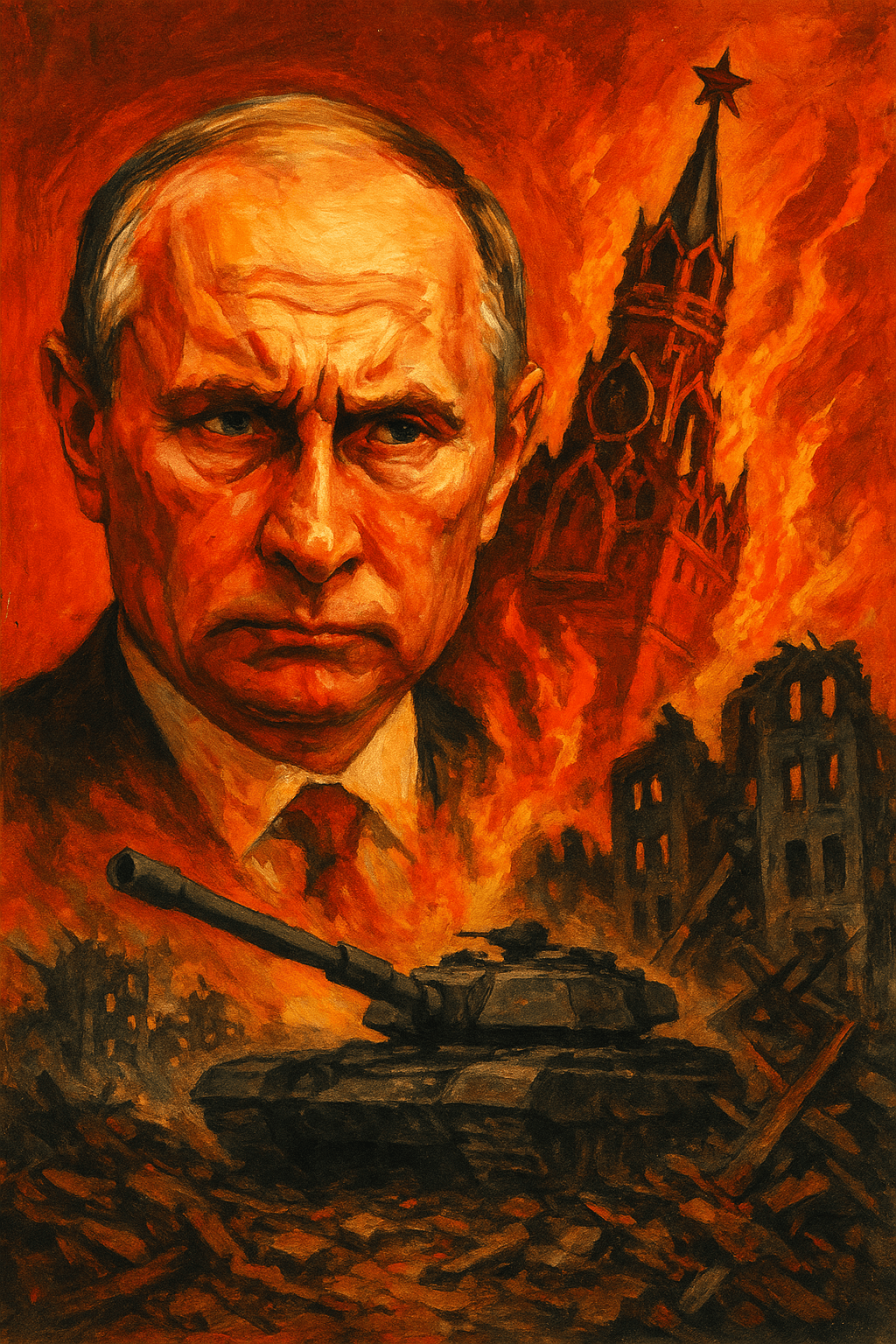
This essay tears the mask off The Economist’s collapse narrative and exposes it as imperial comfort food for a ruling class terrified of losing the world it once controlled. It then digs beneath the rubble of Western claims to recover the independent, Global South–verified facts that reveal the real architecture of the war. With those facts in hand, it reframes the conflict through the lens of multipolar transition, exposing the crisis of unipolar power the West cannot admit. Finally, it maps the forces already resisting this order and lays out concrete strategies for building proletarian, internationalist power in the cracks of a collapsing empire.
By Prince Kapone | Weaponized Information | November 17, 2025
The Collapse Narrative as Imperial Comfort Food
The Economist’s latest dispatch, “Vladimir Putin Has No Plan for Winning in Ukraine”, arrives dressed in the authority of Western expertise but reads like a sermon to a rattled empire trying to steady its own hand. The magazine claims that Russia’s war effort is collapsing, that Putin is running out of options, and that Ukraine—buoyed by Western resolve—stands firm on the edge of victory. It packages battlefield assessments, casualty numbers, and political forecasts as if they were neutral observations rather than the carefully curated talking points of the NATO information complex. Before we examine the machinery behind these claims, we begin by placing the article itself on the table, not as truth, but as an artifact of a ruling class fighting to preserve the illusion that history still bends to its will.
Empires do not simply report the news; they rehearse their fears, recite their fantasies, and baptize their anxieties in the language of inevitability. When The Economist tells its readers that Russia is staggering toward a great reckoning, it is not offering analysis—it is offering reassurance. It is telling the Anglo-American elite that the world they built, the world they looted, the world slipping rapidly out of their grasp, is still theirs if they repeat the script with enough conviction. And so they craft a fable of Russian incompetence, Ukrainian invincibility, and Western unity—a bedtime story for a frightened ruling class desperate to believe history will obey their commands one more time.
What passes for “journalism” in their pages is not investigation but orchestration. Edward Carr—the magazine’s deputy editor and professional custodian of Atlanticist myth-making—functions less like a reporter and more like a conductor in an orchestra of imperial projection. He sets the pace, cues the violins of moral outrage, signals the brass of triumphalism, and ensures the entire ensemble plays in tune with Washington, London, and Brussels. Everything has its place: Russia must be lurching toward collapse; Ukraine must be sturdy and pure; Europe must be calm and coherent; and the United States must be the adult in the room, even when governed by a real-estate showman with the attention span of a fruit fly. If any of these notes falter, the whole ideological symphony risks falling apart.
The task of this opening section is not to argue with Carr’s presentation, nor to fact-check the magazine’s breathless casualty numbers and battlefield tallies. To do so would grant the narrative a legitimacy it has not earned. Instead, we strip it down to its machinery—its gears, its levers, the psychological tricks it uses to convert imperial decline into imperial confidence. Look closely and the pattern reveals itself: inflated figures offered with priestly certainty; hysterical predictions disguised as sober foresight; history deployed not as a teacher but as a cudgel; morality weaponized to sanctify proxy war; and, above all, a suffocating sense of inevitability, as though geopolitics were a Greek tragedy written in advance.
This inevitability is the key. When The Economist declares Russia’s defeat as preordained, it is not describing reality—it is prescribing it. It is demanding that reality conform to the fantasies of the imperial core. It is telling its readers: do not look at the collapse of Western hegemony; do not examine the fractures in Europe; do not question the wisdom of pouring billions into a proxy war that has drained Ukrainian society to the bone. Instead, believe that history is still ours. Believe that multipolarity is a glitch, not a transition. Believe that the world will come back to its senses and return obediently to the chokehold of the dollar, the boot of NATO, and the austerity gospel of the IMF.
But beneath the rhetoric lies the quiet terror of an empire that has lost its mandate. The Economist’s story of Russian collapse is not about Russia at all—it is a mirror reflecting the West’s own crisis of direction, legitimacy, and strategic imagination. It is the ideological coping mechanism of a class that cannot admit it is losing the world it built on sweatshops, coups, and structural adjustment. And so they cling to the fiction that Russia is the one spiraling, that Putin is the one cornered, that the world remains neatly divided between the civilized and the barbaric.
Our work, then, begins with the scalpel. We place the narrative on the table, dissect the organs of manipulation, and name the anatomy of the lie. Only by exposing the machinery can we move to the next stage—extracting the independent, verifiable, Global South–anchored truths that the Atlanticist story seeks to bury. But first, we must understand the story they tell themselves when the world they own is slipping away. This is the task of excavation: revealing the imperial psyche at the moment it confronts its own decline.
Excavating Reality from Beneath the Rubble of Western Claims
Strip away the smoke grenades of Western narrative management and the battlefield looks radically different. The Economist builds its scaffolding out of unverified numbers, recycled talking points, and the narrative architecture of Western intelligence services. Their casualty figures originate in anonymous U.S. intelligence leaks, amplified across Euro-Atlantic think-tank compilations that operate as echo chambers for the same strategic worldview. Their assessments of Russian “collapse” lean on a Western press corps that even intelligence veterans describe as functionally embedded within state propaganda systems. Beneath this fog lies the doctrine that actually governs Western war reporting: NATO’s formalization of narrative warfare through its StratCom Centers, the U.S. Army’s public-facing information operations embedded into combat doctrine, and the wider push within U.S. special operations circles toward cognitive warfare as a strategic weapon. What The Economist presents as impartial analysis is, in fact, a curated product of a formalized information battlespace.
Yet propaganda always reveals itself by what it cannot say. The first forbidden truth is the one Angela Merkel and François Hollande admitted after leaving office: the Minsk Agreements were never meant to resolve the conflict—they were designed to buy time and arm Ukraine for a future war. Long before 2022, the country was already embedded in NATO’s military architecture through training pipelines and deep structural integration, as documented in the Atlantic policy blueprint “Between Now and NATO”. Ukraine’s battlefield operations depend on U.S. intelligence to such an extent that even flagship systems like HIMARS require U.S.-provided targeting coordinates, and European reporting acknowledges that when Washington pauses those feeds, Kyiv’s strike capability collapses. Beyond the battlefield, the vast majority of the world refuses to join the Western sanctions crusade, a stance explained by Global South economists as a rejection of neocolonial economic coercion rooted in historical memory, and echoed in interviews such as Jeffrey Sachs’ warning that U.S.-EU pressure has produced near-universal Global South nonalignment. Europe itself is splintering under the weight of the conflict: Foreign Affairs now openly warns of “war fatigue”, the European Investment Bank documents inflationary shocks tied to sanctions driving living costs to historic highs, and street protests erupt across EU states in response to austerity and energy strain from Madrid to Prague. These are the structural realities the Western narrative must suppress.
But nowhere is the gap between narrative and reality more visible than in Russia itself. Far from economic implosion, Russia has posted annual GDP growth exceeding that of multiple G7 economies, a fact the IMF and World Bank quietly acknowledge through upward revisions. Independent financial analysis concludes that Russia’s economy has continued to outperform expectations despite unprecedented sanctions pressure, while even the anti-Russian Chatham House concedes that the “Fortress Russia” model has adapted, reorganized, and stabilized. Its energy flows have been re-routed almost entirely toward Asia, with Reuters reporting that China and India now absorb the majority of Russian seaborne crude, a finding reinforced by ECB analysis of Russian export realignment after the EU embargo. CREA’s monthly assessments further demonstrate that Russian fossil fuel flows to “friendly” states remain high and resilient. Militarily, Russia’s industrial base far outpaces NATO’s: Business Insider cites NATO commanders acknowledging that Moscow is producing ammunition at a rate that could yield a stockpile triple that of the U.S. and EU combined, while Euronews reports Russia is generating more shells in three months than NATO can produce in a year. This industrial revival coincides with high domestic political cohesion: the Levada Center continues to record strong approval for the Russian government and majority support for the military campaign throughout 2023–24. These are not the coordinates of a collapsing state—they are the hallmarks of adaptive consolidation.
By contrast, Ukraine faces a demographic crisis so severe that even its most zealous media supporters cannot conceal it. The OSW’s March 2025 assessment details a mobilisation and organisational breakdown inside the Ukrainian armed forces, a crisis echoed in Ukrainian reporting about political fear of confronting manpower realities even as shortages become critical. A separate Kyiv Independent investigation reveals a battlefield dynamic where infantry losses have produced a bleak and unsustainable rotation cycle. RFE/RL documents widespread forced recruitment and street-level press-gang tactics across major cities, while the Guardian records the rising tide of draft evasion and civilian flight from mobilization authorities. These are the mechanics of a war machine running on fumes, held together by Western financing rather than internal capacity.
Taken together, these verified facts shatter the curated image of a crumbling Russia, a heroic and united Ukraine, and a steady, principled West. They reveal instead a multipolar reality in motion: an adaptive Russian state reorienting its economy toward Asia, expanding diplomatic weight across the Global South, and restoring industrial capacities the West assumed were dead; a Ukraine struggling under the demographic, social, and political strain of a war it cannot sustain without foreign direction; a Europe dividing beneath the weight of sanctions and inflation; and a Global South refusing to be marched back onto the plantation of Western financial discipline. This is the factual terrain upon which the next section will build—not the illusions of imperial wishcasting, but the stubborn coordinates of a world where unipolar power is bleeding out in real time.
The World the Empire Cannot See: Reframing the War Through a Multipolar Lens
Once the dust settles and the imperial fairytales are cleared from the table, the war in Ukraine looks nothing like the story sold in Western newsrooms. What emerges instead is a conflict shaped not by the alleged incompetence of a single leader, but by the structural contradictions of a dying unipolar order. The Economist tells its readers that Russia “has no plan for victory” because the West cannot tolerate the truth staring it in the face: that it is the American-European project—not Russia—that is stumbling through a crisis of legitimacy, capacity, and historical direction. The war is not a morality play between good and evil; it is the frontline of a world-system struggling to reconfigure itself.
When we rebuild the narrative using only independently verified facts, the mask falls away. The United States runs Ukraine’s battlefield targeting through its unmatched intelligence architecture; Europe funds the Ukrainian state only by cannibalizing its own budgets; and Ukraine’s ability to fight rests on two crutches—Western money and Western machines—without which the entire military effort collapses. This is not an independent actor charting its destiny. It is a forward-operating NATO project, engineered to contain Russia, discipline Europe, and buy time for an empire that is rapidly losing the obedience of the Global South.
This is where Imperial Overstretch enters the picture—not as a slogan, but as an observable material process. The West is pouring billions into a proxy war while its own societies face inflation, political fragmentation, collapsing public services, and rising discontent. To sustain the illusion of strategic competence, it must insist Russia is the one on borrowed time, even as its own capacity to enforce global order erodes. The more the West strains to keep the system intact, the more brittle the system becomes. Like a muscle pulled past its limits, the imperial core cannot maintain the tension forever.
And what of Europe, that supposed bastion of unity? Strip away the propaganda, and a different reality emerges. The EU’s “solidarity” with Ukraine is less the product of conviction than of Coercive Multilateralism: U.S. pressure, financial dependency, and intra-European mechanisms of discipline that punish deviation and reward submission. Italy, Slovakia, Austria, Germany, and France are simmering with anti-war sentiment. Far-right, left-populist, and anti-establishment parties gain traction not because they share a worldview, but because the old consensus is collapsing under the weight of its own contradictions. Europe is not unified; it is held together by fear.
Meanwhile, the imperial narrative collapses entirely when confronted with the phenomenon Western media works hardest to ignore: the agency of the Global South. Most of the world refused to join the sanctions crusade. BRICS+ expanded. Yuan-settled trade surged. Africa, Latin America, and Asia openly rejected the idea that Washington or Brussels should decide the fate of the international order. This refusal is not an accident—it is Multipolar Realignment emerging in real time. The world no longer wishes to live in the shadow of NATO, the dollar, or the IMF. And so it charts a different path.
When seen through this wider lens, the battlefield in Ukraine transforms from a site of Russian miscalculation into a site where the West confronts the limits of its historical project. The West hoped a proxy war would weaken Russia, isolate China, reassert discipline over Europe, and frighten the Global South back into line. Instead, it accelerated the opposite: deeper Asia–Eurasia integration, new trade corridors beyond Western control, and a Global South more unified in its skepticism of Western rule than at any time since Bandung.
This is why the Western narrative must cling so desperately to the trope of Russian collapse. If Russia is collapsing, then the West is still ascendant. If Russia is collapsing, then multipolarity is a mirage. If Russia is collapsing, then Europe is unified. If Russia is collapsing, then the United States still commands the loyalty of a world increasingly determined to break free. The lie must be maintained because the truth is unbearable: the empire is running out of tools, out of legitimacy, and out of time.
The Economist performs the ideological labor of denying this reality. It narrates Russian defeat not to explain the world, but to comfort an anxious ruling class witnessing its centuries-long dominance slip away. Our task is the opposite: to understand the war not as the end of Russia, but as a chapter in the end of Western global supremacy. The facts tell a simple story—one the West cannot afford to tell itself. What is collapsing is not Russia. It is the worldview of those who once believed themselves the permanent managers of human history.
Building Power in the Cracks of a Collapsing Order
If the first three sections strip away illusion, part IV turns toward the living world—the terrain of struggle where people, movements, and nations carve out space against the storm of imperial decline. Because once the Western narrative is exposed as fantasy, the real question emerges with frightening clarity: What now? What do the workers, the colonized, the poor, the anti-war forces of the world do with the knowledge that the unipolar order is dying but still armed to the teeth? What do we build in the rubble of a system that cannot imagine a future without domination? This final section answers not with slogans but with material strategies rooted in the resistance already unfolding across continents.
The frontline of global dissent is not in Brussels or Washington—it is in the Global South blocs that have refused to bow to the sanctions crusade. ALBA, BRICS+, the African Union, SADC, and the East African Community have rejected the demand that they sacrifice their own development to maintain Western supremacy. South Africa drags Western crimes to the International Court of Justice. Latin American governments speak openly of sovereignty against NATO encroachment. Across Africa and Asia, nations build trade corridors outside the dollar, refusing to return to the plantation economics the IMF once enforced. Their message is simple: the world will not return to the cage.
But resistance does not flow only from states. European societies—those supposedly unified vassals of Washington—are cracking under the pressure of endless war, inflation, and austerity. Dockworkers in Italy, Belgium, and South Korea have already shown the way, halting weapons shipments and forcing governments to confront the costs of their obedience to NATO. These are not isolated acts of conscience; they are embryonic forms of proletarian internationalism, echoes of the port strikes that once blocked fascist shipments and apartheid cargo. They point to a future where workers do not merely protest imperial wars—they interrupt them.
In the Global North, the task is not to moralize about peace but to attack the imperial infrastructure at its industrial core. The war machine is not abstract; it has addresses, shareholders, quarterly earnings reports. Lockheed Martin, RTX, BAE Systems, Rheinmetall, Saab, and Thales are the architects of death, the arteries through which the proxy war pumps its blood. Without their missiles, drones, munitions, and production lines, the conflict cannot continue. To confront the war is to confront these corporations—not with polite appeals but with campaigns that target their profits, their legitimacy, and their ability to produce.
Alongside industrial disruption comes narrative disruption. The Global South speaks, but the Western public rarely hears it—not because the voices are faint, but because the imperial media filters them out. A counter-strategic communication infrastructure must rise: a translation network that amplifies AU communiqués, CELAC declarations, BRICS+ economic statements, and SADC resolutions directly into community organizations, unions, student groups, and anti-war coalitions. A thousand small media cells doing the work The Economist refuses to do: telling the truth of the global majority.
And then there is the digital front—the realm where empires increasingly wage their most insidious battles. NATO StratCom, GCHQ, and U.S. influence networks flood the infosphere with curated narratives, botnets, astroturf campaigns, and psychological operations. They rely on the public’s digital illiteracy and the disorganization of dissent. But what happens when that changes? What happens when proletarian cyber-resistance forms its own encrypted channels, its own counter-messaging networks, its own defense against the algorithms of empire? This is not a dream. It is a necessity. And it is already beginning.
The collapse of Western supremacy will not automatically give birth to a just world. History offers no such guarantees. But it does offer opportunities—cracks in the edifice where new forms of power can be built. The task of revolutionary movements today is to seize those cracks, widen them, and transform them into openings wide enough for a new internationalism to breathe. The dying empire offers only war, austerity, and surveillance. Our task is to build the opposite: solidarity, sovereignty, and mass participation in the struggle to dethrone the ruling class that brought the world to this precipice.
In the end, the real reckoning is not Russia’s. It is the West’s. And the real choice is not whether the old world collapses—it already is—but whether the global working class will rise to shape what comes after. To honor that responsibility is to move from analysis to action, from critique to construction, from witnessing the decline of empire to organizing the birth of something better. The future is not written. It is waiting for hands willing to build it.
 Weaponized Information
Leave a comment