Hemispheric Recolonization, Multipolar Sovereignty, and the Coming U.S. Confrontation with China
By Prince Kapone | Weaponized Information | November 16, 2025
When the Empire Can’t Rule the Planet, It Builds a Fortress
Every empire has its favorite lie. For the United States, the lie was that history ended in 1991 and the world would forever orbit around Washington like obedient satellites. That fantasy died quietly, not with a speech but with trade figures, supply chains, long container lines docking in Chinese ports, and a new map of the world economy that no Pentagon briefing could reverse. Today, even inside the imperial think tanks, they say the quiet part out loud: the unipolar moment is over, and the U.S. can no longer dominate the entire planetary system. China’s rise has closed that chapter, structurally, not symbolically.
This is the starting point for understanding the American Pole. Wall Street and the national security crowd didn’t suddenly wake up as fans of Latin American development. They looked at the balance of forces. They saw a China whose industrial base now outstrips that of the United States, whose factories produce the solar panels, batteries, electronics, and machinery that actually make the world run. They saw a Eurasian alignment taking shape from Beijing to Moscow to Tehran, with the Belt and Road stitching together railways, ports, and energy pipelines in directions that bypass Washington’s choke points. They watched as BRICS and other formations chipped away at the dollar’s monopoly. And they understood something very simple: in a head-on confrontation with China under current conditions, the U.S. loses more than it can afford.
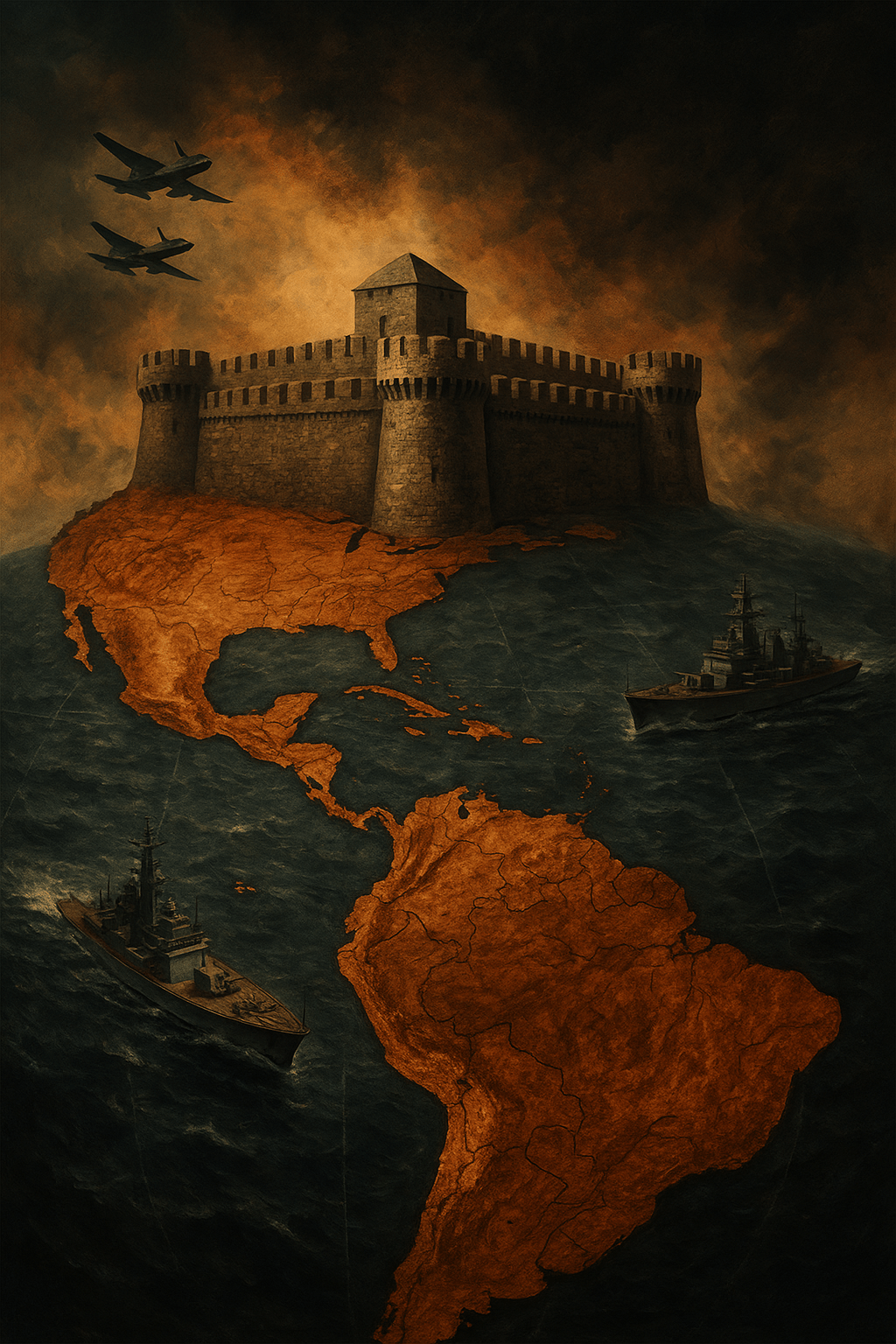
So the empire did what empires always do when they’re too weak to rule everywhere: it retreated to what it considers home ground and started fortifying. The strategy now unfolding is not an improvisation and not just a collection of coups, sanctions, and joint military exercises. It is the conscious construction of a fortress hemisphere — a U.S.-dominated bloc of states welded together as a single commercial, logistical, financial, and military platform. This is what we call the American Pole: a war-preparatory formation designed to give the U.S. the material, geopolitical, and logistical base it believes it needs for a future confrontation with China.
In this framework, the Americas are not a friendly neighborhood or a “community of democracies.” They are a captive rear area. North and South America together are being refashioned into a controlled laboratory where capital can reorganize production, secure resources, and drill military deployments without facing the full turbulence of Eurasian competition. The hemisphere becomes the empire’s fallback territory, its last secure domain, its imperial bunker. At the top of the bunker sit the U.S. ruling class and its junior partners in Canada. Below that, a ring of sub-imperial regimes and comprador elites. At the bottom, the same peoples who have always paid the price: workers, campesinos, Indigenous nations, Black communities, and the poor who turn the machinery of life and war but never control it.
To understand the logic, we have to think like a planner in the Pentagon or a strategist at a New York investment fund, not because we respect them, but because we intend to defeat them. If you admit that you cannot dismantle China’s productive machine today, what do you do? You shore up your own base. You pull supply chains out of outright Chinese territory and replant them in spaces you dominate politically: northern Mexico instead of Guangdong; Guatemalan free-trade zones instead of coastal China; Brazilian or Argentine agribusiness locked into dollar circuits instead of diversified toward BRICS. You treat the entire hemisphere as a single workshop, warehouse, and fuel tank for the coming confrontation.
That is why, all across the map, we see the same pattern repeating with different accents. Nearshoring is sold as “development” for Mexico, but its real function is to rebuild U.S. manufacturing leverage and break partial dependence on Chinese imports. Debt packages and IMF programs are advertised as “stabilization” for Argentina, but their real content is to keep energy and lithium under Western financial control, not to let them be integrated into Chinese-Bolivian industrial projects. Environmental campaigns against “deforestation” in the Amazon are weaponized to discipline Brazil’s sovereignty, making sure that the forest and its minerals remain assets calculated in northern boardrooms. Each of these policies wears a different costume — human rights, climate concern, anti-corruption, drug war, migration control — but underneath is the same skeleton: secure the American Pole as a U.S. base of operations.
On the military side, the logic is even more blunt. If you plan for a long, grinding rivalry with China, you need reliable staging grounds, secure sea lanes, and satellite-linked bases from which you can project power and gather intelligence. That is what the Caribbean, Panama, Colombia, and a network of “cooperation” facilities across the continent are being turned into: a belt of garrisons wrapped in diplomatic language. Under the pretext of fighting drugs or piracy, the U.S. Navy drills for blockades. Under the pretext of “regional security,” southern commands map every port, canal, fiber-optic cable, and fuel line that would matter in a war economy. The hemisphere is being militarized not only against the peoples of the Americas, but also against a future adversary on the other side of the Pacific.
Notice what this means ideologically. The old fantasy of an open, globalized “free market” world order is quietly being scrapped in favor of a harder, more openly imperial doctrine. Instead of pretending that every country can choose its own partners, U.S. planners now speak of “sphere of influence,” “nearshoring,” “trusted supply chains,” “friend-shoring.” These are just polite ways of saying: this hemisphere belongs to us, and anyone who brings China into this house is an enemy. The talk of democracy and values is there for the press release, but the balance sheet in the back room is all about who controls ports, lithium, agro-exports, and data centers.
For the peoples of the Americas, this turn deepens all the existing contradictions. A Chilean miner fighting for better conditions is not only confronting a local boss, but a supply chain that is being folded into U.S. war planning. A Haitian organizer resisting foreign occupation is simultaneously blocking a security experiment that can later be used in any rebellious neighborhood from Tegucigalpa to Chicago. A Mexican auto worker on the border is caught between the promise of jobs and the reality that those factories exist to undercut Chinese labor and to lock Mexico into a subordinate role in a new Cold War configuration. The American Pole is not an abstraction; it is a concrete reorganization of life and labor from Mexico to Patagonia, with the gun sights ultimately pointed across the Pacific.
This is why we insist: the American Pole is not just hemispheric recolonization in the old Monroe Doctrine sense, though it is certainly that. It is recolonization with a specific purpose: to rebuild the empire’s strength for a future clash with China and with any project that dares to stand outside the imperial script. The U.S. ruling class is regrouping, counting its chips, and tightening its grip where it can still dominate. It is turning our continent into its fortress. If we want a different future — a multipolar world led by the needs of workers, peasants, and Indigenous nations, not by the appetites of bankers and admirals — we have to confront this fortress directly. We have to map it, name it, and organize against it. That is the task before us in the rest of this essay: to walk through the blueprint of the American Pole, country by country and corridor by corridor, and to locate the cracks where the peoples of the hemisphere can push back.
The Blueprint of a Cornered Empire
If Part I showed us the empire backing into its hemisphere-sized bunker, Part II forces us to open the bunker’s blueprints. Because empires do not operate by improvisation alone. They dream in diagrams. They think in corridors, staging grounds, chokepoints, and “strategic depth.” And when they feel their power slipping, they draw these diagrams faster, with a shaking but determined hand. A wounded empire scribbles maps like a desperate general — and the American Pole is one such map.
Washington’s planners may speak in the flat, bureaucratic vocabulary of “competitiveness,” “supply-chain resilience,” and “regional alignment,” but beneath the jargon is a very old fear: the fear of losing command over world production. China is not merely a rival; it is the workshop of the world — the beating industrial heart of the global South and the emerging multipolar order. An empire that once ruled the planet through finance, sanctions, and aircraft carriers now finds itself outrun by a country that builds more factories in a year than the United States can dream of building in five. The crisis is not psychological; it is material. And material contradictions always produce strategic reactions.
This is why U.S. grand strategy is undergoing a quiet but decisive shift. The dream of “global leadership” collapses into something smaller but more militarized: dominate the hemisphere first, encircle China later. In the salons of Washington, this is packaged as “trusted value chains” and “friend-shoring.” In practice, it means pulling the entire American continent into the gravitational field of U.S. capital and security doctrine. If the empire cannot command Asia, Africa, or the Eurasian landmass, then it will command the Americas with twice the ferocity.
Listen to the logic. China’s industrial base is too deep to dislodge through tariffs; its Eurasian partnerships too resilient to break through sanctions; its technologic capacity too advanced to contain through chip blacklists. As long as China anchors BRICS, BRI, and South–South development, Washington cannot reclaim global primacy on open ground. So the empire changes terrain. It retreats to the hemisphere it colonized long before it discovered aircraft carriers, and it begins tightening the walls.
But a fortress is not made of stone — it is made of logistics. The architects of the American Pole are re-engineering the hemisphere as if preparing for a long siege. They want a captive labor platform stretching from the maquilas of northern Mexico to the free-trade zones of Central America; an energy corridor running through Venezuela, Guyana, and the Gulf of Mexico; a mineral and agro-extractive belt spanning the Lithium Triangle, the Amazon, and the Pampas; and a naval ring around the Caribbean and Panama Canal capable of supplying, refueling, and projecting force in a future crisis.
This is not development — it is a war economy in embryo. The EV batteries, rare earths, copper, soy, beef, oil, and microchips Washington demands from the region are not destined for some green utopia. They are destined for the engines of competition, coercion, and confrontation. They are the raw materials of a future where the U.S. imagines itself facing China in a drawn-out conflict over dominance in technology, shipping lanes, energy grids, and planetary-scale infrastructure.
And so the U.S. sets out to eliminate every Chinese footprint in the hemisphere, not because of “security concerns,” but because China’s presence disrupts the architecture of the American Pole. A Chinese-operated port in Panama isn’t just a business deal — it’s a crack in the fortress wall. A 5G network built with Huawei isn’t just a telecom choice — it’s a leak in the empire’s surveillance grid. A lithium plant co-owned by Chinese firms isn’t simply foreign investment — it’s a breach in the empire’s future battery supply. And every breach must be sealed with sanctions, coups, diplomatic blackmail, IMF chains, or — when all else fails — a warship in the harbor.
This is why the U.S. now sees the hemisphere not as a set of diverse nations but as a chessboard with nine critical squares: Mexico, Colombia, Brazil, Argentina, Bolivia, Chile, Panama, Venezuela, and Haiti. Each square represents a different material function in the imperial design. Mexico is the industrial frontline; Colombia the military hinge; Brazil the sub-imperial giant; Argentina the IMF lockbox; Bolivia the lithium vault; Chile the Pacific corridor; Panama the canal gate; Venezuela the energy well; Haiti the laboratory of occupation. The empire wants the entire board — and it wants it synchronized.
The result is a hemispheric strategy that looks like development on paper but feels like recolonization on the ground. It’s a plan that speaks the language of “growth,” “integration,” and “stability,” but moves with the gait of a power preparing for war. In the strategic imagination of Washington, the hemisphere must be pacified, disciplined, and aligned so that the empire can turn fully toward Beijing with a reorganized base behind it.
We must be clear: the American Pole is not an accidental byproduct of U.S. decline. It is the empire’s chosen strategy for surviving that decline. It is the scaffolding being erected around a wounded colossus that still believes it can dominate the future if it can dominate its backyard. But history does not move in straight lines. For every corridor they build, people resist. For every port they seize, movements rise. For every government they pressure, contradictions deepen. And those contradictions are where the next chapter of the struggle will be written — not in Washington, but in Bogotá, Buenos Aires, La Paz, Panama City, Port-au-Prince, and the dusty border factories of northern Mexico.
The empire is drawing its plans. Our task is to read those plans with clear eyes, tear away the euphemisms, and understand the battlefield. Only then can we begin to map the counter-project: a sovereign, multipolar, people-centered hemisphere capable of breaking the chains of recolonization and standing firm in the world that is being born. Part III will take us into the heart of that battlefield — into the countries where the empire’s blueprints either advance or collapse under the weight of popular resistance.
The Hemispheric Battleground: Where the Empire Tests Its Fortress
If the American Pole is the empire’s blueprint, then the hemisphere itself is the construction site — noisy, contested, and unstable. Here, the empire does not deal with abstractions. It deals with governments that zig when Washington wants them to zag, movements that refuse to die, and material realities that do not bend to press releases. To understand this moment, we must walk country by country across a region where the U.S. is trying to weld together its fortress and where the peoples of the Americas are refusing to be turned into bricks.
Let us begin with Colombia — the hinge of the entire architecture. For decades, Colombia functioned as Washington’s loyal garrison state, a laboratory of counterinsurgency, paramilitarism, and drug-war mythology. But the election of Gustavo Petro cracked the concrete. Petro questioned the sacred pillars of U.S. control: the drug war, the foreign military presence, the extradition pipeline, the geopolitical obedience that made Bogotá a satellite rather than a sovereign. His declaration at the United Nations — that the drug war was a lie used to justify ecological and human devastation — was not just rhetoric; it was a shot at the core of Washington’s security doctrine. And the U.S. responded exactly as an empire responds when its frontline outpost shows signs of independence: with lawfare, diplomatic daggers, congressional threats, and covert destabilization. A sovereign Colombia, one linked to peace processes and regional integration, would break the U.S. security chain stretching from Mexico to the Caribbean to Panama. For Washington, that is unacceptable. For the people of Colombia, it is an opportunity.
Then comes Brazil — the giant whose every movement shakes the balance of the continent. Brazil lives in a contradiction that speaks to the whole hemisphere: a country that trades with China more than with anyone else, that leads BRICS on one hand and bows to agribusiness lobbies aligned with Washington on the other. Lula, ever the negotiator, tries to walk a line between multipolar sovereignty and domestic capitalist pressures. But Washington does not want balance; it wants alignment. The empire needs Brazil as the anchor state of its American Pole, the industrial and agricultural muscle that keeps the fortress running. That means blocking Brazilian–Chinese cooperation in tech, telecom, satellites, semiconductors, and industrial modernization. It means using the Amazon as a pressure point, cloaking geopolitical leverage in the language of environmental virtue. Beneath the canopy of the forest lies the deeper struggle: will Brazil’s productive capacity serve BRICS-led multipolarity or the war-preparatory architecture of the U.S.?
Move northward and you arrive in Mexico — the industrial frontline of the new Cold War. Here the empire’s strategy is stripped bare. Nearshoring is advertised as “growth,” but its true purpose is to relocate manufacturing from China to Mexico under U.S. supervision. The border becomes a conveyor belt: Chinese supply chains rerouted, Mexican labor superexploited, and U.S. corporations weaving new factories into a war economy disguised as a jobs program. Washington’s pressure on Mexico to militarize the drug war, police migration, and contain Chinese investment is not peripheral — it is central. A Mexico that resists U.S. security demands or deepens cooperation with China becomes a direct threat to the American Pole. That is why every Mexican election, every trade dispute, every energy reform becomes an imperial fault line.
Further south, Argentina stands as a testament to the oldest form of imperial control: debt. The IMF’s grip over Argentina is not an economic arrangement; it is a security instrument, a leash that keeps the country within Washington’s orbit. Under IMF supervision, every peso of public spending, every investment decision, every energy project must be cleared through imperial gatekeepers. And beneath this economic cage lies the real prize: lithium. Argentina’s reserves are vast, and Washington intends to keep them open to Western corporations and sealed off from integration with Bolivia and China. In Argentina’s crisis, we see the claws of the American Pole not just grabbing resources, but shaping entire governments and long-term national trajectories.
Then comes Bolivia, the heart of the Lithium Triangle and one of the most strategically important territories on the planet for any future industrial, ecological, or military system. The fall of the MAS and the rise of a right-wing government aligned with market elites reopens the lithium corridor to U.S. control. The empire hopes to rewire Bolivia into its supply chains, using Santa Cruz oligarchs, NGOs, and foreign extractive companies to break the sovereign model MAS once advanced. Here the contradiction is simple: either lithium becomes the backbone of a multipolar green economy, or it becomes the battery pack for the American war machine.
Chile, meanwhile, becomes the Pacific hinge. Sitting on copper, lithium, and a coastline that looks directly across the Pacific, Chile is the empire’s bridge to Asia. Washington’s aim is to prevent Chile from deepening its industrial ties with China — no joint battery plants, no telecom sovereignty, no autonomous port corridors. Chilean elites imagine themselves global brokers; Washington imagines them subcontractors. And in the gap between those imaginations lies the struggle of Chile’s workers and Indigenous nations, who understand that minerals are not just commodities but weapons in someone else’s arsenal if they are not governed by the people.
And then there is Panama — the crown jewel of the American Pole. When Panama was pressured into exiting the Belt and Road Initiative and freezing Chinese port investments, it was not a business dispute. It was war preparation. The Panama Canal is not just a shipping route; it is a strategic chokepoint whose control determines who moves what across the oceans in times of crisis. Washington’s extraction of Chinese firms from Panama and its insertion of Western corporate and military interests is the clearest demonstration of its doctrine: control the arteries of global trade, and you control the blood flow of any potential adversary. Panama is the empire’s heart valve.
But no fortress can be built without crushing the examples that stand outside imperial command. Venezuela, Cuba, and Nicaragua form a triad of sovereign defiance. Their sin is not ideology; it is independence. They trade with China and Russia, defy sanctions, and build social forms that refuse the neoliberal script. For the American Pole to function, these states must be broken, flipped, or isolated. That is why Venezuela faces a naval blockade, why Cuba endures endless economic siege, and why Nicaragua is painted as a pariah. Sovereignty in one corner of the hemisphere threatens the logic of recolonization everywhere.
And finally, Haiti. Haiti is not a country in the eyes of the empire — it is a laboratory. The occupation missions, the Kenyan-led policing experiment, the IMF-driven austerity, the NGO takeover — all of it is a test run for how to manage a population under total imperial supervision. Haiti is where the empire practices the techniques it hopes to deploy across the region: foreign policing, external administration, and the suppression of popular sovereignty under the banner of “stabilization.” Haiti is the warning of what the American Pole offers to the poor.
Across these battlegrounds, the same contradiction pulses: the empire is racing to consolidate a hemisphere-sized war platform, and the peoples of the Americas are refusing to be conscripted into that project. Every strike, every land defense, every sovereignty campaign, every peace negotiation, every act of political disobedience is a crack in the imperial blueprint. And the empire knows it. That is why it moves with urgency. That is why its language grows more militarized, its diplomacy more coercive, its investments more strategic.
The hemisphere is not simply the site of recolonization — it is the front line of a global confrontation that has not yet fully erupted. Here, the empire is building its fortress. And here, the movements of the Americas are preparing their counteroffensive. Part IV takes us into the machinery behind the battleground: the infrastructure, logistics, and chokepoints that reveal the American Pole not as an abstract doctrine, but as a physical war map laid across our continent.
Infrastructure as War: How the Empire Builds Its Hemispheric Machine
Every empire has its weapons. Some are loud — aircraft carriers, missiles, sanctions, coups. Others are quiet — fiber-optic cables, port concessions, lithium refineries, rail corridors, satellite nodes. The quiet ones are more dangerous. A bomb can take a bridge, but a port contract can take a country. Washington understands this perfectly. If the American Pole is the imperial blueprint, and the hemispheric battleground is where it’s tested, then the infrastructure of the Americas is the machinery being repurposed for war.
The empire does not hide this. U.S. strategic documents speak openly of “secure supply chains,” “critical minerals,” “maritime domain awareness,” “energy corridors,” “digital resilience,” and “hemispheric security integration.” These are not developmental goals — they are war preparations written in technocratic code. They describe a continent where every port is a checkpoint, every canal a chokehold, every mine a weapons depot, and every data cable a surveillance artery. To understand the American Pole, we must read infrastructure the way the Pentagon reads it: as the skeleton of a future conflict.
Begin with the chokepoints. Panama is the most obvious, a metal hinge that holds together the Atlantic and the Pacific. For a century, Washington treated the Canal as a strategic extension of its Navy. When Chinese firms invested in Panamanian ports and logistics upgrades, the empire panicked. Not because of “security concerns,” but because a foreign infrastructure footprint threatened U.S. wartime mobility. So they forced Panama out of the Belt and Road Initiative, pressured it to block Chinese capital, and maneuvered Western firms like BlackRock and MSC into position. Under the polite language of “investment,” Panama became a militarized artery of the American Pole — a canal that must remain obedient in any global confrontation.
The Panama Canal is the empire’s heart valve, but not its only one. The Caribbean has quietly transformed into a naval belt — a chain of ports and islands used to track, intercept, and project power. U.S. carrier groups drill off Venezuela under counternarcotics pretexts. Military exercises dot the Antilles. Intelligence-sharing agreements sprout across the islands. What looks like a map of “partners” is really a map of staging grounds. In an era where shipping routes are geopolitical battlegrounds, the Caribbean is being rewired into a U.S.-controlled maritime firewall, shielding the American Pole from any Chinese presence.
Move inland and you find the rail and road corridors. The Bioceanic Corridor — a massive transcontinental project linking Brazil, Paraguay, Argentina, and Chile — should be a triumph of South American integration. Instead, it has become a geopolitical tug-of-war. Washington fears that if the corridor serves Chinese cargo, it will bind the Southern Cone to Asia, not to the United States. So the empire intervenes politically, financially, and diplomatically to redirect or slow China-linked components of the project. In the shadows of every bulldozer and consultation meeting, you can hear the empire whisper: this corridor must run for us, not for them.
Step into the Southern Cone, and the stakes multiply. The Lithium Triangle — Bolivia, Argentina, Chile — is the global nerve center of modern battery technology. Lithium is not just a mineral; it is the ticket to control energy storage, electric vehicles, drones, satellites, and entire military systems. That is why Washington fights to keep Chinese firms out of upstream lithium extraction and midstream processing. That is why Bolivia’s right-wing factions are courted, Argentina is disciplined through IMF programs, and Chile is nudged toward “responsible mining partnerships” with the West. Control lithium, and you control the batteries of the future. Control the batteries, and you control the machines of war.
But minerals alone don’t build empires — data does. Digital infrastructure has become the invisible battlefield of the hemisphere. Fiber-optic cables, data centers, 5G networks, satellite ground stations — these are the new ports and railways. Washington fears Chinese digital infrastructure because it can’t be surveilled or weaponized as easily. Huawei in Brazil or Argentina threatens the empire’s ability to listen in, map traffic, or shut down networks in crisis. So the U.S. wages a quiet war of tech pressure: warnings, sanctions, diplomatic campaigns, and economic threats to push Latin America into U.S.-approved digital ecosystems. Cybersecurity rhetoric becomes the Trojan horse for expanding control over the hemisphere’s digital veins.
Even agriculture — the most everyday sector — is wrapped into this war-preparatory architecture. Soy from Brazil, beef from Argentina, corn from Mexico, sugar and ethanol from Central America: these are not neutral commodities. They feed global supply chains, stabilize domestic markets, and leverage geopolitical relations. In the eyes of Washington, whoever controls the agro-export corridors controls food security in times of crisis. That is why agribusiness elites in Brazil and Argentina are so deeply interwoven with U.S. interests. They are not just exporters — they are the provisioning arm of the American Pole.
And towering over all of this is the U.S. military architecture. SOUTHCOM’s “partnerships,” “training missions,” and “capacity building” projects are not mere diplomatic niceties. They are the militarized nervous system that wires together ports, bases, corridors, and data hubs. Every training session in Colombia, every naval exercise in the Caribbean, every intelligence agreement in Central America is part of a single, integrated machine. The United States is shaping a hemisphere where logistics equals military readiness and where infrastructure equals power projection.
The American Pole is being built with bulldozers and fiber cables, with port concessions and basing agreements, with debt restructurings and digital standards. It is a war map disguised as a development plan. And as the empire lays its asphalt, the peoples of the Americas feel the pressure: the dispossession of Indigenous lands for lithium extraction; the militarization of the Caribbean under the veil of “security”; the re-routing of national economies toward U.S. supply chains instead of sovereign development.
Infrastructure is not neutral. It is class struggle made concrete. It is imperialism poured in steel and cement. And if we do not understand this machine, we will be crushed beneath it. In Part V, we turn to the deeper contradiction shaping this moment: the fight between two continental projects — one of recolonization through the American Pole, and the other of sovereignty through multipolar alignment. The battle for the hemisphere is no longer theoretical. It is here, and it is infrastructural.
Two Hemispheres, One Continent: The Clash Between Recolonization and Sovereignty
By now the shape of the imperial project is unmistakable. The U.S. is not improvising; it is engineering. It is not confused; it is consolidating. And it is not merely defending an old order; it is constructing a new one — tighter, harsher, more militarized, and openly directed toward preparing for a future confrontation with China. But no empire gets to build freely. Every blueprint meets resistance. Every fortress faces a counter-force. And in the Americas today, that counter-force is gathering strength in a thousand different struggles, each expressing the same underlying contradiction: Will this continent be welded into a war machine for the American Pole, or will it join the multipolar movement toward sovereignty, dignity, and liberation?
This is not a metaphorical fight. It is a structural one. On the imperial side stands a project of hemispheric recolonization — the American Pole — rooted in financial domination, military integration, extractive dependency, digital surveillance, and the reconfiguration of the region into a U.S.-controlled logistical basin. This project moves through familiar channels: the IMF, Wall Street, USAID, SOUTHCOM, embassy pressures, sanctions regimes, and the comprador elites who translate imperial needs into national policy. It wears the mask of “stability,” “security,” “growth,” and “democracy,” but beneath the mask is the same colonial logic that has governed the hemisphere since 1492: the land, labor, and resources of the Americas must serve the centers of power in the North.
On the other side stands a very different project — often fragmented, sometimes contradictory, but growing stronger with each crisis. This is the project of sovereignty and multipolar alignment, woven together by movements, workers, states, Indigenous nations, and regional blocs that refuse to be absorbed into the American Pole. Where Washington imposes recolonization, they propose self-determination. Where the empire demands discipline, they demand development. Where the North insists on subordination, they insist on dignity.
Look across the continent and the outlines come into focus. Colombia’s peace process and drug-war rupture challenge the very foundations of U.S. security doctrine. Brazil’s participation in BRICS, its trade with China, and its industrial ambitions point toward an alternative industrial horizon. Mexico’s energy nationalism and periodic defiance of U.S. security demands reflect the deep tension between nearshoring dependency and sovereignty. Argentina’s flirtation with China, even under the suffocating grip of IMF austerity, signals the possibility of breaking the financial chains that tie nations to Washington. Bolivia’s popular sectors continue to push back against attempts to reverse their lithium sovereignty. Chile’s social movements refuse to let copper, lithium, and the Pacific corridor be subsumed into imperial logistics. Venezuela, Cuba, and Nicaragua maintain geopolitical autonomy in the face of sanctions and sabotage. And Haiti’s grassroots resistance to foreign occupation remains one of the most courageous expressions of sovereignty in the hemisphere.
These are not isolated events. They are nodes of the same continental contradiction. Each struggle reflects a different dimension of the same choice: Will the Americas be bound to a declining empire trying to reorganize its backyard for a future war, or will the continent chart its own path in a multipolar world where China, the Global South, and South–South solidarity offer new possibilities for development outside the imperial script?
Even in the ideological sphere, the contradiction is sharpening. Washington resurrects Cold War language — “democracy vs. autocracy,” “trusted partners,” “rules-based order” — to justify its hemispheric grip, while China, Brazil, and other Global South actors emphasize “sovereign development,” “win-win cooperation,” and “multipolarity” as principles for a new international order. The result is not just a geopolitical struggle but a battle over the meaning of development itself: is development the freedom to build your own future, or the obligation to serve as a supply chain in someone else’s?
And this contradiction is not decided in presidential palaces alone. It is lived in the port worker resisting privatization in Valparaíso, the campesina fighting lithium dispossession in Potosí, the Haitian organizer denouncing foreign occupation, the Brazilian youth defending the Amazon from agribusiness militias, the Colombian community demanding peace instead of militarization, the Mexican auto worker exploited under the banner of nearshoring. These are not separate fights. They are the living arteries of a continental struggle that the U.S. ruling class is desperate to suppress.
The American Pole is a project of recolonization through discipline. But the counter-project — the project of multipolar sovereignty — is a project of liberation through unity. It is not simply about China or BRICS or trade deals; it is about breaking with the historical pattern that has trapped the hemisphere for centuries: the extraction of our labor, our minerals, our energy, our food, and our futures in service of an imperial center. Multipolarity is not a slogan — it is a material alternative to imperial war planning.
The task before the peoples of the Americas is therefore not merely to resist individual policies, sanctions, agreements, or interventions. It is to confront the totality of the American Pole as an integrated system — and to build a continental alternative grounded in sovereignty, solidarity, and people’s power. This means linking struggles across borders, connecting land defense to labor organization, tying anti-austerity fights to anti-militarization movements, and weaving together the popular forces of the hemisphere into an anti-imperialist bloc capable of breaking the imperial formation.
The empire wants us divided by borders, sectors, and identities. But the material contradiction uniting the continent — recolonization versus sovereignty — demands a collective response. Part VI turns to that horizon. It asks a simple but revolutionary question: If the empire is building its American Pole, what would a People’s Hemisphere look like? And more importantly: how do we build it?
Toward a People’s Hemisphere: Breaking the American Pole and Building Our Own Future
If the American Pole is the empire’s war map, then the alternative must be something bolder than resistance alone. It must be a project — a living, breathing political horizon capable of confronting a declining empire and offering a future rooted not in domination, but in life. The U.S. wants a hemisphere designed for extraction, subordination, and war. The peoples of the Americas need a hemisphere built for sovereignty, dignity, and survival. These are two incompatible visions. The former is the blueprint of a wounded empire preparing for a long confrontation with China; the latter is the blueprint of a continent preparing to break free from centuries of dependency and recolonization.
But a People’s Hemisphere cannot be declared by decree. It must be constructed from the ground up, through the struggles already unfolding across the land. In Mexico, auto workers and energy unions confront a nearshoring system that treats the country as a low-wage appendage to U.S. reindustrialization. Their fight for dignified labor is not separate from the anti-imperialist struggle — it is one of its front lines. In Colombia, urban youth and rural communities push for peace against the militarized fantasies of Washington’s security doctrine. Their demand for sovereignty over territory and life breaks directly with the logic of the American Pole. In Brazil, Indigenous nations defending the Amazon are not just environmental defenders; they are custodians of one of humanity’s most vital biomes, resisting its conversion into an imperial carbon factory for agribusiness giants aligned with Washington.
In Argentina, movements resisting IMF austerity and fighting for public control over energy and lithium expose the financial skeleton of the American Pole. The debt is not an accounting problem — it is a colonial infrastructure designed to keep the wealth of the land flowing outward, even as poverty deepens. The struggle to break the IMF’s grip is a struggle to break the empire’s grip. In Bolivia, the push to defend lithium sovereignty — even after right-wing advances — carries forward a long tradition of Indigenous, campesino, and worker resistance. Every community that rejects dispossession, every union that rejects privatization, every assembly that rejects elite sabotage is part of the same continental movement: the refusal to feed the imperial war machine.
Look to the Caribbean, and the contradiction sharpens further. Haiti’s people continue to resist foreign occupation, denouncing the Kenyan-led mission as yet another iteration of imperial trusteeship. The Haitian masses remind the hemisphere that sovereignty is not abstract — it is lived, defended, and bled for. Their struggle is a mirror for every country in the hemisphere: if the empire can occupy Haiti with the blessing of “the international community,” it can do the same anywhere. This is why Haiti is not an isolated tragedy; it is a frontline of the People’s Hemisphere. And in Cuba, Venezuela, and Nicaragua, entire nations have paid a brutal price for keeping a foothold outside the American Pole. Their survival — through sanctions, sabotage, and siege — is itself an act of continental defiance that must be defended and learned from.
A People’s Hemisphere requires more than courage. It requires organization — real, rooted, cross-border organization that can match the scale of the imperial project. Workers must coordinate beyond borders, especially in industries central to imperial logistics: autos, shipping, mining, agriculture, and energy. Campesino and Indigenous movements must form continental assemblies capable of defending land, water, and minerals from extraction by any empire — Western or otherwise. Movements for peace and demilitarization must expose the colonial fantasies behind U.S. “security cooperation” and build a hemispheric front against foreign basing, naval deployments, and military treaties.
Equally essential is a communication infrastructure capable of breaking the empire’s ideological chokehold. U.S. media and think tanks work overtime to paint sovereignty as instability, multipolarity as authoritarianism, and Chinese cooperation as a threat. A People’s Hemisphere needs networks of independent media, investigative reporting, and popular education that reveal the material truth: that the American Pole is a project of recolonization, and resistance to it is a project of collective liberation. Every community radio station in Chiapas, every militant newspaper in Bogotá, every digital platform run from Caracas or Havana, every collective media project in São Paulo or Port-au-Prince is part of this alternative communications network.
And finally, a People’s Hemisphere demands a strategic vision — a long-term horizon that can unify the continent’s movements, governments, intellectuals, and working classes. This is not a question of nostalgia for the pink tide, nor of waiting for a single leader or party. It is a question of building a continental project grounded in the needs of the many, not the ambitions of the few. A project that draws from the strengths of ALBA, CELAC, UNASUR, BRICS, and the legacy of Bandung, but is not limited by their bureaucratic shell. A project that sees multipolarity not as the rise of a new empire, but as the opening of a historical window for the peoples of the South to assert their right to develop without being chained to U.S. militarism and financial tyranny.
This is the decisive contradiction of our time. Washington wants the hemisphere orderly, obedient, and ready for war. The people want it sovereign, abundant, and ready for life. The American Pole is the empire’s attempt to turn our continent into a fortress for a conflict none of us asked for. The People’s Hemisphere is our answer — a continental rebellion rooted in solidarity, dignity, and a future beyond empire.
The task now is clear. The empire is preparing for its next war. The peoples of the Americas must prepare for their next liberation. The American Pole is being constructed with steel, contracts, and coercion. The People’s Hemisphere will be built with struggle, organization, and hope. And in that fight — from Tijuana to Tierra del Fuego, from Port-au-Prince to Valparaíso, from Bogotá to Belém — the future of the hemisphere, and perhaps the future of the world, will be decided.
 Weaponized Information