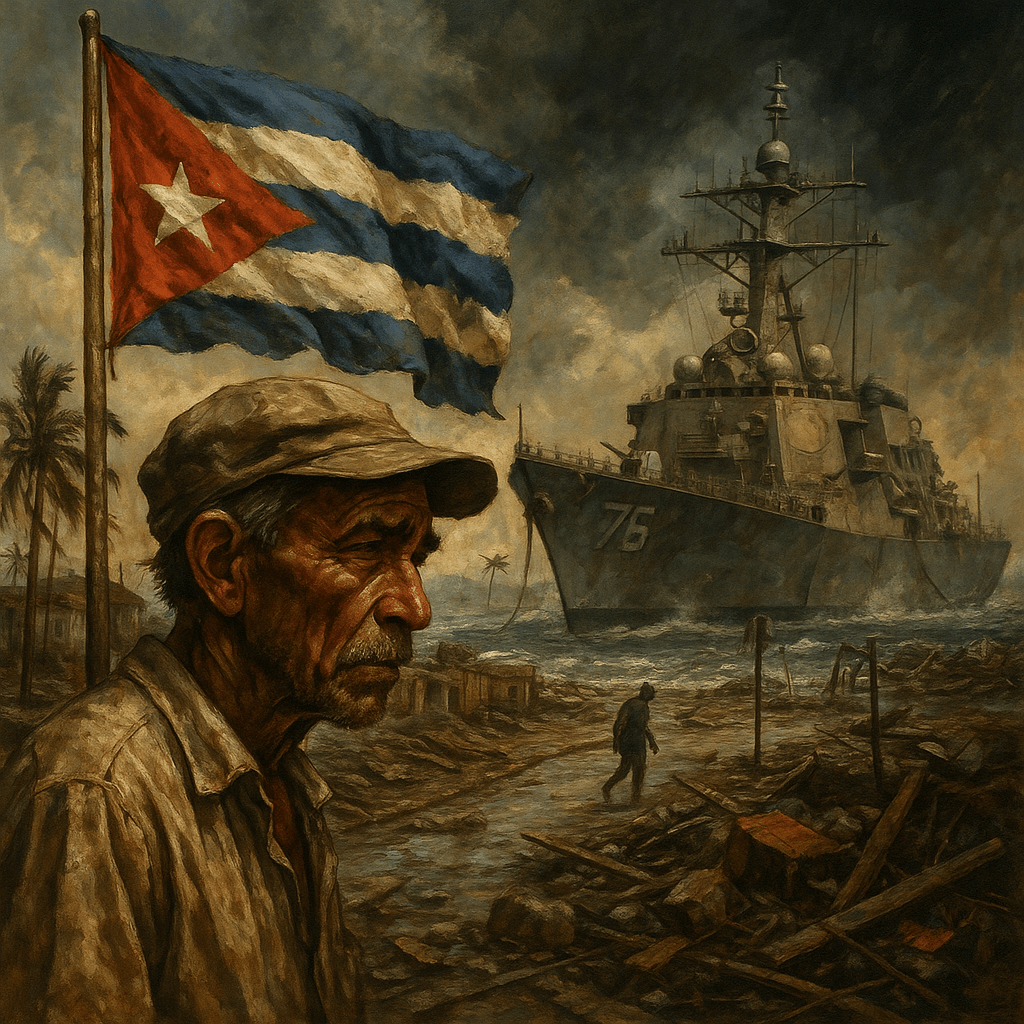
Nearly every nation on Earth votes to end the economic siege of Cuba — and Washington answers with silence, ships, and sanctions.
By Prince Kapone | Weaponized Information | October 31, 2025
How the Story Is Arranged Before We Even Begin
The Associated Press article opens by treating the U.S. embargo on Cuba as if it were a matter of diplomatic disagreement rather than a unilateral economic siege condemned by nearly the entire world. The embargo appears in the article not as an act of policy, but as an opinion Cuba “says” is harmful, a problem Cuba “claims” is causing suffering. The language is gentle, almost casual. Cuba becomes a speaker, while the United States becomes a narrator of events. The structure softens the violence by distributing it. Cuba’s blackouts, food shortages, and mass migration appear next to hurricanes and domestic challenges, as though they all emerged from the same weather system. A blockade becomes a climate condition—unfortunate, regrettable, but natural.
This is the craft of the article: cause and effect are placed beside one another without being connected. Hunger sits next to rainfall. Sanctions sit next to storm debris. The embargo becomes one “factor” among many, not the shaping architecture of the crisis. Meanwhile, U.S. officials speak of “human rights,” “democratic principles,” and “concern.” The moral voice of the piece is handed to Washington by default. No proof is required for the moral claim; it arrives pre-authorized, like a passport waved through a border checkpoint without inspection.
This is not a question of the reporter’s personal intention. The byline belongs to a U.S. State/UN beat reporter whose career depends on credentialed access to briefings, spokespersons, and diplomatic channels. The job requires a kind of listening—one that privileges state-recognized narrators. The Associated Press itself functions as a wire service whose legitimacy and market reach are secured through this very compatibility with official language. It does not need to declare allegiance. Its role is quieter: to produce the tone that passes for neutrality. The neutrality is not neutral. It simply flows in the direction of power.
The effect is a structure that appears balanced while quietly leaning in one direction. Cuba “accuses,” “claims,” and “blames”—verbs that imply exaggeration or defensiveness. The United States, in contrast, simply “states,” “responds,” or “expresses concern,” as though its voice requires no verification. The verbs do ideological work long before any reader’s judgment begins. One side is positioned as emotional, the other as factual. No argument is made for this difference; the language itself performs it.
The blockade is likewise translated from a concrete act into something gentler and more conversational. It is framed as a policy disagreement, an ongoing diplomatic tension—something two parties might debate indefinitely. This makes coercion sound like negotiation. It treats force as if it were just another opinion about how things should be run. Even the expansion of U.S. naval presence in the region is rendered through administrative phrasing: an “anti–drug trafficking” operation, the vocabulary of logistics rather than power. Warships become paperwork by way of diction. Steel becomes a sentence.
In this arrangement, an island under restriction is described as merely “struggling,” as though the hardship were natural or accidental, and the state enforcing the restriction appears as a responsible actor managing a situation. The overwhelming global condemnation of the blockade is not withheld; it is simply minimized—tucked into the narrative like a detail of no particular importance. Nothing blatant is asserted. The piece does not have to lie. It simply stages the conversation so that domination looks like disagreement.
We do not correct the narrative here. We do not insert what was excluded. We only watch the grammar at work: verbs placing doubt on one voice and legitimacy on another, force described as routine, conditions treated as weather, power introduced as though it were merely participating. Before any facts are evaluated, the story has already been arranged.
The Record, Widened and Documented
We begin with what the Associated Press openly acknowledges. Every year, the United Nations votes. The world says the embargo must end. The United States says it will not. The embargo tightened during Trump’s first term, was largely maintained under Biden, and has been tightened further since Trump’s return. Cuba is experiencing shortages, inflation, fuel scarcity, and migration pressures. And the U.S. has increased naval and Coast Guard operations in the Caribbean, described officially as “counter–narcotics efforts.” These are not interpretations. They are the article’s own words.
But the story grows clearer as soon as we widen the frame. In the most recent vote, 187 countries called for the embargo to end. That is not debate—it is near-unanimous global consensus. And the embargo is not a temporary policy preference. It is law. The 1996 Helms–Burton Act embedded the embargo into U.S. statute, barring any president from unilaterally reversing it. Titles III and IV go further, threatening foreign companies: trade with Cuba and you may lose access to U.S. markets. A blockade enforced at ports and shipping lanes is one thing. A blockade enforced in corporate boardrooms across continents is another.
Cuba reports the human and economic damage every year in detailed submissions to the United Nations. These reports document blocked fuel purchases, delayed medical equipment, disrupted transportation systems, and higher import costs for food and basic goods. Independent economic researchers have corroborated how the embargo constrains production and strains public services. Whether one endorses Cuba’s politics or not does not change the record itself. The numbers are itemized, reviewed, and archived.
The enforcement is not metaphor. It has a steel hull. In April 2020, U.S. Southern Command expanded naval and Coast Guard operations across the Caribbean. Navy communications describe this as an “increased presence” mission, now normalized and ongoing. The continued deployments are detailed in SOUTHCOM’s 2023 and 2024 Posture Statements. If the embargo is the law, this is its enforcement wing.
The legal framework is equally direct. Article 2(4) of the UN Charter bars states from using coercive measures to force another nation’s political direction without Security Council authorization. None has ever been granted for the embargo. Article 33 of the Fourth Geneva Convention prohibits collective punishment of civilian populations for political ends. The Declaration on Friendly Relations (UNGA Resolution 2625) states that no nation may use economic pressure to compel another state’s sovereign decisions. These principles form the legal vocabulary the General Assembly uses when it identifies the embargo as a unilateral coercive measure.
The region also speaks clearly. CELAC states have repeatedly reaffirmed their opposition to unilateral coercive measures. CARICOM has issued formal statements condemning the embargo and calling for Cuba’s removal from the U.S. terrorism list. ALBA states continue to coordinate economic cooperation with Cuba. MERCOSUR has likewise reaffirmed its rejection of the blockade in joint declarations. The hemisphere has spoken with one voice.
The material effects follow their own logic. Cuba imports most of its refined fuel, as shown in the International Energy Agency profile. When Venezuelan shipments declined, that cushion disappeared. When Cuba produced its own vaccines, syringe and cold-chain supplies were delayed. When the U.S. restricted remittances, families lost a lifeline.
When fuel is scarce, the lights go out. When imports tighten, scarcity spreads. When scarcity deepens, migration rises. These are not political arguments. They are the coordinates of material life.
None of this is hidden. The votes are public. The shipping logs are public. The Treasury regulations are public. The energy data is public. A map can be drawn from them. We have simply drawn it.
What the Story Tries to Hide
Now we name what the article refuses to say plainly. The economic war against Cuba is not a disagreement between two neighboring governments. It is not about values, not about “human rights,” not about governance style. It is a program of coercion and domination—designed, sharpened, and maintained to break a sovereign people’s capacity to live, eat, power themselves, and care for one another unless they surrender their independence to Washington. The blockade is not a metaphor. It is an instrument. And instruments are crafted with intent.
The AP narrative tells us that Cuba blames the United States, while the United States simply states its position. One side emotional, the other factual. One side pleading, the other asserting. But the historical record is not emotional. It is cold. U.S. planners stated, in their own documents, that the goal of the embargo was to produce “disenchantment based on economic dissatisfaction and hardship” severe enough to break the Cuban Revolution. Hunger was not an accident. Scarcity was not a glitch. These were the levers. This is not a humanitarian policy gone astray. It is a siege in which daily life—meals, medicines, light—is the battlefield.
Once we understand this, the convenient narrative collapses. The blackout is not a coincidence. The empty shelves are not neutral economics. The medical shortages are not bad luck. When access to fuel is cut, hospitals dim. When shipping insurers are threatened, food grows scarce. When remittances are blocked, families lose the difference between stability and starvation. The suffering is not incidental to the blockade. It is the point of the blockade.
To see this clearly, we have to look through the lens of the colonial contradiction itself. Cuba is not being punished because it failed. Cuba is being punished because it succeeded—because it broke from colonial dependency and declared that the wealth of the island would belong to its people, not to Miami shareholders or Washington strategists. A formerly colonized nation asserted political, economic, and cultural sovereignty. The United States responded exactly as an empire responds when sovereignty appears where subordination was expected: with pressure, with siege, with punishment.
This conflict is not frozen in the 1960s. The world is shifting, and that shift intensifies the violence. A new multipolar order is rising—from Beijing to Brasília, from Johannesburg to Caracas—where nations are building trade routes, development banks, and diplomatic alignments outside U.S. control. The Cuban Revolution is one of the original seeds of that world. For the U.S. ruling class, that makes Cuba not a small island, but a symbol. A living demonstration that a people can delink from empire and survive. And symbols are dangerous. They inspire imitation.
Thus, the blockade is counterrevolutionary strategy: a warning shot to the hemisphere. Do not follow this path. Do not turn to your own people. Do not seek development outside Washington’s shadow. Or you will be starved, isolated, and punished. This is why Cuba’s defiance must be made to look miserable—because the U.S. fears the example of a sovereignty that does not bow.
And so, when the AP calls U.S. naval deployments in the Caribbean an “anti–drug trafficking campaign,” the violence disappears behind paperwork. Warships become harmless tools of regulation. A blockade becomes “policy.” The Caribbean is presented not as a sea of sovereign nations but as a zone of U.S. prerogative—an imperial lake where presence does not require justification. What cannot be imposed by law will be enforced by patrol. This is not security. This is domination.
What moral authority does the United States claim here? None that survives contact with history or daylight. The blockade does not defend democracy; it punishes a people for choosing one outside imperial control. It does not protect human rights; it violates the fundamental right of a nation to determine its own destiny. This is not about freedom. It is about discipline. It is about the self-appointed right of empire to decide who may govern themselves and who must be made to kneel.
And this is not an isolated case. It is the continuation of a continental pattern: Haiti starved for daring to break slavery; Guatemala crushed for land reform; Chile shattered for socialism; Granada invaded for imagining a future. The Americas have been treated as U.S. property, their governments allowed autonomy only so long as they do not contradict imperial strategy. Cuba’s refusal—six and a half decades of it—is an existential insult to that order. Not because it is weak, but because it has refused to break.
So the AP writes this as a dispute. But we recognize a siege when we see one. We recognize imperial power when we hear it speak. And we know the difference between suffering born of weather and suffering manufactured as policy. The blockade is not a conversation. It is a war. And in a world that is shifting away from empire, the question is not whether Cuba stands alone—but whether the empire does.
What It Means to Stand with a People Under Siege
If the embargo is a strategy of exhaustion, then the response cannot be charity and it cannot be sympathy. It must be solidarity: the deliberate linking of struggles, the coordination of resources, the building of ties strong enough to withstand pressure. Cuba has endured because it has not faced this alone. Its survival has depended on the willingness of ordinary people across the world to refuse the story that the United States tries to tell—that the siege is natural, deserved, or inevitable.
Across the Americas, this rejection is not theoretical. Regional blocs have already spoken. CELAC, CARICOM, ALBA, and MERCOSUR continue to insist that the embargo is illegitimate and must end. These are not radical parties; they are governments stating that the hemisphere will not accept the punishment of a sovereign nation as normal practice. That matters: it shifts what is sayable, what is negotiable, and what is politically possible. But governments move slowly. The pressure is daily. And so the work falls, as it always has, to ordinary people.
There are networks already in motion. The National Network on Cuba coordinates campaigns and material support. The IFCO/Pastors for Peace caravans have delivered medical supplies for decades, not as charity but as affirmation that Cuba is not alone. The International People’s Assembly and The People’s Forum organize political delegations that break the isolation the embargo tries to create. Trade unionists, teachers, farmers, nurses, students, and cultural workers from dozens of countries travel to Cuba each year to learn, exchange, and return with strengthened ties. These are not symbolic gestures. They are the infrastructure through which the siege is resisted.
In the United States, the work is concrete. Local unions pass resolutions calling for an end to the embargo. City councils vote to support normalized relations. Mutual aid groups collect medical supplies. Community organizations host brigades, film screenings, and political education. Each action, however small it may seem, interrupts the machinery that tries to make Cuba invisible, isolated, and forgotten. The point is not to admire Cuba. The point is to recognize that any society attempting dignity under pressure needs allies who refuse to look away.
And for those outside the United States, solidarity means continuing to build ties that do not ask permission. It means joint research projects, cultural exchange, technical cooperation, agricultural collaboration, and student exchange programs that bypass the bottlenecks of sanctions. It means protecting the political space in which Cuba can breathe—diplomatically, economically, socially. It means insisting that sovereignty is not a slogan but a practice that must be defended by the living, not just the voting.
None of this is abstract. It is daily work. It is choosing to stand with a people who have refused to give up what they won. The embargo is designed to make resignation seem reasonable, to make exhaustion seem inevitable. But Cuba has not yielded. The world majority has not yielded. And those of us who know that another way of living is possible have no reason to yield either.
The blockade is meant to isolate. The answer is connection.
The blockade is meant to starve dignity. The answer is to feed it.
The blockade is meant to break memory. The answer is to carry it forward.
We do not stand with Cuba because it is perfect.
We stand with Cuba because it refused to kneel.
 Weaponized Information
Leave a comment