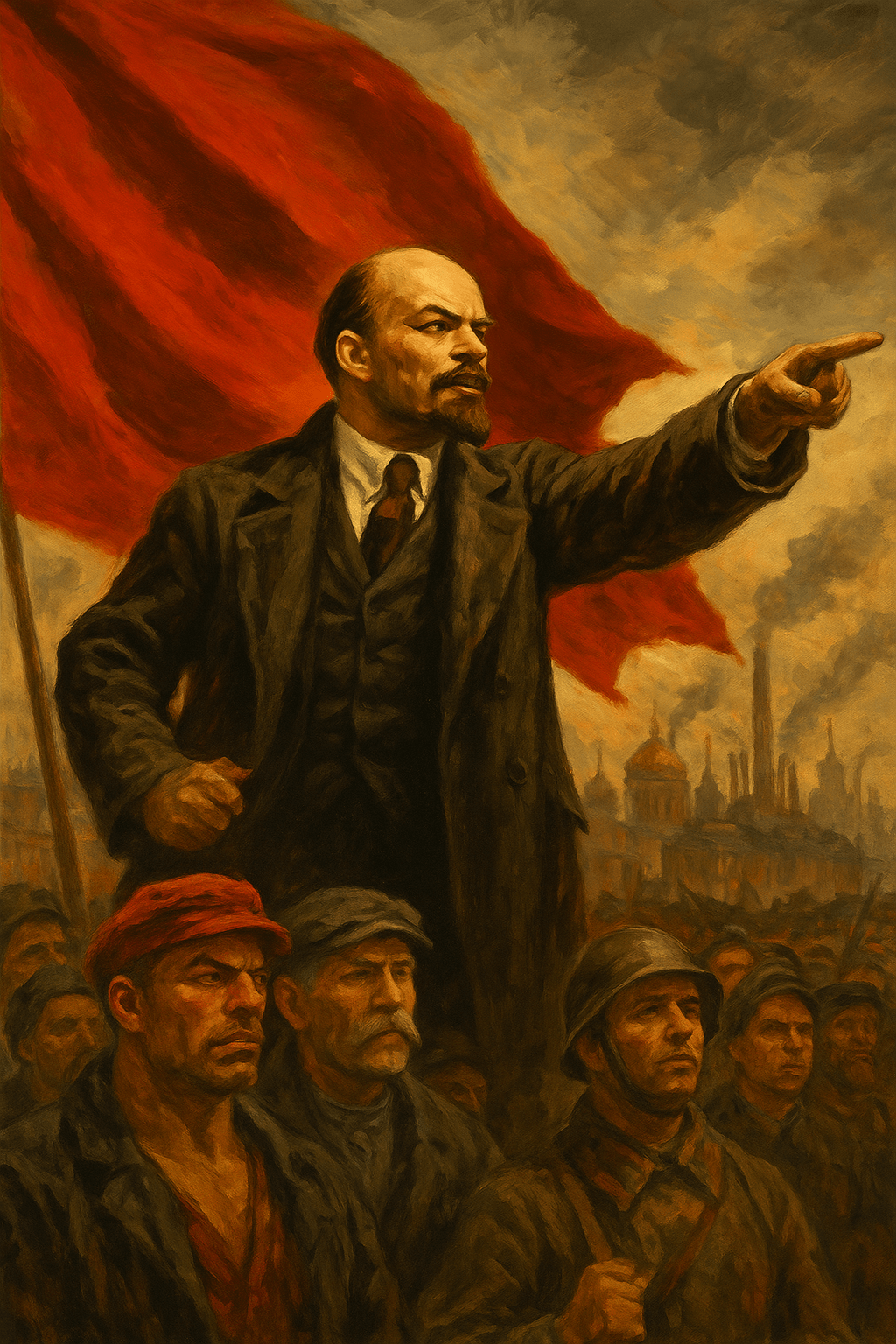
“Revisiting October through Walter Rodney’s Third World lens, this review dismantles Western Marxist fatalism and reclaims the Revolution as the weapon of the oppressed.”
By Prince Kapone | Weaponized Information | Weaponized Intellects Book Review: October Revolution Series | October 25, 2025
October Is Not a Memory, It’s a Method
One hundred and eight years after workers and peasants seized the helm of history in Petrograd, the custodians of empire still insist the October Revolution was a beautiful mistake—tragic, naïve, and best remembered as a warning label. We reject that obituary. October was the first time the exploited made good on a promise older than factories: to govern in their own name. It didn’t descend from heaven; it rose from bread lines, mutinies, and meetings after midnight. That is why the ruling class hates it, and why we commemorate it—not as nostalgia, but as instruction.
This review inaugurates our Weaponized Intellects series marking the 108th anniversary of 1917. We begin with Walter Rodney’s posthumous The Russian Revolution: A View from the Third World, a book written with the steady hand of a guerrilla intellectual who never confused Europe’s libraries for the world’s majority. Rodney reads October the way workers read a toolbox—by asking what each instrument can do, who it serves, and how it wears under fire. His lens is neither academic distance nor sect vanity; it is the sober clarity of the colonized who know that history does not hand out justice—it must be organized.
The terms of debate have not changed as much as the packaging. Liberal historians still sell morality plays where “excess” is the villain and capitalism the quiet hero. Western Marxism, for its part, performs objectivity while smuggling in the same Atlantic prejudices through footnotes and moral sermons. We will not indulge either camp. Our measure is material: Did a line lift the floor for the poor? Did a policy build power among workers and peasants? Did theory bend to conditions, or did conditions get tortured to flatter theory? On these questions Rodney is ruthless and useful—precisely what a revolutionary tradition requires.
This essay tracks Rodney’s chapters closely and moves with them: from the anatomy of the old order to the birth of new power; from arguments over party, peasantry, and dual power to the hard science of governing under siege; from the national question at the heart of the old empire to the lessons and limits that followed. Each section builds on the last, not to repeat, but to escalate—because revolutions don’t circle, they advance or they die. Along the way we will honor the internationalists in the West who broke ranks with empire, while naming and rejecting the Western Left that genuflects to anti-communism, turns class struggle into graduate seminar theater, and mistakes panel invitations for victories.
We read Rodney for what he gives the living: a disciplined disrespect for fatalism; a method that starts from concrete conditions and moves toward victory; a refusal to separate anti-imperialism from socialism as if one could breathe without lungs. In a world where finance capital now wears a hoodie and the whip lives in an algorithm, October still speaks plainly: without organization, there is no democracy; without power, there is no freedom; without internationalism, there is no socialism. That is the spirit of this series and the standard of this review. Let’s get to work.
Two World Views, Two Camps
Walter Rodney opens with a question that slices through the polite chatter of Western historiography: who owns the narrative of revolution? In his hands, history is not a museum but a battlefield, and every interpretation carries a class line. There are not a thousand “perspectives” on October 1917—there are two camps. On one side stands the world of capital, with its academic chroniclers and professional mourners, endlessly repeating that revolutions devour their children. On the other stands the camp of the oppressed, who know revolutions feed the starving, teach the illiterate, and awaken the enslaved. Rodney writes from the latter camp, and he writes for it.
His point is simple and dangerous: the Russian Revolution belongs to the peoples of the world, not to the professors of Europe. It was the first decisive breach in the global colonial order, the first time a power stood up and said that the raw materials of Asia, Africa, and Latin America would no longer be used to subsidize European “civilization.” That is why the ruling class has spent a century trying to turn October into a ghost story—because its victory in 1917 made the future of empire uncertain. Rodney, writing from the Third World’s trenches, resurrects that living threat.
He reminds us that bourgeois historians—whether liberal or conservative—cannot comprehend October because they cannot imagine history without masters. For them, the masses appear only as mobs, and the state only as an instrument of order. Western Marxism fares little better. In its effort to remain “critical” and “independent,” it often functions as the velvet glove of the same imperial fist. It deconstructs revolutions in journals while real people fight and die for bread and land. The Western left loves rebellion as theater, not as strategy. They want permanent protest, not permanent revolution.
Rodney’s vantage from the Third World turns this upside down. He doesn’t see the Russian Revolution as a distant European event, but as a mirror in which colonized peoples could recognize their own possibility. The Soviets’ immediate withdrawal from the imperialist war, their declarations on national self-determination, their support for anti-colonial struggles—all of this announced a world split in two: imperialism on one side, international socialism on the other. Between these worlds there is no “middle ground,” no liberal bridge. There is struggle or surrender.
This is the ideological line we inherit. In today’s language of “democratic renewal” and “rules-based order,” we hear the same sermons Kautsky preached against Lenin—order over upheaval, reform over rupture. The capitalist class, now cloaked in Silicon Valley logos and NATO blue, recycles the same gospel of progress through exploitation. And once again, a chorus of Western leftists provides the harmony, assuring us that the revolution was necessary but “went too far.” Rodney answers them all with a clarity that cuts through decades of slander: there is no safe, gradual path to human emancipation. The bourgeoisie will not step aside; it must be removed.
To read Rodney today is to choose sides. Either we join the camp of those who excuse exploitation as “complexity,” or we stand with those who understand that freedom, like bread, must be seized, not granted. Every historian, every organizer, every worker faces this same question in new form. October 1917 was not just Russia’s reckoning—it was humanity’s. And in the smoke of our own collapsing empire, the line remains bright as ever: choose the world that built gulags for the poor, or the one that tried to abolish poverty itself. Rodney made his choice. So must we.
Forging the Weapon: Marxism Takes Root in Russian Soil
Rodney moves next to the furnace where theory met necessity—where Marxism, imported through translation and exile, fused with the living contradictions of Tsarist Russia. He reminds us that revolutions are never photocopies; they are inventions born under pressure. The Russian Marxists, unlike their European counterparts, could not afford to be philosophers of defeat. They were not debating socialism from comfortable cafés—they were building it in a police state where the czar’s prisons were filled with dreamers and the fields were soaked in peasant blood. Out of that crucible came Leninism: not a deviation from Marx, but Marxism finally stripped of its academic costume and forced to fight.
In Rodney’s retelling, the Russian Left before October was a storm of arguments—about the peasantry, about stages of development, about whether socialism could be born in a backward agrarian economy. Western Marxists later canonized these debates as theoretical puzzles; for Rodney, they were practical questions of survival. Could a revolutionary vanguard organize a semi-literate, famine-ridden population into an instrument of power? Could a movement of workers, so small and persecuted, win the loyalty of millions of peasants who had known only serfdom? These were not seminar topics—they were matters of life and death. Lenin’s genius was to stop treating contradictions as excuses and start treating them as material to be worked with.
Here, Rodney exposes one of Western Marxism’s greatest evasions. Its thinkers exalt “the critique of ideology” while refusing to build ideology for the oppressed. They hold endless conferences on alienation but shy away from organization. They recite Marx but forget his method: to grasp a problem not in abstraction, but in motion, in its concrete historical form. In Russia, this method took shape as the revolutionary party—centralized, disciplined, rooted in the working class yet oriented to the entire oppressed nation. To Western academics, that sounded authoritarian; to the exploited, it was coherence at last.
Rodney stresses that Lenin’s insight was not to impose theory upon reality but to read reality dialectically—to see in Russia’s “backwardness” not an obstacle but a potential advantage. Imperialism had concentrated industry in a few modern centers surrounded by vast rural poverty; the link between the industrial proletariat and the peasantry could therefore become the engine of transformation. The Bolsheviks didn’t worship spontaneity; they harnessed it. They understood that the revolution would not wait for textbooks to catch up. And when the textbooks failed, they wrote new ones—with ink made of experience.
This, Rodney tells us, is the lesson Western Marxism never learned. By fetishizing “Western conditions” as universal, it erased the majority of the world from socialism’s map. Marx’s method, born in Europe, became in their hands a Eurocentric catechism—brilliant in diagnosis, useless in treatment. Lenin shattered that monopoly. He proved that Marxism was not bound by geography or GDP, but by class and consciousness. That is why the October Revolution sent tremors through every colony on Earth. It said, in the clearest language imaginable: the road to socialism does not run only through Manchester or Berlin; it can begin in Petrograd, in Guangzhou, in Havana, in Dar es Salaam.
Rodney’s analysis is not a sentimental tribute; it is a call for rigor. The Russian revolutionaries mastered Marx because they used it. They tested it in factories, in prisons, in underground cells, and in battle. They produced not just theory but organization—something the Western Left, enamored with critique, still fears. Rodney insists that the task of revolutionaries is not to “interpret” Marxism correctly but to apply it courageously, to treat it as a living weapon sharpened by struggle. Lenin did not ask if Russia was “ready” for revolution—he asked if revolutionaries were ready to act. The answer changed the world.
For us, this remains the dividing line. Either Marxism is a science of transformation or it is a literary genre. Either it builds power among the oppressed or it becomes one more ideology of the comfortable. Rodney sides with the builders. His Russia is not a museum of heroes but a workshop of militants who learned that correct ideas emerge from practice, and that every theory must one day hold a rifle. In that sense, the Russian Revolution was less an exception than a prophecy: a signal that the age of passive socialism was over, and the age of the organized proletariat had begun.
Trotsky and the Tragedy of Western Admiration
In the next movement of his analysis, Rodney turns his attention to Leon Trotsky—a figure whose brilliance as a revolutionary writer is often overshadowed by the Western Left’s uncritical worship of his ghost. Rodney approaches Trotsky neither as saint nor villain, but as a product of the same historical storm that forged Lenin, the Bolshevik Party, and October itself. He acknowledges Trotsky’s sharp intellect and unmatched ability to capture the drama of revolution, but he refuses to mistake eloquence for infallibility. The tragedy, Rodney suggests, is not that Trotsky erred, but that the Western Left built an entire religion out of those errors.
Trotsky’s concept of “permanent revolution” was, in its moment, a brilliant rejection of the Menshevik dogma that Russia must first pass through a full capitalist phase before socialism could be possible. In this, he stood closer to Lenin than to his liberal rivals. Yet Rodney points out that Trotsky’s theory, for all its dynamism, contained a subtle arrogance—a failure to fully grasp the peasantry’s revolutionary potential and a lingering faith in Western workers as the natural vanguard of human emancipation. Trotsky, for all his courage, still saw the revolution’s destiny tied to Europe’s redemption. Lenin, by contrast, saw its salvation in breaking free from Europe altogether.
This difference—minor in rhetoric, monumental in consequence—became the fissure through which Western Marxism crawled back into dominance. After Trotsky’s exile and murder, the West adopted him as the “good communist”: the tragic intellectual slain by Stalin’s bureaucracy, the martyr who could cleanse Marxism of its association with actual power. In bourgeois universities and Trotskyist sects alike, he became the perfect icon for those who wanted revolution without responsibility, purity without practice. Rodney dissects this myth with surgical precision. He reminds us that every ruling class needs its loyal opposition, and Trotsky’s posthumous canonization provided one: a revolutionary safe for seminars, a Bolshevik who never governed.
Rodney’s critique is not character assassination—it is political demystification. He refuses to join the Western chorus that weaponizes Trotsky’s name to delegitimize socialist construction. He concedes the real costs of bureaucratization, repression, and distortion in the Soviet experiment, but he insists on situating those contradictions in context: a workers’ state encircled by imperialism, ravaged by civil war, and burdened with centuries of underdevelopment. To tear those realities from their historical soil, as Western Marxists do, is not criticism—it is collaboration with empire. Trotsky’s best insights were forged in revolution; his worst disciples turned them into liberal slogans.
In Rodney’s hands, Trotsky becomes a mirror for the Western Left’s neurosis. They see in him their own reflection—brilliant, articulate, politically impotent. They love him because he absolves them of the need to build power. His exile becomes their aesthetic: always opposed, never responsible; forever pure, never effective. Rodney will have none of it. He calls instead for a Marxism that risks failure in pursuit of victory, not a Marxism that fears power so deeply it retreats into eternal critique.
Trotsky, Rodney notes, was a revolutionary of immense gifts who never fully trusted the masses he claimed to serve. His faith remained in ideas more than in people, in theory more than in the slow, contradictory process of transformation. That faith is precisely what the Western Left inherited—and what must be broken. For Rodney, the true heirs of 1917 are not those who lament its fall from grace, but those who continue its method of struggle under new skies and new conditions. The point is not to admire Trotsky’s prose but to recover Lenin’s discipline; not to romanticize opposition, but to master organization.
Rodney’s Third World vantage strips away the sentimental fog. He refuses to view Soviet history as tragedy or betrayal. He sees it as experiment—a colossal attempt by the oppressed to construct a new mode of existence in the ruins of empire. The question is not whether it was perfect; it is whether it moved humanity forward. And by any honest measure, it did. In reclaiming Trotsky from his own myth, Rodney restores him to his proper place: not as a prophet of Western despair, but as one militant among many in the long, unfinished labor of revolution.
The lesson, Rodney implies, is simple: revolutions produce their own contradictions. The task of revolutionaries is not to mourn them, but to resolve them through struggle. Trotsky understood this once; his admirers forgot it entirely. And so the task falls again to us—to refuse the comfort of tragedy, to reject the glamour of defeat, and to build, as the Bolsheviks did, amid the rubble of the old world, a power that can stand, govern, and endure.
Was October Inevitable? Consciousness, Contradiction, and the Courage to Act
In Chapter 5, “On the ‘Inevitability’ of the Russian Revolution,” Walter Rodney puts the question of October’s “fate” on trial. Against bourgeois fatalism and Marxist determinism alike, he insists the Revolution was neither miracle nor accident, but the conscious act of a people who refused to wait for permission from history. Bourgeois historians, he writes, endlessly repeat that Marx’s theory was “contradicted” because revolution erupted “in a backward country.” Rodney replies directly: “At no point did Marx or Engels say that a revolution would not break out in a backward country.” He reminds us that Marxism, properly understood, never worshipped industrial progress as destiny. It studied motion—how contradictions sharpen, how agency intervenes.
To prove his point, Rodney returns to the sources. In Engels’s 1875 essay “Social Relations in Russia,” he notes, “the contradictions were so sharp that [Engels] felt a revolution might break out at any time.” And in 1882, Marx and Engels themselves wrote that “it was quite feasible and possible that Russia might have a revolution before the West.” Far from condemning Russia’s “backwardness,” they recognized it as part of a larger global system of uneven development—a condition that could, under conscious leadership, explode into transformation. The contradiction between semi-feudal poverty and modern industry was not a reason to postpone socialism; it was the tinder for its ignition.
Rodney drives the argument further. The Revolution, he writes, could only have occurred because Lenin refused to treat Marxism as scripture. “Lenin brought about a fundamental revolution in thought when analyzing the nature of imperialism.” He understood that the same global network that enriched Europe had made Russia combustible. By linking the domestic crisis to the international system of imperial exploitation, Lenin turned Marxism from a European philosophy into what Rodney calls “a method and a world view.” That method, rooted in analysis and guided by struggle, allowed the Bolsheviks to act decisively when the ruling class collapsed under the weight of its own contradictions.
In this reading, the Revolution was not inevitable—it was made. Rodney stresses that “new situations arising after [Marx and Engels’] time required new analyses.” Lenin’s strength was not in predicting history but in responding to it, in recognizing that the window opened by war, hunger, and revolt would not stay open for long. By fusing theory with organization, he turned crisis into opportunity. This, for Rodney, is what separates revolutionary materialism from academic Marxism: one analyzes the world; the other changes it.
Chapter 5 therefore stands as Rodney’s polemic against fatalism. He exposes inevitability as the ideology of resignation—the comfort of those who prefer to watch history unfold rather than shape it. “Marxism,” he reminds us, “is not a finished and complete product contained in a given number of texts.” It evolves, as revolutions do, through engagement with new realities. The October Revolution proved that even in a world defined by dependency and imperial domination, history remained open to intervention. Russia’s “backwardness” did not violate Marxism; it vindicated it.
The lesson is clear. For Rodney, October 1917 is not a monument to destiny but to decision—to the capacity of the oppressed to turn their conditions of misery into the foundation of a new order. It tells us that crises, no matter how deep, guarantee nothing; that leadership and organization make the difference between collapse and creation. The Revolution’s real inevitability lay not in the stars but in the resolve of those who dared to fight for them. In that sense, Rodney concludes, Marxism’s truth is not that history repeats itself, but that the exploited can still interrupt it.
Democracy and Dictatorship: The Battle Over Words and Power
When Rodney arrives at the famous clash between Lenin and Kautsky, he treats it not as an academic quarrel but as a decisive confrontation between two worldviews—one rooted in revolutionary practice, the other in parliamentary illusion. The issue, he reminds us, was never “democracy versus dictatorship” in the abstract. It was a fight over whose democracy and whose dictatorship: that of the bourgeoisie, built on wage slavery and colonial plunder, or that of the proletariat, built on the self-organization of the exploited. Lenin, and history itself, sided with the latter.
Rodney exposes Kautsky as the prototype of the modern liberal left—a man who worshiped democracy as form while ignoring its class content. Under capitalism, democracy is always conditional: it exists only as long as it doesn’t threaten property. Kautsky’s “defense of democracy” was thus a defense of capitalism draped in socialist vocabulary. He wanted a revolution polite enough to ask permission from its enemies. Lenin answered with brutal clarity: the ruling class does not yield to ballots; it yields to power.
For Rodney, the Bolshevik seizure of power was the material resolution of that argument. The Soviets were not a “dictatorship over the proletariat,” as liberal historians sneer, but a new architecture of democracy—one that transferred authority from the owners to the producers, from the landlords to the landless. In the Soviets, the masses governed directly, debating policy in factories, fields, and barracks. For the first time in modern history, ordinary people did not just vote for representatives; they administered the means of life. That was the dictatorship of the proletariat—not tyranny, but collective rule by those who work.
Rodney takes special care to separate this Marxist concept from the caricature manufactured in the West. The “dictatorship of the proletariat,” he explains, was not the opposite of democracy—it was its fulfillment, stripped of hypocrisy. In capitalist democracies, a worker’s vote disappears after election day; in the Soviets, it became the lever of production itself. This is why the bourgeoisie called it dictatorship—because for the first time, democracy threatened to become real.
Yet Rodney does not romanticize this process. He acknowledges the severe pressures of civil war, foreign invasion, and economic collapse that forced the young Soviet state to curtail freedoms in order to survive. But he insists these were not intrinsic to socialism; they were the cost of isolation. Every revolution, he writes, is born surrounded by enemies. To denounce the Bolsheviks for defending themselves is like condemning a newborn for crying. The tragedy was not that the revolution fought back, but that it had to fight alone.
Here Rodney’s argument strikes at the heart of the Western Left’s moral posturing. From comfortable distance, it condemns revolutions for their “excesses” while ignoring the genocides of capitalism that make those excesses necessary. They call Soviet security measures “repression,” but call colonial occupation “order.” They lament that Lenin dissolved the Constituent Assembly, but have nothing to say about France dissolving Haiti’s sovereignty or Britain starving Bengal. For Rodney, this hypocrisy reveals not moral superiority but class allegiance. To demand purity from the oppressed while excusing brutality from the oppressor is the oldest trick in the imperial playbook.
Rodney retrieves Rosa Luxemburg from that same distortion. He honors her as a revolutionary who, unlike Kautsky, opposed capitalism to the end—but he notes that even Luxemburg’s critique of Bolshevik policy was conditioned by her location within a Western socialist milieu. Her warnings about bureaucratization were prescient, yet her faith in the spontaneity of Western workers proved misplaced. The German proletariat, disciplined by imperial privilege, would not rise. In that sense, Rodney suggests, Lenin’s “dictatorship” was not premature but prophetic: a recognition that revolutions must build their own institutions or perish waiting for solidarity that never comes.
To Rodney, the debate between Lenin and Kautsky is not historical relic but permanent fault line. In every era, the same confrontation reappears. It is visible today in the NGO’s “participatory democracy,” in the labor bureaucrat’s “responsible negotiation,” in every politician who praises protest but criminalizes power. They are all Kautsky’s children—guardians of decorum in a burning house. The only real democracy remains the one built from below, defended by force, and accountable to those who produce life itself. That is why October still terrifies the ruling class: it proved that the oppressed could not only speak but rule.
Rodney’s verdict is as clear as Lenin’s: democracy without socialism is a mask; socialism without democracy is suicide. The revolution’s task was to unite them, to make freedom tangible and collective. That experiment, for all its contradictions, remains humanity’s greatest advance. When we strip away the propaganda, what stands revealed in 1917 is not dictatorship, but the first honest democracy the modern world had ever seen—a democracy forged in struggle, defended by arms, and organized for the survival of the poor. And in a century still ruled by billionaires and drones, that remains the most subversive idea of all.
Building Socialism Under Siege: The Long March From Seizure to Construction
Having traced the seizure of power, Rodney turns to the harder, quieter work that followed—the construction of a socialist state in a land gutted by war, blockade, and famine. He refuses to romanticize October as an endpoint. The real revolution, he reminds us, began after the gunfire stopped. Seizing power was an act of genius; keeping it was a science of survival. Here Rodney shows us the revolution not in its moments of glory, but in its long, grueling apprenticeship to history: the years of compromise, improvisation, and rebuilding that turned a desperate people into a modern industrial society.
His central insight is that socialism is not born whole; it must be constructed piece by piece out of the ruins of the old order. The Bolsheviks inherited a collapsed empire—production in shambles, transport crippled, the countryside starving, and the educated classes in open sabotage. Their challenge was not just to plan an economy, but to create one from near zero. Western critics mocked their failures, but Rodney reminds us that no capitalist state has ever faced comparable circumstances. The miracle is not that the Soviets stumbled, but that they survived at all.
Rodney gives special attention to the New Economic Policy (NEP), which he reads not as betrayal but as dialectical flexibility. Faced with economic breakdown and peasant revolt, Lenin temporarily reintroduced limited market mechanisms to restore trade and production. Western Marxists, allergic to nuance, denounced this as retreat. Rodney calls it adaptation: the application of revolutionary science to concrete conditions. To demand ideological purity amid starvation, he writes, is not Marxism—it’s suicide. The NEP was a pause in the march, not a change of direction, and it proved that socialism was a living experiment, not a static dogma.
From there, Rodney traces the immense achievements of the first decades of Soviet construction—mass electrification, the collectivization of agriculture, the rapid industrialization that transformed a semi-feudal state into a global power. These were not miracles but organized effort on a scale the world had never seen. A nation written off by the West as backward built the foundations of modernity while capitalist powers still enslaved half the planet. The price was heavy: mistakes, coercion, repression, sacrifice. But to isolate these from the context of invasion, sabotage, and encirclement is to rewrite history for the comfort of empire.
Rodney’s Third World perspective gives this period a clarity absent from Western accounts. Where bourgeois historians see “authoritarianism,” Rodney sees the brutal arithmetic of survival. A peasant state surrounded by hostile imperial powers had to industrialize or be crushed. That urgency—born not of ideology but of necessity—was the crucible in which the Soviet Union was forged. For the colonized world, it offered proof that development need not be dictated by Wall Street or Westminster. The USSR’s planning model became the lodestar for nations from Ghana to Vietnam: an example of what the dispossessed could build when freed from the chains of the market.
Yet Rodney is too honest to ignore the contradictions. Bureaucracy hardened, inequality resurfaced, and the revolutionary spirit dulled under the weight of administration. But he refuses to join the Western chorus that treats these distortions as evidence of socialism’s failure. For Rodney, they were growing pains of an unprecedented project, the first attempt in human history to organize production for need rather than profit. To expect perfection from the first experiment is to confess bad faith. The West’s real objection was never moral—it was material: that socialism worked too well. It built schools, hospitals, and factories faster than capitalism could explain them away.
Rodney measures success not by Western metrics of consumer comfort, but by transformation of social relations. Under the Soviets, illiteracy collapsed, women entered public life en masse, and whole nations were lifted from medieval poverty. In less than two decades, a nation of serfs became capable of defeating Nazi Germany and launching humanity into space. For Rodney, these were not “Soviet miracles” but the logical fruits of planned development—a vindication of Marxism’s claim that labor, when freed from exploitation, becomes the most creative force on earth.
The Western Left, Rodney observes, could never forgive the revolution for proving that theory works. They preferred it noble in failure. They romanticized the Commune precisely because it lost; they despised the USSR because it endured. Their “solidarity” lasted only as long as socialism remained hypothetical. Once workers began governing, they recoiled. This, Rodney argues, is the enduring pathology of Western Marxism: it fears success more than defeat. The same cowardice drives today’s academic left, which celebrates rebellion in slogans but panics at the prospect of state power.
The lesson Rodney extracts is timeless. Socialism is not a weekend protest—it is a protracted process of transformation, fought in the fields, the factories, and the ministries. It requires organization, planning, and the willingness to govern. It will make errors, and it must correct them. But its measure lies in whether it advances the cause of the oppressed. By that standard, the Russian Revolution remains the greatest act of collective creation in modern history. For the Third World, its legacy was not the export of dogma but the demonstration that the poor could build, govern, and win.
Rodney’s conclusion in this section is not nostalgic but urgent: we are again entering a period of global crisis where survival will depend on our capacity to plan collectively, to use technology and resources for human need rather than profit. The specter of October, which haunted the twentieth century, now stalks the digital one. To build socialism today is to pick up the same hammer the Bolsheviks forged—tempered by new conditions, but wielded with the same conviction that another world is not only possible but necessary. And as Rodney would remind us: no one else will build it for us.
From Empire to Federation: The National Question and the Promise of Internationalism
Having charted the Revolution’s internal battles, Rodney pivots to its most radical external achievement: the transformation of a centuries-old empire into a union of nations. Where the Western Left often treats the “national question” as a side issue—a distraction from class—Rodney restores it to the center of Marxist theory and practice. He reminds us that Lenin and Stalin did not inherit a neutral state; they inherited a prison of peoples. To build socialism in Russia meant dismantling the colonial edifice on which the Tsarist state had been built. The Bolsheviks faced not a single revolution but dozens, each with its own language, land, and historical wound.
The Western Marxists never understood this. Their Eurocentric reading of Marxism assumed the nation had already completed its historical role, that colonialism was peripheral to capitalism’s core logic. Rodney, writing from the Global South, exposes this as self-serving blindness. The Russian Revolution, he argues, was the first socialist experiment to take seriously the link between imperialism abroad and national oppression at home. By granting self-determination to Finns, Ukrainians, Georgians, and the colonized peoples of Central Asia, the early Soviet state redefined socialism not as an extension of European progress, but as the negation of empire itself.
Rodney underscores how unprecedented this was. No bourgeois revolution, from England to France to America, had ever liberated its colonies; all had expanded them. The October Revolution was the first to reverse that pattern. It replaced the Great Russian chauvinism of the Tsars with a federation of equal republics—a concrete, material act of anti-imperialism. It was a signal to the colonized world that socialism could mean freedom from foreign domination as much as from capitalist exploitation. In one stroke, the revolution exposed the false universalism of Western democracy and the hypocrisy of socialist parties that ignored empire while posturing as internationalists.
Rodney’s genius lies in drawing a direct line from the policies of Lenin and Stalin on the national question to the wave of anti-colonial struggles that would later sweep Asia, Africa, and Latin America. The Soviet Union’s recognition of national liberation movements was not charity—it was principle. The Comintern became the first truly international organization that treated the colonized as subjects of history, not as auxiliaries to the European working class. This, Rodney argues, is the real foundation of global Marxism: the recognition that socialism must be planetary or it will perish in isolation. The Revolution’s survival depended on breaking the imperial chain; its moral legitimacy depended on breaking it everywhere.
Yet the Western Left, even at its most radical, recoiled from this truth. It romanticized “proletarian unity” while refusing to confront its own complicity in colonial exploitation. European workers, feeding on imperial superprofits, often became defenders of the very system that oppressed their comrades abroad. Rodney refuses to separate these realities. The Bolsheviks understood that socialism in one country was never isolationism—it was a defensive necessity while building the global offensive. But Western Marxists twisted it into heresy, using it to mask their own retreat from internationalism. They blamed the USSR for its nationalism while waving the flags of their own.
For Rodney, the national question is not an historical curiosity but the hinge on which revolutionary theory turns. Every socialist movement, he insists, must ask: whose nation, whose liberation, and for what class? The Bolsheviks answered by building a multiethnic state that, for all its contradictions, gave oppressed peoples real land, schools, and political power for the first time. Compare that to the “multicultural democracies” of the West, where diversity is decoration and colonial plunder continues under new names. The Soviet model, whatever its limits, remains the most ambitious experiment in decolonization the modern world has ever seen.
Rodney’s argument also serves as a warning to our era. Imperialism has changed its skin but not its nature. The old empires have merged into a single technocratic Leviathan—the “rules-based order” that still dictates who eats and who starves. NATO has replaced the Tsar’s army; the IMF has replaced his tax collectors. And just as the Russian Revolution exposed the hypocrisy of liberal democracy in 1917, today’s struggles—from Palestine to the Congo to Venezuela—expose the moral rot of a world still ruled by capital under a digital flag. To be socialist today, Rodney would say, is to be anti-imperialist—or nothing at all.
He insists that the national question, properly understood, is the bridge between local and global liberation. It transforms patriotism into proletarian internationalism, anchoring global unity in the concrete struggle of nations against imperial domination. This is why the Revolution mattered far beyond its borders: it showed that the fight for bread and the fight for sovereignty are one and the same. In this sense, Lenin’s slogan—“Peace, Land, Bread”—was not Russian at all. It was universal.
Rodney’s conclusion in this section radiates faith in the oppressed world’s creative power. The Russian Revolution did not teach the colonized to imitate Europe—it taught them to trust themselves. By fusing Marxism with anti-colonial struggle, it transformed socialism from a European project into a global one. The torch of October passed to the South, where it burned in the streets of Havana, Algiers, Hanoi, and Dar es Salaam. For Rodney, that is the Revolution’s true immortality: it broke the monopoly of the West on the future. And it is our task, in this new century of empire, to do the same.
The Question of Stalinism: Between Demonology and Dialectics
In this section, Rodney wades into the stormiest waters—the period Western historians, liberals, and Trotskyites alike have turned into a morality play called “Stalinism.” Where they see a story of betrayal and tyranny, Rodney sees a more complex, more human story: a revolution besieged, an economy under impossible strain, a working class exhausted by war and isolation, yet still struggling to build a new world. He does not sanctify Stalin, nor does he indulge the West’s obsession with demonizing him. Instead, Rodney approaches the Soviet experience dialectically—recognizing that the same processes that produced extraordinary progress also generated dangerous contradictions.
He begins from first principles: revolutions do not unfold in laboratory conditions. The Russian Revolution was born amid global encirclement, industrial backwardness, and relentless sabotage from within and without. To survive required measures that, judged from the comfort of Western universities, appear harsh or excessive. But Rodney insists that judgment without context is not history—it’s propaganda. A revolution starving, invaded, and cut off from its allies cannot behave as one basking in peace and prosperity. Every socialist project inherits its terrain from capitalism’s ruins; it must build with the materials history leaves behind, not the ones we wish we had.
Western Marxism’s treatment of this period, Rodney argues, reveals its essential cowardice. It transformed necessary debates over bureaucracy, coercion, and centralization into weapons of anti-communism. Instead of asking why these contradictions emerged, it pretended they were moral failings. The “Stalin Question” became a substitute for serious analysis—a convenient alibi for abandoning revolution altogether. In this way, Western Marxists joined hands with liberal anti-communists, declaring socialism impossible and history closed. Rodney calls this ideological retreat what it is: surrender dressed as sophistication.
He does not, however, excuse or ignore the real deformations of the Soviet system. Bureaucratic ossification, suppression of dissent, the erosion of soviet democracy—these, Rodney admits, were genuine dangers that stifled the revolutionary spirit. But he refuses to see them as evidence that Marxism had failed. Instead, they marked the difficulty of building socialism in isolation and poverty. The USSR carried the burden of both pioneer and scapegoat: it had to invent a new mode of production while repelling the armies of the old. Mistakes were inevitable; learning from them was essential. The tragedy is not that Stalin made errors, but that his critics used those errors to discredit socialism itself.
Rodney places special emphasis on the achievements that the West deliberately erases: the eradication of illiteracy, universal education, industrial transformation, women’s emancipation, and the defeat of fascism. He reminds us that these were not gifts from heaven but the product of collective sacrifice. It was Soviet tanks that broke Hitler’s armies, Soviet workers who rebuilt Europe from rubble, and Soviet scientists who reached the stars. No capitalist nation has ever uplifted hundreds of millions so swiftly from feudal backwardness. To ignore this record while preaching “human rights” from the metropoles that birthed colonial genocide is hypocrisy of the highest order.
Here, Rodney’s anti-colonial lens sharpens the entire debate. He notes that Western moralism about Stalinism masks a deeper anxiety: fear of the colonized learning to wield power. The same imperial ideologues who weep for the victims of the Gulag cheered the incineration of Hiroshima, the napalming of Korea and Vietnam, and the CIA’s coups from Tehran to Santiago. Their outrage is selective because their morality is class-bound. For them, socialism’s sins are unforgivable because they threaten the hierarchy of global wealth and whiteness itself. For Rodney, the lesson is not to romanticize Soviet excesses but to expose the double standard of the world that judges them.
He challenges us to draw the right conclusions: not to repeat mistakes, but to understand their origin. The bureaucratization of Soviet life, he argues, flowed from material scarcity and geopolitical siege. When survival becomes the daily priority, centralization is the path of least resistance. The antidote is not Western liberalism’s hollow pluralism but revolutionary abundance—the creation of conditions where democracy can thrive because necessity no longer strangles it. The solution lies in deepening socialism, not abandoning it. That insight separates Rodney’s dialectical critique from the nihilism of Western Marxists, whose politics end where power begins.
Rodney’s assessment of Stalinism is thus neither apology nor condemnation. It is diagnosis. He sees in the Soviet experience a living contradiction: a working-class state forced to reproduce some features of class society in order to survive long enough to transcend it. It succeeded in transforming the global balance of power, but at the cost of its own revolutionary elasticity. That contradiction would later contribute to the USSR’s stagnation and collapse—but it does not invalidate the experiment. In science, failure teaches; in politics, it instructs. The Western Left learned nothing because it was never trying to win.
The real tragedy, Rodney concludes, is that after the USSR’s fall, the West mistook its own victory for vindication. Capitalism celebrated, claiming history itself had ended, even as inequality, war, and ecological destruction reached new extremes. Yet in the Global South, the lessons of October endured. From Cuba to China, from Vietnam to Venezuela, revolutionaries studied both the triumphs and the failures, determined to walk further along the road the Russians first cleared. That, for Rodney, is the true meaning of critique: to sharpen the weapon, not to discard it.
In the end, Rodney’s treatment of Stalinism serves as both defense and instruction. He defends the Revolution from its enemies by grounding it in material reality, and he instructs revolutionaries by showing that power must be democratized continually if it is to remain socialist. The point, as always, is not to moralize but to build. The West turned Stalin into a monster to frighten children away from socialism. Rodney turns the mirror back on them, revealing a world order whose crimes dwarf any purges. He reminds us that socialism’s errors are the errors of those who tried; capitalism’s crimes are the crimes of those who never stopped killing. And between these two histories, there can be no moral equivalence—only sides.
The Weapon and the Horizon: Walter Rodney and the Future of October
Walter Rodney closes his study not with lamentation, but with a challenge. For him, the Russian Revolution was not a closed chapter in a European chronicle, but the opening act of a still-unfinished world revolution. It was proof that the oppressed, when organized and disciplined, could seize the levers of history and turn them against their masters. The bourgeoisie calls this hubris; Rodney calls it humanity in motion. He insists that to honor October is not to preserve it in amber, but to continue it—to wield its lessons as weapons against the technofascist empire now stalking the planet.
Rodney’s final verdict is unambiguous: Marxism lives or dies by its capacity to adapt without surrender. He saw too clearly how Western Marxism fossilized theory into scripture, endlessly reciting the correct line while abandoning the class that line was meant to liberate. The Revolution’s most enduring lesson, he writes, is that theory divorced from organization becomes theology, and revolution divorced from state power becomes theater. In our time, when activism is commodified and protest becomes performance, Rodney’s warning strikes with new urgency. The question is not whether we “agree” with Lenin or Stalin; it is whether we can still fight, plan, and build as they did—on behalf of the wretched of the earth.
The weapon Rodney offers us is clarity. He restores to Marxism what the West stripped away: its global, insurgent, anti-colonial essence. He places the Russian Revolution in a lineage that runs from the Paris Commune to the Bandung Conference, from the Red Army’s march on Berlin to the anti-imperialist struggles of Ghana, Cuba, Vietnam, and Mozambique. This, he insists, is the real continuity of October—not an inheritance of slogans, but of praxis. The Bolsheviks taught the colonized that liberation was not a favor granted by the civilized world; it was a conquest to be made by the damned themselves.
Rodney’s gaze is fixed forward. He saw that imperialism, far from retreating, was mutating—replacing direct rule with debt, occupation with “development,” chains with contracts. Today, those mutations have matured into a digital empire, where data replaces gold and surveillance replaces gunboats. Yet the logic remains unchanged: the few enrich themselves on the labor and suffering of the many. In such a world, the spirit of 1917 is not a relic—it is the only compass left. The Bolsheviks built their revolution out of famine, illiteracy, and war. What excuse do we have, armed with the sum of human knowledge and global connectivity, to do less?
Rodney’s message to the Global South, and to all the colonized within the imperial core, is the same message Lenin once gave the Russian worker: your emancipation will not be televised, funded, or granted by decree. It must be built. It requires power, not protest; unity, not branding; internationalism, not identity. The task is to forge again what the counterrevolution has worked so hard to destroy: revolutionary organization rooted in the working masses, armed with science, guided by principle, and disciplined by the recognition that history will not wait.
For the Western Left, Rodney’s book is both mirror and indictment. It exposes the rot of a politics that mistakes critique for commitment, irony for analysis, and cynicism for wisdom. It dares those of us in the heart of empire to defect—to break faith with privilege, to study revolution not as abstraction but as obligation. It reminds us that solidarity is not sentiment; it is risk. And it demands that those who claim to oppose empire prove it where it counts: in struggle, not in style.
In his final passages, Rodney affirms what the ruling class fears most: that the lessons of 1917 still breathe in the lungs of the oppressed. Every strike, every uprising, every whisper of revolt carries the genetic memory of October. Its songs echo in the streets of Port-au-Prince, in the mines of the Congo, in the resistance camps of Gaza. Its method—organization, analysis, discipline—remains the only antidote to despair. The bourgeoisie can distort history, but it cannot bury necessity.
Thus, Rodney’s conclusion is also ours. The Revolution was not a moment—it was a method. It teaches that no empire is immortal, no oppression eternal, and no class invincible. Its terrain has shifted—from Petrograd’s factories to the digital supply chains of Shenzhen, from the trenches of World War I to the firewalls of the twenty-first century—but its logic remains: humanity divides between exploiters and exploited, and the only neutral ground is the grave. Rodney compels us to choose.
To commemorate October, then, is not to light candles for the dead but to sharpen the tools of the living. It is to remember that freedom, once seized, must be defended; that democracy, if real, must be armed; and that socialism, if sincere, must be international or it will be nothing at all. Rodney’s voice—calm, lucid, and insurgent—still cuts through the fog of revisionism: the point is not to study revolution endlessly, but to prepare for the next one.
One hundred and eight years later, the horizon remains the same: the abolition of exploitation, the unity of the oppressed, the end of empire. And so we read Rodney, as he read Lenin—not as historians, but as soldiers of a continuing war. The red flag raised in Petrograd has not fallen; it has only changed hands. The task now is to lift it higher.
 Weaponized Information
Leave a comment