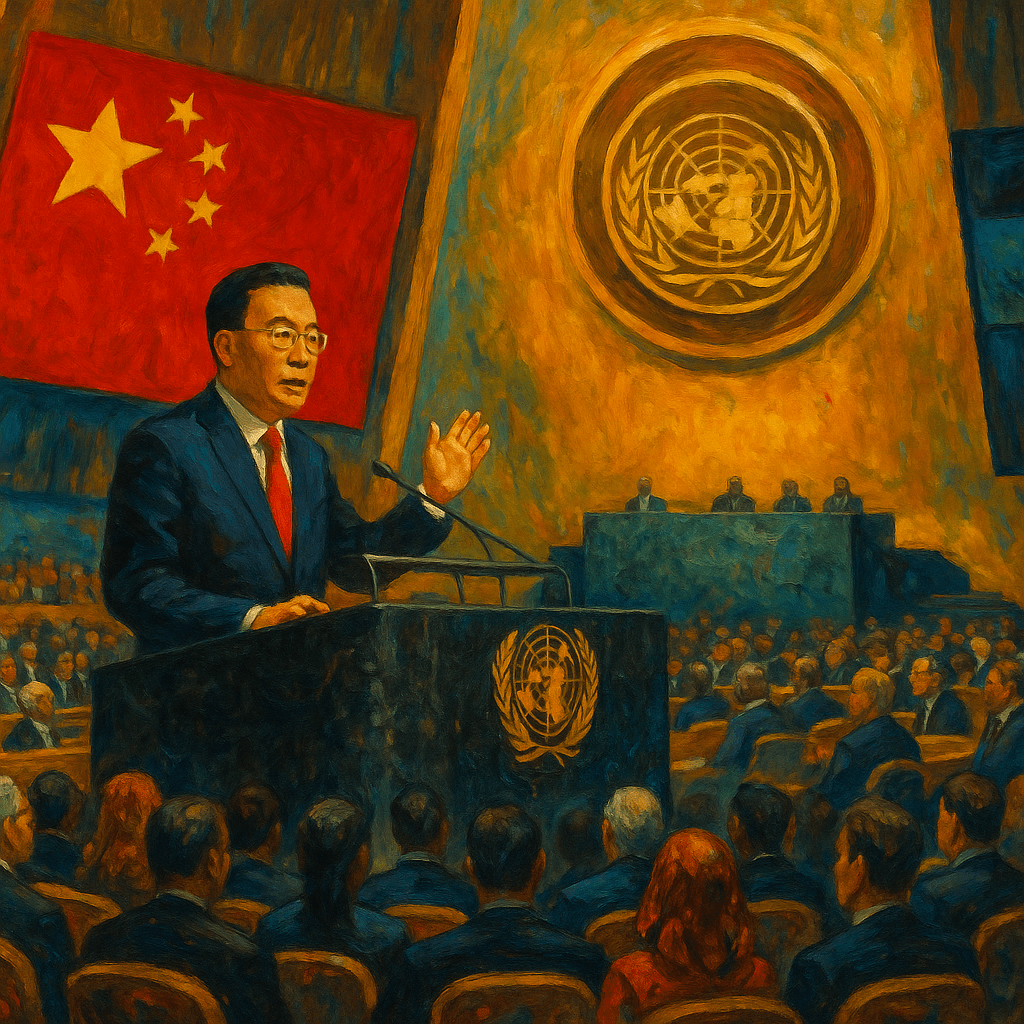
A Weaponized Propaganda Excavation of Didi Tang’s Coverage of Li Qiang’s UN Speech
By Prince Kapone | Weaponized Information | October 1, 2025
Reading the Script: How AP Frames China’s UN Overture as a Threat to “Our” World
Associated Press ran a piece by Didi Tang that pretends to neutrally report on Chinese Premier Li Qiang’s remarks at the United Nations, but the staging gives the game away. The headline primes the reader to see “global norms” as Western property and China as an interloper plotting a remodel while the landlord is out of town. The lede then repeats the trick: China “seizes” on an American “retreat,” as if multilateralism is a battlefield abandoned by a tired empire and now scavenged by an opportunist. The article speaks the language of objectivity while delivering a familiar sermon—Western hegemony is the natural climate; any change in the weather is a storm.
The narrative spine is simple. First, call the speech “jargon-filled” to dismiss the political content before you engage it. Second, translate every Chinese sentence through a security register: talk of responsibility and UN authority becomes a mask for revisionism. Third, put the United States in the story without ever naming it—let euphemism do the heavy lifting. Terms like “unilateralism,” “Cold War mentality,” and “hegemonism” appear as if they were suspicious code words rather than plain descriptions of a world system that most of the planet recognizes on sight. This is how ideology travels as style: you don’t need to prove anything if you can make alternative speech sound foreign, clumsy, or menacing.
The sourcing follows a well-worn choreography. A Western academic voice assures us that China aims to “turn a Western-dominant world order” toward itself. A policy professional affirms that Beijing seeks “influence” while lacking the appetite for a “wholesale alternative.” A Washington think-tanker supplies the moral coda: China says multilateralism, does the opposite. Each quote is framed as sober expertise, but together they serve as a chorus that narrows the reader’s horizon to two choices: U.S. primacy (responsible) or Chinese ambition (suspect). The many worlds beyond that binary—non-aligned projects, South–South cooperation, actual UN-centered sovereignty—exit stage left.
Notice the omertà of omission. There is no time here for the long ledger of U.S. departures from multilateral discipline; no time for the routine use of sanctions as policy theology; no time for how climate sabotage was normalized by the self-appointed steward of the “rules-based order.” Instead, the piece installs a narrative contraption: “retreat” is not an indictment of Washington’s disdain for institutions, it is a vacuum that China rushes to fill. The blame for turbulence is outsourced to the climbers on the ladder, not the ones who pulled it up.
There is a second move at work: emotional ventriloquism. Readers are nudged to feel that the United Nations belongs to the West—an heirloom cabinet to be dusted by responsible caretakers, not rearranged by upstarts. When Li Qiang praises the UN’s role and speaks of responsibility, the article treats it as a tell, not a principle; sincerity becomes strategy, and strategy becomes sin. By the time the copy reaches climate, trade, or development, the frame has already done its counterinsurgency: anything Beijing says is preemptively tagged as image management, not program.
The language of “norms” does the most ideological work. Norms, we are told without ever being told, came down from Olympus in the late twentieth century and were stewarded—with some regrettable lapses—by the West. So when a Chinese official says the words “more just and equitable,” the article hears “remold.” When Beijing says “UN-centered,” the article hears “power grab.” This is not analysis; it is a reflex dressed as reason. To call Chinese discourse “jargon-filled” while treating Atlantic catechism as common sense is the textbook Orientalist maneuver—your idiom is jargon, ours is clarity; your ambitions are designs, ours are responsibilities.
Journalism is never just what it reports; it is also how it arranges the room. Here the Associated Press acts less like a wire and more like a stage manager for a worldview. The authorial posture is professional, the tone is measured, the quotes are balanced, yet the structure funnels the reader toward a single conclusion: the problem with the international system is not the empire that bent it; the problem is the challenger who wants a say in how it bends back. That is how propaganda works when it graduates from posters to prose—no shouting, just a constant hum that says the present order is natural and the alternative is a threat.
We excavate not to nitpick copy but to expose the machine. The piece polices the perimeter of thinkable thought: China can be at the UN, but not of it; it can speak, but not define; it can “participate,” but not “shape.” The reader is invited to confuse Western dominance with world order itself. Strip away the professional varnish and the message is clear enough: sovereignty for us, supervision for you. Against that sermon, the working classes and the colonized hear something else in the hall today—a quarrel among managers about who gets to hold the keys, while the majority knocks at the door demanding a different house.
Facts Buried, Facts Omitted: Building the Real Picture Behind the Copy
If we peel back the wire-service varnish of the Associated Press article, we find a handful of hard claims wrapped in a fog of framing. The piece confirms that Li Qiang told the United Nations General Assembly China is prepared to “take up responsibilities” and inject “positive energy.” It notes Beijing’s lowering of tariffs, its pledge to cut greenhouse gases, and its stated defense of UN authority. It admits that Li criticized “unilateralism, Cold War mentality, hegemonism, and bullying,” and it ties his words to Xi Jinping’s “Global Governance Initiative” announced earlier in September 2025. Beyond this, the so-called expertise comes from carefully curated Western sources: Olivia Cheung from King’s College London calling China ambitious, Ali Wyne from the International Crisis Group cautioning against over-reading Beijing’s capacity, and Craig Singleton from the Foundation for Defense of Democracies claiming Chinese hypocrisy. The article leaves the impression of facts but packages them in suspicion.
What is missing is more telling than what is included. The United States has been the world’s most habitual violator of multilateral rules: leaving UNESCO in 2017, tearing itself from the Paris Climate Accord the same year, and slashing WHO funding during the pandemic. These are not footnotes; they are the defining facts of U.S. conduct in the UN system, and yet AP spares them no ink. On the other side of the ledger, China is today the single largest contributor of peacekeeping troops among the permanent Security Council members, a point Li Qiang’s rhetoric gestures toward but the article refuses to contextualize.
To grasp the real balance sheet, we need to track global institutional shifts. In 2024, BRICS expanded to include six new members—Saudi Arabia, Egypt, Iran, Argentina, Ethiopia, and the UAE—an unmistakable signal that much of the Global South is moving toward multipolar frameworks outside Washington’s orbit. This structural reality is airbrushed from AP’s prose, which casts China as a lone actor scheming against “the order” rather than as a node in a rising bloc of states remaking global governance. Economically, the context is even clearer: the United States today imposes tariffs on Chinese goods averaging about 51.1 percent. The AP report manages to mention tariffs only when China lowers them, as if aggression is one-sided.
And then there is climate. Beijing’s emission pledges are dismissed as performance, while Washington’s sabotage of global climate consensus—whether by deregulation or withdrawal—is written out of the record. To underline the asymmetry: when China vows carbon reductions, it is propaganda; when the U.S. sets fire to the Paris deal, it is omitted. Likewise with war: the article makes much of China’s supposed erosion of sovereignty in Hong Kong or the South China Sea, but has no space to recall the outright U.S. violation of sovereignty in Iraq in 2003, in Libya in 2011, or in the ceaseless drone wars of the last two decades.
Once we gather these scattered facts, the contradictions crystallize. Geopolitically, we are in transition from U.S. unipolar dominance to a more contested multipolar order; AP masks this by narrating Beijing as an opportunist rather than an agent in history. Economically, we see tariffs, sanctions, and blockades deployed by Washington while China emphasizes trade openness—yet only the latter is reported as suspect. Environmentally, the U.S. retreat is erased, while China’s commitments are trivialized. Institutionally, the UN is portrayed as a Western trust, even though Washington itself has undermined it for decades. The result is a hall of mirrors where the actual world is blurred and the reader sees only what empire prefers them to see.
From “Retreat” to Recalibration: Reframing the Crisis of Empire
Once the hard facts are pulled from the wreckage of AP’s framing, the real picture comes into focus. What the article calls an American “retreat” from international institutions is no retreat at all but a strategy of imperialist recalibration: abandoning multilateral forums when they no longer serve U.S. hegemony, while building parallel structures of coercion—sanctions regimes, proxy wars, trade blockades—to enforce obedience outside the halls of the United Nations. Washington’s sulking departure from UNESCO, Paris, and WHO was never about withdrawal; it was about disciplining the world on its own terms, without interference from rules it cannot control. To call this a retreat is to confuse a battlefield maneuver with defeat. The U.S. has not left the field—it has simply changed the terrain of domination.
This maneuver is anchored in the sanctions architecture, the global scaffolding of economic war. The Trump tariffs that continue to weigh down hundreds of billions of dollars in Chinese goods are part of the same machinery that seizes Venezuelan gold, freezes Russian assets, and strangles entire nations into austerity. The AP article notices tariffs only when China reduces them, because acknowledging U.S. economic warfare would fracture the illusion that aggression flows eastward alone. Sanctions are not trade disputes—they are the imperial state’s weapon of choice in the era of financial warfare, a silent blockade that masquerades as policy.
Behind this sleight of hand is a deeper hegemonic crisis. The United States built a world system on its own supremacy, but its capacity to uphold that supremacy has eroded. Its domestic crises—from economic inequality to political implosion—spill outward into foreign policy, producing a state that no longer believes in its own institutions but cannot imagine surrendering control. That contradiction is precisely what AP works overtime to conceal: the empire is not confident, it is cornered. It lashes out at those who attempt to re-center sovereignty, whether in Beijing, Caracas, Tehran, or Pretoria, and then accuses them of destabilizing the “order.” In truth, the order has been destabilized by the very hands that built it.
This is why China’s rhetoric of multipolar sovereignty finds resonance in the Global South. When Li Qiang speaks of a UN-centered order and a “common destiny for humankind,” AP hears revisionism; much of the world hears a demand that sovereignty be respected beyond the North Atlantic. This is not because China is flawless or selfless, but because the alternative is Western monopoly dressed as multilateralism. Beijing’s commitments—to climate targets, tariff reductions, and peacekeeping contributions—are not propaganda lines in a vacuum; they are material counterpoints to Washington’s long record of sabotage. Where the U.S. empties out the institutions it cannot bend, China steps in to occupy the space with the promise of shared governance. That is the contradiction AP cannot name: what the article calls turbulence is the turbulence of empire losing its monopoly.
Reframed in this way, Li Qiang’s UN speech is not a “jargon-filled” opportunism but part of a historic shift. The crisis of imperialism is no longer abstract—it is visible in the daily oscillations of Washington, unable to dominate but unwilling to coexist. China’s entry onto the UN stage is not theft of “norms” but a refusal to let one empire hold the microphone forever. And so the real story is not whether Beijing is “remolding” the world order, but whether the workers, peasants, and colonized nations of the world can seize this fracture to build institutions that serve humanity rather than empire. That is the question AP cannot write, but it is the question history now demands.
From Analysis to Action: Forging Revolutionary Solidarity in the Heart of Empire
If the excavation reveals propaganda, and the reframing uncovers the deeper contradictions of empire, then the final task is to ask: what is to be done? For those of us living in the belly of the beast, in the imperial core where Associated Press narratives circulate as common sense, our responsibility is to tear open the manufactured consensus and build bonds of solidarity with the vast majority of humanity—the colonized nations, the global working classes, the multipolar forces carving space for sovereignty. This is not charity, not enlightened liberal sympathy, but necessity. The survival of any struggle in the Global North depends on the strength of the Global South and vice versa. A fracture in imperial order is an opening not to be observed, but to be widened by conscious, collective struggle.
The first call is to the working classes of the North: see clearly how your lives are tethered to empire. The wages that sustain you, the social programs that remain, the cheap goods on your shelves—all of these are subsidized by super-exploitation abroad and colonial domination at home. Solidarity begins when we refuse the illusion that our prosperity is earned, and recognize it as looted. That recognition must be turned into action, by linking our unions, community organizations, and movements to those of workers and peasants from Caracas to Johannesburg, from Delhi to Gaza. When the U.S. ruling class tells you China is the enemy, hear instead the voice of empire frightened that you might discover who your real friends are.
The second call is to the colonized inside the empire—the Indigenous nations, the Black proletariat and lumpen, the migrant laborers, the internally colonized communities who have borne the brunt of repression since the founding of this settler project. Your struggles are not isolated; they are directly bound to the anti-imperialist fights abroad. When Venezuela defies sanctions, when South Africa drags Israel to the International Court of Justice, when Cuba shelters revolutionaries, these are not distant events but signals of a common front against empire. To connect your battles for land, dignity, wages, and sovereignty with these global eruptions is to see yourself not as a minority fighting for scraps but as a vanguard of a worldwide struggle.
What tactics emerge from this terrain? They must be born of the concrete conditions we face. In some cases, that means waging campaigns against the think tanks and banks that bankroll imperial policy; in others, it means building alternative media platforms that dismantle the lies of AP and CNN; in still others, it means direct material solidarity—raising funds for Global South movements, amplifying their voices, organizing boycotts and divestments. The key is not to impose an abstract blueprint but to build strategies that grow out of the actual configuration of forces: the rise of multipolar blocs like BRICS+, the anti-imperialist fronts from Latin America to Africa, and the militant demands erupting in our own neighborhoods.
The decisive move is solidarity in practice. Workers in Detroit and Delhi, colonized peoples in Chicago and Caracas, Indigenous nations in Turtle Island and the Andes, peasants in Africa and Asia—all are facing the same empire, even if it wears different masks. To link our struggles is to build the muscle of a new internationalism, not the sterile NGO version of “global citizenship” but the living revolutionary unity of those who know the empire must fall for the world to live. AP tells us China’s rise is turbulence; we know the real turbulence is the collapse of an order built on plunder. Our task is to transform that turbulence into a storm of liberation.
 Weaponized Information
Leave a comment