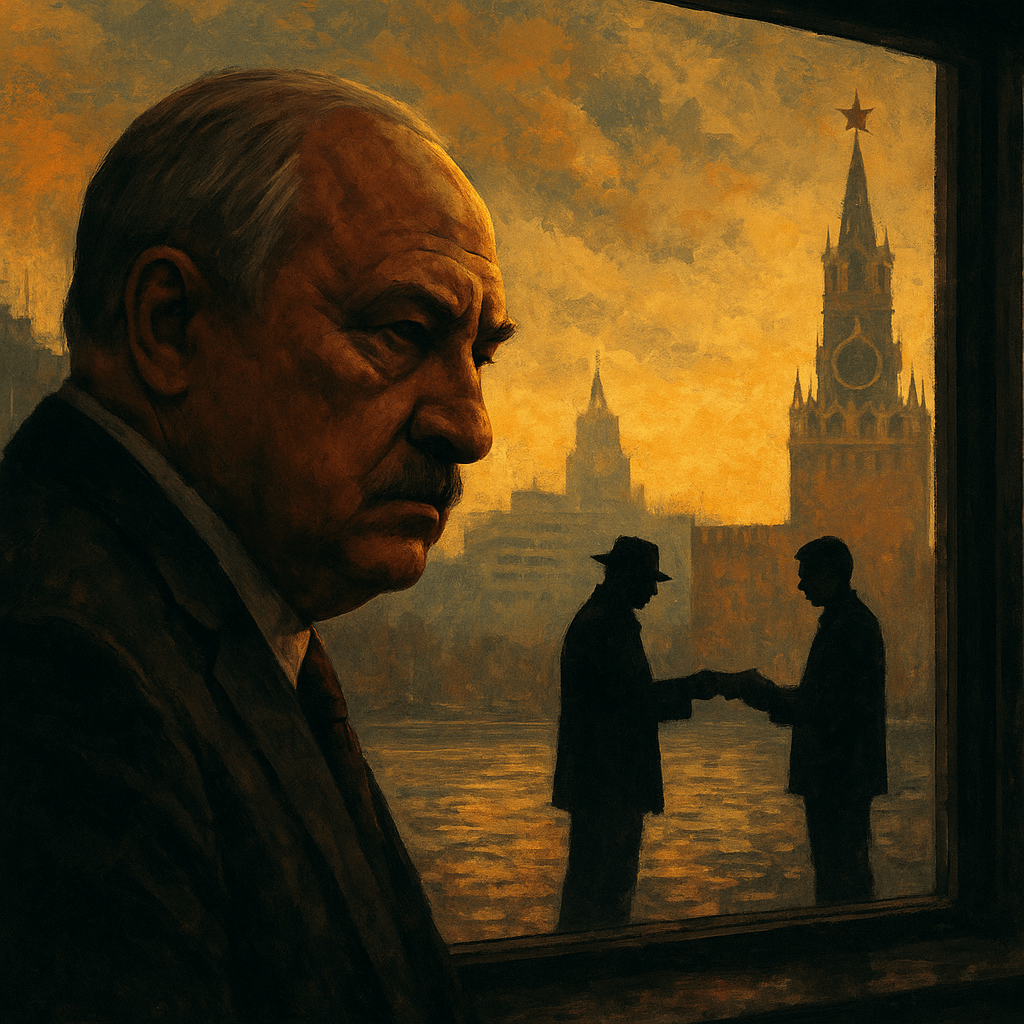
The expulsions and arrests are less about espionage than about bloc discipline. In the twilight of Western supremacy, every accusation becomes a weapon, every headline a tool to enforce loyalty, and every silence a shield for imperial decline.
By Prince Kapone | Weaponized Information | September 9, 2025
Spies, Shadows, and the Manufacture of Fear
On September 8, 2025, CNN ran an Associated Press story about a so-called Belarusian spy ring broken up by Czech, Hungarian, and Romanian intelligence. The piece read like Cold War dinner theater: an Eastern plot uncovered, a traitor exposed, a diplomat tossed out, and the guardians of Europe standing tall once again. The script is familiar. A Moldovan official is accused of treason, a Belarusian envoy is expelled, and the reader is left to nod along as if this little morality play settles the matter.
But scratch the surface and the story starts to wobble. There’s no evidence shown to the public, no documents or recordings offered up, just solemn statements from security chiefs passed along by an anonymous AP byline. CNN serves as the loudspeaker, dressing it up with the gloss of corporate news. What looks like “neutral journalism” is really the ventriloquism of power—security agencies speaking through wire copy, with the press too polite or too complicit to demand proof.
The techniques are textbook. The language is heavy with danger, with talk of “national security” threatened and “hostile activity” discovered, but no one shows the receipts. Characters are written as if from a playbill: the faceless diplomat, the faithless Moldovan, the heroic agencies saving Europe from the shadows. Threats are inflated; context is erased. We’re told what to fear, not what to think.
What’s missing tells the real story. No questions are asked about the timing, the motives, or the wider political climate. No mention that these same governments are knee-deep in NATO’s security orbit, or that expulsions and treason trials are convenient ways to prove loyalty to the bloc. The silence isn’t accidental—it’s crafted. By not saying what matters, the story trains its readers to see only what power wants them to see.
That’s how fear is made: through repetition of official phrases, through selective silence, through the constant suggestion of shadows without ever turning on the light. It’s less about informing the public than about grooming them to accept more border controls, more surveillance, more Cold War on the horizon. What we’ve excavated here is not evidence of espionage but evidence of narrative warfare, the kind that prepares people to welcome chains as if they were shields.
Allegations Without Proof, Context Without Balance
The official tale begins with CNN republishing an Associated Press wire, declaring that Czech, Hungarian, and Romanian agencies had exposed a Belarusian spy network. The words fall like a gavel: dismantled, arrested, expelled. A Moldovan official branded a traitor, a Belarusian diplomat ordered to pack his bags. The narrative is handed down whole, inviting us to receive it as verdict rather than allegation. What is striking is not what we are told, but what we are not shown—no leaked documents, no intercepted phone calls, no material evidence in the public record. Only the solemn assurance of security services, echoed faithfully in print.
The fragments that do exist travel quickly through official channels. Eurojust confirmed that a former deputy of Moldova’s SIS was under investigation for passing state secrets to Belarus. Romania’s DIICOT reported that the suspect—identified by regional media as Alexandru Bălan—was arrested for treason, accused of endangering national security, and detained for thirty days. The Czech Foreign Ministry added that a Belarusian diplomat was expelled within seventy-two hours. Opposition Belarusian outlets like Belsat and Charter97 amplified those official accounts—framing the arrest and expulsion as settled fact. The chorus repeats, but the score—the public presentation of hard evidence—remains locked away.
Minsk answers with its own countermelody. Belarus denounced the Czech decision to expel its diplomat as politically motivated. Poland followed suit, arresting a Belarusian spy and expelling a diplomat under similar accusations. Simultaneously, BelTA reported that Belarus’s KGB had arrested fourteen individuals for espionage and treason in 2025. In Minsk’s telling, it is Belarus that is besieged by hostile services, its sovereignty threatened by Western intrigue. Two worlds of meaning collide: in one, Belarus is the infiltrator; in the other, Belarus is the fortress under attack.
Step back, and the pattern becomes clearer. The allegations against Belarus come in a tight sequence—arrest in Romania, expulsion in Prague, another in Warsaw. Each move announced in chorus, each announcement timed to echo across the bloc. The content is less important than the choreography. This is not simply counterintelligence at work, it is politics in motion: a set of governments with fragile interiors demonstrating loyalty to NATO’s New Cold War discipline. Moldova heads into elections under intense pressure to nail its colors to the EU mast; Romania stages its arrest as evidence of vigilance; the Czech Republic and Poland move in tandem to keep the spotlight bright. None of this makes the allegations inherently false—but it reminds us that in these matters, accusation and alignment often march together.
Beyond the back-and-forth of claims, there is the wider field of espionage that the AP and CNN would rather leave unseen. The Snowden leaks proved that Washington spied on allies, from the mass harvesting of European communications to tapping Chancellor Merkel’s phone. The Five Eyes alliance continues to sweep the globe through ECHELON. NATO’s Tallinn cyber centre trains specialists for both defensive and offensive operations. U.S. tech firms export surveillance architecture worldwide, entangling commerce with covert power. Against this background, the fixation on Belarus alone looks less like concern for truth and more like selective memory, a convenient silence that turns espionage into a one-way mirror.
The factual ground, then, is uneven. Yes, there are official charges, arrests, expulsions. Yes, Belarus denies them and pushes its own spy cases. But what is presented as a clean story of good Europe versus rogue Belarus is in fact a contest of narratives, each serving a political end. The larger reality is that NATO’s intelligence machine dwarfs anything Minsk can field, and that espionage in Europe is not the exception but the rule. What matters is how each revelation is staged, how it is used to discipline allies, prepare populations, and advance a bloc’s position in the grinding confrontation that now defines the continent.
Spy Games in the Twilight of Empire
Once we strip away the headlines and the staged choreography of expulsions, we are left with something deeper than cloak-and-dagger intrigue. The facts are thin—an arrest in Bucharest, a diplomat hustled out of Prague, charges announced in Warsaw. The omissions are thick—no hard proof, no documents on the table, no public evidence beyond press statements. Yet the weight of this story does not rest on what is proved. It rests on how these fragmentary claims are woven into the larger fabric of the West’s confrontation with Russia, Belarus, and ultimately China.
What emerges is not an isolated scandal but a pattern. Governments that are politically volatile, like Moldova and Romania, seize on accusations of espionage to demonstrate their fidelity to NATO. The Czech Republic and Poland join in, moving in sync to amplify the message: the bloc is united, the enemy is near, loyalty will be tested. This is not simply about one Moldovan official or one Belarusian diplomat. It is about bloc discipline, about tightening the screws in Eastern Europe so that no member state drifts out of line in the New Cold War. In the absence of real evidence, the accusation itself becomes the weapon—an instrument of political alignment masquerading as law enforcement.
The logic is familiar. During the first Cold War, charges of espionage were routinely deployed to isolate socialist states, purge dissenters, and build public consent for militarization. Today, the same function is served. The cry of “spy” is less about the clandestine transfer of secrets than about the public transfer of allegiance. It tells Eastern European elites that their careers and parties survive only so long as they purge the ranks, disown past ties with Moscow, and rehearse the lines of NATO’s script. It tells populations weary of crisis that security demands sacrifice—of freedoms, of movement, of sovereignty itself. And it tells the wider world that Europe remains locked inside Washington’s orbit, even as the U.S. itself falters.
This is the dialectic of the present. The West speaks of “hostile networks” and “national security threats,” but what it fears most is not a Belarusian spy. It fears the erosion of its own supremacy. The Sanctions Architecture that sought to strangle Russia and Belarus has failed to break them. The attempt at Imperialist Recalibration—shifting from direct invasions to hybrid war, lawfare, and intelligence spectacle—reveals more weakness than strength. The EU’s drive to restrict diplomatic travel and expand surveillance is a domestic expression of Technofascism, the fusion of corporate media, border policing, and security bureaucracy into a single apparatus of control. And the deployment of espionage charges functions as a form of Counterinsurgency, aimed not only at foreign rivals but at the minds of European citizens themselves, conditioning them to accept austerity and endless war as the price of belonging.
Look at the balance sheet of history. The United States and its allies are in imperial decline—militarily overstretched, economically stagnant, ideologically exhausted. The so-called revelations about Belarus do not signal renewed strength. They signal desperation. They show an empire struggling to police its periphery, inventing threats to justify its grip, and punishing any sign of wavering inside the bloc. At the very moment when multipolarity advances—through BRICS+, through South-South solidarity, through China’s rise and Russia’s endurance—the West doubles down on fear, hoping to hold together its shrinking sphere. The spy story, in this light, is not about hidden plots. It is about the twilight of empire, when shadows are cast long and fear becomes the glue that holds a crumbling order together.
From Manufactured Fear to Living Struggle
If the spy story teaches us anything, it is that the ruling bloc in the West will always find a way to turn shadows into shackles. Accusations without evidence become the scaffolding for tighter borders, heavier surveillance, and louder calls for loyalty. But propaganda only works when people accept its frame. Our task is to break that frame wide open, to refuse the invitation to see the world in miniature—good Europe, bad Belarus—and to insist instead on the full panorama of imperial decline, global resistance, and working-class struggle.
We cannot meet these stories with silence or passive disbelief. We have to counter them with memory: the NSA’s tapping of Merkel’s phone, the long reach of ECHELON, the routine lawbreaking of NATO’s cyber warriors. We have to remind ourselves and others that Europe’s rulers are not victims of espionage but practitioners of it on an industrial scale. Each new “exposure” must be held against the balance sheet of empire. Who really spies on whom? Who really dictates terms of loyalty? And whose lives are disrupted, surveilled, and criminalized in the process?
Out of this recognition grows the need for solidarity that is not abstract but rooted. Solidarity with Belarusians, Russians, and Chinese workers demonized as spies while their countries are targeted for sanctions and destabilization. Solidarity with people inside Europe who are told to surrender rights in the name of security, and who will pay the price of austerity dressed up as vigilance. Solidarity with the Global South, where espionage and sanctions alike function as blunt instruments to keep nations subordinate. These ties of solidarity are not charity; they are self-defense in an age when imperial power collapses inward and turns its fire on anyone who resists.
The work before us is not to draft blueprints or recipes, but to build consciousness and courage in motion. It means refusing to let accusations define reality, insisting instead on historical truth and class perspective. It means turning the tools of surveillance against their masters—learning encryption, protecting our communication, refusing to be easy prey. It means strengthening independent media and grassroots institutions that can tell our stories without the filter of imperial consent. Above all, it means recognizing that every headline of fear is an opportunity: to show the cracks in the empire’s mask, to connect struggles across borders, and to turn suspicion into solidarity.
The spy scare will fade, replaced by another. But the crisis of imperialism that generates it will remain. We cannot afford to chase shadows. We have to face the substance: a world order in collapse, and the chance to build something freer and more humane in its place. The task is immense, but so is the moment. The rulers make their moves in darkness. Our answer is light—collective, unflinching, and grounded in the struggles of ordinary people who refuse to be governed by fear.
 Weaponized Information
Leave a comment