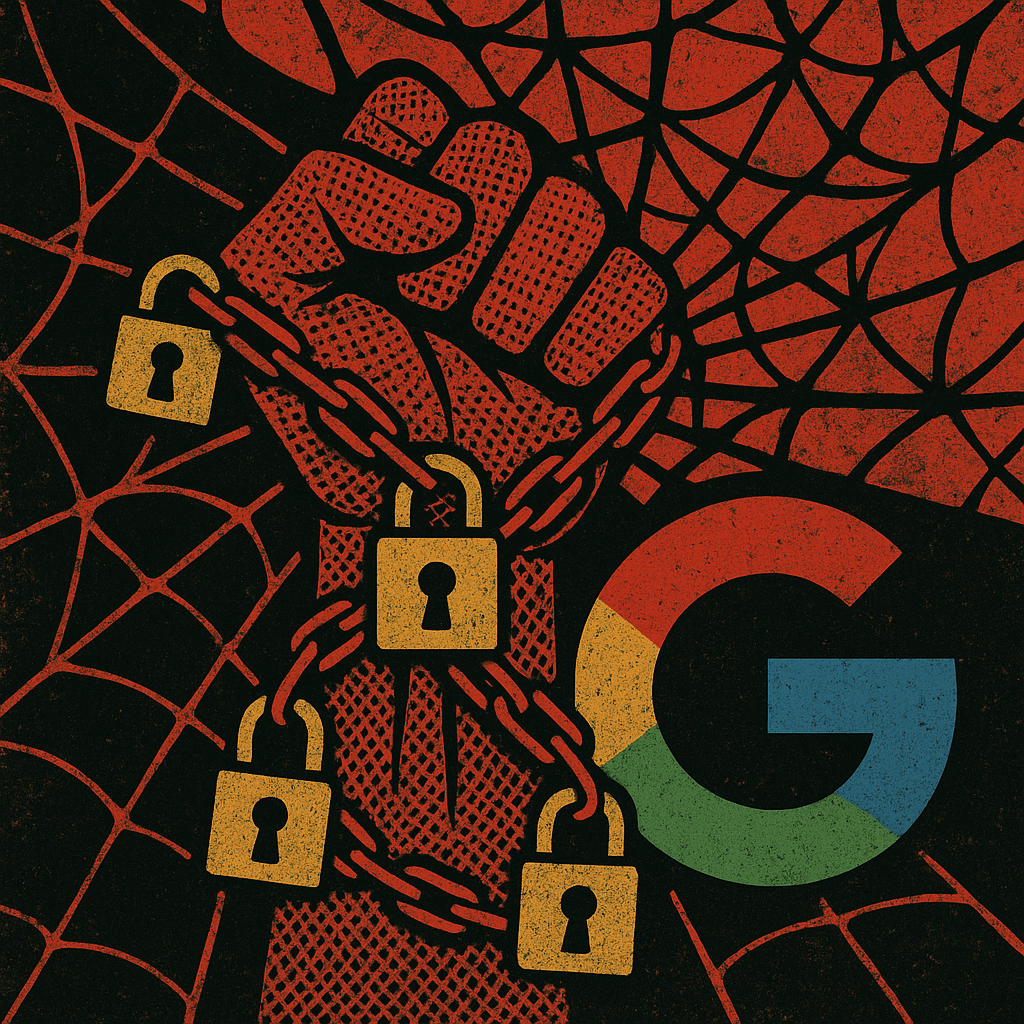
Google admits in court that the “open web” is collapsing, even as it reassures the public everything is fine. This decline was built through decades of deregulation, liability shields, and fake neutrality. What we face now is enclosure—technofascism, platform feudalism, and digital colonialism dressed up as innovation. The answer is to refuse serfdom and build our own infrastructures of dual power in the digital sphere.
By Prince Kapone | Weaponized Information | September 9, 2025
The Mask Slips in Silicon Valley’s Courtroom
On September 8, 2025, Ars Technica carried Ryan Whitwam’s report on Google’s latest courtroom maneuver. The headline was stark: Google admitted in a filing that the “open web is in rapid decline.” The piece presents this as a puzzling contradiction—Google publicly celebrates a thriving web, yet tells a judge the digital commons is collapsing. Rather than probing the stakes of this admission, Whitwam frames it as an instance of corporate inconsistency, a curious bit of double-speak.
Whitwam’s career orbit—Android Police, ExtremeTech, Wirecutter, even the New York Times—marks him as a professional in the gadget-review economy, a niche where access and advertiser goodwill are currency. His class orientation is not neutral: his work depends on amplifying platform narratives while occasionally critiquing their rough edges. In this case, the rough edge is smoothed over, the deeper contradiction left unexamined.
The outlet, Ars Technica, itself belongs to Condé Nast, a media conglomerate whose business model leans on the same advertising infrastructure the story purports to analyze. Its function is to translate monopoly developments into digestible consumer-tech language, keeping the critique surface-level enough to protect the flows that keep its lights on.
Even the supporting voices in the article—Search Engine Roundtable and Pew Research—reinforce the frame without challenging it. Their inclusion gives a sense of balance and authority, but the terrain of analysis remains bounded by the same institutional ecosystem that Google dominates.
The propaganda work emerges in how the story is told. The admission is treated as if it were a slip of the tongue, a corporate contradiction too “murky” to mean much. That framing turns a monopoly strategy into an accident of messaging. The nostalgic invocation of the “open web” appeals to sentimentality, suggesting something precious is being lost, without asking whether it ever truly existed outside the scaffolding of advertising. The reader is nudged to believe that the problem is confusion, not design; that decline is happening to Google, not through Google. Even the article’s pivot to statistics—the “45 percent increase in indexable content”—offers a comforting counterpoint that blunts the force of the admission, implying that abundance offsets collapse. Through this choreography, the shock of the headline is softened, absorbed, and neutralized.
In the end, the article does not strip the mask from monopoly power—it helps reapply it. What could have been read as a confession is reduced to a communications mishap. What could have exposed a deliberate restructuring of the digital world is recast as a confusing inconsistency. The mask has slipped, but the reader is told it was only a glitch in the performance.
Facts on the Table, No Illusions
In the courtroom Google finally said the quiet part out loud: the “open web is already in rapid decline”. This is the same company that tells the public the web is healthy, that traffic is steady, that AI search makes everything better. Yet independent studies show otherwise, with the Pew Research Center proving that when Google slaps an AI summary at the top, people stop clicking through to real sites. Google’s lawyers now say their remark was just about “open-web display advertising,” and industry reporting repeats the claim that ad money is shifting into apps, retail platforms, and connected TV instead of the old web. Call it what you like, but the bones of the matter are clear: the ad dollars that kept publishers alive are vanishing. To cover itself, Google points to a 45 percent jump in indexable content since 2023. But quantity is not vitality. More AI sludge does not mean a thriving commons.
This collapse didn’t come out of nowhere. The Telecommunications Act of 1996 tore up the old rules, gave telecom giants the right to swallow each other, and locked down internet access inside corporate monopolies. In the same cycle, Congress gifted the platforms their shield: Section 230 of the Communications Decency Act made sure companies like Google couldn’t be treated as publishers, letting them gorge on user content while dodging accountability. A couple years later came the Digital Millennium Copyright Act, which wrapped platforms in more legal armor through takedown procedures and safe harbors. These were not “neutral” laws—they were the foundation stones of platform capitalism, ensuring that Silicon Valley could grow without being touched.
In the Obama years the FCC staged its play about “openness.” With the 2015 Open Internet Order, broadband was reclassified under Title II and we were promised no blocking, no throttling, no fast lanes. It sounded good, but it never touched the monopolies at the heart of the system. And in 2017, the Trump FCC came in with the Restoring Internet Freedom Order and tore it all down. The pendulum swings, the speeches change, but the platforms stay in place and the money keeps flowing upward. “Openness” was never more than a slogan—one set of rules to make the public feel protected, another to make sure the monopolies kept their spoils.
The pattern goes back even further. In United States v. Microsoft, the government proved that bundling Internet Explorer with Windows was monopoly abuse. Yet the so-called punishment was nothing more than a settlement, some conduct remedies, and a slap on the wrist. Microsoft stayed intact, the model stayed intact, and the precedent was clear: discipline the monopoly, but never dismantle it. Today’s Department of Justice case against Google follows that script to the letter.
When you line it all up, the story is not murky at all. Google’s “decline” narrative is just the mask slipping off a system that has been hollowed out by design. The laws that were supposed to regulate ended up protecting; the rulings that were supposed to punish ended up preserving. What looks like inconsistency in Google’s messaging is simply the truth peeking out from under decades of legal fictions. The so-called open web is collapsing because it was never open to begin with—it was always scaffolded by deregulation, liability shields, and fake neutrality. That is the record, written not in nostalgia or in myth, but in statutes, orders, and settlements that tell us exactly how monopoly power was built and why it now admits to the decay.
Monopoly Confession and the Architecture of Enclosure
Now that the facts are on the table, the mask can be stripped away. Google’s courtroom line about the “open web” collapsing is not a slip—it is the sound of monopoly capital speaking honestly when it thinks only the judge is listening. For the public, the story remains that everything is fine: traffic is steady, users are happy, innovation is endless. For the court, the story shifts: the foundations are rotting, and only by sparing Google from divestiture can the wreckage be slowed. This is not confusion, it is a calculated strategy. It is Cognitive Warfare in practice—two narratives for two audiences, both designed to preserve the same power.
To see this clearly means refusing the nostalgia for an “open web.” That phrase itself was a marketing campaign, not a social reality. What was called open was always already fenced in by advertising infrastructure, liability shields, and deregulation. The moment advertising budgets migrated elsewhere, the scaffolding collapsed. The open web was not murdered by accident—it was designed to be temporary, a stage in the enclosure of digital life. What comes next is not openness but what can only be called Platform Feudalism. Instead of wandering a commons, users are corralled inside silos, apps, and AI interfaces, reduced to digital serfs feeding value upward to platform lords. The shift from websites to “experiences,” from links to “summaries,” is the lock clicking shut.
This is why the court battles matter, but not in the way the headlines pretend. The Department of Justice does not seek to liberate the internet from monopoly control; it seeks Imperialist Recalibration. Just as with Microsoft a generation ago, the goal is to discipline the monopoly enough to keep the system stable, not to break the machine itself. The remedies debated in Washington are not about restoring a commons—they are about redistributing monopoly rents between rival factions of capital while keeping the same corporate grip intact. The contradiction between Google’s public optimism and courtroom despair is not “murkiness.” It is the choreography of a state managing its own monopolies, making sure no single player crashes the stage.
Beyond the courtroom walls, the meaning of this collapse is global. What is sold as a crisis of advertising is in fact a crisis of empire. The United States built its dominance on the ability of its platforms to extract data and attention worldwide. This was Digital Colonialism: harvesting the informational labor of billions in the Global South while presenting it as “connectivity” and “openness.” Now, as the advertising scaffolding falters and AI enclosures rise, dependency deepens. The peripheries are left with platforms they do not control, infrastructures they cannot own, and digital futures they are denied the right to build. When Google admits the “open web” is declining, it is confessing not only the end of a business model but the tightening of a colonial order.
What emerges in this transition is the raw face of Technofascism. When the commons becomes unprofitable, it is dismantled. When users might escape, they are trapped inside machine-generated interfaces. When publishers complain, they are starved of revenue until they submit. The fusion of monopoly platforms, surveillance infrastructure, and state power produces a system where enclosure is not an accident but the operating principle. Google’s dual messaging only proves the point: to the masses, the story is growth; to the judge, the story is collapse. Both stories serve the same end—consolidation of control in fewer and fewer hands.
Seen from the standpoint of workers, peasants, and the colonized, there is no contradiction at all. What we are watching is the execution of the so-called open web, carried out by the very corporations that claimed to protect it. Antitrust hearings will not resurrect it; regulatory speeches will not restore it. The only real answer lies outside the empire’s scaffolding, in the struggles of the Global South for technological sovereignty and in the refusal of the working class to accept digital serfdom. Google has admitted the decline. Our task is to recognize that the decline is not the end of a golden age but the beginning of naked rule by enclosure—and to prepare accordingly.
From Collapse to Construction
If the so-called “open web” is collapsing, then the question becomes: collapse for whom, and to what end? For Google and its peers, the death of openness is a business plan. For publishers, it is starvation. For users, it is the slow shrinking of horizons until every search, every click, every conversation happens inside the company’s walled garden. This is not decline in the abstract—it is a transfer of power, a tightening of enclosure. And while Google pleads in court that it must be spared from divestiture, outside those walls billions of people already live under its grip. The collapse is happening in real time, and the mask of “openness” has been torn to shreds.
But no monopoly is permanent. Around the world, cracks are widening. In 2024, Brazil, South Africa, and India moved together to establish frameworks for digital sovereignty, part of a wider BRICS+ push to break from dependency and build shared data infrastructure on their own terms. Across Africa, regional unions have begun investing in local cloud and fiber capacity to keep data within their own borders. These are not small gestures—they are the seedlings of a new technological order, where control of digital life is wrested away from Silicon Valley’s lords. Every sovereign cable, every independent data center, is a blow against the empire’s monopoly on information.
In the Global North, solidarity begins with refusal. Refuse to keep feeding the monopoly machine through dependence on Google Ads. Campaigns can be mounted by unions, cooperatives, and community organizations to divest from that pipeline and redirect resources toward worker-run ad collectives and independent networks. Refuse to leave our digital lives entirely in the hands of platforms—support community broadband, open-source platforms, and cooperative media that answer to people rather than shareholders. This is not charity but mutual aid, the building of collective strength in a hostile terrain.
Resistance can also take place at the level of code. Proletarian Cyber Resistance is not about lone hackers in basements—it is about the organized promotion of federated, open-source systems like Mastodon or PeerTube, technologies that let people connect without being trapped in feudal enclosures. Every time a collective chooses these tools over a monopoly platform, it chips away at the empire’s command of attention. Political education must travel alongside this technical struggle: exposing how the story of “open web decline” is not a natural tragedy but a class war waged in the digital sphere, where monopolies enclose what once seemed free and bill it back to us as innovation.
The task ahead is to turn collapse into construction. If the open web is dead, then the fight is not to resuscitate a corpse but to build new institutions in its place. That means dual power in the digital world—our own infrastructures, our own platforms, our own networks that serve people rather than capital. This is how solidarity is made real: by refusing serfdom, by sabotaging enclosure, and by planting the seeds of a different internet in the shell of the old. The monopolies are telling us what they are doing. They have confessed the collapse. Our task is to answer with creation.
 Weaponized Information
Leave a comment