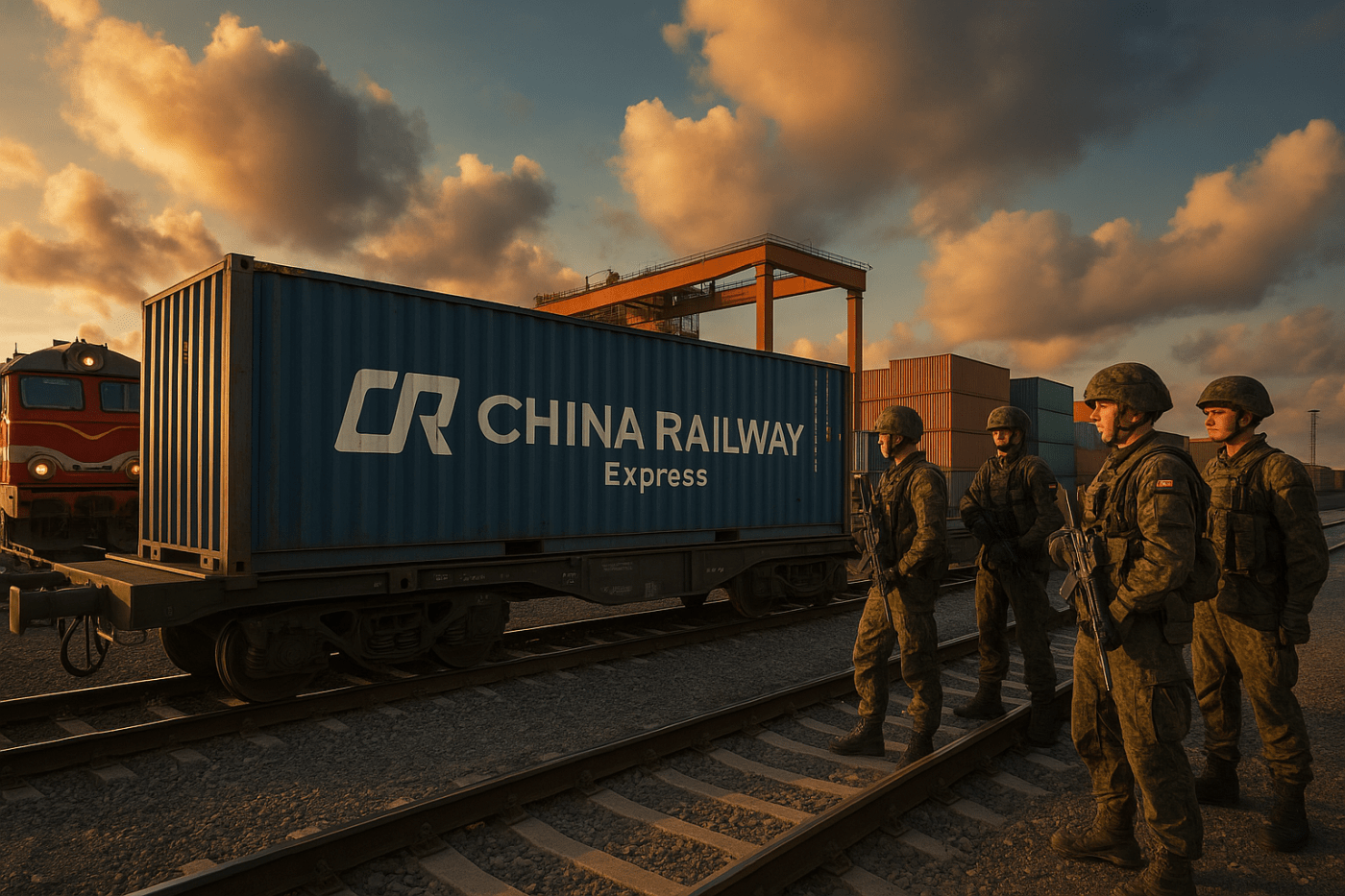
A Warsaw–China rail link exposes the cracks of unipolar order: a NATO frontline state hedging into Belt and Road corridors, caught between Atlanticist loyalty and the pull of multipolar recalibration.
By Prince Kapone | Weaponized Information | September 9, 2025
The Story They Want You to Hear
Alicja Ptak, writing for Notes from Poland, presents the new freight train from Warsaw to China as a triumph of commerce, a neat tale of Europe finding its place on the global map of trade. The piece reads like a ribbon-cutting ceremony transcribed into prose: state rail executives smiling in hard hats, governors declaring Poland’s bright future, journalists assuring readers that cooperation and prosperity are chugging along without friction. It is logistics turned into fairy tale, and the train itself becomes less a machine of steel than a symbol of growth, harmony, and inevitability.
Behind the curtain of neutrality lies a career forged in the house of Western wire services, where reporters are trained to transmute state and corporate talking points into “objective fact.” Ptak plays her role well, polishing Poland’s self-portrait as a nation stepping confidently into Eurasia. This isn’t malice, but class orientation: the professional scribes of the media-managerial layer serve as stenographers for the very institutions that tie their fates to imperial order. Their job is not to doubt but to amplify.
And the outlet itself—Notes from Poland—may posture as an independent nonprofit, funded by the small donations of earnest readers, but its line of sight remains fixed firmly in the horizon of Atlanticist respectability. It has the feel of grassroots journalism while performing the ideological labor of smoothing contradictions. It tells the stories European elites want to hear about themselves: that progress is measured in cargo tonnage, that national prestige rides the rails, that cooperation is simple and apolitical.
The propaganda devices at work are not loud or clumsy; they are quiet, disciplined, and naturalized. There is the glow of national pride, as Poland is cast as an essential gateway linking continents. There is the careful trimming of context, omitting the less flattering facts about whose rails these trains must traverse and what conflicts rage along the routes. There is the soothing rhythm of inevitability, where the messy entanglements of sanctions, militarization, and dependency vanish into the pure hum of efficiency. Even the choice of language—“pave the way,” “strengthen Poland’s position,” “boost economic growth”—is the language of brochures, not analysis.
These are the tools of soft persuasion: gentle hands guiding perception rather than clenched fists forcing belief. By painting trade as a technical matter of speed and investment, the article narrows the field of vision until readers see only steel tracks stretching into a bright horizon. Omitted are the fractures beneath the rails, the cracks in the very edifice of empire that make such hedging and recalibration necessary. That silence is the loudest part of the story.
Puzzle Pieces of Recalibration
That Warsaw–China freight train everyone is applauding is just one stitch in a much larger fabric. Poland’s trade with China already ran to €49.2 billion in imports in 2024 and $3.6 billion in exports. The iron arteries are there too: the LHS line, the westernmost broad-gauge railway in Europe, runs from the Ukrainian border to Sławków, plugging Poland straight into the old Soviet-gauge network. Trains from Xi’an reached Sławków as early as 2020, and in May 2025 Prime Minister Donald Tusk announced the expansion of Euroterminal Sławków to funnel even more goods from China and Central Asia.
Freight is only one part of the story. Poland has gone shopping in South Korea’s arms bazaar, signing deals for K2 tanks, K9 howitzers, FA-50 jets, and K239 rocket launchers. A second batch of K2 deliveries was agreed in July 2025. The relationship now runs to joint exercises and even reciprocal procurement, with Seoul considering purchasing Polish drones.
Step back, and the same pattern repeats across Europe. Hungary is welcoming a €7.3 billion Chinese battery plant in Debrecen, production slated for 2025–2026. The Budapest–Belgrade railway, a Belt and Road flagship, edges toward completion. Germany shouts “de-risking” while its chancellor and CEOs fly to Beijing to cut deals. France’s Macron signed Airbus expansions in 2023. Italy quit the Belt and Road in December 2023, only to reopen cooperation talks the following year.
Yet Poland is also NATO’s prize pupil. Defense spending above four percent of GDP since 2024. In September 2025, Trump promised more U.S. troops in Poland, the same day the EU announced €43.7 billion in defense funding for Warsaw.
The sanctions wall? Full of holes. Russia allows Polish food exports to cross its territory despite the embargo. The EU maintains a culture of carve-outs in energy, fertilizers, and transport. Germany still counts China as its top trading partner. Hungary keeps opening doors for Chinese EVs.
Taken together, these are the raw fragments. Trains, terminals, arms contracts, carve-outs, bases, trade missions—scattered data points that, when pieced together, sketch the outline of a deeper shift. The propaganda article wanted us to see only one train leaving Warsaw. The wider landscape is already there, scattered across Europe’s corridors and contracts, waiting to be assembled into the full picture.
Cracks in the Edifice
As the fragments of fact are assembled, the shape becomes unmistakable. Poland’s eastbound rail link is not an isolated gesture of commerce but part of a larger continental pattern: NATO-aligned states recalibrating within the declining U.S.-led order. The Warsaw–China train rides Russian and Belarusian rails, even as Poland cements itself as NATO’s most obedient pupil, raising defense spending above four percent of GDP and welcoming more U.S. troops. Two contradictory motions unfold at once: loyal proclamations to the Atlantic alliance, and pragmatic integration with Eurasian trade routes. This is not neutrality. It is multipolar recalibration.
The evidence reaches beyond Poland. Hungary locks itself into China’s electric vehicle supply chains and BRI rail corridors. Germany denounces “overdependence” on China, then dispatches CEOs to Beijing to secure contracts. France talks “de-risking” but signs Airbus orders. Italy theatrically quits the Belt and Road only to relaunch bilateral action plans the next year. These are not accidents or one-off inconsistencies. They are systemic: the very fabric of Europe adjusting to the decline of unipolarity by hedging between the imperial core and the rising multipolar pole.
For Poland, this double bind takes specific forms. It operates under neocolonial militarism, where its armed forces, budget, and strategy are subordinated to NATO command. It performs sovereignty theater, presenting new trade corridors as signs of national independence while its real decisions remain scripted in Washington and Brussels. It serves as host to weaponized infrastructure—rail terminals, military bases, logistics hubs—that double as commercial arteries and imperial chokepoints. In each case, the pattern is clear: Poland is not the agent of hyper-imperialism but the executor of imperial strategy, hedging at the edges where material necessity forces it to.
Dialectically, this is the heart of imperialist recalibration. Sanctions proclaimed as walls turn porous when food exports need to cross Russia. Atlanticist rhetoric condemns Beijing, but freight, batteries, and airplanes keep binding Europe to China. Multipolar recalibration is not ideological alignment with the Global South—it is tactical hedging within a decaying system. Yet every hedge is also a crack. Every corridor opened eastward erodes the coherence of the unipolar bloc, forcing the empire to discipline its own frontline states while revealing its inability to command absolute obedience.
From the standpoint of the global proletariat, these cracks matter. They signal that imperial coherence is faltering, that even NATO’s eastern bastions are pulled toward multipolar trade and industrial circuits. The Warsaw freight train, sold as a triumph of logistics, is better read as proof that the empire’s grip is loosening. The unipolar order can shout loyalty from every podium, but the rails, contracts, and exemptions tell another story: the material reality of decline.
From Hedging to Solidarity
The Warsaw–China freight line tells us something deeper than cargo schedules: it reveals how contradictions inside the imperial bloc are widening. Poland cannot cut itself loose from NATO without collapsing its own military scaffolding, yet it cannot prosper without binding itself into Eurasian corridors. The same is true of Germany, France, Italy, and Hungary, each shouting loyalty to Washington while wiring their factories, railways, and markets to Beijing. This is the terrain we stand on—one where the empire projects force more loudly than ever, but where its own allies chip away at its foundations out of necessity.
What flows from this is not a prepackaged call for a single tactic but an opening for struggle. The global working class is watching as Europe’s leaders perform sovereignty while submitting to NATO’s command and hedging into China’s markets. That performance creates fractures where pressure can be applied: workers on the rail lines squeezed by privatization, logistics hubs transformed into chokepoints of dependency, populations paying for militarization even as their states integrate with the very rivals they denounce. Each of these cracks is a site where solidarity can root itself.
In the Global North, the task is to expose the double life of these states and translate it into political education and organizing. The Polish government boasts of independence while signing away sovereignty to NATO; it hails economic growth while tethering its prosperity to the same adversaries its allies are preparing to fight. Workers, students, and movements can seize on these contradictions, not abstractly but concretely: by linking the rising cost of living to militarization budgets, by connecting labor precarity to the logistics corridors celebrated as “national strength,” by insisting that the wealth flowing eastward is built on the exploitation of labor both at home and abroad.
The point is not to dictate a single blueprint but to sharpen awareness of the shifting ground beneath us. The freight train from Warsaw to China is more than a shipment of goods—it is a signal that the unipolar edifice is cracking. To act on that signal is to recognize that empire is not invincible, that its own dependencies betray it, and that solidarity with those pushing for a multipolar world can take root even inside the belly of the beast. Where and how that solidarity grows will depend on the forces in motion: the workers who load the trains, the movements who resist the bases, the people who see through the theater of sovereignty and demand the real thing.
 Weaponized Information
Leave a comment