By Prince Kapone, Weaponized Information
Labor Is the Bridge Between Soil and Society
Food does not emerge from soil alone. It must be coaxed, cultivated, and carried into being by human labor. Labor is the active force that transforms nature—not just for profit, but for survival. Yet under capitalism, this labor is not honored, supported, or protected. It is bought and sold as a commodity. It is extracted, alienated, and exploited as “labor power”—a variable cost on the spreadsheet of accumulation.
This part of our series examines labor in capitalist agriculture—not only as a force of production, but as a metabolic interaction between human life and the land. We trace how capitalism severs labor from its ecological roots, disciplines it through technofascist mechanisms, and enforces its subjugation through imperial logistics, racialized segmentation, and debt bondage. And we look to the insurgent alternatives already taking shape in the fields and collectives of the Global South and beyond.
The Metabolic Character of Human Labor
As Marx writes in Capital, “Labor is, first of all, a process between man and nature, a process by which man, through his own actions, mediates, regulates, and controls the metabolism between himself and nature.”
In the context of agriculture, labor is the hands that till, the feet that water, the backs that carry, and the minds that decide when to sow. It is not external to nature—it is a part of the cycle, facilitating transformation in a reciprocal exchange.
In non-capitalist societies, labor was embedded in the ecological and cultural rhythms of life. In peasant societies and Indigenous systems, labor followed the seasons, was coordinated collectively, and was bound to place and community. Under capitalism, this labor is alienated—reduced to an abstract quantity measured in hours, regulated by price, and commodified through contracts and quotas.
From Ecological Labor to Alienated Labor Power
The transformation of labor into “labor power”—a commodity to be sold—was a historical rupture. Enclosure in Europe forced peasants from common lands into wage work. Slavery and settler colonialism established racialized systems of coerced agricultural labor. Empire built its granaries on stolen land, using stolen bodies, for the benefit of distant metropoles.
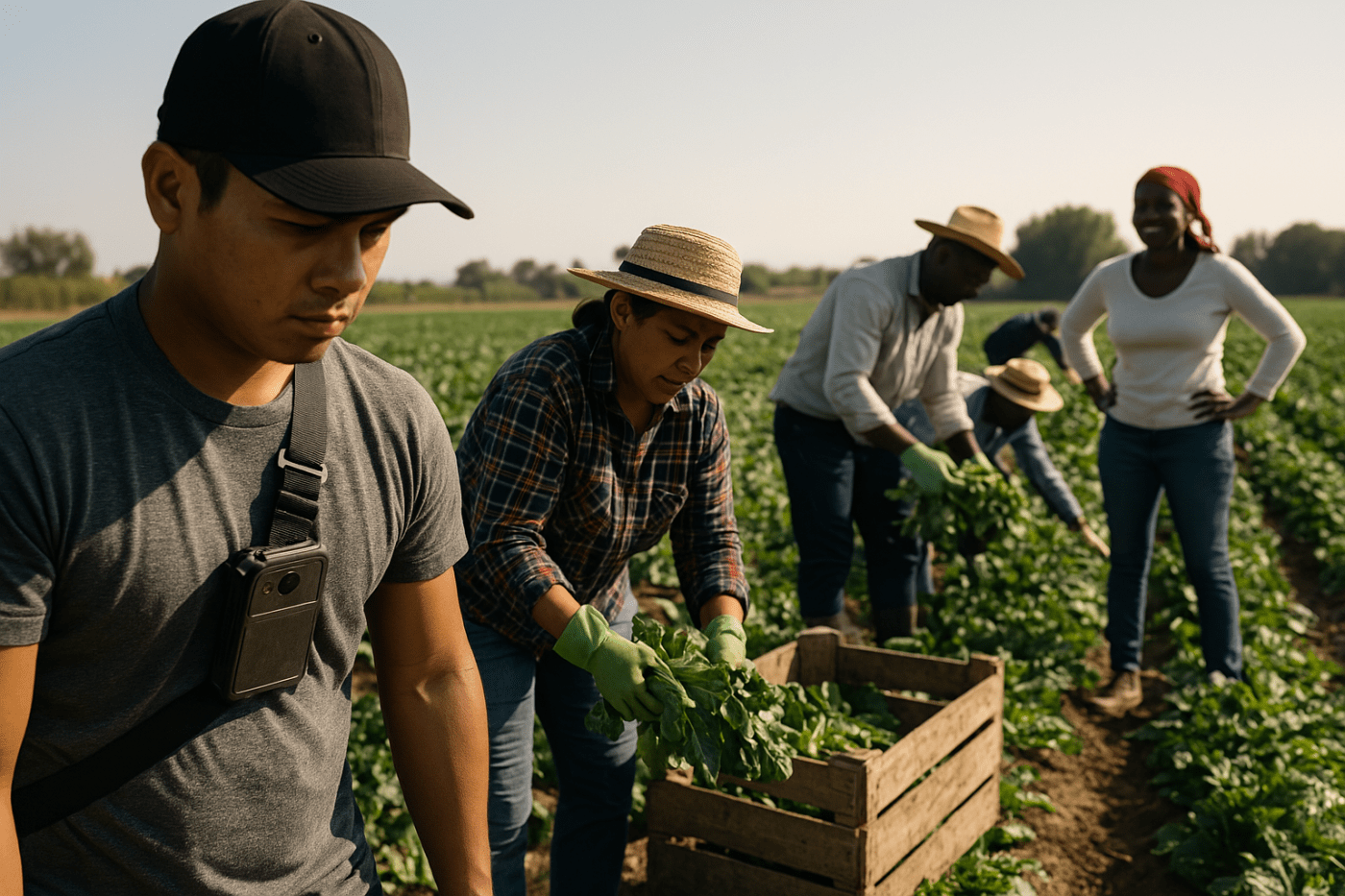
Today, agricultural labor remains hyper-exploited, invisible, and disposable. In India, sugarcane cutters are bound by debt and recruited seasonally by labor contractors. In California and Florida, migrant farmworkers—many undocumented—work under extreme heat, pesticide exposure, and surveillance. In West Africa, cocoa workers are trapped in child labor systems. In Latin America, Indigenous campesinxs work without land, rights, or safety.
These laborers feed the world—but cannot feed themselves. Their labor reproduces human life—yet their own lives are treated as expendable.
The Structure of Agricultural Labor Under Imperial Capitalism
Capitalist agriculture depends on a labor system defined by:
- Hyper-exploitation: Workers paid far less than the value they create; conditions often below legal or physiological minimums.
- Racial and caste stratification: The dirtiest, lowest-paid labor is overwhelmingly done by racialized, migrant, and caste-oppressed peoples—organized into separate circuits of disposability.
- Gendered labor hierarchies: Women do the majority of agricultural work globally (60–80% in Africa and Asia) yet receive a fraction of income, land, or legal recognition.
- Precarity and disposability: Workers are moved like cargo across borders, fields, and seasons. No housing, healthcare, or pension. Just a contract, if even that.
Labor is not only undervalued—it is dehumanized. The capitalist farm seeks not to nourish, but to extract.
Technofascism and the Algorithmic Management of Labor
In the age of technofascism, agricultural labor is increasingly managed not by overseers, but by algorithms and platforms. Workers are scanned, monitored, and scheduled by apps. Facial recognition tracks productivity. Biometric IDs gate access to wages. AI platforms determine when and where a laborer will be deployed, and for how long. As Shoshana Zuboff and others have shown, this is not digitization for efficiency—it is domination masked as data.
Capital does not automate to liberate labor—it automates to discipline, surveil, and extract from it. The worker becomes a node in a digital logistics chain, their life organized for maximal output, minimal cost, and zero resistance.
The Crisis of Reproduction
Capitalism does not care whether labor can survive—only whether it can produce. The result is a global agricultural workforce facing exhaustion, hunger, illness, and death:
- In the U.S., farmworkers have a life expectancy over 10 years shorter than the national average.
- In India, over 300,000 farmers have committed suicide due to debt since the 1990s—many tied to the inability to sustain families on input-dependent farming.
- Globally, millions of women do unpaid food cultivation, caregiving, and seed-saving work—all essential to agricultural reproduction, none recognized by capital.
This is not a bug—it is the model. Labor power must be cheap, replaceable, and silent.
Revolutionary Labor: Re-embedding Work in Life
Ecosocialism does not idealize labor—it liberates it. Labor in a post-capitalist agriculture must be:
- Collective and democratic: Organized in cooperatives and communes, with decisions made by workers themselves.
- Ecologically grounded: Embedded in the rhythms of land, season, and water—not export contracts or profit margins.
- Reproductive and nourishing: Labor that reproduces life—human and non-human—is central, valued, and supported.
- Liberatory: Work becomes praxis, not punishment—a site of self-realization, mutual care, and political formation.
Agroecology and food sovereignty are not just ecological alternatives. They are labor alternatives. They begin with the decommodification of labor power—and the reassertion of labor as a living metabolism with the earth.
The Soil Is Alive Because Labor Made It So
The labor of generations has built our terraces, saved our seeds, composted our nutrients, and fed our people. Yet capitalism has stolen this labor, poisoned its sites, and alienated its workers.
To reclaim the land, we must reclaim labor. To feed the world, we must organize labor. To liberate life, we must abolish labor as a commodity and restore it as a communal, creative, and ecological force.
In Part VI, we will examine how the global food system—through logistics, packaging, branding, retail, and waste—turns the work of many into the profit of a few. We move from labor to circulation, from the field to the supermarket shelf.
 Weaponized Information
Leave a comment