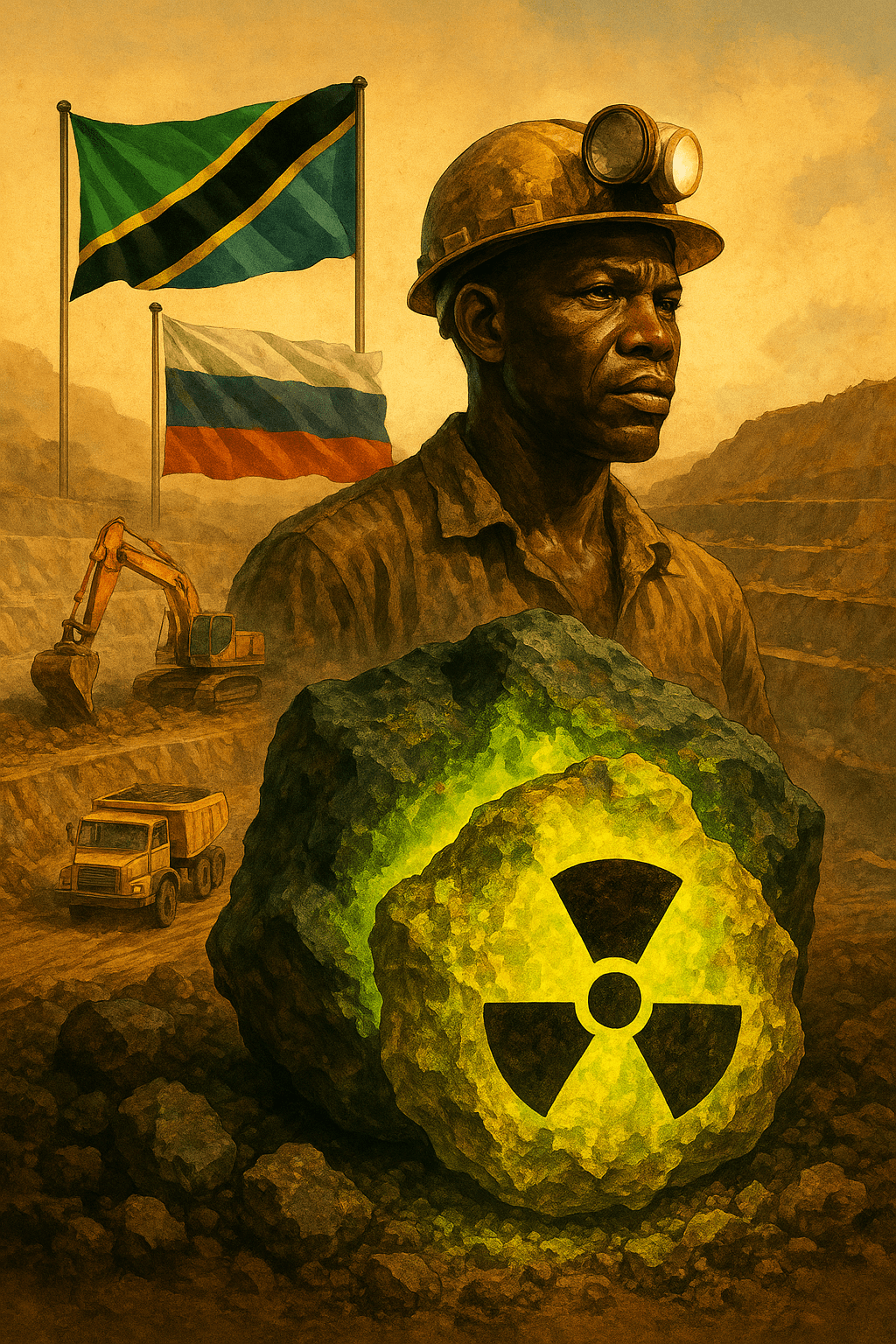
What lies beneath the ground—and the headlines—is a story of empire, extraction, and the contested terrain of multipolarity
By Prince Kapone | Weaponized Information | August 1, 2025
Radioactive Friendship or Resource Grab? Unmasking the Tanzanian-Russian Uranium Deal
On July 31st, The East African ran a brief article by Apolinari Tairo announcing the launch of a joint $1.2 billion uranium mining project between Tanzania and Russia, operated by Mantra Tanzania Ltd. The event, attended by President Samia Suluhu Hassan, was presented as a moment of celebration—complete with photo-ops, development buzzwords, and the obligatory nod to job creation. In three minutes flat, readers were walked through what appeared to be an uncontroversial milestone of national progress. Not a single eyebrow raised. Not a single question asked.
But journalism like this isn’t harmless—it’s house-trained. Apolinari Tairo may not be a name on Langley’s payroll, but that’s not the point. As a career correspondent for Nation Media Group, Tairo operates as a development stenographer for the neoliberal order. His writing style is emblematic of what passes for business journalism in East Africa today: market-friendly, apolitical, and allergic to analysis. What he offers isn’t insight—it’s insulation. A buffer zone between readers and reality. That’s not an oversight—it’s the function.
The institutional role of The East African is no less compromised. Owned by Nation Media Group—whose largest shareholder is the Aga Khan Fund for Economic Development, a Swiss-based capital bloc embedded in Western financial circuits—the outlet consistently frames economic affairs through the lens of privatization, free market reforms, and foreign direct investment. There is no space for structural critique, no breath given to the question of sovereignty. It is, in essence, a mouthpiece for soft empire dressed in regional fonts.
Tairo’s article reflects this editorial DNA to the letter. It opens with ceremonial fluff and ends with techno-optimist boilerplate. It is padded with the language of infrastructure and enterprise but hollowed of any political or historical marrow. The piece does not so much report the uranium project as it launders it—cleansing it of any interpretive weight. Readers are fed a sanitized story of collaboration, stripped of its stakes.
This sterilization is achieved through several classic propaganda maneuvers. First, framing: the project is introduced as a moment of triumph, its significance confined to the realm of economic development. Nothing is permitted to exist outside that horizon. Second, omission: no mention is made of how or why this deal came to be, what strategic interests it serves, or what dynamics of power it may entrench or disrupt. Third, emotional modulation: the reader is offered language calibrated to soothe—progress, opportunity, prosperity—while all tension, contestation, or contradiction is surgically excised. It’s all smiles and forward motion. No ghosts here.
Fourth, the aesthetic of corporate neutrality: Mantra Tanzania Ltd. is treated as a benign investor, devoid of identity, ideology, or connection to state power. The mining site becomes just another business unit. Finally, there’s the imperial optic repackaged: Tanzania provides the terrain; the foreign partner provides the know-how. This isn’t stated outright, but it’s encoded in the narrative’s architecture. The asymmetry is invisible only because it is assumed.
By the end of the article, one is left not with knowledge, but with a mood. A pleasant haze of economic optimism. No controversy, no conflict, no class struggle. The effect is not accidental. It is a calibrated void—a vacuum into which readers can pour their unexamined hope. What The East African offers here is not information. It is anesthesia.
Behind the Headline: Extracting the Buried Realities of the Namtumbo Uranium Deal
Beneath the polished narrative of development and diplomacy lies the hard ore of fact. While The East African painted the uranium deal between Tanzania and Russia as a benign investment, the actual terrain tells a far more complex story—one that cannot be grasped without recovering what was deliberately omitted.
First, the core facts disclosed in the article: Tanzania and Russia have officially launched a $1.2 billion uranium plant in Namtumbo, executed by Mantra Tanzania Ltd. The project was inaugurated by President Samia Suluhu Hassan on July 30, 2025, and is framed as a boost to Tanzania’s energy and industrial sectors. The narrative also highlights expected job creation and economic uplift without offering any data or downstream accountability.
Now for the facts withheld. Mantra Tanzania Ltd. is not an ordinary company—it is a subsidiary of Rosatom, Russia’s state-owned nuclear energy corporation. This partnership is not new: Russia and Tanzania signed a formal cooperation agreement on nuclear energy back in 2016. What has changed is not the intent, but the context. The deal’s formalization in 2025 coincides with the escalating formation of alternative strategic blocs like BRICS+, and Russia’s growing efforts to bypass Western-aligned supply chains. This is not just a resource deal—it is part of a geopolitical chessboard.
The uranium in question is not an inert commodity. As IAEA documentation confirms, uranium has dual-use potential. It fuels civilian nuclear reactors, but it can also be refined for military-grade purposes. Tanzania does not yet possess domestic enrichment or reprocessing capacity, meaning that its uranium must be exported and processed elsewhere—primarily by the more technologically advanced partner. In this case, Russia. As a result, the economic gains for Tanzania are bounded, and strategic autonomy remains an open question.
These dynamics unfold against a brutal historical backdrop. Tanzania’s extractive economy—like much of the African continent—was forged in the colonial crucible, built around raw resource exportation and external processing. Uranium, in particular, has a dark legacy: in Niger’s Arlit region, decades of French-run uranium mining led to radiation exposure, poisoned water, and generational health crises for the local population. Yet none of this historical memory surfaces in The East African’s article.
The region of Namtumbo itself, located in southern Tanzania, sits atop rich mineral veins but remains economically marginalized. It is the classic paradox of postcolonial extraction: a land of riches under the rule of scarcity. The uranium beneath it is likely destined for foreign consumption, while the communities above it may bear the burden of displacement, contamination, and underdevelopment. No environmental impact assessments were cited in the article. No local consent was referenced. No resistance acknowledged.
And yet this project does not exist in isolation. It is part of a continent-wide realignment. Niger’s severing of uranium ties with France, Mali’s pivot to Russia, Burkina Faso’s nationalization measures—these are not unrelated episodes, but fractures in the old neocolonial order. The West, reeling from sanctions blowback and resource insecurity, views these shifts as strategic threats. But for many African states, they are overdue assertions of sovereignty, even when fraught with contradiction.
What we’re seeing in Tanzania is an inflection point. This isn’t just an investment—it’s a wager on which future the country will inhabit: one still yoked to raw extraction and foreign dependency, or one that begins to leverage its resources for sovereign development. Without a clear domestic beneficiation plan, without control over refinement, and without reinvestment into public infrastructure, uranium remains just another mineral in a pipeline that flows outward, not inward.
This is the deeper truth the article refuses to touch. The Namtumbo project is not just about energy. It is about power—who has it, who extracts it, and who defines its use. That power is not just in the uranium. It is in the narrative.
The Core Is Hot: Reframing Uranium, Sovereignty, and the Geometry of Multipolar Struggle
By the time the uranium starts moving out of Namtumbo, most Tanzanians will still be cooking over charcoal and living without grid power. That’s the raw contradiction of this deal—and the reason why it cannot be understood through the lens of “development” alone. What the East African article carefully skirts is not just the political implications of uranium, but its systemic meaning: a resource that embodies the sharpest edge of the global order. This isn’t just a Tanzanian-Russian handshake. It’s a radiological fracture in the West’s imperial circuitry.
To grasp its weight, we start with the architecture of global coercion: the Sanctions Architecture. After 2014, and again post-2022, the United States weaponized dollar-based financial systems to isolate Russia, Iran, Venezuela, and any state deviating from U.S. alignment. But coercion breeds innovation. Russia’s shift toward energy diplomacy in Africa, including nuclear deals like this one, is part of a deliberate wedge strategy: undermine the currency chokepoints and build strategic redundancy. This uranium deal is a brick in that counter-architecture. It’s not just metal. It’s maneuver.
That maneuver reveals another layer: the persistence of Extractive Neocolonialism. The glossy language of “strategic partnership” hides a hard reality—Mantra Tanzania is a Rosatom subsidiary, and the means of processing, enriching, and valorizing this uranium remain outside Tanzanian hands. Just like under British colonial rule, the raw material is exported; the real wealth is extracted elsewhere. A BRICS+ flag on the paperwork doesn’t change that unless power relations within the supply chain are transformed. As it stands, the mine is in Africa, but the command center is not.
Yet this neocolonial echo is now playing out on contested terrain. Western empire, unable to compete with the terms of Russia-China partnerships, has pivoted to sabotage, isolation, and soft censorship. It is here we encounter what Weaponized Information calls Imperialist Recalibration: a shift in tactics, not in goals. If yesterday’s imperialism wore the mask of liberalism, today’s prefers crisis management and plausible deniability. The silence around the Namtumbo deal in Euro-American media is not neglect—it’s narrative strategy. To speak of this openly would be to admit that Africa is no longer locked in a Western orbit.
But the most volatile element in this equation isn’t uranium. It’s Geoeconomic Sovereignty. That’s the battlefield on which this project will either liberate or betray. If Tanzania can seize control of refinement, reinvest surplus into public infrastructure, and enforce environmental protections—then Namtumbo might become a launchpad for sovereign development. But if enrichment, pricing, and export routes remain externally determined, then this deal becomes little more than recolonization by another name—this time wrapped in multipolar packaging.
The contradictions are real—and they are not symmetrical. Russia is not the U.S., and BRICS+ is not NATO. But the presence of a Eurasian partner does not automatically erase the legacy of dispossession. For the people of Namtumbo, the question is not whether Russia or the West profits—it’s whether they do. And on that front, the jury is still out.
What must be emphasized is this: multipolarity is not a moral universe—it is a strategic terrain. And uranium is one of its pressure points. This project exists because the old imperial supply lines are breaking. It also exists because the new order is still uneven, still full of class contradictions, still pulled between popular sovereignty and elite accommodation. Mantra Tanzania may be registered in East Africa, but its interests flow northward—and unless the Tanzanian people intervene, so will their uranium.
Reframing this moment means seeing it not as a “nuclear energy investment,” but as a node in a wider rupture. From Niger’s rejection of French colonial contracts to Zimbabwe’s lithium nationalizations, a pattern is emerging: empire is no longer automatic. But sovereignty is not self-executing. It must be built, defended, and wrenched from the jaws of both old and new capital formations.
The uranium in Namtumbo is not apolitical. It’s radioactive geopolitics. It decays slow, but it burns deep. And whether that fire fuels Tanzanian liberation—or just lights someone else’s reactor—depends on who holds the controls.
From Namtumbo to Everywhere: What Uranium Teaches Us About Empire, Power, and Action
The uranium beneath Namtumbo is not just Tanzania’s—it’s the world’s warning. It reminds us that empire doesn’t vanish; it mutates. That multipolarity doesn’t guarantee justice; it creates room for struggle. And that liberation, even in the age of BRICS+, still demands organized, militant, grounded intervention from below. No bloc, no summit, no foreign partner can substitute for that.
We stand in full solidarity with the workers, farmers, and communities of southern Tanzania whose land, labor, and future are now locked inside a radioactive gamble. Their voices—absent from media celebrations and policy documents—must be centered in any struggle for sovereignty. The uranium belongs to them. So does the right to decide how it’s used, who profits, and what damage is done. This is not just about resources—it’s about the restoration of power to the dispossessed.
There are models to draw from. In Burkina Faso, revolutionary forces under Captain Ibrahim Traoré have begun asserting control over uranium and gold extraction, ejecting French companies and announcing plans for state ownership and ecological protection. Whatever contradictions remain, this bold push for material sovereignty offers a real counterpoint to the “investment partnership” model in Namtumbo. It reminds us that popular control is not only necessary—it’s possible.
In the imperial core, our task is equally clear. We cannot let the struggle for African sovereignty be narrated or managed by think tanks, NGOs, or Beltway soft-power fronts. We must build pressure where we live—against the banks, investors, and corporations complicit in global extraction.
- Campaign Target: Launch a campaign demanding transparency from uranium-importing corporations and their financial backers, especially in Europe and North America. Call out firms sourcing from Africa without local consent or domestic beneficiation.
- Mutual Aid Initiative: Support grassroots environmental monitors and health collectives in Tanzania tracking radiation levels, water contamination, and displacement in Namtumbo and surrounding regions.
- Cyber Resistance Tactic: Develop a crowdsourced, open-access mapping of uranium flows—tracking what leaves Africa, where it goes, who refines it, and who profits.
- Political Education Focus: Embed the story of Namtumbo into broader popular education efforts about nuclear imperialism, resource extraction, and the weaponization of “green energy” narratives by neocolonial capital.
Let us be clear: the mine in Namtumbo may be local, but the system it feeds is global. That means the responsibility is ours—wherever we are. We do not get to cheer BRICS+ and call it a day. We must demand that multipolarity be a platform, not a pretext. That sovereignty be more than ceremony. That uranium be more than export. And that power—not simply over resources, but over our collective destiny—return to those who’ve been robbed of it for centuries.
 Weaponized Information
Leave a comment