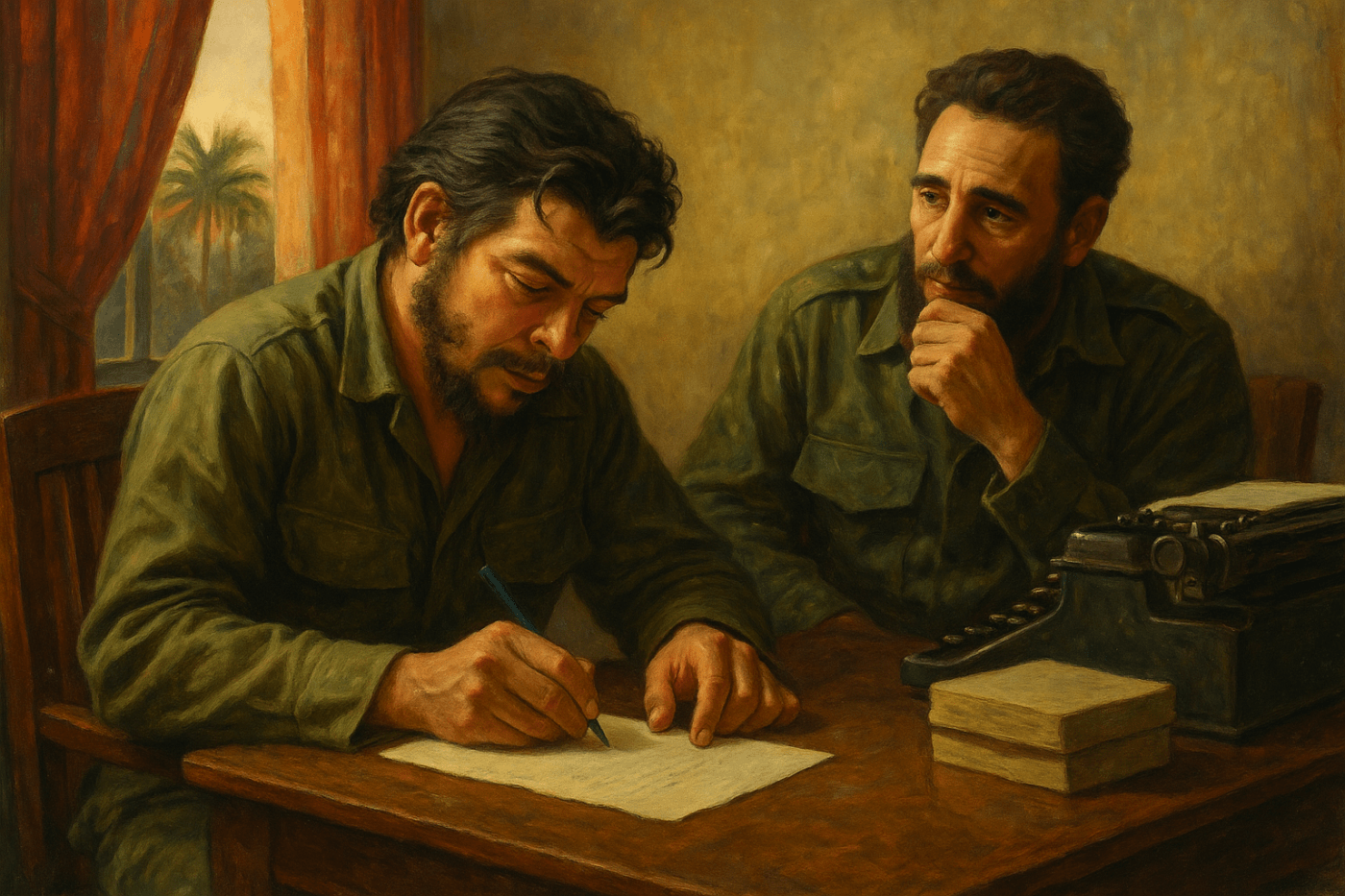
Weaponized Statesman Series | Che Guevara to Fidel Castro, Havana 1965
Written in the crucible of revolutionary governance, Che Guevara’s March 1965 farewell letter to Fidel Castro is not a sentimental departure—it is a political intervention. In it, Che offers a piercing critique of Cuba’s early socialist development, grapples openly with the contradictions of economic planning and party-building, and outlines a bold, still-radical vision of communism rooted in consciousness, not calculation. Half a century later, it remains one of the clearest documents ever produced on the dilemmas of revolutionary transition—and one of the most urgent for our own.
By Prince Kapone | Weaponized Information
July 26, 2025
A Letter Buried Alive
“Communism is a phenomenon of consciousness… not a leap in the void.”
When Ernesto Che Guevara penned his March 26, 1965 letter to Fidel Castro, it was not a farewell—it was a revolutionary intervention. A comrade-to-comrade transmission in the midst of Cuba’s earliest experiments in socialist transition. Often overshadowed by his public declarations or militant departures, this document is something else entirely: a rigorous, internal critique grounded in revolutionary responsibility—not rejection. It is not a repudiation of the Cuban path, nor an endorsement of ultraleft purism. It is a contribution to the struggle to build socialism under siege, from within its own contradictions.
Che writes not as an outsider, but as a Minister of Industry, a guerrilla fighter, and a servant of the Cuban people. He names contradictions not to discredit the Revolution, but to defend its soul. “Improvisation and subjectivism… resulted in a policy of lurches.” This isn’t finger-pointing. It is dialectical rectification. It is the hard and necessary work of turning practice into theory so that theory can return to guide practice.
“The political economy of this whole period has not been created… the Soviets turned a number of facts of their own reality into alleged laws.” Che is not scorning the USSR. He’s warning against dogmatism. Against the mechanical application of one country’s path to another’s distinct material conditions. He is struggling with the reality that Cuba—newly independent, blockaded by imperialism, and experimenting in revolutionary governance—is not the Soviet Union, and cannot follow its model uncritically. What emerges is not rejection, but responsibility: Cuba must build its own science of socialist transition.
His critique of the Central Planning Board (Juceplan), the chaotic investment process, and inefficient foreign trade is not a condemnation of socialism—it’s a plea for its maturation. For better tools. For deeper study. “Communism is a phenomenon of consciousness,” he insists—not mere growth, not brute industrial output, not institutional routine. That line doesn’t negate material development; it elevates its purpose. It reminds us that socialism without revolutionary subjectivity is vulnerable to stagnation—even to reversal.
And yet, as we read Che’s words today—decades later, in a world where U.S. imperialism continues to blockade, sanction, encircle, and sabotage sovereign socialist experiments—we must also resist reading this letter through the lens of abstract moralism. Che did not denounce Cuba. He did not walk away from the state. He remained within the struggle. His critiques are made under the banner of defense, not dismissal. He wanted to rescue the Revolution from the internal reproduction of capitalist logic—not abandon it to the external assault of empire.
“We do not consider the transit of a product through socialist factories as a mercantile act.” In that sentence, Che draws a line in the sand: socialism must break from the commodity form, even while engaging with the global market for survival. This is not a denunciation of states like Vietnam, China, Cuba, or Laos that have tactically integrated market mechanisms under socialist guidance. It is a challenge to ensure that such mechanisms serve the long arc of emancipation—not a slow return to exploitation.
Che’s method was never purist. It was revolutionary. He believed that socialism is built in the crucible of contradiction—and that it requires relentless vigilance, ideological clarity, and deep popular involvement. His letter is a model of principled critique from within the revolutionary process, not outside it. It offers no blueprint, but a method: listen, struggle, revise, stay loyal to the people, and keep building.
We read this letter today not to pass judgment on Cuba or any socialist state. We read it to learn how to lead without dogma. To wield criticism without capitulation. To clarify the struggle in a world still ruled by capital, still patrolled by empire, still hostile to sovereignty and socialism in every form.
This is not a eulogy. It is an inheritance.
Against the Calculators of Revolution
“The Budgetary System was born of practical experience and later converted into theory… it seeks to eliminate the category of profit from socialist planning.”
Che Guevara’s critique of economic management is fierce—but not unmoored. He was not rejecting socialist planning. He was fighting to deepen it. His target was not centralization itself, but the uncritical importation of capitalist metrics and Soviet-era administrative habits that risked diluting revolutionary purpose. In his letter, Che outlines a vision for planning that isn’t just about output or efficiency—it’s about shaping human beings through new forms of social and productive relations.
“We must eliminate the capitalist categories: merchandise between enterprises, bank interest, direct material interest as a lever.” These are not abstract declarations—they are revolutionary proposals grounded in lived contradictions. Che saw firsthand how Cuba’s early post-revolutionary planning was navigating a tightrope: building productive capacity with limited resources, under blockade, while resisting imperialist discipline and market dependency. His call was not to throw out every tool, but to ensure the tools did not end up ruling the builder.
Che’s critique of “the law of value” was not utopian—it was a strategic warning. The law of value—pricing, cost, exchange—remains embedded in all economies, but in capitalism it becomes the dominant logic. In socialism, it must be subordinated to social priorities, moral values, and collective consciousness. Che feared that in attempting to manage socialism through inherited capitalist categories, Cuba (and other socialist experiments) might inadvertently reproduce the very relations they sought to abolish. But crucially, he did not argue that Cuba had already succumbed—only that it was at risk of drift.
This is an essential distinction in our time. Many socialist states today—Cuba, Vietnam, China, the DPRK, Venezuela—have adopted or adapted market mechanisms to overcome underdevelopment, survive sanctions, or access global capital. These decisions were not made in a vacuum. They were responses to imperialist siege, technological blockades, and the weaponization of international finance. They reflect tactical adaptations within broader socialist frameworks, not a betrayal of socialism itself. And Che, were he alive today, would no doubt approach these realities with the same analytical rigor—not dogma, not condemnation, but dialectical struggle.
Che’s challenge was to develop a new form of accounting—one that centered use over exchange, human need over profit, political education over incentives. “We do not consider the transit of a product through socialist factories as a mercantile act.” That was the core of his “budgetary financing system”—a system rooted not in price signals or profit rates, but in conscious planning and collective accountability. Whether such a model was viable at Cuba’s level of development is a question Che himself wrestled with. But the impulse—to subordinate economics to politics, profit to principle—remains profoundly relevant.
And yet, Che’s critique never forgets the global terrain. He explicitly warns of the illusion of self-sufficiency, critiques poor coordination in foreign trade, and names the global division of labor as a structural obstacle. “We continue to maintain an open economy… the incidence of the foreign market is really important.” In other words, he understood that Cuba was not building socialism in a vacuum. It was building socialism while navigating the minefield of imperialist trade, dependency, and debt.
Today, with the BRICS development bank expanding, China deepening South-South trade, and U.S. sanctions targeting half the planet, Che’s insights have grown more—not less—relevant. The challenge remains: how do you survive in a capitalist world without being devoured by it? How do you wield the tools of trade and credit while defending revolutionary ethics? Che didn’t claim to have the final answer. But he offered a method to find one: rigorous critique, ideological clarity, and loyalty to the long arc of human liberation.
“Communism is a phenomenon of consciousness… not of per capita income.” Che’s message, here and throughout the letter, is to reject imperialist metrics. Not to ignore material growth—but to measure it against human transformation, not Western standards. Socialist development is not about catching up to capitalism—it’s about breaking from it. But such rupture must be strategic, not suicidal. Tactical, not doctrinaire. Rooted in the real conditions of the people and the balance of class forces—nationally and globally.
So no, we do not weaponize Che’s critiques against socialist states navigating survival under siege. We study his interventions to sharpen the line: to ensure that wherever market mechanisms are employed, they remain subordinate—not sovereign. That socialism remains a process of human liberation, not technocratic administration. That profit does not return wearing revolutionary slogans.
This is not about purity. It is about purpose.
Discipline Without Commandism, Critique Without Capitulation
“The party must be a vanguard organization, the spearhead of the people, an organization that knows how to interpret the collective desires and is prepared to act as a consequence of that knowledge.”
Here, Che steps beyond economic formality and turns toward the furnace of revolutionary organization. The party, he insists, must not be a bureaucratic shell, nor an echo chamber of state managers. It must be a living organism forged in struggle—proletarian in class character, popular in spirit, rigorous in method. This is where Che is most uncompromising: not on tactics, but on political clarity and revolutionary ethics. His critique is not aimed at the state abandoning central planning—but at the risk of abandoning revolutionary leadership.
He warns against ossification, the retreat into “infallible” party dogma, and the failure to keep one ear pressed to the soil of the masses. “The need for centralization… should not override the need for the party to be rooted in the consciousness of the working masses.” That is not a contradiction—it is the dialectic of leadership. Of vanguard and base. Of guidance and listening. And it is the formula for surviving what Mao would call the “contradictions among the people.”
Che is deeply aware of the historic pitfalls. He had seen how revolutions can degenerate into paralyzed bureaucracies, how commandism can masquerade as discipline, and how critique—when stifled—rots into resentment. That is why he insists: the revolution must renew itself constantly, through internal struggle. “There was a certain hesitance to adopt frank and open criticism of what was wrong.” That sentence is not an attack—it is a warning bell, rung by a comrade who had given everything.
And let us be clear: Che did not demand “pure” revolutionaries who never erred. He demanded revolutionaries who learn from errors. He did not scold missteps; he scolded their concealment. He believed deeply in rectification—not as punishment, but as political rebirth. That is the true spirit of communist self-criticism: not guilt, not shame, but responsibility. A revolutionary does not hide contradictions. A revolutionary names them, struggles through them, and emerges sharper.
This, too, is a message to today’s cadre. In an era where criticism is often weaponized by imperialism and opportunists to undermine socialist states, we must learn the difference between sabotage and struggle. Che models the latter. He never denounces the Cuban Revolution; he engages it as a child of its own making. His criticisms are not moral condemnations from the sidelines—they are strategic contributions from within.
And in this moment—where socialist governments are maligned by U.S.-backed media, infiltrated by counterinsurgents, and isolated by economic warfare—the line between critique and betrayal must be drawn with ideological precision. When we raise contradictions, it must be for the sake of the revolution’s continuity—not its collapse. Che reminds us: loyalty to the people does not mean silence. It means principled struggle in defense of their long-term interests.
“It is not about blindly obeying orders or seeking to climb the ladder. It is about transforming society, and in doing so, transforming ourselves.” That sentence carries more weight than any ideological treatise. It is a call to the cadre, the worker-intellectual, the revolutionary servant of the masses. It demands humility without fear, leadership without arrogance, devotion without dogma.
In our era of NGOs posing as saviors, celebrities preaching liberation, and counterrevolution dressed in progressive language, this model of internal rectification is more vital than ever. Real revolution does not suppress contradiction. It sharpens itself against it.
Che’s letter is not just a document of leadership. It is a pedagogy of it.
The Long Arc of Revolutionary Responsibility
“This is not a matter of taking a firm stand in favor of or against something for the mere pleasure of theorizing… but of discovering the mechanisms that will allow a revolutionary society to survive in a hostile environment.”
Che Guevara’s farewell letter of 1965 is not a relic. It is a weapon—still sharp, still relevant, still dangerous. It is a document forged in contradiction: between ideal and reality, between planning and improvisation, between revolutionary principle and material constraint. And above all, it is a testimony of responsibility: Che does not walk away from the Cuban Revolution. He walks deeper into its contradictions, and by leaving Cuba, he pledges to globalize its cause.
In a world where socialist states are encircled by military bases, choked by sanctions, infiltrated by NGOs, and smeared by media lies, we cannot afford the luxury of either moral purism or uncritical defense. To defend the revolution today is to wield both shield and scalpel. The shield protects against imperialist assault. The scalpel refines the internal line. And Che was a surgeon of revolutionary clarity.
He knew that the survival of socialism would not be guaranteed by slogans, nor by GDP metrics, nor by Western validation. It would depend on the discipline and creativity of those willing to govern differently. It would depend on a politics that could remain both principled and pragmatic—rooted in the masses, but able to maneuver. It would depend on cadres who could act decisively without becoming technocrats, who could administer without becoming administrators.
“To develop consciousness does not mean to indoctrinate… but to link political education to the real material processes of transformation.” That’s not just advice for 1965 Cuba. That’s a blueprint for surviving technofascism in 2025. When algorithms discipline consumption, when profits dictate human worth, when imperialist wars are disguised as humanitarian interventions—this quote becomes a dagger aimed at the heart of capitalist realism.
Today, socialist governments—from Havana to Hanoi, Caracas to Pyongyang—face contradictions Che could not have predicted. But the fundamentals remain. How do you protect the revolution without stagnation? How do you adapt without capitulation? How do you use market tools without being used by them? Che offers no easy answers. What he offers is harder: the courage to pose the questions with uncompromising honesty.
We cannot read Che’s criticisms as ultimatums. We must read them as offerings. They are notes from a revolutionary trying to prevent the very setbacks we see today: the commodification of socialist spaces, the marginalization of ideology, the corrosion of collective purpose. But we must not mistake critique for condemnation. Che was not giving up on Cuba. He was demanding more from it—because he believed in it.
And we, too, must believe—not in perfection, but in process. In the long, uneven, contradictory, heroic process of building socialism under fire. Of reclaiming human dignity from centuries of colonial degradation. Of forging new forms of life beyond profit and private property. That is the horizon Che walked toward. That is the horizon we still struggle to reach.
“Our task is to make the people more conscious, to transform them, to sow light—not to substitute ourselves for them.” That sentence is the legacy. That is the parting gift of the “other” farewell letter. It is not addressed to Fidel alone. It is addressed to all of us.
To the revolutionaries who have not yet picked up a gun—but have picked up the burden of organizing under empire.
To the governments who dare to defy Washington—not with fanfare, but with food, literacy, and dignity.
To the youth who still believe socialism is not just a memory—but a mission.
Che Guevara’s final message is not goodbye. It is an assignment.
 Weaponized Information
Leave a comment