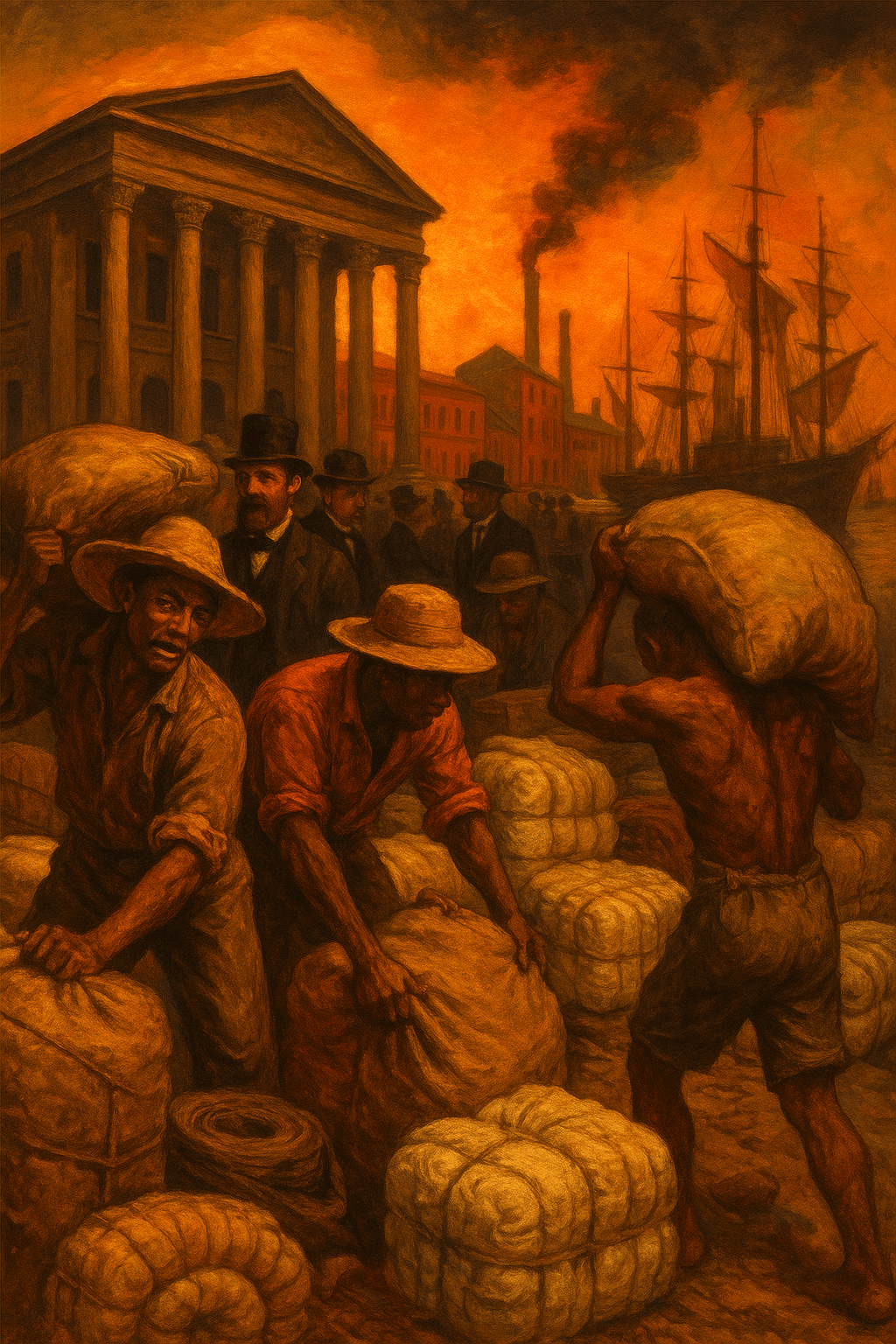
From the cotton of Bengal to the sugar of Jamaica, the wealth of the City was not born of free exchange—but of forced extraction.
By Prince Kapone | Weaponized Information
July 24, 2025
The Architecture of Catharsis
On July 22, 2025, The Guardian published an article by Chris Osuh titled
“Manchester’s Royal Exchange rooted in slavery and colonialism, research reveals”. The headline promises revelation. The content delivers reassurance. Supposedly about new research from the University of Manchester tracing the city’s iconic Royal Exchange to slavery, indentureship, and the opium trade, the article offers up a liberal ritual: acknowledge the past, perform the grief, and then quietly return to business as usual. The centerpiece is a play called Liberation, staged inside the former cotton exchange, commemorating the 1945 Pan-African Congress. But this isn’t reckoning—it’s repackaging. The structure is not being decolonized. It’s being curated. History is not being confronted. It’s being turned into content.
Chris Osuh plays his part well. A veteran of Manchester’s local press circuit, he embodies a caste of liberal narrators trained to manage contradictions, not expose them. He doesn’t challenge the structural power of British capitalism. He narrates around it. He offers proximity to difficult truths, but never to rupture. And The Guardian—his platform—is the liberal empire’s crown jewel. Atlanticist in alignment, funded by the Scott Trust, and editorially obedient to capital, it exists to soothe the conscience of the respectable ruling class. It speaks in the accent of conscience, but walks in lockstep with empire.
The article’s framing depends on institutional accomplices: the University of Manchester, the Royal Exchange Theatre, and The Guardian’s own “Legacies of Enslavement” initiative. These aren’t just cultural bodies. They are imperial amplifiers. The university receives research funding from fossil capital and military contractors. The theater runs on state grants and corporate sponsorship. The Guardian launders imperial narratives through curated liberalism. Together, they don’t reveal history—they administer it. Their function is ideological stabilization. They transform atrocity into acknowledgment, rebellion into retrospection, and demand into décor.
The article deploys a full arsenal of narrative devices to pacify the past. First, the trope of heritage as healing: the idea that former sites of exploitation can now redeem themselves through performance and poetry. By staging Black liberation in a monument built by slave wealth, we are invited to believe something has been repaired. But what, exactly? Ownership hasn’t changed. The ruling class is still in charge of the architecture—and the script. This isn’t reconciliation. It’s cultural pacification.
Then comes temporal containment. The rebels named—Jack Gladstone, Quamina, the insurgents of Tobago—are offered to us like ghosts, safely tucked into the past. There’s no mention of their political descendants. No bridge between the cutlasses of Demerara and the reparations demands of today. The uprisings are sanitized. Their continuity is denied. We are told to mourn, not to mobilize.
Next is personality displacement. The article fixates on dead figures—John Gladstone, Lord Ducie, Oswald Mosley—as if empire was a personal moral failing rather than a living system. It refuses to trace their wealth into present-day trusts, banks, and real estate portfolios. The reader is left with ghosts instead of structures, villains instead of class power.
The language is soaked in emotive reconciliation vocabulary: words like “acknowledge,” “interrogate,” “reveal.” But these verbs are deployed without consequence. They provide psychological closure while denying political transformation. You are encouraged to feel enlightened, perhaps even moved—but never agitated. The story ends in the lobby, not the streets.
We’re then offered moral catharsis through art. The very act of staging a play about Black struggle in a building financed by slavery is treated as redemption. But when the institution controls the narrative, art becomes anesthetic. There is no cultural justice here—only cultural pacification. Liberation, in this context, is not a program—it’s a product.
And finally, the most insidious move: Cognitive Warfare. The article’s tactic of narrative distraction—focusing on the emotional resonance of Liberation—reinforces Britain’s moral authority while isolating readers from today’s living struggles. By flooding the senses with theatrical grief and aestheticized sorrow, it fractures solidarity. There’s no space for the reparations platforms of CARICOM or the demands of Stop the Maangamizi. You are saturated with pathos, not politicized with purpose. This isn’t misinformation—it’s imperial psychology.
This is how propaganda works in a liberal empire. It doesn’t suppress the truth. It selects it. It offers you history as theater, grief as spectacle, and memory as performance. The Royal Exchange is not being held to account—it’s being handed a new costume. And unless we name the function behind the form, the curtain will keep rising, long after the empire falls.
The Cotton Beneath the Curtain
Beneath the article’s somber tone and archival flourish lies a thin but revealing trail of facts. It confirms that Manchester’s Royal Exchange was not just tangentially related to empire—it was built directly from its plunder. Profits from African enslavement, Indian indentureship, and British opium trafficking bankrolled the Exchange’s rise. John Gladstone—slaveholder, plantation baron, and father of future Prime Minister William Gladstone—is named as one of its key funders, and the article nods to the 1823 Demerara Rebellion crushed under his command. It even admits Manchester’s role in commodifying colonial labor, spinning cotton soaked in stolen sweat. The reader is handed these fragments like sacred artifacts, each carefully cleaned and labeled. But what they’re not given is context. These facts hang in midair, severed from the systems that birthed them and the structures that still breathe them forward.
There is no mention, for example, of Manchester’s current role in the global sweatshop economy. British-owned fast fashion firms like Boohoo and PrettyLittleThing, headquartered just blocks from the Exchange, now exploit Black and brown labor from Leicester to Bangladesh. They operate using the same colonial logic of surplus extraction: low wages, high turnover, no rights. Nor does the article connect the past to British mining giants like Glencore, Anglo American, and Rio Tinto, whose operations stretch across Africa and Latin America, pillaging land through legal regimes crafted during colonial occupation and maintained under global financial rule.
The omissions compound. There is no reference to the millions of stolen African and Indigenous artifacts still hoarded in British museums. No mention of how Oxford and Cambridge continue to profit from colonial endowments. No analysis of Britain’s steadfast refusal to pay reparations, even as movements like
Stop the Maangamizi and the
CARICOM Reparations Commission demand it with increasing international backing. The article touches the archive, but avoids the aftermath. It names the corpse but buries the beneficiaries.
Even the University of Manchester, which commissioned the research, escapes scrutiny. This is a university integrated into the security-industrial complex—partnered with fossil capital, AI surveillance firms, and defense contractors. It is not a neutral site of inquiry. It is a managed platform. Its “legacy research” is not meant to empower the descendants of the colonized—it is a form of narrative control, preempting confrontation through symbolic concession.
Historical context exposes the farce. The Royal Exchange was born under the Navigation Acts—mercantilist laws that forced Britain’s colonies into raw material dependency and funneled profits back to the metropole. Manchester’s mills didn’t merely benefit from slavery. They were made possible by it. The looms of Bengal were shattered by British policy to eliminate competition. Caribbean economies were engineered to grow sugar for imperial coffers. The city’s prosperity was not an accident of capitalism—it was a function of conquest.
And that logic never died. Today, as Global South nations assert control over land, labor, and sovereignty, Britain deploys new weapons: trade deals, debt traps, and arbitration courts to discipline those who resist. It greenwashes extraction through climate finance, offering wind turbines in exchange for lithium mines. And through a network of offshore tax shelters—from the Cayman Islands to Jersey—it remains the central node in the global architecture of secrecy and plunder. These are the new slave ships—floating in the cloud, armored in spreadsheets.
Meanwhile, the rest of the world is not sitting idle. BRICS+’s 2024 Johannesburg summit declared open defiance of dollar hegemony, challenging Britain’s entire financial empire of offshore laundering. Bolivia’s lithium nationalization resisted Western corporate capture, reclaiming a future of sovereign development. Burkina Faso nationalized its gold mines. Meanwhile, Iran, Cuba, and Venezuela continue to build parallel trade routes to bypass Western sanctions. They rely on a shadow maritime network of aged tankers, clandestine flight corridors—known as “ghost flights”—and state-led financial workaround systems that sustain essential commerce outside dollar-based markets. These shadow fleets and irregular aviation routes churn economic resilience in the face of embargo.Indian farmers blockaded highways to stop corporate seizure of their land. These are not echoes of a bygone era. These are the frontlines of an insurgent present.
And yet, you will not find any of this in The Guardian’s article. Not a word. The contradiction is glaring. What is presented as newly discovered truth has long been shouted from the streets of Kingston, Accra, Port of Spain, and Birmingham. This omission is not a gap in knowledge. It is a strategy of denial. The most dangerous truth omitted is that empire is not dead—it is digitized. The same Crown that sanctioned slavery now funds “heritage walks.” The same banks that financed genocide now host roundtables on “social impact.” And the same imperial universities that trained colonial officers now give TED Talks about “decolonial inclusion.” This is not reckoning. It is rebranding.
This is the context the article was written to obscure. Not historical curiosity, but geopolitical insulation. The Royal Exchange is being “acknowledged” not to dismantle empire, but to immunize it. These acknowledgments are not designed to provoke resistance. They are designed to contain it. And every paragraph of curated sorrow is a shield—holding the line while the plunder continues.
The Function of Memory in a Dying Empire
There is a reason the British state now funds acknowledgment. Not because it has found its conscience, but because it has lost control. In the twilight of empire—when the profits thin, the climate fractures, and the colonies rise—the ruling class turns to memory, not to tell the truth, but to manage it. The Royal Exchange’s colonial origins are not being uncovered. They’re being repackaged. Converted from crime scene into cultural landmark, its horrors are rendered into heritage. This is not about reckoning—it’s about stabilization. Memory becomes asset. The past becomes brand equity. And the stage becomes the mask.
This is the architecture of the Crisis of Imperialism. The postwar order led by the U.S. and Britain is unraveling—not by conspiracy, but by contradiction. From the mounting calls for dedollarization across the Global South, to the Reparations demands of Africans throughout the Americas, to the resource nationalism spreading across Africa, to the popular protests against neocolonial extractivism in Central and South America- the contradictions are on the verge of rupture. It is the task of the Global working class and peasantry to ensure this rupture is revolutionary.
So the imperial core scrambles for legitimacy. If it can no longer dominate outright, it must perform its morality. That’s where Cultural Counterinsurgency enters. No longer the whip or the gun—it’s the grant, the gallery, the curated play. Institutions like The Guardian, the University of Manchester, and the Royal Exchange Theatre have been enlisted to pacify dissent through performance. They transform rebellion into retrospective. They turn resistance into ritual. They disarm the future by overproducing the past. Every insurgent becomes a martyr. Every demand becomes a discussion point. And every act of oppression is repackaged as “something to think about.”
This is not the denial of history—it is its disarmament. It is the political weaponization of selective memory. The article presents the Royal Exchange’s past as closed, resolved, and mourned. But in doing so, it severs the chain. It breaks the link between the cotton ships of the 1800s and the sweatshops of Boohoo. Between John Gladstone’s Demerara plantation and Barclays’ colonial investment portfolios. Between the Navigation Acts and modern trade arbitration courts. It gives you facts—but not the material continuity that would allow you to name the system and fight it.
And here lies the enduring violence of Primitive Accumulation. British capitalism was not built by innovation. It was built by looting. By enslaving, enclosing, and extracting. Manchester’s cotton boom was subsidized by unpaid labor and imperial warfare. And that logic never ended. It simply adapted. Today, it wears the mask of legality, logistics, and “free trade.” From the cocoa fields of Ghana to the copper pits of Chile, from underpaid health workers in the NHS to over-policed Black communities in Birmingham, the theft continues. It is no longer whipped—it is contracted.
The liberal establishment calls this progress. But it is nothing more than counterinsurgency masked as reconciliation. The function of the curated apology is not to deliver justice. It is to protect empire from justice. That’s why the play is called Liberation—not Reparations, not Repatriation, not Revolution. The message is: the struggle is over. Grieve, but don’t organize. Remember, but don’t demand. The revolution has been resolved into a monologue.
But history is not cooperating. From Haiti to Harare, from Caracas to La Paz, the movements are back—and they are not asking for acknowledgment. They are demanding repossession. They are not interested in theater. They are organizing land seizures, currency blocs, and decolonial diplomacy. And that terrifies the ruling class, not because it fears a riot tomorrow, but because it fears a world where it is no longer needed, no longer obeyed, no longer paid.
So the propaganda must adapt. It offers you elegy instead of evidence. Performance instead of power. The article is not about what was—it’s about what must be prevented. It’s not there to educate. It’s there to inoculate. Every paragraph is a defense mechanism. Every quote is a firewall. And every emotional arc is designed to keep you from connecting the dots.
But the curtain is slipping. The Global South is speaking clearly. The demands are not abstract. They are material. Return the land. Cancel the debt. Pay what you owe. And in response, the empire offers another stage, another script, another scene. But the audience is changing. And soon, no one will clap.
So let’s name the system. What we are witnessing is the management of imperial decline through hyper-imperialism and Cultural Counterinsurgency, sustained by an architecture of Primitive Accumulation draped in liberal costume. The cotton never stopped flowing—it just changed form. The theater never closed—it just changed its cast. The class war never ended—it just moved backstage. And the only thing that will end it is not acknowledgment, but revolutionary memory armed with material demands. That is our task. Not to mourn the confession. To organize the funeral.
From Cultural Containment to Counter-Narrative Insurgency
In the end, what this article—and its entire class of curated “reckonings”—reveals is not historical guilt, but political strategy. The ruling class has realized that the past can be a weapon. Not just in conquest, but in retreat. If memory can be packaged as morality, then empire can retreat behind it. And while statues come down and theaters apologize, the extractive machinery rolls on. BP, Glencore, Barclays—the real heirs of imperial plunder—continue to dominate the global South. What changes is not the theft, but the soundtrack. A slow violin. A sad play. A Guardian exposé, published two centuries too late.
This is why we cannot leave the archive to the imperial institutions. We must seize the means of narration. Not to correct their stories—but to end their rule. The job of revolutionary media is not to decorate memory. It is to arm it. And that requires infrastructure: radical journalism, underground networks, community printers, AI tools repurposed for subversion, and the discipline to produce clarity in a time of noise. We are not fighting bad information—we are fighting organized disinformation backed by billions. Only an organized counter-narrative insurgency can match it.
This is not without precedent. When the Cuban revolutionaries launched Granma, it wasn’t to win awards—it was to build power. When the Black Panther Party printed their paper in Oakland, it wasn’t to teach—it was to prepare. Media was never separate from struggle. It was a weapon. A vehicle. A site of dual and contending power. And that is what we must build again—not commentary, but combat. Not exposure, but escalation.
Because while the Royal Exchange drafts apologies, the world is moving. Venezuela is trading oil in yuan. Iran is routing around SWIFT. Mali is evicting French troops. Burkina Faso is sending its gold to state vaults. And from Soweto to Southall, from Lagos to Leeds, the colonized are watching, remembering, and organizing. They know that the empire’s guilt is not liberation. That memory is not enough. That truth, without power, is just performance.
So let the ruling class keep its theater. Let it have its curated sadness, its professionally staged apologies, its tax-deductible reparative art. We are not interested in their tears. We are interested in their downfall. And that will not come through acknowledgment. It will come through counter-power—built block by block, byte by byte, until the old stage crumbles and a new world rises from the dust.
 Weaponized Information
Leave a comment