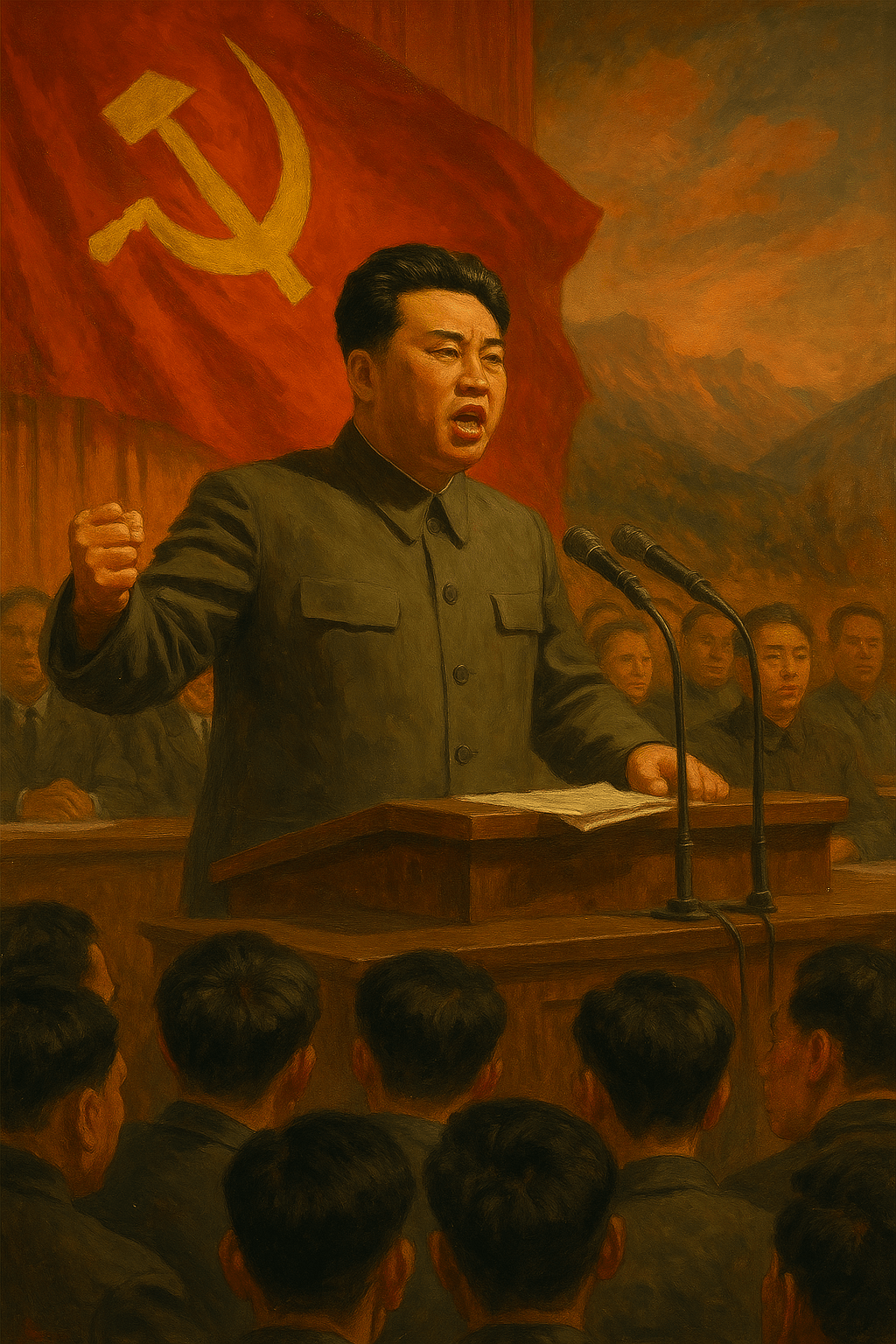
Weaponized Statesman Series | Kim Il Sung at Pyongyang, December 1955
In 1955, Kim Il Sung confronted a Party adrift in imitation. This was not a call for isolation, but a demand to root revolution in the lived experience of the Korean people. Juche, he argued, was not a slogan—it was a method of survival.
By Prince Kapone | Weaponized Information
July 22, 2025
Revolution Is Not an Import: On the Necessity of Juche
“It may not be proper to say Juche is lacking, but, in fact, it has not yet been firmly established. This is a serious matter. We must thoroughly rectify this shortcoming.”
With those words, Kim Il Sung did not simply introduce a theme. He fired the opening salvo in a war within the revolution—a war against imitation, against subordination, against the mechanical reproduction of other people’s paths. The contradiction at stake in December 1955 was not simply ideological; it was national, historical, and existential. Would the Korean revolution be a living process rooted in the soil of its own people, or would it become a ventriloquist act, parroting the slogans of stronger allies while quietly deferring to their political line? Kim’s answer—delivered to a room of party propagandists and agitators—was clear: “We are not engaged in any other country’s revolution, but precisely in the Korean revolution.”
In this speech, Kim is not interested in academic debates or footnotes to Marx. He is diagnosing the sclerosis of a Party that had, in many corners, become a photocopier of Soviet forms. The disease was dogmatism; the symptom, formalism. “Why do our propagandists and agitators fail to go deeply into matters,” he asks, “only embellishing the façade… merely copy[ing] and memorizing foreign things, instead of working creatively?” The language here is deceptively soft. But its implications are severe: if ideology does not reflect the concrete conditions, contradictions, and consciousness of the Korean people, it is not revolutionary. It is ornamental.
And what is Juche, in this context? It is not isolationism. It is not narcissism. It is the basic Marxist principle—neglected far too often—that the “universal truths” of Marxism-Leninism only become real through the particularities of national life. “To make revolution in Korea,” Kim insists, “we must know Korean history and geography and know the customs of the Korean people.” Not just because it’s patriotic—but because it is strategic. People do not fight for ideas abstracted from their own experience. They fight for life, for land, for dignity. And if a revolutionary movement cannot speak in their language—cultural, historical, emotional—it will be outmaneuvered by demagogues who can.
Kim’s sharpest blows fall on the Party’s own functionaries. “It is to be regretted,” he says flatly, “that our propaganda work suffers in many respects from dogmatism and formalism.” It’s not just that they borrowed too much from the USSR—it’s that they erased too much of Korea. Instead of studying the literary legacies of the Korean Artiste Proletarienne Federation (KAPF), propagandists banned articles about the anti-Japanese resistance. They ignored uprisings like the Kwangju Student Incident, leaving Syngman Rhee to appropriate them for bourgeois propaganda. They decorated schools with portraits of Pushkin and Mayakovsky, but left no image of a Korean revolutionary for children to look up to. They wrote textbooks filled with foreign poems, but none from the pens of Korean proletarian poets. What kind of ideology is this, Kim demands, that erases the very people it claims to liberate?
There is nothing innocent in these omissions. They are not clerical errors. They are class betrayals dressed up in ideological fidelity. To erase one’s own revolutionary history in the name of foreign orthodoxy is not Marxist—it is counterrevolutionary. “What assets do we have for carrying on the revolution if the history of our people’s struggle is denied?” Kim asks. The answer, of course, is none. Because revolution is not just a break with the past—it is a culmination of the people’s struggles across generations. Juche, then, is not a rupture with Marxism-Leninism. It is its fulfillment: the insistence that the people—not theory—make history. And any revolutionary party that forgets this is not long for survival.
To Serve the Revolution, Not Mimic the Masters
“Some comrades working in the Propaganda Department of the Party tried to copy mechanically from the Soviet Union in all their work. This was also because they had no intention to study our realities and lacked the true Marxist-Leninist spirit of educating the people in our own merits and in the traditions of our revolution.”
In this next turn, Kim Il Sung drives a wedge between what it means to learn from others and what it means to obey them. He draws the line—sharply—between revolutionary internationalism and colonial mimicry. He is not rejecting the Soviet Union, nor the Chinese Revolution. He is rejecting subservience. “What is the need of being particular about ‘fashion’ in wartime?” he mocks, recounting how Party cadres once bickered about whether to adopt Soviet or Chinese methods of political work in the army. “It does not matter whether you use the right hand or the left, whether you use a spoon or chopsticks at the table…”
What Kim exposes here is a disease common to all movements caught between admiration and dependency. The revolutionaries of the periphery often internalize the aesthetics of the metropole, not its essence. They quote Lenin, but forget their neighbor. They read Pravda, but neglect their own factories. They adopt five-year plans without even drawing a map of the villages they claim to represent. Kim’s attack is not just tactical—it is epistemological. “We should not mechanically copy forms and methods… but should learn from its experience in struggle and Marxist-Leninist truth.” There is no such thing as revolutionary truth in the abstract. The test of truth is practice, and the terrain of that practice is national, historical, and lived.
Kim ridicules the ridiculous: a Korean booklet modeled on a Soviet design, with the table of contents placed at the back because “that’s how it’s done there.” He scorns the worship of foreign poets in primary schools while Korean writers are forgotten. He denounces the habit of glorifying Soviet factories while ignoring the rehabilitation of Korean ones. “What on earth is the need of putting the table of contents in the back of a booklet in foreign style?” he asks. The point isn’t pedantry—it’s power. A people taught to feel shame in their own skin, their own language, their own struggle, is a people ready to be ruled by others.
It is here that Kim formulates a basic, but explosive principle: “Marxism-Leninism is not a dogma, it is a guide to action and a creative theory.” When the people’s revolutionary history is denied, when their heroes are buried and their traditions cast aside as backward, ideology becomes alien. And alien ideology leads to alien class power. That’s the danger Kim is naming. It’s not just about national pride. It’s about who gets to lead, who gets to define truth, and who gets to inherit the revolution.
And this is where Kim marks a clear rupture: “There can be no set principle that we must follow the Soviet pattern… is it not high time to work out our own?” This is not deviationism. It is dialectics. It is the realization that fidelity to Marxist-Leninist principles requires creative application—not ritualistic replication. This is the pivot toward Juche, not as a slogan, but as a method. A method of thinking, organizing, educating, and fighting that emerges from—and returns to—the Korean people themselves.
A Party Without the Masses Is a Cadaver
“A party divorced from the masses is like a fish out of water. With whom can the party carry out the revolution if not with the masses? Such a party will not only be unable to win in the revolution, but also will eventually find its very existence endangered.”
Here Kim Il Sung shifts the ground from ideology to organization, from epistemology to praxis. The lesson is clear: revolution is not an intellectual performance, but a relationship—between Party and people, between cadre and worker, between theory and practice. Without that relationship, all is lost. The speech begins with a critique of copying Soviets; it now demands communion with the Korean masses. This is not a rhetorical pivot—it is the spine of revolutionary politics.
Kim urges his comrades to remember how the guerrillas survived: not through foreign backing or technological advantage, but through the steadfast support of peasants who nursed their wounds, risked their lives, and fed them with the little rice they had. “They would manage to get rice, which they could hardly afford themselves, and boil it for us.” What justified this loyalty? Not propaganda. Not prestige. But practice. The guerrillas had proven—through action—that they would die for the people. And so the people, in turn, risked their lives for the guerrillas. That is mass line in motion.
Kim’s emphasis on a “correct mass viewpoint” is not a soft appeal to empathy—it is a strategic necessity. He warns that Party cadres, lacking this viewpoint, fall into bureaucratic arrogance, isolating themselves from the very class whose revolution they claim to lead. “Everyone, whether a Party worker, an administrative official or a functionary in a social organization, must work consistently in the interests of the revolution and the masses.” This is not advice. It is a political line. Any deviation from it is a step toward degeneration.
He is unsparing in his critique of Party discipline and functionary arrogance. Veterans of the revolutionary struggle are “buried in obscurity.” Educators neglect Korean history. Interior Ministry revolutionaries are dismissed as “incompetent.” Cadres “show no respect for their seniors.” These aren’t personal slights—they are class errors. A Party that forgets its roots cannot lead a people’s war. A Party that disrespects its elders disarms its own lineage. A Party that replaces love for the people with managerial contempt forfeits its right to exist.
What’s most striking is Kim’s insistence that ideological purification is not enough. The masses must be educated, yes—but more importantly, they must be mobilized. He returns to the example of workers and peasants becoming conscious of their role as “masters of power.” Not just voters. Not just supporters. But owners of the revolution. “Everyone will show enthusiasm when he realizes that he is master.” And this transformation cannot be accomplished through speeches or slogans—it requires “long, persistent education” rooted in political work, not bureaucratic coercion.
The revolution does not live in the constitution, the Party school, or the five-year plan. It lives in the rice fields, the classrooms, the factories. It breathes through trust. It moves through commitment. And if the Party cannot keep pace with the people, cannot listen, cannot learn, it will die. This is Kim’s wager. And in this speech, he is not just warning his comrades—he is reminding himself.
Steel the Spirit or Perish: On Internal Struggle and Revolutionary Survival
“In order to meet this great revolutionary event, the Party spirit of the Party members should be steeled; they should be educated to have a correct mass viewpoint and to have faith in victory and optimism regarding the future of the revolution.”
What Kim Il Sung calls “Party spirit” is not mere loyalty—it is ideological steel. It is the capacity to withstand storms without abandoning the line, to hold fast when illusions collapse, to carry the revolution even when surrounded by wreckage. And it is forged not through dogma but through struggle: against imperialism, against class enemies, and most painfully, against comrades whose errors have become liabilities.
“Long, persistent education and criticism are needed,” Kim insists, “not a short-term campaign.” This is a theory of rectification, not purges. A communist party cannot be maintained by exclusion alone. The line must be drawn—but once drawn, those who can be won back must be re-armed. It is a lesson sharpened by guerrilla warfare, confirmed in underground organizing, and now applied to the bureaucracy of state power: mistakes are inevitable. The question is whether they are concealed or confronted, ignored or corrected.
Kim is explicit about past failures. “We were too late in criticizing Pak Chang Ok and Ki Sok Bok.” That delay, he admits, allowed the ideological rot to spread. But even as he condemns these figures, he draws distinctions. “Those who were influenced by Pak Hon Yong cannot all be his ilk or spies.” Here, Kim defends the line of ideological struggle over guilt-by-association. The battle against factionalism, against sabotage, against enemy infiltration must be real—but it must also be surgical. Reckless suspicion, he warns, “will find yourselves suspicious of your own shadow.”
This vigilance is not paranoia—it is clarity. The revolution has enemies. Some wear uniforms. Some wear Party badges. Some hide behind borrowed Marxist phrases while carrying the worldview of the bourgeoisie in their heads. The task is to root them out—but with discipline, not hysteria. “The struggle must always be carried on as an ideological struggle.” No shortcuts. No theatrical expulsions. No witch hunts. Instead: education, criticism, self-criticism. Weaponized truth.
But Party spirit alone is not enough. Kim presses the necessity of what he calls “faith and optimism.” Not blind cheer, but revolutionary clarity—the kind forged in the trenches when comrades desert and the outcome seems impossible. He recounts how, during the anti-Japanese struggle, some guerrillas faltered after the Soviet Union signed non-aggression pacts. Why? Because Party propaganda had failed to teach the dialectics of geopolitical contradiction. “We failed to propagandize the truth about the developments,” he admits. The lesson is clear: revolutionaries must be armed not just with slogans, but with historical analysis and the confidence that struggle shapes outcome. Otherwise, they will collapse at the first shift in the wind.
And here again, Kim turns outward to the people. Propaganda and agitation must not simply proclaim policies—they must “give the workers and peasants, especially the workers, a clear understanding that they are masters of power.” This is how sabotage is defeated. Not just through security forces, but through proletarian consciousness. The factory defended by a class-conscious worker needs no secret police. The commune defended by a peasant who sees the revolution as his own will not fall to spies.
This is revolutionary pedagogy—not in the classroom, but in life. And it is not fast. It requires time, patience, repetition, humility. “Long, persistent education is needed,” Kim says. And then he returns to his refrain: the people must be “united around our Party still more closely.” But this unity is not demanded. It is earned. And it is earned by proving, again and again, that the Party will not abandon the masses—that it listens, learns, and corrects.
Revolution Is National, International, and Ours to Finish
“To love Korea is just as good as to love the Soviet Union and the socialist camp and, likewise, to love the Soviet Union and the socialist camp means precisely loving Korea.”
With this final cadence, Kim Il Sung tightens the dialectic between patriotism and internationalism, between national liberation and proletarian solidarity. For Kim, these are not antagonistic poles—they are the intertwined lifelines of revolution in a colonized, war-ravaged nation. His formulation isn’t simply rhetorical. It is a deliberate rebuke to the kind of mechanical “internationalism” that mistakes subordination for unity, that recites the Comintern line while denying the living labor of local revolutionaries. “He who does not love his own country cannot be loyal to internationalism,” Kim declares, “and he who is unfaithful to internationalism cannot be faithful to his own country and people.”
Here, the historical stakes erupt. Korea stands divided. U.S. imperialism occupies the south. The people are exhausted. The bureaucracy is bloated. The Party has expanded, but its spirit lags. And in this moment, Kim articulates a double prospect: the revolution might advance through peaceful reunification, fueled by socialist construction in the north and political struggle in the south. Or it may be forced to fight again. “We, however, do not want this prospect,” he says of war. “We desire the first prospect… and we are struggling for its realization.”
But that desire means nothing without preparation. Kim is blunt: the Party must grow in number, sharpen in discipline, and deepen its ideological clarity. He lays out a mass line strategy for expansion—one that does not fear complexity. “Among our members there can sometimes be found those who even lag behind the non-Party masses,” he admits. But rather than purging, he prescribes education. Rather than retreat, rectification. Rather than elite consolidation, mass uplift. The goal is not purity. The goal is power, and power that flows through the class that can wield it responsibly—the workers and peasants of Korea.
Kim’s clarity in this final section is striking. The Party must win the south, not by decree, but by persuasion. The newspaper must distinguish itself by function. The core members of the cells must anchor education. And above all, the Party must root out the cancer of bureaucracy—the slow suffocation of revolutionary will by routine, arrogance, and detachment. “If at least 50 per cent of all Party members acquire a correct mass viewpoint, it will mean a great change for our Party.” This is not utopianism. It is a battle plan.
This is where the speech finds its sharpest revolutionary edge. Kim is not issuing platitudes. He is preparing for the second act of revolution. In case of peace, the Party must lead construction and reunification. In case of war, it must survive the flames and carry forward the line. Either way, it must remain intact—not as a formal body, but as a living vanguard.
The lesson for us, reading this today, is not to imitate Kim Il Sung. That would be the very formalism he condemned. The lesson is to do what he did: excavate the revolutionary conditions we inhabit, confront the habits that dull our edge, and build a line of march that is both rooted in our people and disciplined by history. “Koreans must make themselves the creators of their own happiness,” Kim quoted from the Soviet commander. But that truth belongs not just to Koreans. It belongs to all those who would lead—not by imitating revolution, but by carrying it.
A final echo, then, not as monument, but as method:
“If we cast aside all that is good in our country and only copy and memorize foreign things in ideological work, it will certainly bring losses to our revolution.”
 Weaponized Information
Leave a comment