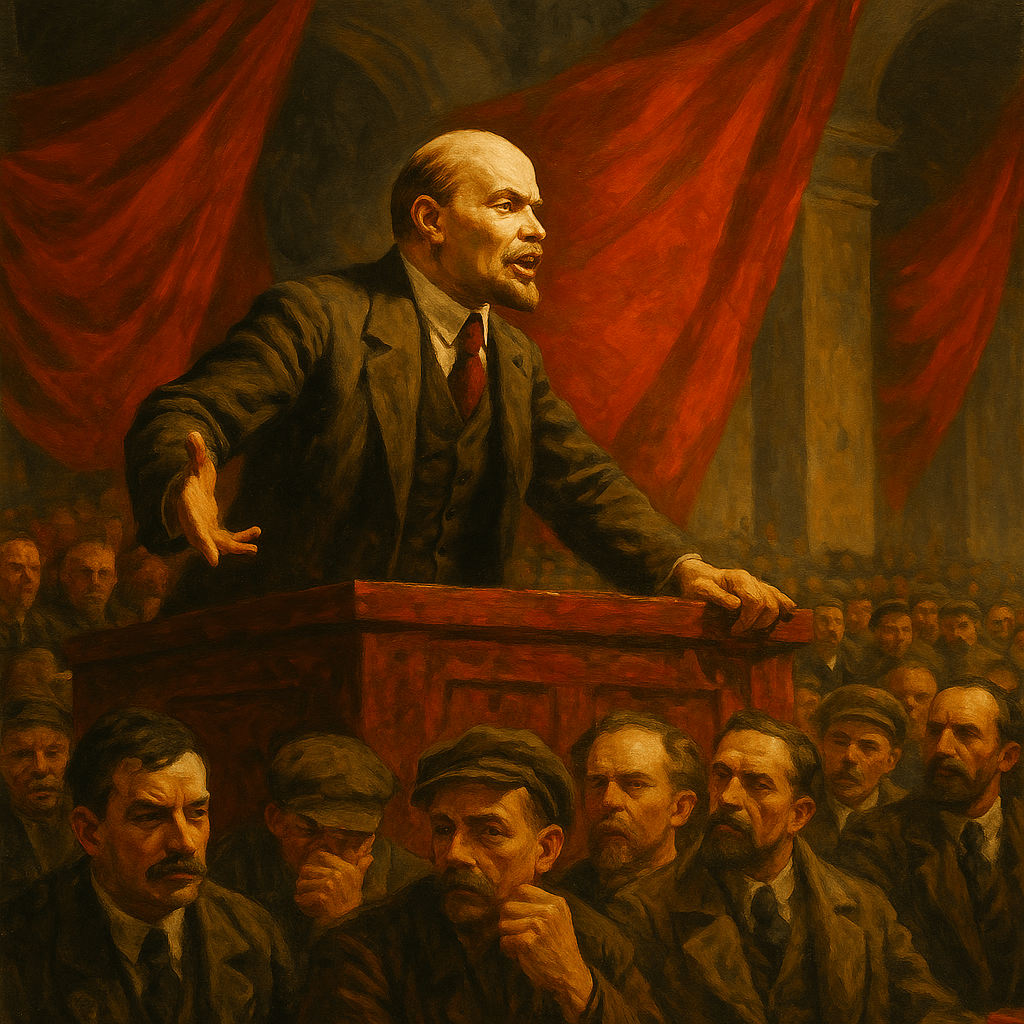
In 1922, with the fires of civil war fading and the hardships of famine and bureaucratic decay sharpening into focus, Lenin stood before the Eleventh Party Congress not to celebrate victory, but to sound an alarm. In his most unsparing speech, he turned the full force of revolutionary critique inward—against incompetence, against illusion, and against the creeping bourgeois restoration hiding in the folds of Soviet administration. What emerged was not a retreat from socialism, but a desperate and disciplined call to rebuild it—brick by brick, from below, or risk losing the revolution altogether.
By Prince Kapone | Weaponized Information
July 17, 2025
🟥 The Political Economy of Retreat
“The retreat is at an end. The principal methods of operation… are outlined. We have examples, even if an insignificant number.” With those words, Lenin drew the line between a tactical withdrawal and strategic degeneration. One year into the New Economic Policy, the Soviet state had begun to allow limited market mechanisms not as a concession to capitalism, but as a test of revolutionary governance under duress. But what Lenin saw by 1922 was not a controlled experiment. It was confusion. Panic. Bureaucratic paralysis masquerading as Party discipline. And above all, a creeping ideological drift where retreat threatened to become habit, and improvisation posed as policy. Lenin called for a halt—not just to the retreat itself, but to the retreat of revolutionary clarity.
This was no empty metaphor. “Stop philosophising and arguing about NEP,” Lenin told the Congress, “get more companies formed.” The danger was not that the Party had allowed capitalists into the economic landscape. The danger was that capitalists were better at feeding the peasantry than the communists were. It was a contest of practical outcomes, not moral standing. “You have the advantage over the capitalists in that political power is in your hands… the only trouble is that you cannot make proper use of them.” NEP, in this sense, was a crucible. Not of belief, but of performance.
What Lenin diagnosed in 1922 was not betrayal, but a contradiction between revolutionary will and technical capacity—a contradiction that metastasized into bureaucratism. Communists appointed to state positions, full of dedication and rank, were functionally incapable of managing trade or production. They issued orders. They wrote decrees. But they did not deliver. “These Communists do not know how to run the economy,” Lenin said bluntly. “They are inferior to the ordinary capitalist salesmen.” The result was not just inefficiency—it was discrediting. A revolution that cannot build is a revolution that cannot survive.
It is here that Lenin turned his polemic inward. The rot, he insisted, was not in ideology but in administration. He did not call for more theory, but for practical control. The market reforms of NEP had exposed not the victory of capitalism, but the immaturity of socialism—its inability to reproduce the material rhythms of daily life. “The machine refused to obey the hand that guided it,” Lenin said. “It was like a car… going in the direction someone else desired.” This metaphor—of a revolutionary vehicle hijacked by inertia, corruption, and technical ignorance—could apply just as easily to any number of postcolonial states in the 20th century, from Ghana to Nicaragua. But Lenin’s focus was laser-sharp: the state was in our hands, and still we lacked the ability to make it obey.
To recover direction, Lenin proposed no purge, no grand realignment—just a sobering shift in the center of gravity. “The key feature now… is not that we have changed our line of policy,” he said. “The key feature is people.” Not laws. Not slogans. Not departments. People. The right ones, in the right place, doing the right thing, with ruthless clarity about what was working and what wasn’t. Revolutionary administration, not in the abstract, but in the grain deliveries, the rail logistics, the trade exchanges. And that, he argued, required the Party to embrace the bitter truth: “We must start learning from the beginning.”
No other revolutionary in history had ever said such a thing with this degree of institutional power. It was not a call for patience. It was a call for rectification. To admit that one’s cadres are incompetent is not self-flagellation—it is political hygiene. It is leadership. And Lenin was daring the Party to lead. “Cast off the tinsel,” he said. “Learn a simple thing simply.” That sentence alone should be painted on the wall of every ministry in every post-revolutionary state. Because what Lenin made brutally clear was that revolution is not just about who rules, but how.
🟥 Learning to Lead: Rectification as Revolutionary Method
If Lenin’s voice cracked with urgency in 1922, it was not because the imperialists had landed—it was because the Communists were forgetting how to walk. “We must start learning from the very beginning,” he insisted—not as metaphor, but as mandate. The most dangerous contradiction in the Soviet Union was not between state and capital, but between the revolutionary’s self-image and their actual ability to administer a socialist economy. In classic Leninist fashion, he stripped away the romanticism: “You have the advantage over the capitalists… the only trouble is that you cannot make proper use of it.” What NEP exposed wasn’t a betrayal of Marxism, but a lack of preparation for the very real and technical responsibilities of state power.
And here, Lenin shifts from economic surgeon to political educator. He diagnoses the condition, yes—but more importantly, he models the method of correction. “If after starting you find yourselves at a dead end, start again… and go on doing it ten times if necessary.” This is not the language of dogma, but of discipline. The mass line, for Lenin, was not a slogan to chant. It was a process of discovering errors, correcting them with humility, and never mistaking momentum for mastery. The enemy was no longer just the White Guard. It was “komchvanstvo”—Communist conceit—the illusion that because one fought valiantly, one now possessed the competence to run a national economy.
Revolutionary leadership, Lenin teaches us here, is not a function of charisma or conviction. It is a function of clarity—of being able to see one’s own weaknesses without collapsing into shame or paralysis. Lenin did not shrink from declaring failure. “During the past year,” he confessed, “we showed quite clearly that we cannot run the economy.” But that was not a surrender. It was a declaration of war against incompetence. “If we realise this, we shall pass our test; and the test is a serious one… set by the Russian and international market.” Even markets—those crude instruments of bourgeois economics—were now weaponized as revolutionary barometers. Could the Soviet state deliver better outcomes than capitalism? Not someday, but now. Not in theory, but in the granaries and factory quotas and consumer supply chains.
It’s worth noting how rarely revolutionary leaders in history have been willing to say, with power in hand: “We are failing, and it is our fault.” The usual reflex is to blame sabotage, spies, or the people’s backwardness. Lenin, by contrast, centers the Party itself. “We Communists have received numerous deferments,” he warns. “But this promissory note is undated, and you cannot learn from the wording when it will be presented for redemption.” The metaphor is sharp: the revolution is living on borrowed time, and unless the Party pays its debts—materially, not rhetorically—the masses will foreclose on the entire project.
In this frame, Lenin’s entire address becomes a manual for cadre development. Not in the abstract Maoist sense of “rectification campaigns,” but in the immediate, sweat-soaked, logistics-bound world of grain, tools, and trade. He is calling not for more theory, but for applied struggle within the machinery of governance. He is demanding that Communists declass themselves—not ideologically, but administratively—and learn from those who can “do things which economically must be done at all costs.” Even if that person is a whiteguard. Even if that person is a petty trader. “Learn from the salesman,” Lenin tells his battle-hardened Party. “Learn from the enemy.”
This is not humility for its own sake. This is not moralism. This is revolutionary survival. Because if the state becomes a bottleneck—if the Party becomes the obstacle to distribution, development, and daily life—then the masses will not rise up to defend socialism. They will walk away from it. The point, Lenin insists, is not just to defeat capitalism once. It is to outperform it every day, in every district, in every transaction. And the only way to do that is to submit to the discipline of results. To organize supply chains with the same seriousness that we organize militias. To treat famine not as an external crisis but as an indictment of our internal capacity. To build communism not with slogans, but with hands that can deliver.
🟥 The Danger Within: Bureaucracy, Bourgeois Culture, and the Struggle Over the State
“The machine refused to obey the hand that guided it.” With that one sentence, Lenin captured the creeping horror that had begun to set in—not counterrevolution from abroad, but counterrevolution from within. The real danger in 1922 was not that imperialists would break the walls, but that the Party itself had become absorbed into the machinery it once stormed. Soviet power had survived the White armies and foreign invasions. But now, Lenin warned, it risked being outmaneuvered by its own bureaucracy, by the quiet, unremarkable inertia of institutional decay. And more damning still: the very Communists who had risked their lives to win the state were now being directed by those they had supposedly defeated.
“Who is directing whom?” Lenin asked about the 4,700 Communists in Moscow’s administration. “To tell the truth, they are not directing, they are being directed.” This is not a casual complaint—it’s a revelation. And it cut to the heart of revolutionary governance. What happens when those who formally hold power are culturally, technically, and practically subordinated to the class they overthrew? What happens when the habits of the old order seep into the practices of the new? Lenin’s answer was brutal: “Very often the bourgeois officials know the business better than our best Communists.”
This was not a case of sabotage. Lenin was not blaming saboteurs—though they certainly existed. He was blaming a deeper, more insidious enemy: the persistence of bourgeois culture within the institutions of the workers’ state. “Miserable and low as it is,” he said of this bourgeois administrative culture, “it is higher than that of our responsible Communist administrators.” Why? Because these functionaries had been trained. They knew how to manage a ledger, organize supply chains, handle contracts. And the Communists, for all their valor, did not. The state had been captured, but the ability to run it had not.
In one of the sharpest metaphors of the entire speech, Lenin compared the Party’s failure to the historical irony of conquest. When a “more cultured” nation conquers a less developed one, it imposes its culture. But when a less cultured nation conquers a more advanced one, it often ends up adopting the victor’s ways. “Has not something like this happened in the capital of the R.S.F.S.R.?” Lenin asked. The implication was chilling: the Communist Party may have seized power, but it was being ideologically and procedurally colonized by the very class it had overthrown.
This was not just an administrative crisis. It was a class struggle waged on the terrain of habits, training, and technical competence. And Lenin offered no easy way out. He did not call for more slogans, more purges, more decrees. He called for humility, training, and control. The Party had to learn how to supervise, not merely dictate. It had to develop “practical control of how things have been done,” and not rely on proclamations. The revolution could no longer afford to be rhetorical. It had to deliver. “Choose the proper men and introduce practical control,” he insisted. “That is what the people will appreciate.”
And if this was not done? Lenin was unequivocal: the people would walk. “The peasants will say: ‘You are splendid fellows; you defended our country… but if you cannot run the show, get out!’” It is perhaps the sharpest formulation of proletarian democracy in practice. Not ballot boxes or constitutional formalities, but the daily plebiscite of survival: does the state feed you, clothe you, support you? If not, it has no right to exist. “We must build communism with the hands of non-Communists,” Lenin argued, “to acquire the practical ability to do what is economically necessary.” Otherwise, even a revolution that has seized the state will be evicted from history by the very people in whose name it governs.
This is the lesson Lenin offered, not as philosophy but as strategy. A Party that cannot govern with competence, humility, and discipline is not a vanguard—it is a liability. And in 1922, with famine raging and NEP exposing the fissures in the Soviet system, Lenin did not wait for collapse. He called it out. He turned to his comrades and said: the problem is not out there. It is us. And we must change—now—or be changed by the conditions we refuse to confront.
🟥 Between Collapse and Continuity: Revolution at the Edge of Its Own Limits
By the time Lenin reached the conclusion of his report to the Eleventh Congress, he had long since dropped the tone of command. What remained was the weary but unshaken clarity of a man who had walked to the edge of revolutionary collapse—and was daring the Party to step back from it. “The key feature now,” he told them, “is not decrees and politics in the narrow sense… the key feature is people.” Not theory. Not authority. Not historical momentum. But people, in motion, in position, and in practice. The entire edifice of the Soviet experiment, he warned, now rested on the ability of actual individuals to carry out the simplest tasks of economic survival—and to do so in a manner superior to the class enemies they had just displaced.
Lenin’s speech closes like a cracked mirror—offering both a reflection of revolutionary greatness and the shards of what had gone wrong. “We are now confronted with the task of laying the foundations of socialist economy,” he said. “Has this been done? No, it has not. We still lack the socialist foundation.” It was a stunning admission. After five years of civil war, forced requisitions, and heroic sacrifice, the base of socialism remained unbuilt. What existed instead was a state structure, a revolutionary will, and a tired, untrained bureaucracy trying to move goods with methods inherited from tsarism and capitalism alike. In this vacuum, Lenin didn’t double down on dogma—he asked the Party to tell the truth.
And the truth was simple: the people no longer needed words. They needed results. “The chief thing the people… want today is nothing but help in their desperate hunger and need,” he said. “They want to be shown that the improvement needed by the peasants is really taking place in the form they are accustomed to.” This is the revolution viewed from the bottom up. No teleology. No divine stages of history. Just the demand of a muzhik trying to feed his children: prove it. Prove this revolution helps me survive.
This, for Lenin, was the final test—what he called “a real test from the viewpoint of the national economy.” Not ideological purity. Not internal loyalty. But output. Did your office move the canned meat? Did your local official ensure the trains ran? Could you do what a capitalist firm would have done faster, cheaper, better? If not, the people would remember. And they would judge. The Party’s authority, he insisted, was not immortal. It lived and died on the basis of delivery.
So he ended not with a triumph, but with a directive: the Central Committee must stop micromanaging, the commissariats must assume responsibility, the Party must choose the right people, and those people must prove themselves in action, not in rank. “It must be admitted,” he said, “that in ninety-nine cases out of a hundred the responsible Communists are not in the jobs they are now fit for.” This was not defeatism—it was discipline. Revolutionary continuity depended not on momentum, but on rectification. Not on myth, but on sober self-assessment.
And here lies Lenin’s final contribution—not as theorist or tactician, but as teacher of revolutionary statecraft. He left behind no romantic illusions, no blueprint for utopia, but a living lesson: socialism is not an event. It is a task. And that task is relentless. It demands honesty, clarity, patience, and performance. “If we realise this,” he concluded, “and take it as our guiding line… we shall conquer this difficulty, too.” The question was no longer whether the Party had seized power, but whether it could wield it. And that, Lenin insisted, was the struggle of 1922. Not against White armies. Not against foreign blockades. But against the soft internal decay that comes when a revolution mistakes authority for capacity—and stops learning.
 Weaponized Information
Leave a comment